
keyword
length generalization
Length generalization refers to the capability of a machine learning model to accurately process, evaluate, or generate sequences that are longer than the sequence lengths encountered during training. In sequence modeling and natural language processing, models frequently achieve strong performance on data matching their training context sizes but suffer significant performance degradation when evaluated on longer inputs. This out-of-distribution challenge often arises because positional encoding schemes degrade on unseen positions, attention distributions become diffuse over long distances, or iterative reasoning mechanisms fail to scale systematically. As a result, length generalization serves as a critical measure of whether a model has internalized robust, length-invariant algorithmic procedures rather than merely fitting statistical patterns within a constrained context window.
12 items
YaRN: Efficient Context Window Extension of Large Language Models
Bowen Peng, Jeffrey Quesnelle, Honglu Fan, Enrico Shippole
Why you should read this
Introduces YaRN, a compute-efficient context extension method that allows RoPE-based large language models to extrapolate to much longer sequence lengths using ten times fewer training tokens than prior techniques.
Rotary Position Embeddings (RoPE) have been shown to effectively encode positional information in transformer-based language models. However, these models fail to generalize past the sequence length they were trained on. We present YaRN (Yet another RoPE extensioN method), a compute-efficient method to extend the context window of such models, requiring 10x less tokens and 2.5x less training steps than previous methods. Using YaRN, we show that LLaMA models can effectively utilize and extrapolate to context lengths much longer than their original pre-training would allow, while also surpassing previous the state-of-the-art at context window extension. In addition, we demonstrate that YaRN exhibits the capability to extrapolate beyond the limited context of a fine-tuning dataset. Code is available at this https URL
Added
2026-10-05
LayerNorm Induces Recency Bias in Transformer Decoders
Junu Kim, Xiao Liu, Zheng-Wen Lin, Lei Ji, Yeyun Gong, Edward Choi
Why you should read this
Demonstrates that LayerNorm turns the early-token attention bias of causal transformers into recency bias, resolving a fundamental contradiction in transformer behavior and informing positional encoding design.
Causal self-attention provides positional information to Transformer decoders. Prior work has shown that stacks of causal self-attention layers alone induce a positional bias in attention scores toward earlier tokens. However, this differs from the bias toward later tokens typically observed in Transformer decoders, known as recency bias. We address this discrepancy by analyzing the interaction between causal self-attention and other architectural components. We show that stacked causal self-attention layers combined with LayerNorm induce recency bias. Furthermore, we examine the effects of residual connections and the distribution of input token embeddings on this bias. Our results provide new theoretical insights into how positional information interacts with architectural components and suggest directions for improving positional encoding strategies.
Added
2026-10-04
Training-Free Long-Context Scaling of Large Language Models
Chenxin An, Fei Huang, Jun Zhang, Shansan Gong, Xipeng Qiu, Chang Zhou, Lingpeng Kong
Why you should read this
Presents Dual Chunk Attention, a training-free framework that decomposes attention into intra-chunk and inter-chunk modules to scale the context window of large language models like LLaMA-2 70B beyond 100k tokens while retaining practical task accuracy.
The ability of Large Language Models (LLMs) to process and generate coherent text is markedly weakened when the number of input tokens exceeds their pretraining length. Given the expensive overhead of finetuning large-scale models with longer sequences, we propose Dual Chunk Attention (DCA), which enables Llama2 70B to support context windows of more than 100k tokens without continual training. By decomposing the attention computation for long sequences into chunk-based modules, DCA manages to effectively capture the relative positional information of tokens within the same chunk (Intra-Chunk) and across distinct chunks (Inter-Chunk), as well as integrates seamlessly with Flash Attention. In addition to its impressive extrapolation capability, DCA achieves performance on practical long-context tasks that is comparable to or even better than that of finetuned models. When compared with proprietary models, our training-free 70B model attains 94% of the performance of gpt-3.5-16k, indicating it is a viable open-source alternative. All code and data used in this work are released at https://github.com/HKUNLP/ChunkLlama.
Added
2026-10-02
NoLiMa: Long-Context Evaluation Beyond Literal Matching
Ali Modarressi, Hanieh Deilamsalehy, Franck Dernoncourt, Trung Bui, Ryan A. Rossi, Seunghyun Yoon, Hinrich Schtze
Why you should read this
Introduces the NoLiMa benchmark to expose how modern long-context language models fail to retrieve information through latent associations when deprived of surface-level lexical matches.
Recent large language models (LLMs) support long contexts ranging from 128K to 1M tokens. A popular method for evaluating these capabilities is the needle-in-a-haystack (NIAH) test, which involves retrieving a “needle” (relevant information) from a “haystack” (long irrelevant context). Extensions of this approach include increasing distractors, fact chaining, and in-context reasoning. However, in these benchmarks, models can exploit existing literal matches between the needle and haystack to simplify the task. To address this, we introduce NoLiMa, a benchmark extending NIAH with a carefully designed needle set, where questions and needles have minimal lexical overlap, requiring models to infer latent associations to locate the needle within the haystack. We evaluate 13 popular LLMs that claim to support contexts of at least 128K tokens. While they perform well in short contexts (<1K), performance degrades significantly as context length increases. At 32K, for instance, 11 models drop below 50% of their strong short-length baselines. Even GPT-4o, one of the top-performing exceptions, experiences a reduction from an almost-perfect baseline of 99.3% to 69.7%. Our analysis suggests these declines stem from the increased difficulty the attention mechanism faces in longer contexts when literal matches are absent, making it harder to retrieve relevant information. Even models enhanced with reasoning capabilities or CoT prompting struggle to maintain performance in long contexts. We publicly release the dataset and evaluation code at https://github.com/adobe-research/NoLiMa.
Added
2026-10-02
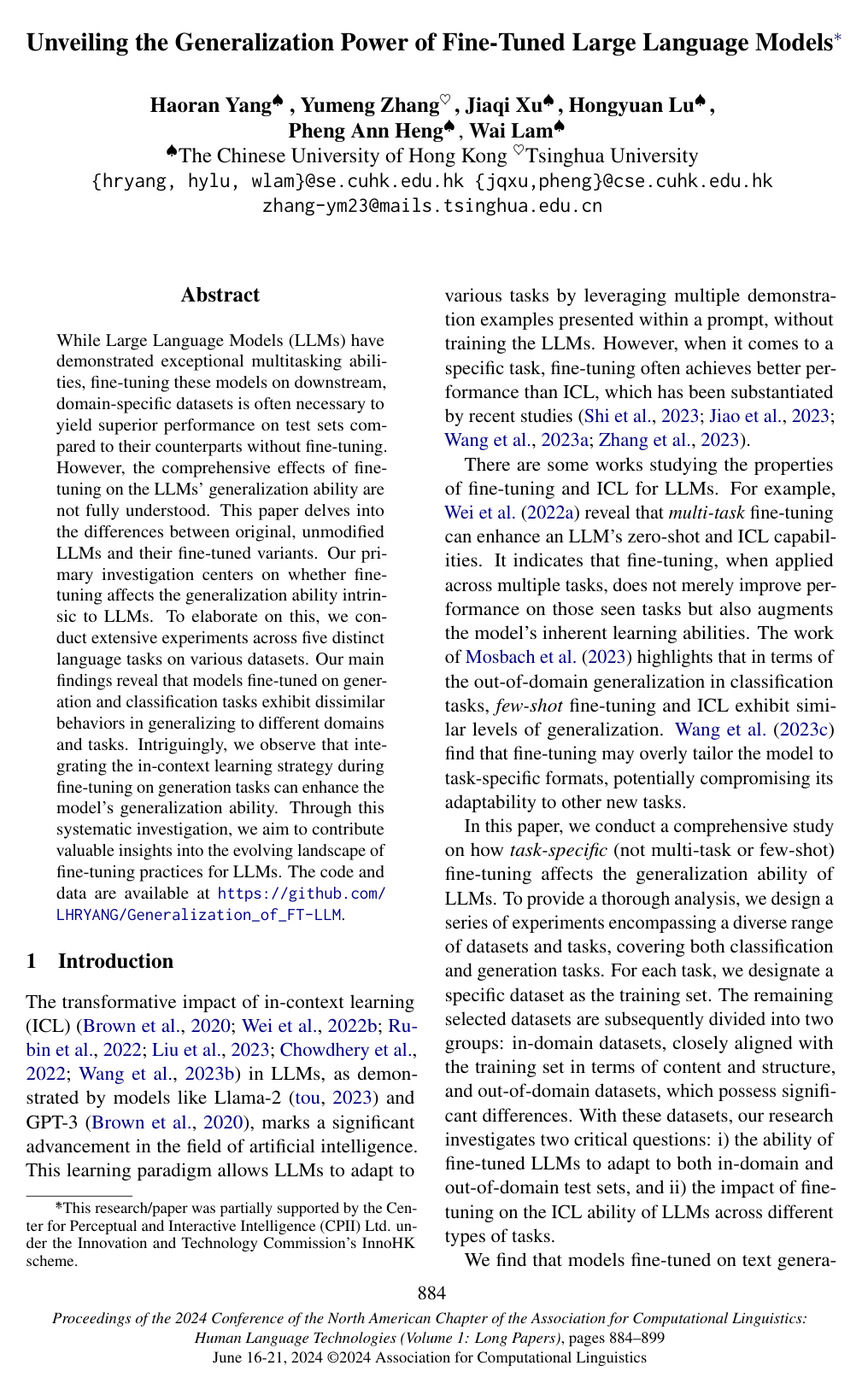
Unveiling the Generalization Power of Fine-Tuned Large Language Models
Haoran Yang, Yumeng Zhang, Jiaqi Xu, Hongyuan Lu, Pheng-Ann Heng, Wai Lam
Why you should read this
Reveals how task-specific fine-tuning alters the out-of-domain and cross-task generalization of large language models differently across classification and generation tasks, demonstrating that incorporating in-context demonstrations during fine-tuning prevents loss of generalizability.
While Large Language Models (LLMs) have demonstrated exceptional multitasking abilities, fine-tuning these models on downstream, domain-specific datasets is often necessary to yield superior performance on test sets compared to their counterparts without fine-tuning. However, the comprehensive effects of fine-tuning on the LLMs’ generalization ability are not fully understood. This paper delves into the differences between original, unmodified LLMs and their fine-tuned variants. Our primary investigation centers on whether fine-tuning affects the generalization ability intrinsic to LLMs. To elaborate on this, we conduct extensive experiments across five distinct language tasks on various datasets. Our main findings reveal that models fine-tuned on generation and classification tasks exhibit dissimilar behaviors in generalizing to different domains and tasks. Intriguingly, we observe that integrating the in-context learning strategy during fine-tuning on generation tasks can enhance the model’s generalization ability. Through this systematic investigation, we aim to contribute valuable insights into the evolving landscape of fine-tuning practices for LLMs. The code and data are available at https://github.com/LHRYANG/Generalization_of_FT-LLM.
Added
2026-10-02
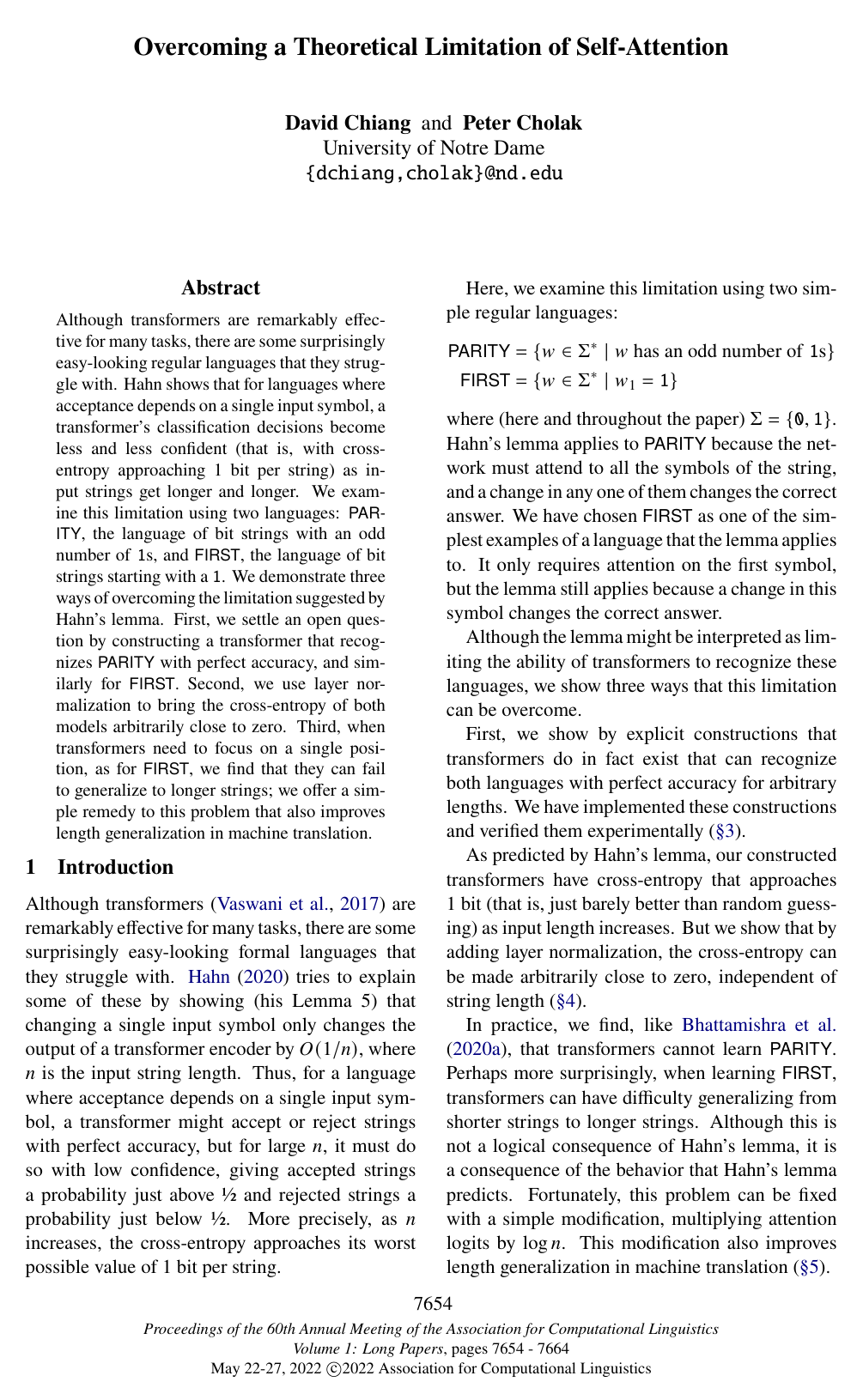
Overcoming a Theoretical Limitation of Self-Attention
David Chiang, Peter Cholak
Why you should read this
Proves that standard transformers can recognize challenging regular languages like PARITY with perfect accuracy and shows that scaling attention logits by the logarithm of sequence length resolves severe length generalization failures in practice.
Although transformers are remarkably effective for many tasks, there are some surprisingly easy-looking regular languages that they struggle with. Hahn shows that for languages where acceptance depends on a single input symbol, a transformer's classification decisions become less and less confident (that is, with cross-entropy approaching 1 bit per string) as input strings get longer and longer. We examine this limitation using two languages: PARITY, the language of bit strings with an odd number of 1s, and FIRST, the language of bit strings starting with a 1. We demonstrate three ways of overcoming the limitation suggested by Hahn's lemma. First, we settle an open question by constructing a transformer that recognizes PARITY with perfect accuracy, and similarly for FIRST. Second, we use layer normalization to bring the cross-entropy of both models arbitrarily close to zero. Third, when transformers need to focus on a single position, as for FIRST, we find that they can fail to generalize to longer strings; we offer a simple remedy to this problem that also improves length generalization in machine translation.
Added
2026-10-01
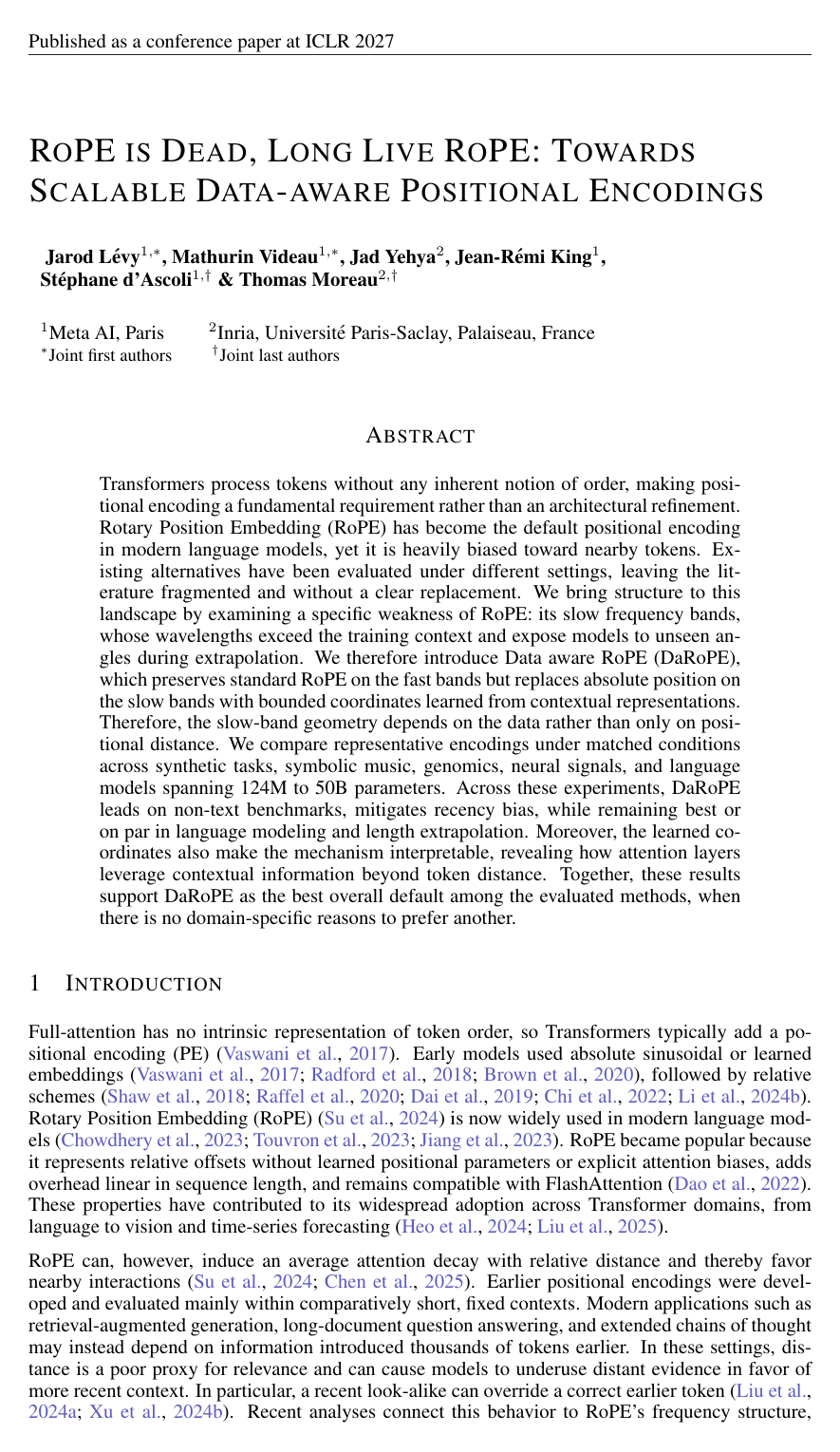
RoPE is Dead, Long Live RoPE: Towards Scalable Data-aware Positional Encodings
Jarod Lévy, Mathurin Videau, Jad Yehya, Jean-Rémi King, Stéphane d'Ascoli, Thomas Moreau
Why you should read this
Introduces Data-aware RoPE (DaRoPE), a positional encoding method that replaces standard rotary embeddings' slow frequency bands with learned contextual coordinates to mitigate recency bias and improve long-sequence modeling across genomics, music, and large language models up to 50B parameters.
Transformers process tokens without any inherent notion of order, making positional encoding a fundamental requirement rather than an architectural refinement. Rotary Position Embedding (RoPE) has become the default positional encoding in modern language models, yet it is heavily biased toward nearby tokens. Existing alternatives have been evaluated under different settings, leaving the literature fragmented and without a clear replacement. We bring structure to this landscape by examining a specific weakness of RoPE: its slow frequency bands, whose wavelengths exceed the training context and expose models to unseen angles during extrapolation. We therefore introduce Data aware RoPE (DaRoPE), which preserves standard RoPE on the fast bands but replaces absolute position on the slow bands with bounded coordinates learned from contextual representations. Therefore, the slow-band geometry depends on the data rather than only on positional distance. We compare representative encodings under matched conditions across synthetic tasks, symbolic music, genomics, neural signals, and language models spanning 124M to 50B parameters. Across these experiments, DaRoPE leads on non-text benchmarks, mitigates recency bias, while remaining best or on par in language modeling and length extrapolation. Moreover, the learned coordinates also make the mechanism interpretable, revealing how attention layers leverage contextual information beyond token distance. Together, these results support DaRoPE as the best overall default among the evaluated methods, when there is no domain-specific reasons to prefer another.
Added
2026-10-01

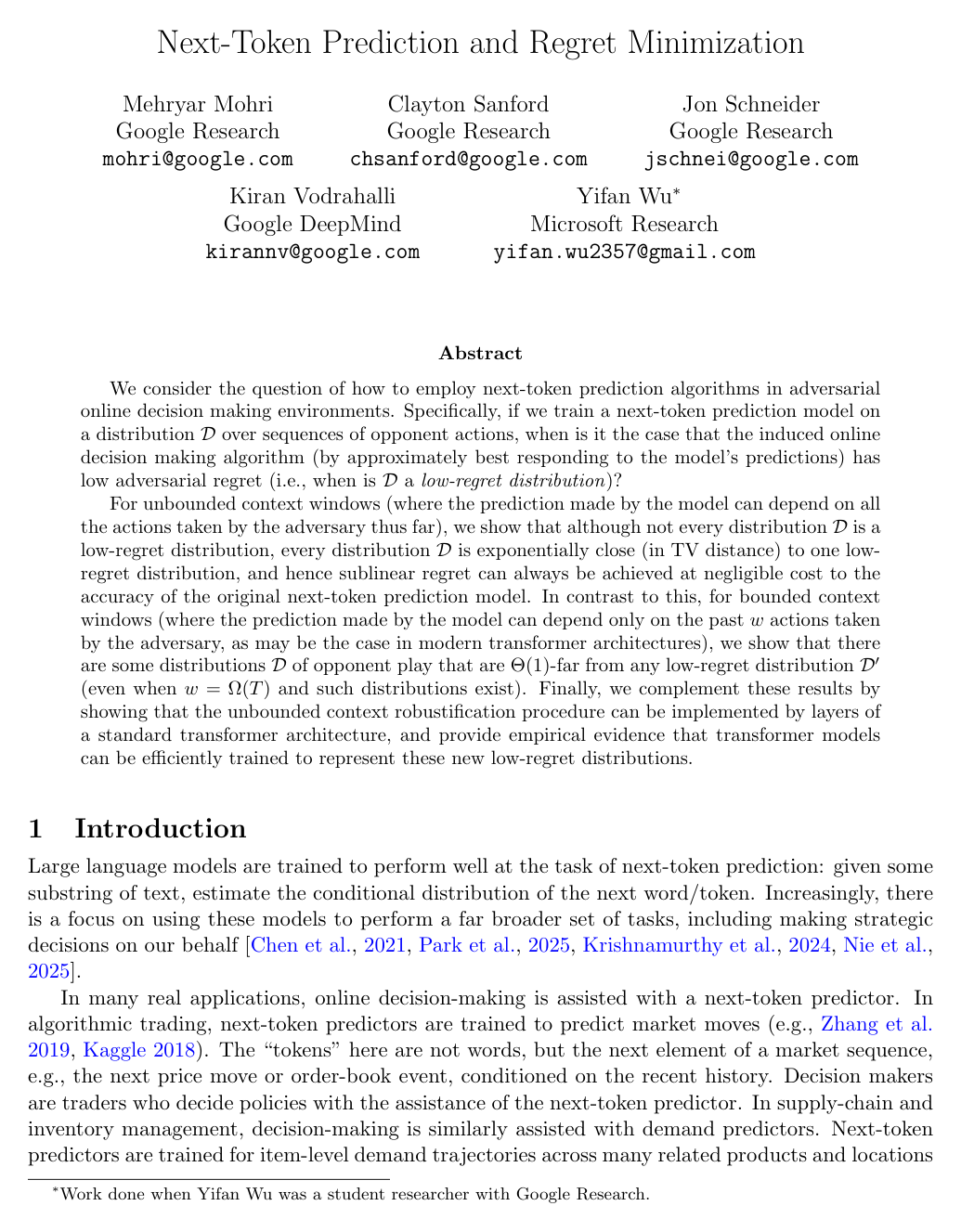
Next-Token Prediction and Regret Minimization
Mehryar Mohri, Clayton Sanford, Jon Schneider, Kiran Vodrahalli, Yifan Wu
Why you should read this
Establishes when next-token predictors can achieve sublinear adversarial regret in online decision-making, proving that unbounded-context models require only negligible accuracy loss whereas bounded-context transformers face fundamental impossibility bounds.
We consider the question of how to employ next-token prediction algorithms in adversarial online decision-making environments. Specifically, if we train a next-token prediction model on a distribution over sequences of opponent actions, when is it the case that the induced online decision-making algorithm (by approximately best responding to the model's predictions) has low adversarial regret (i.e., when is a \emph{low-regret distribution})? For unbounded context windows (where the prediction made by the model can depend on all the actions taken by the adversary thus far), we show that although not every distribution is a low-regret distribution, every distribution is exponentially close (in TV distance) to one low-regret distribution, and hence sublinear regret can always be achieved at negligible cost to the accuracy of the original next-token prediction model. In contrast to this, for bounded context windows (where the prediction made by the model can depend only on the past actions taken by the adversary, as may be the case in modern transformer architectures), we show that there are some distributions of opponent play that are -far from any low-regret distribution (even when and such distributions exist). Finally, we complement these results by showing that the unbounded context robustification procedure can be implemented by layers of a standard transformer architecture, and provide empirical evidence that transformer models can be efficiently trained to represent these new low-regret distributions.
Added
2026-09-30
Exploring Length Generalization in Large Language Models
Cem Anil, Yuhuai Wu, Anders Andreassen, Aitor Lewkowycz, Vedant Misra, Vinay V. Ramasesh, Ambrose Slone, Guy Gur-Ari, Ethan Dyer, Behnam Neyshabur
Why you should read this
Reveals that while standard finetuning fails to extrapolate reasoning to longer problem instances regardless of model scale, combining in-context learning with scratchpad prompting substantially improves length generalization in large language models.
The ability to extrapolate from short problem instances to longer ones is an important form of out-of-distribution generalization in reasoning tasks, and is crucial when learning from datasets where longer problem instances are rare. These include theorem proving, solving quantitative mathematics problems, and reading/summarizing novels. In this paper, we run careful empirical studies exploring the length generalization capabilities of transformer-based language models. We first establish that naively finetuning transformers on length generalization tasks shows significant generalization deficiencies independent of model scale. We then show that combining pretrained large language models’ in-context learning abilities with scratchpad prompting (asking the model to output solution steps before producing an answer) results in a dramatic improvement in length generalization. We run careful failure analyses on each of the learning modalities and identify common sources of mistakes that highlight opportunities in equipping language models with the ability to generalize to longer problems.
Added
2026-09-26
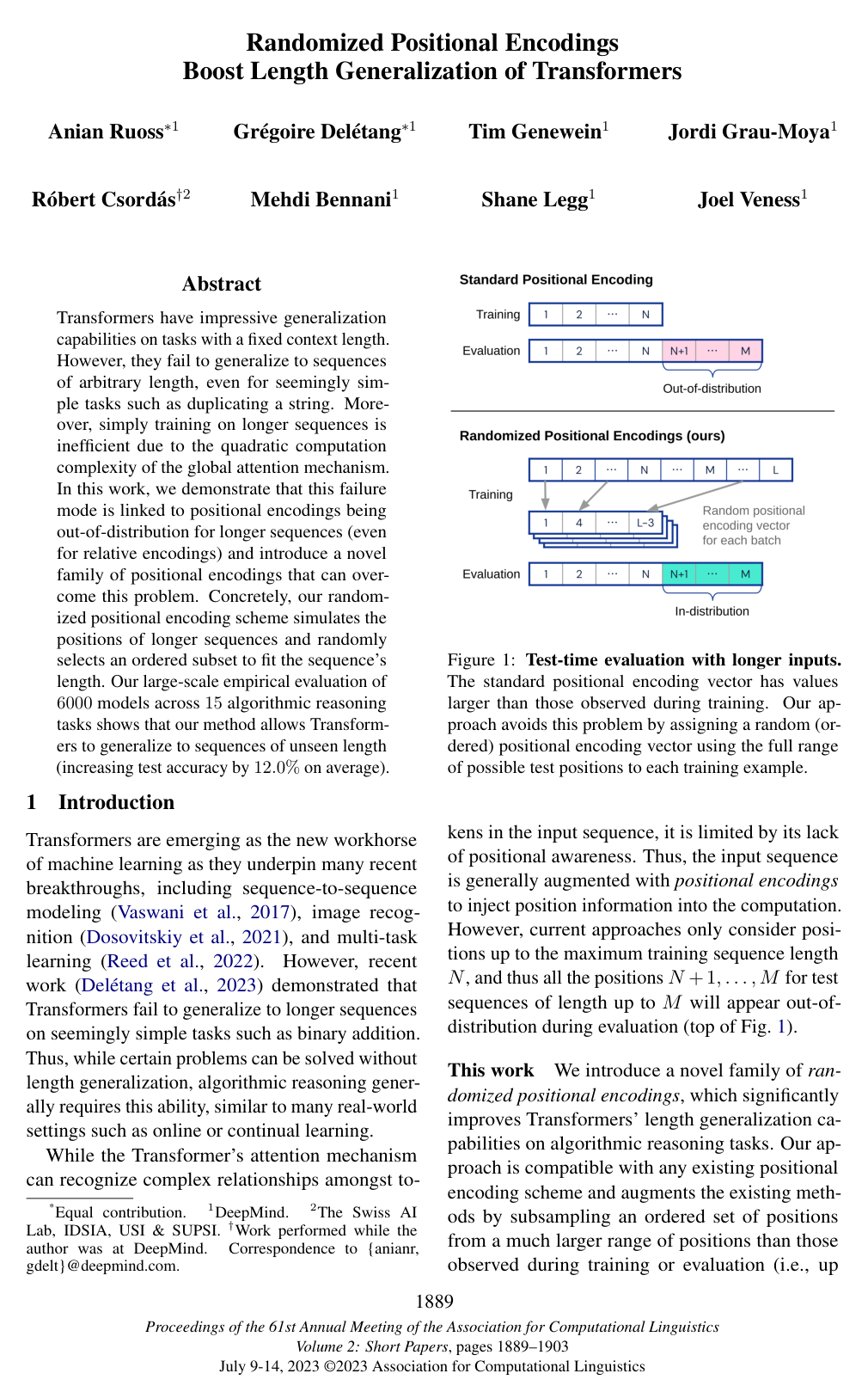
Randomized Positional Encodings Boost Length Generalization of Transformers
Anian Ruoss, Grégoire Delétang, Tim Genewein, Jordi Grau-Moya, Róbert Csordás, Mehdi Bennani, Shane Legg, Joel Veness
Why you should read this
Introduces a randomized positional encoding scheme that subsamples ordered positions from an extended range during training, enabling Transformers trained on short sequences to generalize effectively to unseen sequence lengths across algorithmic reasoning tasks.
Transformers have impressive generalization capabilities on tasks with a fixed context length. However, they fail to generalize to sequences of arbitrary length, even for seemingly simple tasks such as duplicating a string. Moreover, simply training on longer sequences is inefficient due to the quadratic computation complexity of the global attention mechanism. In this work, we demonstrate that this failure mode is linked to positional encodings being out-of-distribution for longer sequences (even for relative encodings) and introduce a novel family of positional encodings that can overcome this problem. Concretely, our randomized positional encoding scheme simulates the positions of longer sequences and randomly selects an ordered subset to fit the sequence's length. Our large-scale empirical evaluation of 6000 models across 15 algorithmic reasoning tasks shows that our method allows Transformers to generalize to sequences of unseen length (increasing test accuracy by 12.0% on average).
Added
2026-09-26
Megalodon: Efficient LLM Pretraining and Inference with Unlimited Context Length
Xuezhe Ma, Xiaomeng Yang, Wenhan Xiong, Beidi Chen, Lili Yu, Hao Zhang, Jonathan May, Luke Zettlemoyer, Omer Levy, Chunting Zhou
Why you should read this
Introduces MEGALODON, a linear-complexity sequence architecture combining complex exponential moving averages with normalized gated attention that outperforms standard Transformer models like LLAMA2 at the 7-billion parameter scale across 2 trillion training tokens while scaling efficiently to virtually unlimited context lengths.
The quadratic complexity and weak length extrapolation of Transformers limits their ability to scale to long sequences, and while sub-quadratic solutions like linear attention and state space models exist, they empirically underperform Transformers in pretraining efficiency and downstream task accuracy. We introduce MEGALODON, an neural architecture for efficient sequence modeling with unlimited context length. MEGALODON inherits the architecture of MEGA (exponential moving average with gated attention), and further introduces multiple technical components to improve its capability and stability, including complex exponential moving average (CEMA), timestep normalization layer, normalized attention mechanism and pre-norm with two-hop residual configuration. In a controlled head-to-head comparison with LLAMA2, MEGALODON achieves better efficiency than Transformer in the scale of 7 billion parameters and 2 trillion training tokens. MEGALODON reaches a training loss of 1.70, landing mid-way between LLAMA2-7B (1.75) and 13B (1.67). The improvements of MEGALODON over Transformers are robust throughout a range of benchmarks across different tasks and modalities. Code: https://github.com/XuezheMax/megalodon
Added
2026-09-26
LeRoPE: Learnable RoPE Frequencies Improve Language Modeling
Petros Karypis, Sean O'Brien, Shreyas Kadekodi, Rui Zhu, Julian McAuley
Why you should read this
Develops LeRoPE, a novel modification to Rotary Positional Encodings that learns a scalar per frequency, consistently outperforming standard and partial RoPE across various model scales while requiring less computational effort.
Rotary Positional Encodings (RoPE) are currently the most popular positional encodings used in modern language models. RoPE rotates two-dimensional chunks of query and key vectors, operating as a function of their relative positional offset. The position-wise rates of rotation in RoPE typically follow a geometric sequence specified by a fixed base-frequency hyperparameter. Prior work has improved performance by either increasing this parameter to slow rotation or by applying RoPE to only a subset of QK dimensions. In this work we modify RoPE by learning a scalar per frequency, treating frequencies as learnable parameters rather than hyperparameters. We validate Learned RoPE by training a ladder of language models from scratch, ranging from 52M to 2.5B parameters. We observe and analyze the emergence of a high-norm, positional LeRoPE band. LeRoPE consistently outperforms RoPE and partial RoPE across all scales, with RoPE requiring 3.4% more compute (FLOPs) to match LeRoPE at the largest scale.
Added
2026-07-30