
RoPE is Dead, Long Live RoPE: Towards Scalable Data-Aware Positional Encodings
Jarod Lévy1,∗^{1,*}1,∗ 1^{1}1Meta AI, Paris
Mathurin Videau1,∗^{1,*}1,∗ 1^{1}1Meta AI, Paris
Jad Yehya2^{2}2 2^{2}2Inria, Université Paris-Saclay, Palaiseau, France
Jean-Rémi King1^{1}1 1^{1}1Meta AI, Paris
Stéphane d’Ascoli1,†^{1,\dagger}1,† 1^{1}1Meta AI, Paris
Thomas Moreau2,†^{2,\dagger}2,† 2^{2}2Inria, Université Paris-Saclay, Palaiseau, France
∗^{*}∗ Joint first authors †^{\dagger}† Joint last authors
Abstract
Transformers process tokens without any inherent notion of order, making positional encoding a fundamental requirement rather than an architectural refinement. Rotary Position Embedding (RoPE) has become the default positional encoding in modern language models, yet it is heavily biased toward nearby tokens. Existing alternatives have been evaluated under different settings, leaving the literature fragmented and without a clear replacement. We bring structure to this landscape by examining a specific weakness of RoPE: its slow frequency bands, whose wavelengths exceed the training context and expose models to unseen angles during extrapolation. We therefore introduce Data aware RoPE (DaRoPE), which preserves standard RoPE on the fast bands but replaces absolute position on the slow bands with bounded coordinates learned from contextual representations. Therefore, the slow-band geometry depends on the data rather than only on positional distance. We compare representative encodings under matched conditions across synthetic tasks, symbolic music, genomics, neural signals, and language models spanning 124M to 50B parameters. Across these experiments, DaRoPE leads on non-text benchmarks, mitigates recency bias, while remaining best or on par in language modeling and length extrapolation. Moreover, the learned coordinates also make the mechanism interpretable, revealing how attention layers leverage contextual information beyond token distance. Together, these results support DaRoPE as the best overall default among the evaluated methods, when there is no domain-specific reasons to prefer another.
1. Introduction
Full-attention has no intrinsic representation of token order, so Transformers typically add a positional encoding (PE) ([1]). Early models used absolute sinusoidal or learned embeddings ([1, 2, 3]), followed by relative schemes ([4, 5, 6, 7, 8]). Rotary Position Embedding (RoPE) ([9]) is now widely used in modern language models ([10, 11, 12]). RoPE became popular because it represents relative offsets without learned positional parameters or explicit attention biases, adds overhead linear in sequence length, and remains compatible with FlashAttention ([13]). These properties have contributed to its widespread adoption across Transformer domains, from language to vision and time-series forecasting ([14, 15]).
RoPE can, however, induce an average attention decay with relative distance and thereby favor nearby interactions ([9, 16]). Earlier positional encodings were developed and evaluated mainly within comparatively short, fixed contexts. Modern applications such as retrieval-augmented generation, long-document question answering, and extended chains of thought may instead depend on information introduced thousands of tokens earlier. In these settings, distance is a poor proxy for relevance and can cause models to underuse distant evidence in favor of more recent context. In particular, a recent look-alike can override a correct earlier token ([17, 18]). Recent analyses connect this behavior to RoPE's frequency structure, particularly its slow bands, whose wavelengths exceed the training context ([19, 20]). RoPE is also sensitive to the rotary base ([21]), numerical precision ([22]), and the long-context training recipe ([23]).
Different domains have adopted different positional conventions, including relative attention in music ([24]) and absolute embeddings in early genomic models ([25]). Yet music and genomes both contain motifs that recur at variable distances ([24, 26]), making them useful tests of whether proximity is an appropriate prior. Neural time series (EEG) provide a complementary test: its quasi-periodic rhythms recur over time, making proximity a similarly questionable proxy for relevance ([27]).
Despite the broad relevance of positional encoding, evidence on the alternatives to RoPE remains fragmented. Each proposal is evaluated using different model sizes, datasets, context lengths, and metrics, usually against RoPE rather than against one another ([19, 16, 20, 28, 29]). Moreover, perplexity, retrieval, and accuracy in few shot settings measure different capabilities and can rank methods differently ([16]). Consequently, it remains unclear which design choices generalize well and scales. RoPE remains the default by inheritance rather than by controlled comparison.
This paper brings structure to the fragmented positional encoding landscape by showing that many methods differ primarily in how they treat RoPE's slow bands, whose wavelengths exceed the training context. This view motivatesa Data aware RoPE (DaRoPE), which leaves the fast bands unchanged but replaces absolute position on the slow bands with a bounded coordinate learned from contextual token representations. Our contributions are:
C1.A data-aware positional encoding at RoPE's cost.
DaRoPE repurposes RoPE's slow bands using a per-head content coordinate. It adds a negligible number of parameters, preserves linear overhead and FlashAttention compatibility, and requires no modification at inference.
C2.A controlled evaluation across domains and scales.
Within each experiment, we keep the architecture, data, and training budget fixed, varying only the positional encoding. We evaluate synthetic capabilities, symbolic music, genomics, neural time series, and language modeling across six positional encodings. We benchmark methods at scales up to 1B parameters and further validate the two strongest approaches in a 50B-parameter mixture-of-experts model.
C3.A practical default.
DaRoPE combines RoPE-like efficiency, strong language-modeling quality and extrapolation, the strongest overall non-text performance, and greater resistance to recency and retrieval interference. In the absence of domain-specific evidence favoring another encoding, we recommend DaRoPE as the first positional encoding to evaluate.
2. From RoPE's slow bands to DaRoPE
2.1 RoPE and its fast and slow bands
RoPE represents position through rotations at multiple frequencies. Consider a training sequence of length LLL, with tokens indexed by m∈{0,…,L−1}m\in\{0,\ldots,L-1\}m∈{0,…,L−1}. After the query and key projections, RoPE groups each ddd-dimensional query and key into d/2d/2d/2 two-dimensional bands and rotates band jjj of token mmm by
The base is typically set to 10k10\text{k}10k. The same position-dependent rotation is applied to the key band km(j)k_m^{(j)}km(j). Thus, for tokens mmm and nnn, their contribution to the query–key score is
q~m(j)⊤k~n(j)=qm(j)⊤R((n−m)θj)kn(j),
because R(mθj) ⊤R(nθj)=R((n−m)θj)R(m\theta_j)^{\!\top}R(n\theta_j)=R\big((n-m)\theta_j\big)R(mθj)⊤R(nθj)=R((n−m)θj). Each band therefore depends on the relative offset n−mn-mn−m, even though its rotation is applied independently to each token. This per-token operation adds positional overhead linear in LLL and remains compatible with FlashAttention.
The bands jjj operate at different positional scales with wavelength λj=2π/θj\lambda_j=2\pi/\theta_jλj=2π/θj. We call a band fast if it completes at least one rotation within the training context length LLL, and slow otherwise:
jis slow⟺λj>L⟺θj<2π/L,K=#{j:θj≥2π/L}.
Thus, bands j<Kj<Kj<K are fast and bands j≥Kj\geq Kj≥K are slow. Fast bands complete at least one rotation during training, whereas slow bands see only part of a cycle and therefore encounter unseen angles beyond the training context. Prior analyses identify this frequency structure as central to RoPE's behavior ([19, 16]). The rotary base sets the fast–slow boundary: at L=4096L{=}4096L=4096 and d=128d{=}128d=128, raising it from 10k10\text{k}10k to 500k500\text{k}500k increases the number of slow bands from 181818 to 323232 of 646464. This base adjustment is a common long-context intervention ([21]).
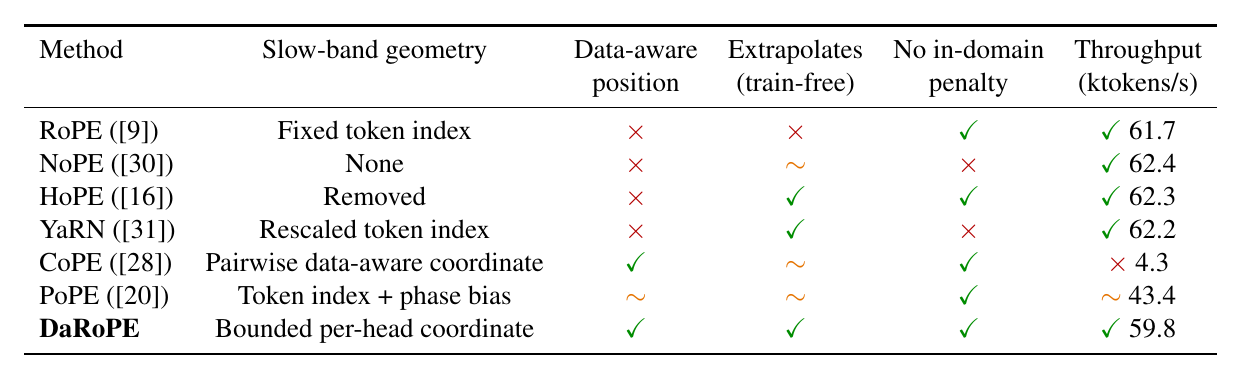
Table 1: Comparison of positional-encoding design properties. 'Data-aware' indicates that the positional mechanism depends on the input. Throughput measures prompt-prefill speed on the 1B architecture at context 4096 on one A100-80GB (higher is better), using the median of nine timed iterations after warmup. ✓ yes, ∼ partial or with caveat, × no.
2.2 Existing approaches and their trade-offs
With this frequency-based view in place, existing methods can be organized into three broad responses to the slow band problem. Table 1 summarizes the different approaches.
Extend at inference (YaRN). YaRN ([31]) rescales RoPE's frequencies at inference to reach longer contexts. It extrapolates without retraining, but requires the target length and can degrade in-domain perplexity as this introduces a shift between training and inference.
Remove the distance prior (NoPE and HoPE). Decoder-only Transformers can infer position from the causal mask alone ([32, 30, 33]). NoPE therefore removes positional rotations entirely. HoPE ([16]) instead retains RoPE on the fast bands and sets the slow-band rotation to zero according to 2.
Content-dependent and polar alternatives (CoPE and PoPE). CoPE ([28]) derives a content-dependent position for each query–key pair by gating their interaction and accumulating those gates between token positions. This requires pairwise accumulation over the sequence and materializes the full L×LL\times LL×L attention matrix, making CoPE O(L2)\mathcal{O}(L^2)O(L2) in memory and inefficient.
PoPE ([20]) instead disentangles magnitude and phase through a polar reparameterization. Magnitudes are obtained by applying a softplus to each element, while the positional phase includes a learned per-component offset:
where sp\mathrm{sp}sp denotes softplus and δc∈[−2π,0]\delta_c\in[-2\pi,0]δc∈[−2π,0] is a learned, input-independent phase bias. PoPE uses ddd frequencies θc\theta_cθc, whereas RoPE uses d/2d/2d/2, doubling the width of QK ⊤QK^{\!\top}QK⊤ and adding an O(L2d)\mathcal{O}(L^2d)O(L2d) term.
The three lines of work disagree on the remedy but converge on the same locus: RoPE's slow bands. Rescaling them requires knowing the target length. Removing their distance prior avoids unseen rotations, but HoPE gives the freed capacity no new role-, an opportunity it explicitly notes: "could be better utilized" ([16]). Content-dependent schemes can adapt position to the input, but existing approaches remain computationally expensive. This suggests a new combination: preserve RoPE's fast-band position clock while placing an efficient content coordinate on the slow bands.
2.3 DaRoPE: Data-aware RoPE
DaRoPE is a content-aware positional method that acts only on RoPE's slow bands. It preserves the index-based fast-band rotations that encode local order, but replaces the token index on each slow band with a bounded, per-head coordinate predicted from the contextual token representation. Slow-band relative phase can therefore reflect which tokens are related rather than only how far apart they occur, while the operation remains a per-token rotary transformation.
Method 1:DaRoPE pseudocode and slow-band geometry. Left: the DaRoPE rotary code update. Right: fast- and slow-band coordinates under RoPE and DaRoPE, with the schematic example the cat is a feline. RoPE preserves token order, HoPE removes slow-band rotation, and DaRoPE places cat and feline nearby in its data-aware coordinate.
theta_j = base ** (-2 * arange(d//2) / d)
K = sum(theta_j >= 2*pi/L)
eps = 1e-6
m_bar = clip(m + .5, eps*L, (1-eps)*L)
beta_m = logit(m_bar / L)
c_h = L * sigmoid(w_h.T @ x_m + alpha_h * beta_m)
angle[..., :K] = m * theta_j[:K]
angle[..., K:] = c_h[..., None] * theta_j[K:]
q, k = rotate(q, angle), rotate(k, angle)
Fast bands angle
Slow bands angle
RoPE
mθ
mθ
DaRoPE
mθ
ch(xm)θ
Token
the
cat
is
a
feline
m
0
1
2
3
4
ch(xm)
0.1
1.0
3
0.7
1.1
Formally, DaRoPE leaves the fast bands (j<Kj<Kj<K) exactly as RoPE Equation (1). On the slow bands (j≥Kj\ge Kj≥K), it replaces the absolute position mmm with a learned per-head content coordinate ch(xm)∈[0,L]c_h(x_m)\in[0,L]ch(xm)∈[0,L] computed from the token's hidden state xmx_mxm:
The formulation uses a learned per-head projection wh∈Rdmodelw_h\in\mathbb{R}^{d_{\text{model}}}wh∈Rdmodel, a learned scalar αh∈R\alpha_h\in\mathbb{R}αh∈R, and σ\sigmaσ the logistic sigmoid bounding the coordinate to [0,L][0,L][0,L]. We define mˉ=m+0.5\bar{m} = m+0.5mˉ=m+0.5 and we clip it in code before applying σ−1\sigma^{-1}σ−1. This keeps the positional prior finite outside the training window while the learned coordinate remains bounded. Within the training context, if wh=0w_h{=}0wh=0 and αh=1\alpha_h{=}1αh=1, the two functions cancel and DaRoPE falls back to RoPE up to a constant offset. The coordinate is data-aware rather than purely content-based: wh⊤xmw_h^\top x_mwh⊤xm can reorder tokens using context, while αhβm\alpha_h\beta_mαhβm retains an explicit positional prior whose strength is learned independently by each head. The slow-band rotation then uses ch(xm)c_h(x_m)ch(xm) in place of mmm:
and the same substitution is applied to the keys. By the relative property of R(⋅)R(\cdot)R(⋅), the slow-band score between mmm and nnn depends on (ch(xn)−ch(xm))θj\big(c_h(x_n)-c_h(x_m)\big)\theta_j(ch(xn)−ch(xm))θj: two tokens with similar content receive similar coordinates and interact as neighbors, however far apart, while the fast bands keep encoding true position. Because σ\sigmaσ bounds chc_hch to [0,L][0,L][0,L], slow-band angles stay in their trained range at any evaluation length, so extrapolation needs no target length. A zero slow-band contribution recovers HoPE. DaRoPE changes only the rotary angle, adding dmodel+1d_{\text{model}}{+}1dmodel+1 scalars per head, at most 0.3%0.3\%0.3% of model parameters in our evaluated models. The output remains a per-token rotation of q,kq,kq,k, so DaRoPE keeps RoPE's O(n)\mathcal{O}(n)O(n) computational cost and FlashAttention compatibility and requires no target-length-dependent inference-time modification. The canonical split follows Equation 2. An ablation experiment supports this formulation: removing the positional prior or making α\alphaα fixed, per-band, or token-dependent weakens the performance (Table 5 in Appendix).
Method 1 summarizes the minimal code update for DaRoPE. Fast bands keep the token index, while slow bands replace it with the data-aware coordinate ch(xm)c_h(x_m)ch(xm), encouraging semantically related tokens to lie close together.
This design is motivated by settings in which relevance is not aligned with linear distance. For example, the learned slow-band coordinate can create a shortcut between a translated word and its aligned source word. More broadly, learned word representations can reflect distance in the syntactic dependency tree rather than linear distance ([34]), while neural activity during speech tracks both when information occurs and what it means ([35, 36]).
3. Language Modeling from 124M to 50B
In our experiments, we systematically compare RoPE-10k/500k, NoPE, HoPE, PoPE, and DaRoPE; CoPE appears only on toy tasks because it does not scale to larger settings (Table 1).
Dense models. Figure 1 reports the perplexity relative to the sequence position for matched decoder-only Transformer at 124M, 350M, and 1B parameters with a 4096 training context, changing only the positional encoding. Using Meta Lingua codebase ([37]), we train the smaller models on FineWeb-Edu ([38]) and the 1B models on DCLM ([39]). Changing the rotary base is itself a common long-context intervention ([21]), so we evaluate both RoPE-10k and RoPE-500k; the latter also provides a matched-base control for HoPE and DaRoPE. Architectures, optimization and validation sets are detailed in Appendix A.1.
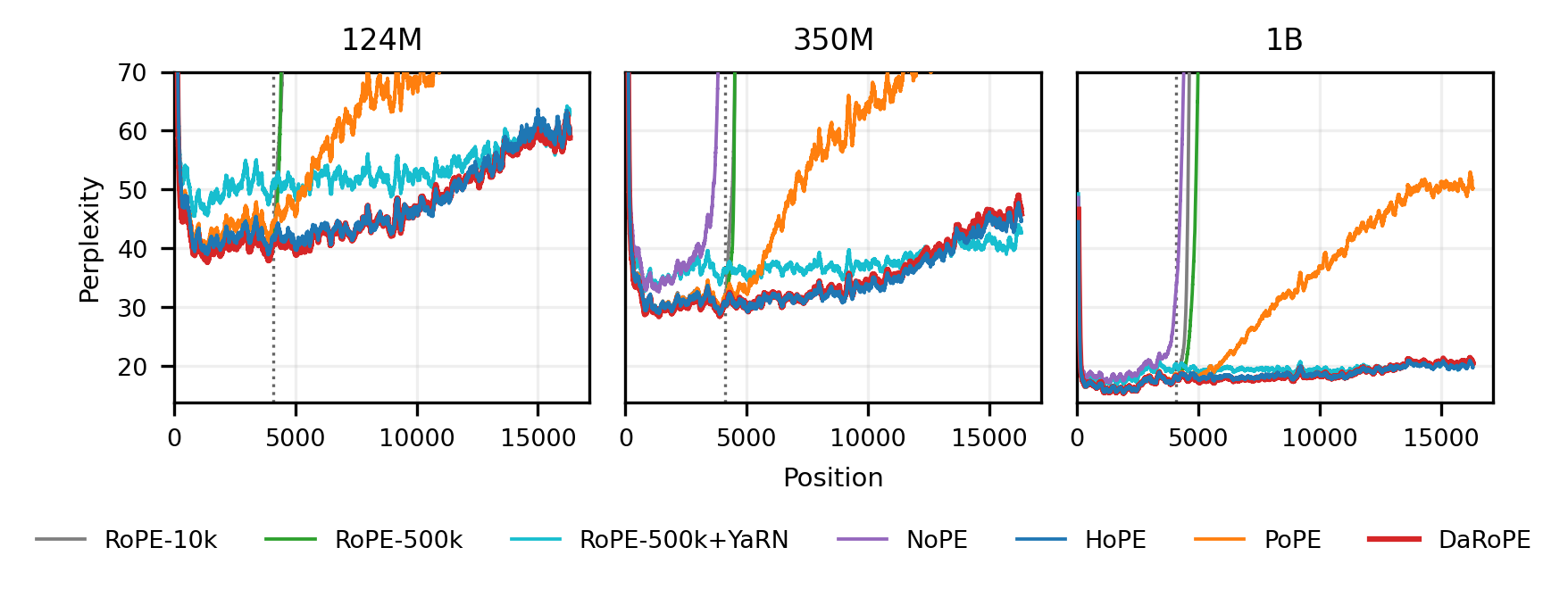
Figure 1:Language Models from 124M to 1B: In-Domain and Extrapolation Performance. Per-position perplexity on N=256 held-out PG-19 documents. Models train at context 4096 (dotted line) and evaluate to 16k without further training; YaRN is applied to RoPE-500k at inference time. Curves use a 128-token moving average; the y-axis is clipped at perplexity 70 for readability.
Within the training window, every trained method that retains a positional signal performs similarly: at 1B over positions 2–4k, these methods cluster at 17.217.217.2–17.517.517.5 perplexity, whereas removing position entirely with NoPE reaches 21.021.021.0. YaRN is different because it rescales frequencies only at inference for the target length; this train–inference shift degrades its in-window perplexity to 19.119.119.1. Table 6 in Appendix reports the trained-model values on their pretraining distributions.
Extrapolation exposes the slow-band problem directly. Standard RoPE fails once its slow bands reach angles unseen during training; increasing the rotary base moderates this failure but does not solve it. Removing position entirely with NoPE is not a solution, and PoPE also eventually diverges beyond the training window. At 1B over positions 8–16k, HoPE and DaRoPE remain near 191919 perplexity, while PoPE rises to 42.942.942.9 and RoPE-500k exceeds 450450450; the other RoPE and NoPE baselines diverge still further. HoPE and DaRoPE are therefore the only trained methods whose perplexity remains stable: preserving the fast-band position clock while removing absolute position from the slow bands keeps their geometry in distribution. Both also match the extrapolation of YaRN without target-length-dependent inference-time rescaling. NoPE becomes increasingly competitive as model size grows. However, context extrapolation does not come from simply removing positional encodings: NoPE alone fails beyond the training context window. Instead, as HoPE and DaRoPE suggest, extrapolation benefits from combining positional encoding with NoPE.
Scaling to a 50B mixture of experts HoPE and DaRoPE are the only methods that combine strong in-domain quality and length extrapolation, so we scale each to one matched 49.5B-parameter mixture-of-experts model (2.572.572.57B active parameters per token). Both train on the same 617B-token mixture at context 4096. More detailed can be found in Appendix B.
We first check that scale does not disturb their in-domain capabilities. The models remain remarkably close on 15 in-context benchmarks: DaRoPE averages 54.754.754.7 and HoPE 54.354.354.3. DaRoPE leads on seven tasks, HoPE on eight (Table 2). This parity spans commonsense reasoning, knowledge, math, and code. The scores are strong for 2.57B active parameters, though differing prompts make prior-work comparisons approximate ([40, 41]).
Long-context tasks separate the two models more clearly, and the separation follows a consistent pattern (Table 3): DaRoPE's advantage concentrates on tasks that require combining evidence spread across a long, natural input. On LongBench (32k) english only subset, multi-document QA alone accounts for about two thirds of DaRoPE's 1.6 point average lead (21.1 versus 14.6), while most other categories remain close. Repository-level code completion shows the same effect: on RepoBench, where the relevant code lies in other files of a 32k context, DaRoPE improves every metric (+5.0 edit similarity, +3.1 exact match, -0.32 answer NLL). Conversely, the gap disappears when long-range aggregation is not required. CrossCodeEval, whose 4k inputs fit inside the training window, is tied, consistent with the in-domain parity above; and on controlled synthetic probes (LongBench synthetic, RULER, BABILong), neither method dominates once task-level variance is taken into account (Figure 6 in Appendix). DaRoPE's long-context benefit is therefore not a uniform improvement but a specific gain in integrating multi-source evidence beyond the training length, obtained without sacrificing in-domain quality.

Table 2: In-context evaluation of the 50B-parameter MoE models. Higher is better; bold marks the best accuracy in each column.
Table 3: Long-context evaluation of the 50B MoE models. LongBench ([42]) uses official metrics averaged within category; CrossCodeEval ([43]) and RepoBench ([44]) report edit similarity, exact match, and answer NLL. Higher is better except for NLL; bold marks the best value in each column. Each method is represented by one trained model.
Efficiency. The accuracy gains retain RoPE-like deployment cost (Table 1). At context 4096, NoPE reaches 62.462.462.4 ktok/s, followed by HoPE at 62.362.362.3, RoPE at 61.761.761.7, and DaRoPE at 59.859.859.8. PoPE falls to 43.443.443.4 because its polar form doubles the query–key width; CoPE reaches only 4.34.34.3. PoPE is 1.4×1.4\times1.4× and CoPE 13.8×13.8\times13.8× slower than DaRoPE before context grows further.
HoPE and DaRoPE are the strongest language-modeling defaults
Both preserve in-domain quality, match YaRN’s extrapolation without inference-time rescaling, and perform comparably in context at 50B. DaRoPE achieves higher average scores on LongBench and RepoBench, particularly when evidence is distributed across long contexts. Both also retain RoPE-like throughput, unlike PoPE and CoPE.
Figure 2:Retrieval through model depth. Rows: return-from-digression (top) and key–value recall (bottom). (left): accuracy across difficulty (N=800; 95% binomial CIs); return compares the correct answer with the recent decoy, while key–value uses exact top-1 selection. (center): At the hardest difficulty, correct token's log-probability advantage (N=200; 95% CIs; gray marks the final ten) for each layer through the final normalization and output head. (right): log attention ratio =log[a(correct)/a(competitor)] averaged over all 16 heads; red favors correct and blue the recent decoy (digression) or mean of the other K−1 values (key-value). No head or layer is selected.
4. DaRoPE Resists Recency and Interference
Long sequences rarely follow a single uninterrupted thread. Books return to earlier entities after pages of digression; code reuses symbols across distant blocks; and musical, genomic, and neural motifs recur after variable gaps. In each case, the relevant information may lie far away. A model must be able to retrieve by content rather than proximity.
We test this behavior on the matched 1B models (Figure 2). Return-from-digression establishes an early topic–codeword binding, inserts up to 2048 unrelated tokens, then introduces a plausible but incorrect recent binding before querying the original topic. The model succeeds only if it prefers the distant correct codeword over the recent decoy. Key–value recall lists KKK bindings in random order and queries one randomly positioned key, so distance provides no clue; increasing KKK tests retrieval as the number of competing values grows. We report correct-answer selection at the output in both tasks. Appendix D gives the full experiment construction.
DaRoPE is the only method that stays strong throughout both stress tests, improving difficulty-grid average accuracy over the strongest competitor by 5.3 percentage points on return-from-digression and 9.6 points on k*ey–value recall* as the number of bindings grows. At the hardest settings, it achieves 88.1%88.1\%88.1% accuracy after a 2048-token digression, compared with 77.6%77.6\%77.6% for RoPE-500k, and 30.5%30.5\%30.5% exact selection with 256 bindings, compared with at most 7.25%7.25\%7.25% for any other method.
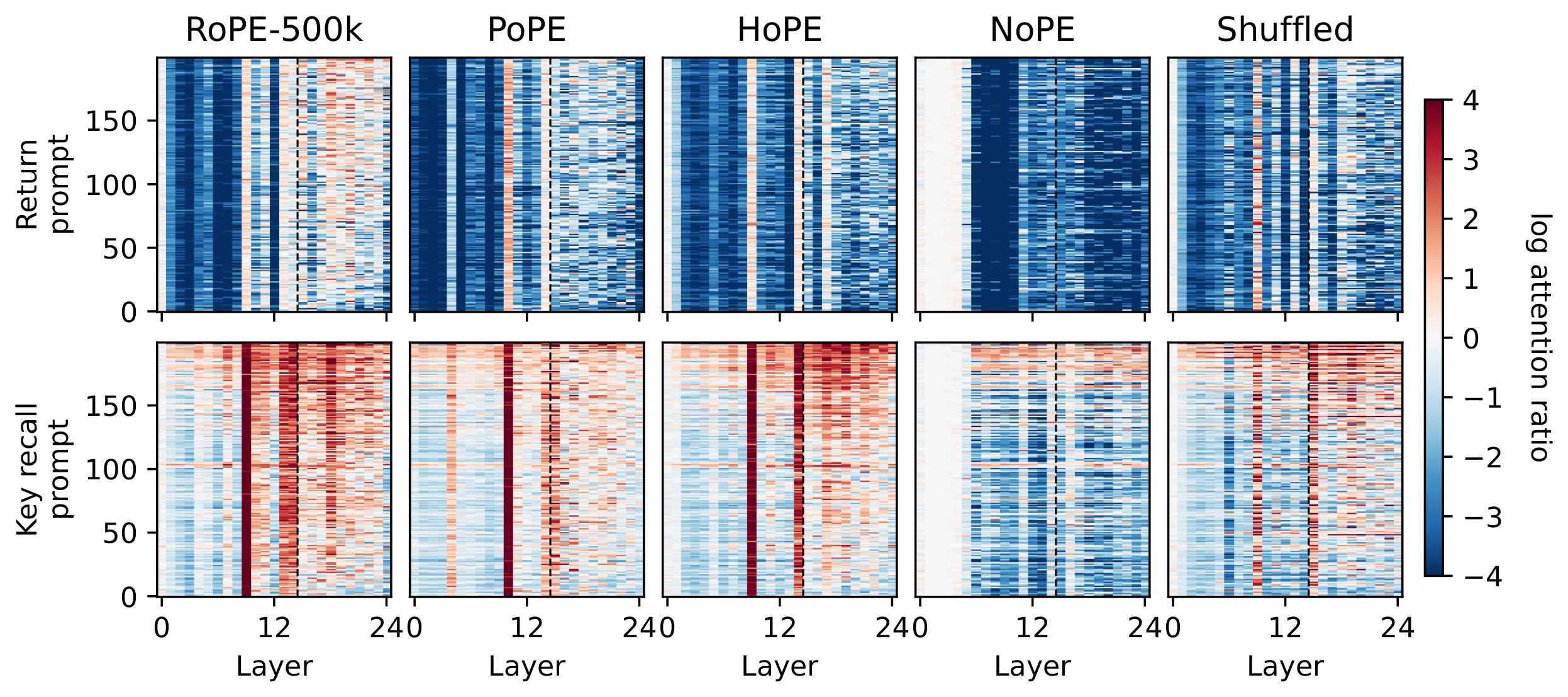
The layerwise view explains why. We use a logit lens: after each Transformer block, we apply the model's final normalization and output head to the query representation and measure the NLL margin of the correct answer over its competitor (Appendix D). This diagnostic shows that RoPE-10k recovers the correct answer internally: its decoded margin reaches +2.0+2.0+2.0 at layer 10. But the signal reverses after layer 16 and finishes at −3.9-3.9−3.9. DaRoPE instead strengthens the correct answer through the final layers and ends at +6.5+6.5+6.5. At the final layer, the decoded margin still favors the correct answer on 86%86\%86% of DaRoPE prompts, versus 78%78\%78% for RoPE-500k, 51%51\%51% for PoPE, 22%22\%22% for RoPE-10k, 17%17\%17% for HoPE, and 3%3\%3% for NoPE. The attention maps show the same transition: late-layer attention favors the correct answer on 86%86\%86% of DaRoPE prompts and only 1%1\%1% of RoPE-10k prompts. RoPE can find the answer; DaRoPE keeps it available until prediction. The pattern is similar for key–value recall. At K=256K{=}256K=256, both models retain a positive signal through depth, but DaRoPE builds a much larger final margin (+4.71+4.71+4.71 versus +2.37+2.37+2.37 on the diagnostic subset). Figure 7 in Appendix extends the attention diagnostic to all methods and controls. Randomly reassigning DaRoPE's learned coordinates across tokens erases most of both gains, tying them to its data-aware geometry.
These probes isolate a capability that long-form language and motif-heavy sequences demand: recovering distant content without being overwritten by what came last. The language-modeling and following non-text results show that this advantage survives in real data.
DaRoPE mitigates recency bias and preserves retrieval under interference
DaRoPE keeps relevant evidence accessible as distance and interference grow, limiting
late-layer drift toward recent decoys and preserving accuracy through prediction.
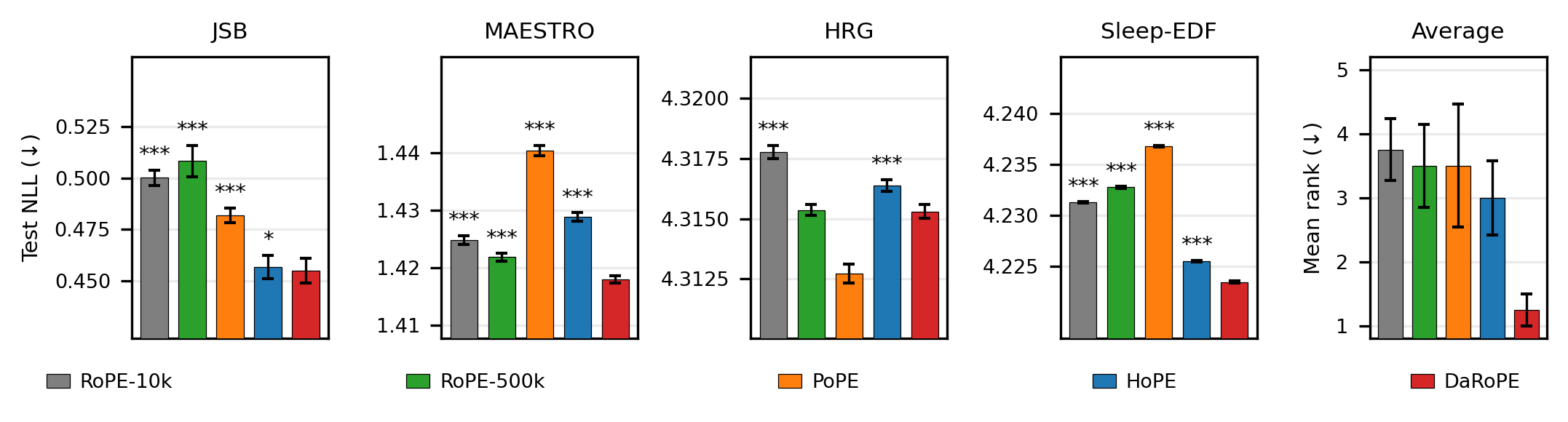
Figure 3:Test NLL on four non-textual datasets. Bars show means across three seeds; error bars are 95% within-example confidence intervals. The right panel reports mean rank across the four datasets, with standard errors across datasets. Holm-corrected paired tests use test examples across three seeds. Significance is relative to DaRoPE: ∗p<0.05, ∗∗p<0.01, ∗∗∗p<0.001. Test sizes are N=77 (JSB), 639 (MAESTRO), 8399 (HRG), and 57,782 (Sleep-EDF). NoPE is off-axis: 1.1634, 1.5075, 4.3494, and 4.4320, respectively.
5. Beyond Language
Music, genomics, and EEG Having established the advantage of HoPE and DaRoPE for language modeling, we ask whether it extends beyond language. We test the same positional choices on JSB Chorales and MAESTRO symbolic music, the human reference genome (HRG), and Sleep-EDF EEG. Within each domain, every method uses the same architecture, data order, and token budget, with three training seeds. We tune the shared model and optimizer with RoPE-10k. Appendix C gives preprocessing, architectures, optimization, and evaluation details.
DaRoPE improves over HoPE on all four datasets: 0.45470.45470.4547 versus 0.45670.45670.4567 on JSB, 1.41801.41801.4180 versus 1.42891.42891.4289 on MAESTRO, 4.31534.31534.3153 versus 4.31644.31644.3164 on HRG, and 4.22354.22354.2235 versus 4.22554.22554.2255 on Sleep-EDF (Figure 3). It also systematically beats RoPE-10k. On the two shared music benchmarks, DaRoPE also improves on the test NLL reported for PoPE in its original paper ([20]); the corrected HRG evaluation is discussed in Appendix C.1. NoPE confirms that removing position altogether is not enough, while HoPE shows that simply removing the slow-band clock does not always beat RoPE, as on MAESTRO and HRG. PoPE reaches the lowest HRG NLL (4.31274.31274.3127), but is much slower: on eight V100s, each PoPE run required 38.938.938.9 hours of training on average, versus 11.811.811.8 hours for DaRoPE. DaRoPE leads JSB, MAESTRO, and Sleep-EDF and has the best average rank across all four datasets.
These domains share a useful structure: musical phrases, genomic motifs, and EEG rhythms recur at variable distances. HoPE removes the slow-band distance prior; DaRoPE goes further and uses those bands to bring related content together. Its consistent gain over HoPE shows that the learned coordinate transfers beyond text.
DaRoPE is the strongest overall non-text default
DaRoPE leads three of four datasets, improves over HoPE on all four, and retains RoPE cost. No other method combines that accuracy and efficiency across non-textual modalities.
5.1 Toy tasks
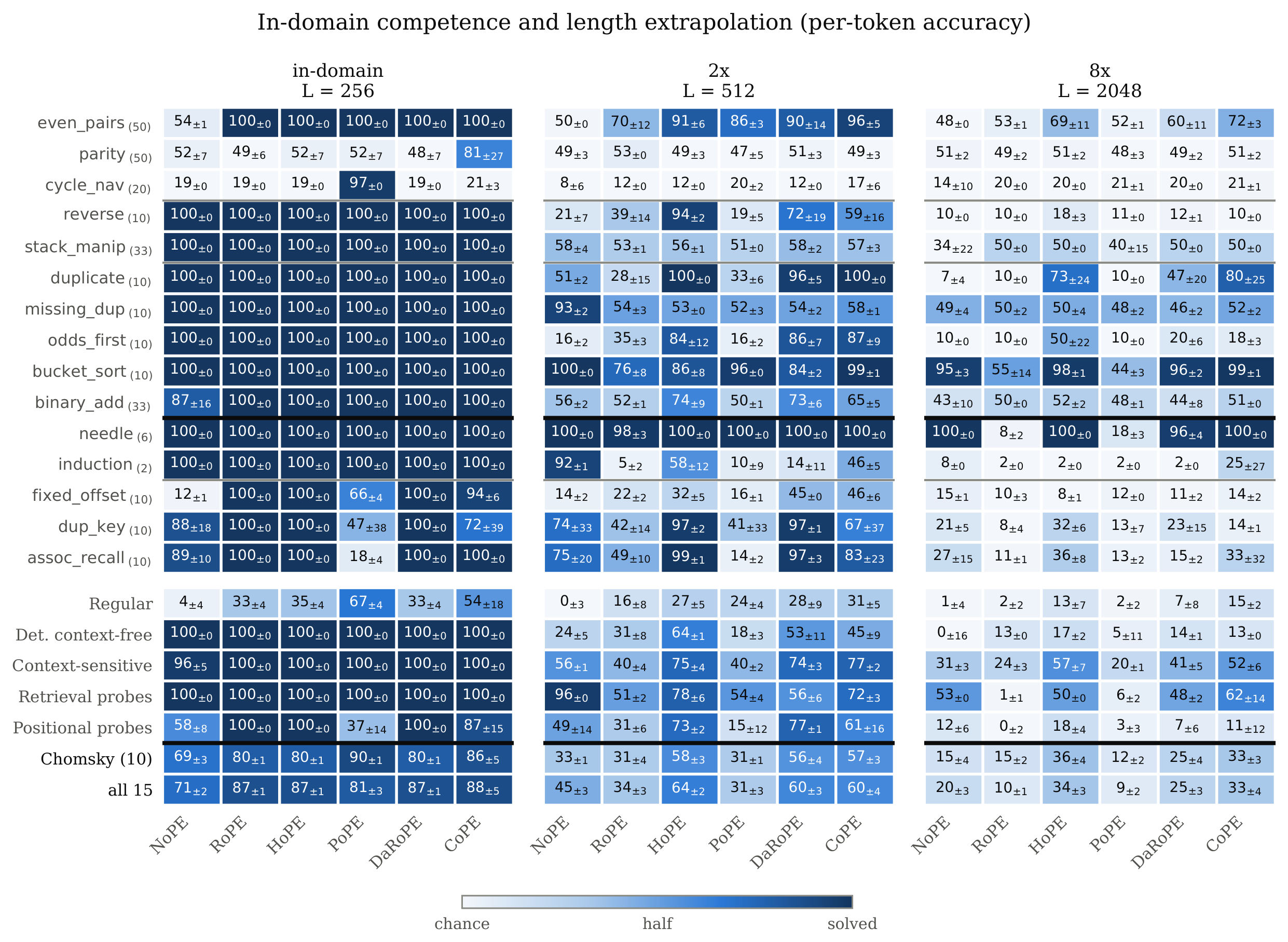
To isolate the capabilities supported by each positional encoding, we evaluate all methods on a suite of synthetic tasks. The suite includes tasks spanning the language classes of the Chomsky hierarchy, following [45], as well as five additional tasks designed to probe fine-grained relative representations and data-aware position. Task definitions are given in Appendix E.1. For each combination of task and positional encoding, we train a four-layer Transformer decoder with a model dimension of 256 on sequences of length 256. For each task, we measure token-level accuracy rather than exact-match accuracy, as exact match can obscure trends by disproportionately penalizing longer outputs. Results use three seeds.
Figure 4 reports chance-normalized in-domain accuracy averaged across all 15 tasks. CoPE, HoPE, DaRoPE, and RoPE form the strongest aggregate group, while PoPE and NoPE trail overall. The aggregate nevertheless hides complementary task profiles: PoPE is strongest on the Chomsky-hierarchy tasks but weaker on retrieval and positional probes, whereas NoPE particularly struggles when the answer requires position. Per-task results and evaluations beyond the training length are reported in Appendix E.
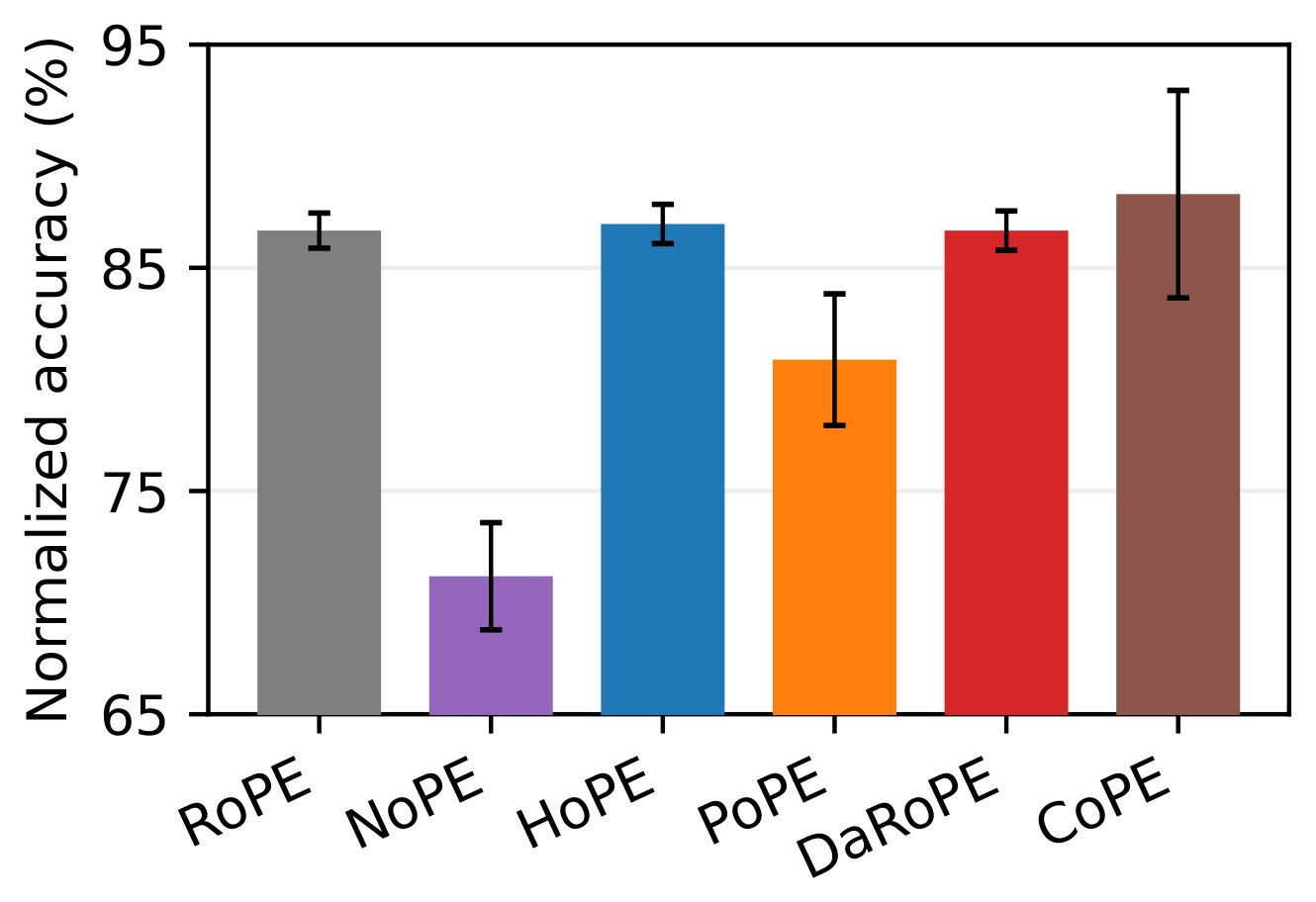
Figure 4:In-domain accuracy. Mean over 15 tasks; propagated seed SD.
6. Related Work
Positional representations and distance biases. Transformers first encoded order with absolute sinusoidal or learned embeddings ([1, 2, 3]). Relative schemes encode pairwise offsets ([4, 6, 5]), while RoPE rotates queries and keys according to token index ([9]). ALiBi, KERPLE, and FIRE add distance-dependent biases, whereas xPos adds distance-dependent scaling ([46, 7, 8, 47]). All derive positional geometry from token indices or offsets.
Length extension and rotary frequencies. Length-generalization methods broaden training positions through randomization or positional skip-wise training ([48, 49]), remap coordinates or frequencies as in positional interpolation, YaRN, CLEX, and LongRoPE ([50, 31, 51, 52]), or target periodic extension directly as in Resonance RoPE and FoPE ([53, 54]). Extrapolation also depends on the rotary base, numerical precision, and frequency allocation ([21, 22, 19]). These approaches improve index-based position; our work asks which bands should encode token index at all.
Removing or learning positional geometry. NoPE shows that causal Transformers can infer order without explicit position ([32, 30, 33]); related methods remove RoPE after training or leave selected low-frequency dimensions unrotated ([55, 29, 19, 16]). Data-aware methods derive distances from content (CoPE), adapt biases (DAPE and GAPE), accumulate transformations (PaTH), or learn input-dependent rotations (CARoPE and Selective RoPE) ([28, 56, 57, 58, 59, 60]). PoPE instead separates content magnitude from positional phase ([20]). DaRoPE targets only the slow bands: they become an interpretable learned reordering, while fast-band RoPE preserves token order at essentially RoPE cost.
7. Conclusion
RoPE’s slow bands need not remain an absolute clock. DaRoPE replaces them with bounded, per-head content coordinates while preserving exact fast-band RoPE. Across our evaluations, it matches HoPE on language modeling, retains in-domain quality, extrapolates without inference-time rescaling, runs at near-RoPE cost, leads on non-textual tasks, and reduces recency bias and retrieval interference. Other content axes, band allocations, and long-context fine-tuning remain open. Overall, retain RoPE’s fast positional structure, but let its slow bands adapt to the data.
AI use statement
Generative AI tools assisted implementation, debugging, data reformatting, figures, code, and manuscript editing. The authors reviewed all assisted outputs, checked reported results against the underlying runs and data, and take responsibility for the final content.
Appendix
A. Dense Language-Model Details
This section gives the dense-model architecture, optimization, in-domain evaluation, length extrapolation protocol, and the formulation ablation referenced in the main paper.
A.1 Dense-model architecture and evaluation
All three scales use the Lingua decoder block, a 409640964096-token context and the cl100k tiktoken tokenizer with BOS/EOS. Weights are tied at 124M/350M and untied at 1B. Optimization is AdamW (weight decay 0.10.10.1, gradient clip 1.01.01.0) with a linear warmup followed by cosine decay. Training uses bf16 with torch.compile, TF32 matmuls disabled, and FSDP (no_shard) across 8×\times×A100-80GB GPUs. Comparisons are made within scale only: 124M/350M train on FineWeb-Edu 10BT ([38]) and 1B on DCLM ([39]). The rotary base is θ=500k\theta=500\text{k}θ=500k for every method except RoPE-10k and PoPE, which use θ=10k\theta=10\text{k}θ=10k. Table 4 gives the per-scale architecture and optimization.
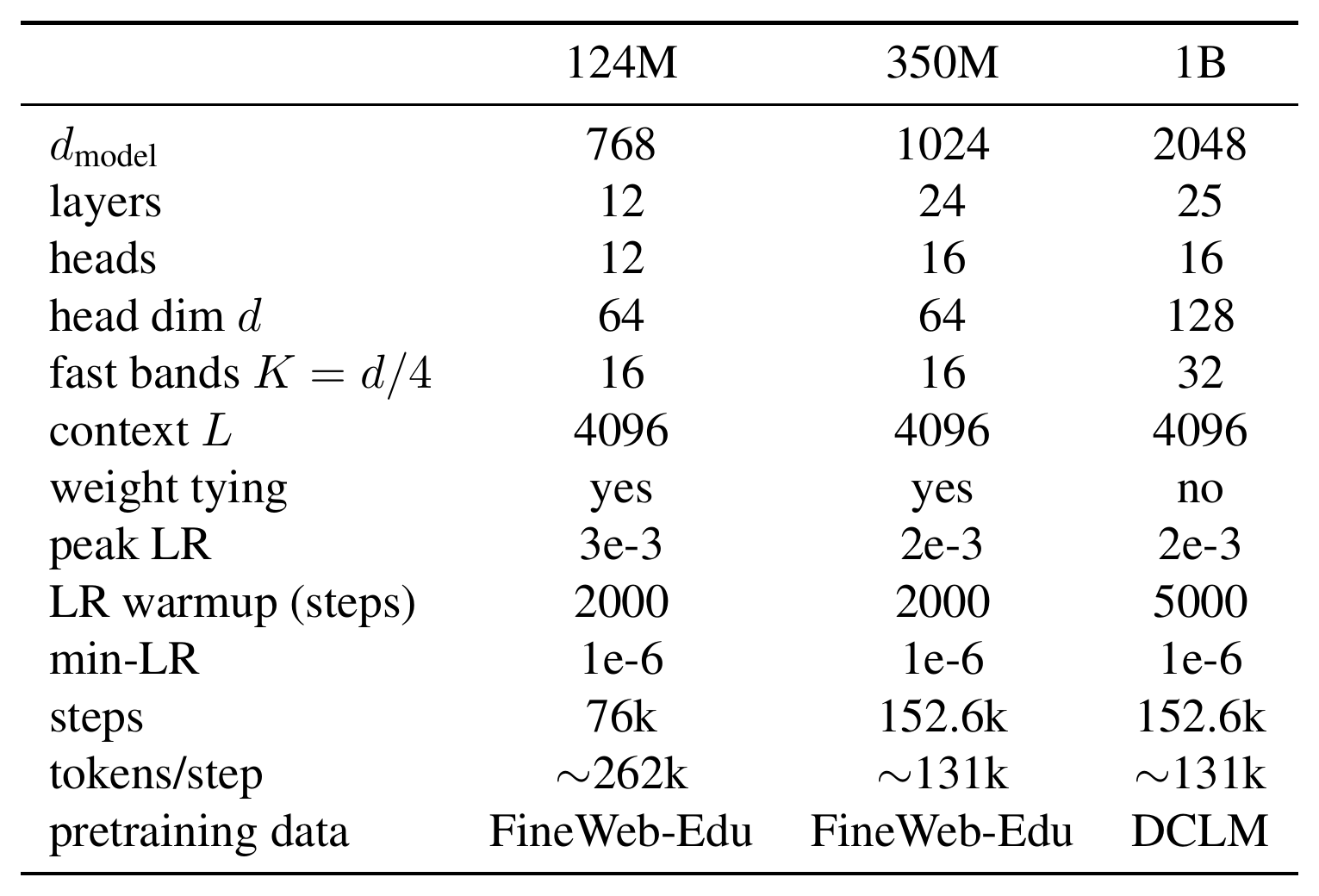
Table 4: Per-scale language-model architecture and training. Head dimension is dmodel/nheads; the wavelength split θj<2π/L yields K=d/4 fast bands at θ=500k,L=4096.
In-domain perplexity. Validation perplexity is computed at the training length on a held-out split of the pretraining distribution – FineWeb-Edu at 124M/350M (1.941.941.94M tokens) and DCLM at 1B (4.014.014.01M tokens) – from the final checkpoint of each run, with every encoding scoring the identical token stream.
Length behaviour. Figure 1 is computed on PG-19 ([61]). We stream the corpus, keep the first 256256256 documents with at least 163851638516385 tokens, truncate each to that length and score the first 163841638416384 positions in a single forward pass – no sliding window, no chunking, no fine-tuning and no positional interpolation. The weights are untouched. The value plotted at a position is the mean next-token NLL over the 256256256 documents, exponentiated, then smoothed with a 128128128-token moving average. Perplexities quoted in the text average positions 222–444k in window (skipping the first few hundred tokens, where every curve is high) and 888–161616k beyond it. YaRN is the single exception to the no-test-time-change rule: following [31] we apply the NTK-by-parts frequency rescaling to the RoPE-500k checkpoint at inference, with extension factor s=16384/4096=4s=16384/4096=4s=16384/4096=4 and use default hyperparameters.
A.2 DaRoPE specifics
The content projection whw_hwh is initialized with standard deviation 0.10.10.1 and the positional-prior scalar αh\alpha_hαh with 0.50.50.5; both are then learned. These two initialization values were chosen by a small hyperparameter search at the 124M scale and reused unchanged at 350M and 1B. The only added parameters are whw_hwh (dmodeld_{\text{model}}dmodel) and αh\alpha_hαh (1) per head, i.e. nheads ⋅ (dmodel+1)n_{\text{heads}}\!\cdot\!(d_{\text{model}}{+}1)nheads⋅(dmodel+1) per layer – under 0.1%0.1\%0.1% of model parameters at every scale. The fast/slow split uses the wavelength criterion θj<2π/L\theta_j<2\pi/Lθj<2π/L of [16]. For the language models at θ=500k\theta{=}500\text{k}θ=500k, L=4096L{=}4096L=4096 this falls at the midpoint (half fast, half slow); the same criterion applied to the shorter music/genomic contexts moves the split accordingly (a larger slow fraction at L=1000L{=}1000L=1000).
Formulation selection. We compare five formulations at 124M: the canonical per-head αh\alpha_hαh, no positional prior, fixed α=0.5\alpha{=}0.5α=0.5, per-band α\alphaα, and token-dependent α\alphaα. Each variant uses one training seed and the final checkpoint; learned content projections are initialized with standard deviation 0.10.10.1, and learned α\alphaα terms with 0.50.50.5. Held-out FineWeb-Edu NLL checks in-domain quality, while mean PG-19 NLL over positions 8–16k selects among formulations that remain tied in domain. Table 5 is therefore formulation-selection evidence rather than evaluation on an untouched test set. The canonical per-head scalar gives the simplest formulation with the strongest selected extrapolation result.
Table 5: DaRoPE formulation ablation at 124M. One training seed; held-out in-domain and 8--16k NLL, lower is better.
Variant
In-domain NLL ↓
8–16k NLL ↓
DaRoPE (per-head α)
2.9447
3.957
No β
2.9420
4.066
Fixed α
2.9437
4.449
Per-band α
2.9439
4.815
Dynamic α
2.9451
4.281
A.3 In-domain validation
Repurposing the slow bands does not cost generic quality. Table 6 complements the in-domain and extrapolation results of Figure 1 by listing the exact in-domain validation perplexity of the full roster at the three dense scales. Every scheme that keeps a positional signal lands within a few tenths of a perplexity point at each scale, with DaRoPE matching the strongest baseline; only full NoPE regresses.
Table 6: In-domain validation perplexity at the three dense scales. Perplexity (lower is better) at the training length L=4096 on a held-out split of each model's own pretraining distribution: FineWeb-Edu at 124M/350M (1.94M tokens) and DCLM at 1B (4.01M tokens). Values are comparable within a column, not across columns.
Method
124M
350M
1B
RoPE-10k
18.95
15.16
17.70
RoPE-500k
18.92
15.10
17.67
NoPE
250.63
20.15
19.56
HoPE
18.94
15.13
17.68
PoPE
19.22
15.28
17.81
DaRoPE
18.95
15.09
17.70
B. 50B Results and Architecture
HoPE and DaRoPE are compared on 15 in-context benchmarks, per-position PG-19 ([61]) loss to 16k tokens, and controlled RULER ([62])/BABILong ([63]) tasks. The complete training and architecture configurations follow these results. Each method is represented by one trained model, so these results compare matched checkpoints rather than variability across retraining. The in-context benchmarks are HellaSwag ([64]), ARC ([65]), PIQA ([66]), OpenBookQA ([67]), WinoGrande ([68]), CommonsenseQA ([69]), COPA ([70]), MMLU ([71]), RACE ([72]), TriviaQA ([73]), BBH ([74]), GSM8K ([75]), HumanEval ([76]), and MBPP ([77]).
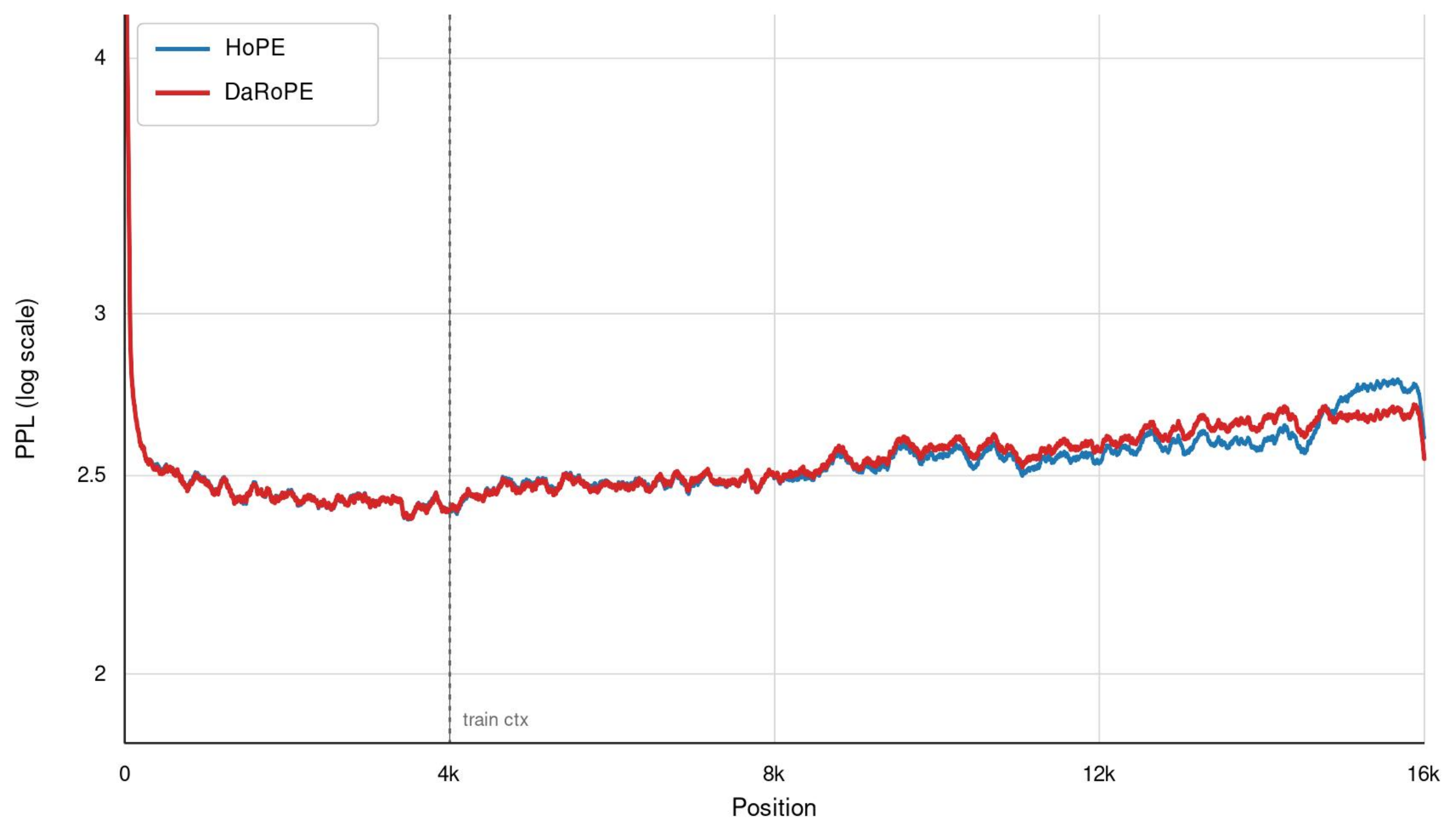
Figure 5:Per-position validation negative log-likelihood. The loss is averaged over N=256 documents for the HoPE and DaRoPE 50B models. Both models are trained with a context length of 4096 tokens, marked by the vertical dashed line, and evaluated on sequences of up to 16,384 tokens. Their curves nearly overlap both within and beyond the training window.
The two models remain close throughout PG-19, but their ordering changes with position (Figure 5). DaRoPE is marginally lower over the first 8k tokens (2.47262.47262.4726 versus 2.47382.47382.4738 NLL), whereas HoPE is lower over 8–16k (2.59132.59132.5913 versus 2.60542.60542.6054). Across the full 16k sequence, HoPE therefore has the lower mean NLL (2.53252.53252.5325 versus 2.53902.53902.5390).
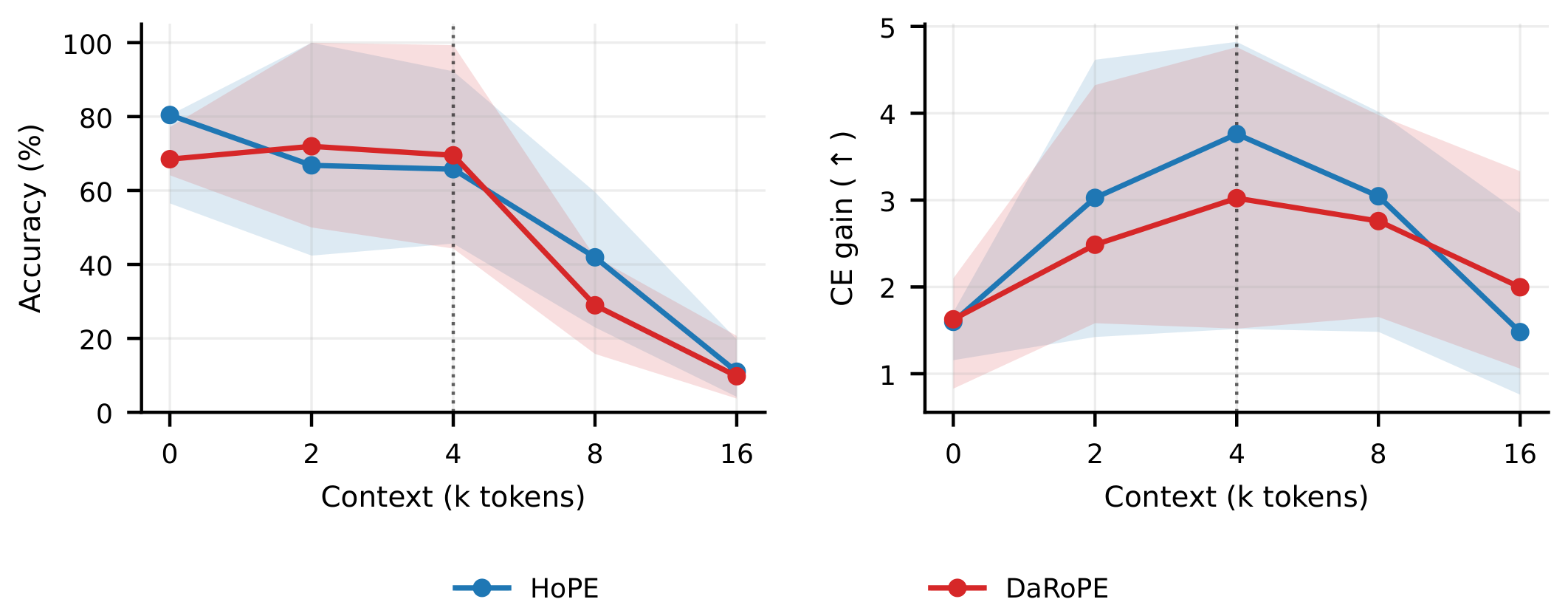
Figure 6:Controlled long-context performance across RULER and BABILong. Lines show task-level median accuracy and CE gain; shaded regions show the interquartile range. The dotted line marks the 4k training context. The two methods are mixed across tasks and context lengths.
lt;5\%$ of the dataset) to comply with internal policy.The model is evaluated on the english only part as our model is trained on an english only corpora.
" data-original-markdown="
Across RULER and BABILong (Figure 6), the median advantages reverse across context lengths and metrics, while the shaded interquartile ranges overlap broadly. The task-to-task variance is therefore too large to distinguish the two methods; these controlled evaluations support a tie.
Note that, for the LongBench results, we excluded news-related data (lt;5\%$ of the dataset) to comply with internal policy.The model is evaluated on the english only part as our model is trained on an english only corpora.
" data-source-offset="41802" class="markdown-segment">
Across RULER and BABILong (Figure 6), the median advantages reverse across context lengths and metrics, while the shaded interquartile ranges overlap broadly. The task-to-task variance is therefore too large to distinguish the two methods; these controlled evaluations support a tie.
Note that, for the LongBench results, we excluded news-related data (<5%<5\%<5% of the dataset) to comply with internal policy.The model is evaluated on the english only part as our model is trained on an english only corpora.
Table 7: Shared training hyperparameters for the HoPE and DaRoPE MoE models.
Training hyperparameter
Value
Training steps
65,392
Sequence length
4,096
GPUs
256
Micro-batch / GPU
1 sequence
Gradient accumulation
9
Global batch size
2,304 sequences
Tokens / optimizer step
9,437,184
Total training tokens
617.1B
Training compute
9.52×10²¹ FLOPs
Optimizer
AdamW
Peak learning rate
1.57076×10⁻³
Minimum learning rate
1×10⁻⁶
Scheduler
Cosine
Warmup steps
5,000
Adam β1,β2
0.9,0.95
Weight decay
0.1
Gradient clipping
0.1
Data mix
Percentage (%)
DCLM
60%
Code
30%
Math
10%
Table 8: Shared architecture hyperparameters for the MoE models. Fine-grained routed experts with a shared expert follow DeepSeekMoE ([40]); sigmoid routing with bias-based load balancing follows DeepSeek-V3 ([78, 79]).
Architecture hyperparameter
Value
Total parameters
49.49B
Active parameters / token†
2.57B
Transformer layers
28
Model dimension
2,560
Attention heads
20
Head dimension
128
Vocabulary size
128,256
Maximum training sequence length
4,096
Number of routed experts
256
Active routed experts / token
8
Shared expert
Yes
Expert FFN hidden dimension
864
FFN activation
SwiGLU
Router score function
Sigmoid
Capacity factor
1.3
Router bias update rate
0.005
RoPE base θ
10,000
C. Non-Textual Sequence Modeling Details
The music and genomic models use a patched clone of the PoPE codebase ([20]); Sleep-EDF uses the same sanitized training protocol. Within each domain, all methods share architecture, data order, optimizer, and token budget.
Each domain follows the same simple two-stage recipe. First, we use RoPE-10k to select the architecture and shared training hyperparameters based on validation loss. We then fix the model architecture and training budget across the full model roster, and give DaRoPE a single small validation-only sweep. The canonical formulation is used for all datasets, except MAESTRO, where we use 161616 slow bands instead of the canonical 171717.
PoPE reproduction and data corrections. During reproduction, we identified and reported an upstream finite-data loader issue. We replaced it with a true infinite loader for training and deterministic full-split evaluation for every method. Under this corrected and better-tuned pipeline, PoPE improves on its originally reported JSB and MAESTRO test NLLs ([20]), indicating that the published configurations left optimization headroom. HRG additionally uses rebuilt source records that remove duplicated sequence overlap from the test set; its stricter, non-redundant test NLL is therefore higher and not directly comparable with the original reported value.
C.1 Dataset configurations
The music models use nanoGPT-style decoders with no bias and full-dimension rotation. All four datasets use the positional-encoding roster and base convention from Appendix A.1.
JSB Chorales.
Data: the Boulanger-Lewandowski chorale corpus ([80]), represented at each timestep by the sounding MIDI notes 212121–108108108, silence, or padding (vocabulary 909090).
Training: AdamW (β2=0.99\beta_2{=}0.99β2=0.99, weight decay 0.10.10.1), LR 6×10−46\times10^{-4}6×10⁻⁴ cosine to 6×10−56\times10^{-5}6×10⁻⁵, 505050 warmup steps, 300030003000 iterations, batch 444.
Evaluation:N=77N{=}77N=77 test sequences.
MAESTRO.
Data: MAESTRO v3 piano performances ([81]), tokenized with the REMI representation ([82]) (pitch 212121–108108108, 323232 velocity bins, 8/48/48/4 beat resolution, chord and tempo tokens, and PAD/BOS/EOS/MASK). Performances use a 90/5/590/5/590/5/5 train/validation/test split; training uses pitch transposition (±3\pm3±3 semitones), and sequences are chunked to context 204820482048 with a two-bar overlap.
Data: the human reference genome (HRG) dataset of [83], built from GRCh38 ([84]), uppercased with non-ACGT bases mapped to N and tokenized into 666-mers (vocabulary 410741074107). Chromosomes are split into train (chr1–20, X, Y), validation (chr21), and test (chr22). We remove duplicated overlap from the 620062006200-base source records and construct 610061006100-base examples with 505050-base overlap (stride 605060506050), adding a 000–999999-base start jitter during training only.
Training: AdamW (β2=0.999\beta_2{=}0.999β2=0.999, weight decay 10−210^{-2}10−2), LR 3.7×10−43.7\times10^{-4}3.7×10⁻⁴ cosine to 2.5×10−52.5\times10^{-5}2.5×10⁻⁵, 383738373837 warmup steps, 95,92195{,}92195,921 iterations, effective batch 646464 across 888 GPUs (63,93663{,}93663,936 tokens/step, 6.136.136.13B tokens).
Evaluation: held-out test NLL on N=8399N{=}8399N=8399 sequences.
Sleep-EDF.
Data: the Sleep Cassette subset of Sleep-EDF Expanded ([27]) from PhysioNet ([85]), comprising 153153153 overnight recordings from 787878 subjects, with Fpz–Cz EEG at 100100100 Hz (Sleep Telemetry excluded). Each night is trimmed from the first to last scored sleep stage plus 303030 minutes on each side, normalized by its median and interquartile range, and clipped to ±20\pm20±20. The age-stratified, subject-disjoint train/validation/test split contains 62/8/862/8/862/8/8 subjects (122/15/16122/15/16122/15/16 nights) and 464.9464.9464.9M/63.263.263.2M/59.259.259.2M tokens. Each sample is mapped through 255255255 training-set quantile boundaries to a 256256256-token vocabulary; no patching, vector quantization, continuous head, or sleep-stage labels are used.
Model:4.794.794.79M parameters, 666 pre-norm layers, 888 heads, dmodel=256d_{\text{model}}{=}256dmodel=256, a 4×4\times4× GELU MLP, RMSNorm ([86]), no bias or dropout, tied embeddings, full-dimension rotation, context 102410241024.
Training: AdamW (β=0.9/0.99\beta{=}0.9/0.99β=0.9/0.99, weight decay 10−210^{-2}10−2, gradient clip 1.01.01.0), LR 6×10−46\times10^{-4}6×10⁻⁴ cosine to 6×10−56\times10^{-5}6×10⁻⁵ after 200200200 warmup steps, batch 161616, and 20,00020{,}00020,000 updates for each of three seeds.
Evaluation: deterministic non-overlapping windows over N=57,782N{=}57{,}782N=57,782 test sequences (59.259.259.2M tokens).
C.2 Test scoring and paired significance
Comparisons are paired: for a baseline bbb we test the per-sequence differences di=NLLi(b)−NLLi(DaRoPE)d_i=\mathrm{NLL}_i(b)-\mathrm{NLL}_i(DaRoPE)di=NLLi(b)−NLLi(DaRoPE), after first averaging each test example across the three seeds. We apply two-sided paired ttt-tests and Holm correction across the four baseline comparisons within each domain. Figure 3 displays a significance marker when the corrected test is significant and DaRoPE has lower NLL. Error bars are 95%95\%95% within-example intervals across the paired methods.
Figure 7:Attention ratios for the remaining methods and coordinate intervention. Rows show return-from-digression at D=2048 (top) and key–value recall at K=256 (bottom), matching Figure 2. Columns show RoPE-500k, PoPE, HoPE, NoPE, and the trained DaRoPE model after its coordinates are shuffled across token positions. Each cell averages all 16 heads in that layer. Red favors the correct value; blue favors the recent decoy or mean competitor. All panels use the same N=200 prompts, row order, and color scale; the dashed line precedes layers 15–24.
D. Recency and Content Coordinates
Models and instances. All numbers come from the 1B roster, evaluated at the 409640964096-token training context. Instances are generated from a fixed seed independently of the model, so the six positional schemes are scored on byte-identical prompts and all comparisons are paired: N=800N{=}800N=800 instances per point and D∈{64,128,256,512,1024,2048}D \in \{64,128,256,512,1024,2048\}D∈{64,128,256,512,1024,2048} with per-instance jitter ±15%\pm15\%±15%. Key–value recall uses K∈{8,16,32,64,128,256}K \in \{8,16,32,64,128,256\}K∈{8,16,32,64,128,256} and 800800800 instances per point.
Return-from-digression. An antecedent binds an answer to a topic; an off-topic digression padded to DDD tokens follows; a decoy binds a different answer to a second topic at the end of the digression; the continuation restates the first topic only. The scored token is the answer, and the margin is NLL(decoy) −-− NLL(correct):
[off-topic filler ...]
Zaryndor417 report: codeword = quartz.
antecedent
[off-topic filler, padded to D tokens ...]
Mournhold263 report: codeword = lantern.
recent decoy
Summary of Zaryndor417: codeword =
continuation
Key–value recall.KKK key–value bindings are listed in random order and one key is queried again. Its binding sits at a random rank, so distance carries no information. The margin is the mean NLL of the K−1K{-}1K−1 competing values minus the NLL of the correct one; exact selection requires the correct value to rank first.
Layerwise diagnostics. The mechanism panels use the hardest displayed settings, D=2048D{=}2048D=2048 and K=256K{=}256K=256, with N=200N{=}200N=200 model-independent prompts. After block ℓ\ellℓ, let hℓh_\ellhℓ be the hidden state at the final query position and WvW_vWv the output vector for token vvv. The logit-lens margin is
Mℓ=⟨Norm(hℓ),Wcorrect−Wcompetitors⟩,
where the bar is the recent decoy for return-from-digression and the mean of the K−1K{-}1K−1 competing values for key–value recall. We apply the model's final normalization and output head at every layer. Thus MℓM_\ellMℓ asks which answer is decodable at that depth; only the final layer is the model's actual output.
For attention, we first average the final query's attention probability across all 16 heads within a layer, then report the log ratio between the correct value and the recent decoy or mean competing value. Positive values favor the correct binding. No layer or head is selected. Prompt rows are sorted once by DaRoPE's mean ratio over layers 15–24 and reused unchanged for every method.
The near-white first layers for NoPE do not indicate missing attention. White means a log ratio near zero: correct and competing values receive similar attention. Without an explicit positional signal, early NoPE layers have not yet separated candidates with the same local format. Later contextual representations can still become order-sensitive through the causal network, which explains why a strong preference emerges only after several layers.
Coordinate intervention. We keep DaRoPE's trained weights and the complete set of coordinates fixed, but randomly reassign those coordinates across token positions at inference. This preserves their values while breaking the token–coordinate correspondence. At the final layer, shuffling reduces the paired margin by 8.79±0.778.79\pm0.778.79±0.77 nats on return-from-digression and 3.76±0.473.76\pm0.473.76±0.47 on key–value recall (95% CIs), favoring native coordinates on 96%96\%96% and 93%93\%93% of prompts.
Figure 8:Full synthetic-task results. Per-task token accuracy (mean ± SD across seeds) in domain and at 2× and 8× the training length, with task-family and aggregate summaries.
E. Synthetic Tasks
E.1 Task descriptions
We evaluate on 15 synthetic tasks in three groups. All are rendered as ASCII strings with a task-specific prefix, tokenised at byte level, and supervised only on the output span. "Answer" below distinguishes a single output symbol from a sequence; this matters for scoring, because per-token accuracy and exact-match coincide on single-symbol tasks, whereas on sequence tasks exact-match requires every symbol to be right and its chance level collapses to ≈0\approx 0≈0. Chance is 1/∣A∣1/|\mathcal{A}|1/∣A∣ for the answer alphabet A\mathcal{A}A.
E.2 Chomsky-hierarchy benchmark (15 tasks)
The Chomsky-hierarchy benchmark ([45]) is grouped by the level of the formal-language hierarchy required to solve it. Ten are learnable by a 4-layer transformer and carry the main results; modular_arithmetic, modular_arithmetic_brackets and solve_equation are at chance for every positional encoding at that depth; binary_multiplication and compute_sqrt reach exact-match 000 at depth 4 with a 256-token context and are excluded from our results.
Table 9: Chomsky-hierarchy tasks. × excluded from our results: at depth 4 with a 256-token training context, exact-match is 0 for every encoding we ran them with, so no instance is solved in this configuration.
Task
Example
Answer
⟨ch⟩
Description
Regular
even_pairs
EP:01110011 → 1
single
50
Is the number of adjacent differing pairs even?
parity
P:01110011 → 1
single
50
Parity of the number of 1s.
cycle_navigation
CY:11220022 → 2
single
20
Position on a 5-cycle after a walk (0/1/2 = left/stay/right).
modular_arithmetic
MA:2-3*0+4 → 1
single
20
Evaluate a flat expression mod 5 (the paper's simple variant; no brackets).
Deterministic context-free
reverse_string
R:45790189 → 98109754
sequence
10
Reverse the input.
stack_manipulation
ST:11102442 → 1111
sequence
33
Run a stack program (2=pop, 3/4=push) and emit the final stack.
modular_arithmetic_brackets
MB:(-2+(3)) → 1
single
20
Evaluate a bracketed expression mod 5; needs a nesting stack.
solve_equation
EQ:(2+-x)=4 → 3
single
20
Solve for x mod 5; requires inverting the expression.
Context-sensitive
duplicate_string
D:45790189 → 45790189
sequence
10
Emit the input twice (ss).
missing_duplicate_string
MD:21110111 → 0
single
10
One symbol of a duplicated string ss is masked; recover it.
odds_first
OF:45790189 → 59194708
sequence
10
Emit odd-indexed symbols, then even-indexed ones.
binary_addition
BA:111+0111 → 10101
sequence
33
Add two little-endian binary numbers.
bucket_sort
S:45790189 → 01457899
sequence
10
Sort the symbols of a fixed alphabet.
binary_multiplication×
BM:111*0111 → 0100011
sequence
≈50
Multiply two little-endian binary numbers.
compute_sqrt×
SQ:11110011 → 1111
sequence
≈50
⌊n⌋ of a big-endian binary number.
E.3 Retrieval probes (2 tasks)
Two retrieval tasks that ship with our codebase but are not part of the benchmark. We keep them separate because they behave very differently from the benchmark tasks: they are the only place where removing positional information (NoPE) is a large win, and pooling them with the benchmark inflates NoPE's average.
Table 10: Retrieval probes. Pure content matching: the answer never depends on absolute position.
Task
Example
Answer
⟨ch⟩
Description
needle
N:45790189 → 00000001
sequence
6
At each step, has the current symbol occurred earlier?
induction
I:55791289 → 05000001
sequence
2
Given AB A, predict B (induction head).
E.4 Positional probes (3 tasks)
Three tasks we introduce to isolate the positional axis. They share their rendering, alphabets and answer format exactly, and differ only in how much positional information the answer requires.
Table 11: Positional probes. assoc_recall is the control: it is identical to dup_key_recall except that the query key is unique, so any gap between the two is attributable to the positional requirement rather than to capacity.
Task
Example
Answer
⟨ch⟩
Description
fixed_offset
FO:3141592#0003 → 5
single
10
Pure position: return the digit k places from the end.
dup_key_recall
DK:a3b7a9c1?a → 9
single
10
Position + content: the query key occurs twice; return the later value.
assoc_recall
AR:a3b7c1?b → 7
single
10
Content only: the query key occurs once; return its value.
References
[1] Ashish Vaswani, Noam Shazeer, Niki Parmar, Jakob Uszkoreit, Llion Jones, Aidan N. Gomez, Łukasz Kaiser, and Illia Polosukhin. Attention is all you need. In Advances in Neural Information Processing Systems (NeurIPS), 2017.
[2] Alec Radford, Karthik Narasimhan, Tim Salimans, and Ilya Sutskever. Improving language understanding by generative pre-training. Technical report, OpenAI, 2018.
[3] Tom B. Brown, Benjamin Mann, Nick Ryder, Melanie Subbiah, Jared Kaplan, Prafulla Dhariwal, Arvind Neelakantan, Pranav Shyam, Girish Sastry, Amanda Askell, et al. Language models are few-shot learners. In Advances in Neural Information Processing Systems (NeurIPS), 2020.
[4] Peter Shaw, Jakob Uszkoreit, and Ashish Vaswani. Self-attention with relative position representations. In Proceedings of the 2018 Conference of the North American Chapter of the Association for Computational Linguistics (NAACL), 2018.
[5] Colin Raffel, Noam Shazeer, Adam Roberts, Katherine Lee, Sharan Narang, Michael Matena, Yanqi Zhou, Wei Li, and Peter J. Liu. Exploring the limits of transfer learning with a unified text-to-text transformer. Journal of Machine Learning Research, 21(140):1–67, 2020.
[6] Zihang Dai, Zhilin Yang, Yiming Yang, Jaime Carbonell, Quoc V. Le, and Ruslan Salakhutdinov. Transformer-XL: Attentive language models beyond a fixed-length context. In Proceedings of the 57th Annual Meeting of the Association for Computational Linguistics (ACL), 2019.
[7] Ta-Chung Chi, Ting-Han Fan, Peter J. Ramadge, and Alexander I. Rudnicky. KERPLE: Kernelized relative positional embedding for length extrapolation. In Advances in Neural Information Processing Systems (NeurIPS), 2022.
[8] Shanda Li, Chong You, Guru Guruganesh, Joshua Ainslie, Santiago Ontanon, Manzil Zaheer, Sumit Sanghai, Yiming Yang, Sanjiv Kumar, and Srinadh Bhojanapalli. Functional interpolation for relative positions improves long context transformers. In International Conference on Learning Representations (ICLR), 2024b.
[9] Jianlin Su, Murtadha Ahmed, Yu Lu, Shengfeng Pan, Wen Bo, and Yunfeng Liu. RoFormer: Enhanced transformer with rotary position embedding. Neurocomputing, 568:127063, 2024.
[10] Aakanksha Chowdhery, Sharan Narang, Jacob Devlin, Maarten Bosma, Gaurav Mishra, Adam Roberts, Paul Barham, Hyung Won Chung, Charles Sutton, Sebastian Gehrmann, et al. PaLM: Scaling language modeling with pathways. Journal of Machine Learning Research, 24(240):1–113, 2023.
[11] Hugo Touvron, Thibaut Lavril, Gautier Izacard, Xavier Martinet, Marie-Anne Lachaux, Timothée Lacroix, Baptiste Rozière, Naman Goyal, Eric Hambro, Faisal Azhar, Aurelien Rodriguez, Armand Joulin, Edouard Grave, and Guillaume Lample. LLaMA: Open and efficient foundation language models. preprint arXiv:2302.13971, 2023.
[12] Albert Q. Jiang, Alexandre Sablayrolles, Arthur Mensch, Chris Bamford, Devendra Singh Chaplot, Diego de las Casas, Florian Bressand, Gianna Lengyel, Guillaume Lample, Lucile Saulnier, et al. Mistral 7B. preprint arXiv:2310.06825, 2023.
[13] Tri Dao, Daniel Y. Fu, Stefano Ermon, Atri Rudra, and Christopher Ré. FlashAttention: Fast and memory-efficient exact attention with IO-awareness. In Advances in Neural Information Processing Systems (NeurIPS), 2022.
[14] Byeongho Heo, Song Park, Dongyoon Han, and Sangdoo Yun. Rotary position embedding for vision transformer. In European Conference on Computer Vision (ECCV), pp. 289–305, 2024.
[15] Yong Liu, Guo Qin, Xiangdong Huang, Jianmin Wang, and Mingsheng Long. Timer-XL: Long-context transformers for unified time series forecasting. In International Conference on Learning Representations (ICLR), 2025.
[16] Yuhan Chen, Ang Lv, Jian Luan, Bin Wang, and Wei Liu. HoPE: A novel positional encoding without long-term decay for enhanced context awareness and extrapolation. In Proceedings of the 63rd Annual Meeting of the Association for Computational Linguistics (ACL), 2025.
[17] Nelson F. Liu, Kevin Lin, John Hewitt, Ashwin Paranjape, Michele Bevilacqua, Fabio Petroni, and Percy Liang. Lost in the middle: How language models use long contexts. Transactions of the Association for Computational Linguistics (TACL), 12:157–173, 2024a.
[18] Xiaoyue Xu, Qinyuan Ye, and Xiang Ren. Stress-testing long-context language models with lifelong ICL and task haystack. In Advances in Neural Information Processing Systems (NeurIPS), Datasets and Benchmarks Track, 2024b.
[19] Federico Barbero, Alex Vitvitskyi, Christos Perivolaropoulos, Razvan Pascanu, and Petar Veličković. Round and round we go! What makes Rotary Positional Encodings useful? In International Conference on Learning Representations (ICLR), 2025.
[20] Anand Gopalakrishnan, Róbert Csordás, Jürgen Schmidhuber, and Michael C. Mozer. Decoupling the "what" and "where" with polar coordinate positional embeddings. In International Conference on Machine Learning (ICML), 2026.
[21] Mingyu Xu, Xin Men, Bingning Wang, Qingyu Zhang, Hongyu Lin, Yaojie Lu, Xianpei Han, and Weipeng Chen. Base of RoPE bounds context length. In Advances in Neural Information Processing Systems (NeurIPS), volume 37, pp. 87386–87410, 2024a.
[22] Haonan Wang, Qian Liu, Chao Du, Tongyao Zhu, Cunxiao Du, Kenji Kawaguchi, and Tianyu Pang. When precision meets position: BFloat16 breaks down RoPE in long-context training. Transactions on Machine Learning Research (TMLR), 2025.
[23] Tianyu Gao, Alexander Wettig, Howard Yen, and Danqi Chen. How to train long-context language models (effectively). In Proceedings of the 63rd Annual Meeting of the Association for Computational Linguistics (ACL), 2025.
[24] Cheng-Zhi Anna Huang, Ashish Vaswani, Jakob Uszkoreit, Noam Shazeer, Ian Simon, Curtis Hawthorne, Andrew M. Dai, Matthew D. Hoffman, Monica Dinculescu, and Douglas Eck. Music Transformer: Generating music with long-term structure. In International Conference on Learning Representations (ICLR), 2019.
[25] Yanrong Ji, Zhihan Zhou, Han Liu, and Ramana V. Davuluri. DNABERT: pre-trained bidirectional encoder representations from transformers model for DNA-language in genome. Bioinformatics, 37(15):2112–2120, 2021.
[26] Eric Nguyen, Michael Poli, Marjan Faizi, Armin W. Thomas, Callum Birch Sykes, Michael Wornow, Aman Patel, Clayton Rabideau, Stefano Massaroli, Yoshua Bengio, Stefano Ermon, Stephen A. Baccus, and Christopher Ré. HyenaDNA: Long-range genomic sequence modeling at single nucleotide resolution. In Advances in Neural Information Processing Systems (NeurIPS), 2023.
[27] Bob Kemp, Aeilko H. Zwinderman, Bert Tuk, Hilbert A. C. Kamphuisen, and Josefien J. L. Oberyé. Analysis of a sleep-dependent neuronal feedback loop: the slow-wave microcontinuity of the EEG. IEEE Transactions on Biomedical Engineering, 47(9):1185–1194, 2000.
[28] Olga Golovneva, Tianlu Wang, Jason Weston, and Sainbayar Sukhbaatar. Contextual position encoding: Learning to count what's important. preprint arXiv:2405.18719, 2024.
[29] Bowen Yang, Bharat Venkitesh, Dwaraknath Gnaneshwar Talupuru, Hangyu Lin, David Cairuz, Phil Blunsom, and Acyr Locatelli. Rope to Nope and back again: A new hybrid attention strategy. In Advances in Neural Information Processing Systems (NeurIPS), 2025a.
[30] Amirhossein Kazemnejad, Inkit Padhi, Karthikeyan Natesan Ramamurthy, Payel Das, and Siva Reddy. The impact of positional encoding on length generalization in transformers. In Advances in Neural Information Processing Systems (NeurIPS), 2023.
[31] Bowen Peng, Jeffrey Quesnelle, Honglu Fan, and Enrico Shippole. YaRN: Efficient context window extension of large language models. In International Conference on Learning Representations (ICLR), 2024.
[32] Adi Haviv, Ori Ram, Ofir Press, Peter Izsak, and Omer Levy. Transformer language models without positional encodings still learn positional information. In Findings of the Association for Computational Linguistics: EMNLP 2022, 2022.
[33] Kazuki Irie. Why are positional encodings nonessential for deep autoregressive transformers? A Petroglyph Revisited. In Findings of the Association for Computational Linguistics: ACL 2025, 2025.
[34] John Hewitt and Christopher D. Manning. A structural probe for finding syntax in word representations. In Proceedings of the 2019 Conference of the North American Chapter of the Association for Computational Linguistics (NAACL). Association for Computational Linguistics, 2019.
[35] Nai Ding, Lucia Melloni, Hang Zhang, Xing Tian, and David Poeppel. Cortical tracking of hierarchical linguistic structures in connected speech. Nature Neuroscience, 19(1):158–164, 2016.
[36] Alexander G. Huth, Wendy A. de Heer, Thomas L. Griffiths, Frédéric E. Theunissen, and Jack L. Gallant. Natural speech reveals the semantic maps that tile human cerebral cortex. Nature, 532(7600):453–458, 2016.
[37] Mathurin Videau, Badr Youbi Idrissi, Daniel Haziza, Luca Wehrstedt, Jade Copet, Olivier Teytaud, and David Lopez-Paz. Meta Lingua: A minimal PyTorch LLM training library. https://github.com/facebookresearch/lingua, 2024.
[38] Guilherme Penedo, Hynek Kydlíček, Loubna Ben Allal, Anton Lozhkov, Margaret Mitchell, Colin Raffel, Leandro Von Werra, and Thomas Wolf. The FineWeb datasets: Decanting the web for the finest text data at scale. In Advances in Neural Information Processing Systems (NeurIPS), Datasets and Benchmarks Track, 2024.
[39] Jeffrey Li, Alex Fang, Georgios Smyrnis, Maor Ivgi, Matt Jordan, Samir Gadre, et al. DataComp-LM: In search of the next generation of training sets for language models. In Advances in Neural Information Processing Systems (NeurIPS), Datasets and Benchmarks Track, 2024a.
[40] Damai Dai, Chengqi Deng, Chenggang Zhao, R. X. Xu, Huazuo Gao, Deli Chen, Jiashi Li, Wangding Zeng, Xingkai Yu, Y. Wu, Zhenda Xie, Y. K. Li, Panpan Huang, Fuli Luo, Chong Ruan, Zhifang Sui, and Wenfeng Liang. DeepSeekMoE: Towards ultimate expert specialization in mixture-of-experts language models. In Proceedings of the 62nd Annual Meeting of the Association for Computational Linguistics (ACL), pp. 1280–1297, 2024.
[41] Albert Q. Jiang, Alexandre Sablayrolles, Antoine Roux, Arthur Mensch, Blanche Savary, Chris Bamford, Devendra Singh Chaplot, Diego de las Casas, Emma Bou Hanna, Florian Bressand, Gianna Lengyel, Guillaume Bour, Guillaume Lample, Lélio Renard Lavaud, Lucile Saulnier, Marie-Anne Lachaux, Pierre Stock, Sandeep Subramanian, Sophia Yang, Szymon Antoniak, Teven Le Scao, Théophile Gervet, Thibaut Lavril, Thomas Wang, Timothée Lacroix, and William El Sayed. Mixtral of experts. preprint arXiv:2401.04088, 2024.
[42] Yushi Bai, Xin Lv, Jiajie Zhang, Hongchang Lyu, Jiankai Tang, Zhidian Huang, Zhengxiao Du, Xiao Liu, Aohan Zeng, Lei Hou, Yuxiao Dong, Jie Tang, and Juanzi Li. LongBench: A bilingual, multitask benchmark for long context understanding. In Proceedings of the 62nd Annual Meeting of the Association for Computational Linguistics (ACL), 2024.
[43] Yangruibo Ding, Zijian Wang, Wasi Uddin Ahmad, Hantian Ding, Ming Tan, Nihal Jain, Murali Krishna Ramanathan, Ramesh Nallapati, Parminder Bhatia, Dan Roth, and Bing Xiang. CrossCodeEval: A diverse and multilingual benchmark for cross-file code completion. In Advances in Neural Information Processing Systems (NeurIPS), Datasets and Benchmarks Track, 2023.
[44] Tianyang Liu, Canwen Xu, and Julian McAuley. RepoBench: Benchmarking repository-level code auto-completion systems. In International Conference on Learning Representations (ICLR), 2024b.
[45] Grégoire Delétang, Anian Ruoss, Jordi Grau-Moya, Tim Genewein, Li Kevin Wenliang, Elliot Catt, Chris Cundy, Marcus Hutter, Shane Legg, Joel Veness, and Pedro A. Ortega. Neural networks and the Chomsky hierarchy. In International Conference on Learning Representations (ICLR), 2023.
[46] Ofir Press, Noah A. Smith, and Mike Lewis. Train short, test long: Attention with linear biases enables input length extrapolation. In International Conference on Learning Representations (ICLR), 2022.
[47] Yutao Sun, Li Dong, Barun Patra, Shuming Ma, Shaohan Huang, Alon Benhaim, Vishrav Chaudhary, Xia Song, and Furu Wei. A length-extrapolatable transformer. In Proceedings of the 61st Annual Meeting of the Association for Computational Linguistics (ACL), 2023.
[48] Anian Ruoss, Grégoire Delétang, Tim Genewein, Jordi Grau-Moya, Róbert Csordás, Mehdi Bennani, Shane Legg, and Joel Veness. Randomized positional encodings boost length generalization of transformers. In Proceedings of the 61st Annual Meeting of the Association for Computational Linguistics (ACL), 2023.
[49] Dawei Zhu, Nan Yang, Liang Wang, Yifan Song, Wenhao Wu, Furu Wei, and Sujian Li. PoSE: Efficient context window extension of LLMs via positional skip-wise training. In International Conference on Learning Representations (ICLR), 2024.
[50] Shouyuan Chen, Sherman Wong, Liangjian Chen, and Yuandong Tian. Extending context window of large language models via positional interpolation. preprint arXiv:2306.15595, 2023.
[51] Guanzheng Chen, Xin Li, Zaiqiao Meng, Shangsong Liang, and Lidong Bing. CLEX: Continuous length extrapolation for large language models. In International Conference on Learning Representations (ICLR), 2024.
[52] Yiran Ding, Li Lyna Zhang, Chengruidong Zhang, Yuanyuan Xu, Ning Shang, Jiahang Xu, Fan Yang, and Mao Yang. LongRoPE: Extending LLM context window beyond 2 million tokens. In International Conference on Machine Learning (ICML), 2024.
[53] Suyuchen Wang, Ivan Kobyzev, Peng Lu, Mehdi Rezagholizadeh, and Bang Liu. Resonance RoPE: Improving context length generalization of large language models. In Findings of the Association for Computational Linguistics: ACL 2024, 2024b.
[54] Ermo Hua, Che Jiang, Xingtai Lv, Kaiyan Zhang, Youbang Sun, Yuchen Fan, Xuekai Zhu, Biqing Qi, Ning Ding, and Bowen Zhou. Fourier position embedding: Enhancing attention's periodic extension for length generalization. In International Conference on Machine Learning (ICML), 2025.
[55] Yoav Gelberg, Koshi Eguchi, Takuya Akiba, and Edoardo Cetin. Extending the context of pretrained LLMs by dropping their positional embedding. In International Conference on Learning Representations (ICLR), 2026.
[56] Chuanyang Zheng, Yihang Gao, Han Shi, Minbin Huang, Jingyao Li, Jing Xiong, Xiaozhe Ren, Michael Ng, Xin Jiang, Zhenguo Li, and Yu Li. DAPE: Data-adaptive positional encoding for length extrapolation. In Advances in Neural Information Processing Systems (NeurIPS), 2024.
[57] Riccardo Ali, Alessio Borgi, Christopher Irwin, Mario Severino, and Pietro Liò. Remember to forget: Gated adaptive positional encoding. preprint arXiv:2605.10414, 2026.
[58] Songlin Yang, Yikang Shen, Kaiyue Wen, Shawn Tan, Mayank Mishra, Liliang Ren, Rameswar Panda, and Yoon Kim. PaTH attention: Position encoding via accumulating Householder transformations. In Advances in Neural Information Processing Systems (NeurIPS), 2025b.
[59] Ali Veisi, Delaram Fartoot, and Hamidreza Amirzadeh. Context-aware rotary position embedding. preprint arXiv:2507.23083, 2025.
[60] Sajad Movahedi, Timur Carstensen, Arshia Afzal, Frank Hutter, Antonio Orvieto, and Volkan Cevher. Selective rotary position embedding. In International Conference on Learning Representations (ICLR), 2026.
[61] Jack W. Rae, Anna Potapenko, Siddhant M. Jayakumar, Chloe Hillier, and Timothy P. Lillicrap. Compressive transformers for long-range sequence modelling. In International Conference on Learning Representations (ICLR), 2020.
[62] Cheng-Ping Hsieh, Simeng Sun, Samuel Kriman, Shantanu Acharya, Dima Rekesh, Fei Jia, and Boris Ginsburg. RULER: What's the real context size of your long-context language models? In First Conference on Language Modeling (COLM), 2024.
[63] Yuri Kuratov, Aydar Bulatov, Petr Anokhin, Ivan Rodkin, Dmitry Sorokin, Artyom Sorokin, and Mikhail Burtsev. BABILong: Testing the limits of LLMs with long context reasoning-in-a-haystack. In Advances in Neural Information Processing Systems (NeurIPS), Datasets and Benchmarks Track, 2024.
[64] Rowan Zellers, Ari Holtzman, Yonatan Bisk, Ali Farhadi, and Yejin Choi. HellaSwag: Can a machine really finish your sentence? In Proceedings of the 57th Annual Meeting of the Association for Computational Linguistics (ACL), 2019.
[65] Peter Clark, Isaac Cowhey, Oren Etzioni, Tushar Khot, Ashish Sabharwal, Carissa Schoenick, and Oyvind Tafjord. Think you have solved question answering? Try ARC, the AI2 reasoning challenge. preprint arXiv:1803.05457, 2018.
[66] Yonatan Bisk, Rowan Zellers, Ronan Le Bras, Jianfeng Gao, and Yejin Choi. PIQA: Reasoning about physical commonsense in natural language. In Proceedings of the AAAI Conference on Artificial Intelligence (AAAI), 2020.
[67] Todor Mihaylov, Peter Clark, Tushar Khot, and Ashish Sabharwal. Can a suit of armor conduct electricity? A new dataset for open book question answering. In Proceedings of the 2018 Conference on Empirical Methods in Natural Language Processing (EMNLP), 2018.
[68] Keisuke Sakaguchi, Ronan Le Bras, Chandra Bhagavatula, and Yejin Choi. WinoGrande: An adversarial Winograd schema challenge at scale. In Proceedings of the AAAI Conference on Artificial Intelligence (AAAI), 2020.
[69] Alon Talmor, Jonathan Herzig, Nicholas Lourie, and Jonathan Berant. CommonsenseQA: A question answering challenge targeting commonsense knowledge. In Proceedings of the 2019 Conference of the North American Chapter of the Association for Computational Linguistics (NAACL), 2019.
[70] Andrew S. Gordon, Zornitsa Kozareva, and Melissa Roemmele. SemEval-2012 task 7: Choice of plausible alternatives: An evaluation of commonsense causal reasoning. In Proceedings of the Sixth International Workshop on Semantic Evaluation, 2012.
[71] Dan Hendrycks, Collin Burns, Steven Basart, Andy Zou, Mantas Mazeika, Dawn Song, and Jacob Steinhardt. Measuring massive multitask language understanding. In International Conference on Learning Representations (ICLR), 2021.
[72] Guokun Lai, Qizhe Xie, Hanxiao Liu, Yiming Yang, and Eduard Hovy. RACE: Large-scale ReAding comprehension dataset from examinations. In Proceedings of the 2017 Conference on Empirical Methods in Natural Language Processing (EMNLP), 2017.
[73] Mandar Joshi, Eunsol Choi, Daniel S. Weld, and Luke Zettlemoyer. TriviaQA: A large scale distantly supervised challenge dataset for reading comprehension. In Proceedings of the 55th Annual Meeting of the Association for Computational Linguistics (ACL), 2017.
[74] Mirac Suzgun, Nathan Scales, Nathanael Schärli, Sebastian Gehrmann, Yi Tay, Hyung Won Chung, Aakanksha Chowdhery, Quoc V. Le, Ed H. Chi, Denny Zhou, and Jason Wei. Challenging BIG-Bench tasks and whether chain-of-thought can solve them. In Findings of the Association for Computational Linguistics: ACL 2023, 2023.
[75] Karl Cobbe, Vineet Kosaraju, Mohammad Bavarian, Mark Chen, Heewoo Jun, Lukasz Kaiser, Matthias Plappert, Jerry Tworek, Jacob Hilton, Reiichiro Nakano, Christopher Hesse, and John Schulman. Training verifiers to solve math word problems. preprint arXiv:2110.14168, 2021.
[76] Mark Chen, Jerry Tworek, Heewoo Jun, Qiming Yuan, Henrique Ponde de Oliveira Pinto, Jared Kaplan, Harri Edwards, Yuri Burda, Nicholas Joseph, Greg Brockman, et al. Evaluating large language models trained on code. preprint arXiv:2107.03374, 2021.
[77] Jacob Austin, Augustus Odena, Maxwell Nye, Maarten Bosma, Henryk Michalewski, David Dohan, Ellen Jiang, Carrie Cai, Michael Terry, Quoc Le, and Charles Sutton. Program synthesis with large language models. preprint arXiv:2108.07732, 2021.
[80] Nicolas Boulanger-Lewandowski, Yoshua Bengio, and Pascal Vincent. Modeling temporal dependencies in high-dimensional sequences: Application to polyphonic music generation and transcription. In International Conference on Machine Learning (ICML), 2012.
[81] Curtis Hawthorne, Andriy Stasyuk, Adam Roberts, Ian Simon, Cheng-Zhi Anna Huang, Sander Dieleman, Erich Elsen, Jesse Engel, and Douglas Eck. Enabling factorized piano music modeling and generation with the MAESTRO dataset. In International Conference on Learning Representations (ICLR), 2019.
[82] Yu-Siang Huang and Yi-Hsuan Yang. Pop music Transformer: Beat-based modeling and generation of expressive pop piano compositions. In Proceedings of the 28th ACM International Conference on Multimedia (ACM MM), pp. 1180–1188, 2020.
[83] Hugo Dalla-Torre, Liam Gonzalez, Javier Mendoza-Revilla, Nicolas Lopez Carranza, Adam Henryk Grzywaczewski, Francesco Oteri, Christian Dallago, Evan Trop, Bernardo P. de Almeida, Hassan Sirelkhatim, Guillaume Richard, Marcin Skwark, Karim Beguir, Marie Lopez, and Thomas Pierrot. Nucleotide Transformer: building and evaluating robust foundation models for human genomics. Nature Methods, 22(2):287–297, 2025.
[84] Valerie A. Schneider, Tina Graves-Lindsay, Kerstin Howe, Nathan Bouk, Hsiu-Chuan Chen, Paul A. Kitts, Terence D. Murphy, Kim D. Pruitt, Françoise Thibaud-Nissen, Derek Albracht, et al. Evaluation of GRCh38 and de novo haploid genome assemblies demonstrates the enduring quality of the reference assembly. Genome Research, 27(5):849–864, 2017.
[85] Tom Pollard, Benjamin E. Moody, Li-wei H. Lehman, Brian J. Gow, Chrystinne Fernandes, Chen Xie, Alistair Johnson, Roger G. Mark, and Thomas Heldt. PhysioNet as a global platform for biomedical research. Nature Health, 1(8):792–795, 2026.
[86] Biao Zhang and Rico Sennrich. Root mean square layer normalization. In Advances in Neural Information Processing Systems (NeurIPS), 2019.
