
keyword
language modeling
Language modeling is the task in computational linguistics and artificial intelligence of learning the probability distribution over sequences of words, characters, or tokens. In practice, it involves training probabilistic or machine learning algorithms to evaluate the likelihood of text sequences or to predict missing and subsequent tokens given their surrounding context. While traditional methods relied on statistical count-based n-gram techniques and smoothing algorithms, modern approaches leverage deep learning architectures such as recurrent neural networks, state-space models, and Transformers trained on extensive text datasets. Typically measured using performance metrics like cross-entropy loss and perplexity, language modeling serves as a foundational pre-training framework that allows computational models to acquire linguistic structure, generate coherent text, and support a broad range of downstream natural language processing tasks.
32 items
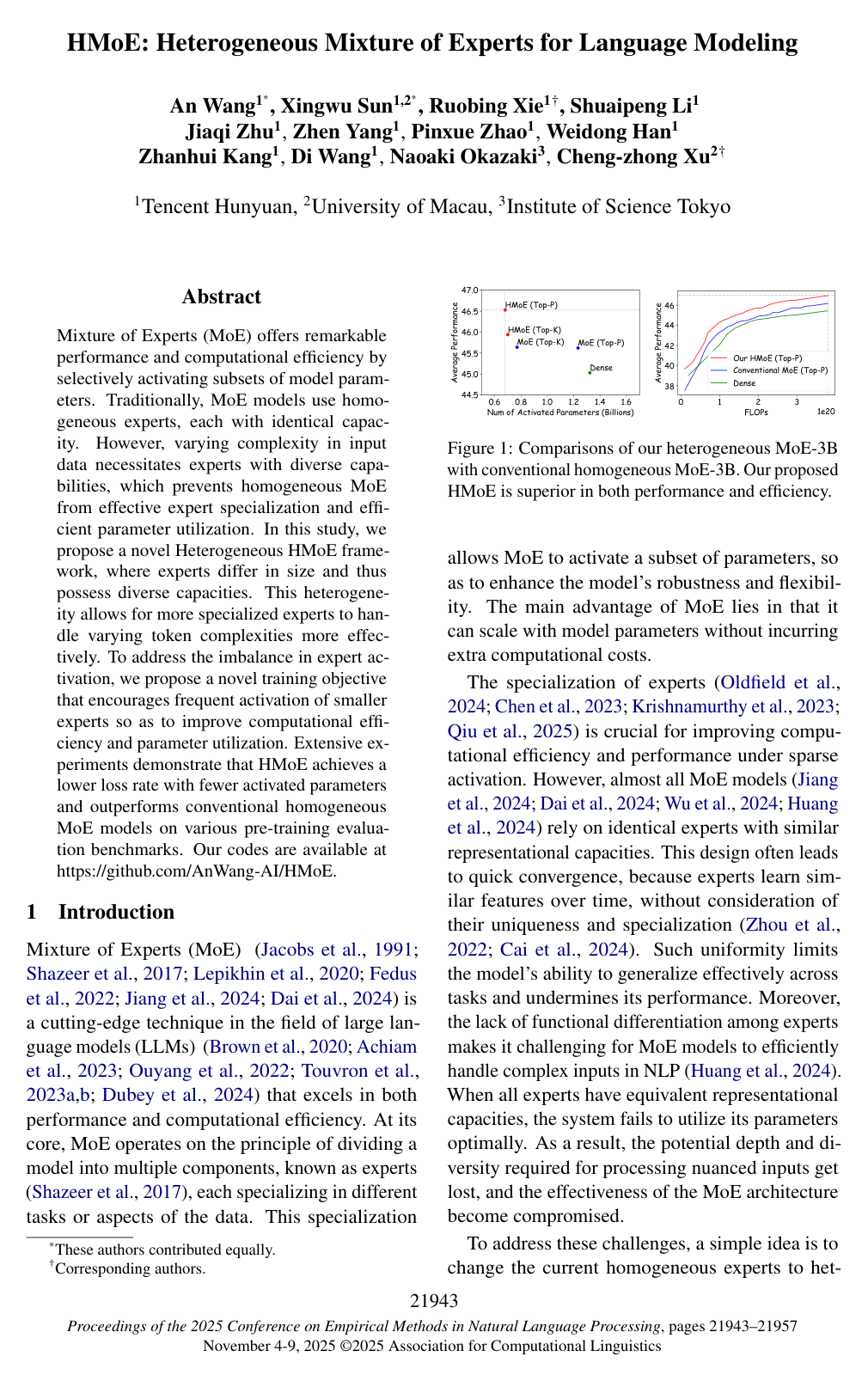
HMoE: Heterogeneous Mixture of Experts for Language Modeling
An Wang, Xingwu Sun, Ruobing Xie, Shuaipeng Li, Jiaqi Zhu, Zhen Yang, Pinxue Zhao, Weidong Han, Zhanhui Kang, Di Wang, Naoaki Okazaki, Cheng-Zhong Xu
Why you should read this
Proposes a heterogeneous Mixture of Experts framework featuring differently sized expert networks paired with a parameter-penalty loss, reducing activated parameter counts while surpassing standard homogeneous architectures across language modeling benchmarks.
Mixture of Experts (MoE) offers remarkable performance and computational efficiency by selectively activating subsets of model parameters. Traditionally, MoE models use homogeneous experts, each with identical capacity. However, varying complexity in input data necessitates experts with diverse capabilities, which prevents homogeneous MoE from effective expert specialization and efficient parameter utilization. In this study, we propose a novel Heterogeneous HMoE framework, where experts differ in size and thus possess diverse capacities. This heterogeneity allows for more specialized experts to handle varying token complexities more effectively. To address the imbalance in expert activation, we propose a novel training objective that encourages frequent activation of smaller experts so as to improve computational efficiency and parameter utilization. Extensive experiments demonstrate that HMoE achieves a lower loss rate with fewer activated parameters and outperforms conventional homogeneous MoE models on various pre-training evaluation benchmarks. Our codes are available at https://github.com/AnWang-AI/HMoE.
Added
2026-10-05
Language Modeling by Language Models
Junyan Cheng Peter Clark Kyle Richardson
Why you should read this
Presents Genesys, an autonomous multi-agent system that uses genetic programming and progressive scaling to discover, implement, and train novel language model architectures that outperform established models like GPT-2 and Mamba-2 on standard benchmarks.
Can we leverage LLMs to model the process of discovering novel language model (LM) architectures? Inspired by real research, we propose a multi-agent LLM approach that simulates the conventional stages of research, from ideation and literature search (proposal stage) to design implementation (code generation), generative pre-training, and downstream evaluation (verification). Using ideas from scaling laws, our system, Genesys, employs a Ladder of Scales approach; new designs are proposed, adversarially reviewed, implemented, and selectively verified at increasingly larger model scales (14M350M parameters) with a narrowing budget (the number of models we can train at each scale). To help make discovery efficient and factorizable, Genesys uses a novel genetic programming backbone, which we show has empirical advantages over commonly used direct prompt generation workflows (e.g., 86\% percentage point improvement in successful design generation, a key bottleneck). We report experiments involving 1,162 newly discovered designs (1,062 fully verified through pre-training) and find the best designs to be highly competitive with known architectures (e.g., outperform GPT2, Mamba2, etc., on 6/9 common benchmarks). We couple these results with comprehensive system-level ablations and formal results, which give broader insights into the design of effective autonomous discovery systems.
Added
2026-10-04
Express Language Modeling
Albert Gong, Annabelle Michael Carrell, Raaz Dwivedi, Lester Mackey
Why you should read this
Develops Express, a method for converting non-causal attention approximations into causal ones with provable theoretical guarantees, delivering faster execution speeds than FlashAttention 2 across key long-context prefill and decoding bottlenecks.
We introduce a new tool, Express, for converting a non-causal attention approximation into a causal approximation with matching approximation guarantees. When combined with the state-of-the-art Thinformer approximation, Express improves upon the best known causal attention guarantees, delivering approximation error with only memory and compression overhead for a sequence of length . We pair these developments with an efficient I/O-aware Triton implementation, demonstrate substantial speedups over FlashAttention 2, and use Express to overcome four resource bottlenecks in the language modeling pipeline: long-context prefill, KV cache compression, long-form memory-constrained decoding, and long-form compute-constrained decoding.
Added
2026-09-30
Hungry Hungry Hippos: Towards Language Modeling with State Space Models
Daniel Y. Fu, Tri Dao, Khaled Kamal Saab, Armin W. Thomas, Atri Rudra, Christopher Ré
Why you should read this
Introduces the H3 state space architecture and FlashConv algorithm, enabling sub-quadratic language models scaled up to 2.7 billion parameters that surpass Transformers on SuperGLUE benchmarks while generating text 2.4 times faster.
State space models (SSMs) have demonstrated state-of-the-art sequence modeling performance in some modalities, but underperform attention in language modeling. Moreover, despite scaling nearly linearly in sequence length instead of quadratically, SSMs are still slower than Transformers due to poor hardware utilization. In this paper, we make progress on understanding the expressivity gap between SSMs and attention in language modeling, and on reducing the hardware barrier between SSMs and attention. First, we use synthetic language modeling tasks to understand the gap between SSMs and attention. We find that existing SSMs struggle with two capabilities: recalling earlier tokens in the sequence and comparing tokens across the sequence. To understand the impact on language modeling, we propose a new SSM layer, H3, that is explicitly designed for these abilities. H3 matches attention on the synthetic languages and comes within 0.4 PPL of Transformers on OpenWebText. Furthermore, a hybrid 125M-parameter H3-attention model that retains two attention layers surprisingly outperforms Transformers on OpenWebText by 1.0 PPL. Next, to improve the efficiency of training SSMs on modern hardware, we propose FlashConv. FlashConv uses a fused block FFT algorithm to improve efficiency on sequences up to 8K, and introduces a novel state passing algorithm that exploits the recurrent properties of SSMs to scale to longer sequences. FlashConv yields 2 speedup on the long-range arena benchmark and allows hybrid language models to generate text 2.4 faster than Transformers. Using FlashConv, we scale hybrid H3-attention language models up to 2.7B parameters on the Pile and find promising initial results, achieving lower perplexity than Transformers and outperforming Transformers in zero- and few-shot learning on a majority of tasks in the SuperGLUE benchmark.
Added
2026-09-26
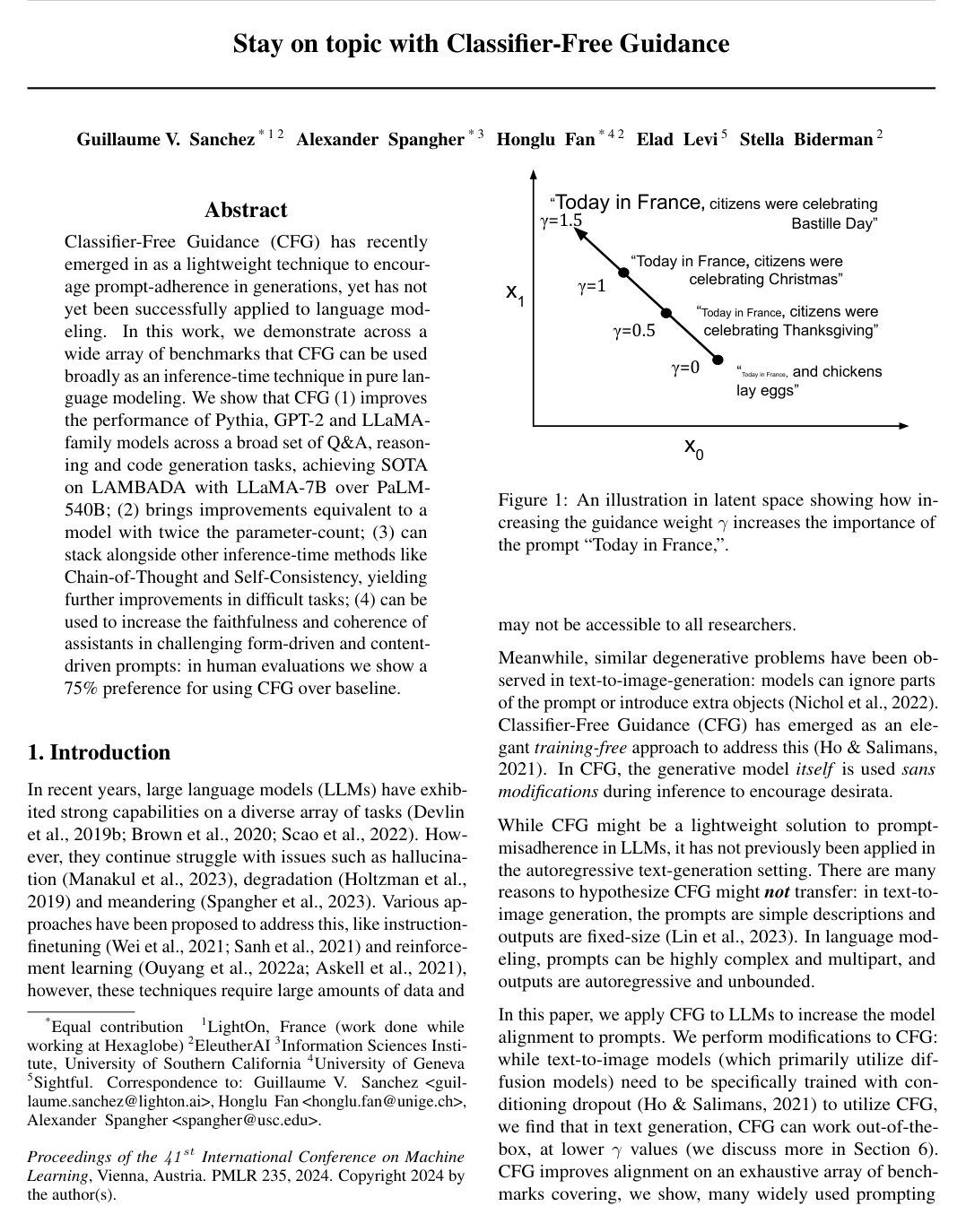
Stay on Topic with Classifier-Free Guidance
Guillaume Sanchez, Alexander Spangher, Honglu Fan, Elad Levi, Stella Biderman
Why you should read this
Demonstrates how classifier-free guidance can be applied directly at inference time to autoregressive language models to substantially improve prompt adherence and benchmark accuracy without retraining.
Classifier-Free Guidance (CFG) has recently emerged as a lightweight technique to encourage prompt-adherence in generations, yet has not yet been successfully applied to language modeling. In this work, we demonstrate across a wide array of benchmarks that CFG can be used broadly as an inference-time technique in pure language modeling. We show that CFG (1) improves the performance of Pythia, GPT-2 and LLaMA-family models across a broad set of Q&A, reasoning and code generation tasks, achieving SOTA on LAMBADA with LLaMA-7B over PaLM-540B; (2) brings improvements equivalent to a model with twice the parameter-count; (3) can stack alongside other inference-time methods like Chain-of-Thought and Self-Consistency, yielding further improvements in difficult tasks; (4) can be used to increase the faithfulness and coherence of assistants in challenging form-driven and content-driven prompts: in human evaluations we show a 75% preference for using CFG over baseline.
Added
2026-09-26
From Language Modeling to Instruction Following: Understanding the Behavior Shift in LLMs after Instruction Tuning
Xuansheng Wu, Wenlin Yao, Jianshu Chen, Xiaoman Pan, Xiaoyang Wang, Ninghao Liu, Dong Yu
Why you should read this
Explains the internal mechanisms of instruction tuning by analyzing how it redirects attention heads toward action verbs and rotates feed-forward representations toward task-oriented concepts to sustain prompt conditioning during generation.
Large Language Models (LLMs) have achieved remarkable success, where instruction tuning is the critical step in aligning LLMs with user intentions. In this work, we investigate how the instruction tuning adjusts pre-trained models with a focus on intrinsic changes. Specifically, we first develop several local and global explanation methods, including a gradient-based method for input-output attribution, and techniques for interpreting patterns and concepts in self-attention and feed-forward layers. The impact of instruction tuning is then studied by comparing the explanations derived from the pre-trained and instruction-tuned models. This approach provides an internal perspective of the model shifts on a human-comprehensible level. Our findings reveal three significant impacts of instruction tuning: 1) It empowers LLMs to recognize the instruction parts of user prompts, and promotes the response generation constantly conditioned on the instructions. 2) It encourages the self-attention heads to capture more word-word relationships about instruction verbs. 3) It encourages the feed-forward networks to rotate their pre-trained knowledge toward user-oriented tasks. These insights contribute to a more comprehensive understanding of instruction tuning and lay the groundwork for future work that aims at explaining and optimizing LLMs for various applications. Our code and data are publicly available at https://github.com/JacksonWuxs/Interpret_Instruction_Tuning_LLMs.
Added
2026-09-26
Unified Speech-Text Pre-training for Speech Translation and Recognition
Yun Tang, Hongyu Gong, Ning Dong, Changhan Wang, Wei-Ning Hsu, Jiatao Gu, Alexei Baevski, Xian Li, Abdelrahman Mohamed, Michael Auli, Juan Miguel Pino
Why you should read this
Proposes a joint speech-text pre-training framework that integrates linguistic knowledge from text into speech models across four multi-task objectives, providing tailored encoder sharing strategies to resolve subtask interference and substantially boosting performance on speech translation and recognition.
We describe a method to jointly pre-train speech and text in an encoder-decoder modeling framework for speech translation and recognition. The proposed method incorporates four self-supervised and supervised subtasks for cross modality learning. A self-supervised speech subtask leverages unlabelled speech data, and a (self-)supervised text to text subtask makes use of abundant text training data. Two auxiliary supervised speech tasks are included to unify speech and text modeling space. Our contribution lies in integrating linguistic information from the text corpus into the speech pre-training. Detailed analysis reveals learning interference among subtasks. Two pre-training configurations for speech translation and recognition, respectively, are presented to alleviate subtask interference. Our experiments show the proposed method can effectively fuse speech and text information into one model. It achieves between 1.7 and 2.3 BLEU improvement above the state of the art on the MUST-C speech translation dataset and comparable WERs to wav2vec 2.0 on the LIBRISPEECH speech recognition task.
Added
2026-09-26
GraphCodeBERT: Pre-training Code Representations with Data Flow
Daya Guo, Shuo Ren, Shuai Lu, Zhangyin Feng, Duyu Tang, Shujie Liu, Long Zhou, Nan Duan, Jian Yin, Daxin Jiang, Ming Zhou
Why you should read this
Introduces GraphCodeBERT, a pre-trained Transformer model that incorporates variable data-flow graphs to capture semantic code structure, achieving state-of-the-art performance across code search, clone detection, and translation without the overhead of deep abstract syntax trees.
Pre-trained models for programming language have achieved dramatic empirical improvements on a variety of code-related tasks such as code search, code completion, code summarization, etc. However, existing pre-trained models regard a code snippet as a sequence of tokens, while ignoring the inherent structure of code, which provides crucial code semantics and would enhance the code understanding process. We present GraphCodeBERT, a pre-trained model for programming language that considers the inherent structure of code. Instead of taking syntactic-level structure of code like abstract syntax tree (AST), we use data flow in the pre-training stage, which is a semantic-level structure of code that encodes the relation of "where-the-value-comes-from" between variables. Such a semantic-level structure is neat and does not bring an unnecessarily deep hierarchy of AST, the property of which makes the model more efficient. We develop GraphCodeBERT based on Transformer. In addition to using the task of masked language modeling, we introduce two structure-aware pre-training tasks. One is to predict code structure edges, and the other is to align representations between source code and code structure. We implement the model in an efficient way with a graph-guided masked attention function to incorporate the code structure. We evaluate our model on four tasks, including code search, clone detection, code translation, and code refinement. Results show that code structure and newly introduced pre-training tasks can improve GraphCodeBERT and achieves state-of-the-art performance on the four downstream tasks. We further show that the model prefers structure-level attentions over token-level attentions in the task of code search.
Added
2026-09-18
OpenNMT: Open-Source Toolkit for Neural Machine Translation
Guillaume Klein, Yoon Kim, Yuntian Deng, Jean Senellart, Alexander M. Rush
Why you should read this
Presents OpenNMT, an efficient and modular open-source framework that allows researchers to easily implement, train, and evaluate novel neural machine translation architectures and multimodal models.
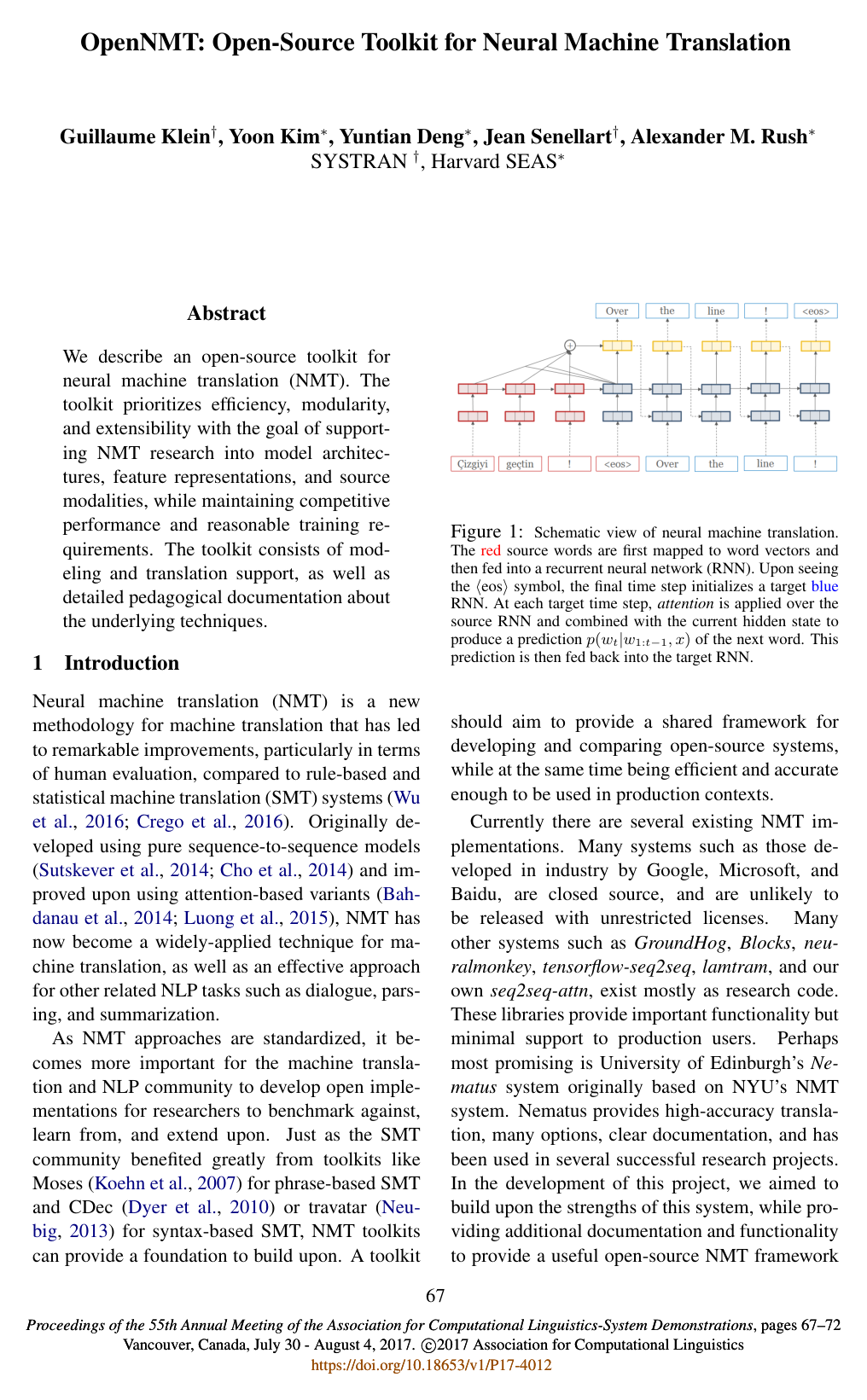
We introduce an open-source toolkit for neural machine translation (NMT) to support research into model architectures, feature representations, and source modalities, while maintaining competitive performance, modularity and reasonable training requirements.
Added
2026-09-18
Hierarchical Neural Story Generation
Angela Fan, Mike Lewis, Yann Dauphin
Why you should read this
Presents a hierarchical story generation framework and a 300,000-example prompt-story dataset that substantially improves narrative coherence by first generating a high-level premise before expanding it into full text using gated multi-scale self-attention.
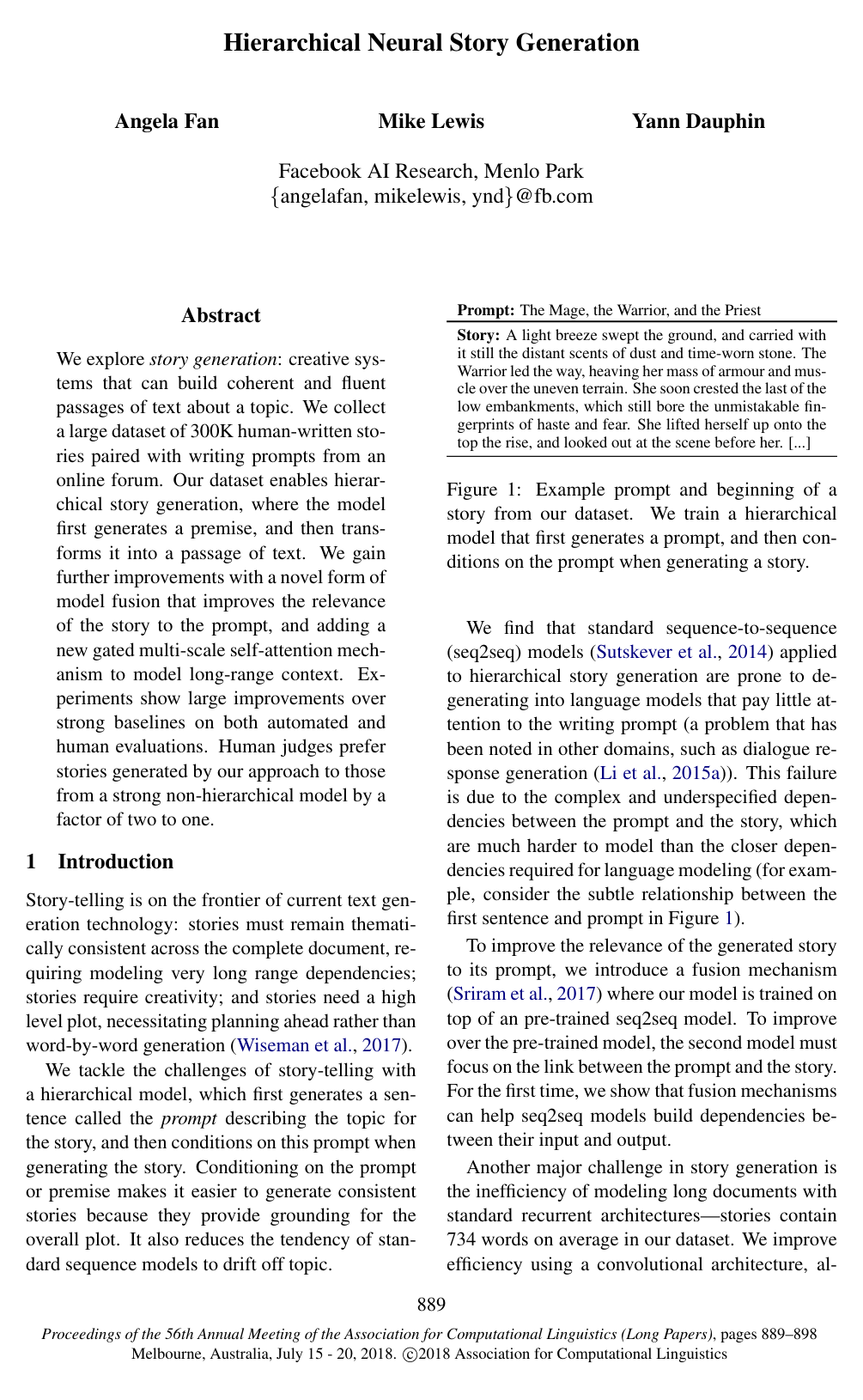
We explore story generation: creative systems that can build coherent and fluent passages of text about a topic. We collect a large dataset of 300K human-written stories paired with writing prompts from an online forum. Our dataset enables hierarchical story generation, where the model first generates a premise, and then transforms it into a passage of text. We gain further improvements with a novel form of model fusion that improves the relevance of the story to the prompt, and adding a new gated multi-scale self-attention mechanism to model long-range context. Experiments show large improvements over strong baselines on both automated and human evaluations. Human judges prefer stories generated by our approach to those from a strong non-hierarchical model by a factor of two to one.
Added
2026-09-16
Fundamentals of Recurrent Neural Network (RNN) and Long Short-Term Memory (LSTM) Network
Alex Sherstinsky
Why you should read this
Establishes a rigorous mathematical foundation for recurrent neural networks and LSTMs by deriving their formulations from differential equations, formally proving the unrolling method, and providing complete training equations alongside a generalized model variant.
Because of their effectiveness in broad practical applications, LSTM networks have received a wealth of coverage in scientific journals, technical blogs, and implementation guides. However, in most articles, the inference formulas for the LSTM network and its parent, RNN, are stated axiomatically, while the training formulas are omitted altogether. In addition, the technique of "unrolling" an RNN is routinely presented without justification throughout the literature. The goal of this paper is to explain the essential RNN and LSTM fundamentals in a single document. Drawing from concepts in signal processing, we formally derive the canonical RNN formulation from differential equations. We then propose and prove a precise statement, which yields the RNN unrolling technique. We also review the difficulties with training the standard RNN and address them by transforming the RNN into the "Vanilla LSTM" network through a series of logical arguments. We provide all equations pertaining to the LSTM system together with detailed descriptions of its constituent entities. Albeit unconventional, our choice of notation and the method for presenting the LSTM system emphasizes ease of understanding. As part of the analysis, we identify new opportunities to enrich the LSTM system and incorporate these extensions into the Vanilla LSTM network, producing the most general LSTM variant to date. The target reader has already been exposed to RNNs and LSTM networks through numerous available resources and is open to an alternative pedagogical approach. A Machine Learning practitioner seeking guidance for implementing our new augmented LSTM model in software for experimentation and research will find the insights and derivations in this tutorial valuable as well.
Added
2026-09-14
A Critical Review of Recurrent Neural Networks for Sequence Learning
Zachary C. Lipton, John Berkowitz, Charles Elkan
Why you should read this
Synthesizes three decades of recurrent neural network research by reconciling conflicting notation and explaining the architectural and optimization advancements that made models like LSTMs effective for sequence learning.
Countless learning tasks require dealing with sequential data. Image captioning, speech synthesis, and music generation all require that a model produce outputs that are sequences. In other domains, such as time series prediction, video analysis, and musical information retrieval, a model must learn from inputs that are sequences. Interactive tasks, such as translating natural language, engaging in dialogue, and controlling a robot, often demand both capabilities. Recurrent neural networks (RNNs) are connectionist models that capture the dynamics of sequences via cycles in the network of nodes. Unlike standard feedforward neural networks, recurrent networks retain a state that can represent information from an arbitrarily long context window. Although recurrent neural networks have traditionally been difficult to train, and often contain millions of parameters, recent advances in network architectures, optimization techniques, and parallel computation have enabled successful large-scale learning with them. In recent years, systems based on long short-term memory (LSTM) and bidirectional (BRNN) architectures have demonstrated ground-breaking performance on tasks as varied as image captioning, language translation, and handwriting recognition. In this survey, we review and synthesize the research that over the past three decades first yielded and then made practical these powerful learning models. When appropriate, we reconcile conflicting notation and nomenclature. Our goal is to provide a self-contained explication of the state of the art together with a historical perspective and references to primary research.
Added
2026-09-14
Dialogue act modeling for automatic tagging and recognition of conversational speech
Andreas Stolcke, Klaus Ries, Noah Coccaro, Elizabeth Shriberg, Rebecca Bates, Daniel Jurafsky, Paul Taylor, Rachel Martin, Carol Van Ess-Dykema, Marie Meteer
Why you should read this
Develops a probabilistic framework combining discourse grammar, acoustic prosody, and word n-grams to automatically classify dialogue acts and improve conversational speech recognition on the Switchboard corpus.
We describe a statistical approach for modeling dialogue acts in conversational speech, i.e., speech-act-like units such as Statement, Question, Backchannel, Agreement, Disagreement, and Apology. Our model detects and predicts dialogue acts based on lexical, collocational, and prosodic cues, as well as on the discourse coherence of the dialogue act sequence. The dialogue model is based on treating the discourse structure of a conversation as a hidden Markov model and the individual dialogue acts as observations emanating from the model states. Constraints on the likely sequence of dialogue acts are modeled via a dialogue act n-gram. The statistical dialogue grammar is combined with word n-grams, decision trees, and neural networks modeling the idiosyncratic lexical and prosodic manifestations of each dialogue act. We develop a probabilistic integration of speech recognition with dialogue modeling, to improve both speech recognition and dialogue act classification accuracy. Models are trained and evaluated using a large hand-labeled database of 1,155 conversations from the Switchboard corpus of spontaneous human-to-human telephone speech. We achieved good dialogue act labeling accuracy (65% based on errorful, automatically recognized words and prosody, and 71% based on word transcripts, compared to a chance baseline accuracy of 35% and human accuracy of 84%) and a small reduction in word recognition error.
Added
2026-09-14
Language Modeling with Gated Convolutional Networks
Yann Dauphin, Angela Fan, Michael Auli, David Grangier
Why you should read this
Introduces a gated convolutional architecture for language modeling that achieves state-of-the-art results on WikiText-103 and reduces evaluation latency by an order of magnitude compared to recurrent baselines through parallelized computation.
The pre-dominant approach to language modeling to date is based on recurrent neural networks. Their success on this task is often linked to their ability to capture unbounded context. In this paper we develop a finite context approach through stacked convolutions, which can be more efficient since they allow parallelization over sequential tokens. We propose a novel simplified gating mechanism that outperforms Oord et al (2016) and investigate the impact of key architectural decisions. The proposed approach achieves state-of-the-art on the WikiText-103 benchmark, even though it features long-term dependencies, as well as competitive results on the Google Billion Words benchmark. Our model reduces the latency to score a sentence by an order of magnitude compared to a recurrent baseline. To our knowledge, this is the first time a non-recurrent approach is competitive with strong recurrent models on these large scale language tasks.
Added
2026-09-13
The Pile: An 800GB Dataset of Diverse Text for Language Modeling
Leo Gao, Stella Biderman, Sid Black, Laurence Golding, Travis Hoppe, Charles Foster, Jason Phang, Horace He, Anish Thite, Noa Nabeshima, Shawn Presser, Connor Leahy
Why you should read this
Introduces an 825 GiB open-source dataset combining 22 specialized text sources to address the limitations of standard web crawls and improve the cross-domain generalization of large language models.
Recent work has demonstrated that increased training dataset diversity improves general cross-domain knowledge and downstream generalization capability for large-scale language models. With this in mind, we present \textit{the Pile}: an 825 GiB English text corpus targeted at training large-scale language models. The Pile is constructed from 22 diverse high-quality subsets -- both existing and newly constructed -- many of which derive from academic or professional sources. Our evaluation of the untuned performance of GPT-2 and GPT-3 on the Pile shows that these models struggle on many of its components, such as academic writing. Conversely, models trained on the Pile improve significantly over both Raw CC and CC-100 on all components of the Pile, while improving performance on downstream evaluations. Through an in-depth exploratory analysis, we document potentially concerning aspects of the data for prospective users. We make publicly available the code used in its construction.
Added
2026-09-13

fairseq: A Fast, Extensible Toolkit for Sequence Modeling
Myle Ott, Sergey Edunov, Alexei Baevski, Angela Fan, Sam Gross, Nathan Ng, David Grangier, Michael Auli
Why you should read this
Presents fairseq, a high-performance PyTorch library that accelerates sequence generation research by enabling scalable multi-GPU distributed training and mixed-precision computation for machine translation, summarization, and language modeling.
fairseq is an open-source sequence modeling toolkit that allows researchers and developers to train custom models for translation, summarization, language modeling, and other text generation tasks. The toolkit is based on PyTorch and supports distributed training across multiple GPUs and machines. We also support fast mixed-precision training and inference on modern GPUs. A demo video can be found at this https URL
Added
2026-09-11
An Empirical Study of Smoothing Techniques for Language Modeling
Stanley F. Chen, Joshua Goodman
Why you should read this
Evaluates prominent n-gram smoothing methods across diverse corpora and training set sizes while introducing novel interpolation techniques that consistently outperform classical baselines.
We present an extensive empirical comparison of several smoothing techniques in the domain of language modeling, including those described by Jelinek and Mercer (1980), Katz (1987), and Church and Gale (1991). We investigate for the first time how factors such as training data size, corpus (e.g., Brown versus Wall Street Journal), and n-gram order (bigram versus trigram) affect the relative performance of these methods, which we measure through the cross-entropy of test data. In addition, we introduce two novel smoothing techniques, one a variation of Jelinek-Mercer smoothing and one a very simple linear interpolation technique, both of which outperform existing methods.
Added
2026-09-11
Energy and Policy Considerations for Deep Learning in NLP
Emma Strubell, Ananya Ganesh, Andrew McCallum
Why you should read this
Quantifies the massive carbon footprint and financial expense of training modern natural language processing models while offering concrete recommendations to prioritize computational efficiency and equitable access in AI research.
Recent progress in hardware and methodology for training neural networks has ushered in a new generation of large networks trained on abundant data. These models have obtained notable gains in accuracy across many NLP tasks. However, these accuracy improvements depend on the availability of exceptionally large computational resources that necessitate similarly substantial energy consumption. As a result these models are costly to train and develop, both financially, due to the cost of hardware and electricity or cloud compute time, and environmentally, due to the carbon footprint required to fuel modern tensor processing hardware. In this paper we bring this issue to the attention of NLP researchers by quantifying the approximate financial and environmental costs of training a variety of recently successful neural network models for NLP. Based on these findings, we propose actionable recommendations to reduce costs and improve equity in NLP research and practice.
Added
2026-09-11
On the difficulty of training recurrent neural networks
Razvan Pascanu, Tomas Mikolov, Yoshua Bengio
Why you should read this
Introduces gradient norm clipping to prevent exploding gradients while providing a dynamical systems analysis that explains why recurrent neural networks struggle to learn long-term temporal dependencies.
There are two widely known issues with properly training Recurrent Neural Networks, the vanishing and the exploding gradient problems detailed in Bengio et al. (1994). In this paper we attempt to improve the understanding of the underlying issues by exploring these problems from an analytical, a geometric and a dynamical systems perspective. Our analysis is used to justify a simple yet effective solution. We propose a gradient norm clipping strategy to deal with exploding gradients and a soft constraint for the vanishing gradients problem. We validate empirically our hypothesis and proposed solutions in the experimental section.
Added
2026-09-09
License
Published with permission
Moses: Open Source Toolkit for Statistical Machine Translation
Philipp Koehn, Hieu Hoang, Alexandra Birch, Chris Callison-Burch, Marcello Federico, Nicola Bertoldi, Brooke Cowan, Wade Shen, Christine Moran, Richard Zens, Chris Dyer, Ondřej Bojar, Alexandra Constantin, Evan Herbst
Why you should read this
Presents a complete open-source statistical machine translation framework featuring factored translation models, confusion network decoding, and memory-efficient data structures for training, tuning, and decoding.
We describe an open-source toolkit for statistical machine translation whose novel contributions are (a) support for linguistically motivated factors, (b) confusion network decoding, and (c) efficient data formats for translation models and language models. In addition to the SMT decoder, the toolkit also includes a wide variety of tools for training, tuning and applying the system to many translation tasks.
Added
2026-09-09