
keyword
kernel dependency estimation
Kernel dependency estimation is a supervised machine learning framework used to model functional relationships and predict complex, structured outputs from input data, encompassing domains such as strings, trees, images, and graphs. The approach utilizes positive definite kernel functions on both the input and output spaces, implicitly mapping arbitrary objects into reproducing kernel Hilbert spaces that preserve their relational and structural geometries. By applying dimensionality reduction, such as kernel principal component analysis, to the output space, the structured learning task is decomposed into a series of independent scalar regression problems. Once regression models estimate the latent feature representation for a novel input, the final structured prediction is obtained by solving a pre-image optimization problem that identifies the candidate object in the output domain whose embedded representation best matches the estimated coordinates.
2 items
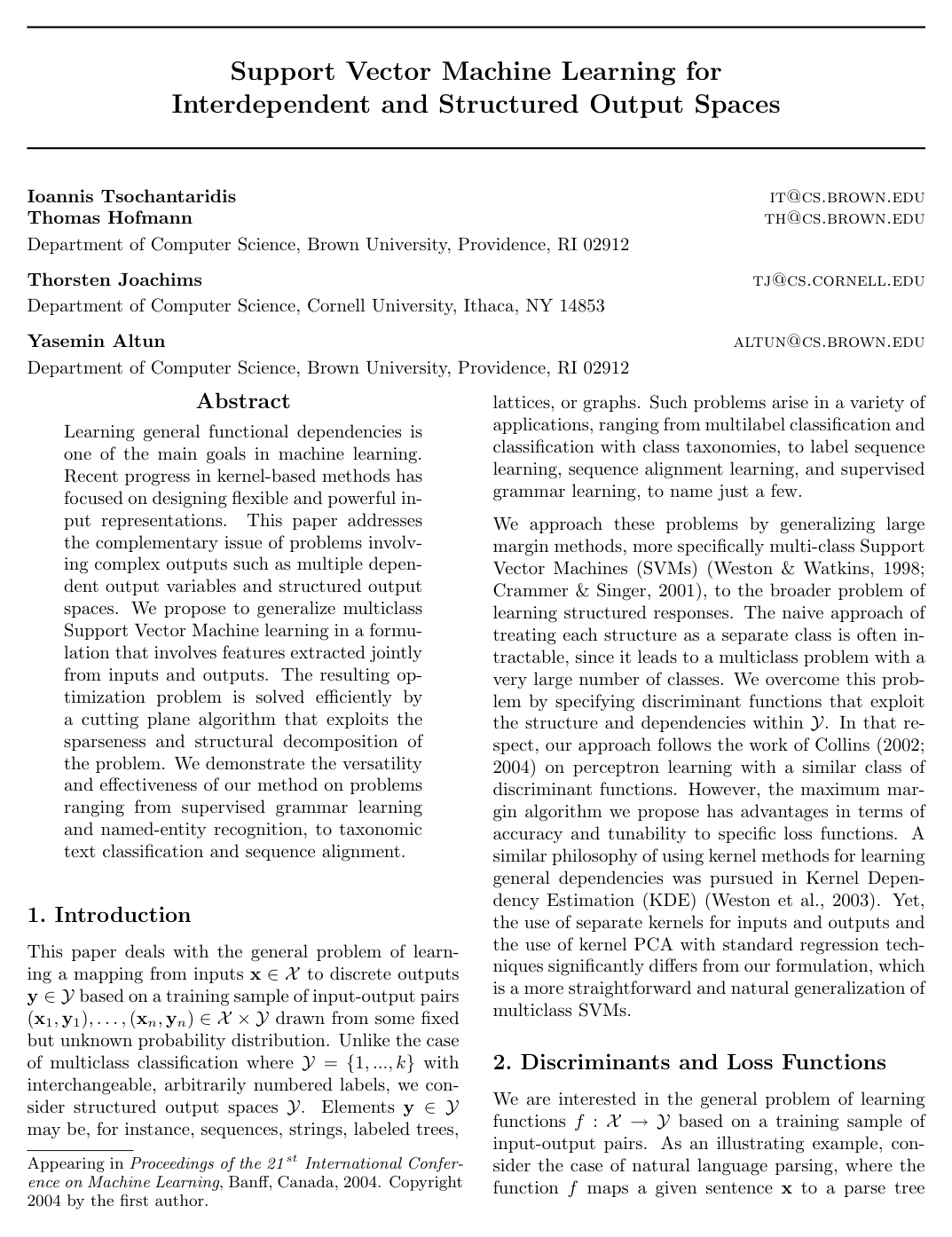
Support vector machine learning for interdependent and structured output spaces
Ioannis Tsochantaridis, Thomas Hofmann, Thorsten Joachims, Yasemin Altun
Why you should read this
Presents a maximum-margin framework that extends Support Vector Machines to complex, structured prediction tasks and solves the resulting exponential-sized optimization problem via an efficient cutting-plane algorithm.
Learning general functional dependencies is one of the main goals in machine learning. Recent progress in kernel-based methods has focused on designing flexible and powerful input representations. This paper addresses the complementary issue of problems involving complex outputs such as multiple dependent output variables and structured output spaces. We propose to generalize multiclass Support Vector Machine learning in a formulation that involves features extracted jointly from inputs and outputs. The resulting optimization problem is solved efficiently by a cutting plane algorithm that exploits the sparseness and structural decomposition of the problem. We demonstrate the versatility and effectiveness of our method on problems ranging from supervised grammar learning and named-entity recognition, to taxonomic text classification and sequence alignment.
Added
2026-09-25
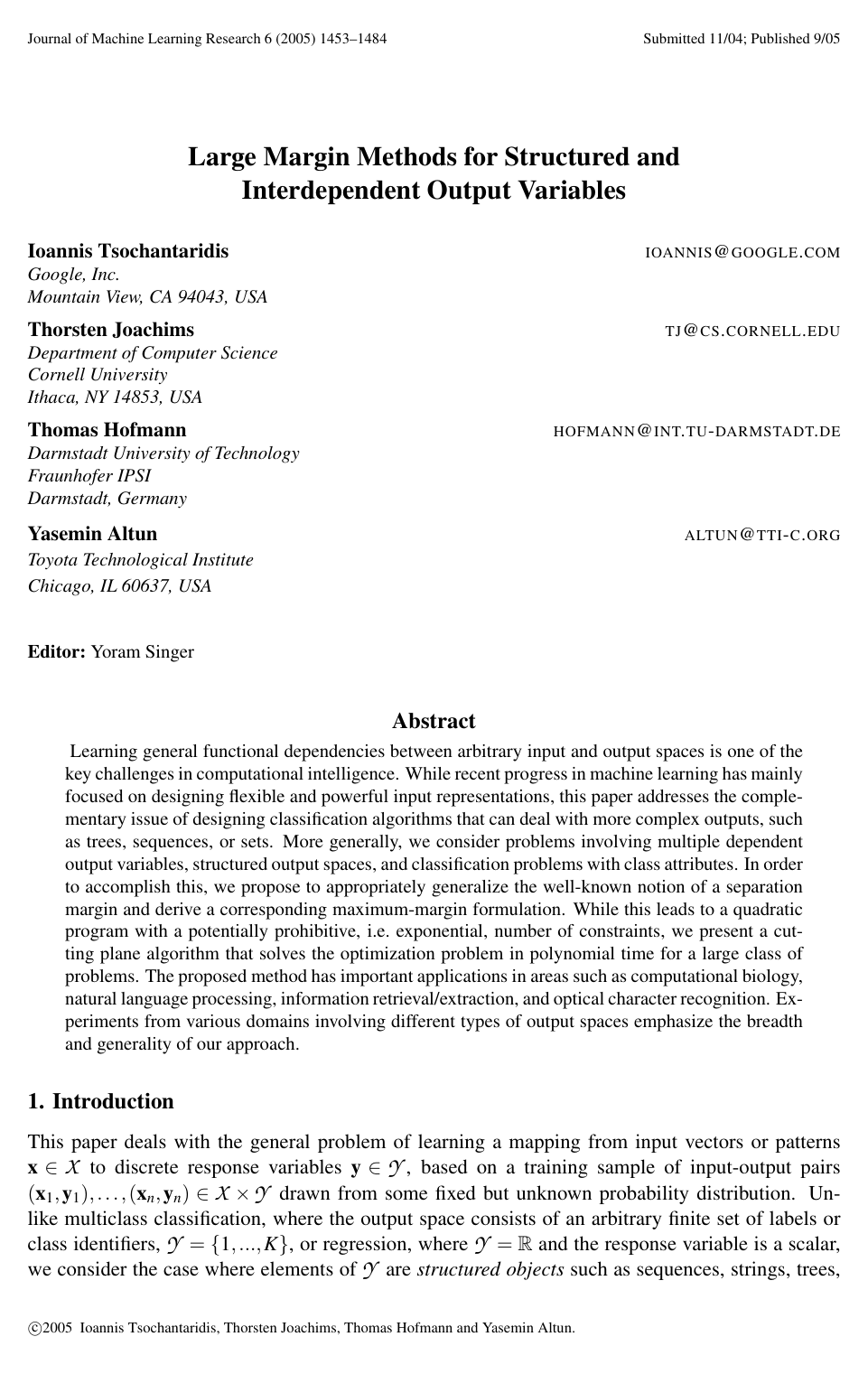
Large Margin Methods for Structured and Interdependent Output Variables
Ioannis Tsochantaridis, Thorsten Joachims, Thomas Hofmann, Yasemin Altun
Why you should read this
Develops a generalized maximum-margin learning framework and an efficient cutting-plane algorithm that enables support vector machines to predict complex, interdependent outputs such as trees, sequences, and graphs in polynomial time.
Learning general functional dependencies between arbitrary input and output spaces is one of the key challenges in computational intelligence. While recent progress in machine learning has mainly focused on designing flexible and powerful input representations, this paper addresses the complementary issue of designing classification algorithms that can deal with more complex outputs, such as trees, sequences, or sets. More generally, we consider problems involving multiple dependent output variables, structured output spaces, and classification problems with class attributes. In order to accomplish this, we propose to appropriately generalize the well-known notion of a separation margin and derive a corresponding maximum-margin formulation. While this leads to a quadratic program with a potentially prohibitive, i.e. exponential, number of constraints, we present a cutting plane algorithm that solves the optimization problem in polynomial time for a large class of problems. The proposed method has important applications in areas such as computational biology, natural language processing, information retrieval/extraction, and optical character recognition. Experiments from various domains involving different types of output spaces emphasize the breadth and generality of our approach.
Added
2026-09-15
