
Built independently by an author, for readers. Read the story and support ChapterPal

keyword

interventionist reasoning

Interventionist reasoning is a method of causal understanding and explanation that defines relationships between causes and effects through the lens of actual or hypothetical manipulations. Under this approach, an event or variable is considered a genuine cause of an outcome if a targeted, external change to the former reliably produces a change in the latter while holding other confounding factors fixed. Rather than relying merely on passive observational correlations or exhaustive descriptions of physical mechanisms, this mode of reasoning focuses on counterfactual scenarios concerning how an effect would change under specific alterations to its candidate causes. By isolating how systems respond to deliberate control, interventionist reasoning allows individuals and computational models to identify key explanatory variables, predict the outcomes of actions, and distinguish causal influence from spurious association.

1 item
Explanation in Artificial Intelligence: Insights from the Social Sciences

Explanation in Artificial Intelligence: Insights from the Social Sciences

Tim Miller

OrganizationsUniversity of Melbourne

Why you should read this

Synthesizes decades of findings from philosophy, cognitive science, and social psychology to define how explainable artificial intelligence should align with human cognitive biases and social expectations rather than developer intuition.

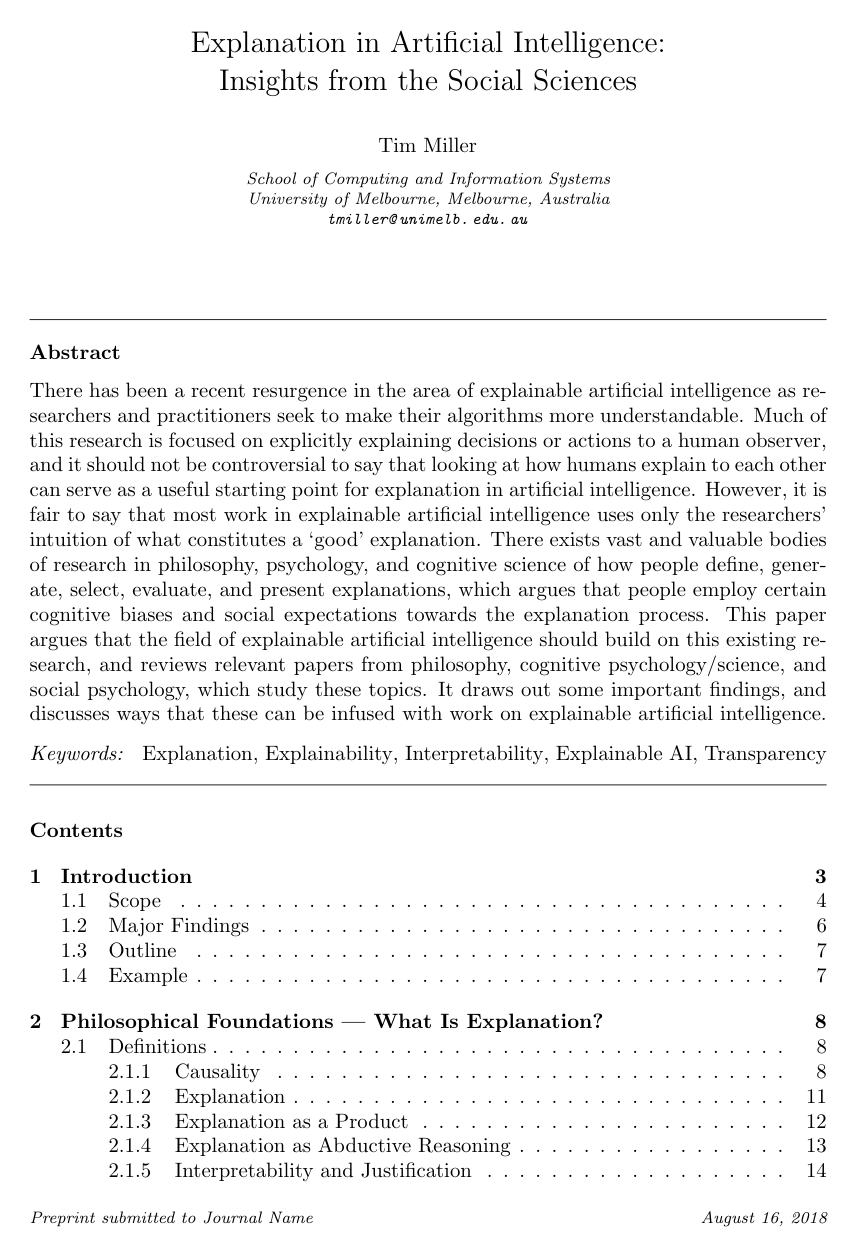
There has been a recent resurgence in the area of explainable artificial intelligence as researchers and practitioners seek to make their algorithms more understandable. Much of this research is focused on explicitly explaining decisions or actions to a human observer, and it should not be controversial to say that looking at how humans explain to each other can serve as a useful starting point for explanation in artificial intelligence. However, it is fair to say that most work in explainable artificial intelligence uses only the researchers' intuition of what constitutes a `good' explanation. There exists vast and valuable bodies of research in philosophy, psychology, and cognitive science of how people define, generate, select, evaluate, and present explanations, which argues that people employ certain cognitive biases and social expectations towards the explanation process. This paper argues that the field of explainable artificial intelligence should build on this existing research, and reviews relevant papers from philosophy, cognitive psychology/science, and social psychology, which study these topics. It draws out some important findings, and discusses ways that these can be infused with work on explainable artificial intelligence.

Added

2026-09-12