
keyword
internal representations
Internal representations refer to the intermediate patterns of activation, hidden states, or numerical vectors that a neural network computes within its hidden layers as it processes input data. Instead of relying solely on raw inputs or final outputs, a deep learning model transforms data across successive layers into high-dimensional mathematical abstractions that capture semantic concepts, structural patterns, and task-relevant features. These representations emerge automatically during training as the network optimizes its parameters to balance data compression with predictive utility. By encoding the underlying knowledge and latent properties extracted from training data, internal representations serve as the computational basis for a model decisions and provide a primary subject of study for analyzing, probing, and interpreting the inner mechanisms of artificial intelligence systems.
8 items
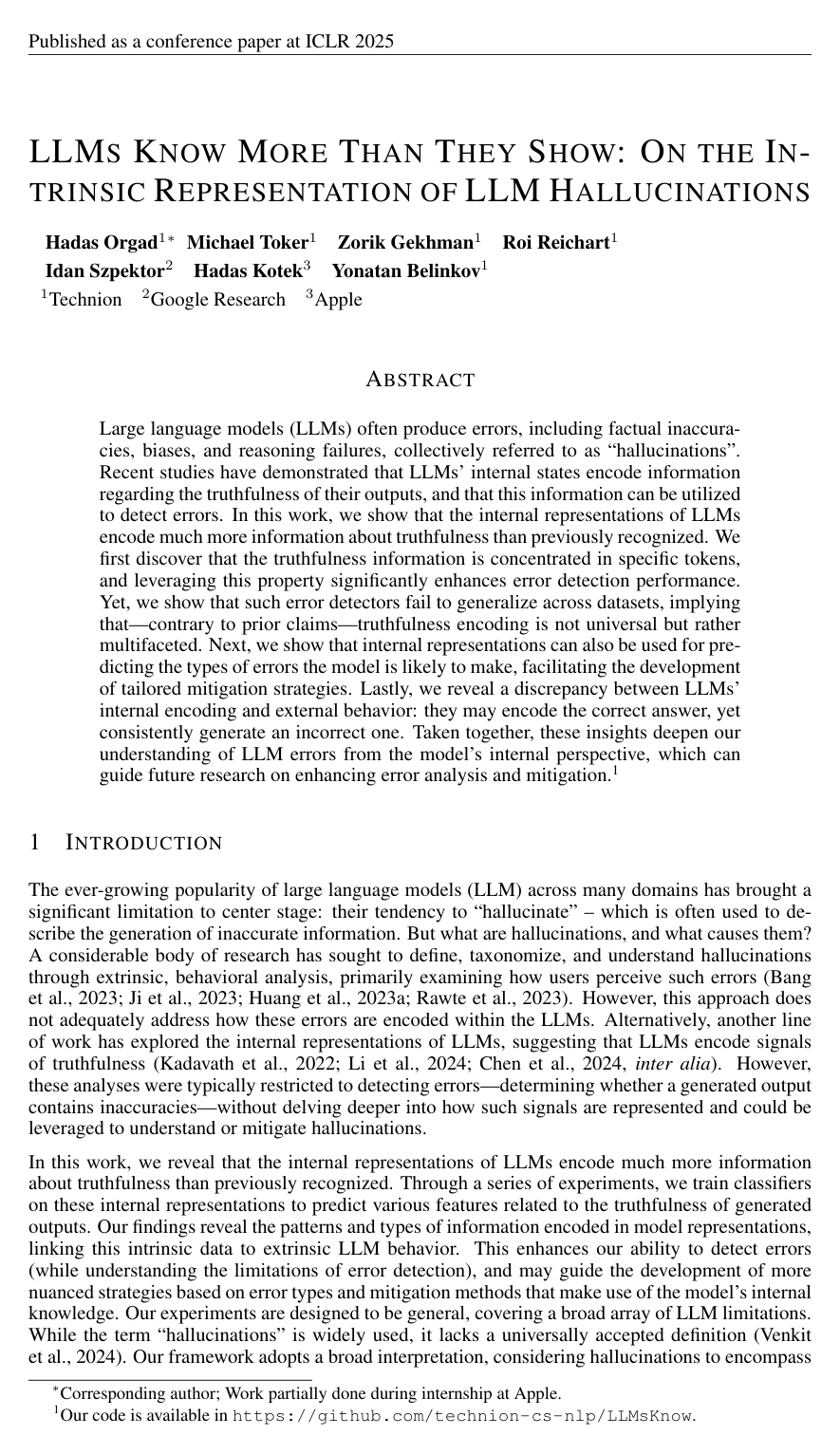
LLMs Know More Than They Show: On the Intrinsic Representation of LLM Hallucinations
Hadas Orgad, Michael Toker, Zorik Gekhman, Roi Reichart, Idan Szpektor, Hadas Kotek, Yonatan Belinkov
Why you should read this
Demonstrates that large language models often internally represent the correct answer while generating hallucinations, and identifies token-level truthfulness signals that predict specific error types despite failing to transfer across datasets.
Large language models (LLMs) often produce errors, including factual inaccuracies, biases, and reasoning failures, collectively referred to as "hallucinations". Recent studies have demonstrated that LLMs' internal states encode information regarding the truthfulness of their outputs, and that this information can be utilized to detect errors. In this work, we show that the internal representations of LLMs encode much more information about truthfulness than previously recognized. We first discover that the truthfulness information is concentrated in specific tokens, and leveraging this property significantly enhances error detection performance. Yet, we show that such error detectors fail to generalize across datasets, implying that -- contrary to prior claims -- truthfulness encoding is not universal but rather multifaceted. Next, we show that internal representations can also be used for predicting the types of errors the model is likely to make, facilitating the development of tailored mitigation strategies. Lastly, we reveal a discrepancy between LLMs' internal encoding and external behavior: they may encode the correct answer, yet consistently generate an incorrect one. Taken together, these insights deepen our understanding of LLM errors from the model's internal perspective, which can guide future research on enhancing error analysis and mitigation.
Added
2026-10-05
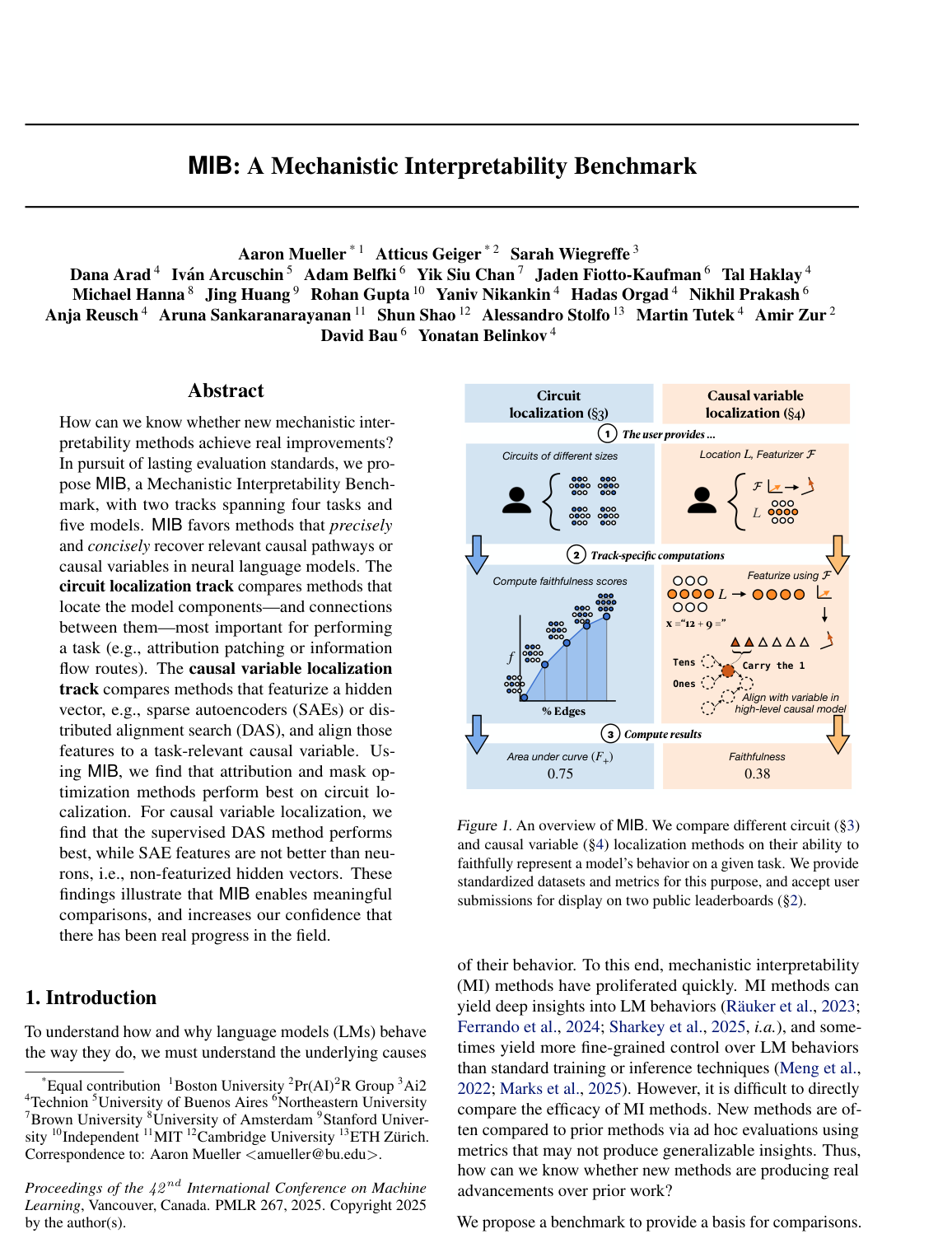
MIB: A Mechanistic Interpretability Benchmark
Aaron Mueller, Atticus Geiger, Sarah Wiegreffe, Dana Arad, Iván Arcuschin, Adam Belfki, Yik Siu Chan, Jaden Fiotto-Kaufman, Tal Haklay, Michael Hanna, Jing Huang, Rohan Gupta, Yaniv Nikankin, Hadas Orgad, Nikhil Prakash, Anja Reusch, Aruna Sankaranarayanan, Shun Shao, Alessandro Stolfo, Martin Tutek, Amir Zur, David Bau, Yonatan Belinkov
Why you should read this
Establishes a standardized benchmark to rigorously evaluate mechanistic interpretability methods across circuit and causal variable localization, revealing critical performance differences among popular techniques like sparse autoencoders and attribution patching.
How can we know whether new mechanistic interpretability methods achieve real improvements? In pursuit of lasting evaluation standards, we propose MIB, a Mechanistic Interpretability Benchmark, with two tracks spanning four tasks and five models. MIB favors methods that precisely and concisely recover relevant causal pathways or causal variables in neural language models. The circuit localization track compares methods that locate the model components - and connections between them - most important for performing a task (e.g., attribution patching or information flow routes). The causal variable localization track compares methods that featurize a hidden vector, e.g., sparse autoencoders (SAEs) or distributed alignment search (DAS), and align those features to a task-relevant causal variable. Using MIB, we find that attribution and mask optimization methods perform best on circuit localization. For causal variable localization, we find that the supervised DAS method performs best, while SAE features are not better than neurons, i.e., non-featurized hidden vectors. These findings illustrate that MIB enables meaningful comparisons, and increases our confidence that there has been real progress in the field.
Added
2026-10-04
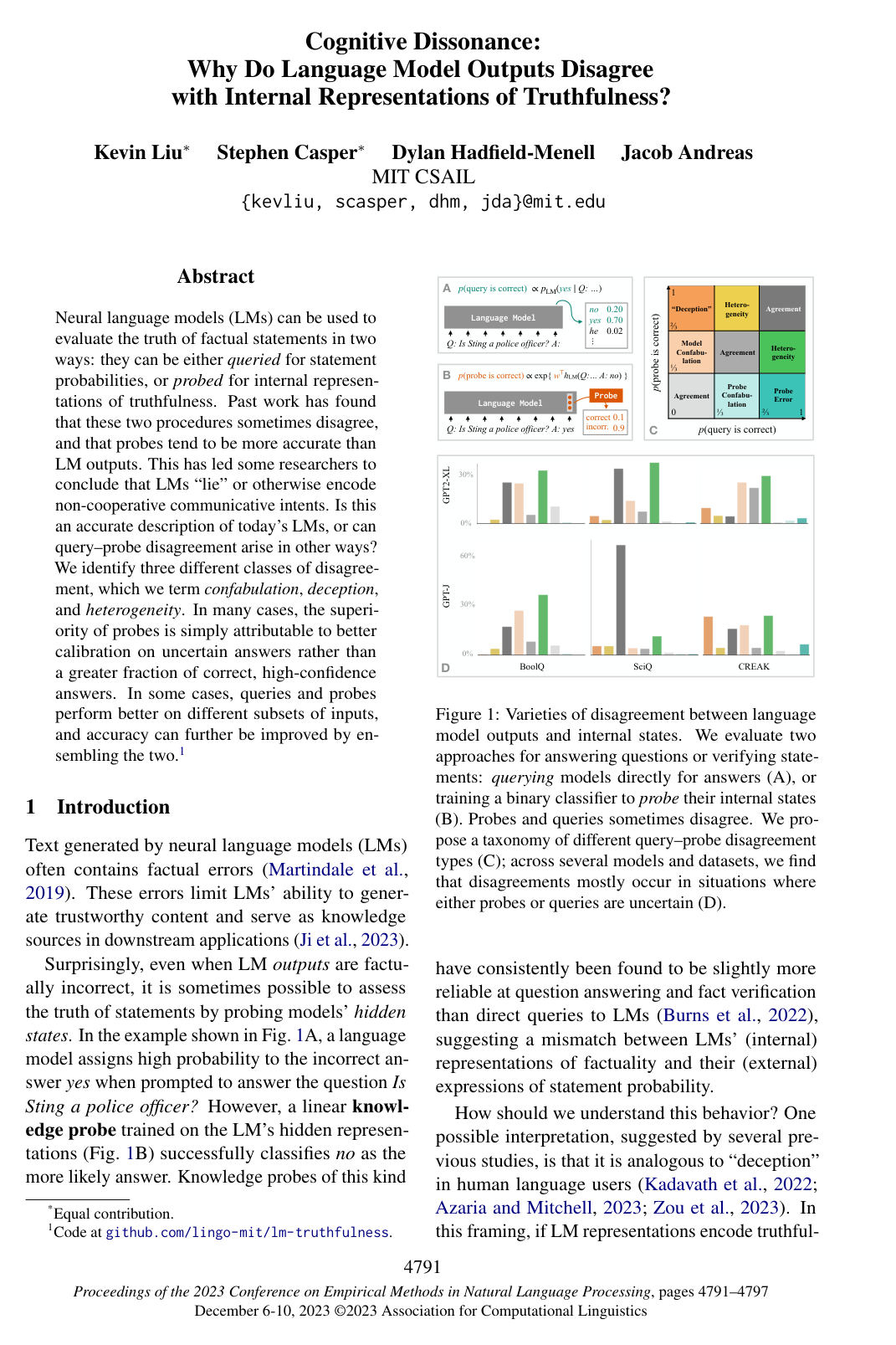
Cognitive Dissonance: Why Do Language Model Outputs Disagree with Internal Representations of Truthfulness?
Kevin Liu, Stephen Casper, Dylan Hadfield-Menell, Jacob Andreas
Why you should read this
Explains why internal probes often outperform direct language model outputs by categorizing query–probe disagreements into confabulation, deception, and heterogeneity, showing that superior probe accuracy stems primarily from better uncertainty calibration rather than intentional deception.
Neural language models (LMs) can be used to evaluate the truth of factual statements in two ways: they can be either queried for statement probabilities, or probed for internal representations of truthfulness. Past work has found that these two procedures sometimes disagree, and that probes tend to be more accurate than LM outputs. This has led some researchers to conclude that LMs “lie” or otherwise encode non-cooperative communicative intents. Is this an accurate description of today’s LMs, or can query–probe disagreement arise in other ways? We identify three different classes of disagreement, which we term confabulation, deception, and heterogeneity. In many cases, the superiority of probes is simply attributable to better calibration on uncertain answers rather than a greater fraction of correct, high-confidence answers. In some cases, queries and probes perform better on different subsets of inputs, and accuracy can further be improved by ensembling the two.¹
Added
2026-10-03
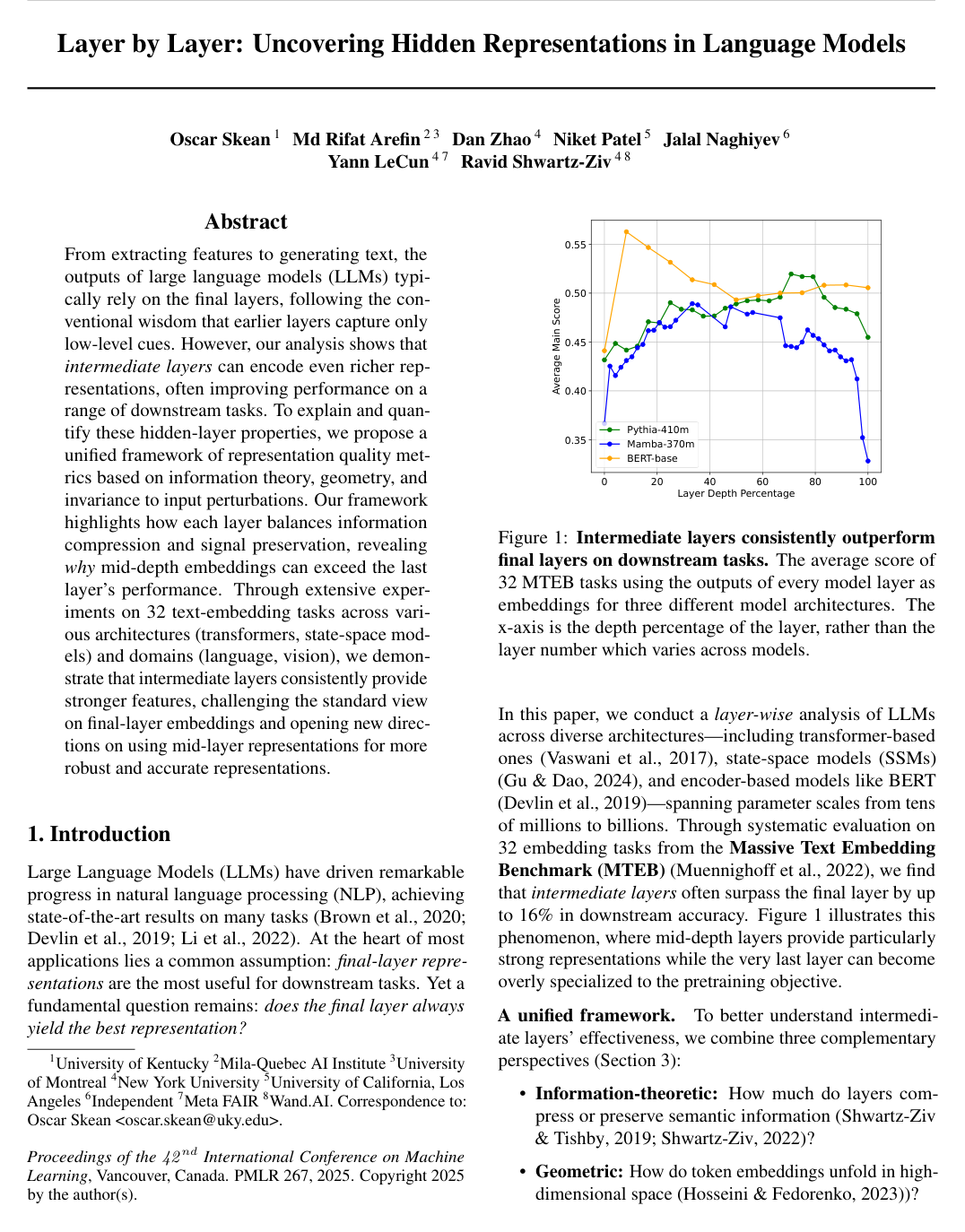
Layer by Layer: Uncovering Hidden Representations in Language Models
Oscar Skean, Md Rifat Arefin, Dan Zhao, Niket Patel, Jalal Naghiyev, Yann LeCun, Ravid Shwartz-Ziv
Why you should read this
Demonstrates that intermediate layers in language models consistently produce richer representations than the final layer, introducing a geometric and information-theoretic framework that explains why mid-depth embeddings achieve superior performance across diverse downstream tasks.
From extracting features to generating text, the outputs of large language models (LLMs) typically rely on the final layers, following the conventional wisdom that earlier layers capture only low-level cues. However, our analysis shows that intermediate layers can encode even richer representations, often improving performance on a range of downstream tasks. To explain and quantify these hidden-layer properties, we propose a unified framework of representation quality metrics based on information theory, geometry, and invariance to input perturbations. Our framework highlights how each layer balances information compression and signal preservation, revealing why mid-depth embeddings can exceed the last layer's performance. Through extensive experiments on 32 text-embedding tasks across various architectures (transformers, state-space models) and domains (language, vision), we demonstrate that intermediate layers consistently provide stronger features, challenging the standard view on final-layer embeddings and opening new directions on using mid-layer representations for more robust and accurate representations.
Added
2026-09-28
A Model of Inductive Bias Learning
Jonathan Baxter
Why you should read this
Establishes a foundational theoretical framework for automatically learning inductive biases across related tasks, proving explicit generalization bounds that demonstrate how multi-task experience drastically reduces the sample complexity required to learn novel problems.
A major problem in machine learning is that of inductive bias: how to choose a learner's hypothesis space so that it is large enough to contain a solution to the problem being learnt, yet small enough to ensure reliable generalization from reasonably-sized training sets. Typically such bias is supplied by hand through the skill and insights of experts. In this paper a model for automatically learning bias is investigated. The central assumption of the model is that the learner is embedded within an environment of related learning tasks. Within such an environment the learner can sample from multiple tasks, and hence it can search for a hypothesis space that contains good solutions to many of the problems in the environment. Under certain restrictions on the set of all hypothesis spaces available to the learner, we show that a hypothesis space that performs well on a sufficiently large number of training tasks will also perform well when learning novel tasks in the same environment. Explicit bounds are also derived demonstrating that learning multiple tasks within an environment of related tasks can potentially give much better generalization than learning a single task.
Added
2026-09-25
Representation Engineering: A Top-Down Approach to AI Transparency
Andy Zou, Long Phan, Sarah Chen, James Campbell, Phillip Guo, Richard Ren, Alexander Pan, Xuwang Yin, Mantas Mazeika, Ann-Kathrin Dombrowski, Shashwat Goel, Nathaniel Li, Michael J. Byun, Zifan Wang, Alex Troy Mallen, Steven Basart, Sanmi Koyejo, Dawn Song, Matt Fredrikson, Zico Kolter, Dan Hendrycks
Why you should read this
Introduces representation engineering, a top-down transparency approach inspired by cognitive neuroscience that tracks and directly controls high-level concepts like honesty, safety, and power-seeking in large language models.
In this paper, we identify and characterize the emerging area of representation engineering (RepE), an approach to enhancing the transparency of AI systems that draws on insights from cognitive neuroscience. RepE places population-level representations, rather than neurons or circuits, at the center of analysis, equipping us with novel methods for monitoring and manipulating high-level cognitive phenomena in deep neural networks (DNNs). We provide baselines and an initial analysis of RepE techniques, showing that they offer simple yet effective solutions for improving our understanding and control of large language models. We showcase how these methods can provide traction on a wide range of safety-relevant problems, including honesty, harmlessness, power-seeking, and more, demonstrating the promise of top-down transparency research. We hope that this work catalyzes further exploration of RepE and fosters advancements in the transparency and safety of AI systems.
Added
2026-09-25
Opening the Black Box of Deep Neural Networks via Information
Ravid Shwartz-Ziv, Naftali Tishby
Why you should read this
Demonstrates through the Information Bottleneck principle that deep neural network training consists of distinct label-fitting and representation-compression phases, explaining theoretically why hidden layers accelerate generalization.
Despite their great success, there is still no comprehensive theoretical understanding of learning with Deep Neural Networks (DNNs) or their inner organization. Previous work proposed to analyze DNNs in the \textit{Information Plane}; i.e., the plane of the Mutual Information values that each layer preserves on the input and output variables. They suggested that the goal of the network is to optimize the Information Bottleneck (IB) tradeoff between compression and prediction, successively, for each layer. In this work we follow up on this idea and demonstrate the effectiveness of the Information-Plane visualization of DNNs. Our main results are: (i) most of the training epochs in standard DL are spent on {\emph compression} of the input to efficient representation and not on fitting the training labels. (ii) The representation compression phase begins when the training errors becomes small and the Stochastic Gradient Decent (SGD) epochs change from a fast drift to smaller training error into a stochastic relaxation, or random diffusion, constrained by the training error value. (iii) The converged layers lie on or very close to the Information Bottleneck (IB) theoretical bound, and the maps from the input to any hidden layer and from this hidden layer to the output satisfy the IB self-consistent equations. This generalization through noise mechanism is unique to Deep Neural Networks and absent in one layer networks. (iv) The training time is dramatically reduced when adding more hidden layers. Thus the main advantage of the hidden layers is computational. This can be explained by the reduced relaxation time, as this it scales super-linearly (exponentially for simple diffusion) with the information compression from the previous layer.
Added
2026-09-24
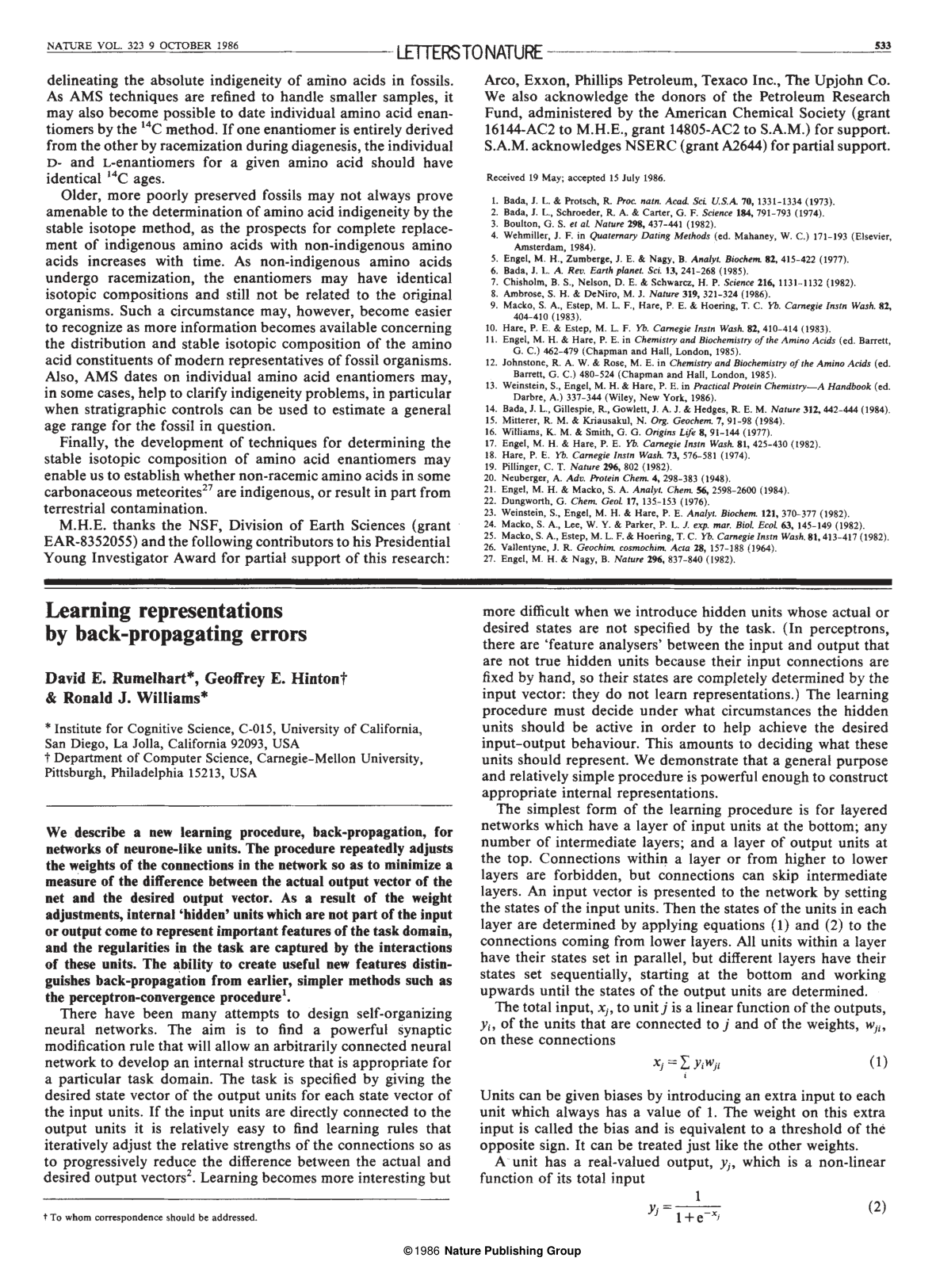
Learning representations by back-propagating errors
David E. Rumelhart, Geoffrey E. Hinton, Ronald J. Williams
Why you should read this
Demonstrates how the backpropagation algorithm enables multi-layer neural networks to learn complex internal representations via gradient descent.
Back-propagation (BP) is widely used learning algorithm for neural network optimization. However, BP requires enormous computation cost and is too slow to train in central processing unit (CPU). Therefore current neural network optimizaiton is performed in graphical processing unit (GPU) with compute unified device architecture (CUDA) programming. In this paper, we propose a light, fast learning algorithm on CPU that is fast as CUDA acceleration on GPU. This algorithm is based on forward-propagating method, using concept of dual number in algebraic geometry.
Added
2026-05-14