
keyword
instruction generation
Instruction generation is the creation of natural-language directions or task requests that tell a person or AI system what to do. In AI, it can mean producing new instructions—sometimes with corresponding examples or responses—for training, evaluating, or guiding models, or generating grounded directions for a task such as navigating a route.
7 items
Large Language Models as Optimizers
Chengrun Yang, Xuezhi Wang, Yifeng Lu, Hanxiao Liu, Quoc V. Le, Denny Zhou, Xinyun Chen
Why you should read this
Introduces Optimization by PROmpting (OPRO), a technique that uses large language models as gradient-free optimizers to iteratively generate solutions, discovering prompts that outperform human-engineered instructions by up to 50% on Big-Bench Hard.
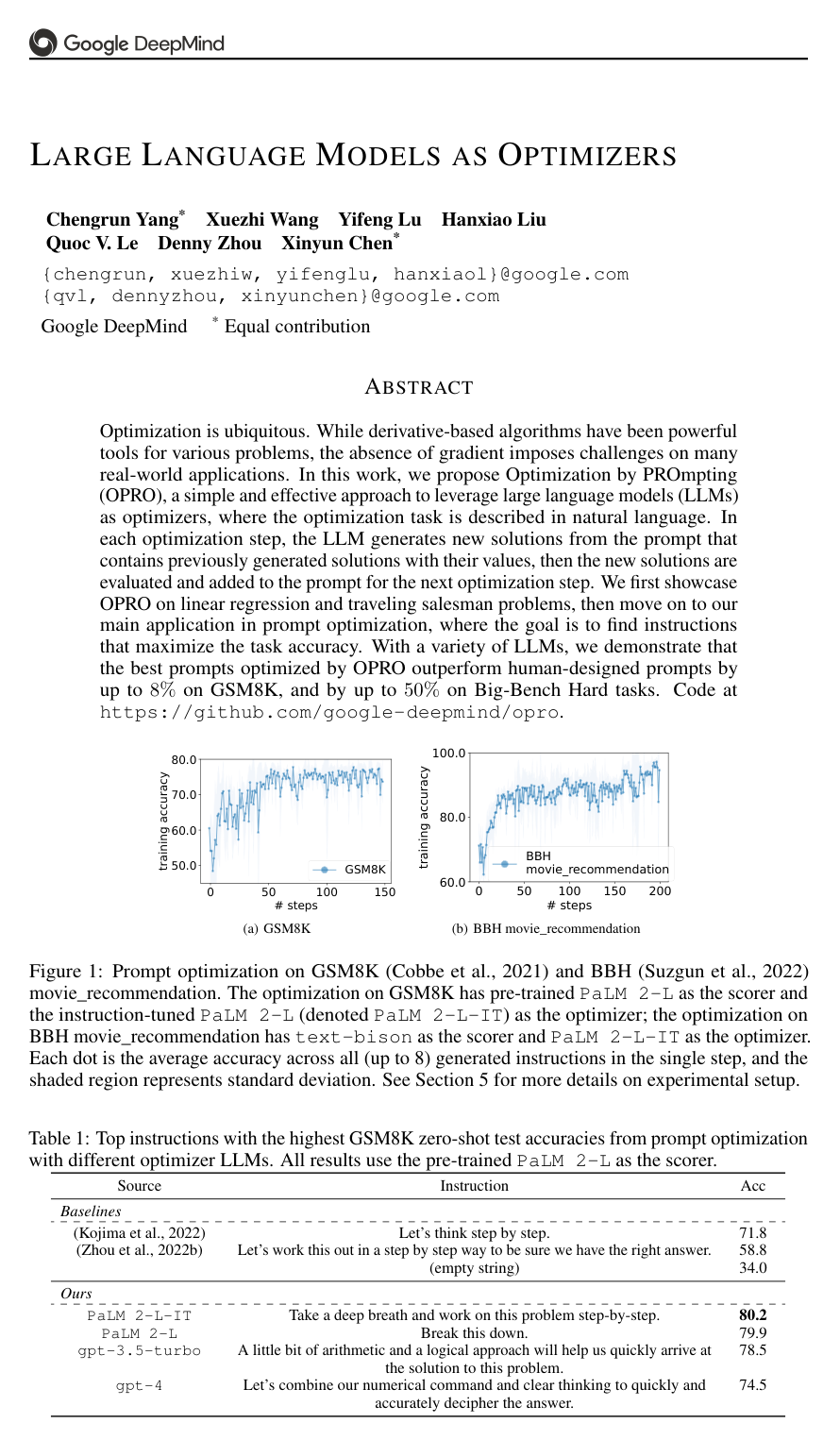
Optimization is ubiquitous. While derivative-based algorithms have been powerful tools for various problems, the absence of gradient imposes challenges on many real-world applications. In this work, we propose Optimization by PROmpting (OPRO), a simple and effective approach to leverage large language models (LLMs) as optimizers, where the optimization task is described in natural language. In each optimization step, the LLM generates new solutions from the prompt that contains previously generated solutions with their values, then the new solutions are evaluated and added to the prompt for the next optimization step. We first showcase OPRO on linear regression and traveling salesman problems, then move on to our main application in prompt optimization, where the goal is to find instructions that maximize the task accuracy. With a variety of LLMs, we demonstrate that the best prompts optimized by OPRO outperform human-designed prompts by up to 8% on GSM8K, and by up to 50% on Big-Bench Hard tasks. Code at this https URL.
Added
2026-10-04
Instruct and Extract: Instruction Tuning for On-Demand Information Extraction
Yizhu Jiao, Ming Zhong, Sha Li, Ruining Zhao, Siru Ouyang, Heng Ji, Jiawei Han
Why you should read this
Proposes an instruction-tuned extraction framework and benchmark, INSTRUCTIE, that enables language models to convert unstructured text into custom tabular formats based on either explicit user specifications or inferred contextual headers.
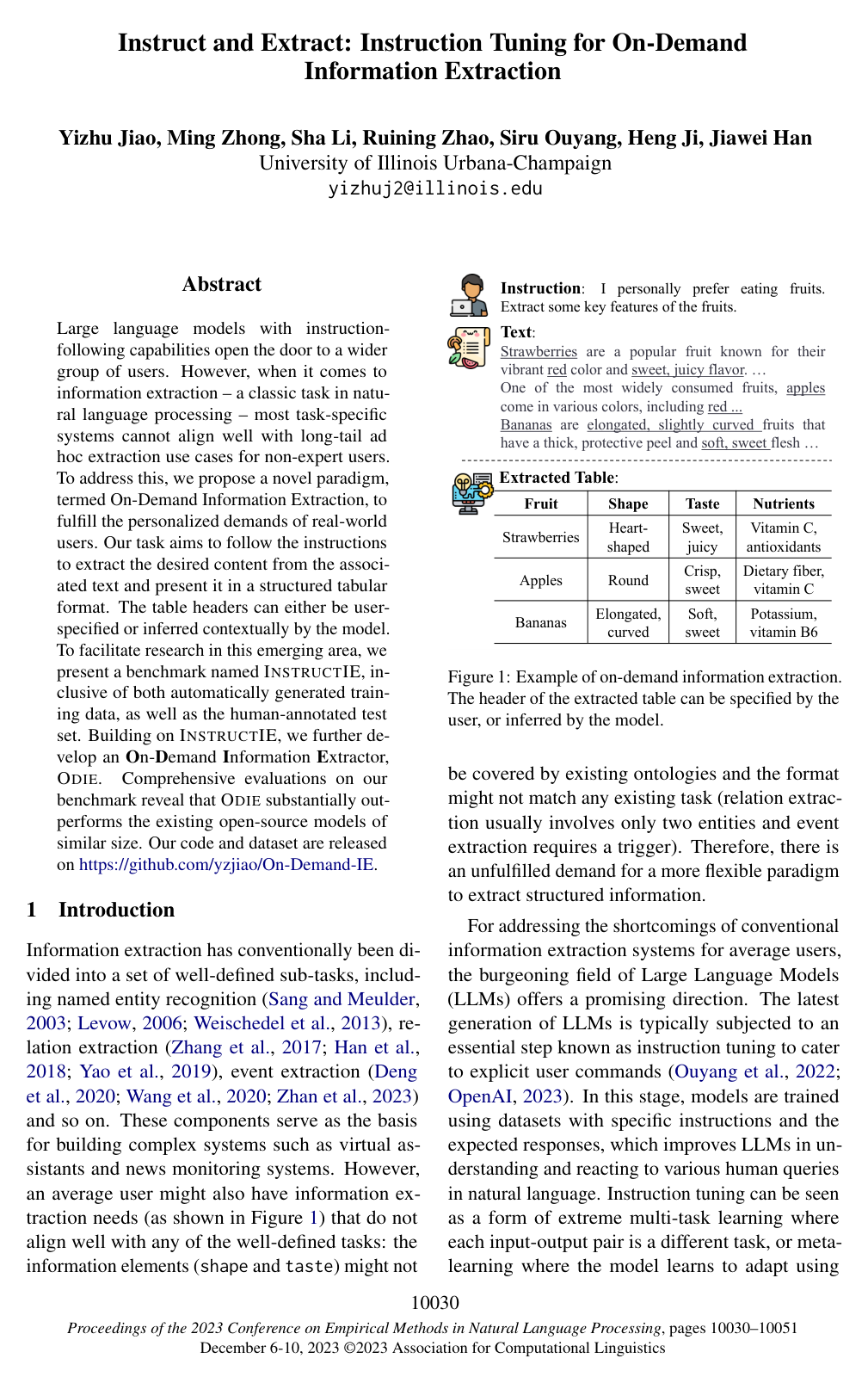
Large language models with instruction-following capabilities open the door to a wider group of users. However, when it comes to information extraction – a classic task in natural language processing – most task-specific systems cannot align well with long-tail ad hoc extraction use cases for non-expert users. To address this, we propose a novel paradigm, termed On-Demand Information Extraction, to fulfill the personalized demands of real-world users. Our task aims to follow the instructions to extract the desired content from the associated text and present it in a structured tabular format. The table headers can either be user-specified or inferred contextually by the model. To facilitate research in this emerging area, we present a benchmark named INSTRUCTIE, inclusive of both automatically generated training data, as well as the human-annotated test set. Building on INSTRUCTIE, we further develop an On-Demand Information Extractor, ODIE. Comprehensive evaluations on our benchmark reveal that ODIE substantially outperforms the existing open-source models of similar size. Our code and dataset are released on https://github.com/yzjiao/On-Demand-IE.
Added
2026-10-04
MAmmoTH-VL: Eliciting Multimodal Reasoning with Instruction Tuning at Scale
Jiawei Guo, Tianyu Zheng, Yizhi Li, Yuelin Bai, Bo Li, Yubo Wang, King Zhu, Graham Neubig, Wenhu Chen, Xiang Yue
Why you should read this
Presents a cost-effective data rewriting and filtering pipeline that uses only open-weight models to construct a 12-million-sample visual instruction dataset with chain-of-thought rationales, substantially boosting open-source multimodal model accuracy on complex reasoning benchmarks like MathVerse, MMMU-Pro, and MuirBench.
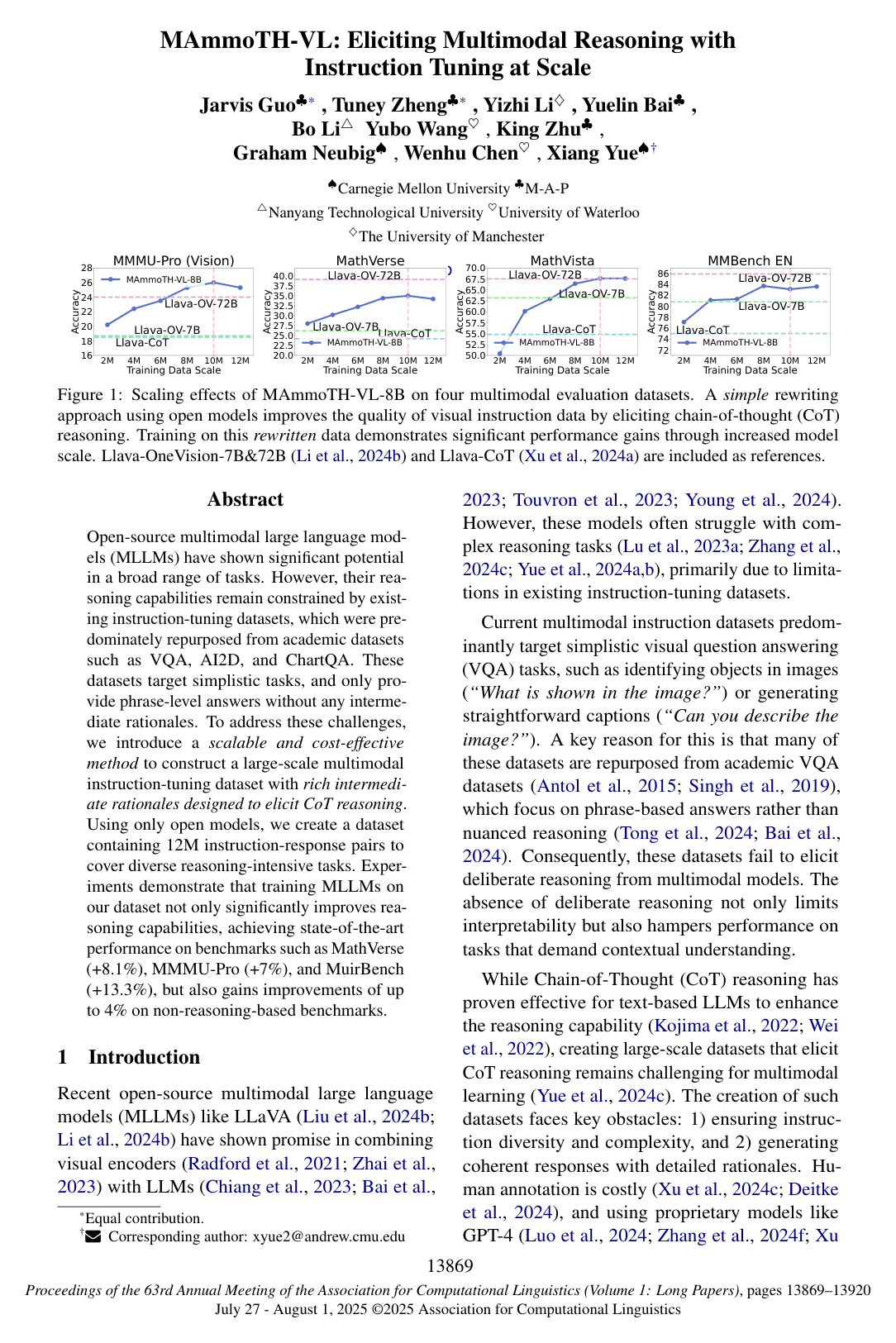
Open-source multimodal large language models (MLLMs) have shown significant potential in a broad range of tasks. However, their reasoning capabilities remain constrained by existing instruction-tuning datasets, which were predominately repurposed from academic datasets such as VQA, AI2D, and ChartQA. These datasets target simplistic tasks, and only provide phrase-level answers without any intermediate rationales. To address these challenges, we introduce a scalable and cost-effective method to construct a large-scale multimodal instruction-tuning dataset with rich intermediate rationales designed to elicit CoT reasoning. Using only open models, we create a dataset containing 12M instruction-response pairs to cover diverse reasoning-intensive tasks. Experiments demonstrate that training MLLMs on our dataset not only significantly improves reasoning capabilities, achieving state-of-the-art performance on benchmarks such as MathVerse (+8.1%), MMMU-Pro (+7%), and MuirBench (+13.3%), but also gains improvements of up to 4% on non-reasoning-based benchmarks.
Added
2026-10-01
Magpie: Alignment Data Synthesis from Scratch by Prompting Aligned LLMs with Nothing
Zhangchen Xu, Fengqing Jiang, Luyao Niu, Yuntian Deng, Radha Poovendran, Yejin Choi, Bill Yuchen Lin
Why you should read this
Introduces Magpie, an automated data synthesis technique that extracts millions of diverse instruction-response pairs from aligned language models by prompting empty user templates, allowing base models fine-tuned on this data to rival official instruction-tuned baselines across standard alignment benchmarks.
High-quality instruction data is critical for aligning large language models (LLMs). Although some models, such as Llama-3-Instruct, have open weights, their alignment data remain private, which hinders the democratization of AI. High human labor costs and a limited, predefined scope for prompting prevent existing open-source data creation methods from scaling effectively, potentially limiting the diversity and quality of public alignment datasets. Is it possible to synthesize high-quality instruction data at scale by extracting it directly from an aligned LLM? We present a self-synthesis method for generating large-scale alignment data named Magpie. Our key observation is that aligned LLMs like Llama-3-Instruct can generate a user query when we input only the left-side templates up to the position reserved for user messages, thanks to their auto-regressive nature. We use this method to prompt Llama-3-Instruct and generate 4 million instructions along with their corresponding responses. We perform a comprehensive analysis of the extracted data and select 300K high-quality instances. To compare Magpie data with other public instruction datasets, we fine-tune Llama-3-8B-Base with each dataset and evaluate the performance of the fine-tuned models. Our results indicate that in some tasks, models fine-tuned with Magpie perform comparably to the official Llama-3-8B-Instruct, despite the latter being enhanced with 10 million data points through supervised fine-tuning (SFT) and subsequent feedback learning. We also show that using Magpie solely for SFT can surpass the performance of previous public datasets utilized for both SFT and preference optimization, such as direct preference optimization with UltraFeedback. This advantage is evident on alignment benchmarks such as AlpacaEval, ArenaHard, and WildBench.
Added
2026-10-01

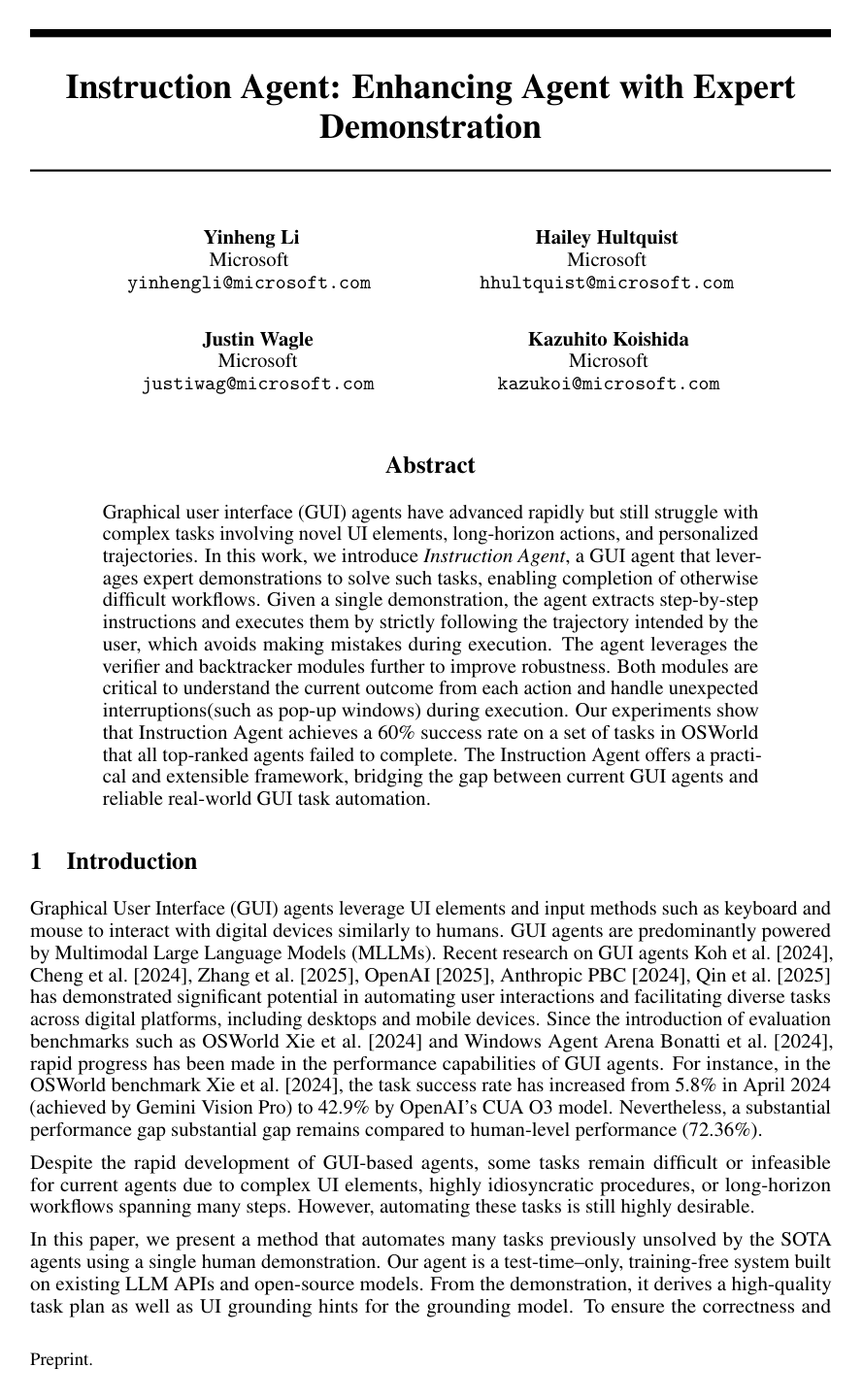
Instruction Agent: Enhancing Agent with Expert Demonstration
Yinheng Li, Hailey Hultquist, Justin Wagle, Kazuhito Koishida
Why you should read this
Introduces Instruction Agent, a GUI automation framework that converts single expert demonstrations into verified, backtrackable execution steps, achieving a 60% success rate on complex OSWorld tasks that defeat all leading agents.
Graphical user interface (GUI) agents have advanced rapidly but still struggle with complex tasks involving novel UI elements, long-horizon actions, and personalized trajectories. In this work, we introduce Instruction Agent, a GUI agent that leverages expert demonstrations to solve such tasks, enabling completion of otherwise difficult workflows. Given a single demonstration, the agent extracts step-by-step instructions and executes them by strictly following the trajectory intended by the user, which avoids making mistakes during execution. The agent leverages the verifier and backtracker modules further to improve robustness. Both modules are critical to understand the current outcome from each action and handle unexpected interruptions(such as pop-up windows) during execution. Our experiments show that Instruction Agent achieves a 60% success rate on a set of tasks in OSWorld that all top-ranked agents failed to complete. The Instruction Agent offers a practical and extensible framework, bridging the gap between current GUI agents and reliable real-world GUI task automation.
Added
2026-09-29
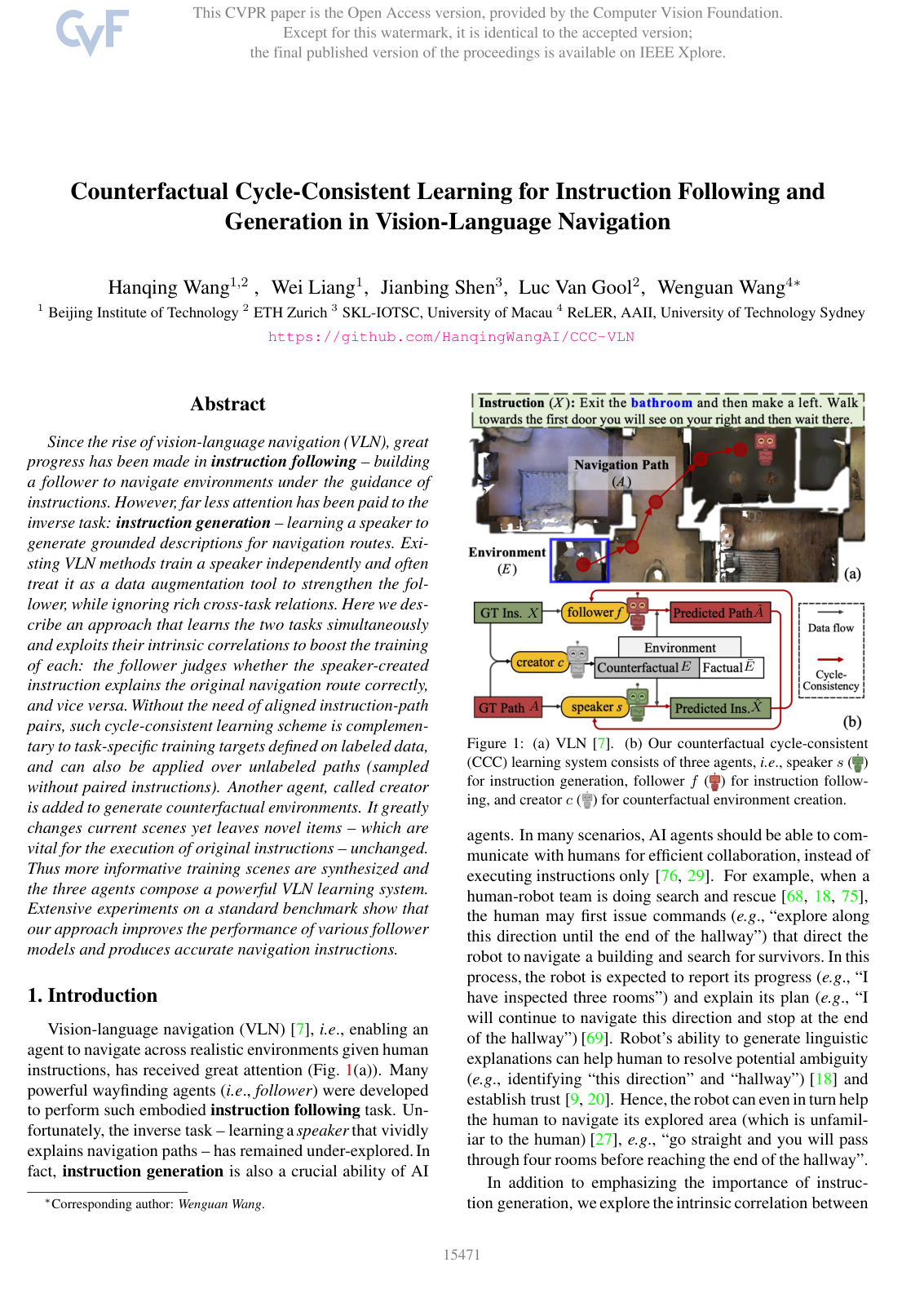
Counterfactual Cycle-Consistent Learning for Instruction Following and Generation in Vision-Language Navigation
Hanqing Wang, Wei Liang, Jianbing Shen, Luc Van Gool, Wenguan Wang
Why you should read this
Proposes a cycle-consistent framework that jointly trains instruction-following and instruction-generation agents using counterfactual scene synthesis, allowing vision-language navigation models to learn effectively from both labeled trajectories and unlabeled paths.
Since the rise of vision-language navigation (VLN), great progress has been made in instruction following – building a follower to navigate environments under the guidance of instructions. However, far less attention has been paid to the inverse task: instruction generation – learning a speaker to generate grounded descriptions for navigation routes. Existing VLN methods train a speaker independently and often treat it as a data augmentation tool to strengthen the follower, while ignoring rich cross-task relations. Here we describe an approach that learns the two tasks simultaneously and exploits their intrinsic correlations to boost the training of each: the follower judges whether the speaker-created instruction explains the original navigation route correctly, and vice versa. Without the need of aligned instruction-path pairs, such cycle-consistent learning scheme is complementary to task-specific training targets defined on labeled data, and can also be applied over unlabeled paths (sampled without paired instructions). Another agent, called creator is added to generate counterfactual environments. It greatly changes current scenes yet leaves novel items – which are vital for the execution of original instructions – unchanged. Thus more informative training scenes are synthesized and the three agents compose a powerful VLN learning system. Extensive experiments on a standard benchmark show that our approach improves the performance of various follower models and produces accurate navigation instructions.
Added
2026-09-26
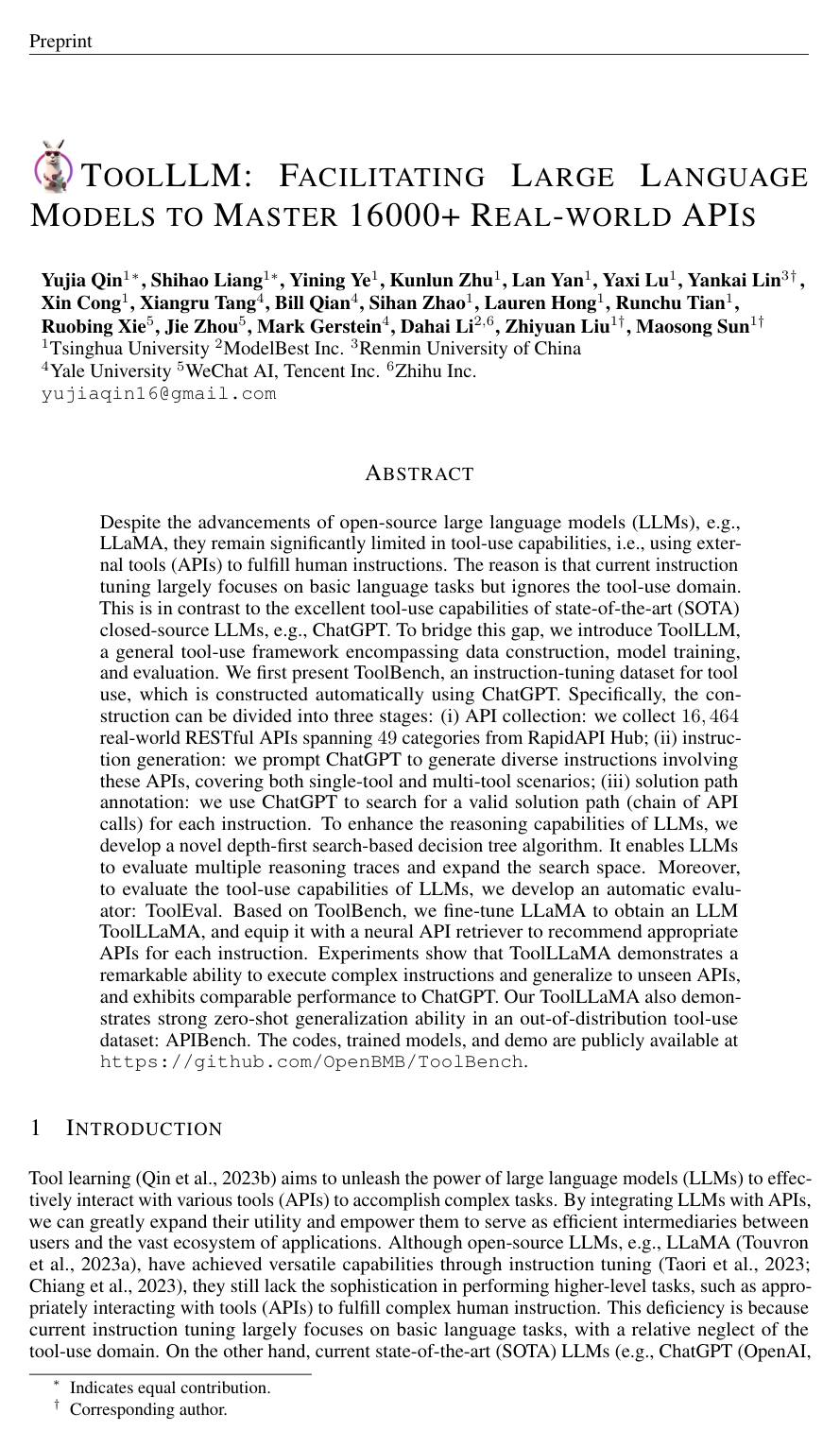
ToolLLM: Facilitating Large Language Models to Master 16000+ Real-world APIs
Yujia Qin, Shi Liang, Yining Ye, Kunlun Zhu, Lan Yan, Yaxi Lu, Yankai Lin, Xin Cong, Xiangru Tang, Bill Qian, Sihan Zhao, Runchu Tian, Ruobing Xie, Jie Zhou, Marc H. Gerstein, Dahai Li, Zhiyuan Liu, Maosong Sun
Why you should read this
Introduces an instruction-tuning framework and a benchmark of over 16,000 real-world APIs that enables open-source language models to execute complex multi-tool tasks and achieve tool-use performance competitive with proprietary systems like ChatGPT.
Despite the advancements of open-source large language models (LLMs), e.g., LLaMA, they remain significantly limited in tool-use capabilities, i.e., using external tools (APIs) to fulfill human instructions. The reason is that current instruction tuning largely focuses on basic language tasks but ignores the tool-use domain. This is in contrast to the excellent tool-use capabilities of state-of-the-art (SOTA) closed-source LLMs, e.g., ChatGPT. To bridge this gap, we introduce ToolLLM, a general tool-use framework encompassing data construction, model training, and evaluation. We first present ToolBench, an instruction-tuning dataset for tool use, which is constructed automatically using ChatGPT. Specifically, the construction can be divided into three stages: (i) API collection: we collect 16,464 real-world RESTful APIs spanning 49 categories from RapidAPI Hub; (ii) instruction generation: we prompt ChatGPT to generate diverse instructions involving these APIs, covering both single-tool and multi-tool scenarios; (iii) solution path annotation: we use ChatGPT to search for a valid solution path (chain of API calls) for each instruction. To enhance the reasoning capabilities of LLMs, we develop a novel depth-first search-based decision tree algorithm. It enables LLMs to evaluate multiple reasoning traces and expand the search space. Moreover, to evaluate the tool-use capabilities of LLMs, we develop an automatic evaluator: ToolEval. Based on ToolBench, we fine-tune LLaMA to obtain an LLM ToolLLaMA, and equip it with a neural API retriever to recommend appropriate APIs for each instruction. Experiments show that ToolLLaMA demonstrates a remarkable ability to execute complex instructions and generalize to unseen APIs, and exhibits comparable performance to ChatGPT. Our ToolLLaMA also demonstrates strong zero-shot generalization ability in an out-of-distribution tool-use dataset: APIBench.
Added
2026-09-16