Counterfactual Cycle-Consistent Learning for Instruction Following and Generation in Vision-Language Navigation
Hanqing WangWei LiangJianbing ShenLuc Van GoolWenguan Wang
Proposes a cycle-consistent framework that jointly trains instruction-following and instruction-generation agents using counterfactual scene synthesis, allowing vision-language navigation models to learn effectively from both labeled trajectories and unlabeled paths.
Autonomous agents operating alongside humans in physical environments must be able to understand visual scenes and natural language instructions. While existing research in vision-language navigation has predominantly concentrated on training an agent to follow route descriptions (instruction following), far less focus has been given to the reverse capability: generating accurate, human-understandable route descriptions from visual paths (instruction generation). Traditional workflows treat instruction generation merely as a disconnected, isolated tool for generating synthetic training data. This isolation limits navigation robustness and prevents agents from effectively communicating, explaining actions, and collaborating with human partners during complex operations such as search-and-rescue.
The article introduces and evaluates a counterfactual cycle-consistent learning framework that jointly trains a route-following agent (follower) and an instruction-generating agent (speaker) alongside an environment-generating module (creator). The primary objective is to demonstrate that coupling instruction following and instruction generation in a closed learning loop, enhanced with counterfactual visual scenes, systematically improves the performance of both tasks across diverse navigation architectures.
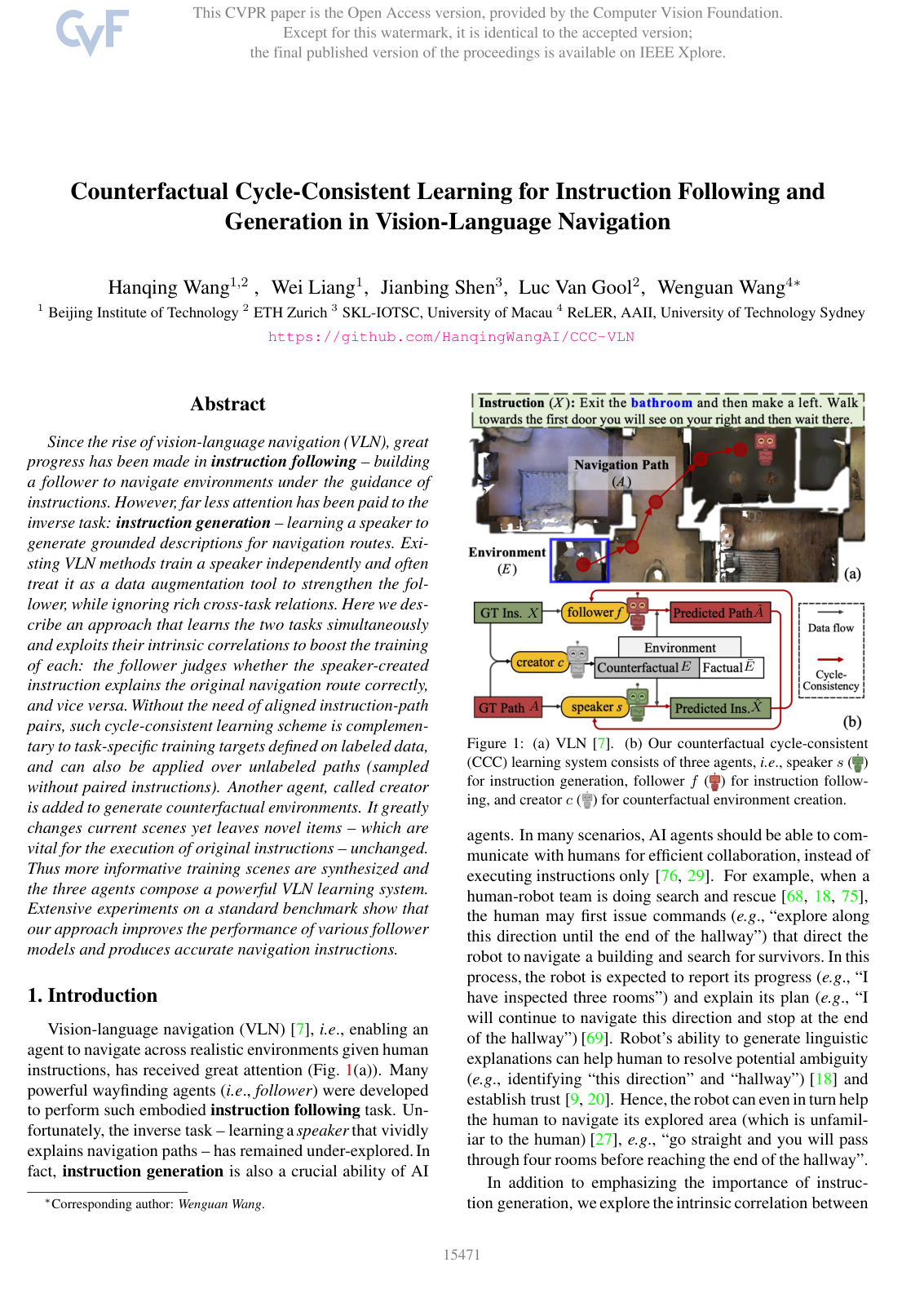
The evaluated framework connects the follower and speaker so each evaluates the other: the speaker assesses whether a follower's path matches the given instruction, while the follower assesses whether a speaker's generated instruction produces the original path. Because this cycle-consistency mechanism relies on circular verification rather than aligned human labels, it seamlessly incorporates unlabeled navigation paths alongside standard labeled datasets. In addition, the creator module synthesizes counterfactual training environments by blending elements from alternative reference scenes while preserving critical navigation landmarks. The entire system was validated using standard benchmarks on the photo-realistic Room-to-Room dataset, testing across multiple baseline architectures and leading navigation models under both seen and previously unseen environments.
Key findings show significant, consistent performance gains across both navigation and text generation tasks. First, the proposed framework substantially boosted follower success rates across different model architectures, outperforming previous data augmentation methods by up to 4.8 percentage points in seen environments and up to 6.1 percentage points on unseen test environments. Second, when applied to existing top-performing benchmark followers, the framework consistently set new performance highs, raising the success rate of a leading memory-based navigation model to 62.2%. Third, the framework dramatically improved the linguistic quality of generated instructions, outperforming standalone speaker models across all standard language metrics. Finally, blind human user evaluations confirmed this language improvement, with human reviewers preferring the system's generated instructions over existing generation baselines by a 68.6% to 18.2% margin.
These results demonstrate that treating route following and instruction generation as interdependent tasks provides mutual regularization and resolves data quality issues inherent in traditional synthetic data pipelines. By enabling agents to generalize more effectively to unseen environments without requiring expensive manual annotations, this approach lowers the operational risk and cost of deploying autonomous robots. Technical leaders and engineering teams developing embodied artificial intelligence should integrate dual-task cycle consistency and counterfactual scene generation into their training pipelines rather than relying on isolated data augmentation steps. Future development should focus on extending these counterfactual training techniques to dynamic, real-time physical environments and evaluating their performance under noisy, real-world robotic sensor conditions.
- Paper: Vision-and-Language Navigation: Interpreting Visually-Grounded Navigation Instructions in Real Environments, Peter Anderson et al. (2017). Introduces the foundational Vision-and-Language Navigation task and the Room-to-Room benchmark upon which the source paper develops its follower, speaker, and cycle-consistent frameworks.
- Paper: Generation and Comprehension of Unambiguous Object Descriptions, Junhua Mao et al. (2015). Establishes the foundational dual framework for jointly generating and comprehending natural language descriptions in visual tasks, directly underpinning the source's speaker-follower navigation dynamics.
- Paper: Modeling Context in Referring Expressions, Licheng Yu et al. (2016). Provides fundamental principles of referring expression generation and comprehension through visual comparison, informing the source's speaker and creator modules.
- Paper: Learning to Navigate in Complex Environments, Piotr Mirowski et al. (2017). Pioneers reinforcement learning with auxiliary training objectives for navigating complex 3D environments from sensory inputs, establishing essential techniques for visual navigation policies.
- Paper: Target-driven visual navigation in indoor scenes using deep reinforcement learning, Yuke Zhu et al. (2016). Develops deep reinforcement learning architectures for target-driven indoor visual navigation that form the architectural basis for visual instruction following.
- Paper: PanoGen: Text-Conditioned Panoramic Environment Generation for Vision-and-Language Navigation, Jialu Li et al. (2023). Extends generative environment modeling for vision-and-language navigation by using text-to-image diffusion models and outpainting to synthesize diverse panoramic indoor training scenes.
- Paper: GOAT-Bench: A Benchmark for Multi-Modal Lifelong Navigation, Mukul Khanna et al. (2024). Broadens visual instruction navigation from isolated single-target paths to lifelong multimodal navigation sequences with persistent environmental memory.
- Paper: PhyScene: Physically Interactable 3D Scene Synthesis for Embodied AI, Yandan Yang et al. (2024). Advances synthetic training environment generation for embodied AI agents by integrating physics guidance and reachability constraints into generative 3D indoor scene synthesis.
- Paper: SimLingo: Vision-Only Closed-Loop Autonomous Driving with Language-Action Alignment, Katrin Renz et al. (2025). Applies counterfactual simulation and unified language-action alignment to closed-loop autonomous driving agents.
- Paper: SPOC: Imitating Shortest Paths in Simulation Enables Effective Navigation and Manipulation in the Real World, Kiana Ehsani et al. (2024). Scales up simulated imitation learning and language navigation policies to massive procedurally generated indoor environments deployed on physical robots.