
keyword
instance segmentation
Instance segmentation is a computer vision task that involves detecting and delineating each individual object of interest in visual data at the pixel level. Unlike object detection, which localizes objects using approximate bounding boxes, and semantic segmentation, which classifies every pixel into a category without distinguishing between separate occurrences of the same class, instance segmentation unifies both approaches by generating a distinct spatial mask or boundary for every separate entity. This capability allows systems to accurately recognize, differentiate, and trace individual overlapping or adjacent objects belonging to the same countable category within a scene.
38 items
FocalClick: Towards Practical Interactive Image Segmentation
Xi Chen, Zhiyan Zhao, Yilei Zhang, Manni Duan, Donglian Qi, Hengshuang Zhao
Why you should read this
Proposes a localized interactive segmentation pipeline that cuts computational cost through coarse-to-fine cropping while introducing a morphology-based merging strategy to refine preexisting masks without destroying correctly annotated regions.
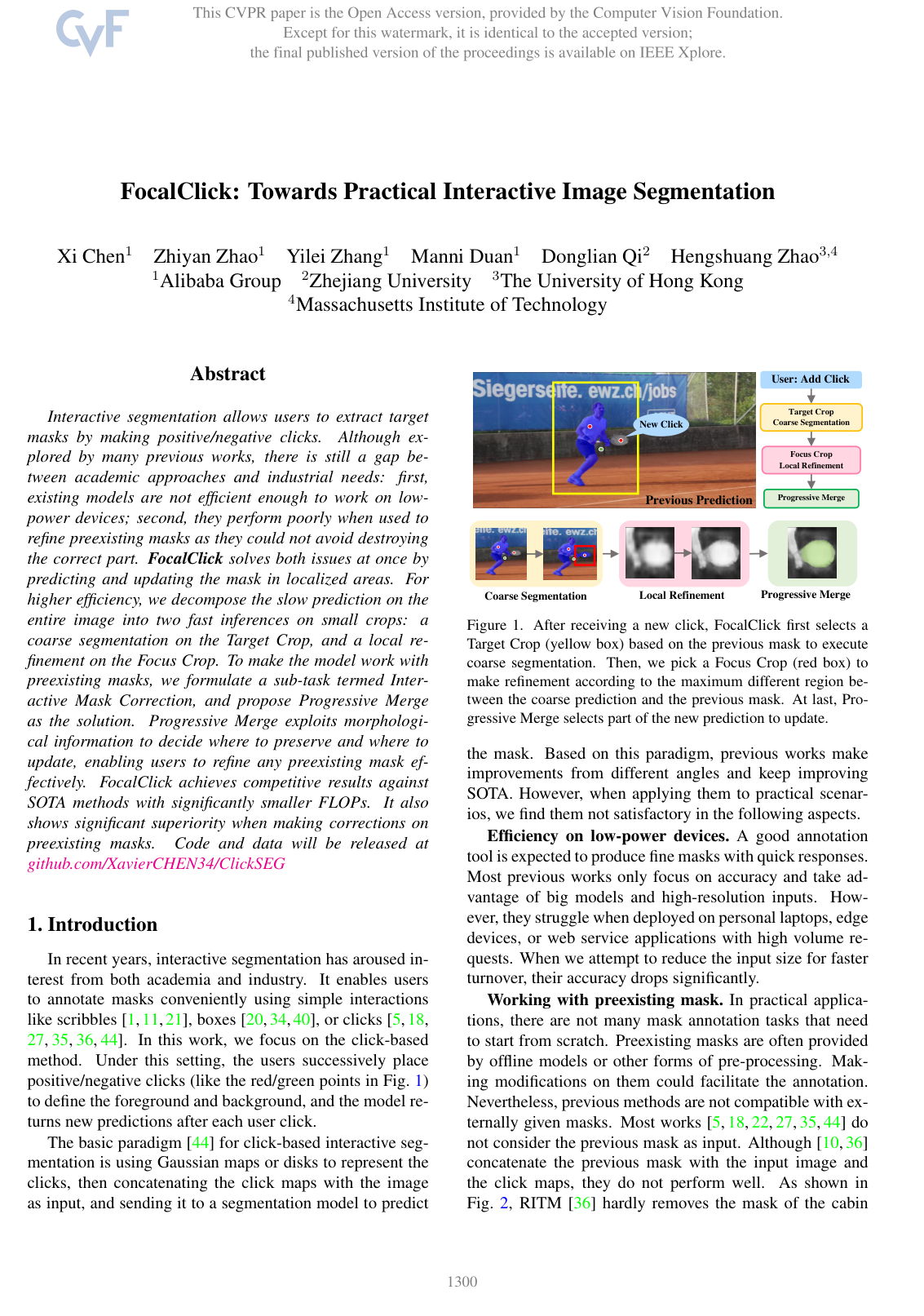
Interactive segmentation allows users to extract target masks by making positive/negative clicks. Although explored by many previous works, there is still a gap between academic approaches and industrial needs: first, existing models are not efficient enough to work on low-power devices; second, they perform poorly when used to refine preexisting masks as they could not avoid destroying the correct part. FocalClick solves both issues at once by predicting and updating the mask in localized areas. For higher efficiency, we decompose the slow prediction on the entire image into two fast inferences on small crops: a coarse segmentation on the Target Crop, and a local refinement on the Focus Crop. To make the model work with preexisting masks, we formulate a sub-task termed Interactive Mask Correction, and propose Progressive Merge as the solution. Progressive Merge exploits morphological information to decide where to preserve and where to update, enabling users to refine any preexisting mask effectively. FocalClick achieves competitive results against SOTA methods with significantly smaller FLOPs. It also shows significant superiority when making corrections on preexisting masks. Code and data will be released at github.com/XavierCHEN34/ClickSEG
Added
2026-10-05
Aligning Bag of Regions for Open-Vocabulary Object Detection
Size Wu, Wenwei Zhang, Sheng Jin, Wentao Liu, Chen Change Loy
Why you should read this
Proposes BARON, an open-vocabulary object detection framework that models contextual relations among multiple regions by encoding them as pseudo-word sentences for alignment with vision-language models, significantly boosting novel-category detection performance on COCO and LVIS benchmarks.
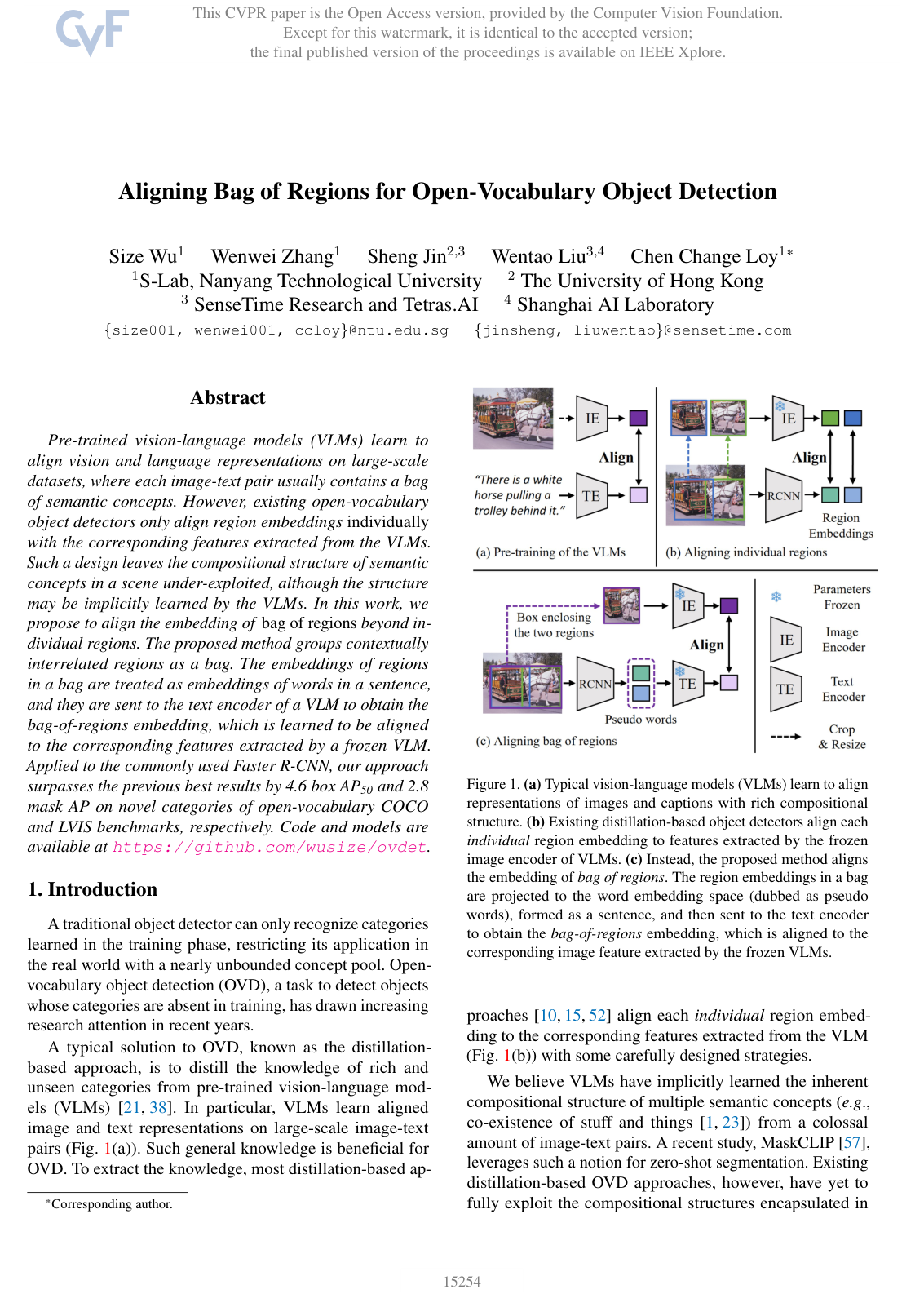
Pre-trained vision-language models (VLMs) learn to align vision and language representations on large-scale datasets, where each image-text pair usually contains a bag of semantic concepts. However, existing open-vocabulary object detectors only align region embeddings individually with the corresponding features extracted from the VLMs. Such a design leaves the compositional structure of semantic concepts in a scene under-exploited, although the structure may be implicitly learned by the VLMs. In this work, we propose to align the embedding of bag of regions beyond individual regions. The proposed method groups contextually interrelated regions as a bag. The embeddings of regions in a bag are treated as embeddings of words in a sentence, and they are sent to the text encoder of a VLM to obtain the bag-of-regions embedding, which is learned to be aligned to the corresponding features extracted by a frozen VLM. Applied to the commonly used Faster R-CNN, our approach surpasses the previous best results by 4.6 box AP50 and 2.8 mask AP on novel categories of open-vocabulary COCO and LVIS benchmarks, respectively. Code and models are available at https://github.com/wusize/ovdet.
Added
2026-10-05
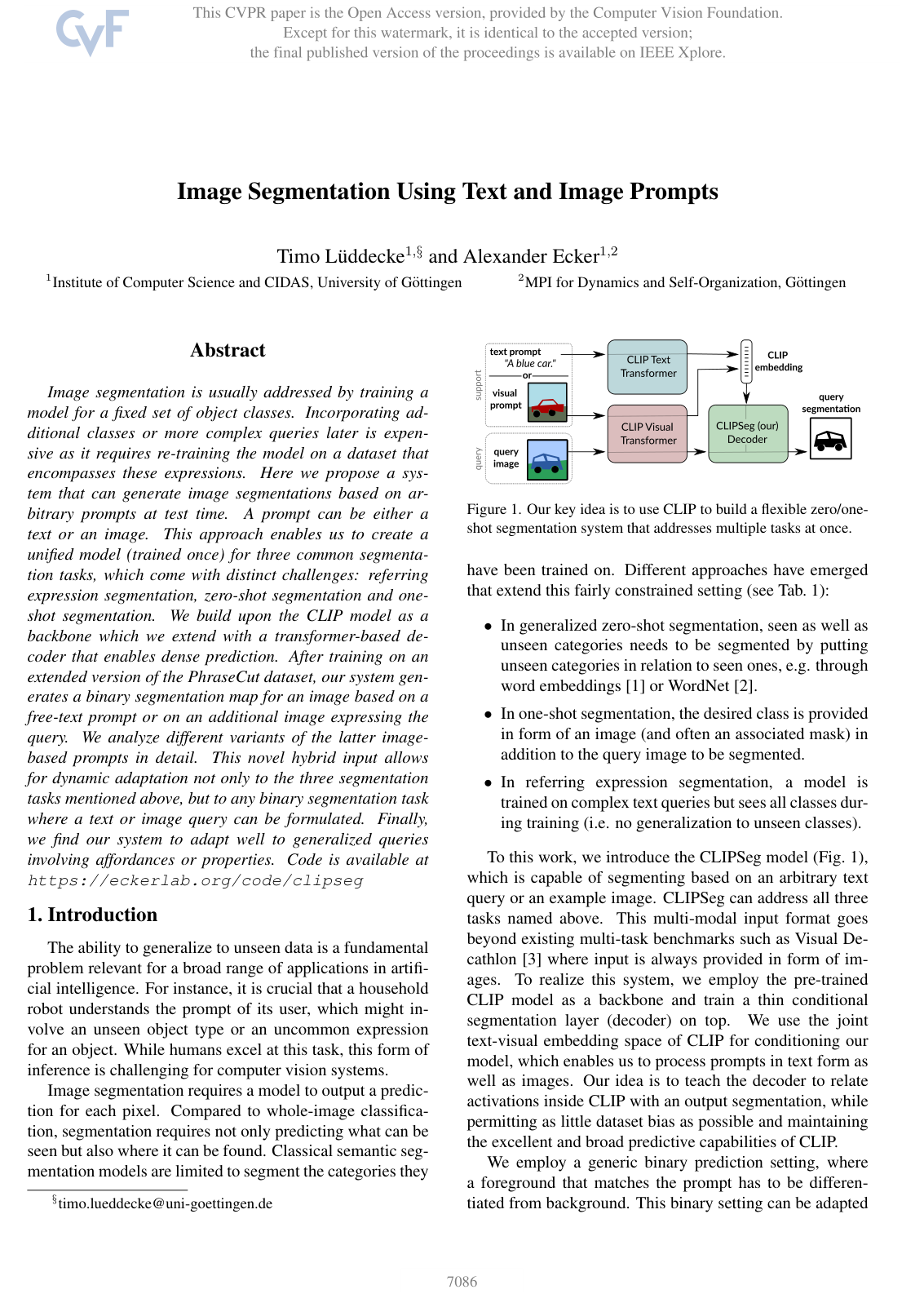
Image Segmentation Using Text and Image Prompts
Timo Lüddecke, Alexander S. Ecker
Why you should read this
Proposes CLIPSeg, a unified system that adds a lightweight transformer-based decoder to a frozen CLIP model to perform zero-shot, one-shot, and referring expression image segmentation using arbitrary text or visual prompts at test time.
Image segmentation is usually addressed by training a model for a fixed set of object classes. Incorporating additional classes or more complex queries later is expensive as it requires re-training the model on a dataset that encompasses these expressions. Here we propose a system that can generate image segmentations based on arbitrary prompts at test time. A prompt can be either a text or an image. This approach enables us to create a unified model (trained once) for three common segmentation tasks, which come with distinct challenges: referring expression segmentation, zero-shot segmentation and one-shot segmentation. We build upon the CLIP model as a backbone which we extend with a transformer-based decoder that enables dense prediction. After training on an extended version of the PhraseCut dataset, our system generates a binary segmentation map for an image based on a free-text prompt or on an additional image expressing the query. We analyze different variants of the latter image-based prompts in detail. This novel hybrid input allows for dynamic adaptation not only to the three segmentation tasks mentioned above, but to any binary segmentation task where a text or image query can be formulated. Finally, we find our system to adapt well to generalized queries involving affordances or properties. Code is available at https://eckerlab.org/code/clipseg
Added
2026-10-05
Invariant Slot Attention: Object Discovery with Slot-Centric Reference Frames
Ondrej Biza, Sjoerd van Steenkiste, Mehdi S. M. Sajjadi, Gamaleldin Fathy Elsayed, Aravindh Mahendran, Thomas Kipf
Why you should read this
Introduces a mechanism that incorporates per-object spatial symmetries into Slot Attention by dynamically transforming position encodings into slot-centric reference frames, significantly improving data efficiency and unsupervised object discovery across synthetic benchmarks and real-world driving data.
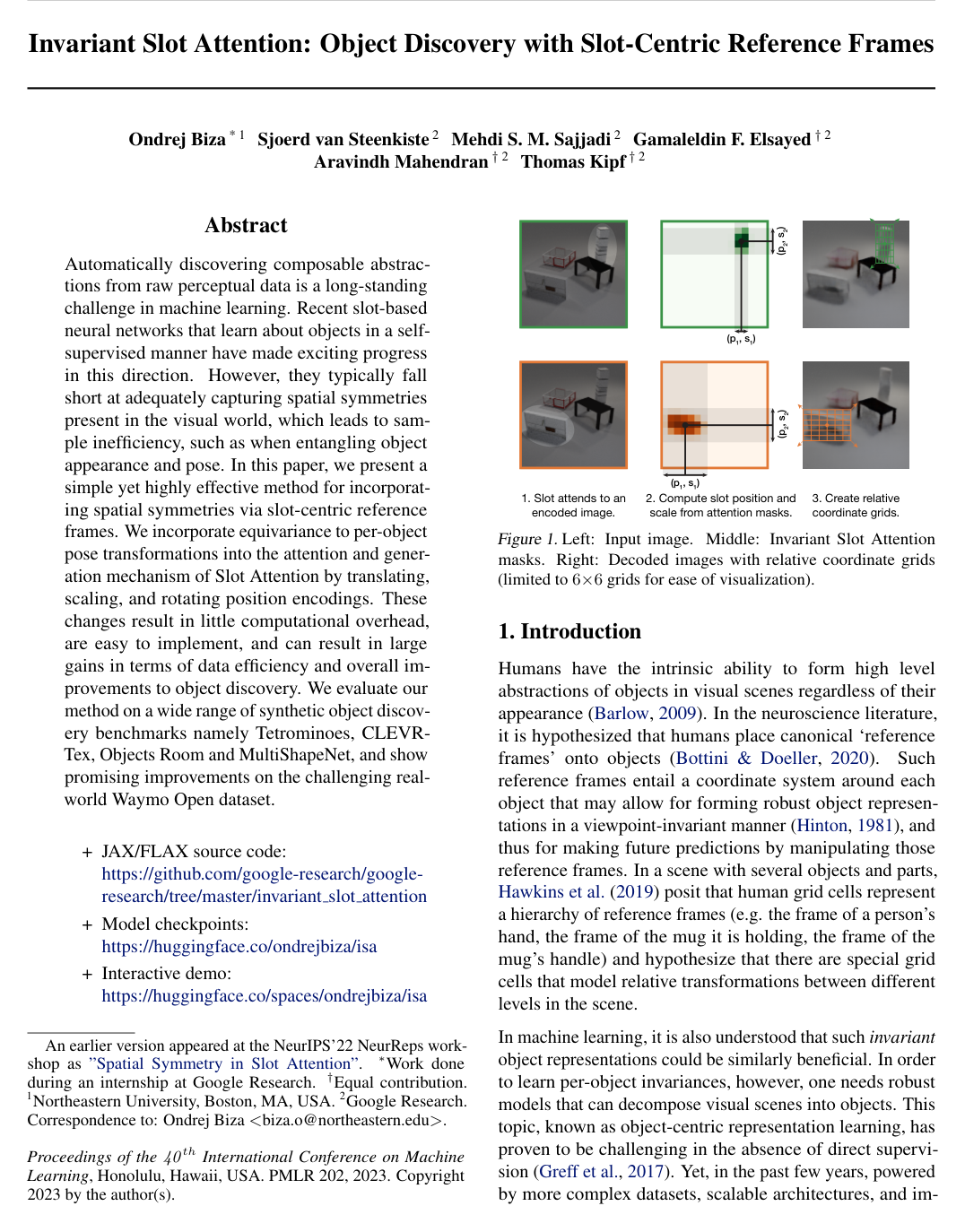
Automatically discovering composable abstractions from raw perceptual data is a long-standing challenge in machine learning. Recent slot-based neural networks that learn about objects in a self-supervised manner have made exciting progress in this direction. However, they typically fall short at adequately capturing spatial symmetries present in the visual world, which leads to sample inefficiency, such as when entangling object appearance and pose. In this paper, we present a simple yet highly effective method for incorporating spatial symmetries via slot-centric reference frames. We incorporate equivariance to per-object pose transformations into the attention and generation mechanism of Slot Attention by translating, scaling, and rotating position encodings. These changes result in little computational overhead, are easy to implement, and can result in large gains in terms of data efficiency and overall improvements to object discovery. We evaluate our method on a wide range of synthetic object discovery benchmarks namely Tetrominoes, CLEVR-Tex, Objects Room and MultiShapeNet, and show promising improvements on the challenging real-world Waymo Open dataset.
Added
2026-10-03
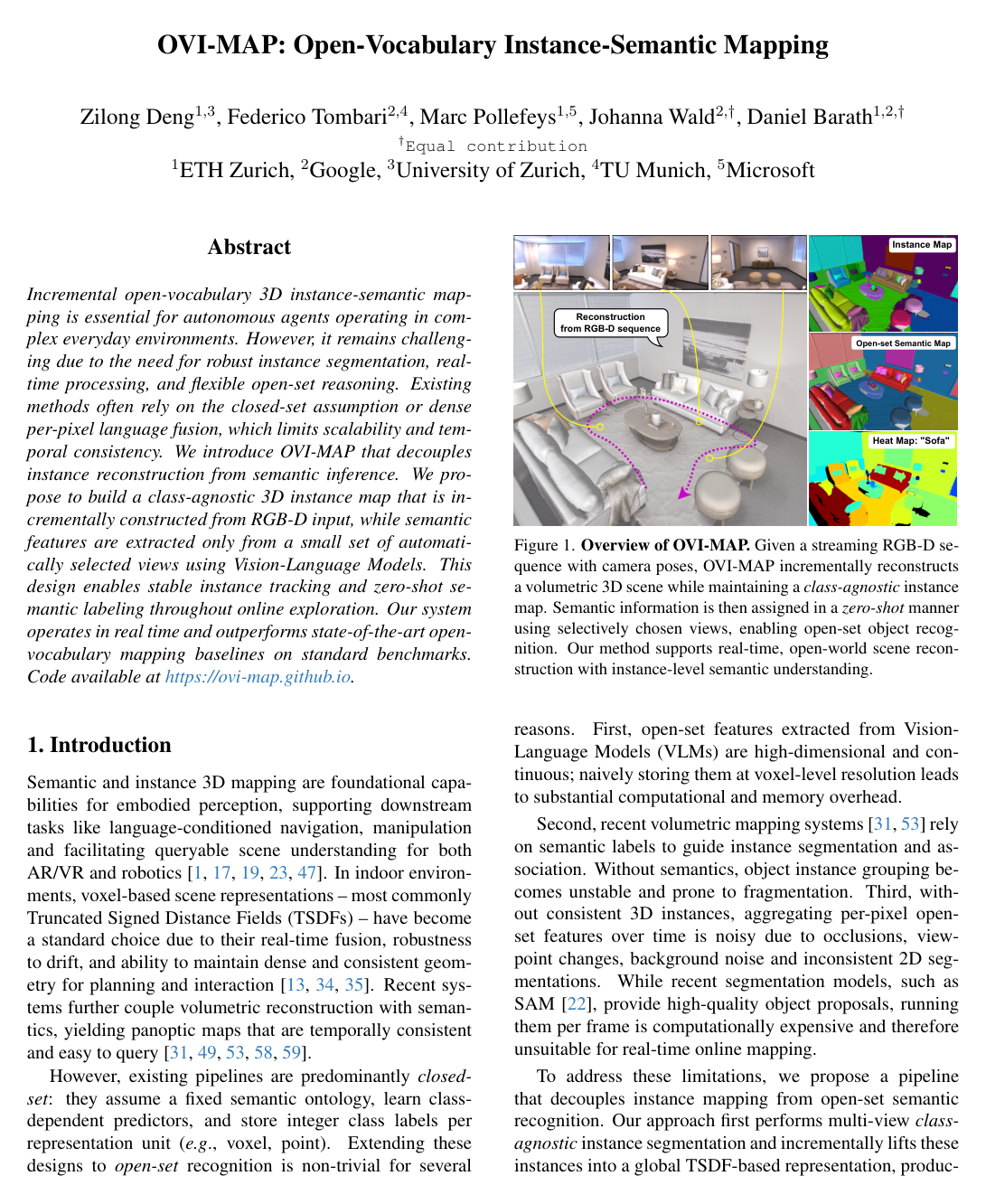
OVI-MAP:Open-Vocabulary Instance-Semantic Mapping
Zilong Deng, Federico Tombari, Marc Pollefeys, Johanna Wald, Dániel Baráth
Why you should read this
Presents a real-time open-vocabulary 3D instance mapping system that decouples geometry reconstruction from semantic inference using selective-view vision-language querying, eliminating dense feature fusion while maintaining high temporal consistency during online exploration.
Incremental open-vocabulary 3D instance-semantic mapping is essential for autonomous agents operating in complex everyday environments. However, it remains challenging due to the need for robust instance segmentation, real-time processing, and flexible open-set reasoning. Existing methods often rely on the closed-set assumption or dense per-pixel language fusion, which limits scalability and temporal consistency. We introduce OVI-MAP that decouples instance reconstruction from semantic inference. We propose to build a class-agnostic 3D instance map that is incrementally constructed from RGB-D input, while semantic features are extracted only from a small set of automatically selected views using vision-language models. This design enables stable instance tracking and zero-shot semantic labeling throughout online exploration. Our system operates in real time and outperforms state-of-the-art open-vocabulary mapping baselines on standard benchmarks.
Added
2026-09-29
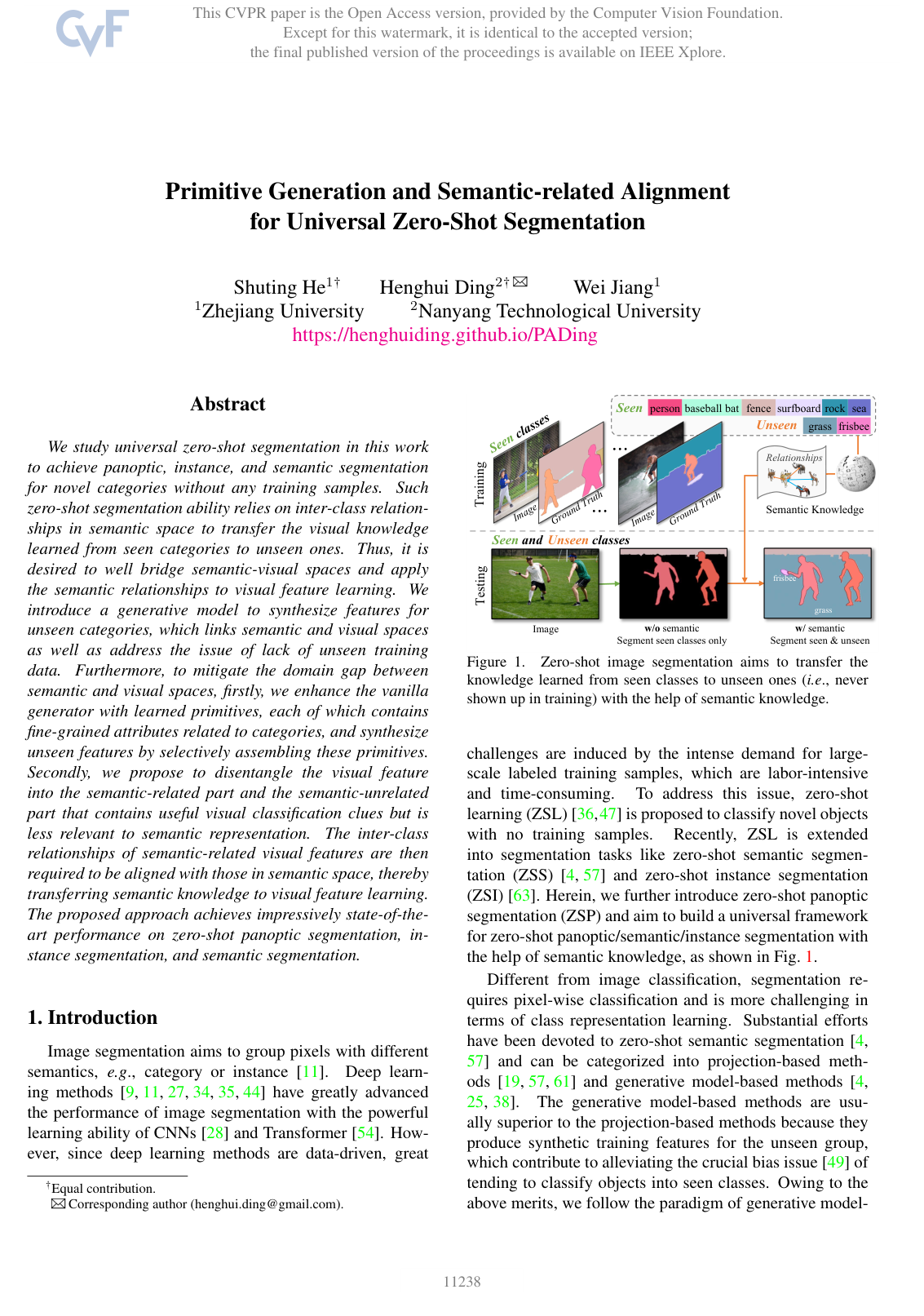
Primitive Generation and Semantic-Related Alignment for Universal Zero-Shot Segmentation
Shuting He, Henghui Ding, Wei Jiang
Why you should read this
Proposes PADing, a unified universal zero-shot segmentation framework that bridges the cross-modal domain gap by assembling learned fine-grained primitives to synthesize unseen visual features and aligning their semantic-related components with linguistic class relationships.
We study universal zero-shot segmentation in this work to achieve panoptic, instance, and semantic segmentation for novel categories without any training samples. Such zero-shot segmentation ability relies on inter-class relationships in semantic space to transfer the visual knowledge learned from seen categories to unseen ones. Thus, it is desired to well bridge semantic and visual spaces and apply the semantic relationships to visual feature learning. We introduce a generative model to synthesize features for unseen categories, which links semantic and visual spaces as well as addresses the issue of lack of unseen training data. Furthermore, to mitigate the domain gap between semantic and visual spaces, firstly, we enhance the vanilla generator with learned primitives, each of which contains fine-grained attributes related to categories, and synthesize unseen features by selectively assembling these primitives. Secondly, we propose to disentangle the visual feature into the semantic-related part and the semantic-unrelated part that contains useful visual classification clues but is less relevant to semantic representation. The inter-class relationships of semantic-related visual features are then required to be aligned with those in semantic space, thereby transferring semantic knowledge to visual feature learning. The proposed approach achieves impressively state-of-the-art performance on zero-shot panoptic segmentation, instance segmentation, and semantic segmentation.
Added
2026-09-26
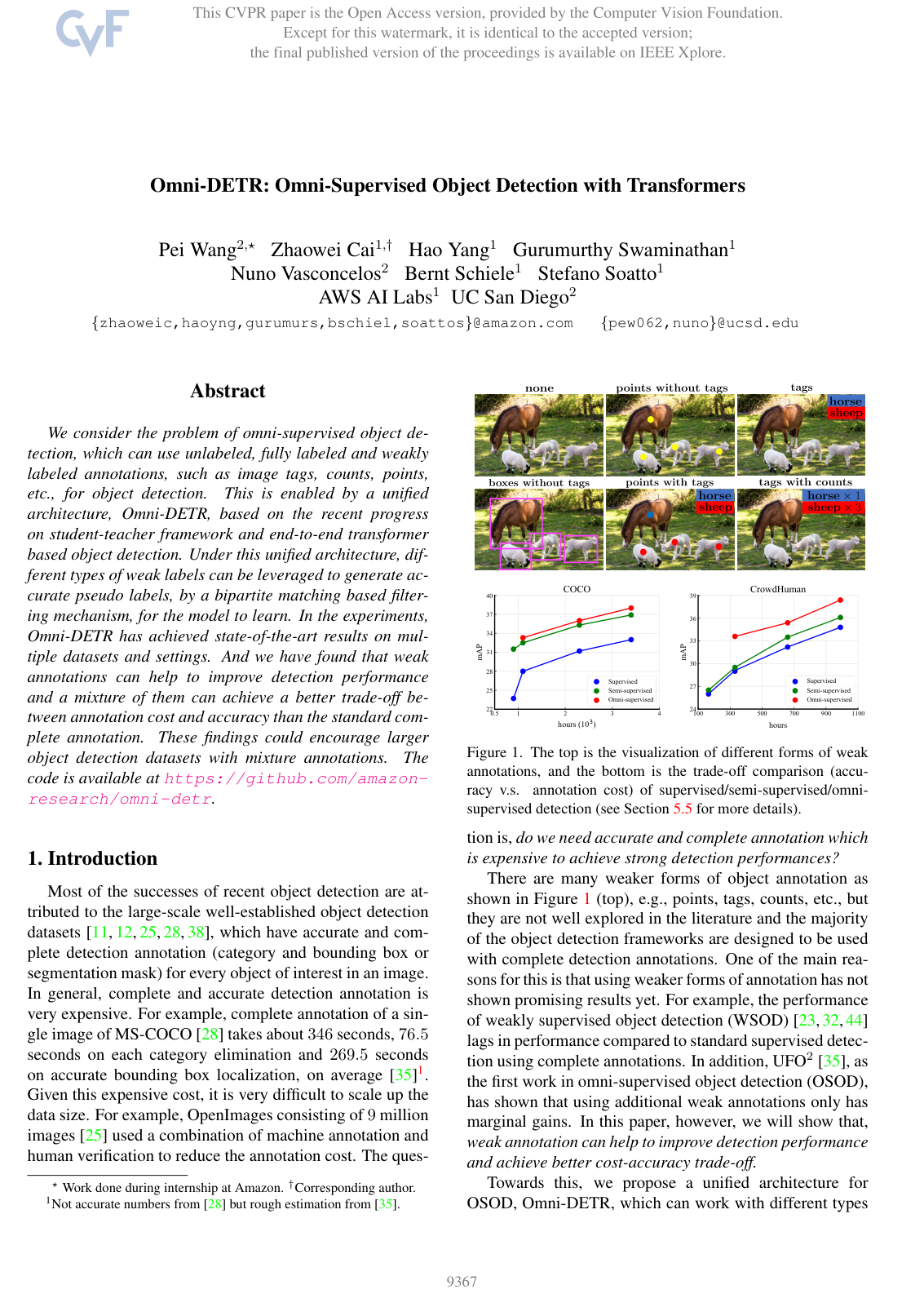
Omni-DETR: Omni-Supervised Object Detection with Transformers
Pei Wang, Zhaowei Cai, Hao Yang, Gurumurthy Swaminathan, Nuno Vasconcelos, Bernt Schiele, Stefano Soatto
Why you should read this
Proposes an end-to-end transformer framework that unifies diverse weak annotations—including tags, points, and counts—through bipartite-matching pseudo-label filtering, demonstrating that mixed-supervision strategies can outperform fully annotated datasets under a fixed labeling budget.
We consider the problem of omni-supervised object detection, which can use unlabeled, fully labeled and weakly labeled annotations, such as image tags, counts, points, etc., for object detection. This is enabled by a unified architecture, Omni-DETR, based on the recent progress on student-teacher framework and end-to-end transformer based object detection. Under this unified architecture, different types of weak labels can be leveraged to generate accurate pseudo labels, by a bipartite matching based filtering mechanism, for the model to learn. In the experiments, Omni-DETR has achieved state-of-the-art results on multiple datasets and settings. And we have found that weak annotations can help to improve detection performance and a mixture of them can achieve a better trade-off between annotation cost and accuracy than the standard complete annotation. These findings could encourage larger object detection datasets with mixture annotations. The code is available at https://github.com/amazon-research/omni-detr.
Added
2026-09-26
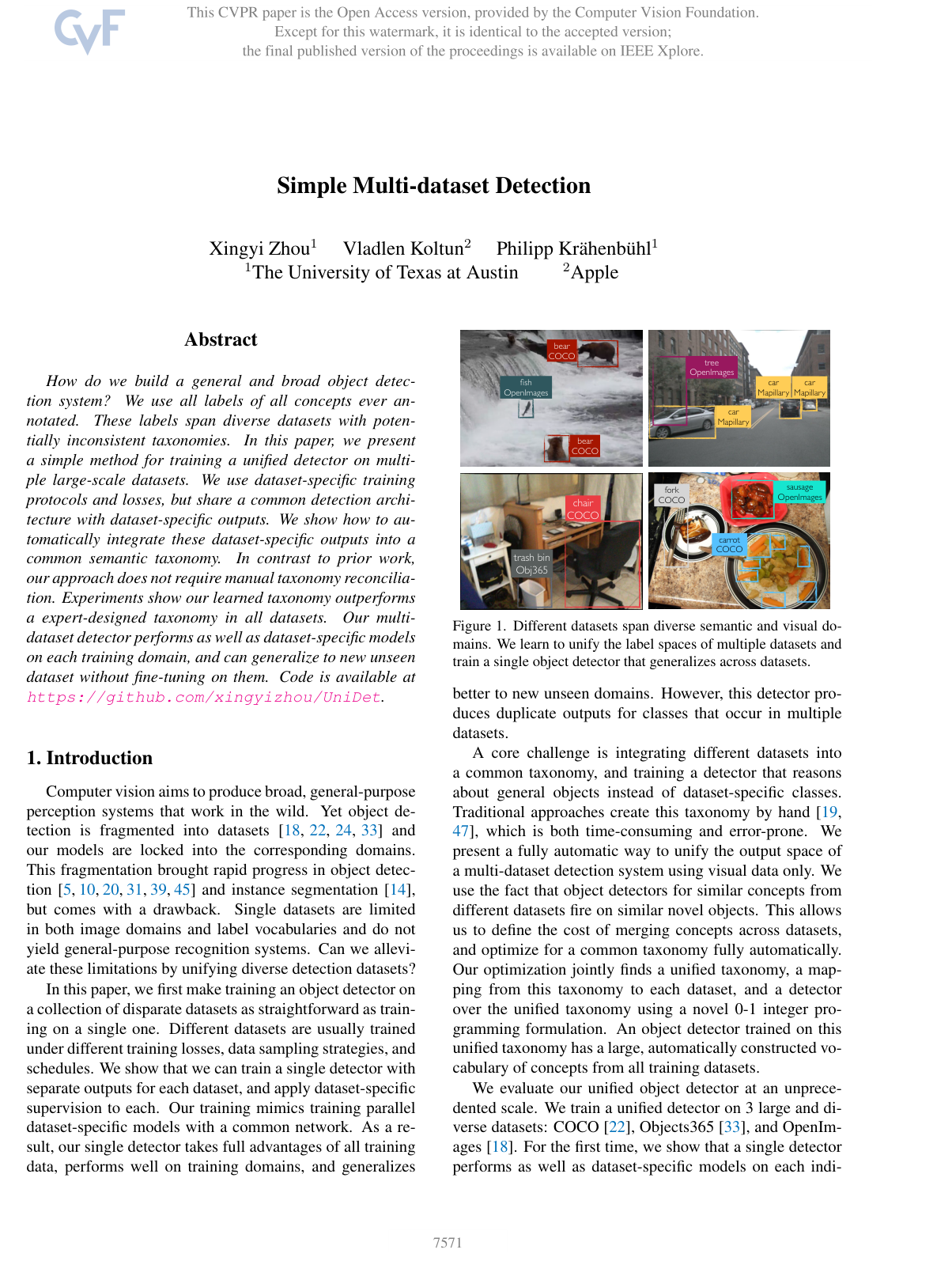
Simple Multi-dataset Detection
Xingyi Zhou, Vladlen Koltun, Philipp Krähenbühl
Why you should read this
Presents a multi-dataset object detection framework that automatically integrates disparate label spaces via 0-1 integer programming without manual taxonomy reconciliation, enabling a single detector to match dataset-specific baselines and generalize directly to unseen domains.
How do we build a general and broad object detection system? We use all labels of all concepts ever annotated. These labels span diverse datasets with potentially inconsistent taxonomies. In this paper, we present a simple method for training a unified detector on multiple large-scale datasets. We use dataset-specific training protocols and losses, but share a common detection architecture with dataset-specific outputs. We show how to automatically integrate these dataset-specific outputs into a common semantic taxonomy. In contrast to prior work, our approach does not require manual taxonomy reconciliation. Experiments show our learned taxonomy outperforms a expert-designed taxonomy in all datasets. Our multi-dataset detector performs as well as dataset-specific models on each training domain, and can generalize to new unseen dataset without fine-tuning on them. Code is available at https://github.com/xingyizhou/UniDet.
Added
2026-09-26
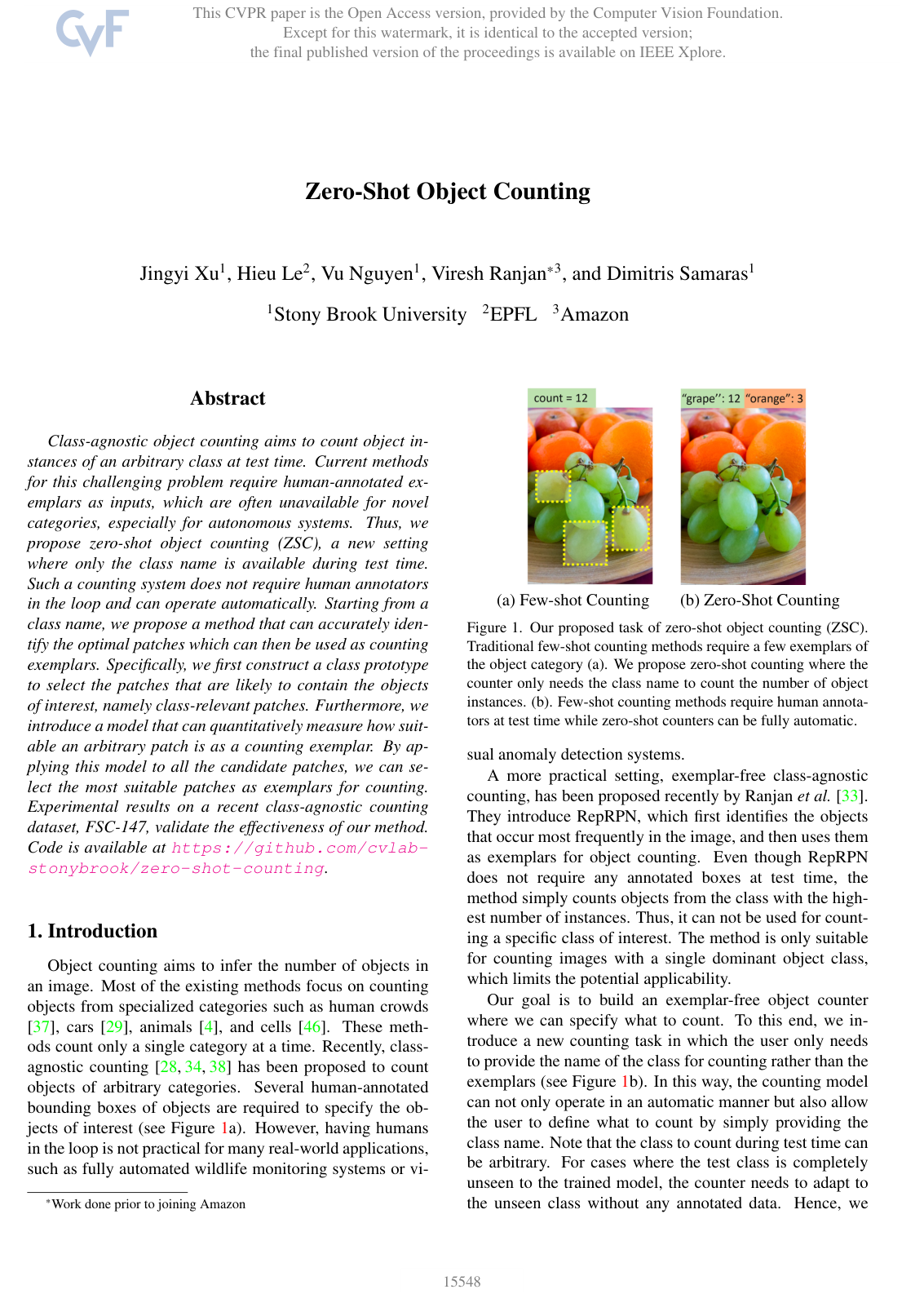
Zero-Shot Object Counting
Jingyi Xu, Hieu Le, Vu Nguyen, Viresh Ranjan, Dimitris Samaras
Why you should read this
Introduces a zero-shot object counting framework that automatically localizes and selects optimal visual exemplars using only class names and a learned error predictor, eliminating the need for human-annotated bounding boxes at test time.
Added
2026-09-26
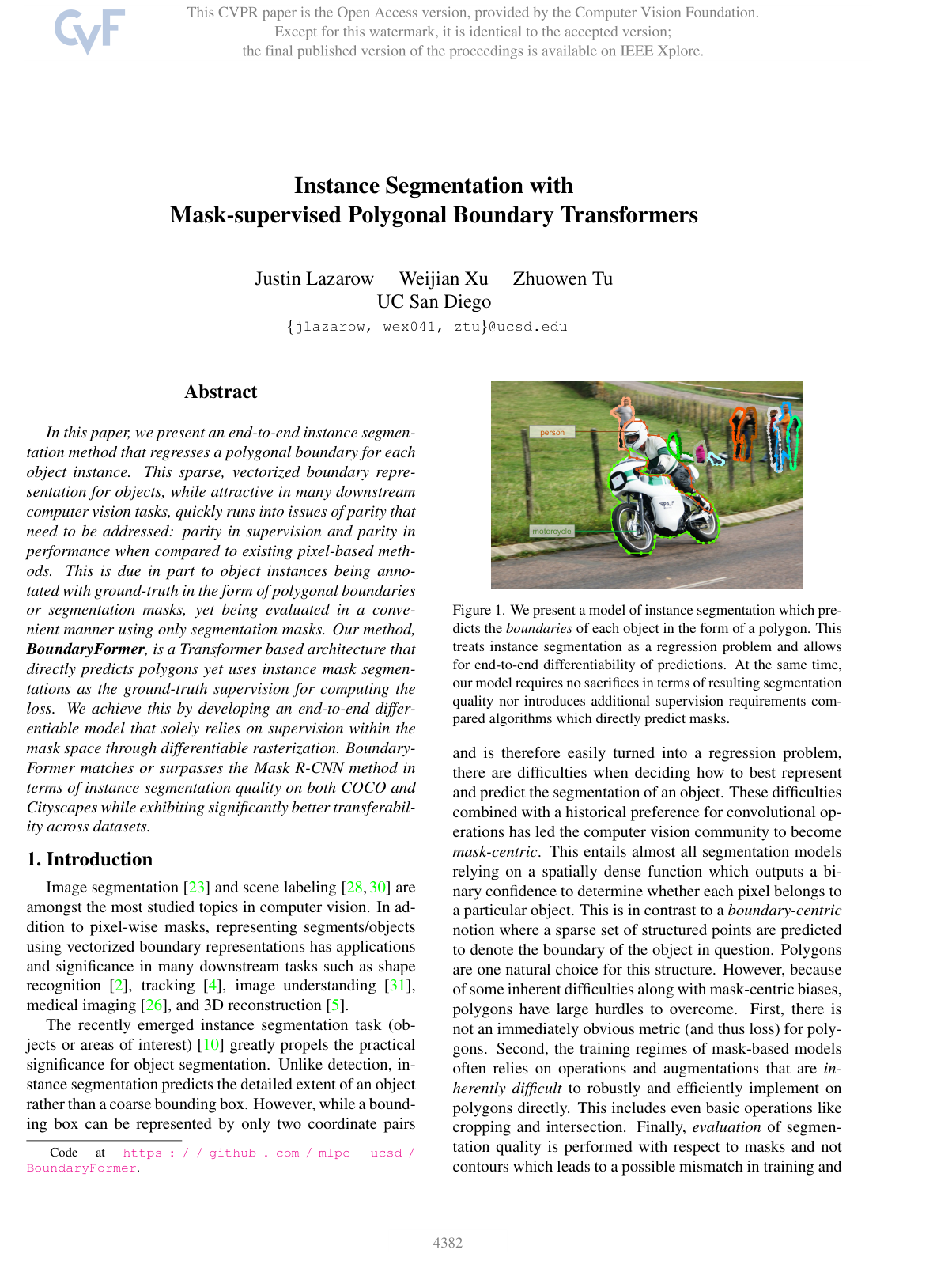
Instance Segmentation with Mask-supervised Polygonal Boundary Transformers
Justin Lazarow, Weijian Xu, Zhuowen Tu
Why you should read this
Introduces BoundaryFormer, an end-to-end framework that directly predicts object boundary polygons supervised solely by pixel masks via differentiable rasterization, matching or outperforming Mask R-CNN on standard benchmarks without requiring polygon annotations.
In this paper, we present an end-to-end instance segmentation method that regresses a polygonal boundary for each object instance. This sparse, vectorized boundary representation for objects, while attractive in many downstream computer vision tasks, quickly runs into issues of parity that need to be addressed: parity in supervision and parity in performance when compared to existing pixel-based methods. This is due in part to object instances being annotated with ground-truth in the form of polygonal boundaries or segmentation masks, yet being evaluated in a conventional manner using only segmentation masks. Our method, BoundaryFormer, is a Transformer based architecture that directly predicts polygons yet uses instance mask segmentations as the ground-truth supervision for computing the loss. We achieve this by developing an end-to-end differentiable model that solely relies on supervision within the mask space through differentiable rasterization. BoundaryFormer matches or surpasses the Mask R-CNN method in terms of instance segmentation quality on both COCO and Cityscapes while exhibiting significantly better transferability across datasets.
Added
2026-09-26
Hierarchical Open-vocabulary Universal Image Segmentation
Xudong Wang, Shufan Li, Konstantinos Kallidromitis, Yusuke Kato, Kazuki Kozuka, Trevor Darrell
Why you should read this
Presents HIPIE, a unified open-vocabulary framework that resolves segmentation ambiguity across multiple granularities by incorporating hierarchical visual representations alongside decoupled text-image fusion mechanisms for stuff and thing categories.
Open-vocabulary image segmentation aims to partition an image into semantic regions according to arbitrary text descriptions. However, complex visual scenes can be naturally decomposed into simpler parts and abstracted at multiple levels of granularity, introducing inherent segmentation ambiguity. Unlike existing methods that typically sidestep this ambiguity and treat it as an external factor, our approach actively incorporates a hierarchical representation encompassing different semantic-levels into the learning process. We also propose a decoupled text-image fusion mechanism and representation learning modules for both “things” and “stuff”.1 Additionally, we systematically examine the differences that exist in the textual and visual features between these types of categories. Our resulting model, named HIPIE, tackles HIerarchical, oPen-vocabulary, and unIvErsal segmentation tasks within a unified framework. Benchmarked on over 40 datasets, e.g., ADE20K, COCO, Pascal-VOC Part, RefCOCO/RefCOCOg, ODinW and SeginW, HIPIE achieves the state-of-the-art results at various levels of image comprehension, including semantic-level (e.g., semantic segmentation), instance-level (e.g., panoptic/referring segmentation and object detection), as well as part-level (e.g., part/subpart segmentation) tasks.
Added
2026-09-26
EPIC-KITCHENS VISOR Benchmark: VIdeo Segmentations and Object Relations
Ahmad Darkhalil, Dandan Shan, Bin Zhu, Jian Ma, Amlan Kar, Richard E. L. Higgins, Sanja Fidler, David Fouhey, Dima Damen
Why you should read this
Presents a large-scale egocentric video benchmark featuring dense pixel-level masks and hand-object contact relations across complex cooking sequences, establishing evaluation challenges for long-term video object segmentation and interaction reasoning.
We introduce VISOR, a new dataset of pixel annotations and a benchmark suite for segmenting hands and active objects in egocentric video. VISOR annotates videos from EPIC-KITCHENS, which comes with a new set of challenges not encountered in current video segmentation datasets. Specifically, we need to ensure both short- and long-term consistency of pixel-level annotations as objects undergo transformative interactions, e.g. an onion is peeled, diced and cooked - where we aim to obtain accurate pixel-level annotations of the peel, onion pieces, chopping board, knife, pan, as well as the acting hands. VISOR introduces an annotation pipeline, AI-powered in parts, for scalability and quality. In total, we publicly release 272K manual semantic masks of 257 object classes, 9.9M interpolated dense masks, 67K hand-object relations, covering 36 hours of 179 untrimmed videos. Along with the annotations, we introduce three challenges in video object segmentation, interaction understanding and long-term reasoning. For data, code and leaderboards: http://epic-kitchens.github.io/VISOR
Added
2026-09-26
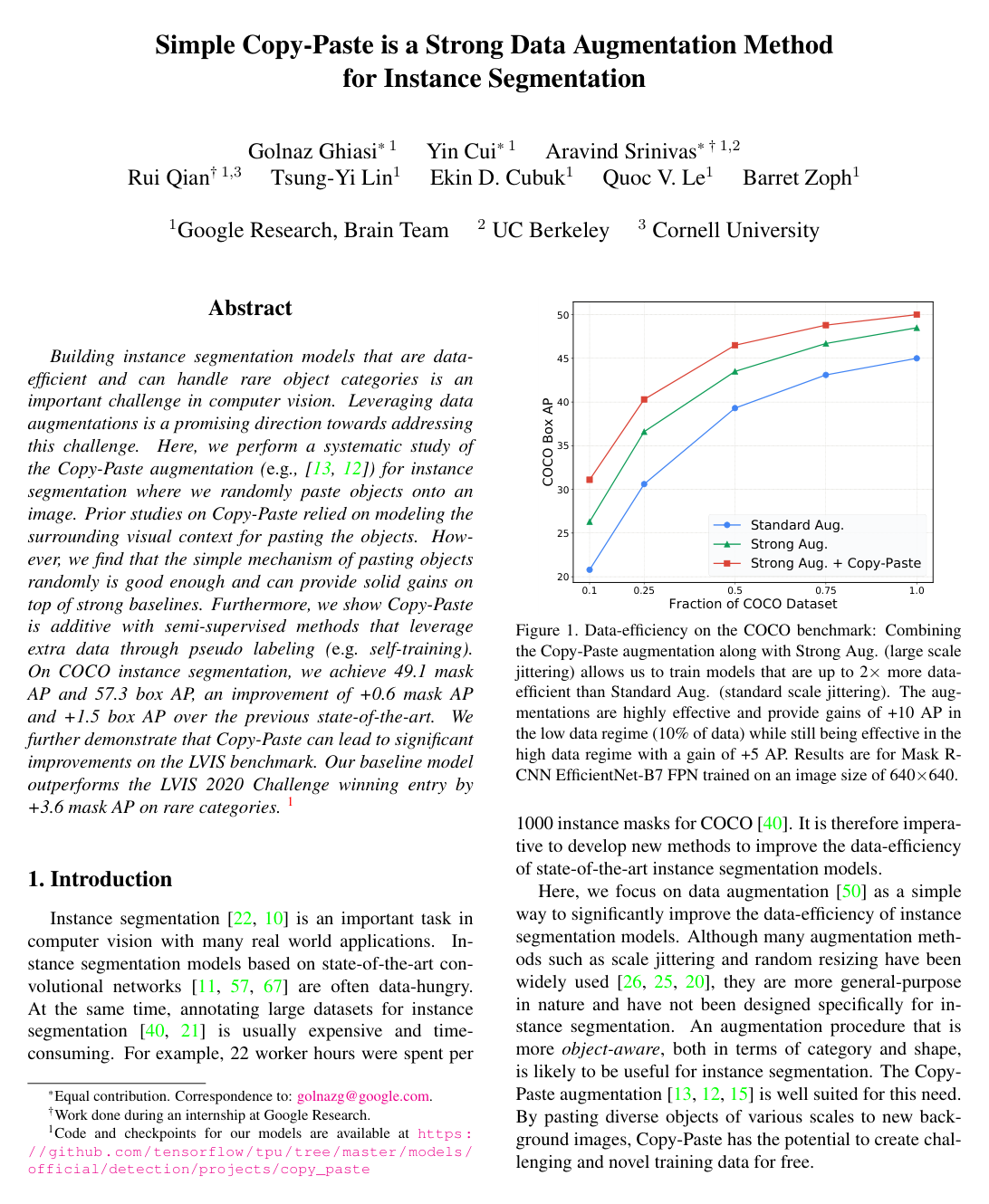
Simple Copy-Paste is a Strong Data Augmentation Method for Instance Segmentation
Golnaz Ghiasi, Yin Cui, Aravind Srinivas, Rui Qian, Tsung-Yi Lin, Ekin D. Cubuk, Quoc V. Le, Barret Zoph
Why you should read this
Demonstrates that randomly pasting objects onto training images without visual context modeling yields substantial performance gains on COCO and LVIS instance segmentation benchmarks, establishing a simple yet highly effective data augmentation strategy.
Building instance segmentation models that are data-efficient and can handle rare object categories is an important challenge in computer vision. Leveraging data augmentations is a promising direction towards addressing this challenge. Here, we perform a systematic study of the Copy-Paste augmentation ([13, 12]) for instance segmentation where we randomly paste objects onto an image. Prior studies on Copy-Paste relied on modeling the surrounding visual context for pasting the objects. However, we find that the simple mechanism of pasting objects randomly is good enough and can provide solid gains on top of strong baselines. Furthermore, we show Copy-Paste is additive with semi-supervised methods that leverage extra data through pseudo labeling (e.g. self-training). On COCO instance segmentation, we achieve 49.1 mask AP and 57.3 box AP, an improvement of +0.6 mask AP and +1.5 box AP over the previous state-of-the-art. We further demonstrate that Copy-Paste can lead to significant improvements on the LVIS benchmark. Our baseline model outperforms the LVIS 2020 Challenge winning entry by +3.6 mask AP on rare categories.
Added
2026-09-25
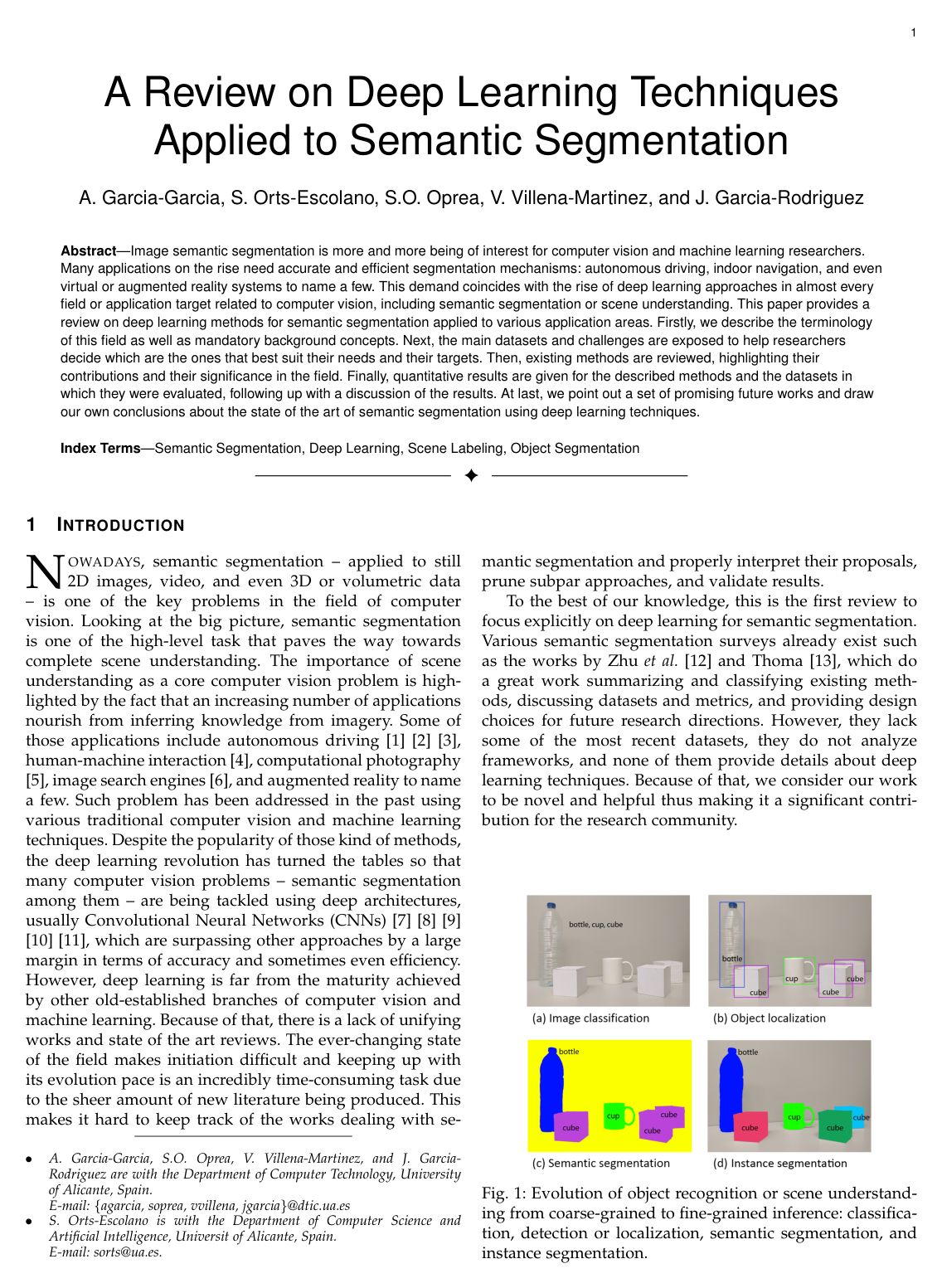
A Review on Deep Learning Techniques Applied to Semantic Segmentation
Alberto Garcia-Garcia, Sergio Orts-Escolano, Sergiu Oprea, Victor Villena-Martinez, Jose Garcia-Rodriguez
Why you should read this
Surveys deep learning methods for semantic segmentation by systematically categorizing leading architectures, comparing quantitative benchmark performance across standard datasets, and identifying key future research directions for computer vision applications.
Image semantic segmentation is more and more being of interest for computer vision and machine learning researchers. Many applications on the rise need accurate and efficient segmentation mechanisms: autonomous driving, indoor navigation, and even virtual or augmented reality systems to name a few. This demand coincides with the rise of deep learning approaches in almost every field or application target related to computer vision, including semantic segmentation or scene understanding. This paper provides a review on deep learning methods for semantic segmentation applied to various application areas. Firstly, we describe the terminology of this field as well as mandatory background concepts. Next, the main datasets and challenges are exposed to help researchers decide which are the ones that best suit their needs and their targets. Then, existing methods are reviewed, highlighting their contributions and their significance in the field. Finally, quantitative results are given for the described methods and the datasets in which they were evaluated, following up with a discussion of the results. At last, we point out a set of promising future works and draw our own conclusions about the state of the art of semantic segmentation using deep learning techniques.
Added
2026-09-25
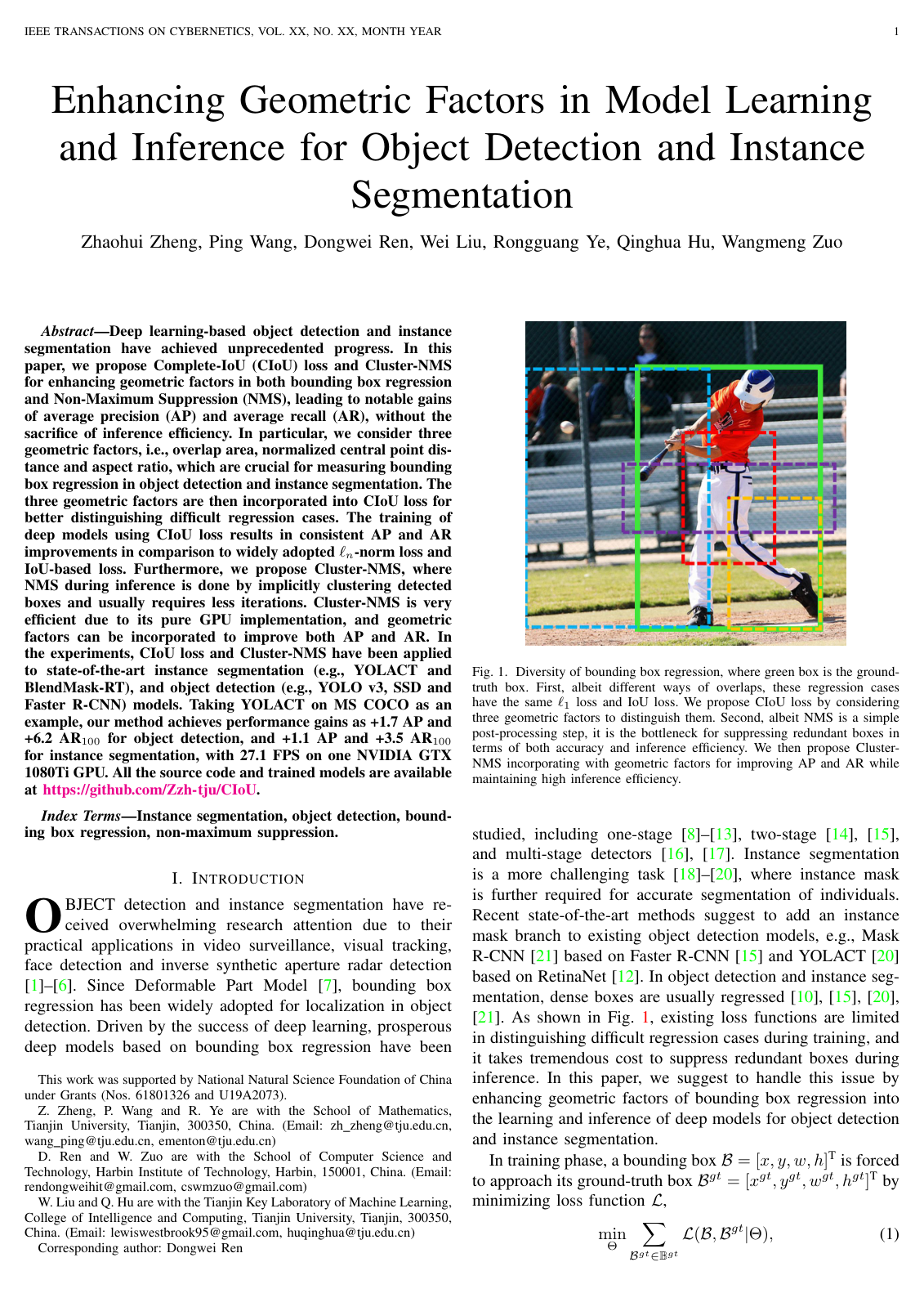
Enhancing Geometric Factors in Model Learning and Inference for Object Detection and Instance Segmentation
Zhaohui Zheng, Ping Wang, Dongwei Ren, Wei Liu, Rongguang Ye, Qinghua Hu, Wangmeng Zuo
Why you should read this
Proposes Complete-IoU loss and Cluster-NMS to integrate key geometric factors into bounding box regression and suppression, boosting object detection and instance segmentation accuracy across popular architectures without sacrificing real-time inference speed.
Deep learning-based object detection and instance segmentation have achieved unprecedented progress. In this paper, we propose Complete-IoU (CIoU) loss and Cluster-NMS for enhancing geometric factors in both bounding box regression and Non-Maximum Suppression (NMS), leading to notable gains of average precision (AP) and average recall (AR), without the sacrifice of inference efficiency. In particular, we consider three geometric factors, i.e., overlap area, normalized central point distance and aspect ratio, which are crucial for measuring bounding box regression in object detection and instance segmentation. The three geometric factors are then incorporated into CIoU loss for better distinguishing difficult regression cases. The training of deep models using CIoU loss results in consistent AP and AR improvements in comparison to widely adopted -norm loss and IoU-based loss. Furthermore, we propose Cluster-NMS, where NMS during inference is done by implicitly clustering detected boxes and usually requires less iterations. Cluster-NMS is very efficient due to its pure GPU implementation, and geometric factors can be incorporated to improve both AP and AR. In the experiments, CIoU loss and Cluster-NMS have been applied to state-of-the-art instance segmentation (e.g., YOLACT and BlendMask-RT), and object detection (e.g., YOLO v3, SSD and Faster R-CNN) models. Taking YOLACT on MS COCO as an example, our method achieves performance gains as +1.7 AP and +6.2 AR for object detection, and +0.9 AP and +3.5 AR for instance segmentation, with 27.1 FPS on one NVIDIA GTX 1080Ti GPU. All the source code and trained models are available at this https URL
Added
2026-09-25
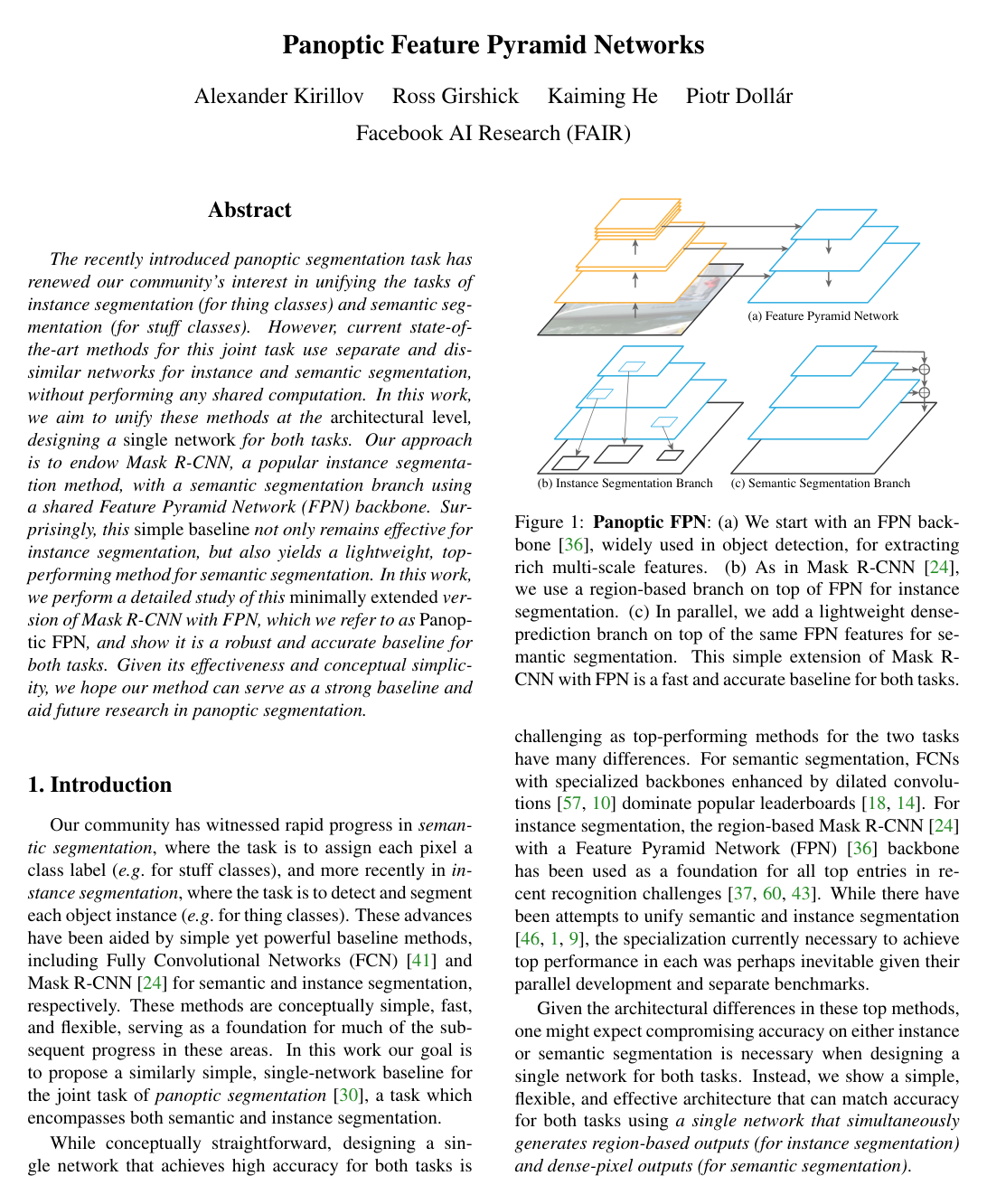
Panoptic Feature Pyramid Networks
Alexander Kirillov, Ross B. Girshick, Kaiming He, Piotr Dollár
Why you should read this
Presents Panoptic FPN, a simple yet highly effective framework that unifies instance and semantic segmentation into a single architecture by adding a lightweight semantic segmentation branch to Mask R-CNN over a shared Feature Pyramid Network backbone.
The recently introduced panoptic segmentation task has renewed our community's interest in unifying the tasks of instance segmentation (for thing classes) and semantic segmentation (for stuff classes). However, current state-of-the-art methods for this joint task use separate and dissimilar networks for instance and semantic segmentation, without performing any shared computation. In this work, we aim to unify these methods at the architectural level, designing a single network for both tasks. Our approach is to endow Mask R-CNN, a popular instance segmentation method, with a semantic segmentation branch using a shared Feature Pyramid Network (FPN) backbone. Surprisingly, this simple baseline not only remains effective for instance segmentation, but also yields a lightweight, top-performing method for semantic segmentation. In this work, we perform a detailed study of this minimally extended version of Mask R-CNN with FPN, which we refer to as Panoptic FPN, and show it is a robust and accurate baseline for both tasks. Given its effectiveness and conceptual simplicity, we hope our method can serve as a strong baseline and aid future research in panoptic segmentation.
Added
2026-09-24
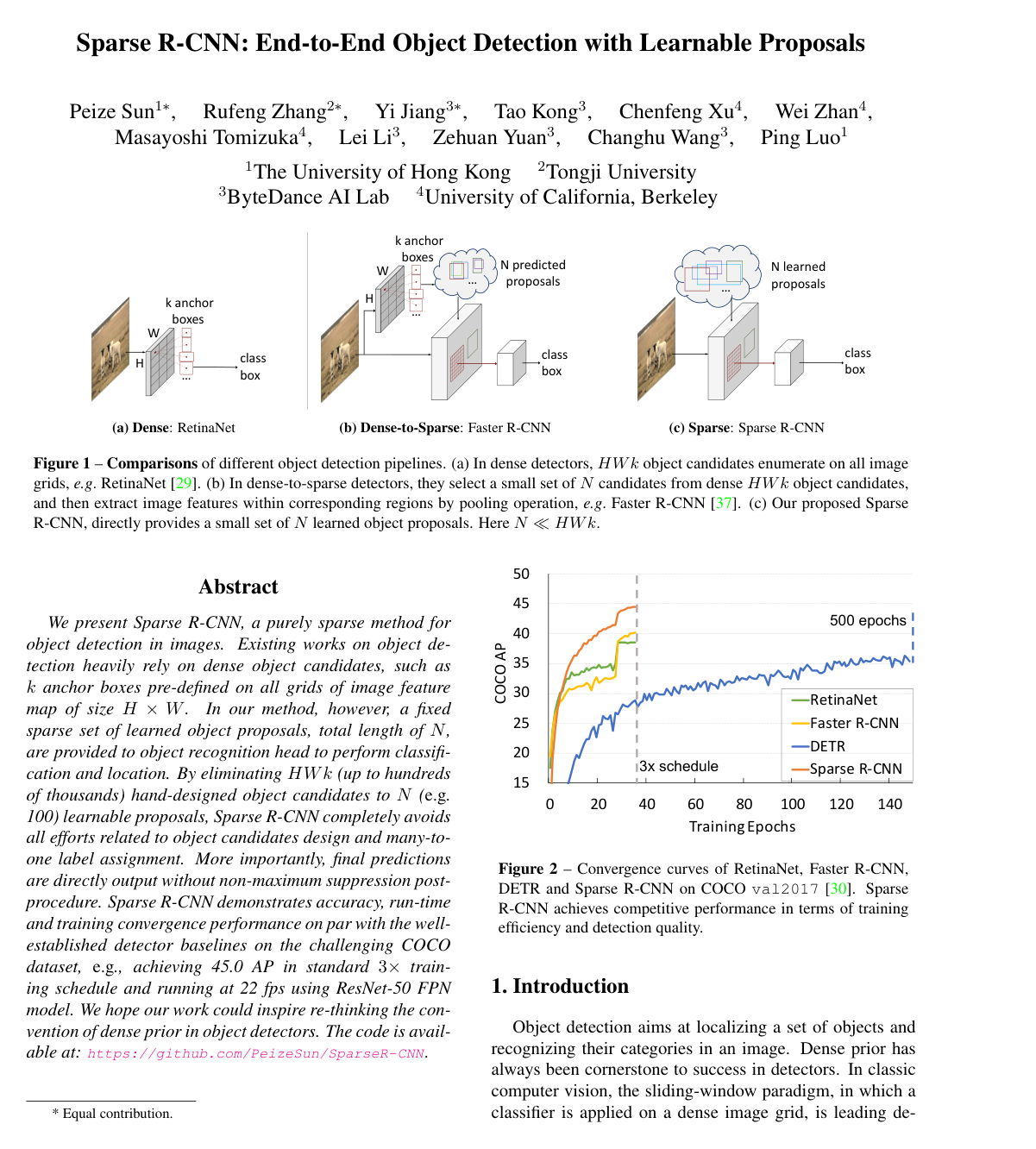
Sparse R-CNN: End-to-End Object Detection with Learnable Proposals
Peize Sun, Rufeng Zhang, Yi Jiang, Tao Kong, Chenfeng Xu, Wei Zhan, Masayoshi Tomizuka, Lei Li, Zehuan Yuan, Changhu Wang, Ping Luo
Why you should read this
Introduces Sparse R-CNN, a purely sparse object detection framework that replaces dense anchor boxes with a small set of learnable proposals, eliminating hand-designed candidates and non-maximum suppression while achieving competitive accuracy and speed on the COCO benchmark.
We present Sparse R-CNN, a purely sparse method for object detection in images. Existing works on object detection heavily rely on dense object candidates, such as anchor boxes pre-defined on all grids of image feature map of size . In our method, however, a fixed sparse set of learned object proposals, total length of , are provided to object recognition head to perform classification and location. By eliminating (up to hundreds of thousands) hand-designed object candidates to (e.g. 100) learnable proposals, Sparse R-CNN completely avoids all efforts related to object candidates design and many-to-one label assignment. More importantly, final predictions are directly output without non-maximum suppression post-procedure. Sparse R-CNN demonstrates accuracy, run-time and training convergence performance on par with the well-established detector baselines on the challenging COCO dataset, e.g., achieving 45.0 AP in standard training schedule and running at 22 fps using ResNet-50 FPN model. We hope our work could inspire re-thinking the convention of dense prior in object detectors. The code is available at: this https URL.
Added
2026-09-24
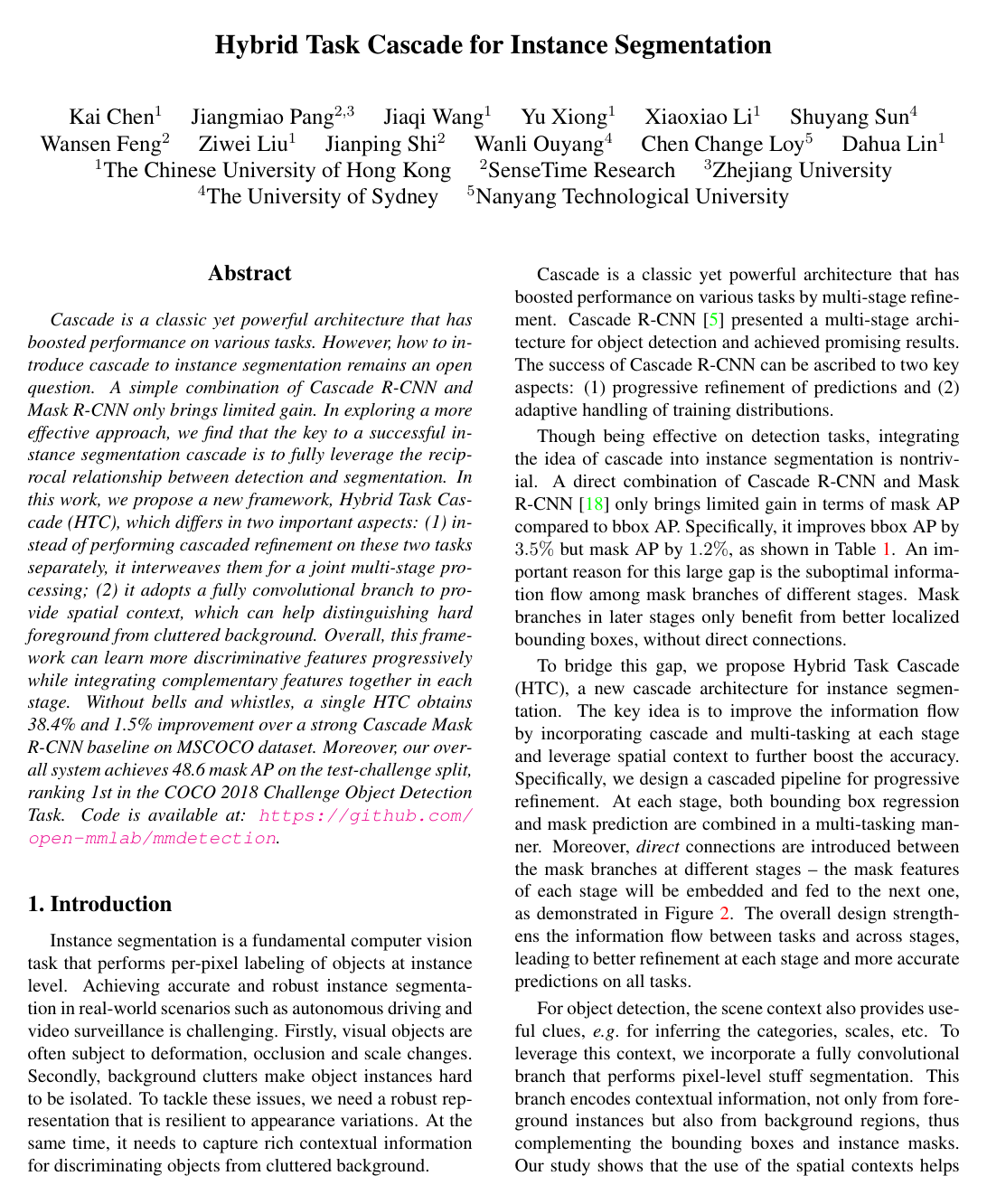
Hybrid Task Cascade for Instance Segmentation
Kai Chen, Jiangmiao Pang, Jiaqi Wang, Yu Xiong, Xiaoxiao Li, Shuyang Sun, Wansen Feng, Ziwei Liu, Jianping Shi, Wanli Ouyang, Chen Change Loy, Dahua Lin
Why you should read this
Introduces Hybrid Task Cascade (HTC), a multi-stage instance segmentation framework that interweaves detection and mask features while incorporating spatial context to achieve state-of-the-art performance on the COCO benchmark.
Cascade is a classic yet powerful architecture that has boosted performance on various tasks. However, how to introduce cascade to instance segmentation remains an open question. A simple combination of Cascade R-CNN and Mask R-CNN only brings limited gain. In exploring a more effective approach, we find that the key to a successful instance segmentation cascade is to fully leverage the reciprocal relationship between detection and segmentation. In this work, we propose a new framework, Hybrid Task Cascade (HTC), which differs in two important aspects: (1) instead of performing cascaded refinement on these two tasks separately, it interweaves them for a joint multi-stage processing; (2) it adopts a fully convolutional branch to provide spatial context, which can help distinguishing hard foreground from cluttered background. Overall, this framework can learn more discriminative features progressively while integrating complementary features together in each stage. Without bells and whistles, a single HTC obtains 38.4 and 1.5 improvement over a strong Cascade Mask R-CNN baseline on MSCOCO dataset. Moreover, our overall system achieves 48.6 mask AP on the test-challenge split, ranking 1st in the COCO 2018 Challenge Object Detection Task. Code is available at: this https URL.
Added
2026-09-24
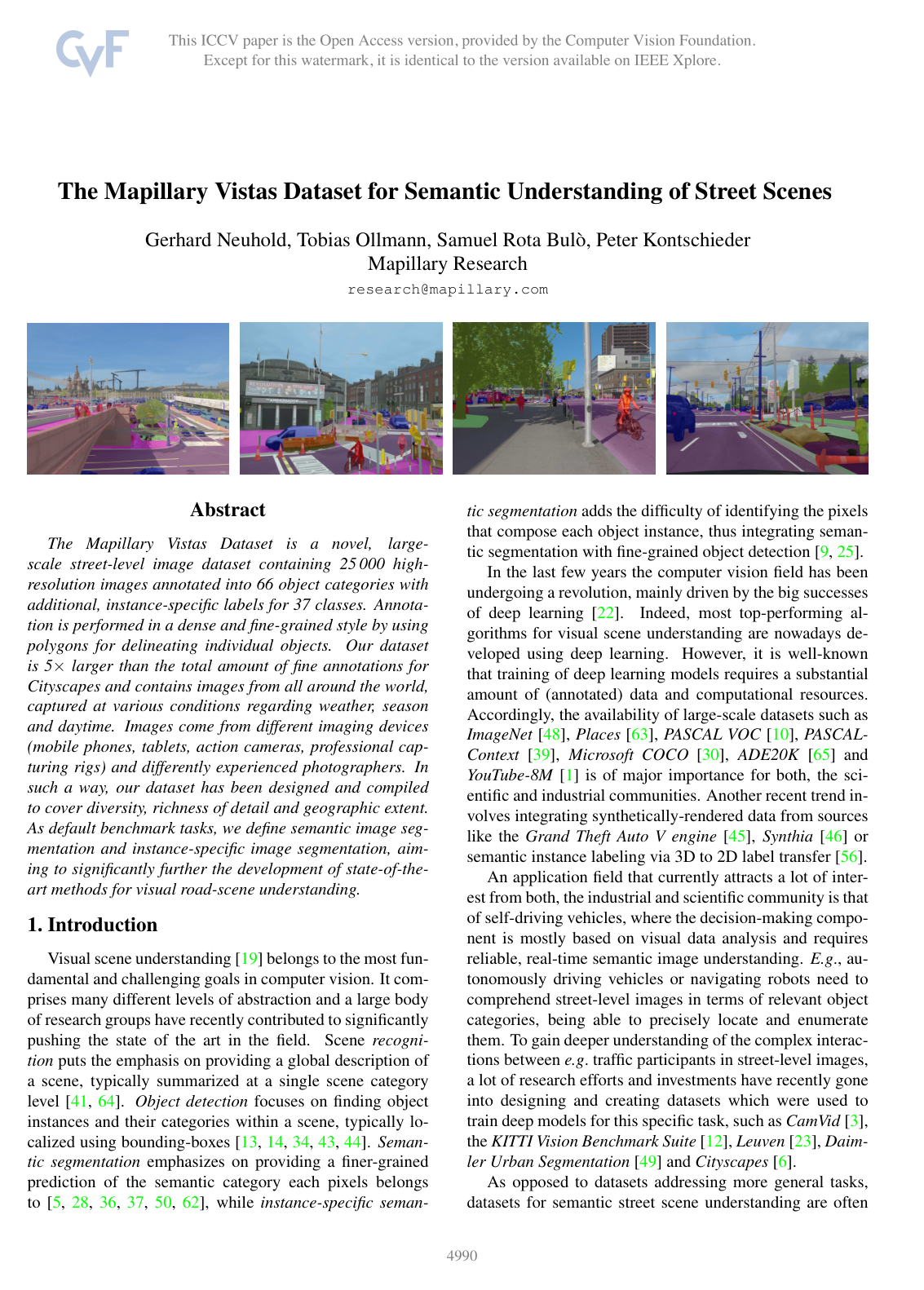
The Mapillary Vistas Dataset for Semantic Understanding of Street Scenes
Gerhard Neuhold, Tobias Ollmann, S. R. Bulò, P. Kontschieder
Why you should read this
Introduces a globally diverse, high-resolution dataset of 25,000 street-level images with polygon-level annotations across 66 semantic categories to advance autonomous driving perception beyond the geographic and environmental limits of existing benchmarks.
The Mapillary Vistas Dataset is a novel, large-scale street-level image dataset containing 25 000 high-resolution images annotated into 66 object categories with additional, instance-specific labels for 37 classes. Annotation is performed in a dense and fine-grained style by using polygons for delineating individual objects. Our dataset is 5× larger than the total amount of fine annotations for Cityscapes and contains images from all around the world, captured at various conditions regarding weather, season and daytime. Images come from different imaging devices (mobile phones, tablets, action cameras, professional capturing rigs) and differently experienced photographers. In such a way, our dataset has been designed and compiled to cover diversity, richness of detail and geographic extent. As default benchmark tasks, we define semantic image segmentation and instance-specific image segmentation, aiming to significantly further the development of state-of-the-art methods for visual road-scene understanding.
Added
2026-09-24
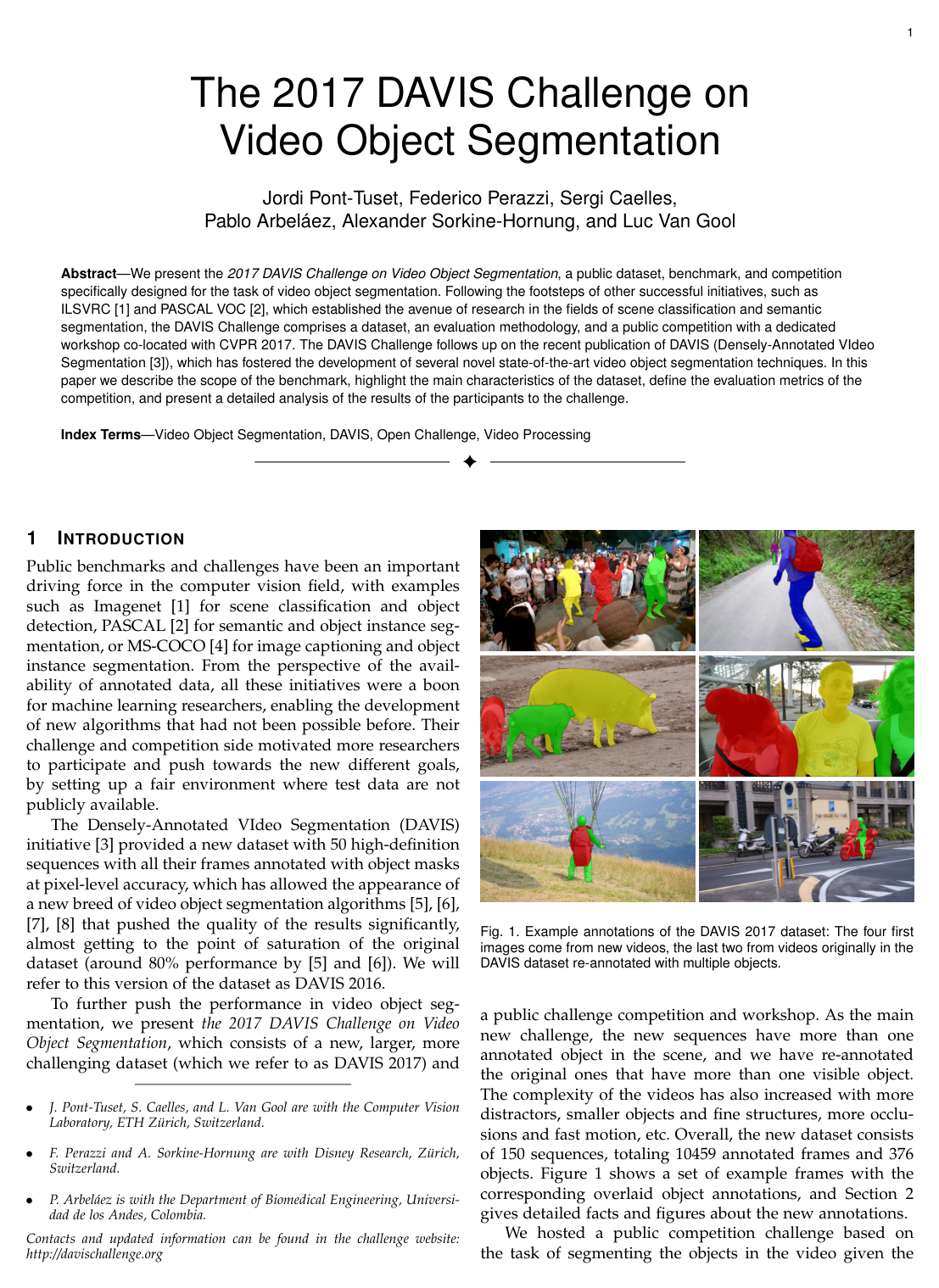
The 2017 DAVIS Challenge on Video Object Segmentation
Jordi Pont-Tuset, Federico Perazzi, Sergi Caelles, Pablo Arbeláez, Alex Sorkine-Hornung, Luc Van Gool
Why you should read this
Establishes a standardized benchmark for video object segmentation by introducing an expanded multi-object dataset, formal evaluation metrics, and a comparative performance analysis of top-performing methods.
We present the 2017 DAVIS Challenge on Video Object Segmentation, a public dataset, benchmark, and competition specifically designed for the task of video object segmentation. Following the footsteps of other successful initiatives, such as ILSVRC and PASCAL VOC, which established the avenue of research in the fields of scene classification and semantic segmentation, the DAVIS Challenge comprises a dataset, an evaluation methodology, and a public competition with a dedicated workshop co-located with CVPR 2017. The DAVIS Challenge follows up on the recent publication of DAVIS (Densely-Annotated VIdeo Segmentation), which has fostered the development of several novel state-of-the-art video object segmentation techniques. In this paper we describe the scope of the benchmark, highlight the main characteristics of the dataset, define the evaluation metrics of the competition, and present a detailed analysis of the results of the participants to the challenge.
Added
2026-09-24