
keyword
image inpainting
Image inpainting is a computer vision and digital image processing task that involves reconstructing missing, damaged, or intentionally masked regions within an image to produce a complete and visually plausible result. The primary objective is to synthesize new content for the omitted areas so that they blend seamlessly with the surrounding unmasked context, maintaining consistency across both fine local textures and broad semantic structures. Widely applied in digital photograph restoration, unwanted object removal, and image editing, contemporary inpainting techniques employ generative deep learning architectures, such as convolutional networks, transformers, and diffusion models, alongside traditional patch-based and filtering methods, to hallucinate realistic structures that appear natural and unedited.
7 items
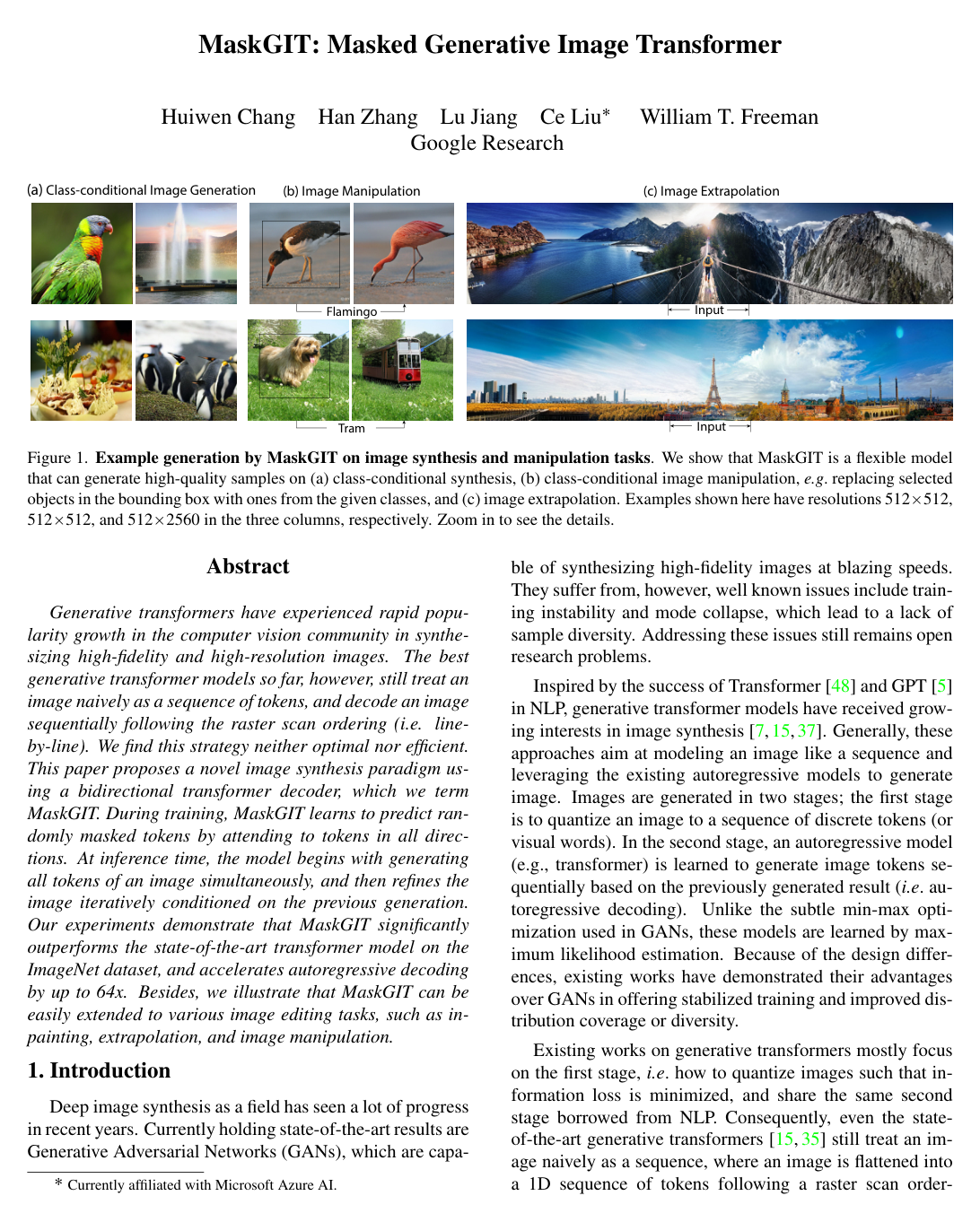
MaskGIT: Masked Generative Image Transformer
Huiwen Chang, Han Zhang, Lu Jiang, Ce Liu, William T. Freeman
Why you should read this
Proposes a bidirectional masked transformer that replaces sequential autoregressive decoding with iterative parallel generation, accelerating image synthesis by up to 64x while improving visual quality and enabling flexible image editing.
Generative transformers have experienced rapid popularity growth in the computer vision community in synthesizing high-fidelity and high-resolution images. The best generative transformer models so far, however, still treat an image naively as a sequence of tokens, and decode an image sequentially following the raster scan ordering (i.e. line-by-line). We find this strategy neither optimal nor efficient. This paper proposes a novel image synthesis paradigm using a bidirectional transformer decoder, which we term MaskGIT. During training, MaskGIT learns to predict randomly masked tokens by attending to tokens in all directions. At inference time, the model begins with generating all tokens of an image simultaneously, and then refines the image iteratively conditioned on the previous generation. Our experiments demonstrate that MaskGIT significantly outperforms the state-of-the-art transformer model on the ImageNet dataset, and accelerates autoregressive decoding by up to 64x. Besides, we illustrate that MaskGIT can be easily extended to various image editing tasks, such as inpainting, extrapolation, and image manipulation.
Added
2026-10-04
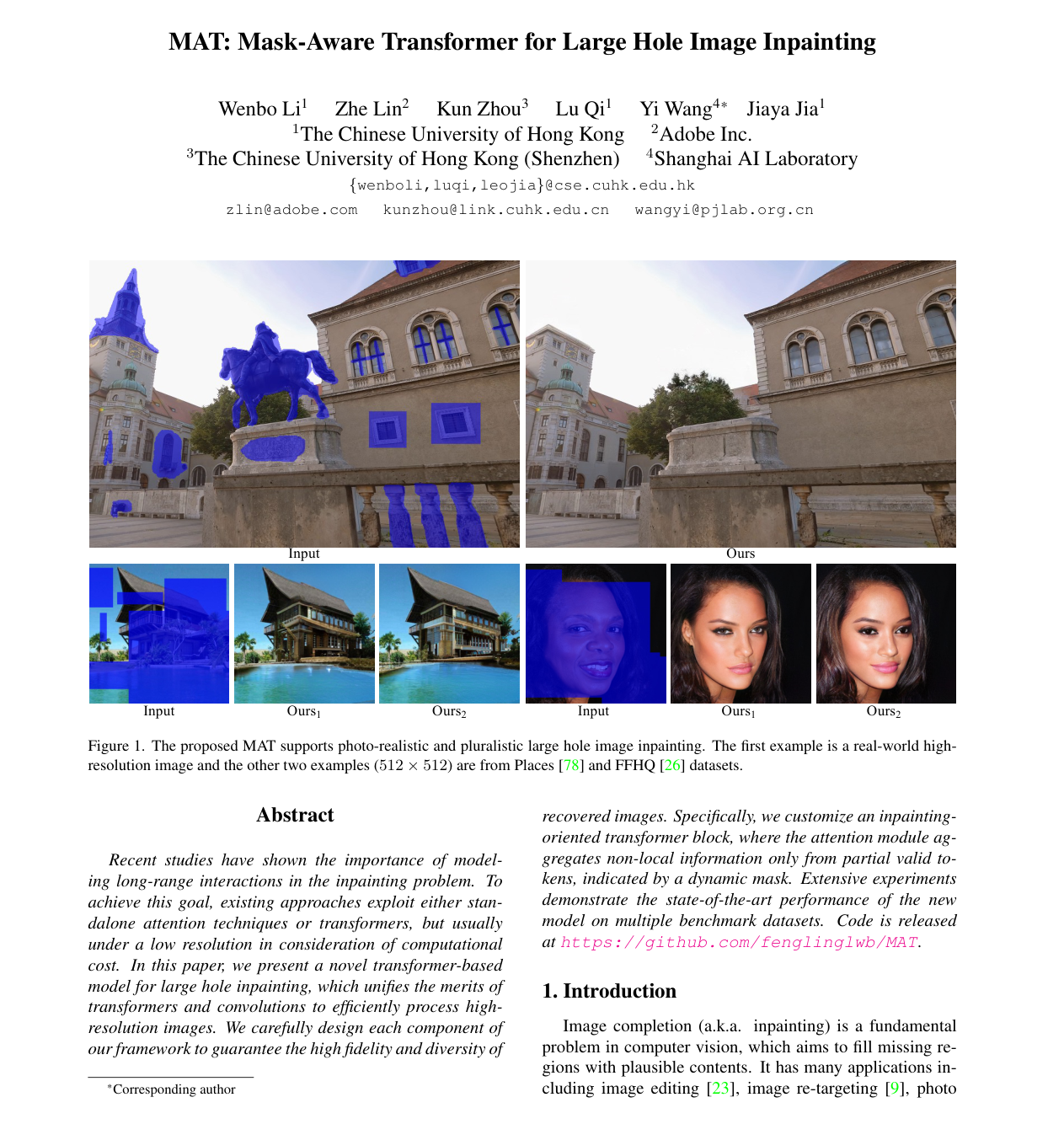
MAT: Mask-Aware Transformer for Large Hole Image Inpainting
Wenbo Li, Zhe Lin, Kun Zhou, Lu Qi, Yi Wang, Jiaya Jia
Why you should read this
Develops a mask-aware transformer that restricts attention computation to valid image tokens, enabling efficient high-resolution inpainting of large missing regions with high fidelity and diversity.
Recent studies have shown the importance of modeling long-range interactions in the inpainting problem. To achieve this goal, existing approaches exploit either standalone attention techniques or transformers, but usually under a low resolution in consideration of computational cost. In this paper, we present a novel transformer-based model for large hole inpainting, which unifies the merits of transformers and convolutions to efficiently process high-resolution images. We carefully design each component of our framework to guarantee the high fidelity and diversity of recovered images. Specifically, we customize an inpainting-oriented transformer block, where the attention module aggregates non-local information only from partial valid tokens, indicated by a dynamic mask. Extensive experiments demonstrate the state-of-the-art performance of the new model on multiple benchmark datasets. Code is released at this https URL.
Added
2026-09-26
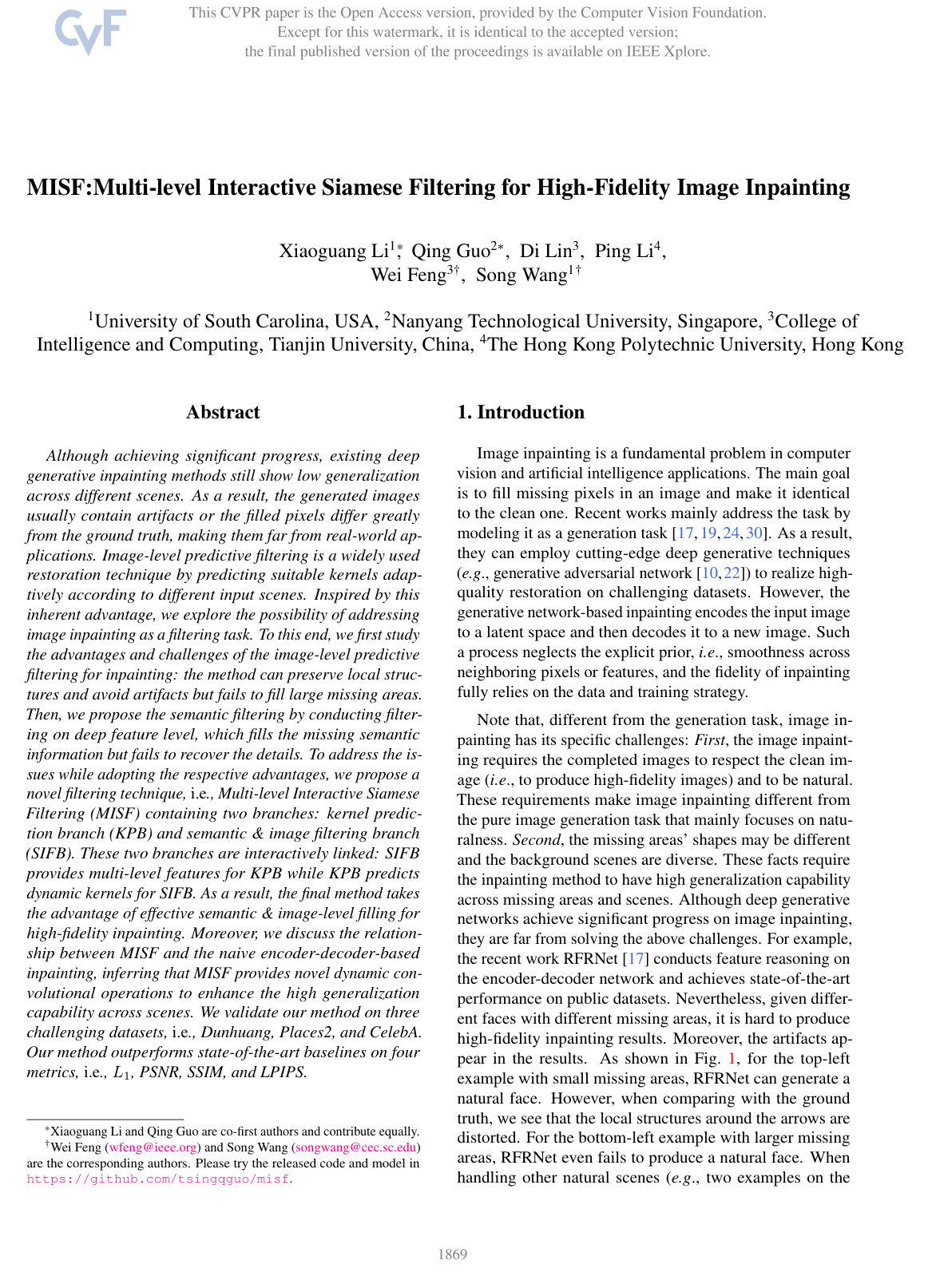
MISF: Multi-level Interactive Siamese Filtering for High-Fidelity Image Inpainting
Xiaoguang Li, Qing Guo, Di Lin, Ping Li, Wei Feng, Song Wang
Why you should read this
Proposes Multi-level Interactive Siamese Filtering, a dual-branch framework that couples dynamic kernel prediction with feature- and image-level filtering to reduce visual artifacts and improve generalization across diverse inpainting benchmarks.
Although achieving significant progress, existing deep generative inpainting methods still show low generalization across different scenes. As a result, the generated images usually contain artifacts or the filled pixels differ greatly from the ground truth, making them far from real-world applications. Image-level predictive filtering is a widely used restoration technique by predicting suitable kernels adaptively according to different input scenes. Inspired by this inherent advantage, we explore the possibility of addressing image inpainting as a filtering task. To this end, we first study the advantages and challenges of the image-level predictive filtering for inpainting: the method can preserve local structures and avoid artifacts but fails to fill large missing areas. Then, we propose the semantic filtering by conducting filtering on deep feature level, which fills the missing semantic information but fails to recover the details. To address the issues while adopting the respective advantages, we propose a novel filtering technique, i.e., Multi-level Interactive Siamese Filtering (MISF) containing two branches: kernel prediction branch (KPB) and semantic & image filtering branch (SIFB). These two branches are interactively linked: SIFB provides multi-level features for KPB while KPB predicts dynamic kernels for SIFB. As a result, the final method takes the advantage of effective semantic & image-level filling for high-fidelity inpainting. Moreover, we discuss the relationship between MISF and the naive encoder-decoder-based inpainting, inferring that MISF provides novel dynamic convolutional operations to enhance the high generalization capability across scenes. We validate our method on three challenging datasets, i.e., Dunhuang, Places2, and CelebA. Our method outperforms state-of-the-art baselines on four metrics, i.e., L1, PSNR, SSIM, and LPIPS.
Added
2026-09-26
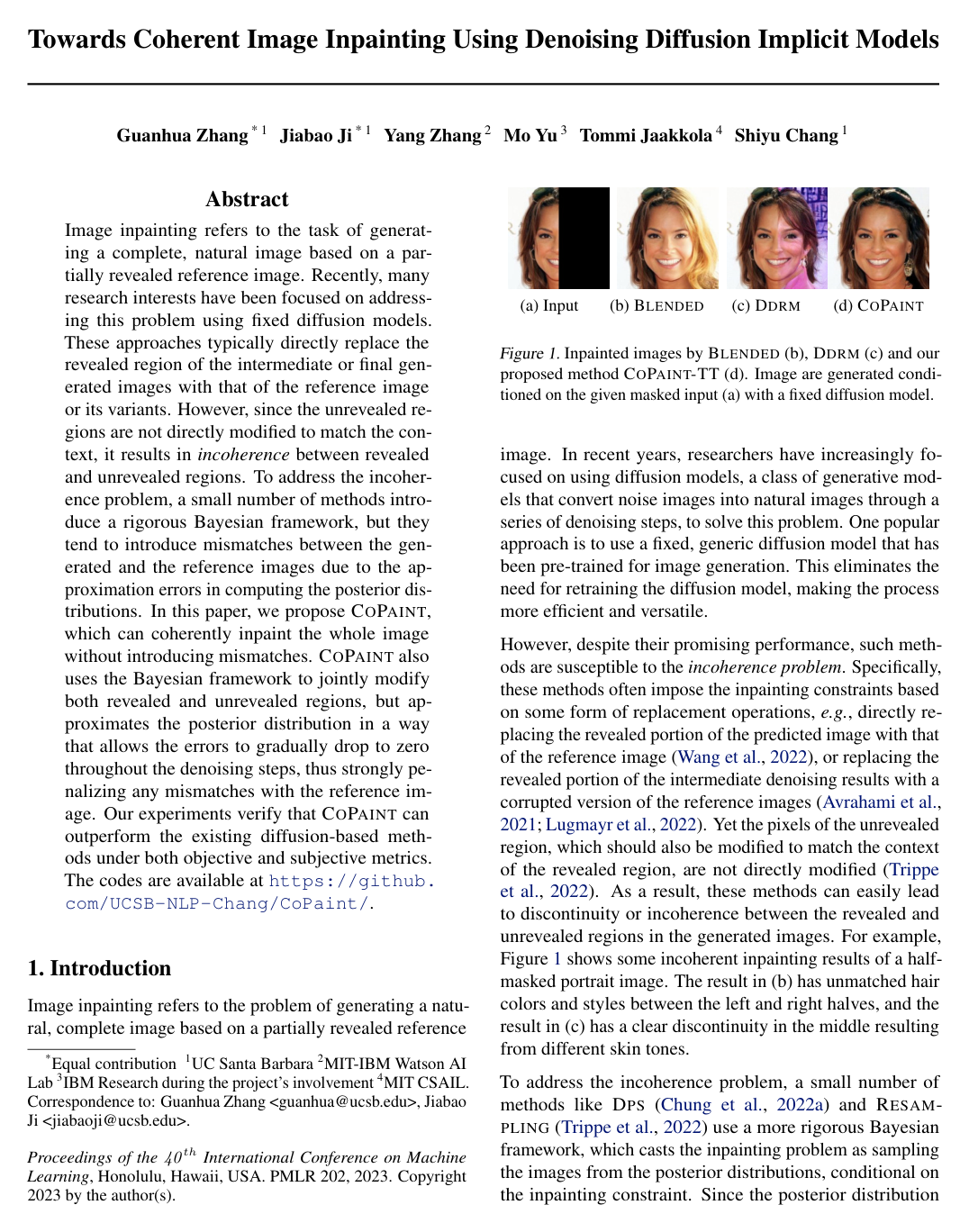
Towards Coherent Image Inpainting Using Denoising Diffusion Implicit Models
Guanhua Zhang, Jiabao Ji, Yang Zhang, Mo Yu, Tommi S. Jaakkola, Shiyu Chang
Why you should read this
Proposes CoPaint, a Bayesian framework for diffusion-based image inpainting that jointly modifies revealed and unrevealed regions to eliminate incoherence while driving approximation errors to zero to strictly match reference constraints.
Image inpainting refers to the task of generating a complete, natural image based on a partially revealed reference image. Recently, many research interests have been focused on addressing this problem using fixed diffusion models. These approaches typically directly replace the revealed region of the intermediate or final generated images with that of the reference image or its variants. However, since the unrevealed regions are not directly modified to match the context, it results in incoherence between revealed and unrevealed regions. To address the incoherence problem, a small number of methods introduce a rigorous Bayesian framework, but they tend to introduce mismatches between the generated and the reference images due to the approximation errors in computing the posterior distributions. In this paper, we propose CoPaint, which can coherently inpaint the whole image without introducing mismatches. CoPaint also uses the Bayesian framework to jointly modify both revealed and unrevealed regions, but approximates the posterior distribution in a way that allows the errors to gradually drop to zero throughout the denoising steps, thus strongly penalizing any mismatches with the reference image. Our experiments verify that CoPaint can outperform the existing diffusion-based methods under both objective and subjective metrics. The codes are available at https://github.com/UCSB-NLP-Chang/CoPaint/.
Added
2026-09-26
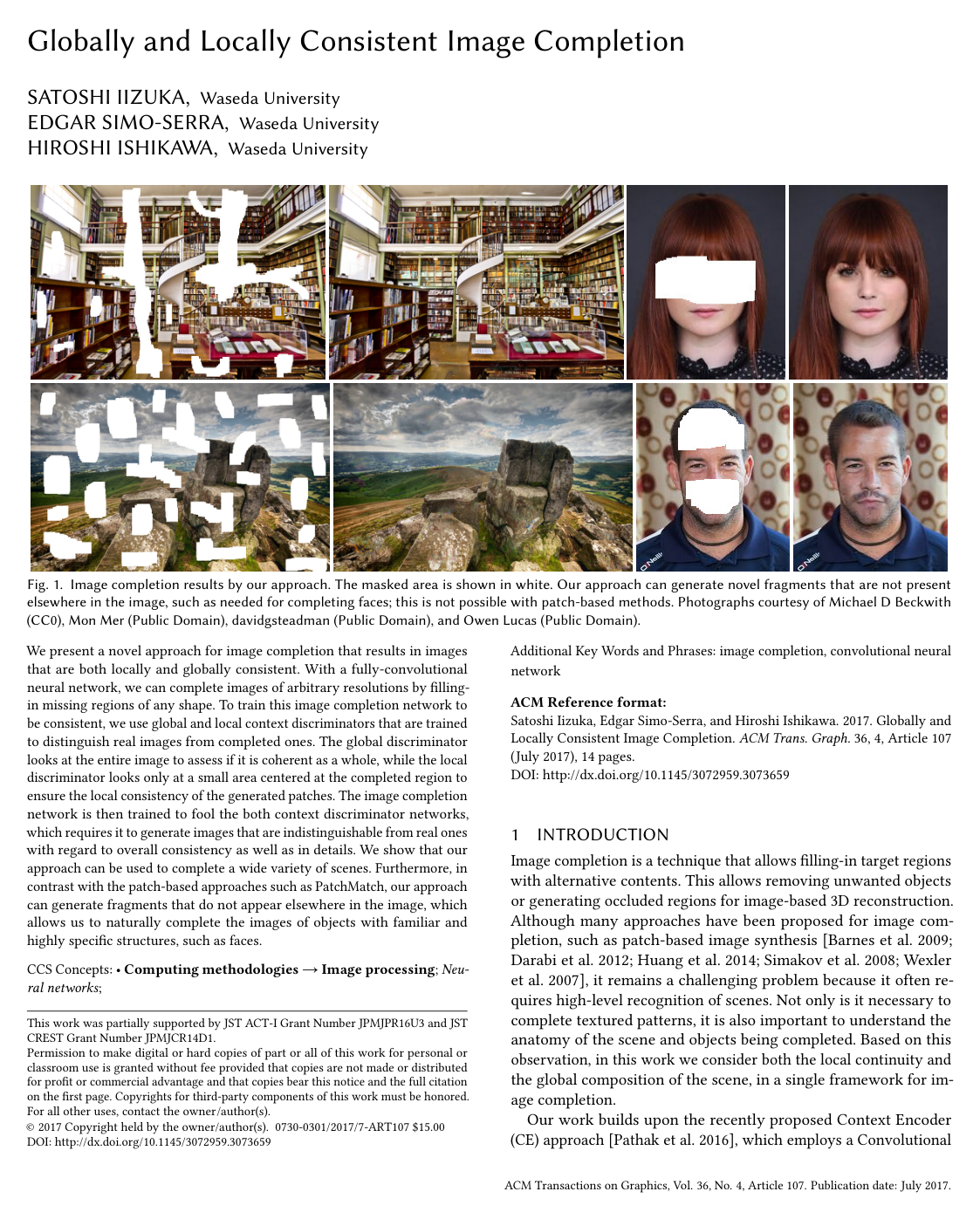
Globally and locally consistent image completion
SATOSHI IIZUKA, EDGAR SIMO-SERRA, HIROSHI ISHIKAWA
Why you should read this
Proposes a fully convolutional image completion framework trained with dual global and local context discriminators, enabling realistic synthesis of arbitrary-shaped missing regions while preserving both fine local details and overall semantic coherence across diverse scenes.
We present a novel approach for image completion that results in images that are both locally and globally consistent. With a fully-convolutional neural network, we can complete images of arbitrary resolutions by filling-in missing regions of any shape. To train this image completion network to be consistent, we use global and local context discriminators that are trained to distinguish real images from completed ones. The global discriminator looks at the entire image to assess if it is coherent as a whole, while the local discriminator looks only at a small area centered at the completed region to ensure the local consistency of the generated patches. The image completion network is then trained to fool the both context discriminator networks, which requires it to generate images that are indistinguishable from real ones with regard to overall consistency as well as in details. We show that our approach can be used to complete a wide variety of scenes. Furthermore, in contrast with the patch-based approaches such as PatchMatch, our approach can generate fragments that do not appear elsewhere in the image, which allows us to naturally complete the images of objects with familiar and highly specific structures, such as faces.
Added
2026-09-16
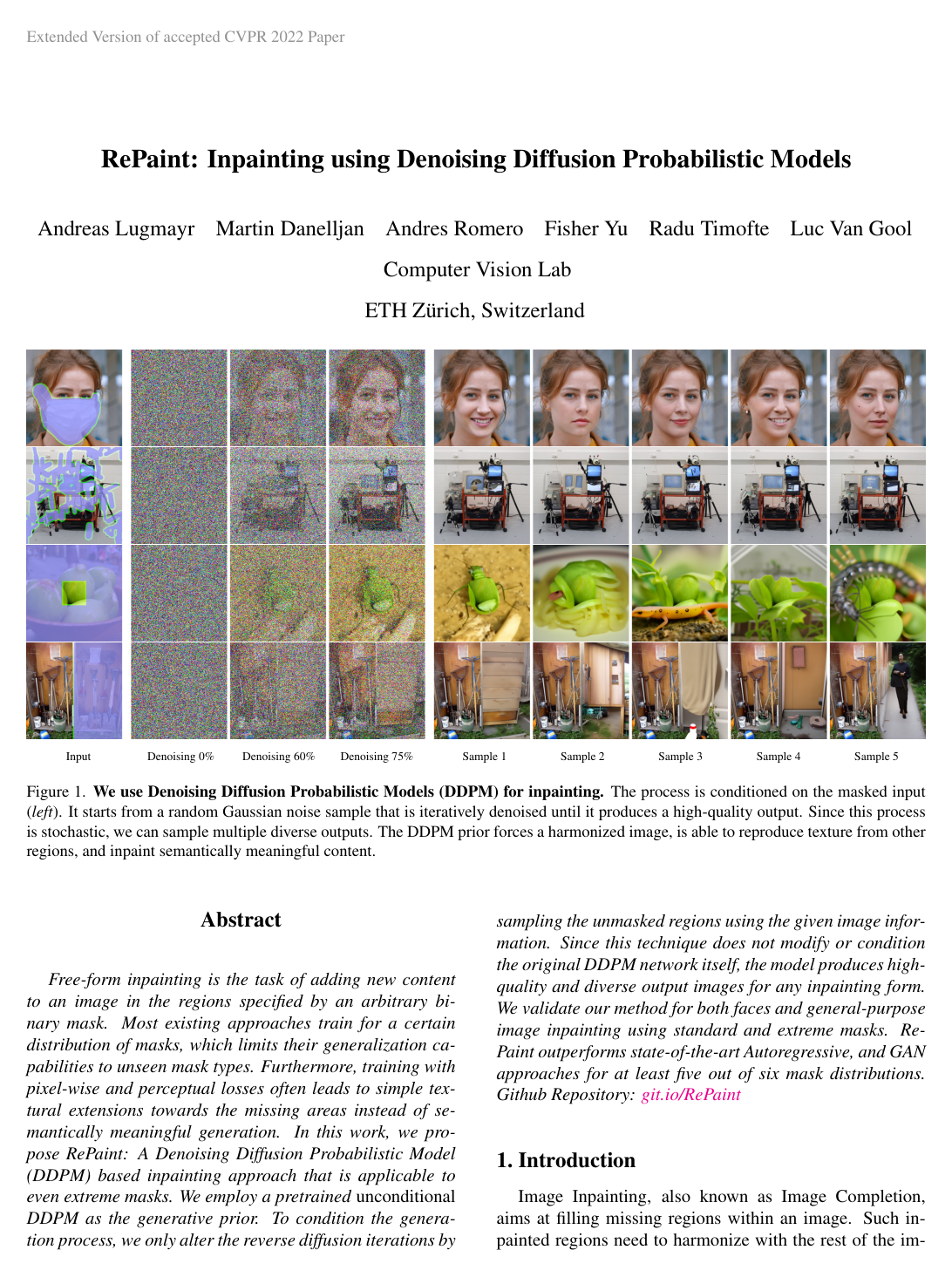
RePaint: Inpainting using Denoising Diffusion Probabilistic Models
Andreas Lugmayr, Martin Danelljan, Andres Romero, Fisher Yu, Radu Timofte, Luc Van Gool
Why you should read this
Proposes RePaint, an image inpainting method that conditions pretrained unconditional diffusion models during reverse sampling without retraining, achieving state-of-the-art results on arbitrary and extreme masks.
Free-form inpainting is the task of adding new content to an image in the regions specified by an arbitrary binary mask. Most existing approaches train for a certain distribution of masks, which limits their generalization capabilities to unseen mask types. Furthermore, training with pixel-wise and perceptual losses often leads to simple textural extensions towards the missing areas instead of semantically meaningful generation. In this work, we propose RePaint: A Denoising Diffusion Probabilistic Model (DDPM) based inpainting approach that is applicable to even extreme masks. We employ a pretrained unconditional DDPM as the generative prior. To condition the generation process, we only alter the reverse diffusion iterations by sampling the unmasked regions using the given image information. Since this technique does not modify or condition the original DDPM network itself, the model produces high-quality and diverse output images for any inpainting form. We validate our method for both faces and general-purpose image inpainting using standard and extreme masks. RePaint outperforms state-of-the-art Autoregressive, and GAN approaches for at least five out of six mask distributions. Github Repository: this http URL
Added
2026-09-16
Image Inpainting for Irregular Holes Using Partial Convolutions
Guilin Liu, Fitsum A. Reda, Kevin J. Shih, Ting-Chun Wang, Andrew Tao, Bryan Catanzaro
Why you should read this
Proposes partial convolutions with automatic mask updating to condition convolutional operations exclusively on valid pixels, successfully eliminating visual artifacts and the need for post-processing in irregular image inpainting.
Existing deep learning based image inpainting methods use a standard convolutional network over the corrupted image, using convolutional filter responses conditioned on both valid pixels as well as the substitute values in the masked holes (typically the mean value). This often leads to artifacts such as color discrepancy and blurriness. Post-processing is usually used to reduce such artifacts, but are expensive and may fail. We propose the use of partial convolutions, where the convolution is masked and renormalized to be conditioned on only valid pixels. We further include a mechanism to automatically generate an updated mask for the next layer as part of the forward pass. Our model outperforms other methods for irregular masks. We show qualitative and quantitative comparisons with other methods to validate our approach.
Added
2026-09-15