
keyword
hierarchical learning
Hierarchical learning is a machine learning framework that organizes the acquisition of features, representations, or decision-making policies across multiple levels of abstraction or granularity. In this paradigm, lower tiers capture fine-grained, localized details or elementary structures, while higher tiers integrate these components to represent broader contexts, global patterns, or complex semantic concepts. This multi-level organization enables learning systems to decompose intricate, high-dimensional tasks into structured sub-problems, facilitating the progressive construction of high-level understanding from basic elements across temporal scales, spatial domains, or representational depths.
2 items
How Two-Layer Neural Networks Learn, One (Giant) Step at a Time
Yatin Dandi, Florent Krzakala, Bruno Loureiro, Luca Pesce, Ludovic Stephan
Why you should read this
Establishes exact sample complexity bounds showing how two-layer neural networks escape the lazy regime and learn multi-index target directions across single and multiple gradient descent steps.
For high-dimensional Gaussian data, we investigate theoretically how the features of a two-layer neural network adapt to the structure of the target function through a few large batch gradient descent steps, leading to an improvement in the approximation capacity with respect to the initialization. First, we compare the influence of batch size to that of multiple (but finitely many) steps. For a single gradient step, a batch of size n = O(d) is both necessary and sufficient to align with the target function, although only a single direction can be learned. In contrast, n = O(d²) is essential for neurons to specialize in multiple relevant directions of the target with a single gradient step. Even in this case, we show there might exist “hard” directions requiring n = O(d^ℓ) samples to be learned, where ℓ is known as the leap index of the target. Second, we show that the picture drastically improves over multiple gradient steps: a batch size of n = O(d) is indeed sufficient to learn multiple target directions satisfying a staircase property, where more and more directions can be learned over time. Finally, we discuss how these directions allow for a drastic improvement in the approximation capacity and generalization error over the initialization, illustrating a separation of scale between the random features/lazy regime and the feature learning regime. Our technical analysis leverages a combination of techniques related to concentration, projection-based conditioning, and Gaussian equivalence, which we believe are of independent interest. By pinning down the conditions necessary for specialization and learning, our results highlight the intertwined role of the structure of the task to
Added
2026-10-03
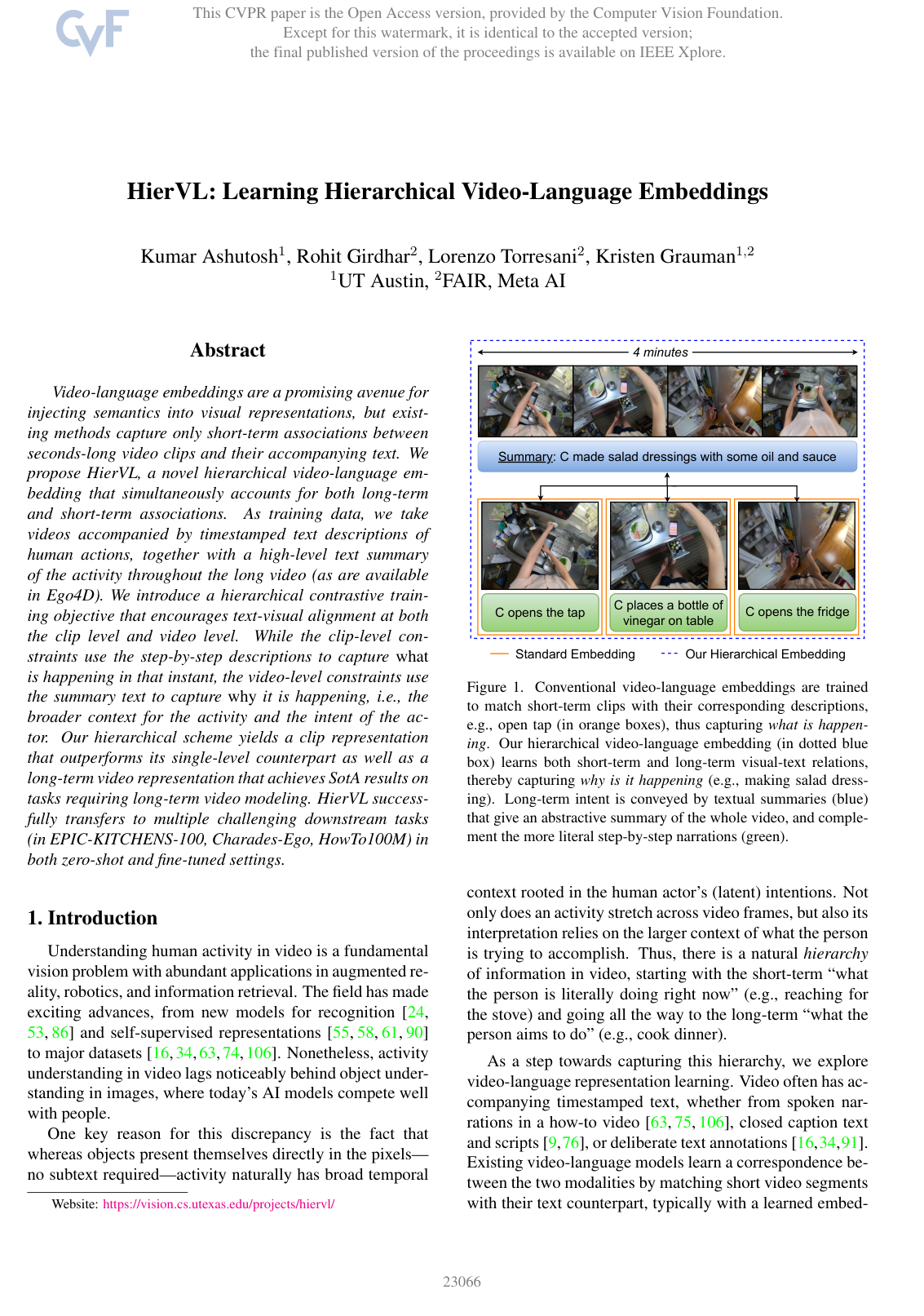
HierVL: Learning Hierarchical Video-Language Embeddings
Kumar Ashutosh, Rohit Girdhar, Lorenzo Torresani, Kristen Grauman
Why you should read this
Proposes a hierarchical video-language framework that jointly aligns short-term action clips with step-by-step descriptions and aggregated video features with abstract summaries to capture both immediate actions and long-term actor intent.
Video-language embeddings are a promising avenue for injecting semantics into visual representations, but existing methods capture only short-term associations between seconds-long video clips and their accompanying text. We propose HierVL, a novel hierarchical video-language embedding that simultaneously accounts for both long-term and short-term associations. As training data, we take videos accompanied by timestamped text descriptions of human actions, together with a high-level text summary of the activity throughout the long video (as are available in Ego4D). We introduce a hierarchical contrastive training objective that encourages text-visual alignment at both the clip level and video level. While the clip-level constraints use the step-by-step descriptions to capture what is happening in that instant, the video-level constraints use the summary text to capture why it is happening, i.e., the broader context for the activity and the intent of the actor. Our hierarchical scheme yields a clip representation that outperforms its single-level counterpart as well as a long-term video representation that achieves SotA results on tasks requiring long-term video modeling. HierVL successfully transfers to multiple challenging downstream tasks (in EPIC-KITCHENS-100, Charades-Ego, HowTo100M) in both zero-shot and fine-tuned settings.
Added
2026-09-26