
keyword
hallucination evaluation
Hallucination evaluation is the systematic process of detecting, measuring, and analyzing instances where artificial intelligence models generate information that is factually incorrect, unsubstantiated, or inconsistent with provided source data and context. Applied primarily to natural language processing, large language models, and vision-language systems, it quantifies how frequently and severely a model fabricates facts, misinterprets input documents, or contradicts visual and textual evidence. This assessment utilizes standardized benchmark datasets, automated scoring metrics, model-based probing, and human annotation across various generative tasks, such as summarization, dialogue, question answering, and retrieval-augmented generation. By establishing objective criteria for model reliability and factual fidelity, hallucination evaluation helps researchers and developers identify vulnerability patterns, compare model architectures, and design effective mitigation strategies to improve the safety and trustworthiness of generated content.
6 items
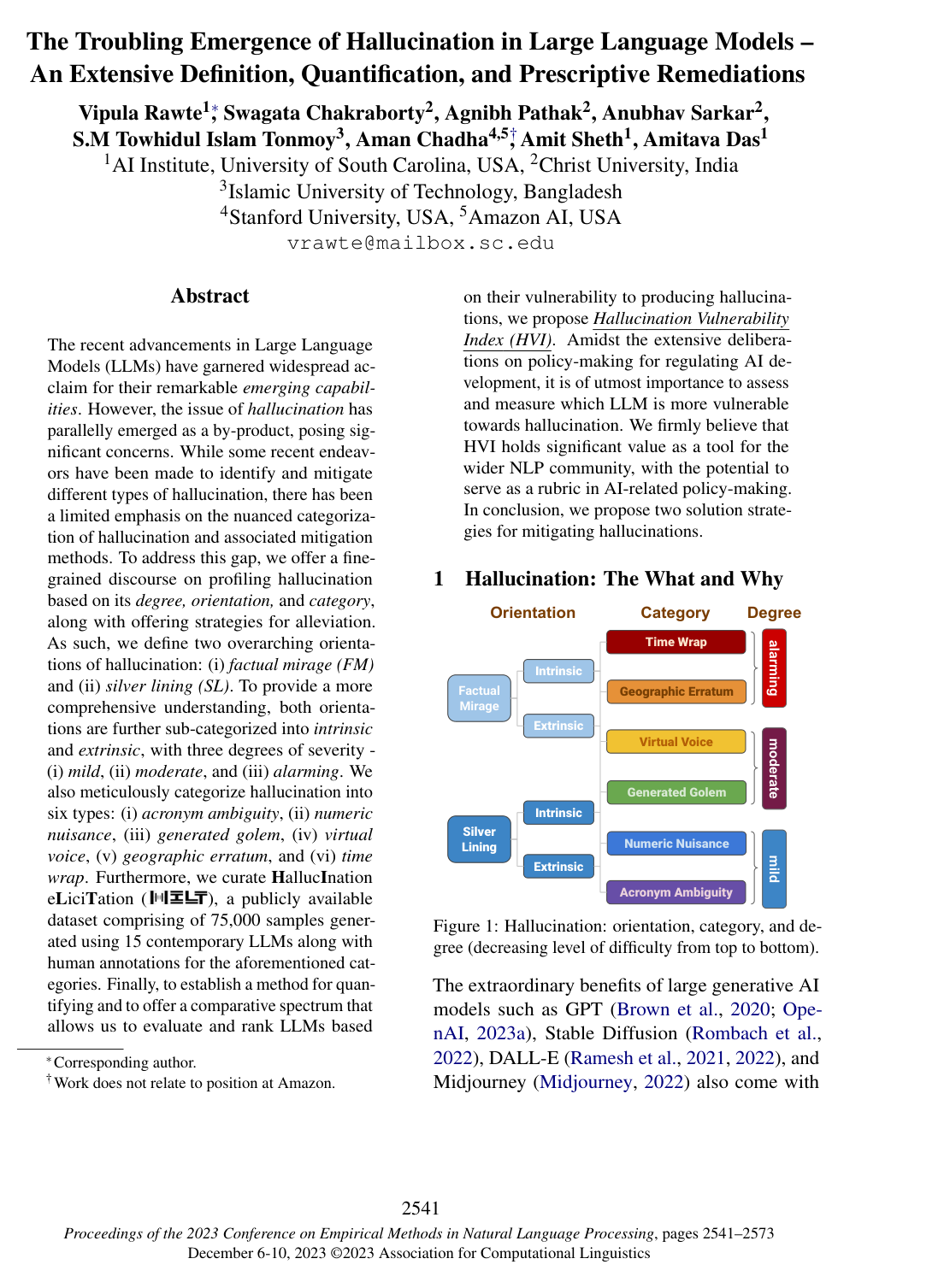
The Troubling Emergence of Hallucination in Large Language Models - An Extensive Definition, Quantification, and Prescriptive Remediations
Vipula Rawte, Swagata Chakraborty, Agnibh Pathak, Anubhav Sarkar, S. M. Towhidul Islam Tonmoy, Aman Chadha, Amit P. Sheth, Amitava Das
Why you should read this
Establishes a systematic taxonomy of language model hallucinations alongside a 75,000-sample human-annotated dataset, a vulnerability index to benchmark fifteen models, and targeted mitigation strategies for unfaithful generations.
The recent advancements in Large Language Models (LLMs) have garnered widespread acclaim for their remarkable emerging capabilities. However, the issue of hallucination has parallelly emerged as a by-product, posing significant concerns. While some recent endeavors have been made to identify and mitigate different types of hallucination, there has been a limited emphasis on the nuanced categorization of hallucination and associated mitigation methods. To address this gap, we offer a fine-grained discourse on profiling hallucination based on its degree, orientation, and category, along with offering strategies for alleviation. As such, we define two overarching orientations of hallucination: (i) factual mirage (FM) and (ii) silver lining (SL). To provide a more comprehensive understanding, both orientations are further sub-categorized into intrinsic and extrinsic, with three degrees of severity - (i) mild, (ii) moderate, and (iii) alarming. We also meticulously categorize hallucination into six types: (i) acronym ambiguity, (ii) numeric nuisance, (iii) generated golem, (iv) virtual voice, (v) geographic erratum, and (vi) time wrap. Furthermore, we curate Hallucination eLicitation (H-ELT), a publicly available dataset comprising of 75,000 samples generated using 15 contemporary LLMs along with human annotations for the aforementioned categories. Finally, to establish a method for quantifying and to offer a comparative spectrum that allows us to evaluate and rank LLMs based on their vulnerability to producing hallucinations, we propose Hallucination Vulnerability Index (HVI). Amidst the extensive deliberations on policy-making for regulating AI development, it is of utmost importance to assess and measure which LLM is more vulnerable towards hallucination. We firmly believe that HVI holds significant value as a tool for the wider NLP community, with the potential to serve as a rubric in AI-related policy-making. In conclusion, we propose two solution strategies for mitigating hallucinations.
Added
2026-10-05
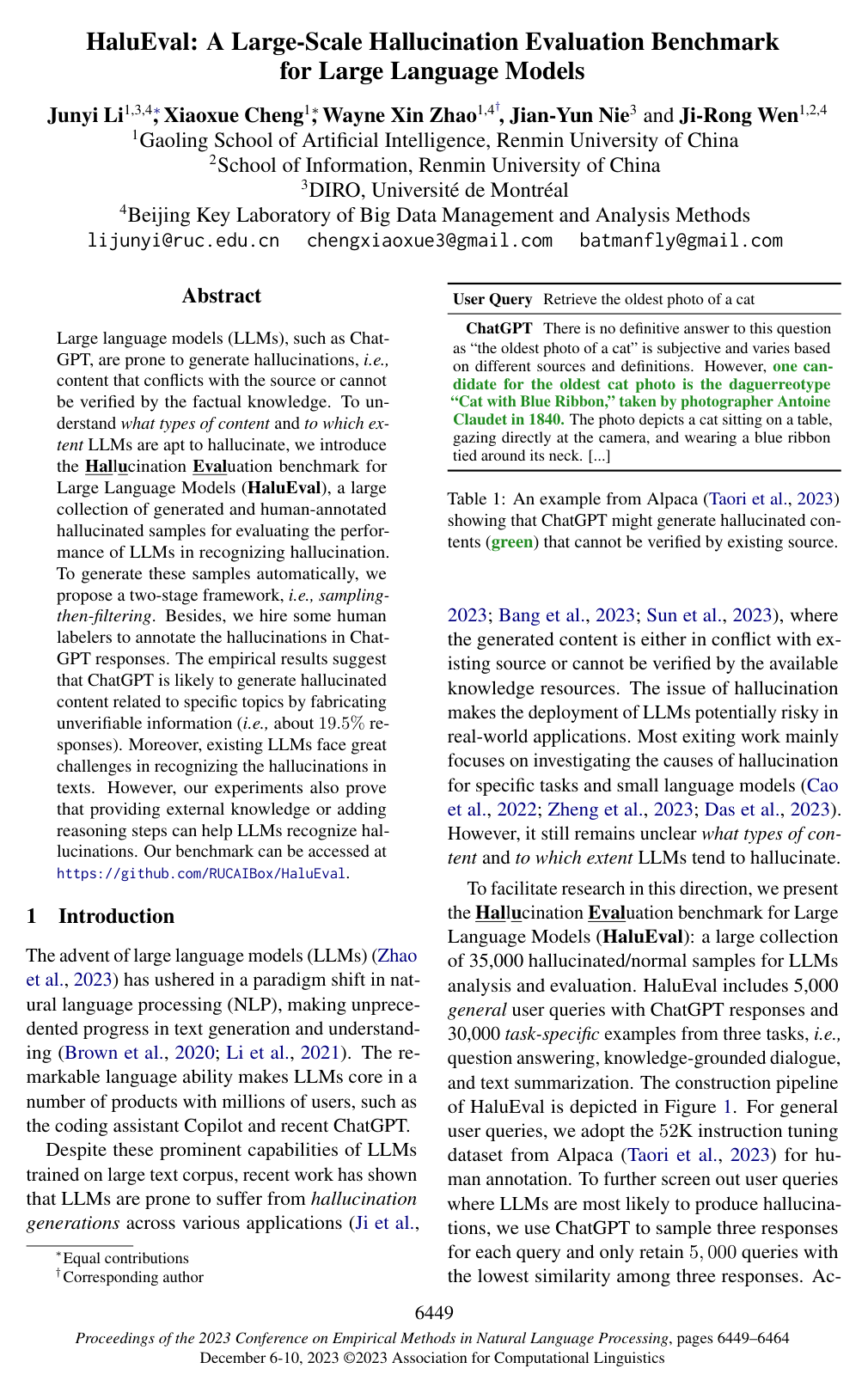
HaluEval: A Large-Scale Hallucination Evaluation Benchmark for Large Language Models
Junyi Li, Xiaoxue Cheng, Xin Zhao, Jian-Yun Nie, Ji-Rong Wen
Why you should read this
Presents HaluEval, a benchmark of 35,000 generated and human-annotated samples across question answering, dialogue, and summarization, revealing that large language models struggle to recognize factual fabrications without explicit external knowledge or step-by-step reasoning.
Large language models (LLMs), such as ChatGPT, are prone to generate hallucinations, i.e., content that conflicts with the source or cannot be verified by the factual knowledge. To understand what types of content and to which extent LLMs are apt to hallucinate, we introduce the Hallucination Evaluation benchmark for Large Language Models (HaluEval), a large collection of generated and human-annotated hallucinated samples for evaluating the performance of LLMs in recognizing hallucination. To generate these samples automatically, we propose a two-stage framework, i.e., sampling-then-filtering. Besides, we hire some human labelers to annotate the hallucinations in ChatGPT responses. The empirical results suggest that ChatGPT is likely to generate hallucinated content related to specific topics by fabricating unverifiable information (i.e., about 19.5% responses). Moreover, existing LLMs face great challenges in recognizing the hallucinations in texts. However, our experiments also prove that providing external knowledge or adding reasoning steps can help LLMs recognize hallucinations. Our benchmark can be accessed at https://github.com/RUCAIBox/HaluEval.
Added
2026-09-28
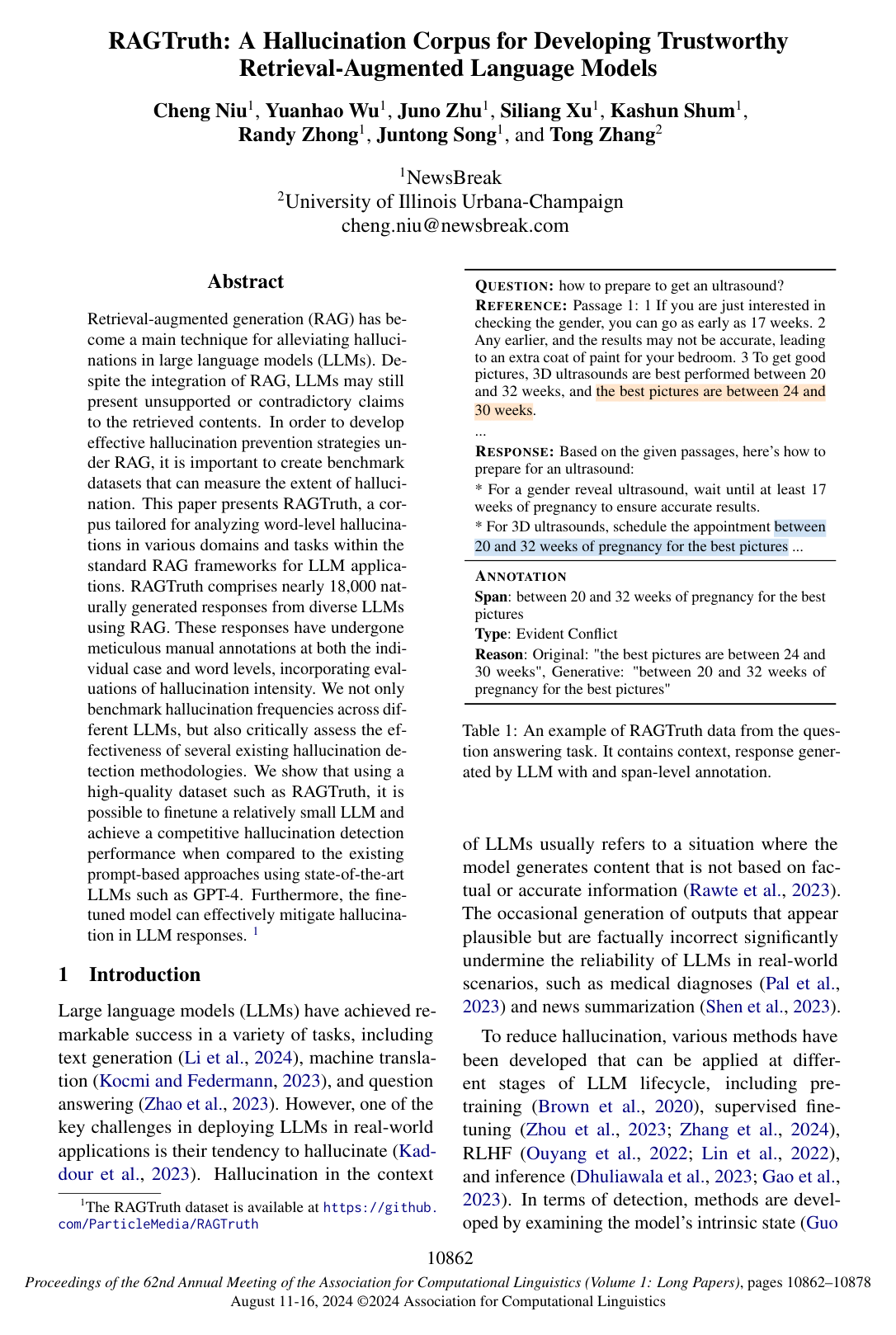
RAGTruth: A Hallucination Corpus for Developing Trustworthy Retrieval-Augmented Language Models
Cheng Niu, Yuanhao Wu, Juno Zhu, Siliang Xu, Kashun Shum, Randy Zhong, Juntong Song, Tong Zhang
Why you should read this
Presents RAGTruth, a large-scale word-level hallucination benchmark of nearly 18,000 manually annotated retrieval-augmented generations that enables smaller language models to match GPT-4 in detecting and mitigating factual errors.
Retrieval-augmented generation (RAG) has become a main technique for alleviating hallucinations in large language models (LLMs). Despite the integration of RAG, LLMs may still present unsupported or contradictory claims to the retrieved contents. In order to develop effective hallucination prevention strategies under RAG, it is important to create benchmark datasets that can measure the extent of hallucination. This paper presents RAGTruth, a corpus tailored for analyzing word-level hallucinations in various domains and tasks within the standard RAG frameworks for LLM applications. RAGTruth comprises nearly 18,000 naturally generated responses from diverse LLMs using RAG. These responses have undergone meticulous manual annotations at both the individual case and word levels, incorporating evaluations of hallucination intensity. We not only benchmark hallucination frequencies across different LLMs, but also critically assess the effectiveness of several existing hallucination detection methodologies. We show that using a high-quality dataset such as RAGTruth, it is possible to finetune a relatively small LLM and achieve a competitive hallucination detection performance when compared to the existing prompt-based approaches using state-of-the-art LLMs such as GPT-4. Furthermore, the finetuned model can effectively mitigate hallucination in LLM responses.
Added
2026-09-26
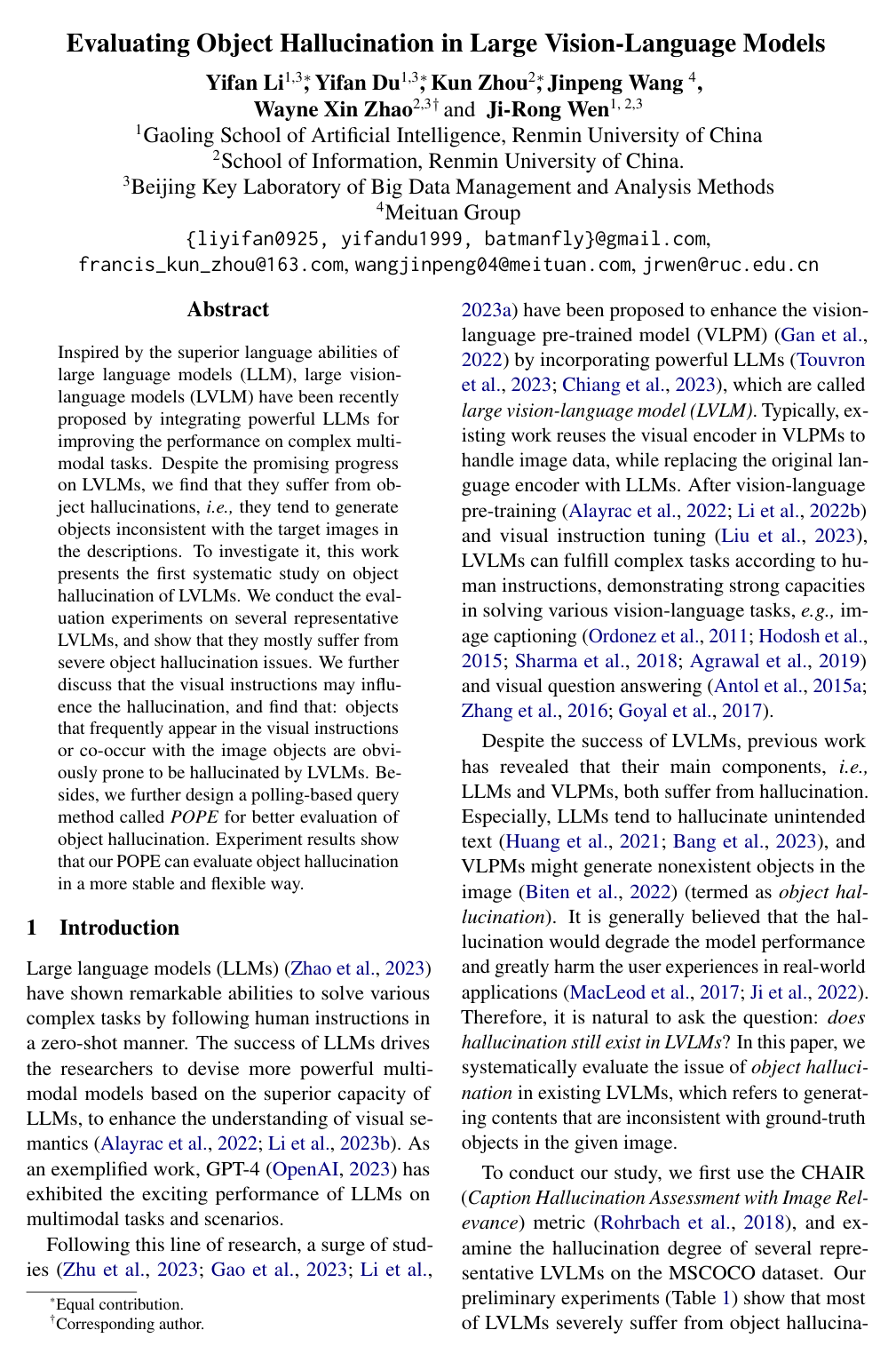
Evaluating Object Hallucination in Large Vision-Language Models
Yifan Li, Yifan Du, Kun Zhou, Jinpeng Wang, Wayne Xin Zhao, Ji-Rong Wen
Why you should read this
Presents POPE, a polling-based evaluation method that reliably measures object hallucination in large vision-language models while identifying how visual instruction biases trigger these generative errors.
Inspired by the superior language abilities of large language models (LLM), large vision-language models (LVLM) have been recently explored by integrating powerful LLMs for improving the performance on complex multimodal tasks. Despite the promising progress on LVLMs, we find that LVLMs suffer from the hallucination problem, i.e. they tend to generate objects that are inconsistent with the target images in the descriptions. To investigate it, this work presents the first systematic study on object hallucination of LVLMs. We conduct the evaluation experiments on several representative LVLMs, and show that they mostly suffer from severe object hallucination issue. We further discuss that the visual instructions may influence the hallucination, and find that: objects that frequently occur in the visual instructions or co-occur with the image objects, are obviously prone to be hallucinated by LVLMs. Besides, we find that existing evaluation methods might be affected by the input instructions and generation styles of LVLMs. Thus, we further design an improved evaluation method for object hallucination by proposing a polling-based query method called POPE. Experiment results demonstrate that our POPE can evaluate the object hallucination in a more stable and flexible way. Our codes and data are publicly available at this https URL.
Added
2026-09-18
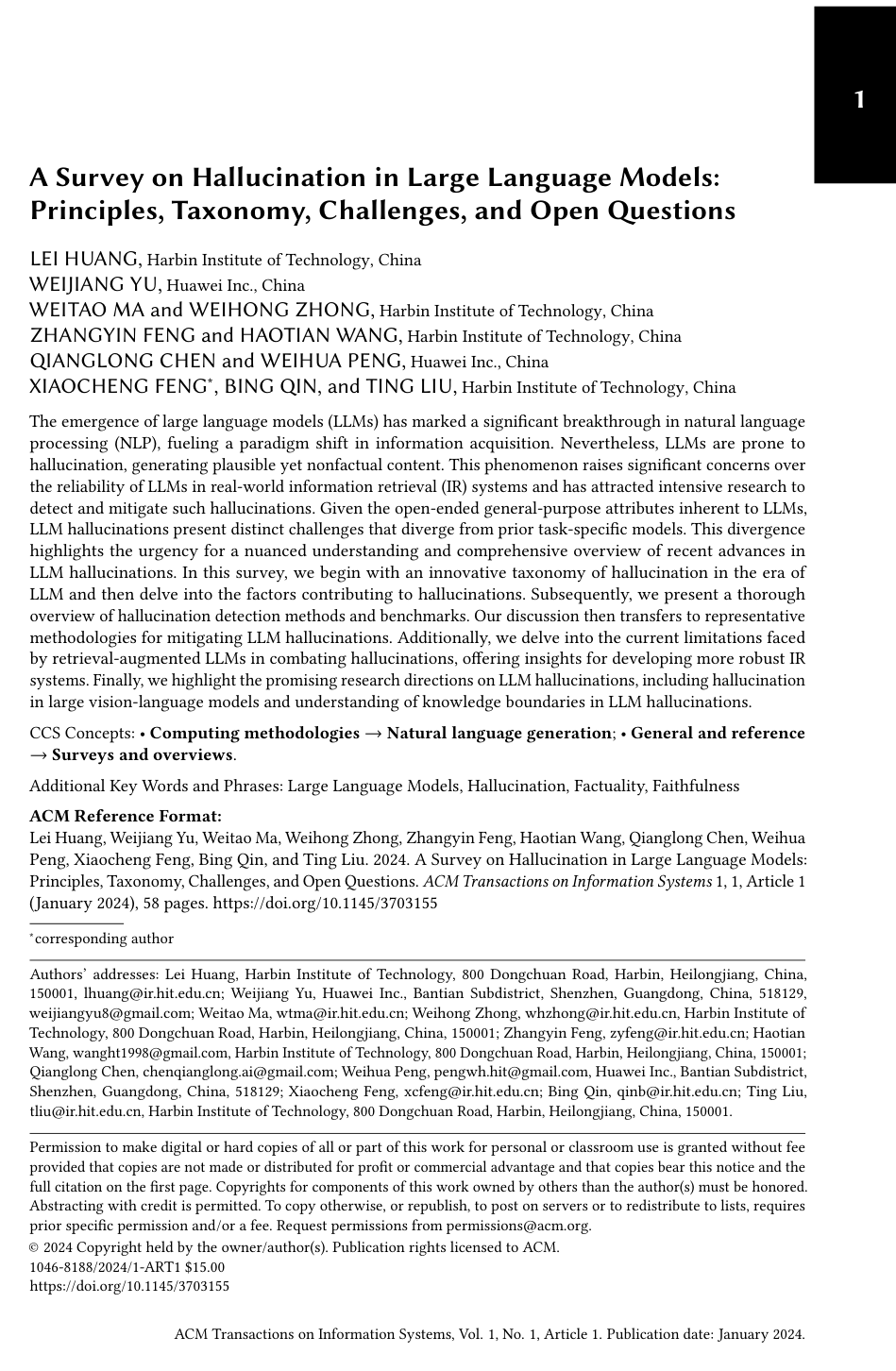
A Survey on Hallucination in Large Language Models: Principles, Taxonomy, Challenges, and Open Questions
Lei Huang, Weijiang Yu, Weitao Ma, Weihong Zhong, Zhangyin Feng, Haotian Wang, Qianglong Chen, Weihua Peng, Xiaocheng Feng, Bing Qin, Ting Liu
Why you should read this
Presents a structured taxonomy of large language model hallucinations alongside an evaluation of detection benchmarks, mitigation strategies, and key failure modes in retrieval-augmented and vision-language systems.
The emergence of large language models (LLMs) has marked a significant breakthrough in natural language processing (NLP), fueling a paradigm shift in information acquisition. Nevertheless, LLMs are prone to hallucination, generating plausible yet nonfactual content. This phenomenon raises significant concerns over the reliability of LLMs in real-world information retrieval (IR) systems and has attracted intensive research to detect and mitigate such hallucinations. Given the open-ended general-purpose attributes inherent to LLMs, LLM hallucinations present distinct challenges that diverge from prior task-specific models. This divergence highlights the urgency for a nuanced understanding and comprehensive overview of recent advances in LLM hallucinations. In this survey, we begin with an innovative taxonomy of hallucination in the era of LLM and then delve into the factors contributing to hallucinations. Subsequently, we present a thorough overview of hallucination detection methods and benchmarks. Our discussion then transfers to representative methodologies for mitigating LLM hallucinations. Additionally, we delve into the current limitations faced by retrieval-augmented LLMs in combating hallucinations, offering insights for developing more robust IR systems. Finally, we highlight the promising research directions on LLM hallucinations, including hallucination in large vision-language models and understanding of knowledge boundaries in LLM hallucinations.
Added
2026-09-15
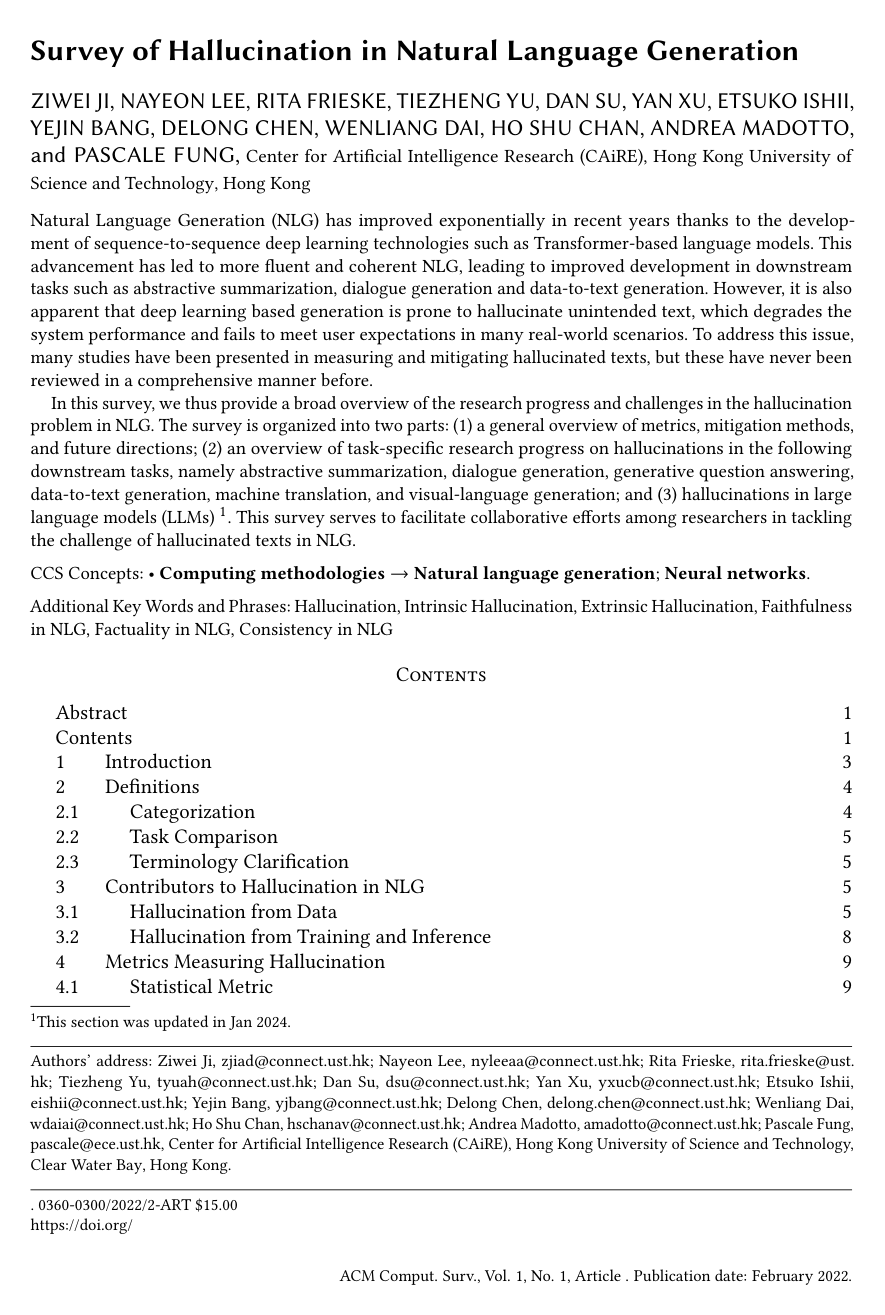
Survey of Hallucination in Natural Language Generation
Ziwei Ji, Nayeon Lee, Rita Frieske, Tiezheng Yu, Dan Su, Yan Xu, Etsuko Ishii, Ye Jin Bang, Andrea Madotto, Pascale Fung
Why you should read this
Systematizes the evaluation metrics and mitigation techniques for hallucinations across diverse natural language generation tasks and large language models to guide the development of factually reliable systems.
Natural Language Generation (NLG) has improved exponentially in recent years thanks to the development of sequence-to-sequence deep learning technologies such as Transformer-based language models. This advancement has led to more fluent and coherent NLG, leading to improved development in downstream tasks such as abstractive summarization, dialogue generation and data-to-text generation. However, it is also apparent that deep learning based generation is prone to hallucinate unintended text, which degrades the system performance and fails to meet user expectations in many real-world scenarios. To address this issue, many studies have been presented in measuring and mitigating hallucinated texts, but these have never been reviewed in a comprehensive manner before. In this survey, we thus provide a broad overview of the research progress and challenges in the hallucination problem in NLG. The survey is organized into two parts: (1) a general overview of metrics, mitigation methods, and future directions; (2) an overview of task-specific research progress on hallucinations in the following downstream tasks, namely abstractive summarization, dialogue generation, generative question answering, data-to-text generation, machine translation, and visual-language generation; and (3) hallucinations in large language models (LLMs). This survey serves to facilitate collaborative efforts among researchers in tackling the challenge of hallucinated texts in NLG.
Added
2026-09-14