
keyword
Gumbel Softmax
The Gumbel-Softmax is a continuous and differentiable approximation of discrete categorical sampling used in machine learning and neural networks. It works by combining the Gumbel-Max trick, which draws discrete categorical samples using independent Gumbel-distributed noise, with a softmax function controlled by a temperature parameter. At high temperatures, the distribution generates smooth probability vectors, while lowering the temperature anneals the outputs toward sharp, one-hot discrete selections. By replacing non-differentiable categorical sampling with this continuous relaxation, the Gumbel-Softmax serves as a reparameterization technique that enables standard gradient-based backpropagation through stochastic discrete variables, facilitating end-to-end training in architectures involving discrete latent spaces, differentiable neural architecture search, and representation quantization.
5 items
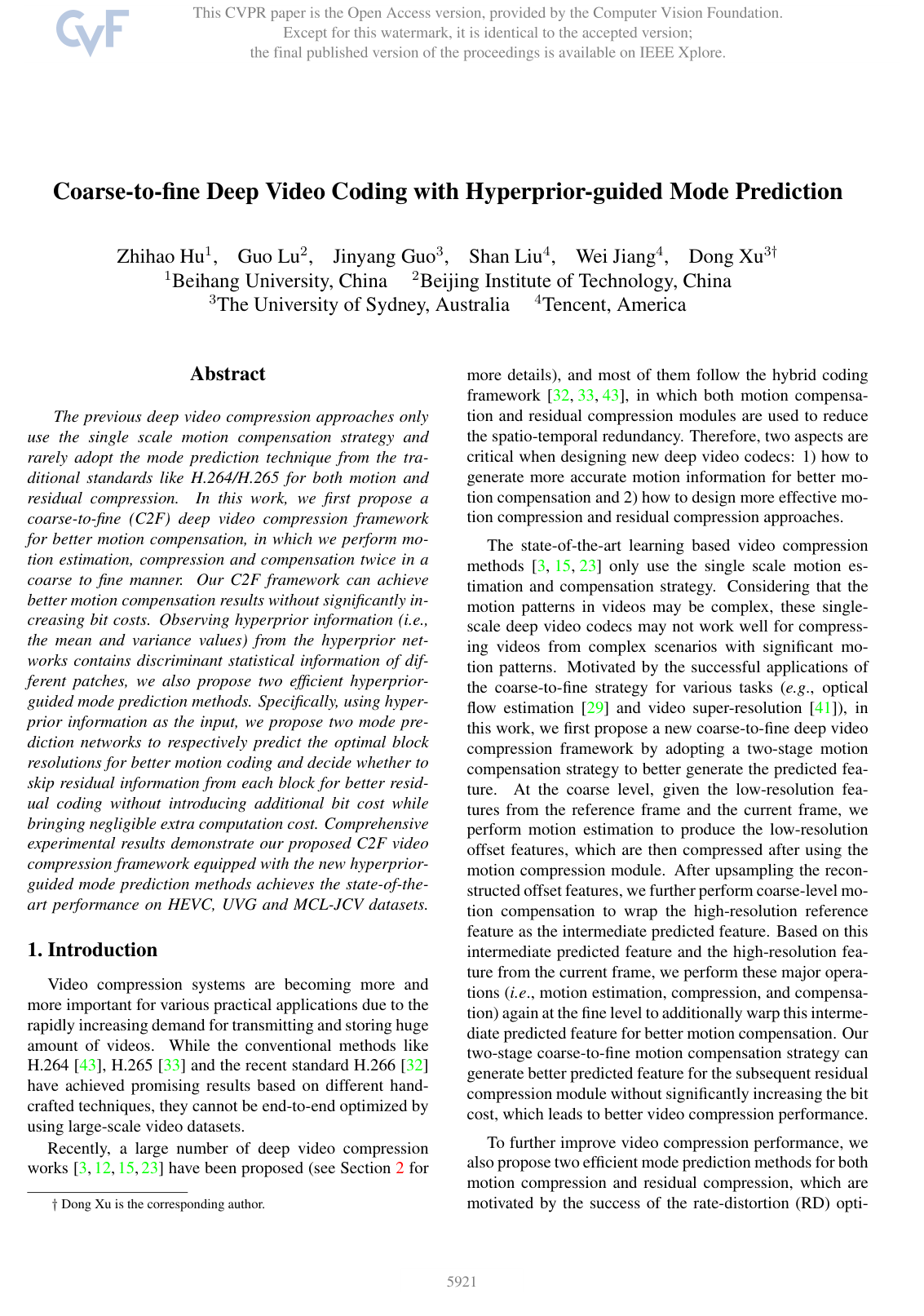
Coarse-To-Fine Deep Video Coding with Hyperprior-Guided Mode Prediction
Zhihao Hu, Guo Lu, Jinyang Guo, Shan Liu, Wei Jiang, Dong Xu
Why you should read this
Presents a coarse-to-fine deep video compression framework that uses two-stage motion compensation alongside hyperprior-guided mode prediction to dynamically select block resolutions and skip residual coding without transmitting extra side information.
The previous deep video compression approaches only use the single scale motion compensation strategy and rarely adopt the mode prediction technique from the traditional standards like H.264/H.265 for both motion and residual compression. In this work, we first propose a coarse-to-fine (C2F) deep video compression framework for better motion compensation, in which we perform motion estimation, compression and compensation twice in a coarse to fine manner. Our C2F framework can achieve better motion compensation results without significantly increasing bit costs. Observing hyperprior information (i.e., the mean and variance values) from the hyperprior networks contains discriminant statistical information of different patches, we also propose two efficient hyperprior-guided mode prediction methods. Specifically, using hyperprior information as the input, we propose two mode prediction networks to respectively predict the optimal block resolutions for better motion coding and decide whether to skip residual information from each block for better residual coding without introducing additional bit cost while bringing negligible extra computation cost. Comprehensive experimental results demonstrate our proposed C2F video compression framework equipped with the new hyperprior-guided mode prediction methods achieves the state-of-the-art performance on HEVC, UVG and MCL-JCV datasets.
Added
2026-09-26
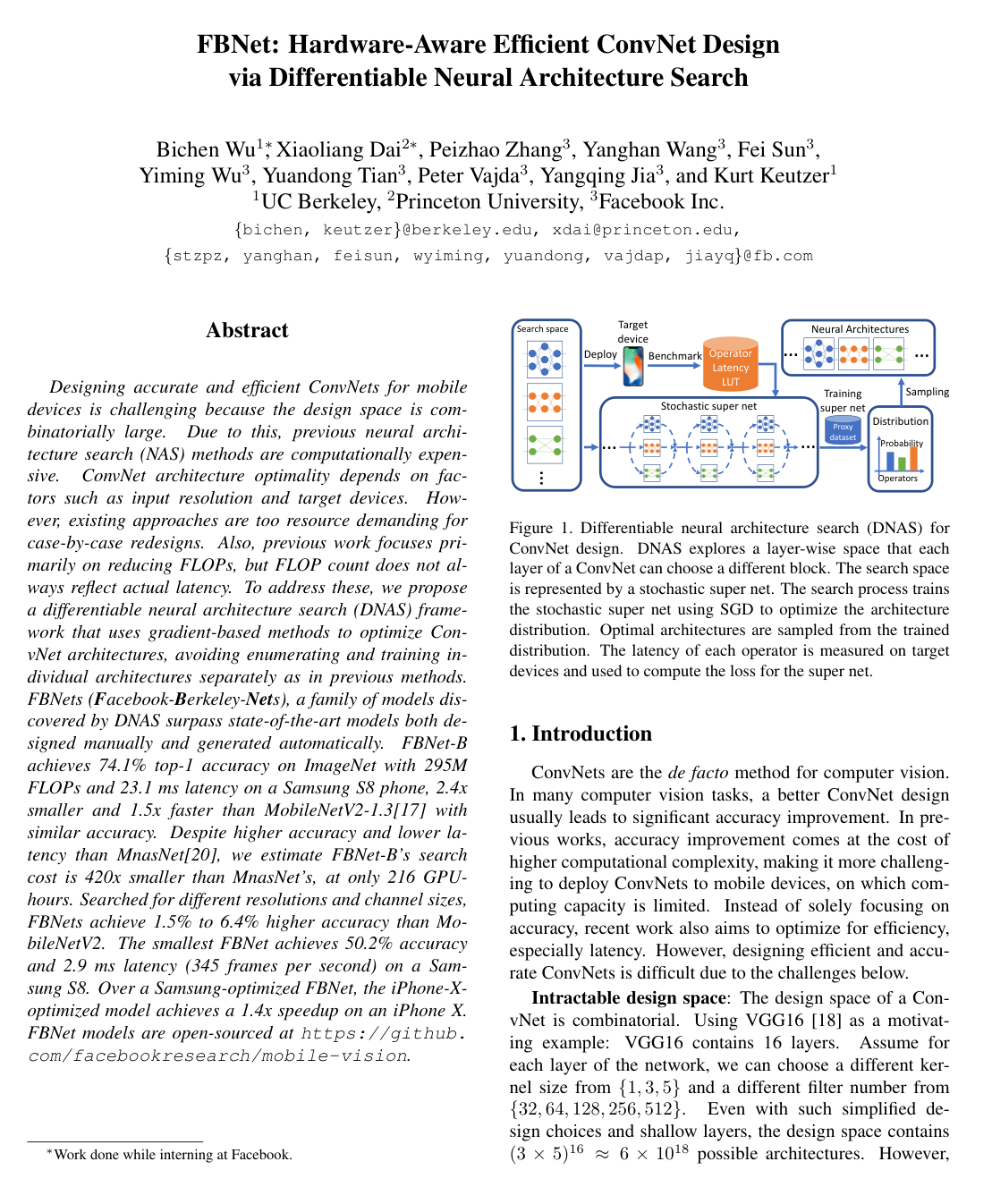
FBNet: Hardware-Aware Efficient ConvNet Design via Differentiable Neural Architecture Search
Bichen Wu, Xiaoliang Dai, Peizhao Zhang, Yanghan Wang, Fei Sun, Yiming Wu, Yuandong Tian, Peter Vajda, Yangqing Jia, Kurt Keutzer
Why you should read this
Introduces a hardware-aware differentiable neural architecture search framework that directly optimizes ConvNets for device-specific latency, cutting search costs by over 400 times compared to prior methods while achieving superior speed and accuracy on mobile devices.
Designing accurate and efficient ConvNets for mobile devices is challenging because the design space is combinatorially large. Due to this, previous neural architecture search (NAS) methods are computationally expensive. ConvNet architecture optimality depends on factors such as input resolution and target devices. However, existing approaches are too expensive for case-by-case redesigns. Also, previous work focuses primarily on reducing FLOPs, but FLOP count does not always reflect actual latency. To address these, we propose a differentiable neural architecture search (DNAS) framework that uses gradient-based methods to optimize ConvNet architectures, avoiding enumerating and training individual architectures separately as in previous methods. FBNets, a family of models discovered by DNAS surpass state-of-the-art models both designed manually and generated automatically. FBNet-B achieves 74.1% top-1 accuracy on ImageNet with 295M FLOPs and 23.1 ms latency on a Samsung S8 phone, 2.4x smaller and 1.5x faster than MobileNetV2-1.3 with similar accuracy. Despite higher accuracy and lower latency than MnasNet, we estimate FBNet-B's search cost is 420x smaller than MnasNet's, at only 216 GPU-hours. Searched for different resolutions and channel sizes, FBNets achieve 1.5% to 6.4% higher accuracy than MobileNetV2. The smallest FBNet achieves 50.2% accuracy and 2.9 ms latency (345 frames per second) on a Samsung S8. Over a Samsung-optimized FBNet, the iPhone-X-optimized model achieves a 1.4x speedup on an iPhone X.
Added
2026-09-25
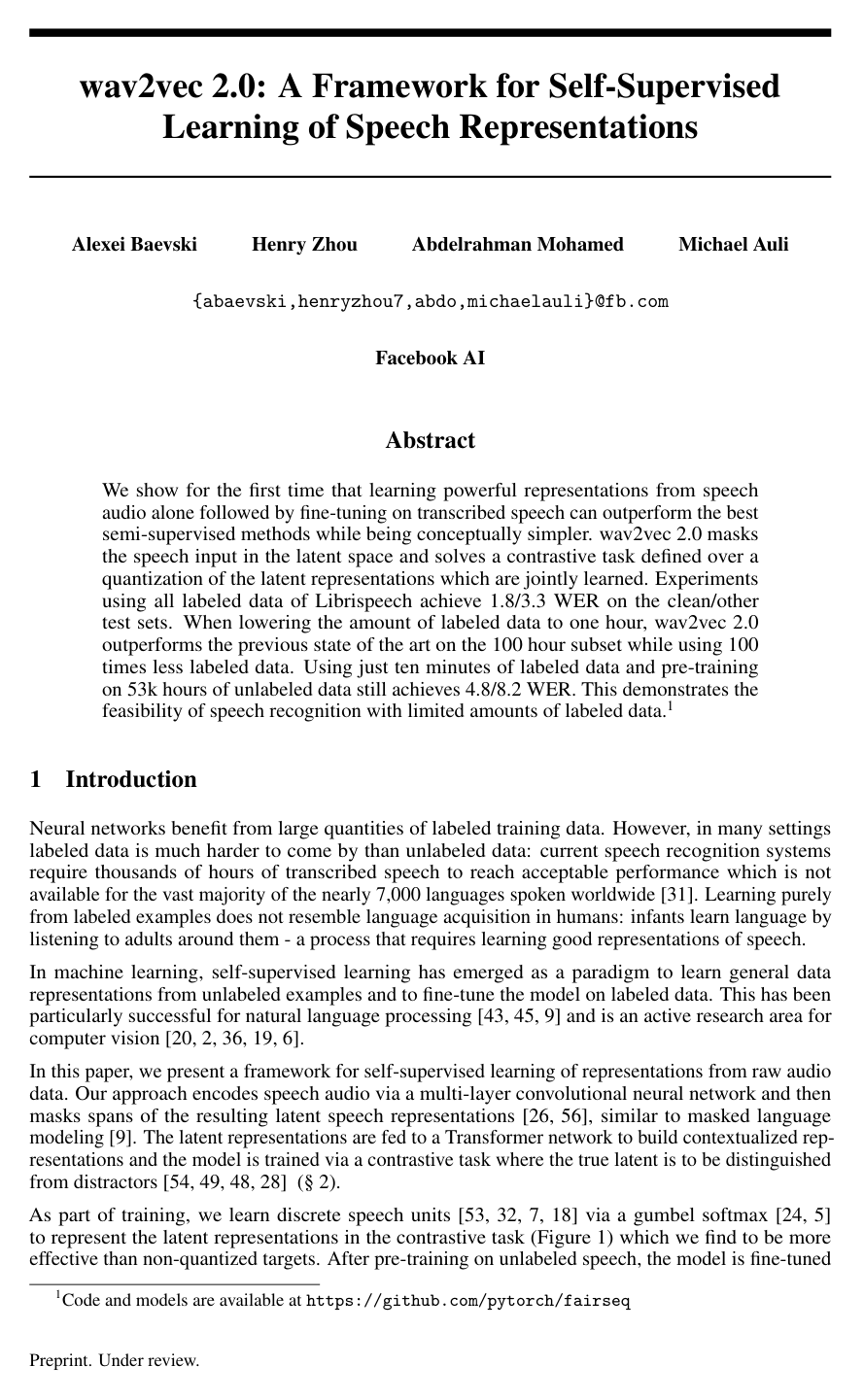
wav2vec 2.0: A Framework for Self-Supervised Learning of Speech Representations
Alexei Baevski, Henry Zhou, Abdelrahman Mohamed, Michael Auli
Why you should read this
Introduces wav2vec 2.0, a self-supervised framework that jointly learns contextualized speech representations and discrete units through masked contrastive learning, enabling state-of-the-art speech recognition with as little as ten minutes of transcribed audio.
We show for the first time that learning powerful representations from speech audio alone followed by fine-tuning on transcribed speech can outperform the best semi-supervised methods while being conceptually simpler. wav2vec 2.0 masks the speech input in the latent space and solves a contrastive task defined over a quantization of the latent representations which are jointly learned. Experiments using all labeled data of Librispeech achieve 1.8/3.3 WER on the clean/other test sets. When lowering the amount of labeled data to one hour, wav2vec 2.0 outperforms the previous state of the art on the 100 hour subset while using 100 times less labeled data. Using just ten minutes of labeled data and pre-training on 53k hours of unlabeled data still achieves 4.8/8.2 WER. This demonstrates the feasibility of speech recognition with limited amounts of labeled data.
Added
2026-09-08
License
Published with permission
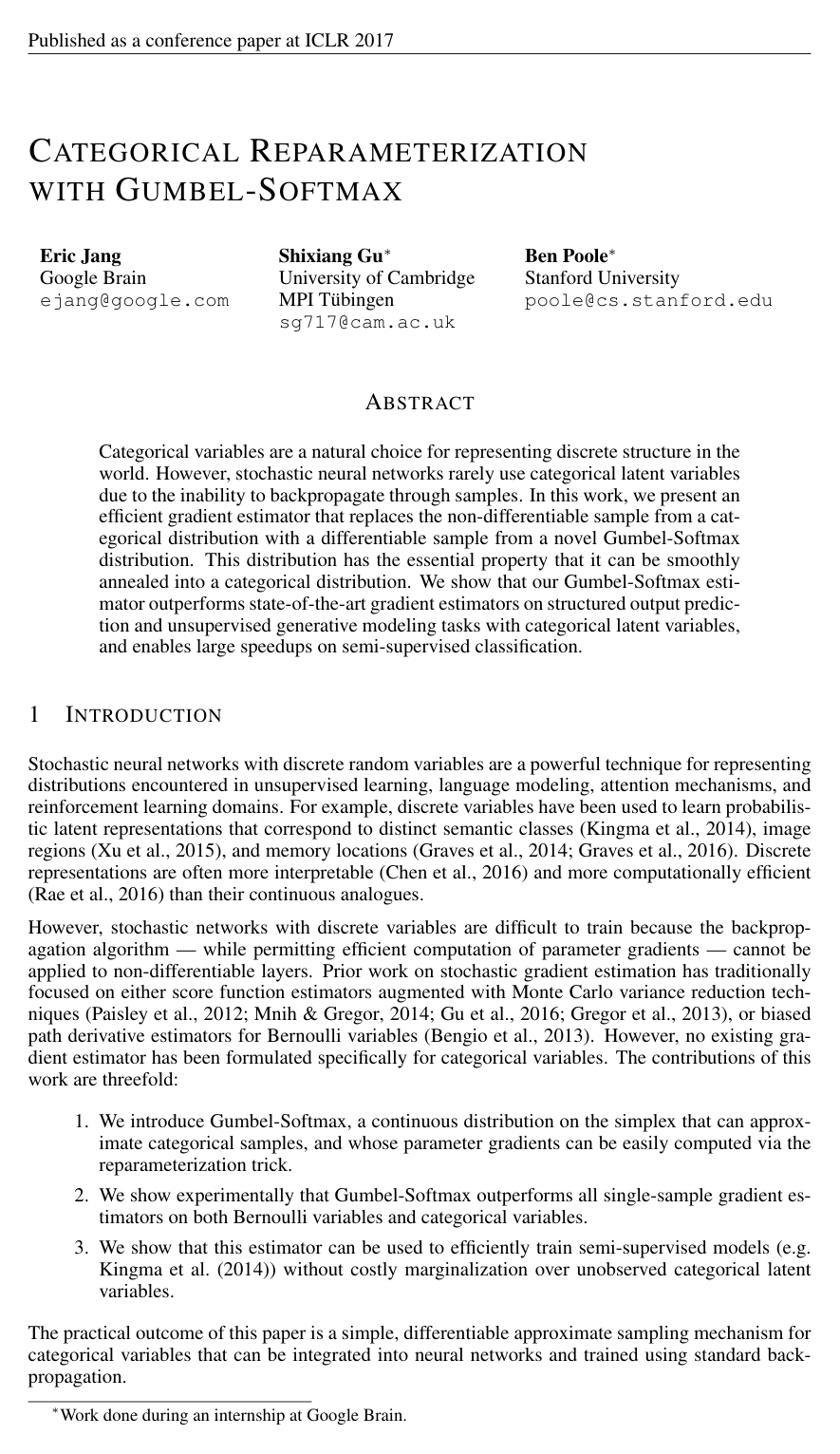
Categorical Reparameterization with Gumbel-Softmax
Eric Jang, Shixiang Gu, Ben Poole
Why you should read this
Establishes a continuous relaxation of categorical distributions, allowing the "reparameterization trick" to function on discrete data.
Categorical variables are a natural choice for representing discrete structure in the world. However, stochastic neural networks rarely use categorical latent variables due to the inability to backpropagate through samples. In this work, we present an efficient gradient estimator that replaces the non-differentiable sample from a categorical distribution with a differentiable sample from a novel Gumbel-Softmax distribution. This distribution has the essential property that it can be smoothly annealed into a categorical distribution. We show that our Gumbel-Softmax estimator outperforms state-of-the-art gradient estimators on structured output prediction and unsupervised generative modeling tasks with categorical latent variables, and enables large speedups on semi-supervised classification.
Added
2026-03-09
DSelect-k: Differentiable Selection in the Mixture of Experts with Applications to Multi-Task Learning
Hussein Hazimeh, Zhe Zhao, Aakanksha Chowdhery, Maheswaran Sathiamoorthy, Yihua Chen, Rahul Mazumder, Lichan Hong, Ed H. Chi
Why you should read this
Develops a continuously differentiable and sparse gating mechanism, DSelect-k, that significantly improves predictive performance and training stability in Mixture-of-Experts models for multi-task learning, as evidenced by a 22%+ boost in a real-world recommender system.
The Mixture-of-Experts (MoE) architecture is showing promising results in improving parameter sharing in multi-task learning (MTL) and in scaling high-capacity neural networks. State-of-the-art MoE models use a trainable sparse gate to select a subset of the experts for each input example. While conceptually appealing, existing sparse gates, such as Top-k, are not smooth. The lack of smoothness can lead to convergence and statistical performance issues when training with gradient-based methods. In this paper, we develop DSelect-k: a continuously differentiable and sparse gate for MoE, based on a novel binary encoding formulation. The gate can be trained using first-order methods, such as stochastic gradient descent, and offers explicit control over the number of experts to select. We demonstrate the effectiveness of DSelect-k on both synthetic and real MTL datasets with up to tasks. Our experiments indicate that DSelect-k can achieve statistically significant improvements in prediction and expert selection over popular MoE gates. Notably, on a real-world, large-scale recommender system, DSelect-k achieves over improvement in predictive performance compared to Top-k. We provide an open-source implementation of DSelect-k.
Added
2026-02-23
