
keyword
global optimization
Global optimization is a branch of applied mathematics and numerical analysis concerned with finding the absolute best solution—the overall minimum or maximum value of an objective function—across an entire feasible search space. Unlike local optimization, which only identifies solutions that are optimal within an immediate neighborhood and frequently gets trapped in suboptimal local extrema, global optimization seeks the true optimum across the full domain regardless of starting conditions. This capability is essential for non-convex and multimodal problems that feature multiple peaks, valleys, or complex constraint boundaries. To solve such problems, global optimization utilizes deterministic methods that provide theoretical guarantees of optimality, as well as stochastic, heuristic, and surrogate-based metaheuristics—including evolutionary algorithms, swarm intelligence, and Bayesian optimization—that balance the exploration of untested regions with the exploitation of known promising areas.
9 items
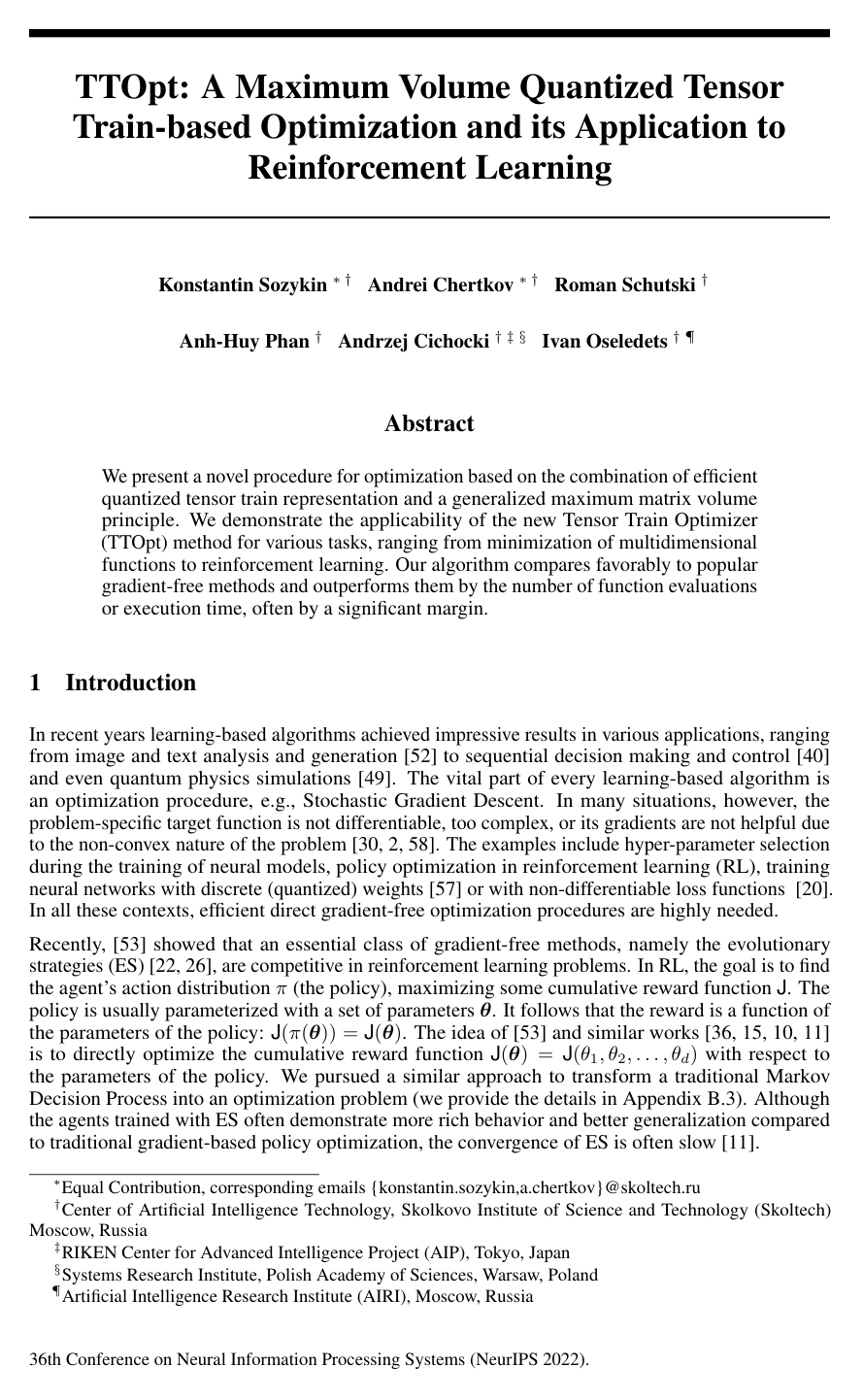
TTOpt: A Maximum Volume Quantized Tensor Train-based Optimization and its Application to Reinforcement Learning
Konstantin Sozykin, Andrei Chertkov, Roman Schutski, Anh-Huy Phan, Andrzej S. Cichocki, Ivan V. Oseledets
Why you should read this
Develops a gradient-free optimization algorithm based on quantized tensor train decomposition and the maximum matrix volume principle, enabling direct training of quantized neural network policies for reinforcement learning with substantially fewer function evaluations than existing methods.
We present a novel procedure for optimization based on the combination of efficient quantized tensor train representation and a generalized maximum matrix volume principle. We demonstrate the applicability of the new Tensor Train Optimizer (TTOpt) method for various tasks, ranging from minimization of multidimensional functions to reinforcement learning. Our algorithm compares favorably to popular gradient-free methods and outperforms them by the number of function evaluations or execution time, often by a significant margin.
Added
2026-09-26
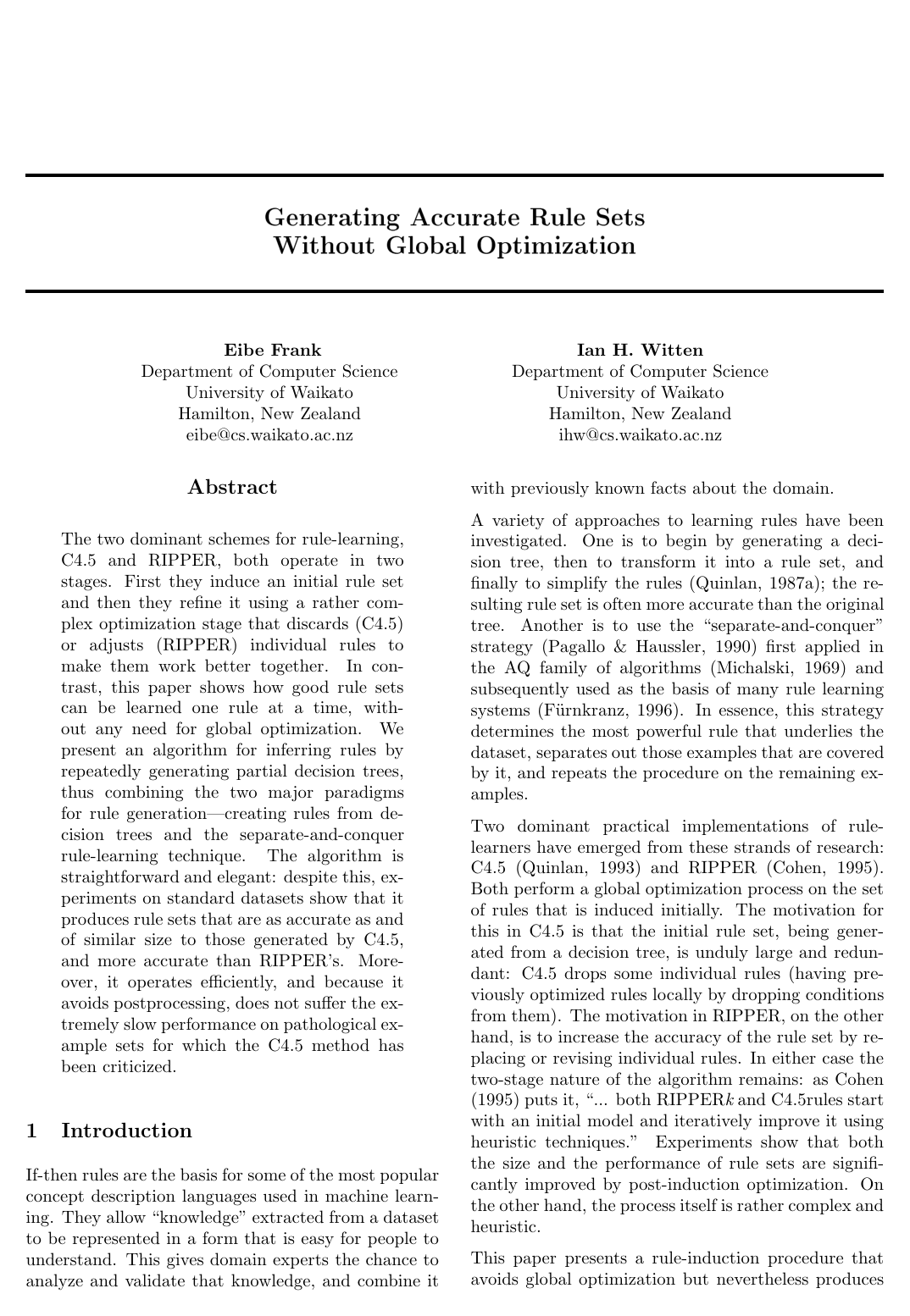
Generating Accurate Rule Sets Without Global Optimization
Eibe Frank, Ian H. Witten
Why you should read this
Presents PART, a fast rule-learning algorithm that avoids complex global optimization by deriving rules from partial decision trees within a separate-and-conquer framework to achieve accuracy and compact model sizes matching or exceeding C4.5 and RIPPER.
The two dominant schemes for rule-learning, C4.5 and RIPPER, both operate in two stages. First they induce an initial rule set and then they refine it using a rather complex optimization stage that discards (C4.5) or adjusts (RIPPER) individual rules to make them work better together. In contrast, this paper shows how good rule sets can be learned one rule at a time, without any need for global optimization. We present an algorithm for inferring rules by repeatedly generating partial decision trees, thus combining the two major paradigms for rule generation—creating rules from decision trees and the separate-and-conquer rule-learning technique. The algorithm is straightforward and elegant: despite this, experiments on standard datasets show that it produces rule sets that are as accurate as and of similar size to those generated by C4.5, and more accurate than RIPPER's. Moreover, it operates efficiently, and because it avoids postprocessing, does not suffer the extremely slow performance on pathological example sets for which the C4.5 method has been criticized.
Source
https://researchcommons.waikato.ac.nz/bitstreams/2e1b230f-cab4-471b-8076-915fd9a2d79c/downloadAdded
2026-09-25
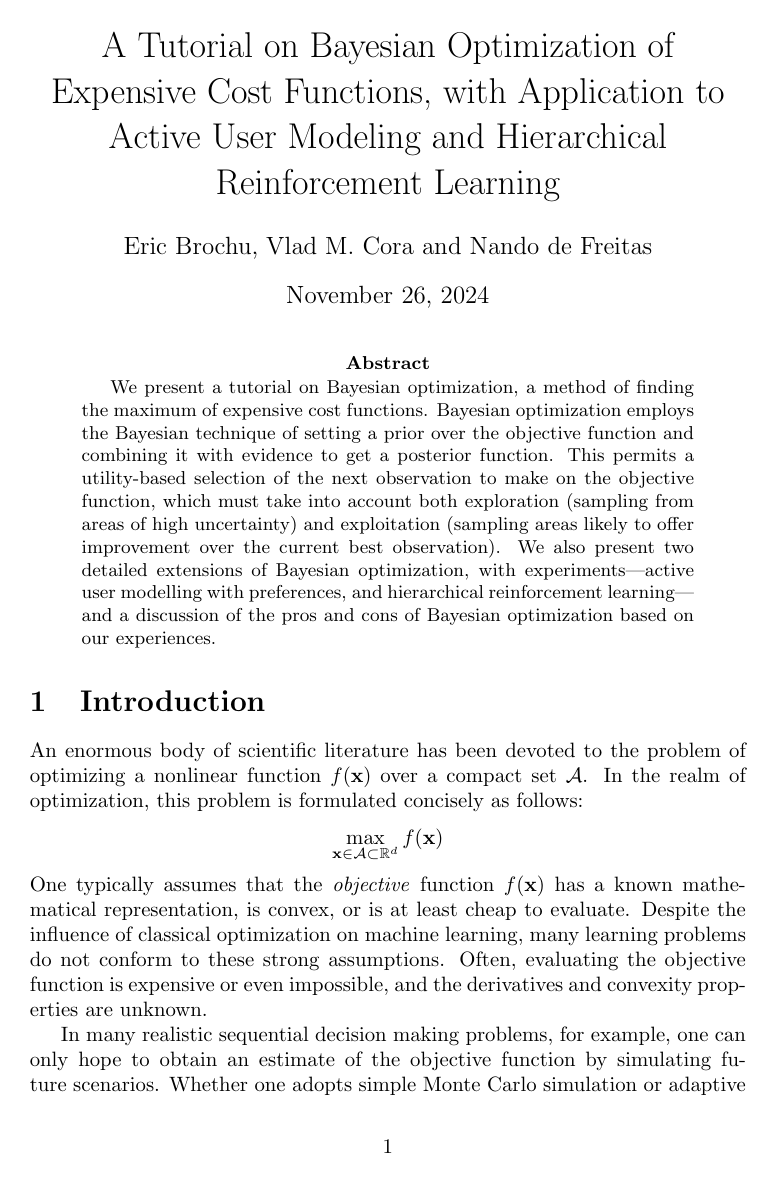
A Tutorial on Bayesian Optimization of Expensive Cost Functions, with Application to Active User Modeling and Hierarchical Reinforcement Learning
Eric Brochu, Vlad M. Cora, Nando de Freitas
Why you should read this
Explains how Bayesian optimization efficiently maximizes expensive, derivative-free black-box functions by balancing exploration and exploitation, demonstrated through practical applications in active user modeling and hierarchical reinforcement learning.
We present a tutorial on Bayesian optimization, a method of finding the maximum of expensive cost functions. Bayesian optimization employs the Bayesian technique of setting a prior over the objective function and combining it with evidence to get a posterior function. This permits a utility-based selection of the next observation to make on the objective function, which must take into account both exploration (sampling from areas of high uncertainty) and exploitation (sampling areas likely to offer improvement over the current best observation). We also present two detailed extensions of Bayesian optimization, with experiments---active user modelling with preferences, and hierarchical reinforcement learning---and a discussion of the pros and cons of Bayesian optimization based on our experiences.
Added
2026-09-16
License
Published with permission
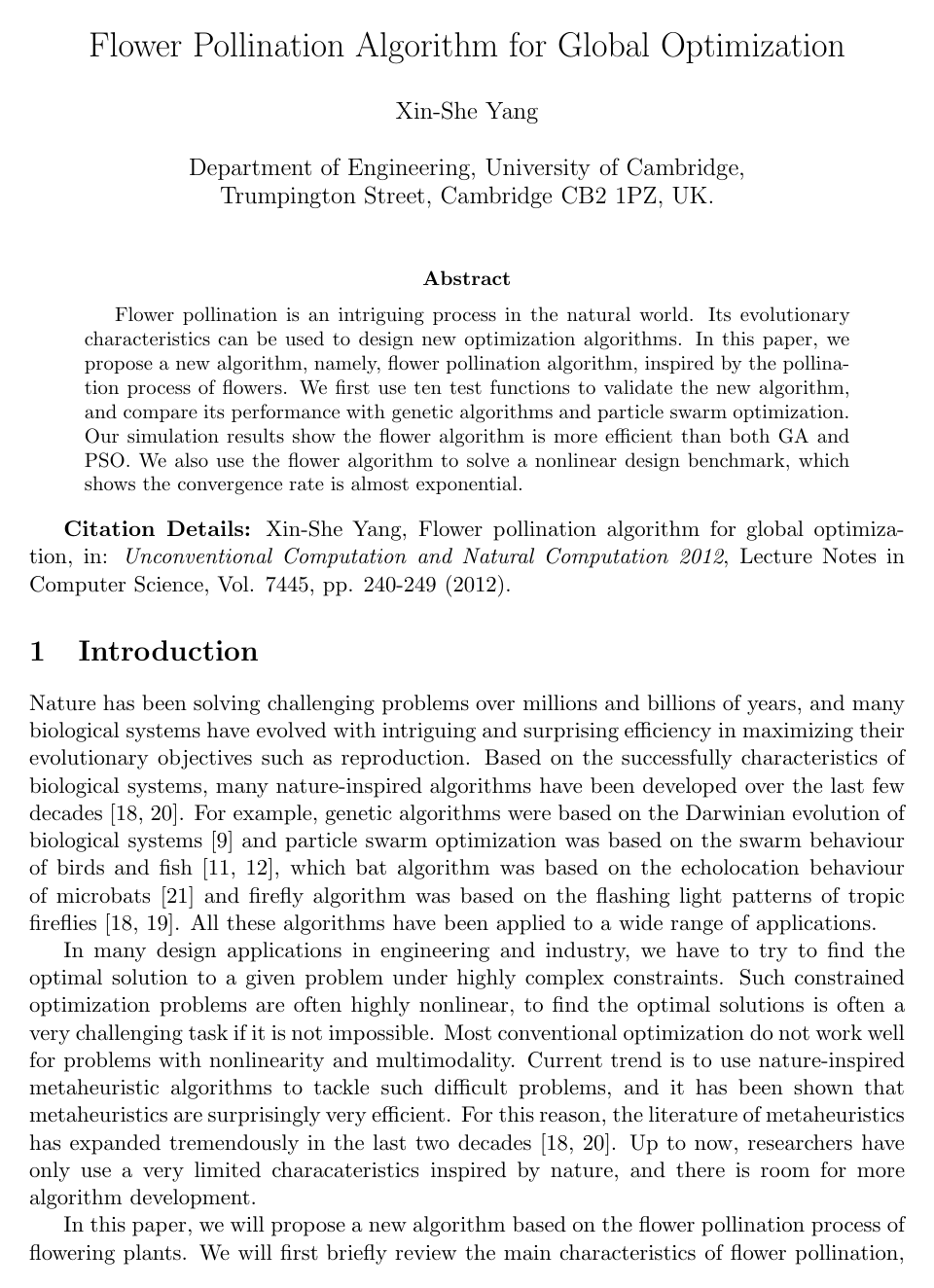
Flower Pollination Algorithm for Global Optimization
Xin-She Yang
Why you should read this
Introduces the Flower Pollination Algorithm, a nature-inspired global optimization method that outperforms genetic algorithms and particle swarm optimization with near-exponential convergence rates on complex nonlinear benchmarks.
Flower pollination is an intriguing process in the natural world. Its evolutionary characteristics can be used to design new optimization algorithms. In this paper, we propose a new algorithm, namely, flower pollination algorithm, inspired by the pollination process of flowers. We first use ten test functions to validate the new algorithm, and compare its performance with genetic algorithms and particle swarm optimization. Our simulation results show the flower algorithm is more efficient than both GA and PSO. We also use the flower algorithm to solve a nonlinear design benchmark, which shows the convergence rate is almost exponential.
Added
2026-09-16
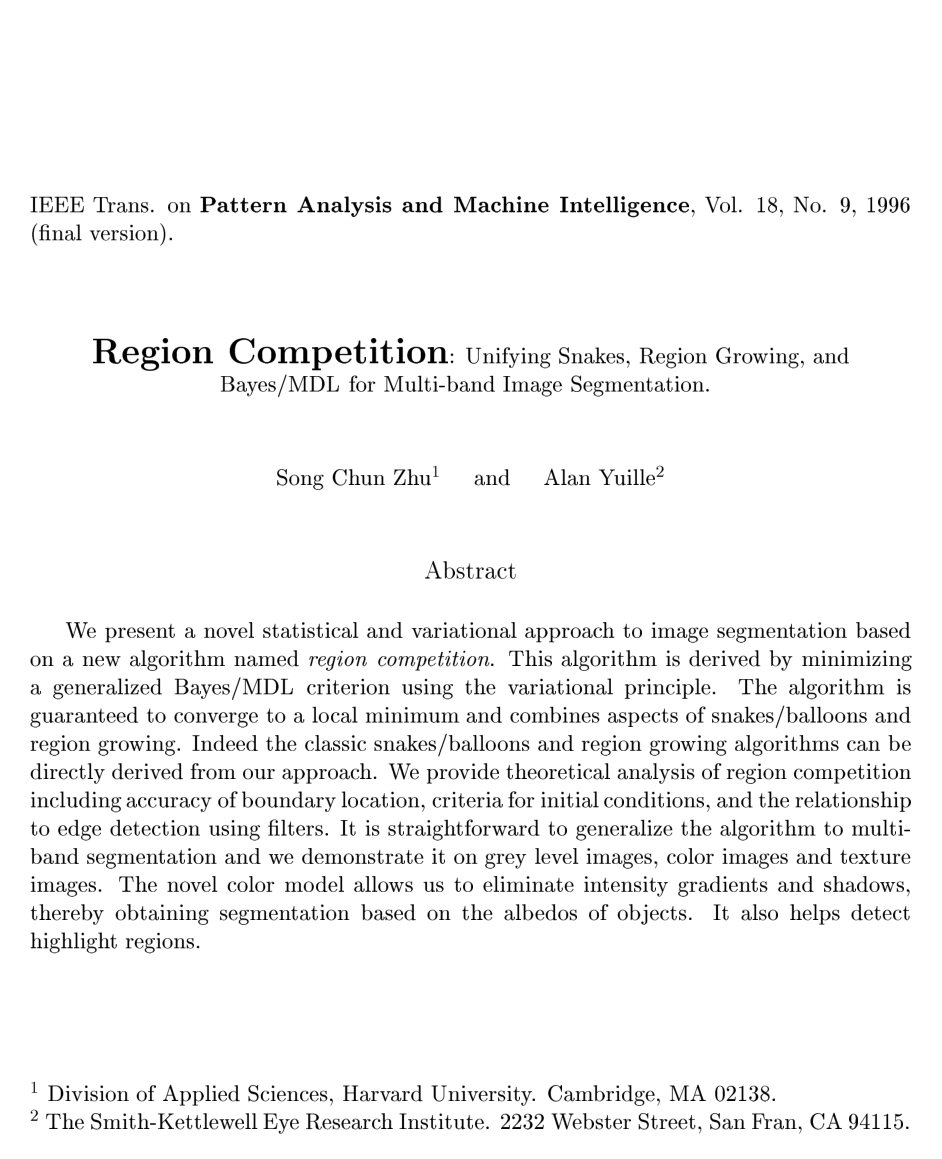
Region Competition: Unifying Snakes, Region Growing, and Bayes/MDL for Multiband Image Segmentation
Song-Chun Zhu, A. Yuille
Why you should read this
Unifies active contour models, region growing, and Bayesian criteria into a single variational framework that accurately segments multi-band images while accounting for shadows, intensity gradients, and textures.
We present a novel statistical and variational approach to image segmentation based on a new algorithm named region competition. This algorithm is derived by minimizing a generalized Bayes/MDL criterion using the variational principle. The algorithm is guaranteed to converge to a local minimum and combines aspects of snakes/balloons and region growing. Indeed the classic snakes/balloons and region growing algorithms can be directly derived from our approach. We provide theoretical analysis of region competition including accuracy of boundary location, criteria for initial conditions, and the relationship to edge detection using filters. It is straightforward to generalize the algorithm to multi-band segmentation and we demonstrate it on grey level images, color images and texture images. The novel color model allows us to eliminate intensity gradients and shadows, thereby obtaining segmentation based on the albedos of objects. It also helps detect highlight regions.
Added
2026-09-16
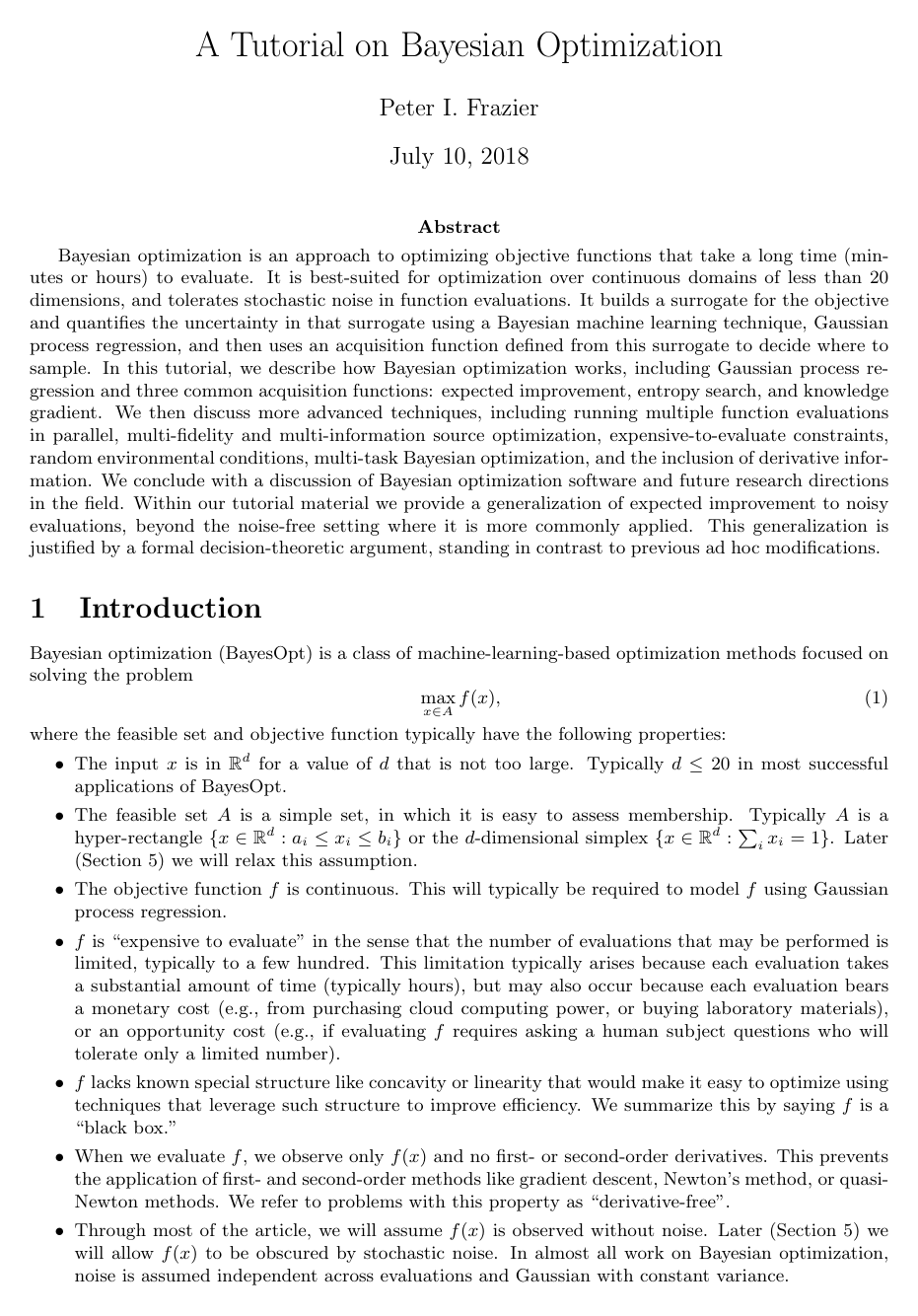
A Tutorial on Bayesian Optimization
Peter I. Frazier
Why you should read this
Presents a comprehensive guide to optimizing computationally expensive objective functions with Bayesian optimization, covering core acquisition functions, advanced multi-fidelity settings, and a decision-theoretic generalization of expected improvement for noisy evaluations.
Bayesian optimization is an approach to optimizing objective functions that take a long time (minutes or hours) to evaluate. It is best-suited for optimization over continuous domains of less than 20 dimensions, and tolerates stochastic noise in function evaluations. It builds a surrogate for the objective and quantifies the uncertainty in that surrogate using a Bayesian machine learning technique, Gaussian process regression, and then uses an acquisition function defined from this surrogate to decide where to sample. In this tutorial, we describe how Bayesian optimization works, including Gaussian process regression and three common acquisition functions: expected improvement, entropy search, and knowledge gradient. We then discuss more advanced techniques, including running multiple function evaluations in parallel, multi-fidelity and multi-information source optimization, expensive-to-evaluate constraints, random environmental conditions, multi-task Bayesian optimization, and the inclusion of derivative information. We conclude with a discussion of Bayesian optimization software and future research directions in the field. Within our tutorial material we provide a generalization of expected improvement to noisy evaluations, beyond the noise-free setting where it is more commonly applied. This generalization is justified by a formal decision-theoretic argument, standing in contrast to previous ad hoc modifications.
Added
2026-09-14
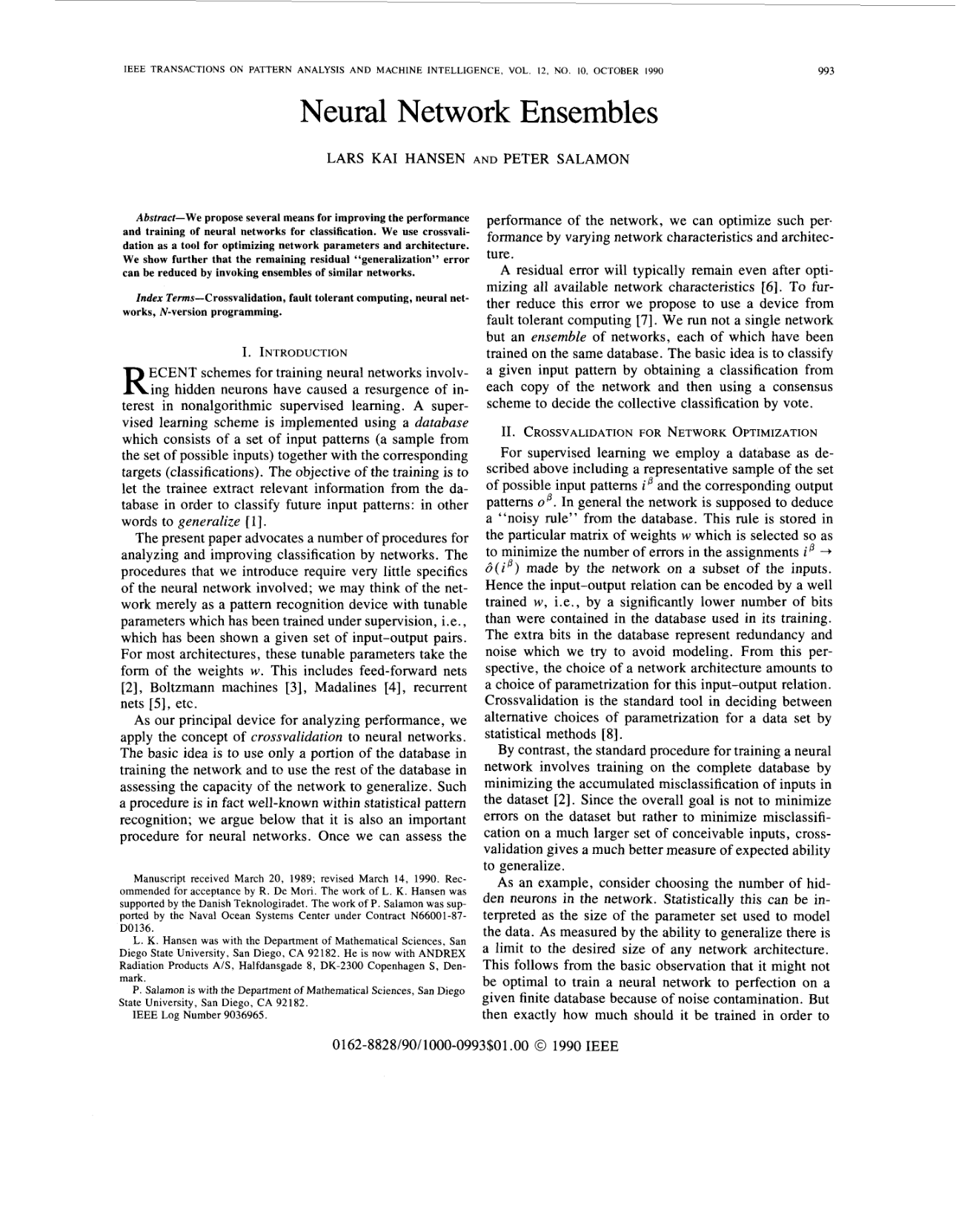
Neural Network Ensembles
L. K. Hansen, P. Salamon
Why you should read this
Demonstrates that combining independently trained neural networks through consensus voting substantially reduces generalization error by exploiting the distinct classification mistakes caused by different local minima.
We propose several means for improving the performance and training of neural networks for classification. We use crossvalidation as a tool for optimizing network parameters and architecture. We show further that the remaining residual “generalization” error can be reduced by invoking ensembles of similar networks.
Added
2026-09-14
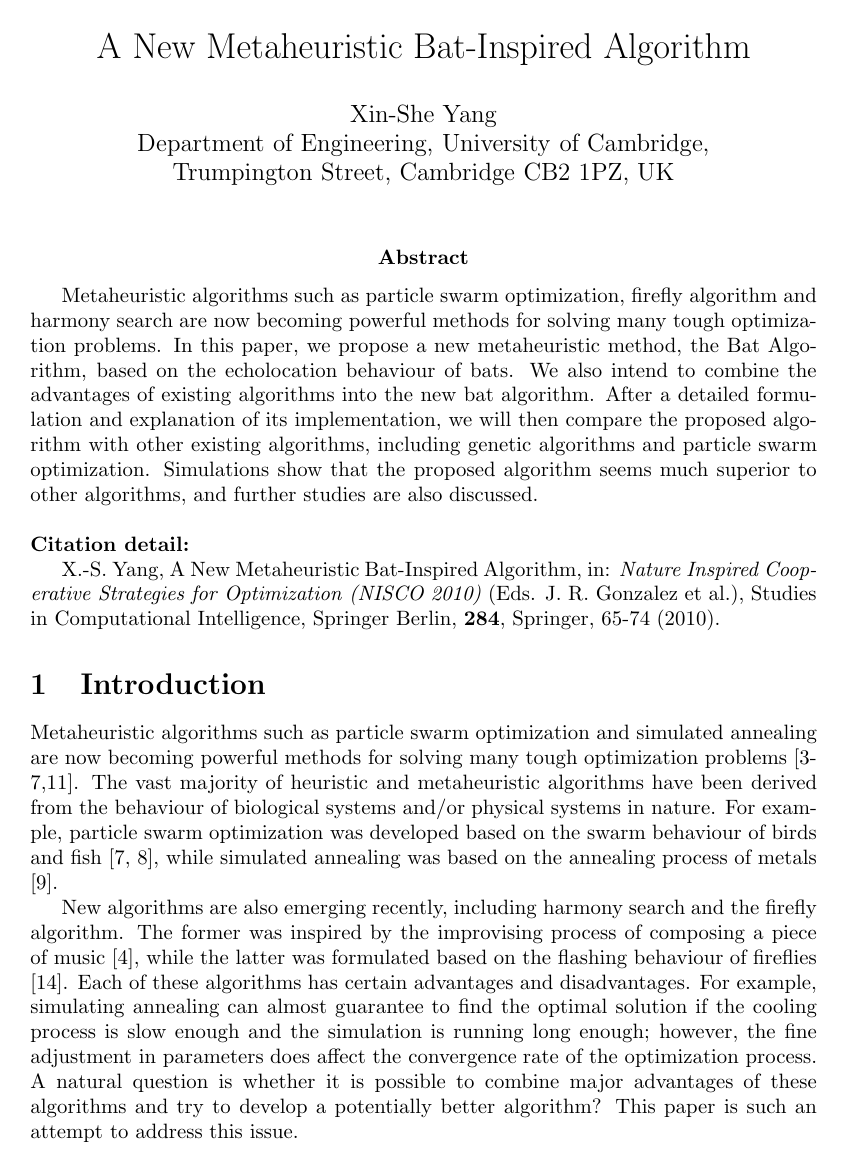
A New Metaheuristic Bat-Inspired Algorithm
Xin-She Yang
Why you should read this
Proposes the Bat Algorithm, a metaheuristic optimization method based on bat echolocation that combines the strengths of existing swarm techniques to outperform particle swarm optimization and genetic algorithms on complex benchmark problems.
Metaheuristic algorithms such as particle swarm optimization, firefly algorithm and harmony search are now becoming powerful methods for solving many tough optimization problems. In this paper, we propose a new metaheuristic method, the Bat Algorithm, based on the echolocation behaviour of bats. We also intend to combine the advantages of existing algorithms into the new bat algorithm. After a detailed formulation and explanation of its implementation, we will then compare the proposed algorithm with other existing algorithms, including genetic algorithms and particle swarm optimization. Simulations show that the proposed algorithm seems much superior to other algorithms, and further studies are also discussed.
Added
2026-09-10
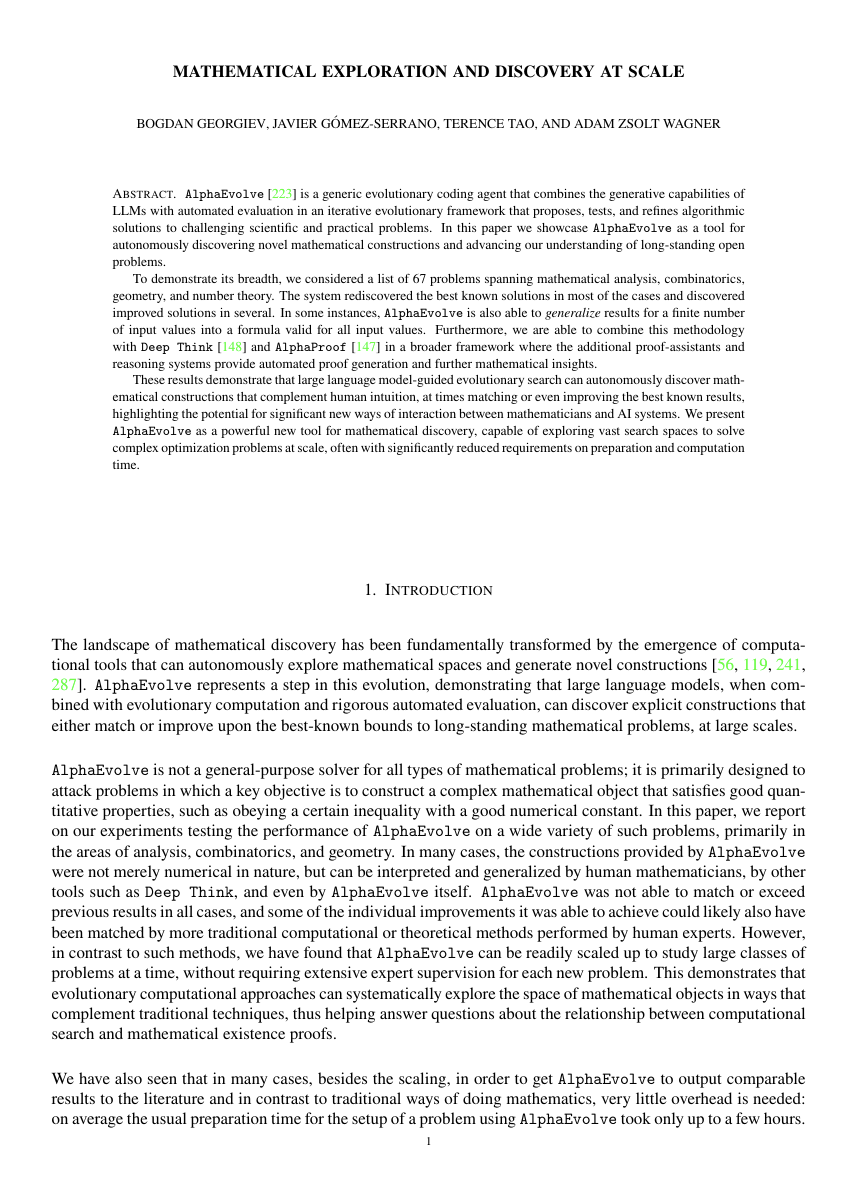
Mathematical exploration and discovery at scale
Bogdan Georgiev, Javier Gómez-Serrano, Terence Tao, Adam Zsolt Wagner
Why you should read this
Demonstrates how AlphaEvolve, an AI system, autonomously discovers novel mathematical constructions and even improves upon best-known solutions to challenging open problems, presenting a powerful new tool for mathematical discovery.
AlphaEvolve is a generic evolutionary coding agent that combines the generative capabilities of LLMs with automated evaluation in an iterative evolutionary framework that proposes, tests, and refines algorithmic solutions to challenging scientific and practical problems. In this paper we showcase AlphaEvolve as a tool for autonomously discovering novel mathematical constructions and advancing our understanding of long-standing open problems. To demonstrate its breadth, we considered a list of 67 problems spanning mathematical analysis, combinatorics, geometry, and number theory. The system rediscovered the best known solutions in most of the cases and discovered improved solutions in several. In some instances, AlphaEvolve is also able to generalize results for a finite number of input values into a formula valid for all input values. Furthermore, we are able to combine this methodology with Deep Think and AlphaProof in a broader framework where the additional proof-assistants and reasoning systems provide automated proof generation and further mathematical insights. These results demonstrate that large language model-guided evolutionary search can autonomously discover mathematical constructions that complement human intuition, at times matching or even improving the best known results, highlighting the potential for significant new ways of interaction between mathematicians and AI systems. We present AlphaEvolve as a powerful new tool for mathematical discovery, capable of exploring vast search spaces to solve complex optimization problems at scale, often with significantly reduced requirements on preparation and computation time.
Added
2025-11-14
