
keyword
Gibbs sampling
Gibbs sampling is a Markov chain Monte Carlo algorithm used to generate a sequence of random samples from a joint multivariate probability distribution when direct sampling is mathematically or computationally intractable. The algorithm operates iteratively by updating one variable or subset of variables at a time, drawing each new value directly from its conditional distribution given the current values of all remaining variables. Because full conditional distributions are frequently easier to compute and sample from than the complete joint distribution, Gibbs sampling reduces a complex multidimensional sampling task into a sequence of simpler, lower-dimensional steps. Over successive iterations, the resulting sequence of states forms a Markov chain whose stationary distribution converges to the target joint distribution, making it a widely utilized method for approximate statistical inference in Bayesian modeling and machine learning.
15 items
Reprompting: Automated Chain-of-Thought Prompt Inference Through Gibbs Sampling
Weijia Xu, Andrzej Banburski, Nebojsa Jojic
Why you should read this
Proposes an automated method that uses Gibbs sampling to infer effective chain-of-thought prompts without human intervention, outperforming human-written prompts and existing prompt optimization techniques across twenty complex reasoning benchmarks.
We introduce Reprompting, an iterative sampling algorithm that automatically learns the Chain-of-Thought (CoT) recipes for a given task without human intervention. Through Gibbs sampling, Reprompting infers the CoT recipes that work consistently well for a set of training samples by iteratively sampling new recipes using previously sampled recipes as parent prompts to solve other training problems. We conduct extensive experiments on 20 challenging reasoning tasks. Results show that Reprompting outperforms human-written CoT prompts substantially by +9.4 points on average. It also achieves consistently better performance than the state-of-the-art prompt optimization and decoding algorithms.
Added
2026-10-03
Scalable Model-Based Clustering with Sequential Monte Carlo
Connie Trojan, Pavel Myshkov, Paul Fearnhead, James Hensman, Tom Minka, Christopher Nemeth
Why you should read this
Proposes a scalable Sequential Monte Carlo algorithm for online clustering that overcomes critical memory bottlenecks by decomposing cluster uncertainty into approximately independent subproblems.
In online clustering problems, there is often a large amount of uncertainty over possible cluster assignments that cannot be resolved until more data are observed. This difficulty is compounded when clusters follow complex distributions, as is the case with text data. Sequential Monte Carlo (SMC) methods give a natural way of representing and updating this uncertainty over time, but have prohibitive memory requirements for large-scale problems. We propose a novel SMC algorithm that decomposes clustering problems into approximately independent subproblems, allowing a more compact representation of the algorithm state. Our approach is motivated by the knowledge base construction problem, and we show that our method is able to accurately and efficiently solve clustering problems in this setting and others where traditional SMC struggles.
Added
2026-09-29
One Transformer Fits All Distributions in Multi-Modal Diffusion at Scale
Fan Bao, Shen Nie, Kaiwen Xue, Chongxuan Li, Shi Pu, Yaole Wang, Gang Yue, Yue Cao, Hang Su, Jun Zhu
Why you should read this
Proposes UniDiffuser, a single transformer-based framework that captures marginal, conditional, and joint multi-modal distributions to handle diverse generation tasks—including text-to-image, image-to-text, and paired generation—without requiring task-specific models or extra computational overhead.
This paper proposes a unified diffusion framework (dubbed UniDiffuser) to fit all distributions relevant to a set of multi-modal data in one model. Our key insight is – learning diffusion models for marginal, conditional, and joint distributions can be unified as predicting the noise in the perturbed data, where the perturbation levels (i.e. timesteps) can be different for different modalities. Inspired by the unified view, UniDiffuser learns all distributions simultaneously with a minimal modification to the original diffusion model – perturbs data in all modalities instead of a single modality, inputs individual timesteps in different modalities, and predicts the noise of all modalities instead of a single modality. UniDiffuser is parameterized by a transformer for diffusion models to handle input types of different modalities. Implemented on large-scale paired image-text data, UniDiffuser is able to perform image, text, text-to-image, image-to-text, and image-text pair generation by setting proper timesteps without additional overhead. In particular, UniDiffuser is able to produce perceptually realistic samples in all tasks and its quantitative results (e.g., the FID and CLIP score) are not only superior to existing general-purpose models but also comparable to the bespoke models (e.g., Stable Diffusion and DALL·E 2) in representative tasks (e.g., text-to-image generation). Our code is available at https://github.com/thu-ml/unidiffuser.
Added
2026-09-28
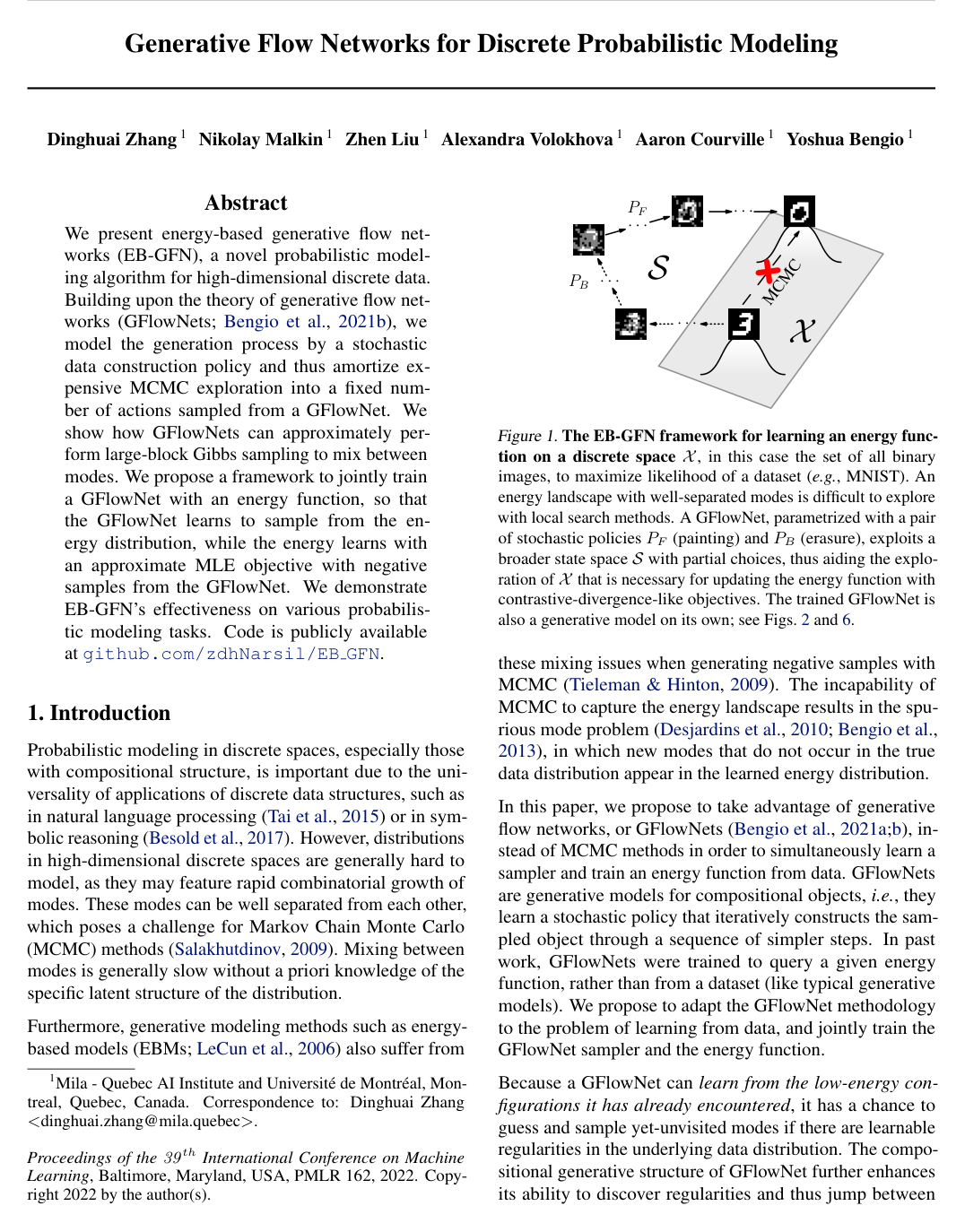
Generative Flow Networks for Discrete Probabilistic Modeling
Dinghuai Zhang, Nikolay Malkin, Zhen Liu, Alexandra Volokhova, Aaron C. Courville, Yoshua Bengio
Why you should read this
Proposes energy-based generative flow networks to overcome the slow mixing of traditional MCMC methods in high-dimensional discrete spaces by jointly training an energy function alongside a generative policy that amortizes mode-hopping exploration.
We present energy-based generative flow networks (EB-GFN), a novel probabilistic modeling algorithm for high-dimensional discrete data. Building upon the theory of generative flow networks (GFlowNets; Bengio et al., 2021b), we model the generation process by a stochastic data construction policy and thus amortize expensive MCMC exploration into a fixed number of actions sampled from a GFlowNet. We show how GFlowNets can approximately perform large-block Gibbs sampling to mix between modes. We propose a framework to jointly train a GFlowNet with an energy function, so that the GFlowNet learns to sample from the energy distribution, while the energy learns with an approximate MLE objective with negative samples from the GFlowNet. We demonstrate EB-GFN's effectiveness on various probabilistic modeling tasks. Code is publicly available at github.com/zdhnarsil/EB_GFN.
Added
2026-09-26
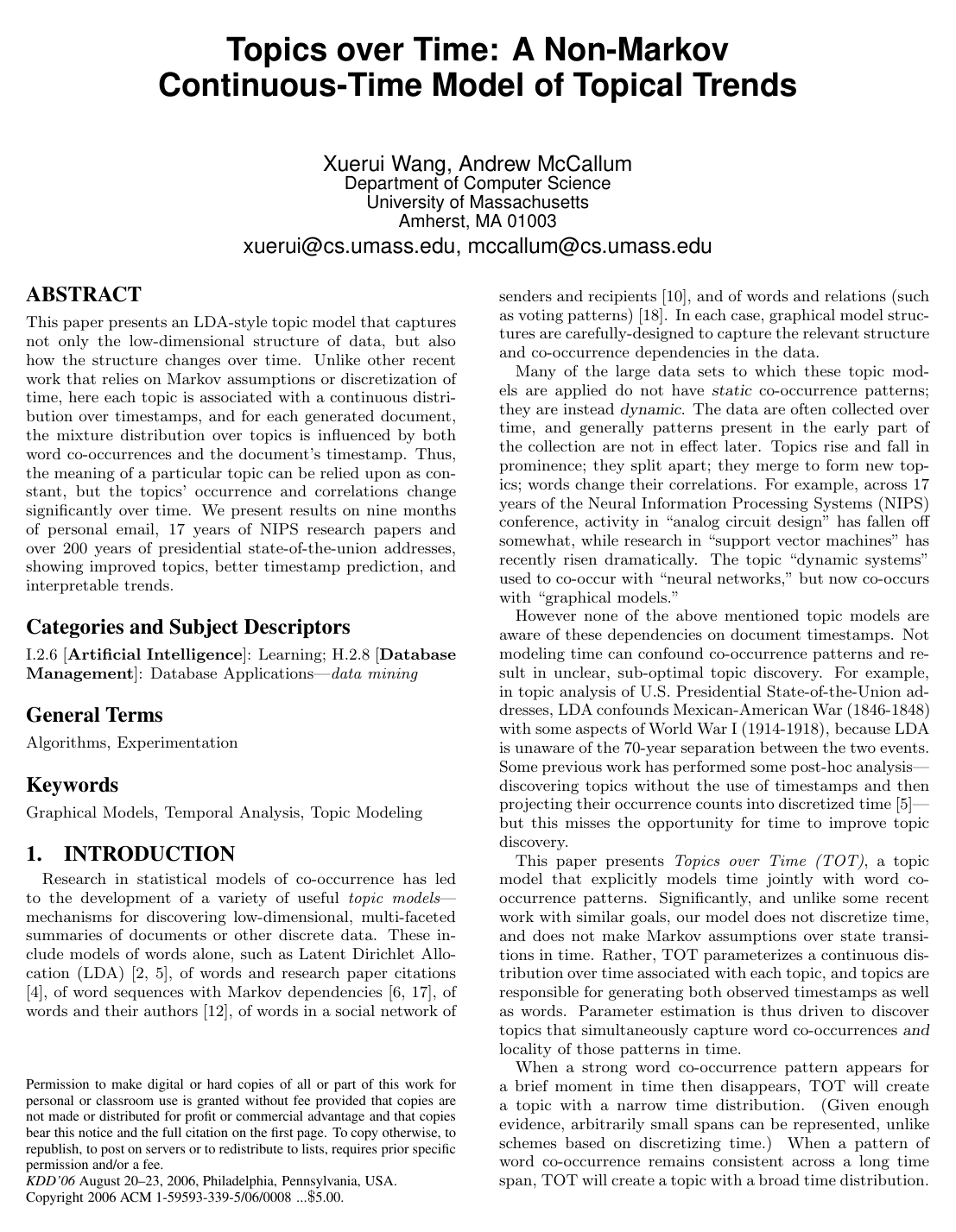
Topics over time: a non-Markov continuous-time model of topical trends
Xuerui Wang, Andrew McCallum
Why you should read this
Proposes a continuous-time topic model that associates each topic with a continuous distribution over document timestamps, capturing temporal topical trends and improving timestamp prediction without relying on time discretization or Markov assumptions.
This paper presents an LDA-style topic model that captures not only the low-dimensional structure of data, but also how the structure changes over time. Unlike other recent work that relies on Markov assumptions or discretization of time, here each topic is associated with a continuous distribution over timestamps, and for each generated document, the mixture distribution over topics is influenced by both word co-occurrences and the document’s timestamp. Thus, the meaning of a particular topic can be relied upon as constant, but the topics’ occurrence and correlations change significantly over time. We present results on nine months of personal email, 17 years of NIPS research papers and over 200 years of presidential state-of-the-union addresses, showing improved topics, better timestamp prediction, and interpretable trends.
Added
2026-09-25
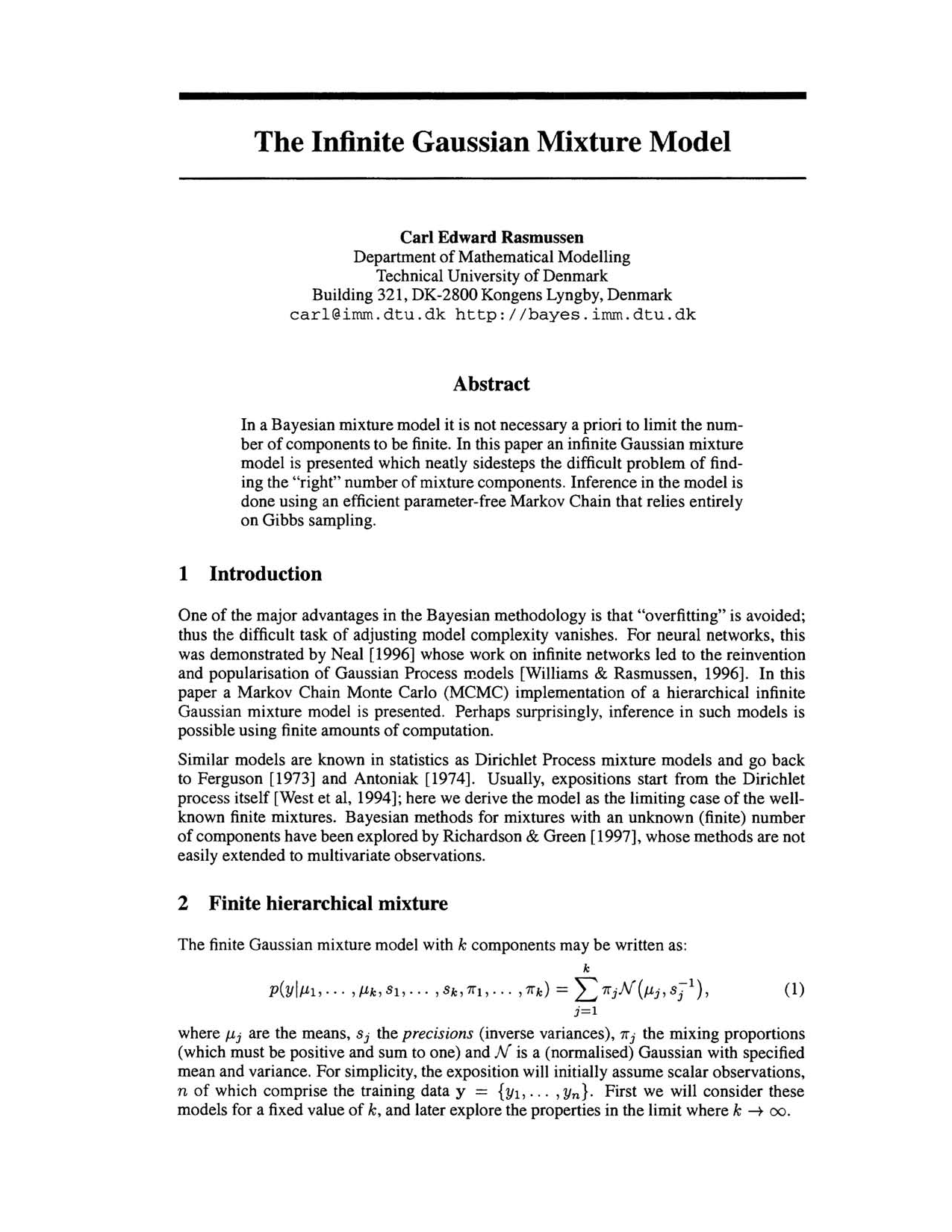
The Infinite Gaussian Mixture Model
C. Rasmussen
Why you should read this
Develops an infinite Gaussian mixture model that bypasses the challenge of predefined cluster selection by using an efficient, parameter-free Gibbs sampling algorithm for tractable Bayesian inference across countably infinite components.
In a Bayesian mixture model it is not necessary a priori to limit the number of components to be finite. In this paper an infinite Gaussian mixture model is presented which neatly sidesteps the difficult problem of finding the “right” number of mixture components. Inference in the model is done using an efficient parameter-free Markov Chain that relies entirely on Gibbs sampling.
Added
2026-09-25
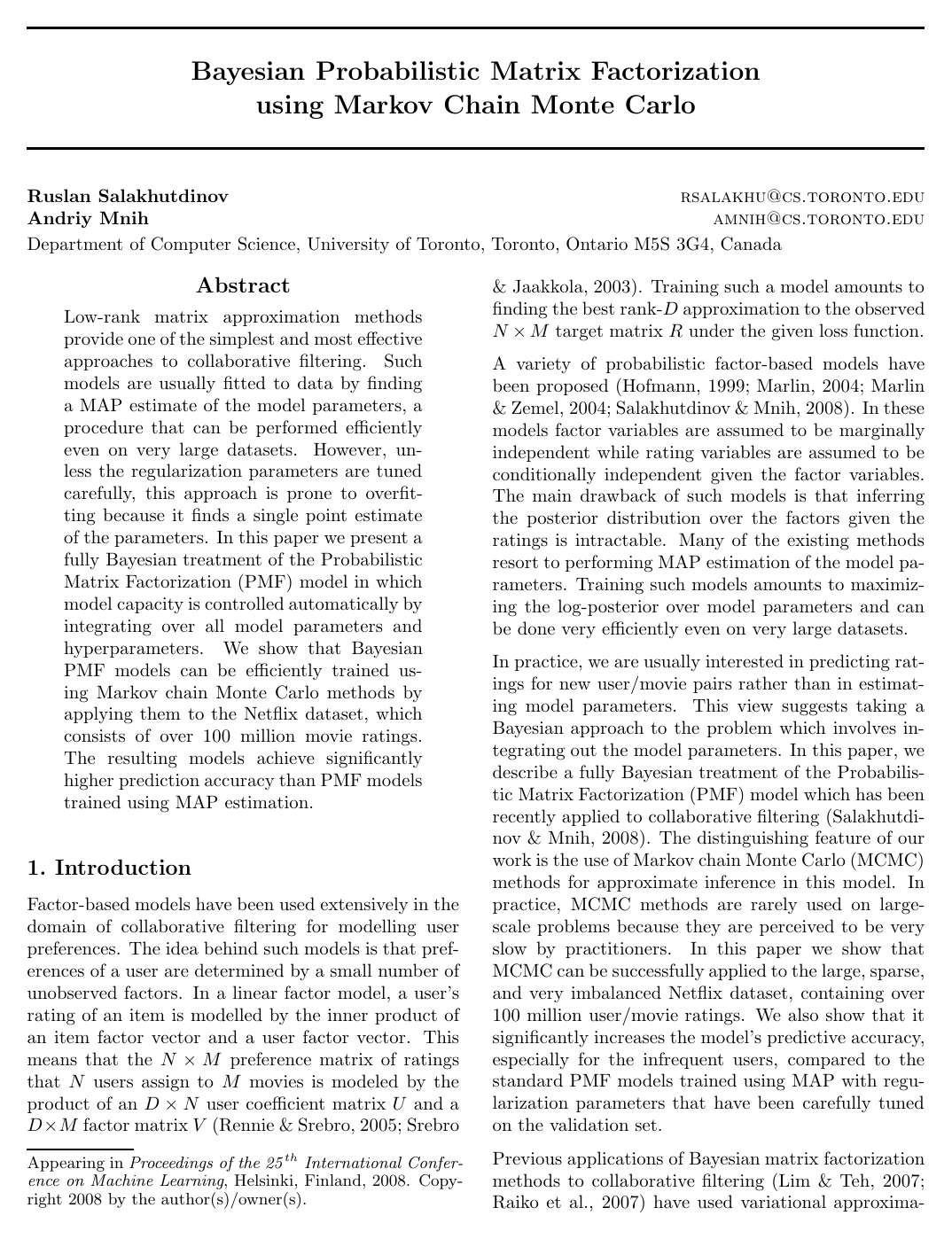
Bayesian probabilistic matrix factorization using Markov chain Monte Carlo
R. Salakhutdinov, A. Mnih
Why you should read this
Presents a fully Bayesian treatment of probabilistic matrix factorization using Markov chain Monte Carlo methods to automatically control model complexity and significantly improve recommendation accuracy on large-scale collaborative filtering datasets like Netflix.
Low-rank matrix approximation methods provide one of the simplest and most effective approaches to collaborative filtering. Such models are usually fitted to data by finding a MAP estimate of the model parameters, a procedure that can be performed efficiently even on very large datasets. However, unless the regularization parameters are tuned carefully, this approach is prone to overfitting because it finds a single point estimate of the parameters. In this paper we present a fully Bayesian treatment of the Probabilistic Matrix Factorization (PMF) model in which model capacity is controlled automatically by integrating over all model parameters and hyperparameters. We show that Bayesian PMF models can be efficiently trained using Markov chain Monte Carlo methods by applying them to the Netflix dataset, which consists of over 100 million movie ratings. The resulting models achieve significantly higher prediction accuracy than PMF models trained using MAP estimation.
Added
2026-09-24
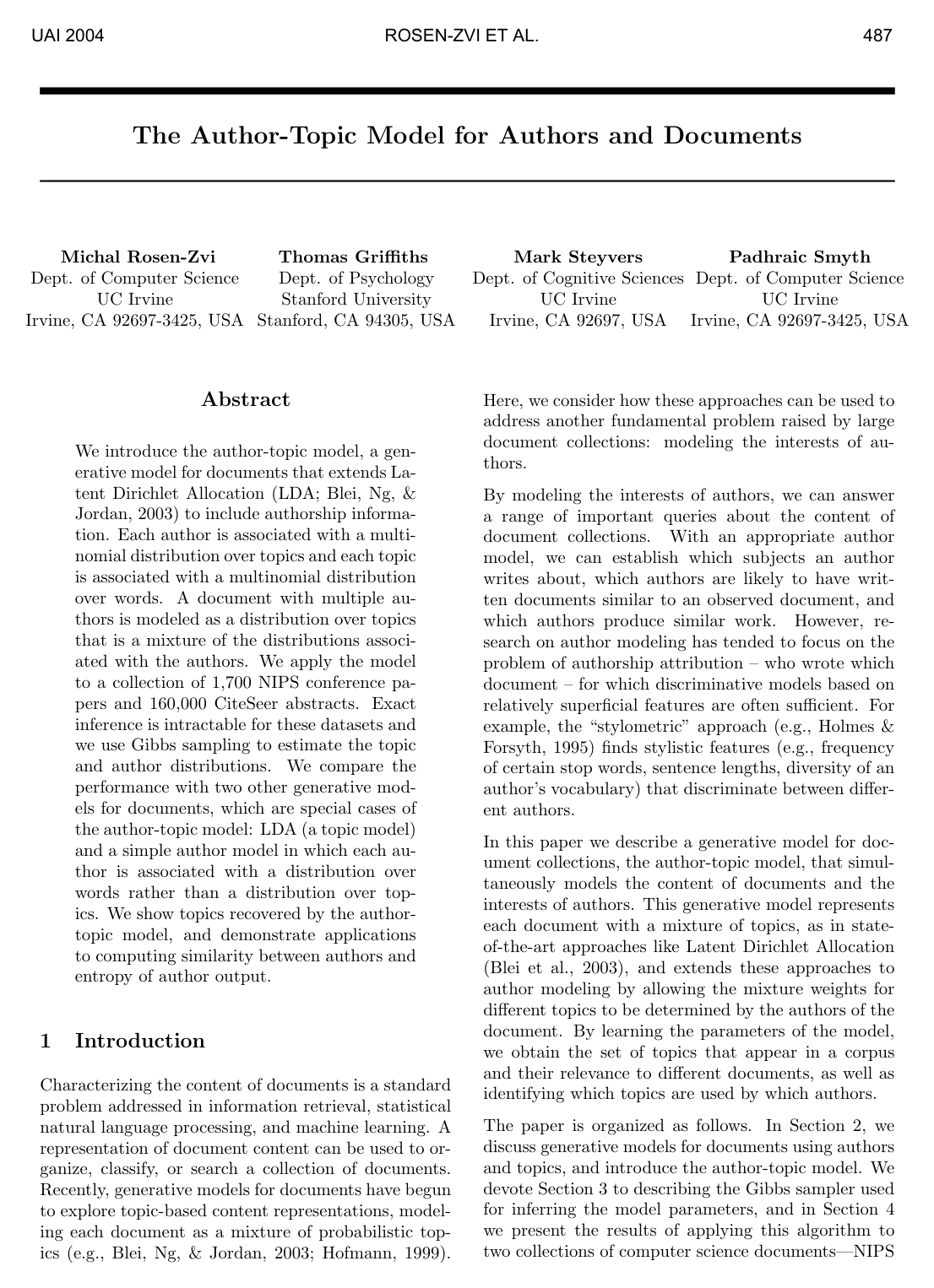
The Author-Topic Model for Authors and Documents
Michal Rosen-Zvi, Thomas Griffiths, Mark Steyvers, Padhraic Smyth
Why you should read this
Extends Latent Dirichlet Allocation by simultaneously modeling document content and authorship distributions, providing a probabilistic framework to discover research interests, measure author similarities, and analyze multi-authored texts.
We introduce the author-topic model, a generative model for documents that extends Latent Dirichlet Allocation (LDA; Blei, Ng, & Jordan, 2003) to include authorship information. Each author is associated with a multinomial distribution over topics and each topic is associated with a multinomial distribution over words. A document with multiple authors is modeled as a distribution over topics that is a mixture of the distributions associated with the authors. We apply the model to a collection of 1,700 NIPS conference papers and 160,000 CiteSeer abstracts. Exact inference is intractable for these datasets and we use Gibbs sampling to estimate the topic and author distributions. We compare the performance with two other generative models for documents, which are special cases of the author-topic model: LDA (a topic model) and a simple author model in which each author is associated with a distribution over words rather than a distribution over topics. We show topics recovered by the author-topic model, and demonstrate applications to computing similarity between authors and entropy of author output.
Added
2026-09-24
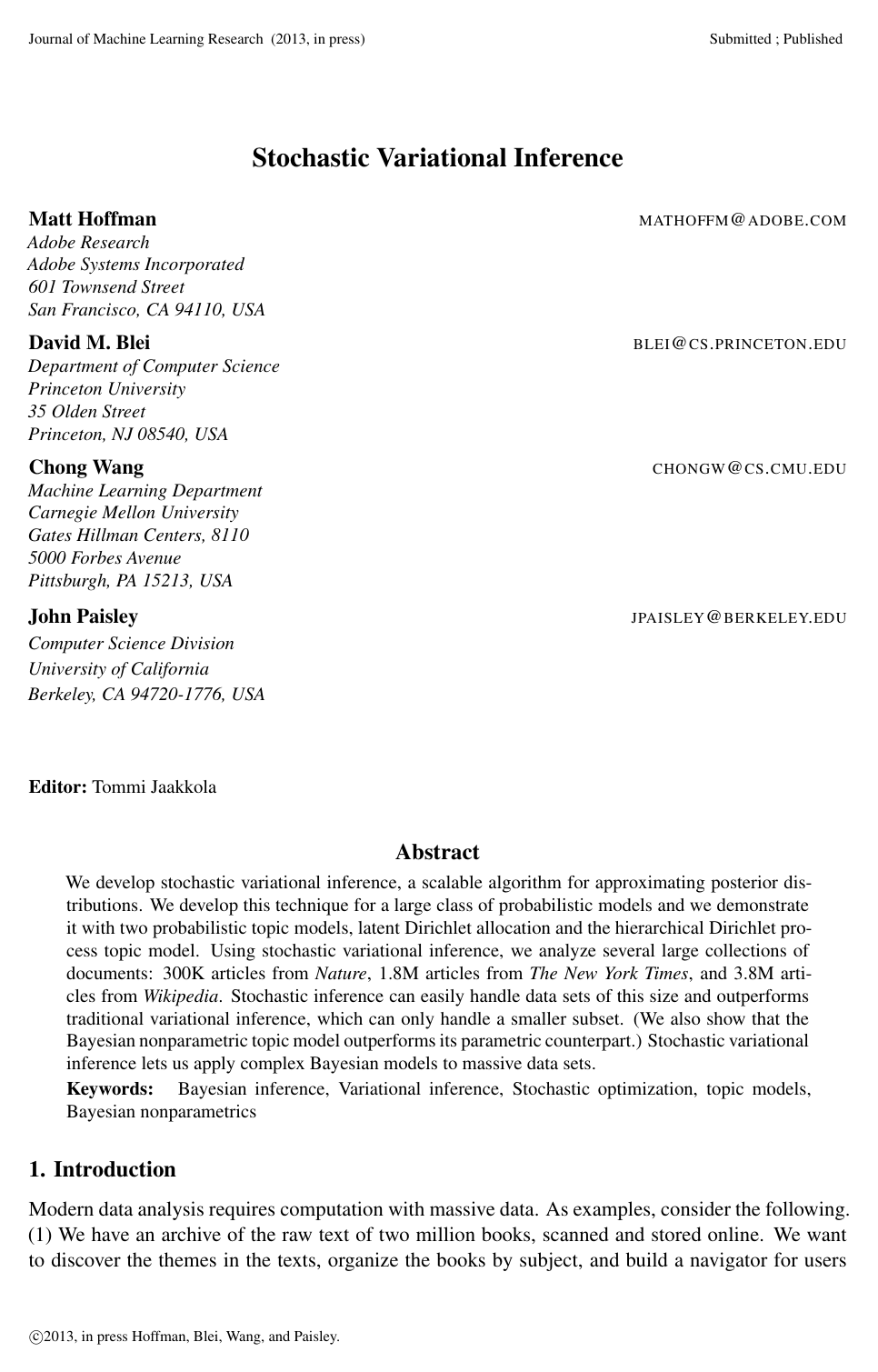
Stochastic variational inference
Matt Hoffman, David M. Blei, Chong Wang, John Paisley
Why you should read this
Develops stochastic variational inference, a scalable algorithm that applies stochastic optimization to variational bounds, enabling complex Bayesian models to perform posterior inference on massive datasets containing millions of documents.
We develop stochastic variational inference, a scalable algorithm for approximating posterior distributions. We develop this technique for a large class of probabilistic models and we demonstrate it with two probabilistic topic models, latent Dirichlet allocation and the hierarchical Dirichlet process topic model. Using stochastic variational inference, we analyze several large collections of documents: 300K articles from Nature, 1.8M articles from The New York Times, and 3.8M articles from Wikipedia. Stochastic inference can easily handle data sets of this size and outperforms traditional variational inference, which can only handle a smaller subset. (We also show that the Bayesian nonparametric topic model outperforms its parametric counterpart.) Stochastic variational inference lets us apply complex Bayesian models to massive data sets.
Added
2026-09-14
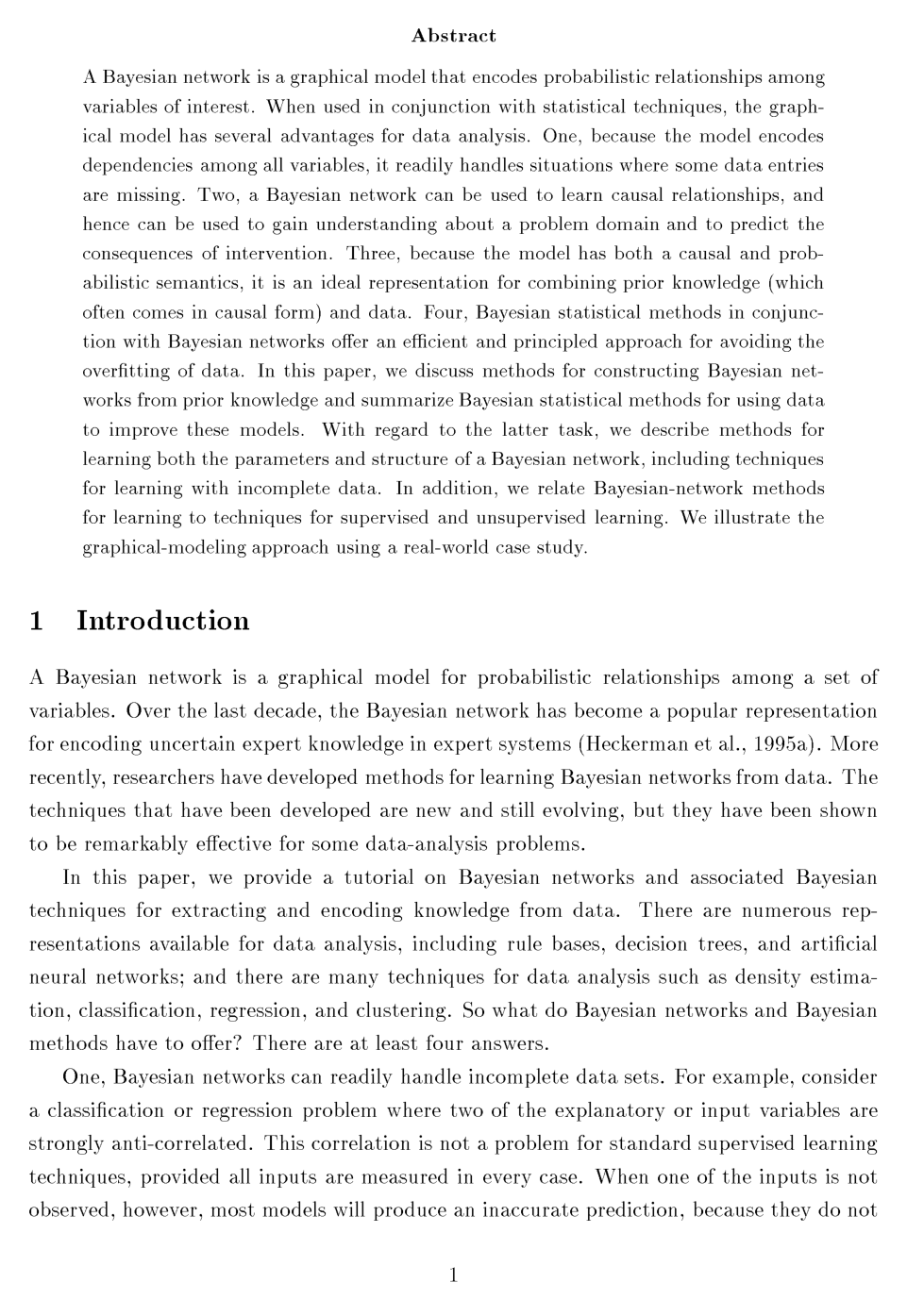
A Tutorial on Learning with Bayesian Networks
David Heckerman
Why you should read this
Explains the foundational principles and practical algorithms for learning both the structure and parameters of Bayesian networks from complete and incomplete data, bridging statistical inference, prior knowledge integration, and causal discovery.
A Bayesian network is a graphical model that encodes probabilistic relationships among variables of interest. When used in conjunction with statistical techniques, the graphical model has several advantages for data analysis. One, because the model encodes dependencies among all variables, it readily handles situations where some data entries are missing. Two, a Bayesian network can be used to learn causal relationships, and hence can be used to gain understanding about a problem domain and to predict the consequences of intervention. Three, because the model has both a causal and probabilistic semantics, it is an ideal representation for combining prior knowledge (which often comes in causal form) and data. Four, Bayesian statistical methods in conjunction with Bayesian networks offer an efficient and principled approach for avoiding the overfitting of data. In this paper, we discuss methods for constructing Bayesian networks from prior knowledge and summarize Bayesian statistical methods for using data to improve these models. With regard to the latter task, we describe methods for learning both the parameters and structure of a Bayesian network, including techniques for learning with incomplete data. In addition, we relate Bayesian-network methods for learning to techniques for supervised and unsupervised learning. We illustrate the graphical-modeling approach using a real-world case study.
Added
2026-09-13
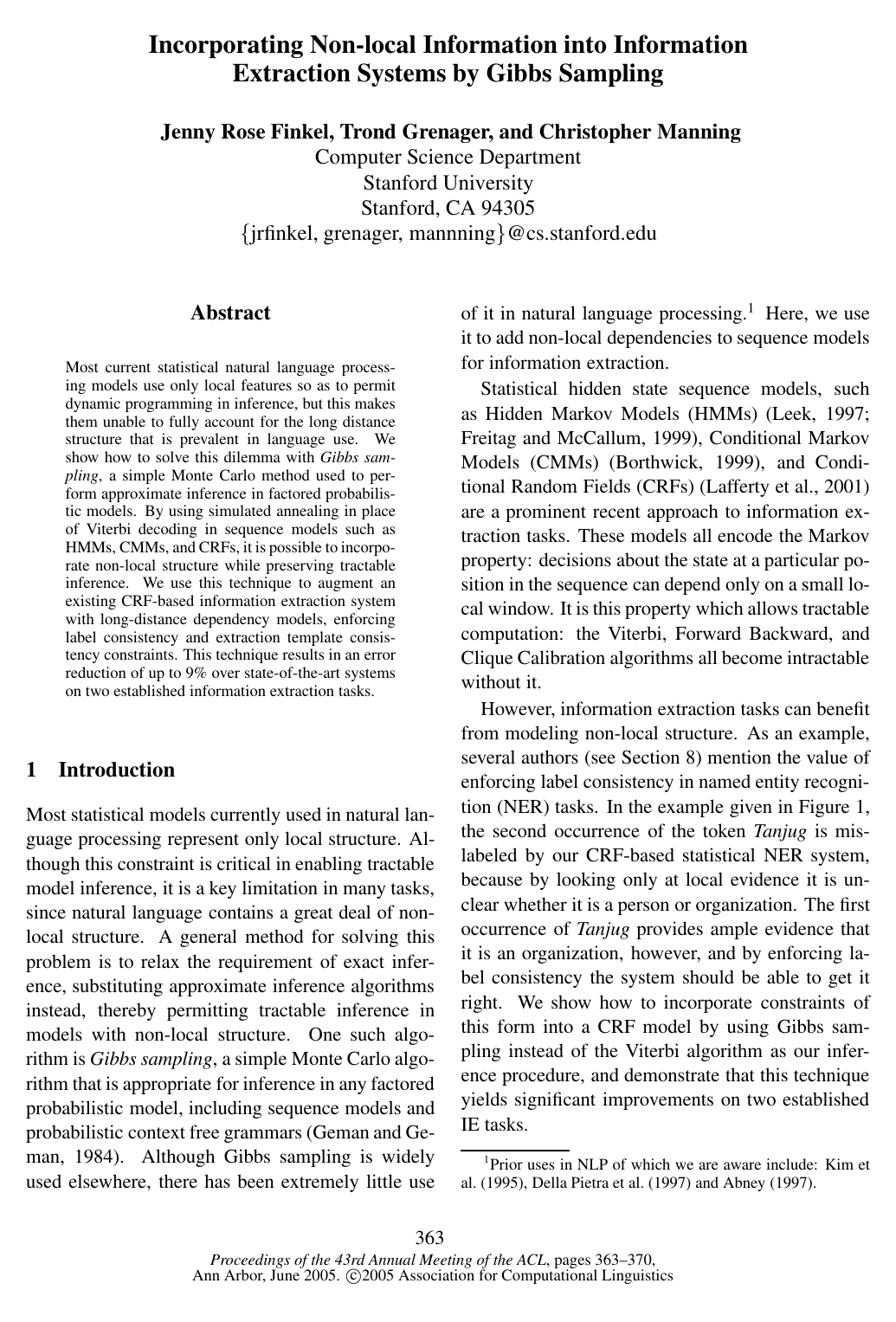
Incorporating Non-local Information into Information Extraction Systems by Gibbs Sampling
Jenny Rose Finkel, Trond Grenager, Christopher D. Manning
Why you should read this
Proposes using Gibbs sampling with simulated annealing during inference to incorporate long-range consistency constraints into conditional random fields, boosting information extraction accuracy on standard benchmarks without requiring structural retraining.
Most current statistical natural language processing models use only local features so as to permit dynamic programming in inference, but this makes them unable to fully account for the long distance structure that is prevalent in language use. We show how to solve this dilemma with Gibbs sampling, a simple Monte Carlo method used to perform approximate inference in factored probabilistic models. By using simulated annealing in place of Viterbi decoding in sequence models such as HMMs, CMMs, and CRFs, it is possible to incorporate non-local structure while preserving tractable inference. We use this technique to augment an existing CRF-based information extraction system with long-distance dependency models, enforcing label consistency and extraction template consistency constraints. This technique results in an error reduction of up to 9% over state-of-the-art systems on two established information extraction tasks.
Added
2026-09-11
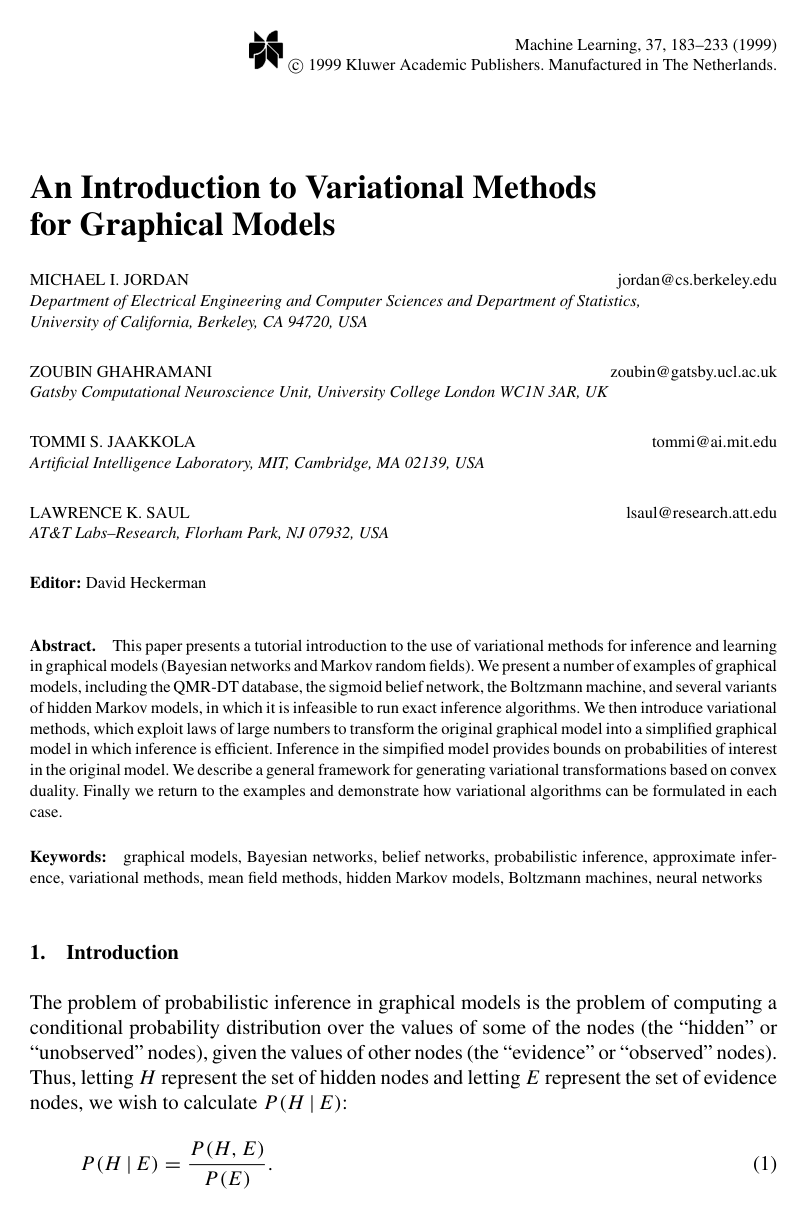
An Introduction to Variational Methods for Graphical Models
MICHAEL I. JORDAN, ZOUBIN GHAHRAMANI, TOMMI S. JAAKKOLA, LAWRENCE K. SAUL
Why you should read this
Establishes a foundational framework for approximate inference and learning in graphical models by using convex duality to convert intractable probabilistic calculations into tractable optimization problems.
This paper presents a tutorial introduction to the use of variational methods for inference and learning in graphical models (Bayesian networks and Markov random fields). We present a number of examples of graphical models, including the QMR-DT database, the sigmoid belief network, the Boltzmann machine, and several variants of hidden Markov models, in which it is infeasible to run exact inference algorithms. We then introduce variational methods, which exploit laws of large numbers to transform the original graphical model into a simplified graphical model in which inference is efficient. Inference in the simplified model provides bounds on probabilities of interest in the original model. We describe a general framework for generating variational transformations based on convex duality. Finally we return to the examples and demonstrate how variational algorithms can be formulated in each case.
Added
2026-09-10
The No-U-turn sampler: adaptively setting path lengths in Hamiltonian Monte Carlo
Matthew D. Hoffman, Andrew Gelman
Why you should read this
Introduces the No-U-Turn Sampler (NUTS), an algorithm that automates path length selection and step-size adaptation in Hamiltonian Monte Carlo to enable efficient, hands-free sampling for high-dimensional Bayesian models.
Hamiltonian Monte Carlo (HMC) is a Markov chain Monte Carlo (MCMC) algorithm that avoids the random walk behavior and sensitivity to correlated parameters that plague many MCMC methods by taking a series of steps informed by first-order gradient information. These features allow it to converge to high-dimensional target distributions much more quickly than simpler methods such as random walk Metropolis or Gibbs sampling. However, HMC's performance is highly sensitive to two user-specified parameters: a step size {\epsilon} and a desired number of steps L. In particular, if L is too small then the algorithm exhibits undesirable random walk behavior, while if L is too large the algorithm wastes computation. We introduce the No-U-Turn Sampler (NUTS), an extension to HMC that eliminates the need to set a number of steps L. NUTS uses a recursive algorithm to build a set of likely candidate points that spans a wide swath of the target distribution, stopping automatically when it starts to double back and retrace its steps. Empirically, NUTS perform at least as efficiently as and sometimes more efficiently than a well tuned standard HMC method, without requiring user intervention or costly tuning runs. We also derive a method for adapting the step size parameter {\epsilon} on the fly based on primal-dual averaging. NUTS can thus be used with no hand-tuning at all. NUTS is also suitable for applications such as BUGS-style automatic inference engines that require efficient "turnkey" sampling algorithms.
Added
2026-09-09

A Fast Learning Algorithm for Deep Belief Nets
Geoffrey E. Hinton, Simon Osindero, Yee‐Whye Teh
Why you should read this
Introduces a layer-wise unsupervised pre-training method that effectively initializes weights for deep architectures preventing early optimization stalls.
We show how to use "complementary priors" to eliminate the explaining-away effects that make inference difficult in densely connected belief nets that have many hidden layers. Using complementary priors, we derive a fast, greedy algorithm that can learn deep, directed belief networks one layer at a time, provided the top two layers form an undirected associative memory. The fast, greedy algorithm is used to initialize a slower learning procedure that fine-tunes the weights using a contrastive version of the wake-sleep algorithm. After fine-tuning, a network with three hidden layers forms a very good generative model of the joint distribution of handwritten digit images and their labels. This generative model gives better digit classification than the best discriminative learning algorithms. The low-dimensional manifolds on which the digits lie are modeled by long ravines in the free-energy landscape of the top-level associative memory, and it is easy to explore these ravines by using the directed connections to display what the associative memory has in mind.
Added
2026-02-21
Pen and Paper Exercises in Machine Learning
Michael U. Gutmann
Why you should read this
This book would help anyone who wants to deeply understand the mathematical foundations of machine learning through hands-on practice, covering essential topics from linear algebra and optimization to graphical models and variational inference with structured exercises and solutions.
This is a collection of (mostly) pen-and-paper exercises in machine learning. The exercises are on the following topics: linear algebra, optimisation, directed graphical models, undirected graphical models, expressive power of graphical models, factor graphs and message passing, inference for hidden Markov models, model-based learning (including ICA and unnormalised models), sampling and Monte-Carlo integration, and variational inference.
Added
2025-10-08