
keyword
generative inference
Generative inference is the computational process by which a trained generative artificial intelligence model creates new content, such as text, code, or images, in response to an input prompt or conditioning signal. Unlike discriminative inference, which assigns labels or classifications to existing data, generative inference produces novel sequences or structured outputs, commonly using autoregressive or iterative sampling methods that synthesize tokens or features step by step. In practice, this runtime phase typically involves processing the initial input context and repeatedly generating subsequent elements while maintaining intermediate state representations, such as key-value caches, to manage sequential dependencies, memory bandwidth, and execution latency.
4 items
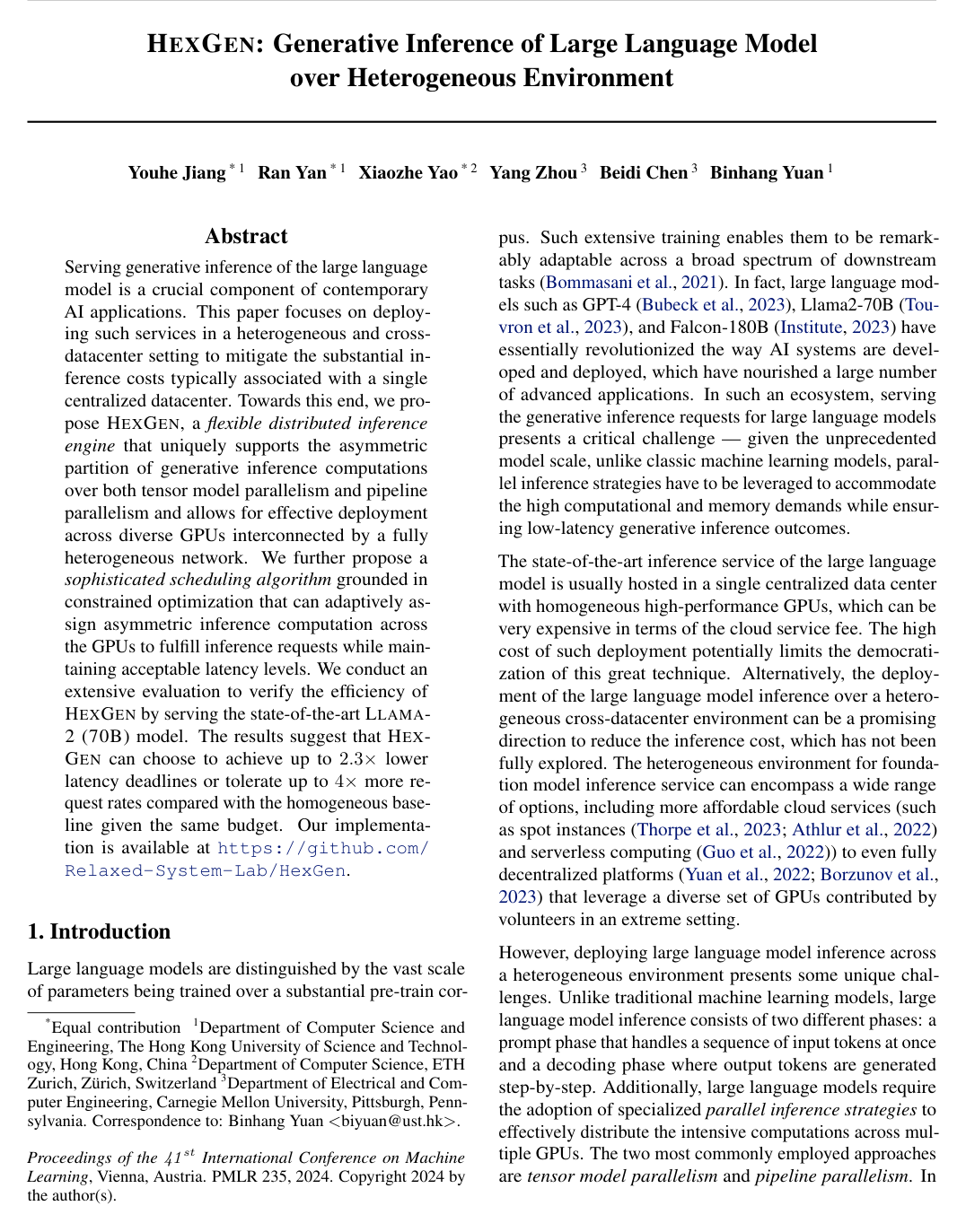
HexGen: Generative Inference of Large Language Model over Heterogeneous Environment
Youhe Jiang, Ran Yan, Xiaozhe Yao, Yang Zhou, Beidi Chen, Binhang Yuan
Why you should read this
Presents an asymmetric distributed inference engine and optimization-based scheduling algorithm that cuts cloud serving costs by deploying large language models across heterogeneous GPUs and networks while meeting strict latency targets.
Serving generative inference of the large language model is a crucial component of contemporary AI applications. This paper focuses on deploying such services in a heterogeneous and cross-datacenter setting to mitigate the substantial inference costs typically associated with a single centralized datacenter. Towards this end, we propose HExGen, a flexible distributed inference engine that uniquely supports the asymmetric partition of generative inference computations over both tensor model parallelism and pipeline parallelism and allows for effective deployment across diverse GPUs interconnected by a fully heterogeneous network. We further propose a sophisticated scheduling algorithm grounded in constrained optimization that can adaptively assign asymmetric inference computation across the GPUs to fulfill inference requests while maintaining acceptable latency levels. We conduct an extensive evaluation to verify the efficiency of HExGen by serving the state-of-the-art LLAMA-2 (70B) model. The results suggest that HExGen can choose to achieve up to 2.3× lower latency deadlines or tolerate up to 4× more request rates compared with the homogeneous baseline given the same budget. Our implementation is available at https://github.com/Relaxed-System-Lab/HexGen.
Added
2026-10-05
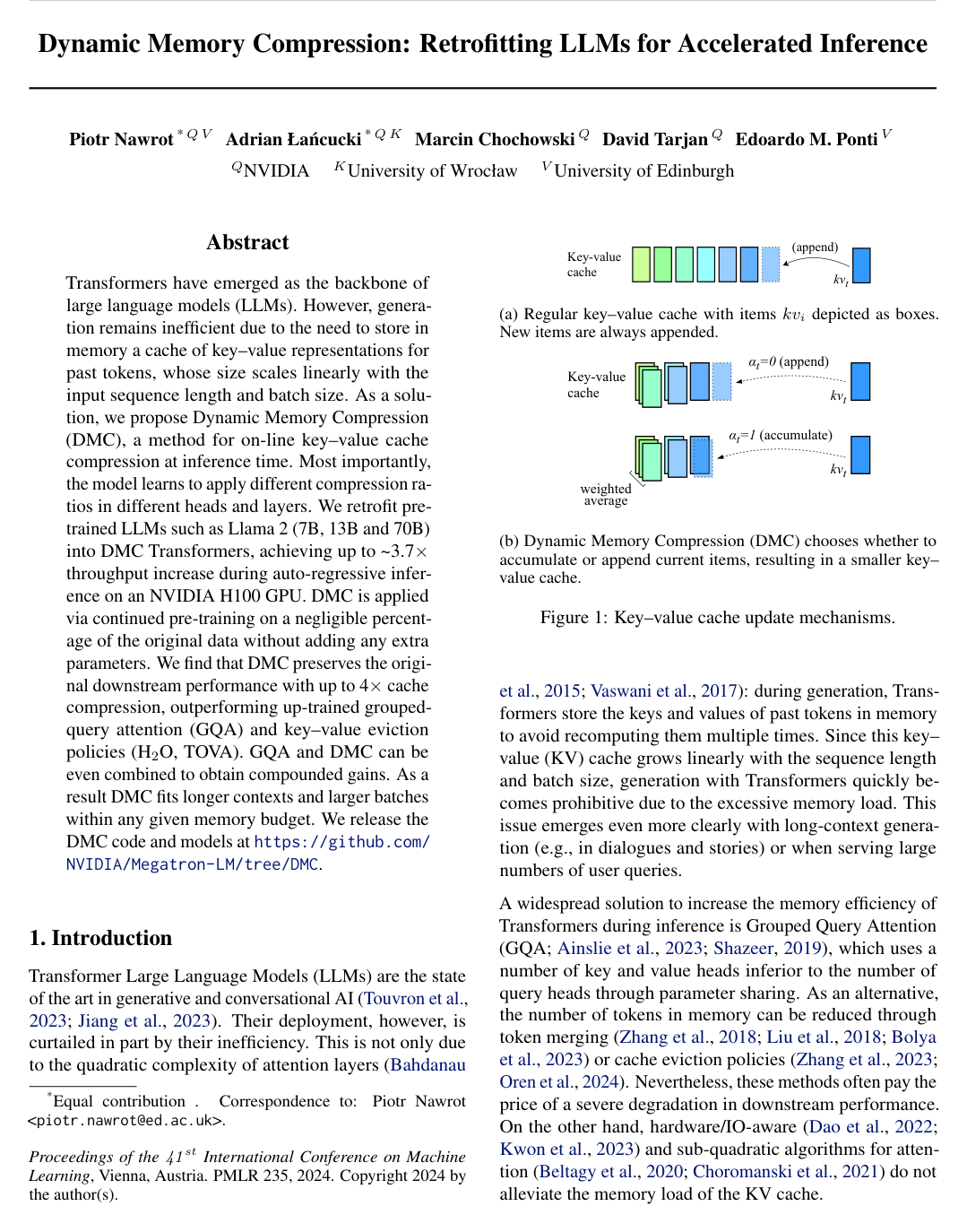
Dynamic Memory Compression: Retrofitting LLMs for Accelerated Inference
Piotr Nawrot, Adrian Lancucki, Marcin Chochowski, David Tarjan, Edoardo M. Ponti
Why you should read this
Introduces Dynamic Memory Compression, an approach for retrofitting pre-trained large language models to adaptively compress key-value caches across heads and layers, increasing inference throughput up to 3.7x without requiring extra parameters or degrading downstream accuracy.
Transformers have emerged as the backbone of large language models (LLMs). However, generation remains inefficient due to the need to store in memory a cache of key–value representations for past tokens, whose size scales linearly with the input sequence length and batch size. As a solution, we propose Dynamic Memory Compression (DMC), a method for on-line key–value cache compression at inference time. Most importantly, the model learns to apply different compression ratios in different heads and layers. We retrofit pre-trained LLMs such as Llama 2 (7B, 13B and 70B) into DMC Transformers, achieving up to ~3.7× throughput increase during auto-regressive inference on an NVIDIA H100 GPU. DMC is applied via continued pre-training on a negligible percentage of the original data without adding any extra parameters. We find that DMC preserves the original downstream performance with up to 4× cache compression, outperforming up-trained grouped-query attention (GQA) and key–value eviction policies (H2O, TOVA). GQA and DMC can be even combined to obtain compounded gains. As a result DMC fits longer contexts and larger batches within any given memory budget. We release the DMC code and models at https://github.com/NVIDIA/Megatron-LM/tree/DMC.
Added
2026-09-26
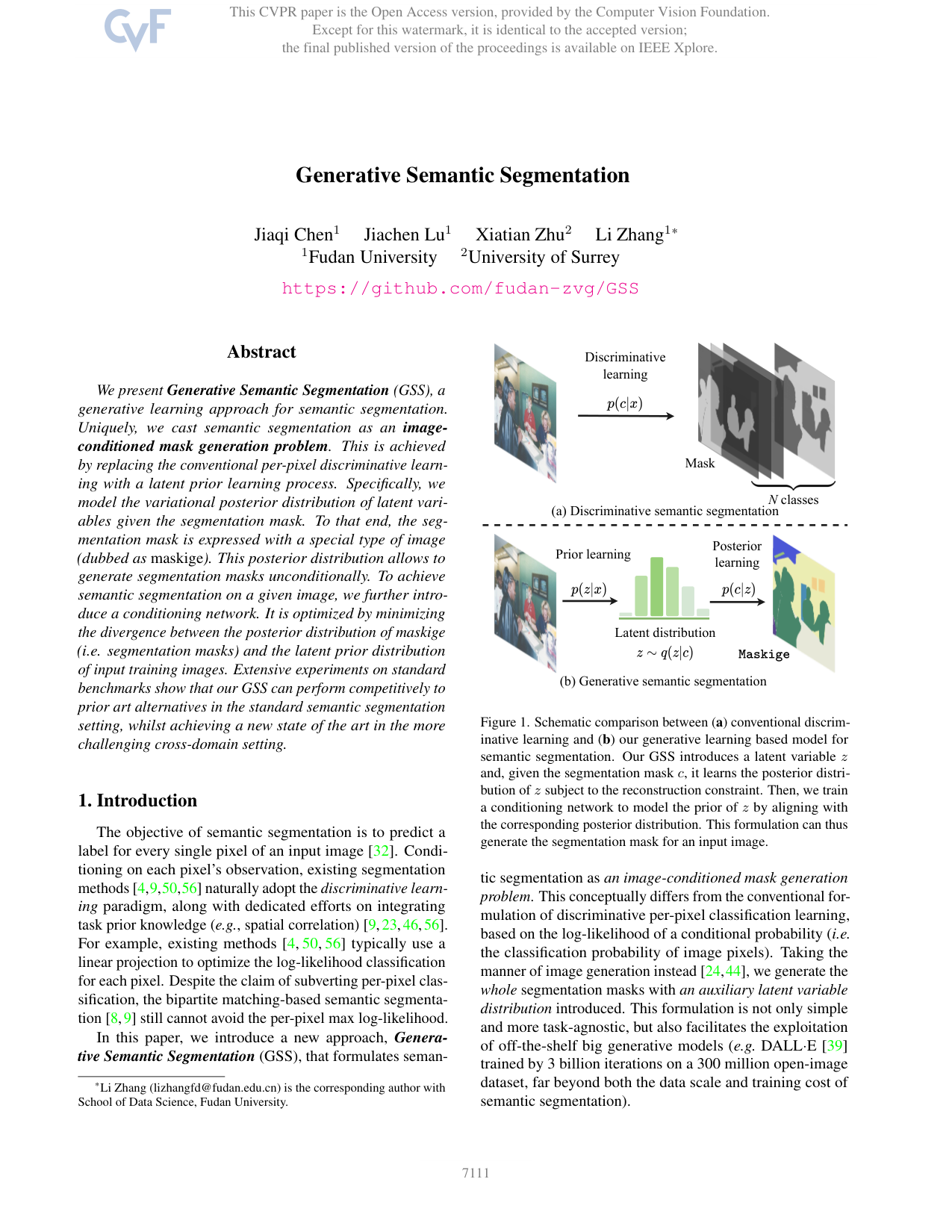
Generative Semantic Segmentation
Jiaqi Chen, Jiachen Lu, Xiatian Zhu, Li Zhang
Why you should read this
Proposes Generative Semantic Segmentation to cast semantic segmentation as an image-conditioned mask generation problem using discrete latent priors and mask-as-image representations, delivering state-of-the-art generalization on challenging cross-domain benchmarks.
We present Generative Semantic Segmentation (GSS), a generative learning approach for semantic segmentation. Uniquely, we cast semantic segmentation as an image-conditioned mask generation problem. This is achieved by replacing the conventional per-pixel discriminative learning with a latent prior learning process. Specifically, we model the variational posterior distribution of latent variables given the segmentation mask. To that end, the segmentation mask is expressed with a special type of image (dubbed as maskige). This posterior distribution allows to generate segmentation masks unconditionally. To achieve semantic segmentation on a given image, we further introduce a conditioning network. It is optimized by minimizing the divergence between the posterior distribution of maskige (i.e. segmentation masks) and the latent prior distribution of input training images. Extensive experiments on standard benchmarks show that our GSS can perform competitively to prior art alternatives in the standard semantic segmentation setting, whilst achieving a new state of the art in the more challenging cross-domain setting.
Added
2026-09-26
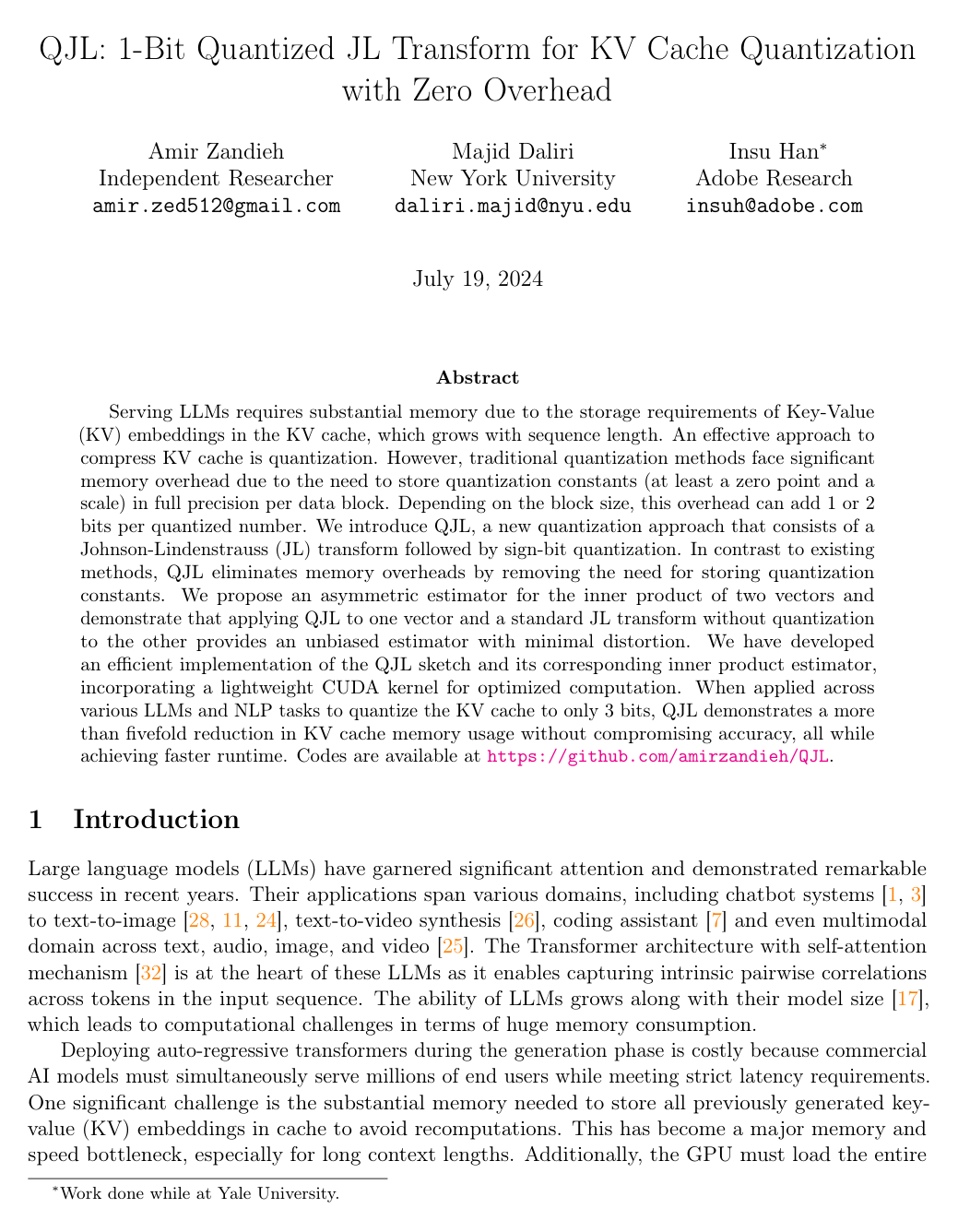
QJL: 1-Bit Quantized JL Transform for KV Cache Quantization with Zero Overhead
Amir Zandieh, Majid Daliri, Insu Han
Why you should read this
Proposes QJL, a novel quantization technique that drastically reduces LLM KV cache memory use by over fivefold without accuracy loss and achieves faster runtime by eliminating storage overheads for quantization constants.
Serving LLMs requires substantial memory due to the storage requirements of Key-Value (KV) embeddings in the KV cache, which grows with sequence length. An effective approach to compress KV cache is quantization. However, traditional quantization methods face significant memory overhead due to the need to store quantization constants (at least a zero point and a scale) in full precision per data block. Depending on the block size, this overhead can add 1 or 2 bits per quantized number. We introduce QJL, a new quantization approach that consists of a Johnson-Lindenstrauss (JL) transform followed by sign-bit quantization. In contrast to existing methods, QJL eliminates memory overheads by removing the need for storing quantization constants. We propose an asymmetric estimator for the inner product of two vectors and demonstrate that applying QJL to one vector and a standard JL transform without quantization to the other provides an unbiased estimator with minimal distortion. We have developed an efficient implementation of the QJL sketch and its corresponding inner product estimator, incorporating a lightweight CUDA kernel for optimized computation. When applied across various LLMs and NLP tasks to quantize the KV cache to only 3 bits, QJL demonstrates a more than fivefold reduction in KV cache memory usage without compromising accuracy, all while achieving faster runtime. Codes are available at \url{this https URL}.
Added
2026-03-25
