
keyword
generative adversarial network
A generative adversarial network is a machine learning framework in which two neural networks compete against each other in a zero-sum game to generate realistic synthetic data. The system consists of a generator, which learns to create plausible data samples such as images from random noise or conditional inputs, and a discriminator, which evaluates incoming samples and attempts to distinguish genuine data in the training set from the generator-produced outputs. Through this adversarial process, the discriminator provides feedback that drives the generator to synthesize increasingly convincing data that matches the statistical distribution of the original dataset without requiring explicit modeling of the underlying probability density function. Generative adversarial networks are widely used across artificial intelligence tasks, including photo-realistic image synthesis, image-to-image translation, super-resolution, and data augmentation.
13 items
Generative Adversarial Symmetry Discovery
Jianke Yang, Robin Walters, Nima Dehmamy, Rose Yu
Why you should read this
Introduces LieGAN, an adversarial framework that discovers continuous symmetries directly from data as interpretable Lie algebra generators, enabling the construction of equivariant neural networks without prior knowledge of the underlying physical group structure.
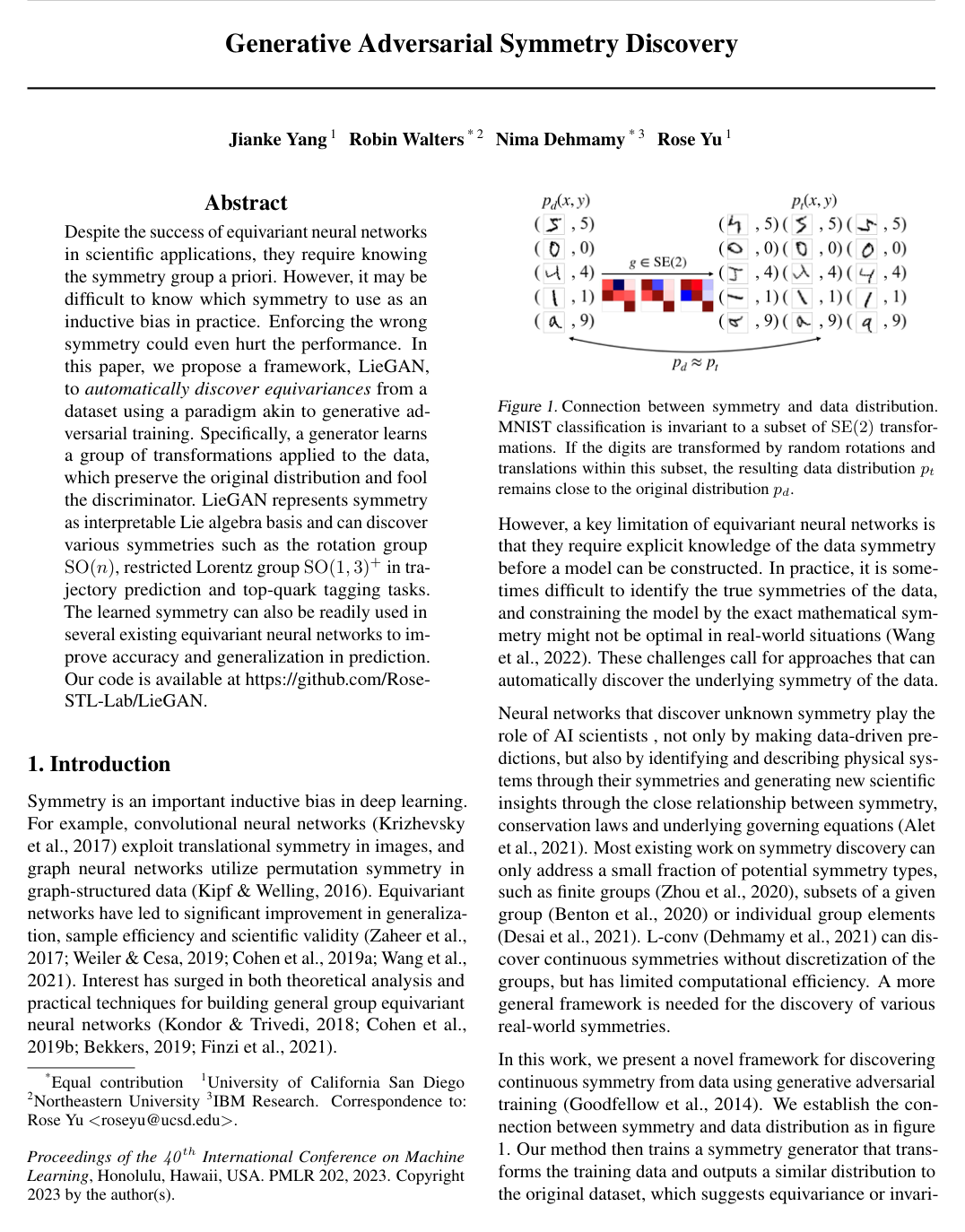
Despite the success of equivariant neural networks in scientific applications, they require knowing the symmetry group a priori. However, it may be difficult to know which symmetry to use as an inductive bias in practice. Enforcing the wrong symmetry could even hurt the performance. In this paper, we propose a framework, LieGAN, to automatically discover equivariances from a dataset using a paradigm akin to generative adversarial training. Specifically, a generator learns a group of transformations applied to the data, which preserve the original distribution and fool the discriminator. LieGAN represents symmetry as interpretable Lie algebra basis and can discover various symmetries such as the rotation group SO(n), restricted Lorentz group SO(1,3)+ in trajectory prediction and top-quark tagging tasks. The learned symmetry can also be readily used in several existing equivariant neural networks to improve accuracy and generalization in prediction. Our code is available at https://github.com/Rose-STL-Lab/LieGAN.
Added
2026-10-05

Vector Quantized Diffusion Model for Text-to-Image Synthesis
Shuyang Gu, Dong Chen, Jianmin Bao, Fang Wen, Bo Zhang, Dongdong Chen, Lu Yuan, Baining Guo
Why you should read this
Proposes a non-autoregressive text-to-image framework that models discrete VQ-VAE latent tokens with conditional diffusion, eliminating unidirectional bias and error accumulation while generating higher-quality images up to fifteen times faster than traditional autoregressive models.
We present the vector quantized diffusion (VQ-Diffusion) model for text-to-image generation. This method is based on a vector quantized variational autoencoder (VQ-VAE) whose latent space is modeled by a conditional variant of the recently developed Denoising Diffusion Probabilistic Model (DDPM). We find that this latent-space method is well-suited for text-to-image generation tasks because it not only eliminates the unidirectional bias with existing methods but also allows us to incorporate a mask-and-replace diffusion strategy to avoid the accumulation of errors, which is a serious problem with existing methods. Our experiments show that the VQ-Diffusion produces significantly better text-to-image generation results when compared with conventional autoregressive (AR) models with similar numbers of parameters. Compared with previous GAN-based text-to-image methods, our VQ-Diffusion can handle more complex scenes and improve the synthesized image quality by a large margin. Finally, we show that the image generation computation in our method can be made highly efficient by reparameterization. With traditional AR methods, the text-to-image generation time increases linearly with the output image resolution and hence is quite time consuming even for normal size images. The VQ-Diffusion allows us to achieve a better trade-off between quality and speed. Our experiments indicate that the VQ-Diffusion model with the reparameterization is fifteen times faster than traditional AR methods while achieving a better image quality. The code and models are available at https://github.com/cientgu/VQ-Diffusion.
Added
2026-10-04
Sketching without Worrying: Noise-Tolerant Sketch-Based Image Retrieval
Ayan Kumar Bhunia, Subhadeep Koley, Abdullah Faiz Ur Rahman Khilji, Aneeshan Sain, Pinaki Nath Chowdhury, Tao Xiang, Yi-Zhe Song
Why you should read this
Proposes a reinforcement learning-based stroke subset selector that filters out noisy or detrimental strokes from amateur drawings to boost fine-grained sketch-based image retrieval accuracy without retraining underlying retrieval models.
Sketching enables many exciting applications, notably, image retrieval. The fear-to-sketch problem (i.e., “I can’t sketch”) has however proven to be fatal for its widespread adoption. This paper tackles this “fear” head on, and for the first time, proposes an auxiliary module for existing retrieval models that predominantly lets the users sketch without having to worry. We first conducted a pilot study that revealed the secret lies in the existence of noisy strokes, but not so much of the “I can’t sketch”. We consequently design a stroke subset selector that detects noisy strokes, leaving only those which make a positive contribution towards successful retrieval. Our Reinforcement Learning based formulation quantifies the importance of each stroke present in a given subset, based on the extent to which that stroke contributes to retrieval. When combined with pre-trained retrieval models as a pre-processing module, we achieve a significant gain of 8%-10% over standard baselines and in turn report new state-of-the-art performance. Last but not least, we demonstrate the selector once trained, can also be used in a plug-and-play manner to empower various sketch applications in ways that were not previously possible.
Added
2026-09-26
Age Progression/Regression by Conditional Adversarial Autoencoder
Zhifei Zhang, Yang Song, Hairong Qi
Why you should read this
Proposes a conditional adversarial autoencoder that performs realistic facial age progression and regression from a single unlabeled photograph without requiring paired training data while preserving individual identity.
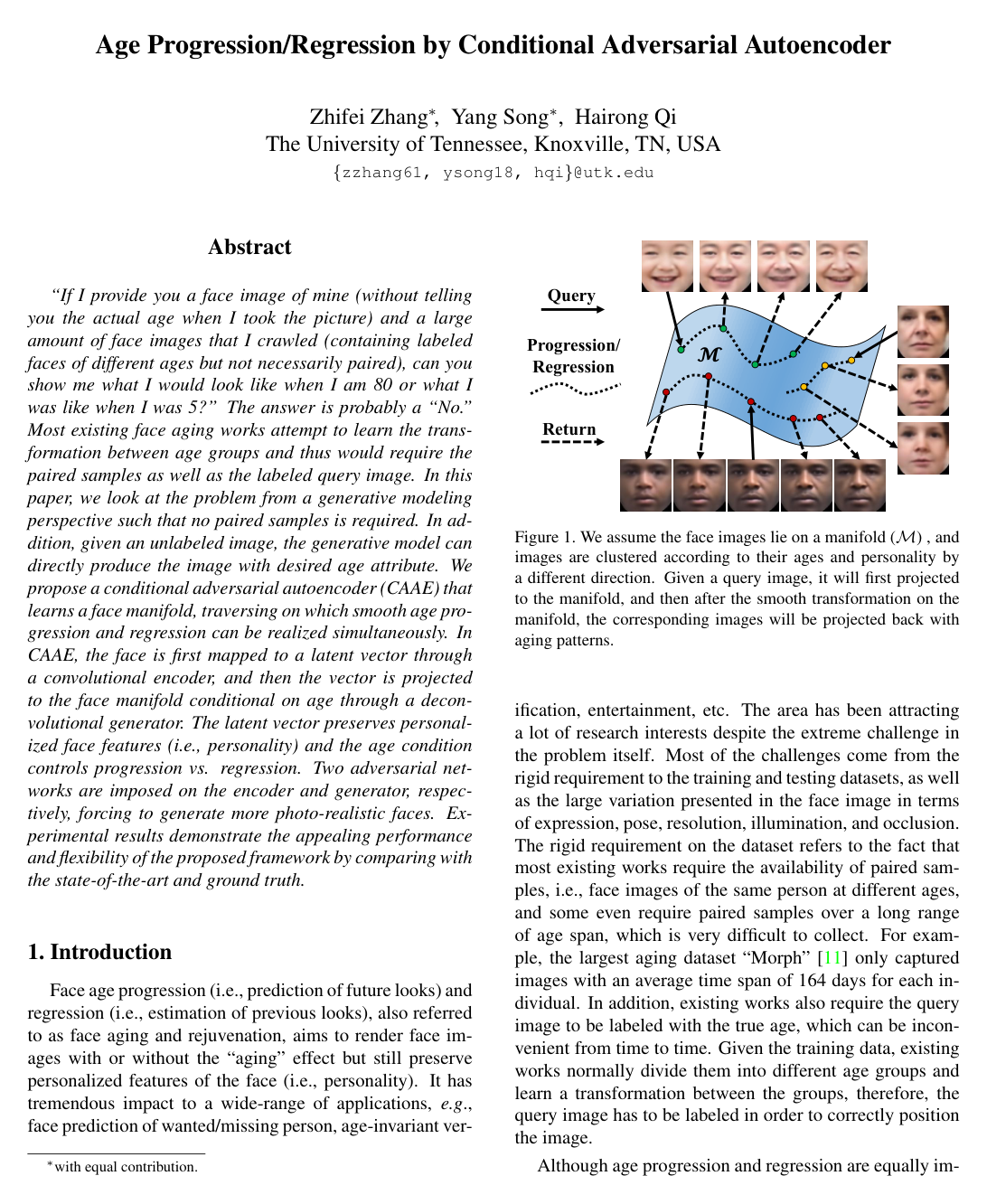
"If I provide you a face image of mine (without telling you the actual age when I took the picture) and a large amount of face images that I crawled (containing labeled faces of different ages but not necessarily paired), can you show me what I would look like when I am 80 or what I was like when I was 5?" The answer is probably a "No." Most existing face aging works attempt to learn the transformation between age groups and thus would require the paired samples as well as the labeled query image. In this paper, we look at the problem from a generative modeling perspective such that no paired samples is required. In addition, given an unlabeled image, the generative model can directly produce the image with desired age attribute. We propose a conditional adversarial autoencoder (CAAE) that learns a face manifold, traversing on which smooth age progression and regression can be realized simultaneously. In CAAE, the face is first mapped to a latent vector through a convolutional encoder, and then the vector is projected to the face manifold conditional on age through a deconvolutional generator. The latent vector preserves personalized face features (i.e., personality) and the age condition controls progression vs. regression. Two adversarial networks are imposed on the encoder and generator, respectively, forcing to generate more photo-realistic faces. Experimental results demonstrate the appealing performance and flexibility of the proposed framework by comparing with the state-of-the-art and ground truth.
Added
2026-09-25
Low Dose CT Image Denoising Using a Generative Adversarial Network with Wasserstein Distance and Perceptual Loss
Qingsong Yang, Pingkun Yan, Yanbo Zhang, Hengyong Yu, Yongyi Shi, Xuanqin Mou, Mannudeep K. Kalra, Yi Zhang, Ling Sun, Ge Wang
Why you should read this
Proposes a Wasserstein generative adversarial framework with perceptual loss to suppress noise and artifacts in low-dose CT scans while preserving fine diagnostic structures.
In this paper, we introduce a new CT image denoising method based on the generative adversarial network (GAN) with Wasserstein distance and perceptual similarity. The Wasserstein distance is a key concept of the optimal transform theory, and promises to improve the performance of the GAN. The perceptual loss compares the perceptual features of a denoised output against those of the ground truth in an established feature space, while the GAN helps migrate the data noise distribution from strong to weak. Therefore, our proposed method transfers our knowledge of visual perception to the image denoising task, is capable of not only reducing the image noise level but also keeping the critical information at the same time. Promising results have been obtained in our experiments with clinical CT images.
Added
2026-09-25
Generative Adversarial Network in Medical Imaging: A Review
Xin Yi, Ekta Walia, Paul Babyn
Why you should read this
Surveys the core applications of generative adversarial networks across medical imaging, detailing how adversarial learning addresses practical challenges in image reconstruction, cross-modality synthesis, segmentation, and data augmentation.
Generative adversarial networks have gained a lot of attention in the computer vision community due to their capability of data generation without explicitly modelling the probability density function. The adversarial loss brought by the discriminator provides a clever way of incorporating unlabeled samples into training and imposing higher order consistency. This has proven to be useful in many cases, such as domain adaptation, data augmentation, and image-to-image translation. These properties have attracted researchers in the medical imaging community, and we have seen rapid adoption in many traditional and novel applications, such as image reconstruction, segmentation, detection, classification, and cross-modality synthesis. Based on our observations, this trend will continue and we therefore conducted a review of recent advances in medical imaging using the adversarial training scheme with the hope of benefiting researchers interested in this technique.
Added
2026-09-24
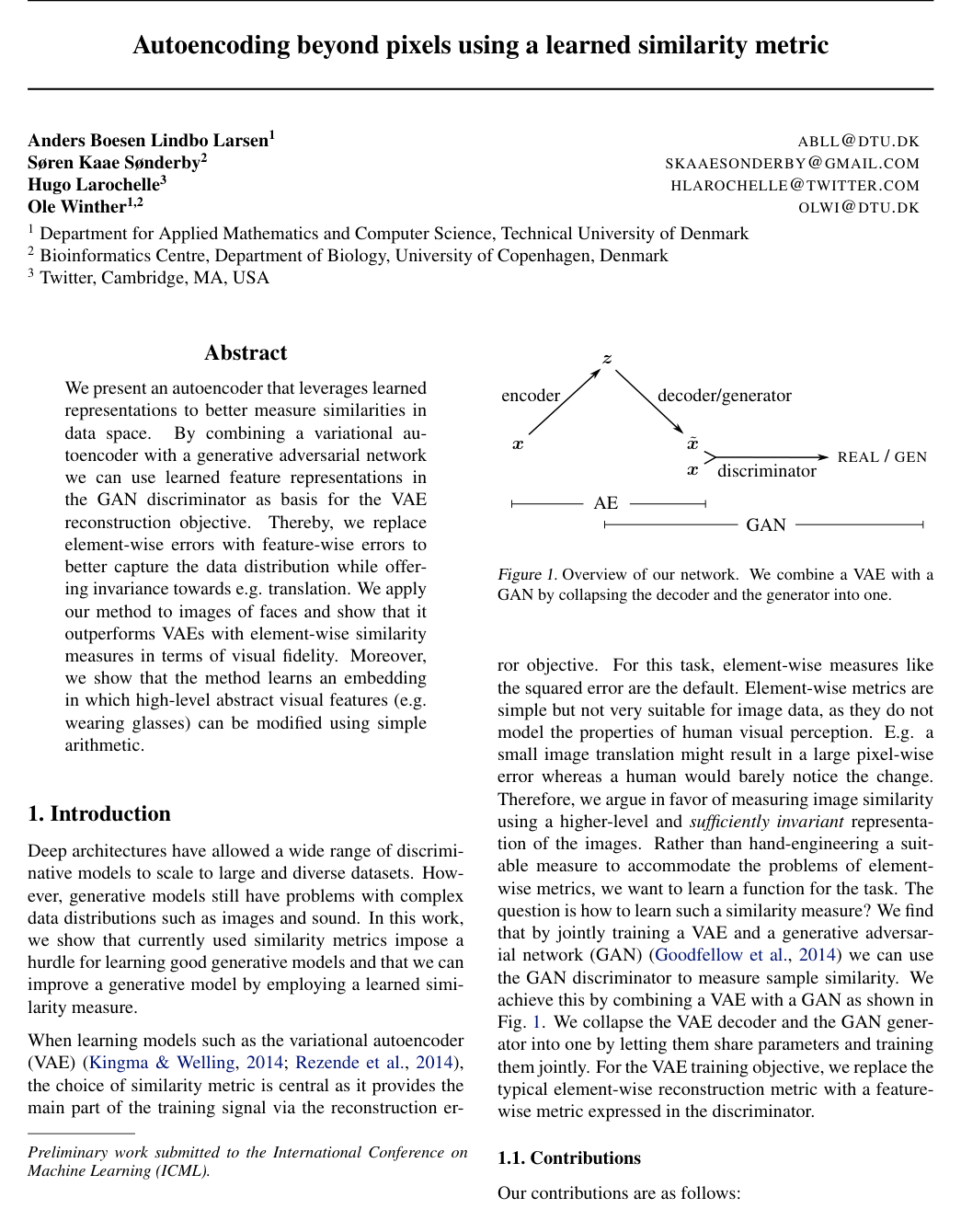
Autoencoding beyond pixels using a learned similarity metric
Anders Boesen Lindbo Larsen, Søren Kaae Sønderby, Hugo Larochelle, Ole Winther
Why you should read this
Proposes combining variational autoencoders and generative adversarial networks to measure reconstruction loss using learned discriminator features rather than pixel-wise comparisons, producing sharper images and enabling semantic latent vector arithmetic.
We present an autoencoder that leverages learned representations to better measure similarities in data space. By combining a variational autoencoder with a generative adversarial network we can use learned feature representations in the GAN discriminator as basis for the VAE reconstruction objective. Thereby, we replace element-wise errors with feature-wise errors to better capture the data distribution while offering invariance towards e.g. translation. We apply our method to images of faces and show that it outperforms VAEs with element-wise similarity measures in terms of visual fidelity. Moreover, we show that the method learns an embedding in which high-level abstract visual features (e.g. wearing glasses) can be modified using simple arithmetic.
Added
2026-09-16
EnlightenGAN: Deep Light Enhancement Without Paired Supervision
Yifan Jiang, Xinyu Gong, Ding Liu, Yu Cheng, Chen Fang, Xiaohui Shen, Jianchao Yang, Pan Zhou, Zhangyang Wang
Why you should read this
Proposes an unsupervised generative adversarial network that restores low-light images without paired training data by utilizing self-regularized perceptual loss, attention mechanisms, and a dual-discriminator architecture.
Deep learning-based methods have achieved remarkable success in image restoration and enhancement, but are they still competitive when there is a lack of paired training data? As one such example, this paper explores the low-light image enhancement problem, where in practice it is extremely challenging to simultaneously take a low-light and a normal-light photo of the same visual scene. We propose a highly effective unsupervised generative adversarial network, dubbed EnlightenGAN, that can be trained without low/normal-light image pairs, yet proves to generalize very well on various real-world test images. Instead of supervising the learning using ground truth data, we propose to regularize the unpaired training using the information extracted from the input itself, and benchmark a series of innovations for the low-light image enhancement problem, including a global-local discriminator structure, a self-regularized perceptual loss fusion, and attention mechanism. Through extensive experiments, our proposed approach outperforms recent methods under a variety of metrics in terms of visual quality and subjective user study. Thanks to the great flexibility brought by unpaired training, EnlightenGAN is demonstrated to be easily adaptable to enhancing real-world images from various domains. The code is available at \url{this https URL}
Added
2026-09-14
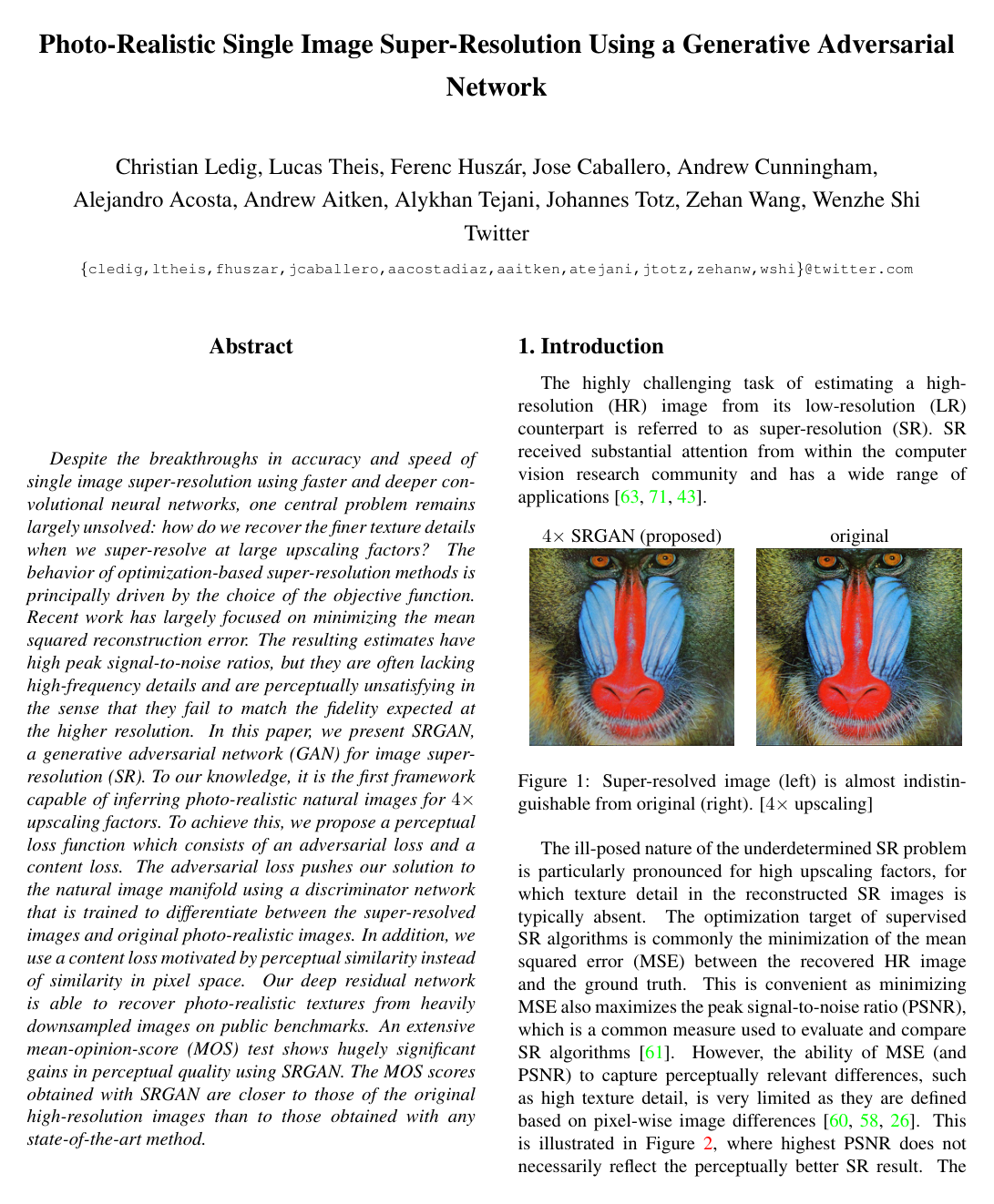
Photo-Realistic Single Image Super-Resolution Using a Generative Adversarial Network
Christian Ledig, Lucas Theis, Ferenc Huszar, Jose Caballero, Andrew Cunningham, Alejandro Acosta, Andrew Aitken, Alykhan Tejani, Johannes Totz, Zehan Wang, Wenzhe Shi
Why you should read this
Introduces SRGAN, a framework combining generative adversarial training and a perceptual loss to produce photo-realistic textures in 4x image super-resolution, overcoming the blurriness typical of standard pixel-space optimization.
Despite the breakthroughs in accuracy and speed of single image super-resolution using faster and deeper convolutional neural networks, one central problem remains largely unsolved: how do we recover the finer texture details when we super-resolve at large upscaling factors? The behavior of optimization-based super-resolution methods is principally driven by the choice of the objective function. Recent work has largely focused on minimizing the mean squared reconstruction error. The resulting estimates have high peak signal-to-noise ratios, but they are often lacking high-frequency details and are perceptually unsatisfying in the sense that they fail to match the fidelity expected at the higher resolution. In this paper, we present SRGAN, a generative adversarial network (GAN) for image super-resolution (SR). To our knowledge, it is the first framework capable of inferring photo-realistic natural images for 4x upscaling factors. To achieve this, we propose a perceptual loss function which consists of an adversarial loss and a content loss. The adversarial loss pushes our solution to the natural image manifold using a discriminator network that is trained to differentiate between the super-resolved images and original photo-realistic images. In addition, we use a content loss motivated by perceptual similarity instead of similarity in pixel space. Our deep residual network is able to recover photo-realistic textures from heavily downsampled images on public benchmarks. An extensive mean-opinion-score (MOS) test shows hugely significant gains in perceptual quality using SRGAN. The MOS scores obtained with SRGAN are closer to those of the original high-resolution images than to those obtained with any state-of-the-art method.
Added
2026-09-06
Wasserstein GAN
Martin Arjovsky, Soumith Chintala, Léon Bottou
Why you should read this
Demonstrates that Generative Adversarial Networks (GANs) can be made stable and robust, eliminating mode collapse and providing interpretable learning curves, by leveraging the Wasserstein distance.
We introduce a new algorithm named WGAN, an alternative to traditional GAN training. In this new model, we show that we can improve the stability of learning, get rid of problems like mode collapse, and provide meaningful learning curves useful for debugging and hyperparameter searches. Furthermore, we show that the corresponding optimization problem is sound, and provide extensive theoretical work highlighting the deep connections to other distances between distributions.
Added
2026-03-08
Progressive Growing of GANs for Improved Quality, Stability, and Variation
Tero Karras, Timo Aila, Samuli Laine, Jaakko Lehtinen
Why you should read this
Demonstrates a training methodology that starts with low resolution and progressively adds layers to achieve megapixel scale.
We describe a new training methodology for generative adversarial networks. The key idea is to grow both the generator and discriminator progressively: starting from a low resolution, we add new layers that model increasingly fine details as training progresses. This both speeds the training up and greatly stabilizes it, allowing us to produce images of unprecedented quality, e.g., CelebA images at 1024^2. We also propose a simple way to increase the variation in generated images, and achieve a record inception score of 8.80 in unsupervised CIFAR10. Additionally, we describe several implementation details that are important for discouraging unhealthy competition between the generator and discriminator. Finally, we suggest a new metric for evaluating GAN results, both in terms of image quality and variation. As an additional contribution, we construct a higher-quality version of the CelebA dataset.
Added
2026-03-07
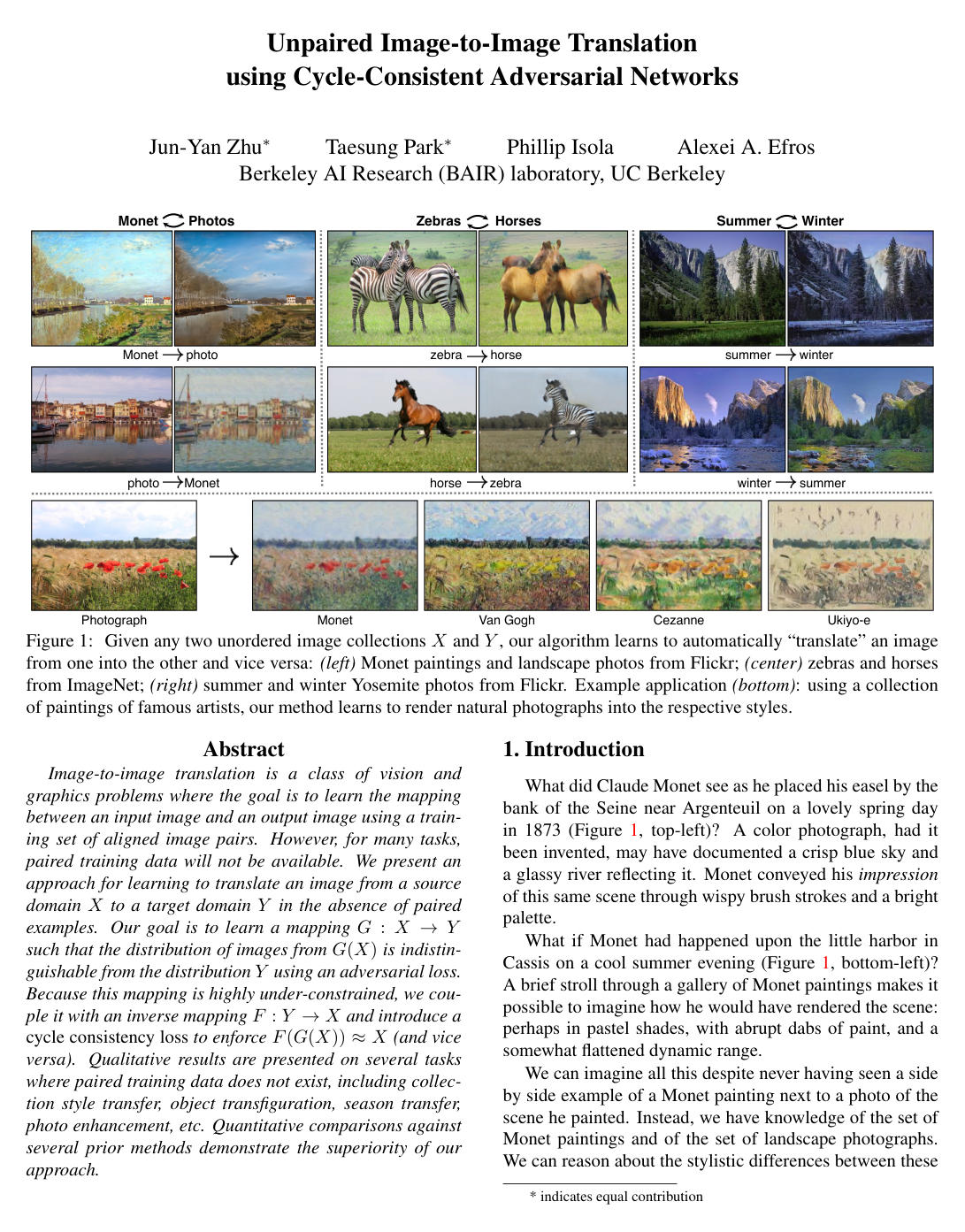
Unpaired Image-to-Image Translation Using Cycle-Consistent Adversarial Networks
Jun-Yan Zhu, Taesung Park, Phillip Isola, Alexei A. Efros
Why you should read this
Introduces cycle-consistency loss to allow translation between image domains without requiring paired training examples.
Image-to-image translation is a class of vision and graphics problems where the goal is to learn the mapping between an input image and an output image using a training set of aligned image pairs. However, for many tasks, paired training data will not be available. We present an approach for learning to translate an image from a source domain X to a target domain Y in the absence of paired examples. Our goal is to learn a mapping G : X → Y such that the distribution of images from G(X) is indistinguishable from the distribution Y using an adversarial loss. Because this mapping is highly under-constrained, we couple it with an inverse mapping F : Y → X and introduce a cycle consistency loss to push F(G(X)) ≈ X (and vice versa). Qualitative results are presented on several tasks where paired training data does not exist, including collection style transfer, object transfiguration, season transfer, photo enhancement, etc. Quantitative comparisons against several prior methods demonstrate the superiority of our approach.
Added
2026-03-07

Dive into Deep Learning (with PyTorch)
Aston Zhang, Zachary Lipton, Mu Li, Alexander Smola
Why you should read this
Combines rigorous mathematical foundations with hands-on, executable code examples in a free, interactive format that takes you from deep learning fundamentals to state-of-the-art techniques, making it ideal whether you're a student, researcher, or practitioner looking to truly understand and implement neural networks.
Source
https://d2l.ai/Added
2025-09-22