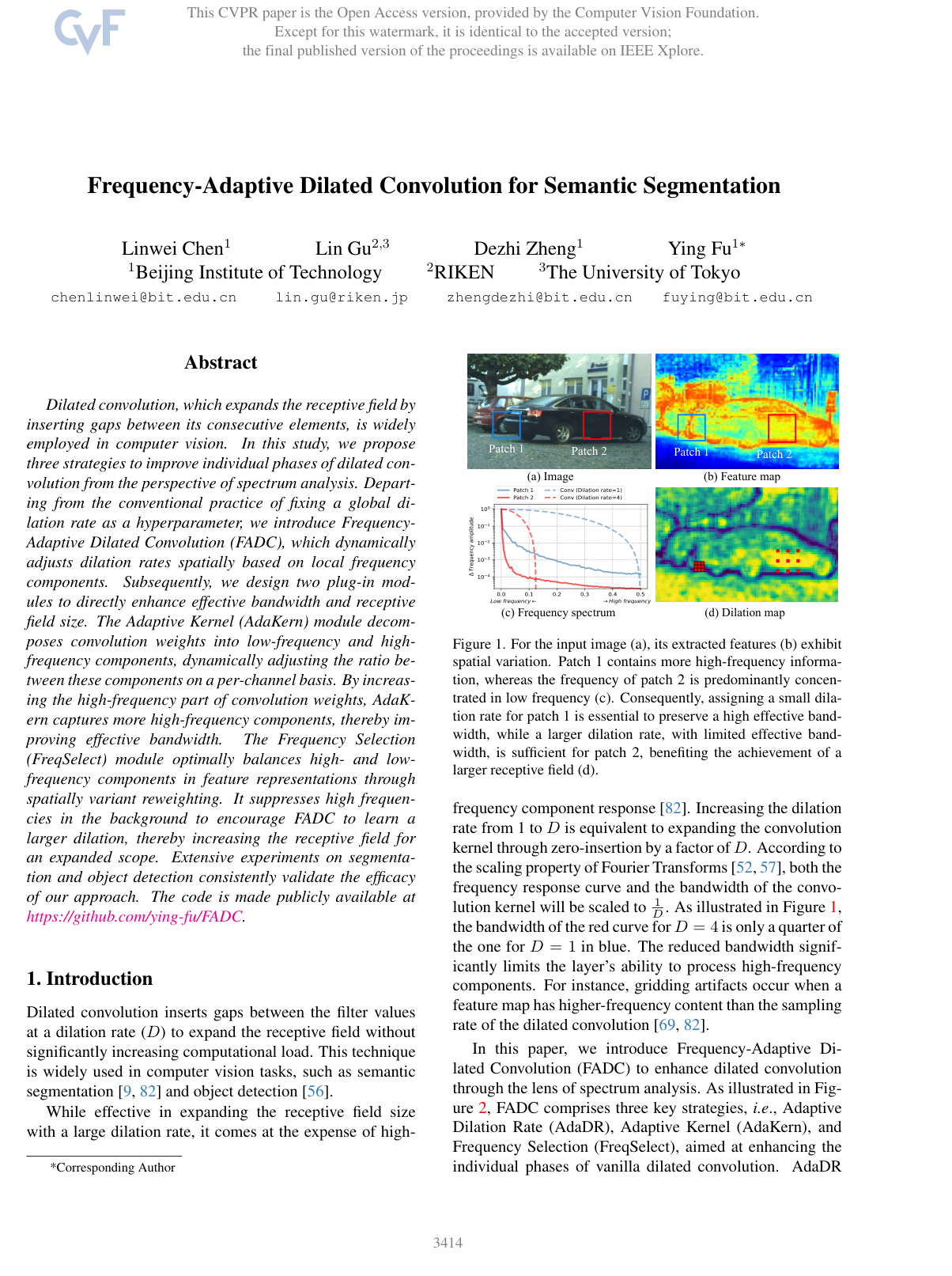
A frequency-balanced feature is an intermediate data representation in deep learning and computer vision in which different spatial frequency components, such as fine high-frequency details and broad low-frequency structures, are adaptively reweighted across an image. Rather than maintaining a fixed spectral distribution across all locations, this representation modulates the proportion of low- and high-frequency content based on local context, often suppressing irrelevant high frequencies in uniform background regions while preserving them around detailed boundaries and objects. By regulating the frequency spectrum spatially, frequency-balanced features enable neural network operations, such as dilated convolutions, to expand their effective receptive fields and capture wide contextual information without losing critical edge details or suffering from spectral artifacts.