Built independently by an author, for readers. Read the story and support ChapterPal

keyword

frequency-adaptive dilated convolution

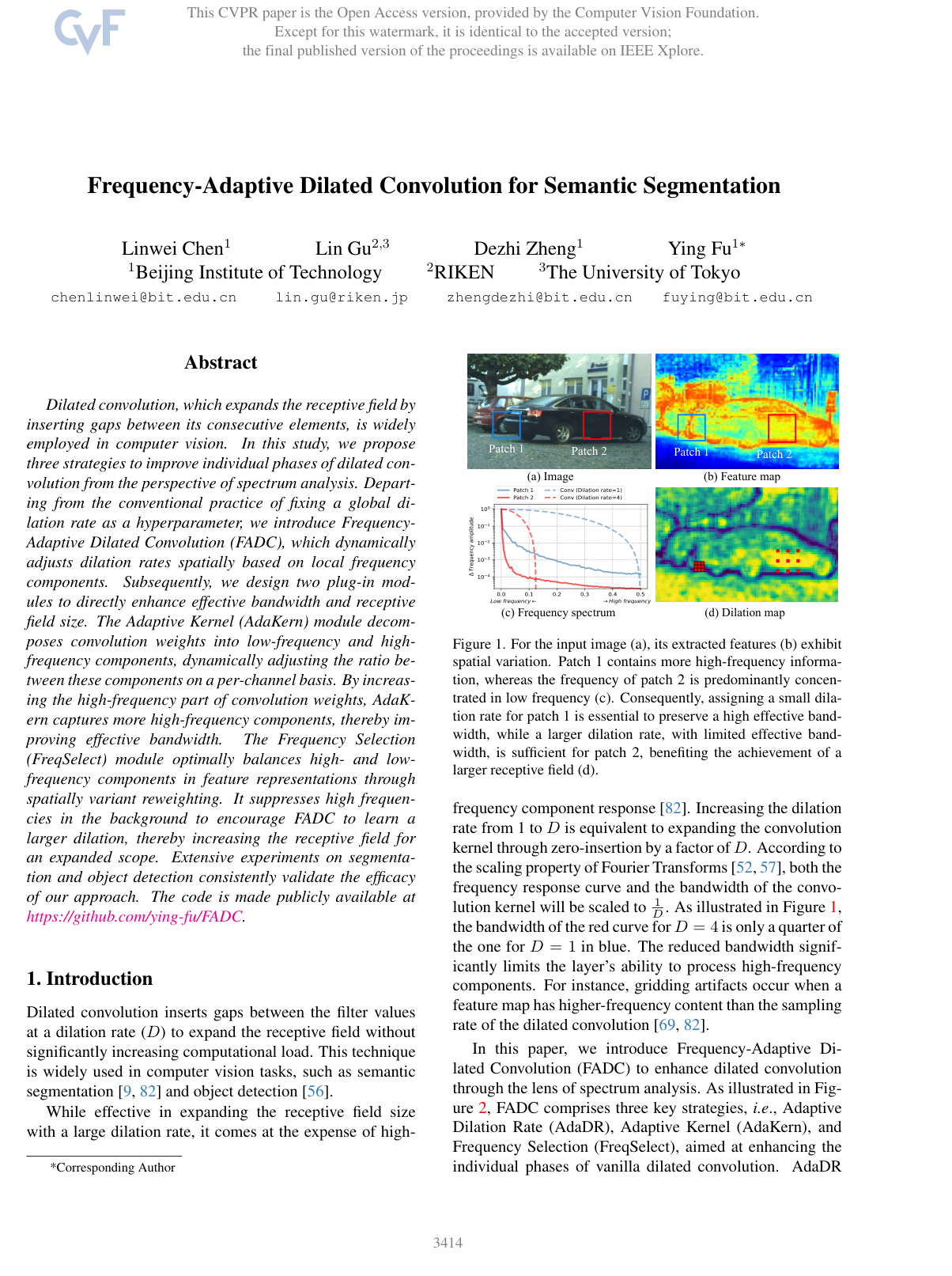
Frequency-adaptive dilated convolution is a deep learning operation that dynamically adjusts the dilation rate across spatial locations based on the local frequency characteristics of an input feature map. Unlike conventional dilated convolutions that apply a predetermined, uniform dilation rate across an entire image, this technique alters its sampling spacing according to whether local regions contain high-frequency details, such as edges and textures, or low-frequency areas, such as smooth backgrounds. By adapting receptive fields and kernel properties to spatial frequency distributions, the operation balances receptive field size and effective feature bandwidth, allowing computer vision models to preserve fine structural details while capturing broad contextual information.

1 item

Frequency-Adaptive Dilated Convolution for Semantic Segmentation

Frequency-Adaptive Dilated Convolution for Semantic Segmentation

Linwei Chen, Lin Gu, Dezhi Zheng, Ying Fu

OrganizationsBeijing Institute of TechnologyRIKENUniversity of Tokyo

Why you should read this

Proposes Frequency-Adaptive Dilated Convolution to dynamically adjust dilation rates and kernel weights based on local spectral analysis, mitigating aliasing artifacts while balancing receptive field size and effective bandwidth in semantic segmentation.

Dilated convolution, which expands the receptive field by inserting gaps between its consecutive elements, is widely employed in computer vision. In this study, we propose three strategies to improve individual phases of dilated convolution from the perspective of spectrum analysis. Departing from the conventional practice of fixing a global dilation rate as a hyperparameter, we introduce Frequency-Adaptive Dilated Convolution (FADC), which dynamically adjusts dilation rates spatially based on local frequency components. Subsequently, we design two plug-in modules to directly enhance effective bandwidth and receptive field size. The Adaptive Kernel (AdaKern) module decomposes convolution weights into low-frequency and high-frequency components, dynamically adjusting the ratio between these components on a per-channel basis. By increasing the high-frequency part of convolution weights, AdaKern captures more high-frequency components, thereby improving effective bandwidth. The Frequency Selection (FreqSelect) module optimally balances high- and low-frequency components in feature representations through spatially variant reweighting. It suppresses high frequencies in the background to encourage FADC to learn a larger dilation, thereby increasing the receptive field for an expanded scope. Extensive experiments on segmentation and object detection consistently validate the efficacy of our approach. The code is made publicly available at https://github.com/ying-fu/FADC.

Added

2026-09-26