
keyword
forecast horizon
A forecast horizon is the length of time into the future for which predictions are made from a given point in time. In time series analysis and statistical forecasting, it represents the number of future time steps or the temporal distance between the most recent known observation and the final target value being estimated. Forecast horizons are commonly categorized as short, medium, or long term depending on the domain, data frequency, and planning objectives. The length of the horizon directly impacts model design, evaluation methods, and predictive confidence, as uncertainty and forecasting error typically increase the further into the future predictions extend.
6 items
Context is Key: A Benchmark for Forecasting with Essential Textual Information
Andrew Robert Williams, Arjun Ashok, tienne Marcotte, Valentina Zantedeschi, Jithendaraa Subramanian, Roland Riachi, James Requeima, Alexandre Lacoste, Irina Rish, Nicolas Chapados, Alexandre Drouin
Why you should read this
Presents Context is Key (CiK), a time series benchmark spanning seven real-world domains where accurate predictions strictly require integrating textual context with numerical history, alongside a simple prompting baseline that outperforms existing foundation models.
Forecasting is a critical task in decision-making across numerous domains. While historical numerical data provide a start, they fail to convey the complete context for reliable and accurate predictions. Human forecasters frequently rely on additional information, such as background knowledge and constraints, which can efficiently be communicated through natural language. However, in spite of recent progress with LLM-based forecasters, their ability to effectively integrate this textual information remains an open question. To address this, we introduce “Context is Key” (CiK), a time series forecasting benchmark that pairs numerical data with diverse types of carefully crafted textual context, requiring models to integrate both modalities; crucially, every task in CiK requires understanding textual context to be solved successfully. We evaluate a range of approaches, including statistical models, time series foundation models, and LLM-based forecasters, and propose a simple yet effective LLM prompting method that outperforms all other tested methods on our benchmark. Our experiments highlight the importance of incorporating contextual information, demonstrate surprising performance when using LLM-based forecasting models, and also reveal some of their critical shortcomings. This benchmark aims to advance multimodal forecasting by promoting models that are both accurate and accessible to decision-makers with varied technical expertise. The benchmark can be visualized at https://servicenow.github.io/context-is-key-forecasting/v0/.
Added
2026-10-03
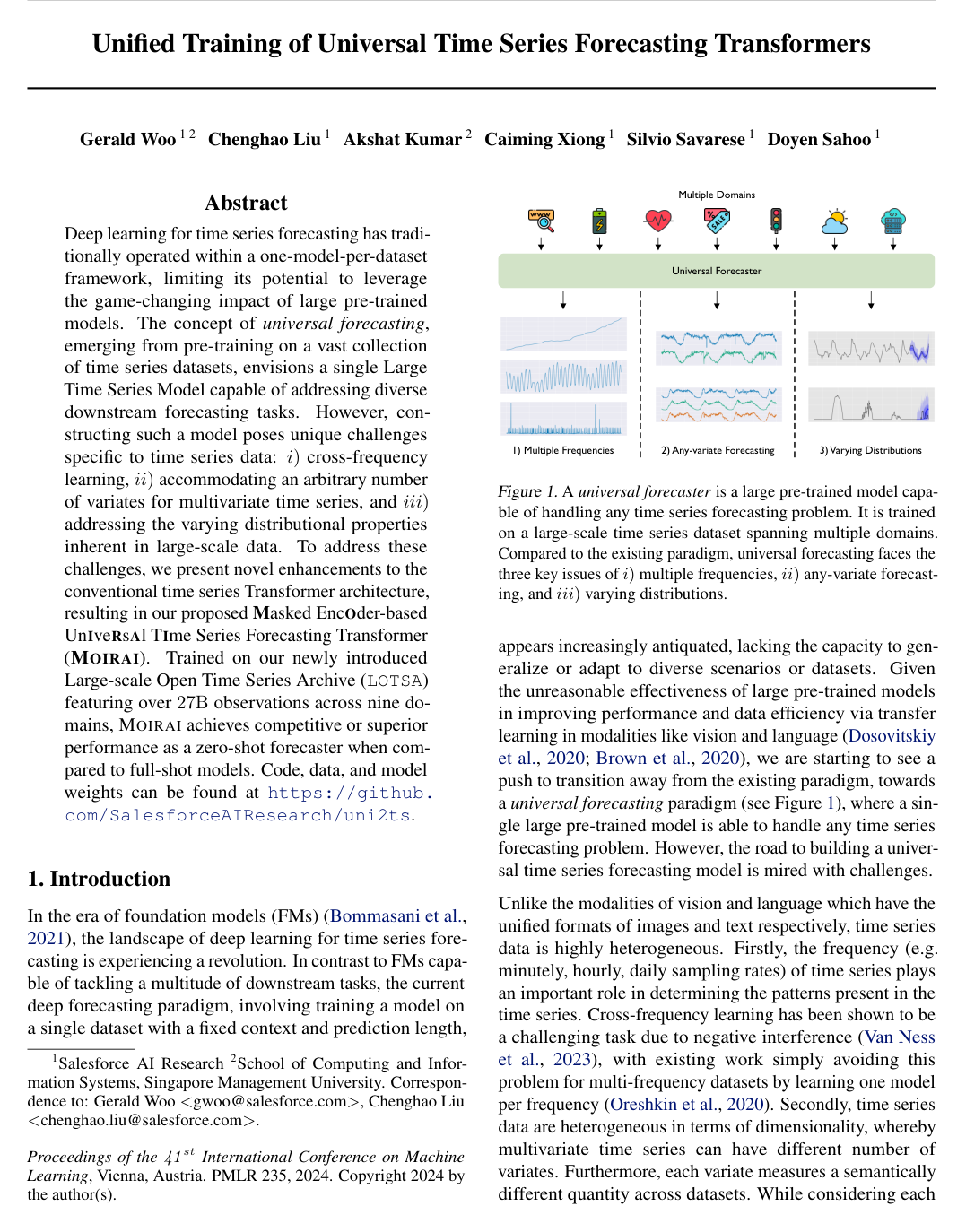
Unified Training of Universal Time Series Forecasting Transformers
Gerald Woo, Chenghao Liu, Akshat Kumar, Caiming Xiong, Silvio Savarese, Doyen Sahoo
Why you should read this
Presents Moirai, a universal time series transformer trained on the 27-billion-observation LOTSA archive, which handles arbitrary variate counts and frequencies to match or outperform dataset-specific models in zero-shot forecasting.
Deep learning for time series forecasting has traditionally operated within a one-model-per-dataset framework, limiting its potential to leverage the game-changing impact of large pre-trained models. The concept of universal forecasting, emerging from pre-training on a vast collection of time series datasets, envisions a single Large Time Series Model capable of addressing diverse downstream forecasting tasks. However, constructing such a model poses unique challenges specific to time series data: i) cross-frequency learning, ii) accommodating an arbitrary number of variates for multivariate time series, and iii) addressing the varying distributional properties inherent in large-scale data. To address these challenges, we present novel enhancements to the conventional time series Transformer architecture, resulting in our proposed Masked Encoder-based Universal Time Series Forecasting Transformer (Moirai). Trained on our newly introduced Large-scale Open Time Series Archive (LOTSA) featuring over 27B observations across nine domains, Moirai achieves competitive or superior performance as a zero-shot forecaster when compared to full-shot models. Code, data, and model weights can be found at this https URL.
Added
2026-09-26
N-BEATS: Neural basis expansion analysis for interpretable time series forecasting
Boris N. Oreshkin, Dmitri Carpov, Nicolas Chapados, Yoshua Bengio
Why you should read this
Proposes a pure deep learning architecture comprised of backward and forward residual basis expansions that matches classical interpretability without requiring domain-specific feature engineering.
We focus on solving the univariate times series point forecasting problem using deep learning. We propose a deep neural architecture based on backward and forward residual links and a very deep stack of fully-connected layers. The architecture has a number of desirable properties, being interpretable, applicable without modification to a wide array of target domains, and fast to train. We test the proposed architecture on several well-known datasets, including M3, M4 and TOURISM competition datasets containing time series from diverse domains. We demonstrate state-of-the-art performance for two configurations of N-BEATS for all the datasets, improving forecast accuracy by 11% over a statistical benchmark and by 3% over last year's winner of the M4 competition, a domain-adjusted hand-crafted hybrid between neural network and statistical time series models. The first configuration of our model does not employ any time-series-specific components and its performance on heterogeneous datasets strongly suggests that, contrarily to received wisdom, deep learning primitives such as residual blocks are by themselves sufficient to solve a wide range of forecasting problems. Finally, we demonstrate how the proposed architecture can be augmented to provide outputs that are interpretable without considerable loss in accuracy.
Added
2026-06-27
Forecasting at Scale
Sean J. Taylor, Benjamin Letham
Why you should read this
Proposes a practical decomposable forecasting system designed specifically to mathematically handle common business anomalies like irregular holidays and structural trend shifts.
There are a variety of challenges that come with producing a large number of forecasts across a variety time series. Our approach to forecasting at scale is a combination of configurable models and thorough analyst-in-the-loop performance analysis. We present a forecasting approach based on a decomposable model with interpretable parameters that can be intuitively adjusted by the analyst. We describe performance analysis that we use compare and evaluate forecasting procedures, as well as automatically flag forecasts for manual review and adjustment. Tools that help analysts to use their expertise most effectively enable reliable forecasting of a large variety of business time series.
Added
2026-06-27
On the use of cross-validation for time series predictor evaluation
Christoph Bergmeir, José M. Benítez
Why you should read this
This paper tackles a practical question that remains central to forecasting: when time-ordered observations violate ordinary cross-validation assumptions, which evaluation procedure still selects reliable models? Its controlled comparison of six validation schemes across synthetic and real series shows why blocked cross-validation is a strong default when stationarity is checked.
In time series predictor evaluation, we observe that with respect to the model selection procedure there is a gap between evaluation of traditional forecasting procedures, on the one hand, and evaluation of machine learning techniques on the other hand. In traditional forecasting, it is common practice to reserve a part from the end of each time series for testing, and to use the rest of the series for training. Thus it is not made full use of the data, but theoretical problems with respect to temporal evolutionary effects and dependencies within the data as well as practical problems regarding missing values are eliminated. On the other hand, when evaluating machine learning and other regression methods used for time series forecasting, often cross-validation is used for evaluation, paying little attention to the fact that those theoretical problems invalidate the fundamental assumptions of cross-validation. To close this gap and examine the consequences of different model selection procedures in practice, we have developed a rigorous and extensive empirical study. Six different model selection procedures, based on (i) cross-validation and (ii) evaluation using the series’ last part, are used to assess the performance of four machine learning and other regression techniques on synthetic and real-world time series. No practical consequences of the theoretical flaws were found during our study, but the use of cross-validation techniques led to a more robust model selection. To make use of the “best of both worlds,” we suggest that the use of a blocked form of cross-validation for time series evaluation became the standard procedure, thus using all available information and circumventing the theoretical problems.
Added
2026-06-27
Another look at measures of forecast accuracy
Rob J. Hyndman, Anne B. Koehler
Why you should read this
Establishes the Mean Absolute Scaled Error as an essential mathematically rigorous metric for comparing forecast accuracy across diverse series with highly variable scales.
We discuss and compare measures of accuracy of univariate time series forecasts. The methods used in the M-competition and the M3-competition, and many of the measures recommended by previous authors on this topic, are found to be inadequate, and many of them are degenerate in commonly occurring situations. Instead, we propose that the mean absolute scaled error become the standard measure for comparing forecast accuracy across multiple time series.
Added
2026-06-27