
keyword
episodic memory
Episodic memory is a category of long-term declarative memory that allows an individual or intelligent agent to store, recall, and reconstruct personally experienced events situated in specific temporal and spatial contexts. In cognitive neuroscience and psychology, it is heavily associated with the medial temporal lobes and hippocampus, facilitating the conscious recollection of what happened, where, and when, as well as the flexible simulation of future scenarios based on past experiences. In artificial intelligence and computational modeling, the term also encompasses architectures and memory buffers that store discrete interaction histories, sensory observations, or past trajectories, enabling agents to retrieve relevant past experiences to inform current decision-making, ground queries about past observations, and mitigate catastrophic forgetting during continual learning.
15 items
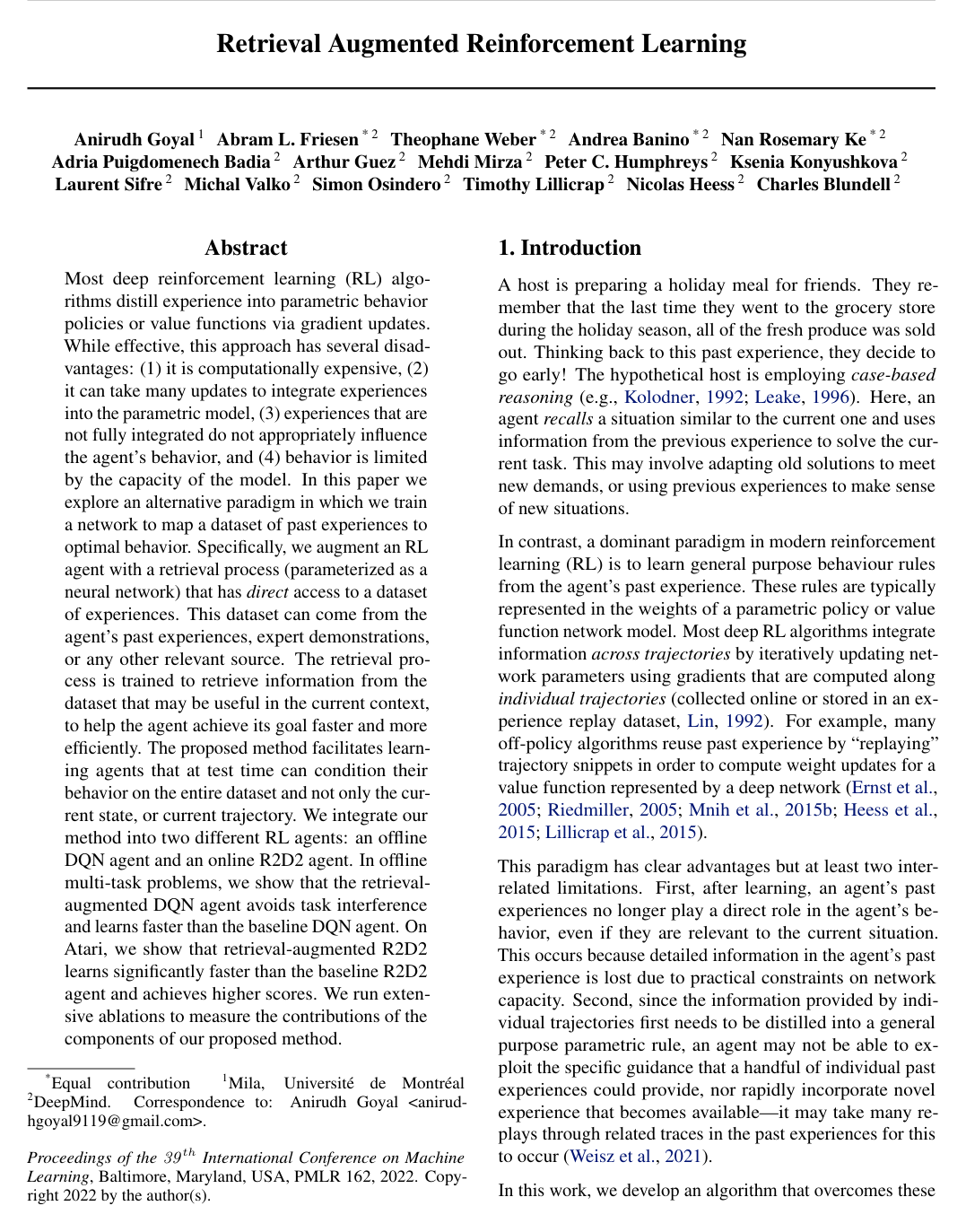
Retrieval-Augmented Reinforcement Learning
Anirudh Goyal, Abram L. Friesen, Andrea Banino, Theophane Weber, Nan Rosemary Ke, Adrià Puigdomènech Badia, Arthur Guez, Mehdi Mirza, Peter Conway Humphreys, Ksenia Konyushkova, Michal Valko, Simon Osindero, Timothy P. Lillicrap, Nicolas Heess, Charles Blundell
Why you should read this
Proposes an architecture that augments reinforcement learning agents with an attention-based neural retrieval process, allowing policies to dynamically query past trajectories to reduce task interference in multi-task offline settings and significantly accelerate learning in online Atari benchmarks.
Most deep reinforcement learning (RL) algorithms distill experience into parametric behavior policies or value functions via gradient updates. While effective, this approach has several disadvantages: (1) it is computationally expensive, (2) it can take many updates to integrate experiences into the parametric model, (3) experiences that are not fully integrated do not appropriately influence the agent’s behavior, and (4) behavior is limited by the capacity of the model. In this paper we explore an alternative paradigm in which we train a network to map a dataset of past experiences to optimal behavior. Specifically, we augment an RL agent with a retrieval process (parameterized as a neural network) that has direct access to a dataset of experiences. This dataset can come from the agent’s past experiences, expert demonstrations, or any other relevant source. The retrieval process is trained to retrieve information from the dataset that may be useful in the current context, to help the agent achieve its goal faster and more efficiently. The proposed method facilitates learning agents that at test time can condition their behavior on the entire dataset and not only the current state, or current trajectory. We integrate our method into two different RL agents: an offline DQN agent and an online R2D2 agent. In offline multi-task problems, we show that the retrieval-augmented DQN agent avoids task interference and learns faster than the baseline DQN agent. On Atari, we show that retrieval-augmented R2D2 learns significantly faster than the baseline R2D2 agent and achieves higher scores. We run extensive ablations to measure the contributions of the components of our proposed method.
Added
2026-10-02
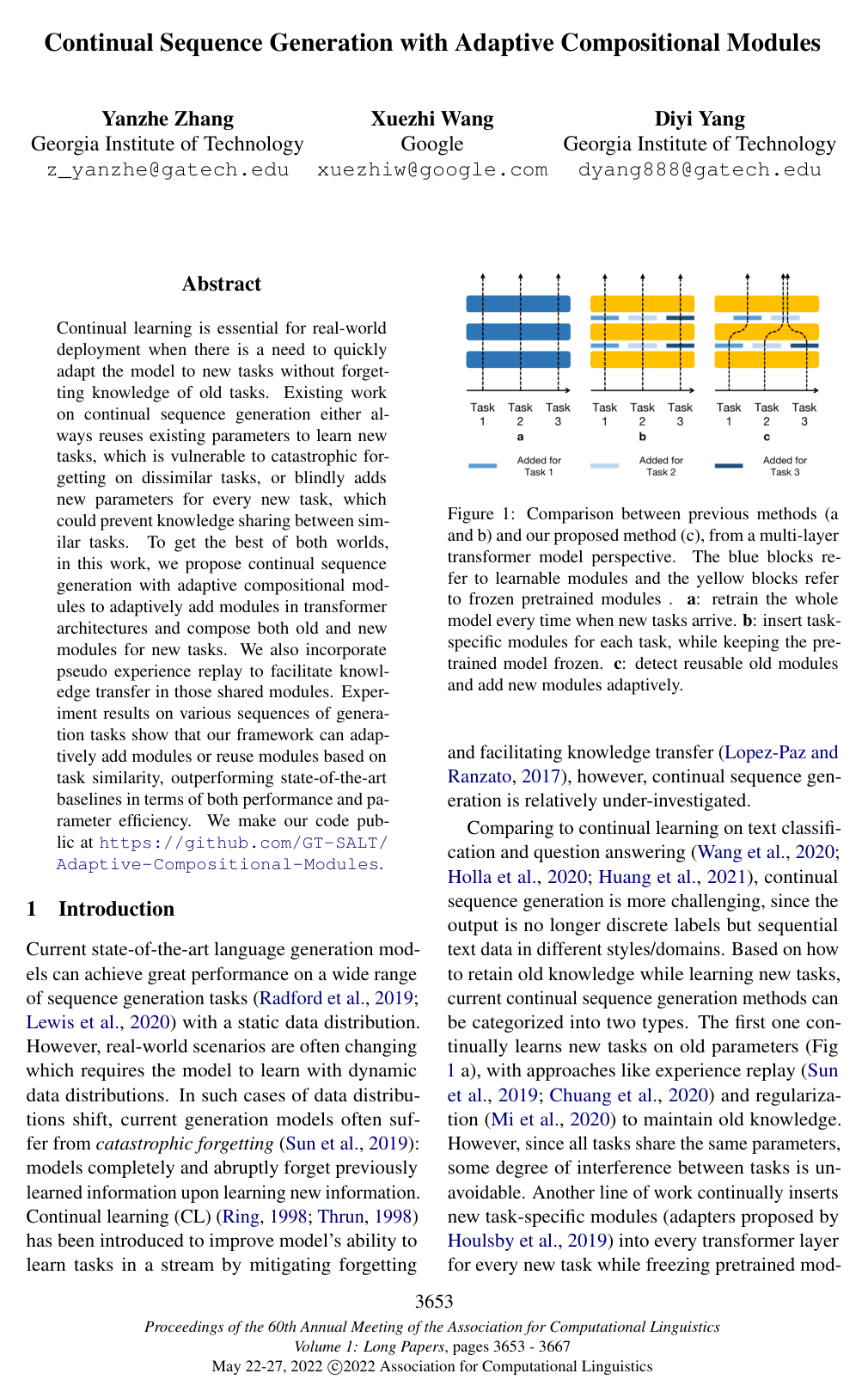
Continual Sequence Generation with Adaptive Compositional Modules
Yanzhe Zhang, Xuezhi Wang, Diyi Yang
Why you should read this
Proposes an adaptive modular framework for continual sequence generation that dynamically decides whether to reuse existing transformer adapters or insert new ones based on task similarity, preventing catastrophic forgetting while maximizing parameter efficiency.
Continual learning is essential for real-world deployment when there is a need to quickly adapt the model to new tasks without forgetting knowledge of old tasks. Existing work on continual sequence generation either always reuses existing parameters to learn new tasks, which is vulnerable to catastrophic forgetting on dissimilar tasks, or blindly adds new parameters for every new task, which could prevent knowledge sharing between similar tasks. To get the best of both worlds, in this work, we propose continual sequence generation with adaptive compositional modules to adaptively add modules in transformer architectures and compose both old and new modules for new tasks. We also incorporate pseudo experience replay to facilitate knowledge transfer in those shared modules. Experiment results on various sequences of generation tasks show that our framework can adaptively add modules or reuse modules based on task similarity, outperforming state-of-the-art baselines in terms of both performance and parameter efficiency. We make our code public at https://github.com/GT-SALT/Adaptive-Compositional-Modules.
Added
2026-09-26
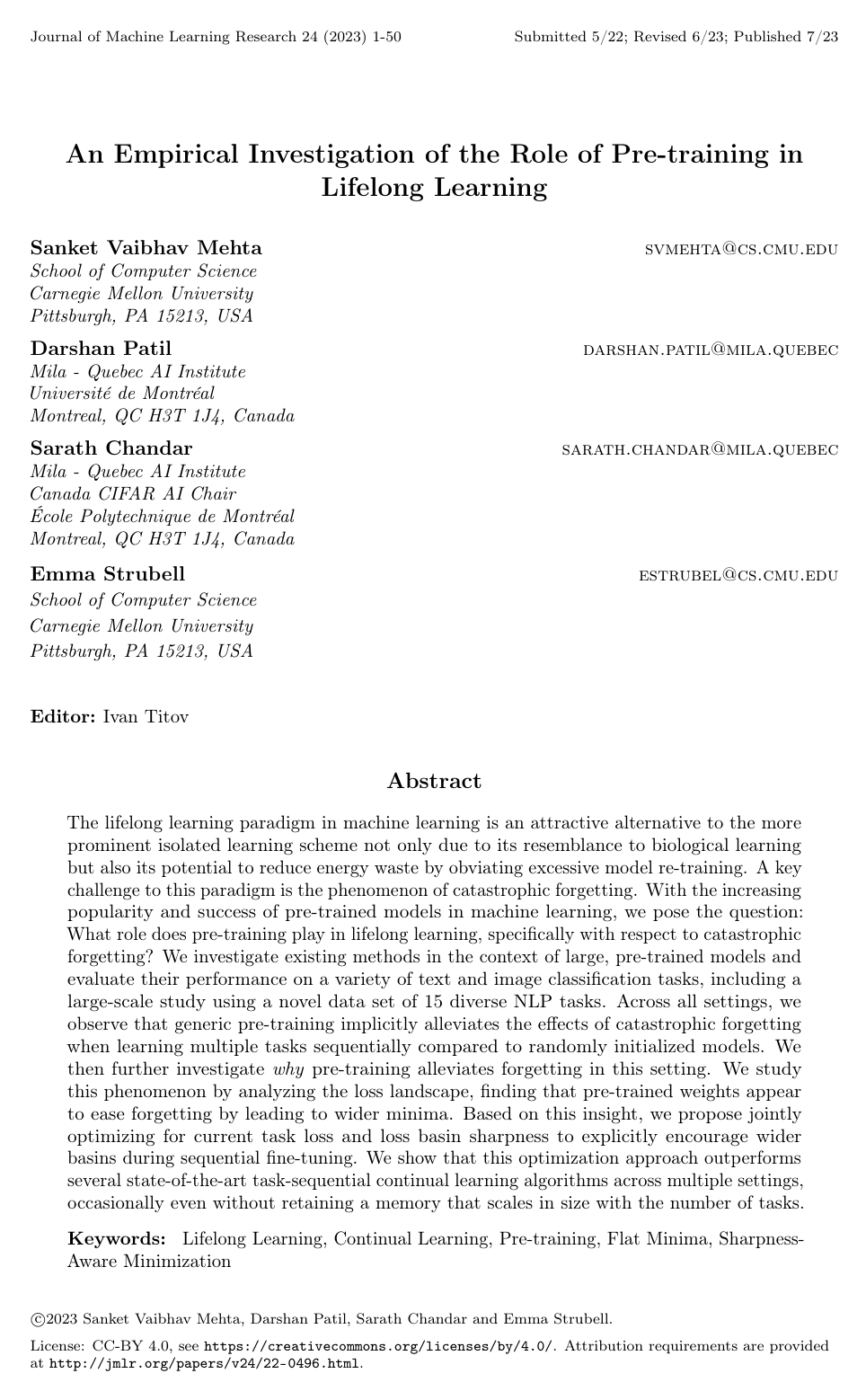
An Empirical Investigation of the Role of Pre-training in Lifelong Learning
Sanket Vaibhav Mehta, Darshan Patil, Sarath Chandar, Emma Strubell
Why you should read this
Reveals that pre-trained initializations naturally reduce catastrophic forgetting in sequential task learning by converging to wider loss basins, and introduces a sharpness-aware optimization method to explicitly promote flat minima during fine-tuning.
The lifelong learning paradigm in machine learning is an attractive alternative to the more prominent isolated learning scheme not only due to its resemblance to biological learning but also its potential to reduce energy waste by obviating excessive model re-training. A key challenge to this paradigm is the phenomenon of catastrophic forgetting. With the increasing popularity and success of pre-trained models in machine learning, we pose the question: What role does pre-training play in lifelong learning, specifically with respect to catastrophic forgetting? We investigate existing methods in the context of large, pre-trained models and evaluate their performance on a variety of text and image classification tasks, including a large-scale study using a novel data set of 15 diverse NLP tasks. Across all settings, we observe that generic pre-training implicitly alleviates the effects of catastrophic forgetting when learning multiple tasks sequentially compared to randomly initialized models. We then further investigate why pre-training alleviates forgetting in this setting. We study this phenomenon by analyzing the loss landscape, finding that pre-trained weights appear to ease forgetting by leading to wider minima. Based on this insight, we propose jointly optimizing for current task loss and loss basin sharpness to explicitly encourage wider basins during sequential fine-tuning. We show that this optimization approach outperforms several state-of-the-art task-sequential continual learning algorithms across multiple settings, occasionally even without retaining a memory that scales in size with the number of tasks.
Added
2026-09-26
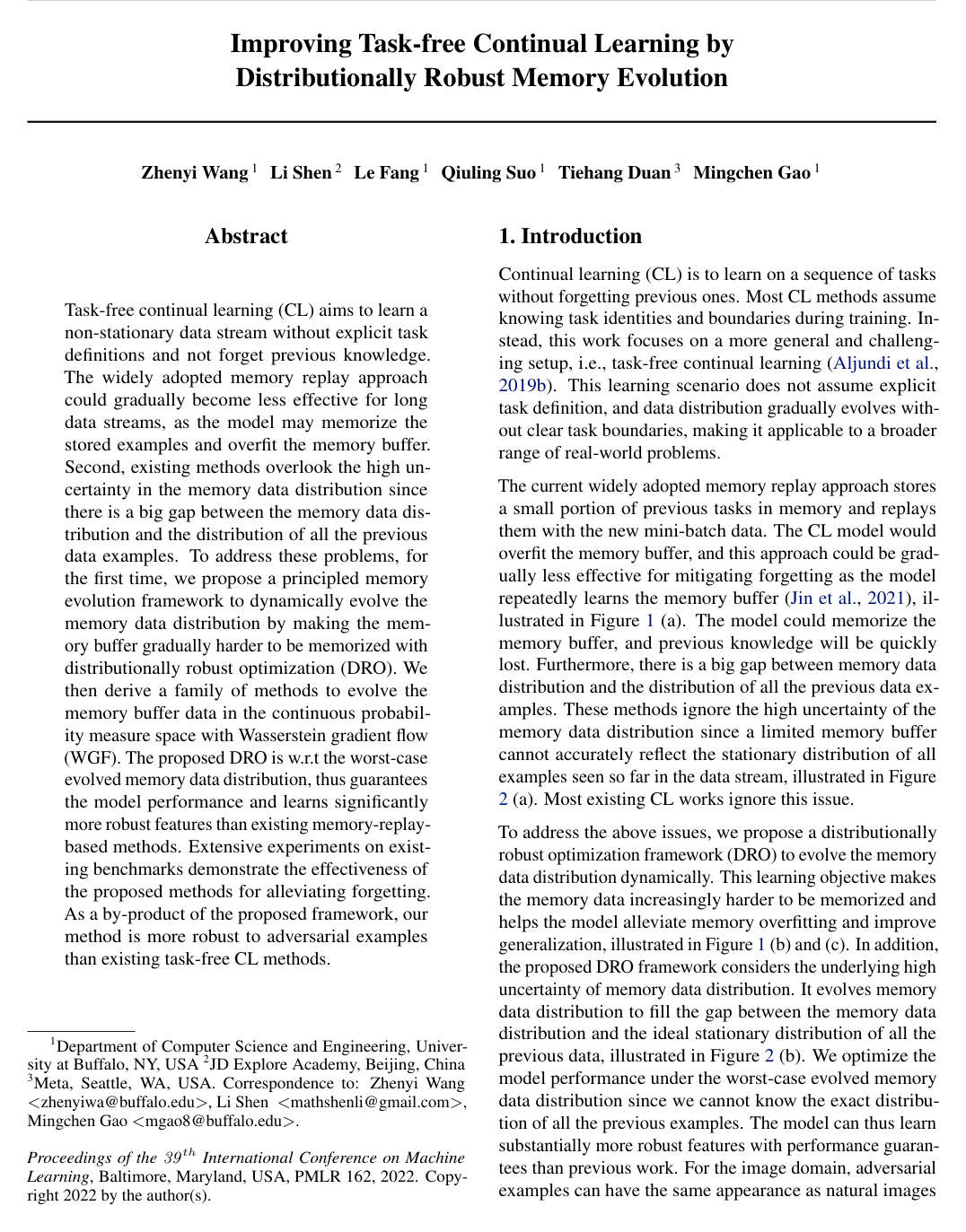
Improving Task-free Continual Learning by Distributionally Robust Memory Evolution
Zhenyi Wang, Li Shen, Le Fang, Qiuling Suo, Tiehang Duan, Mingchen Gao
Why you should read this
Proposes a distributionally robust memory evolution framework that uses Wasserstein gradient flows to dynamically update replay buffers, preventing overfitting to stored samples and mitigating catastrophic forgetting in task-free continual learning.
Task-free continual learning (CL) aims to learn a non-stationary data stream without explicit task definitions and not forget previous knowledge. The widely adopted memory replay approach could gradually become less effective for long data streams, as the model may memorize the stored examples and overfit the memory buffer. Second, existing methods overlook the high uncertainty in the memory data distribution since there is a big gap between the memory data distribution and the distribution of all the previous data examples. To address these problems, for the first time, we propose a principled memory evolution framework to dynamically evolve the memory data distribution by making the memory buffer gradually harder to be memorized with distributionally robust optimization (DRO). We then derive a family of methods to evolve the memory buffer data in the continuous probability measure space with Wasserstein gradient flow (WGF). The proposed DRO is w.r.t the worst-case evolved memory data distribution, thus guarantees the model performance and learns significantly more robust features than existing memory-replay-based methods. Extensive experiments on existing benchmarks demonstrate the effectiveness of the proposed methods for alleviating forgetting. As a by-product of the proposed framework, our method is more robust to adversarial examples than existing task-free CL methods.
Added
2026-09-26
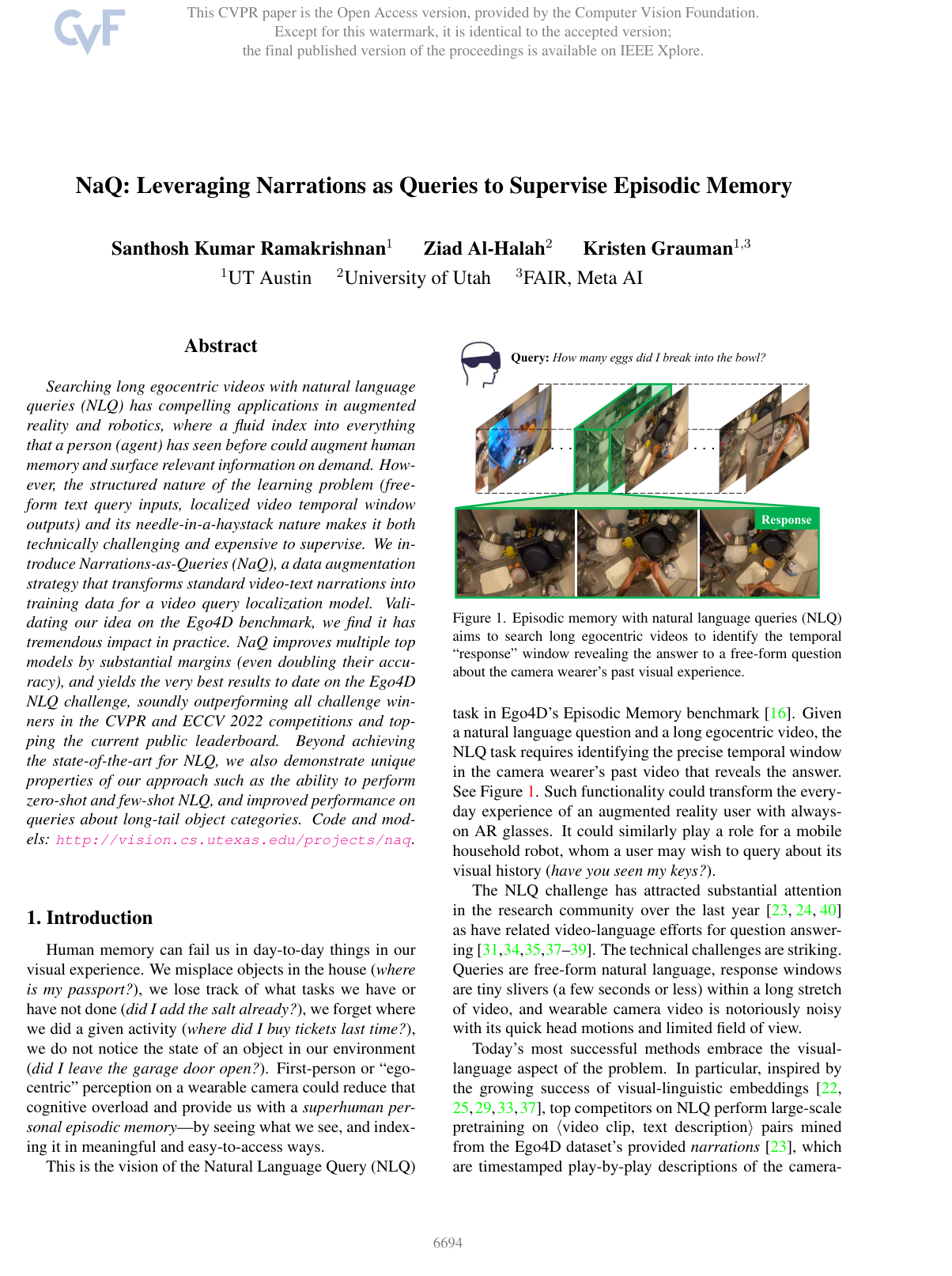
NaQ: Leveraging Narrations as Queries to Supervise Episodic Memory
Santhosh Kumar Ramakrishnan, Ziad Al-Halah, Kristen Grauman
Why you should read this
Proposes an effective data augmentation strategy that converts dense video narrations into query-response supervision, substantially improving temporal localization accuracy for natural language queries in long egocentric video.
Searching long egocentric videos with natural language queries (NLQ) has compelling applications in augmented reality and robotics, where a fluid index into everything that a person (agent) has seen before could augment human memory and surface relevant information on demand. How-ever, the structured nature of the learning problem (free-form text query inputs, localized video temporal window outputs) and its needle-in-a-haystack nature makes it both technically challenging and expensive to supervise. We introduce Narrations-as-Queries (NaQ), a data augmentation strategy that transforms standard video-text narrations into training data for a video query localization model. Validating our idea on the Ego4D benchmark, we find it has tremendous impact in practice. NaQ improves multiple top models by substantial margins (even doubling their accuracy), and yields the very best results to date on the Ego4D NLQ challenge, soundly outperforming all challenge winners in the CVPR and ECCV 2022 competitions and topping the current public leaderboard. Beyond achieving the state-of-the-art for NLQ, we also demonstrate unique properties of our approach such as the ability to perform zero-shot and few-shot NLQ, and improved performance on queries about long-tail object categories. Code and mod-els: http://vision.cs.utexas.edu/projects/naq.
Added
2026-09-26
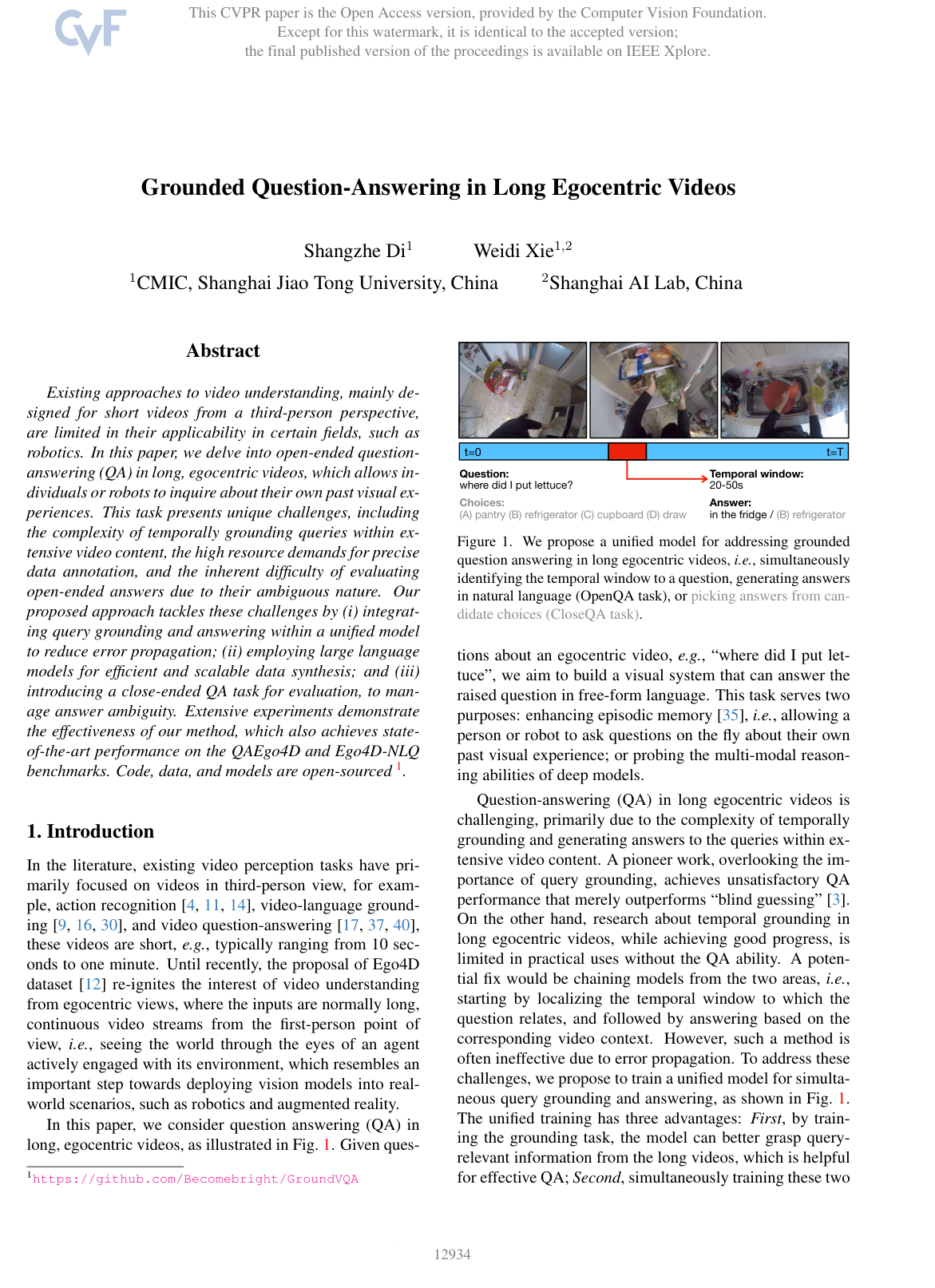
Grounded Question-Answering in Long Egocentric Videos
Shangzhe Di, Weidi Xie
Why you should read this
Proposes GroundVQA, a unified multimodal framework that simultaneously localizes relevant temporal windows and generates answers for questions in long egocentric videos, supported by an LLM-driven data generation pipeline that scales training triplets to achieve state-of-the-art performance on Ego4D benchmarks.
Existing approaches to video understanding, mainly designed for short videos from a third-person perspective, are limited in their applicability in certain fields, such as robotics. In this paper, we delve into open-ended question-answering (QA) in long, egocentric videos, which allows individuals or robots to inquire about their own past visual experiences. This task presents unique challenges, including the complexity of temporally grounding queries within extensive video content, the high resource demands for precise data annotation, and the inherent difficulty of evaluating open-ended answers due to their ambiguous nature. Our proposed approach tackles these challenges by (i) integrating query grounding and answering within a unified model to reduce error propagation; (ii) employing large language models for efficient and scalable data synthesis; and (iii) introducing a closed-ended QA task for evaluation, to manage answer ambiguity. Extensive experiments demonstrate the effectiveness of our method, which also achieves state-of-the-art performance on the QAEgo4D and Ego4D-NLQ benchmarks. Code, data, and models are open-sourced^1.
Added
2026-09-26
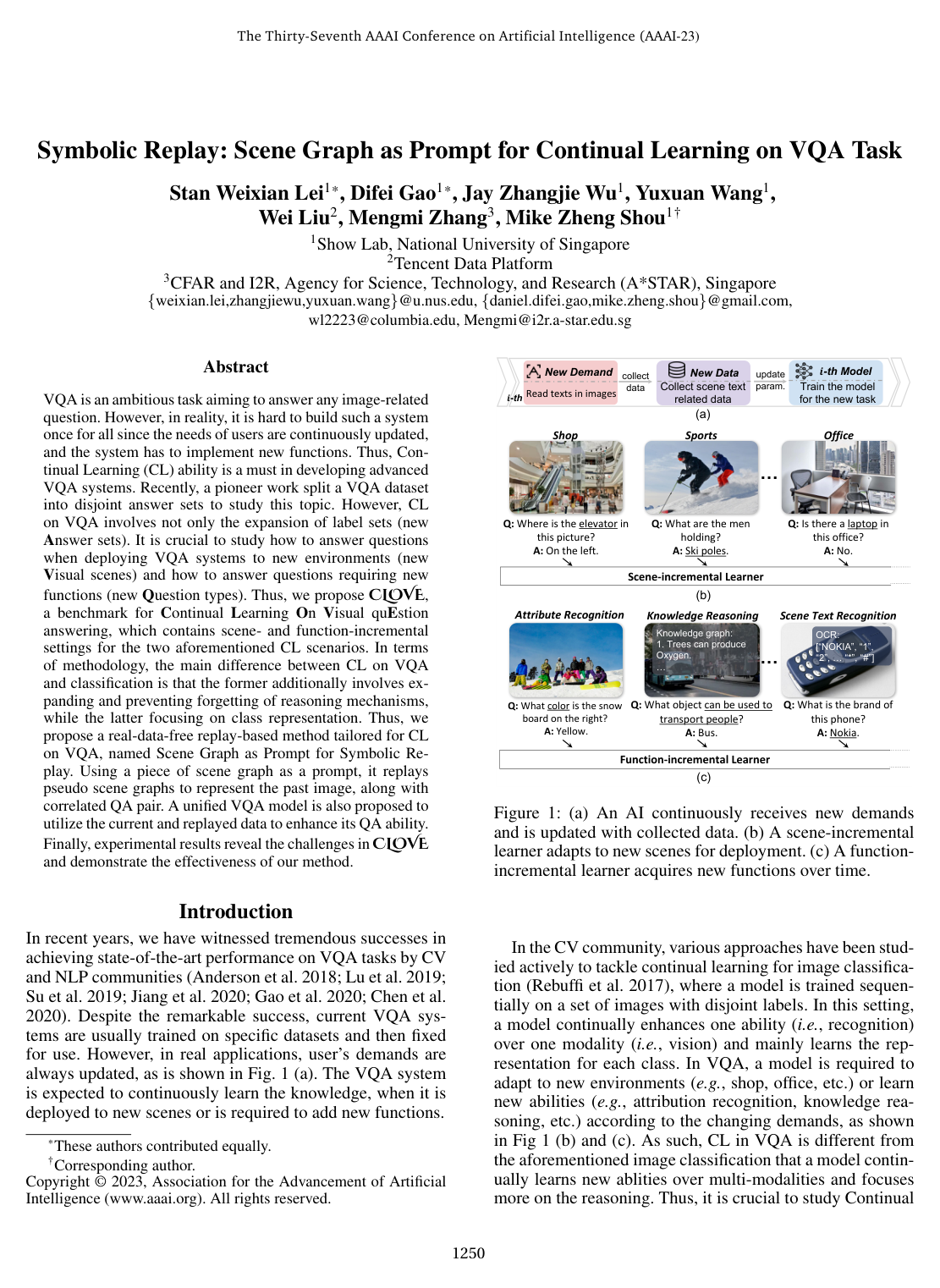
Symbolic Replay: Scene Graph as Prompt for Continual Learning on VQA Task
Stan Weixian Lei, Difei Gao, Jay Zhangjie Wu, Yuxuan Wang, Wei Liu, Mengmi Zhang, Mike Zheng Shou
Why you should read this
Proposes a real-data-free continual learning framework that replays scene graphs instead of images to prevent catastrophic forgetting in visual question answering models across evolving visual environments and question types.
Added
2026-09-26
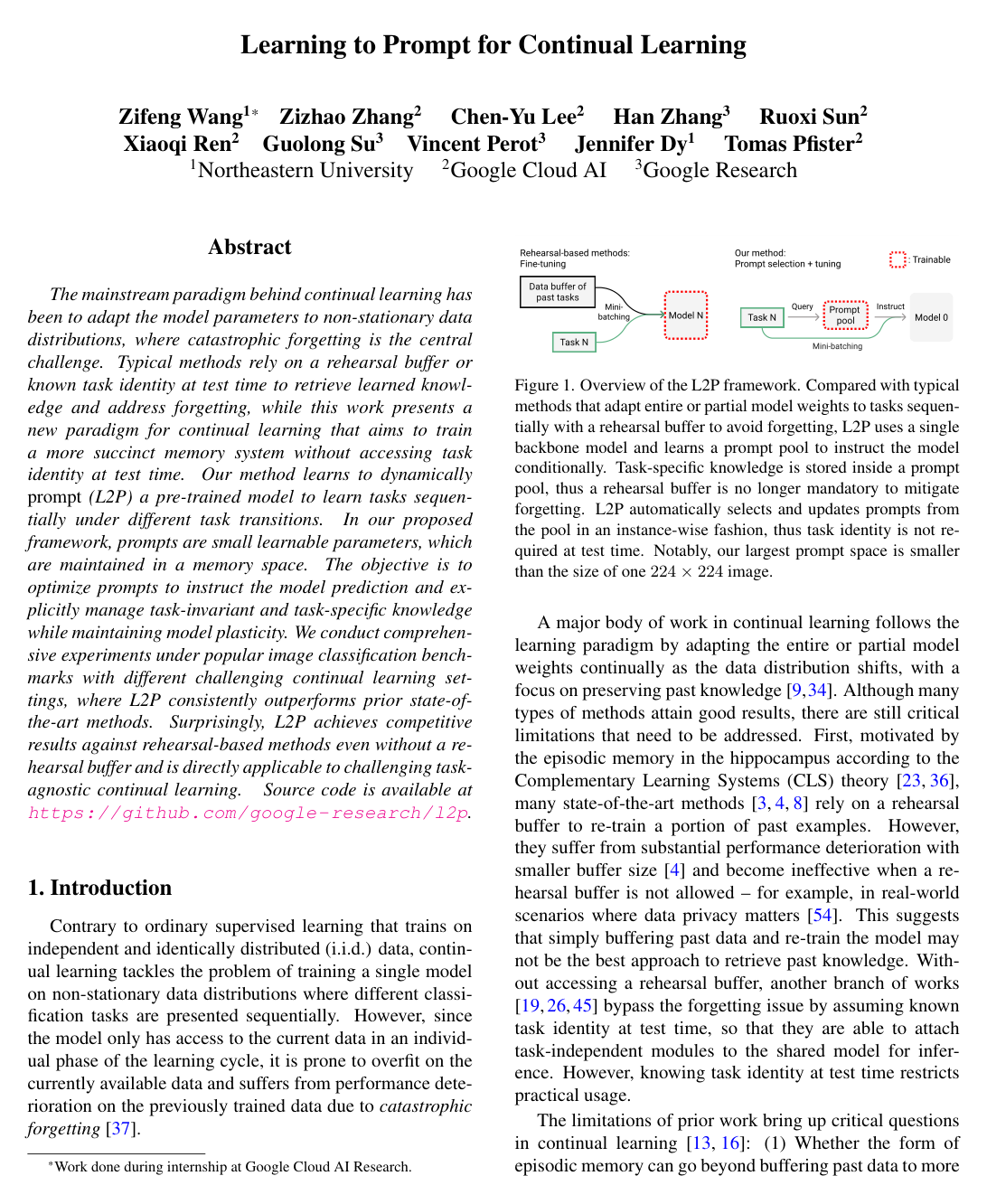
Learning to Prompt for Continual Learning
Zifeng Wang, Zizhao Zhang, Chen-Yu Lee, Han Zhang, Ruoxi Sun, Xiaoqi Ren, Guolong Su, Vincent Perot, Jennifer Dy, Tomas Pfister
Why you should read this
Introduces a prompt-based continual learning framework that dynamically selects learnable prompts to guide pre-trained models across sequential tasks, matching rehearsal-based performance without storing past data or requiring task identities at test time.
The mainstream paradigm behind continual learning has been to adapt the model parameters to non-stationary data distributions, where catastrophic forgetting is the central challenge. Typical methods rely on a rehearsal buffer or known task identity at test time to retrieve learned knowledge and address forgetting, while this work presents a new paradigm for continual learning that aims to train a more succinct memory system without accessing task identity at test time. Our method learns to dynamically prompt (L2P) a pre-trained model to learn tasks sequentially under different task transitions. In our proposed framework, prompts are small learnable parameters, which are maintained in a memory space. The objective is to optimize prompts to instruct the model prediction and explicitly manage task-invariant and task-specific knowledge while maintaining model plasticity. We conduct comprehensive experiments under popular image classification benchmarks with different challenging continual learning settings, where L2P consistently outperforms prior state-of-the-art methods. Surprisingly, L2P achieves competitive results against rehearsal-based methods even without a rehearsal buffer and is directly applicable to challenging task-agnostic continual learning. Source code is available at this https URL.
Added
2026-09-25
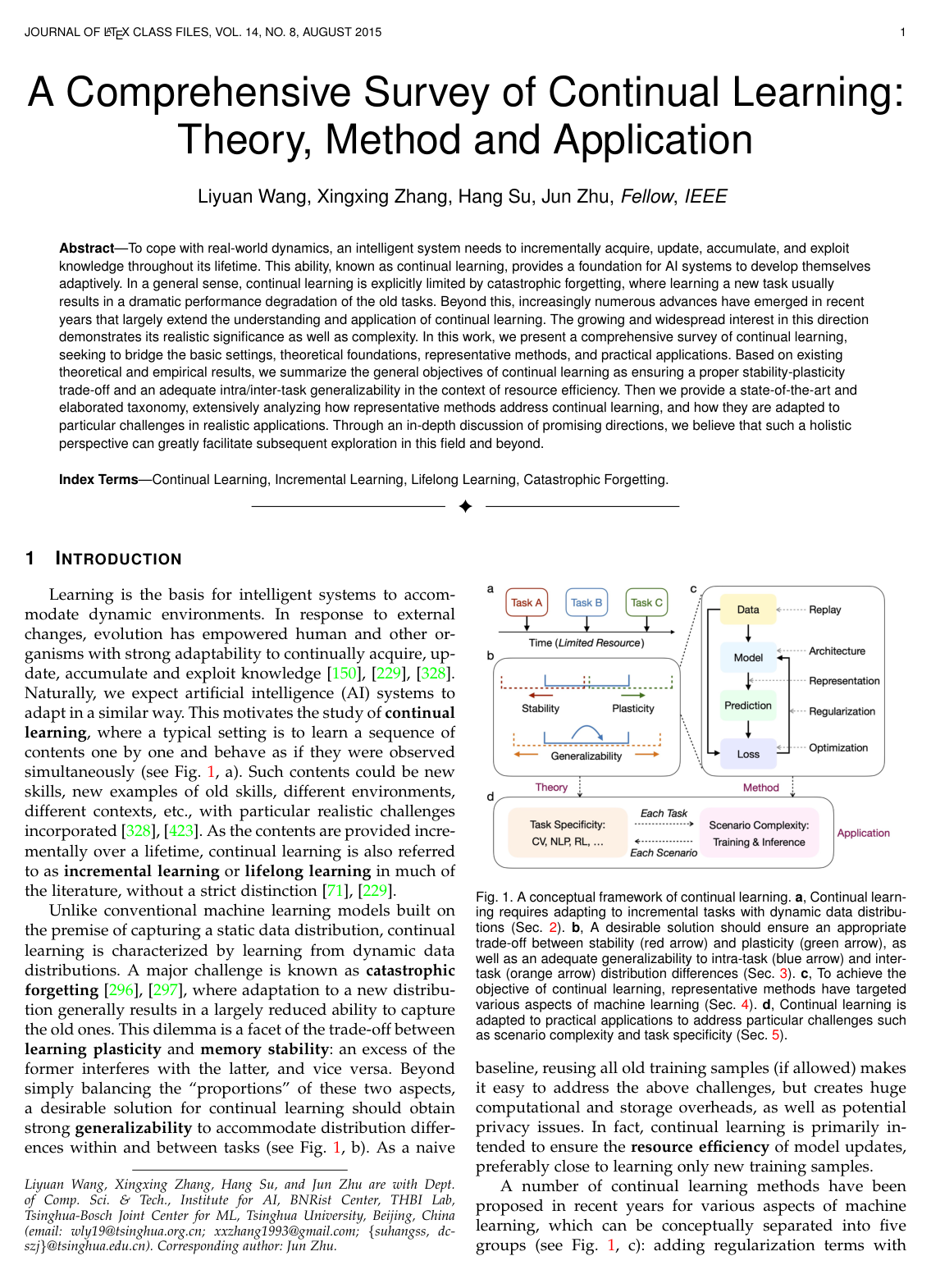
A Comprehensive Survey of Continual Learning: Theory, Method and Application
Liyuan Wang, Xingxing Zhang, Hang Su, Jun Zhu
Why you should read this
Presents a systematic taxonomy of continual learning that bridges theoretical foundations, methods for overcoming catastrophic forgetting, and practical applications across real-world dynamic environments.
To cope with real-world dynamics, an intelligent system needs to incrementally acquire, update, accumulate, and exploit knowledge throughout its lifetime. This ability, known as continual learning, provides a foundation for AI systems to develop themselves adaptively. In a general sense, continual learning is explicitly limited by catastrophic forgetting, where learning a new task usually results in a dramatic performance degradation of the old tasks. Beyond this, increasingly numerous advances have emerged in recent years that largely extend the understanding and application of continual learning. The growing and widespread interest in this direction demonstrates its realistic significance as well as complexity. In this work, we present a comprehensive survey of continual learning, seeking to bridge the basic settings, theoretical foundations, representative methods, and practical applications. Based on existing theoretical and empirical results, we summarize the general objectives of continual learning as ensuring a proper stability-plasticity trade-off and an adequate intra/inter-task generalizability in the context of resource efficiency. Then we provide a state-of-the-art and elaborated taxonomy, extensively analyzing how representative methods address continual learning, and how they are adapted to particular challenges in realistic applications. Through an in-depth discussion of promising directions, we believe that such a holistic perspective can greatly facilitate subsequent exploration in this field and beyond.
Added
2026-09-24
Efficient Lifelong Learning with A-GEM
Arslan Chaudhry, Marc'Aurelio Ranzato, Marcus Rohrbach, Mohamed Elhoseiny
Why you should read this
Develops Averaged Gradient Episodic Memory (A-GEM) and a realistic single-pass benchmark protocol, achieving the high accuracy of memory-based continual learning at a fraction of the computational and storage cost.
In lifelong learning, the learner is presented with a sequence of tasks, incrementally building a data-driven prior which may be leveraged to speed up learning of a new task. In this work, we investigate the efficiency of current lifelong approaches, in terms of sample complexity, computational and memory cost. Towards this end, we first introduce a new and a more realistic evaluation protocol, whereby learners observe each example only once and hyper-parameter selection is done on a small and disjoint set of tasks, which is not used for the actual learning experience and evaluation. Second, we introduce a new metric measuring how quickly a learner acquires a new skill. Third, we propose an improved version of GEM (Lopez-Paz & Ranzato, 2017), dubbed Averaged GEM (A-GEM), which enjoys the same or even better performance as GEM, while being almost as computationally and memory efficient as EWC (Kirkpatrick et al., 2016) and other regularization-based methods. Finally, we show that all algorithms including A-GEM can learn even more quickly if they are provided with task descriptors specifying the classification tasks under consideration. Our experiments on several standard lifelong learning benchmarks demonstrate that A-GEM has the best trade-off between accuracy and efficiency.
Added
2026-09-18
Reflexion: language agents with verbal reinforcement learning
Noah Shinn, Federico Cassano, Beck Labash, A. Gopinath, Karthik Narasimhan, Shunyu Yao
Why you should read this
Introduces Reflexion, a framework enabling large language model agents to learn from trial and error through verbal self-reflection and episodic memory, achieving superior performance on complex coding and reasoning benchmarks without expensive weight updates or fine-tuning.
Large language models (LLMs) have been increasingly used to interact with external environments (e.g., games, compilers, APIs) as goal-driven agents. However, it remains challenging for these language agents to quickly and efficiently learn from trial-and-error as traditional reinforcement learning methods require extensive training samples and expensive model fine-tuning. We propose Reflexion, a novel framework to reinforce language agents not by updating weights, but instead through linguistic feedback. Concretely, Reflexion agents verbally reflect on task feedback signals, then maintain their own reflective text in an episodic memory buffer to induce better decision-making in subsequent trials. Reflexion is flexible enough to incorporate various types (scalar values or free-form language) and sources (external or internally simulated) of feedback signals, and obtains significant improvements over a baseline agent across diverse tasks (sequential decision-making, coding, language reasoning). For example, Reflexion achieves a 91% pass@1 accuracy on the HumanEval coding benchmark, surpassing the previous state-of-the-art GPT-4 that achieves 80%. We also conduct ablation and analysis studies using different feedback signals, feedback incorporation methods, and agent types, and provide insights into how they affect performance. We release all code, demos, and datasets at https://github.com/noahshinn024/reflexion.
Added
2026-09-10

Memory is Reconstructed, Not Retrieved: Graph Memory for LLM Agents
Shuo Ji, Yibo Li, Bryan Hooi
Why you should read this
Develops MRAgent, a framework that uniquely integrates an associative memory graph with active reconstruction, enabling LLM agents to dynamically adapt memory access to reasoning contexts for enhanced performance in long-horizon tasks while reducing computational costs.
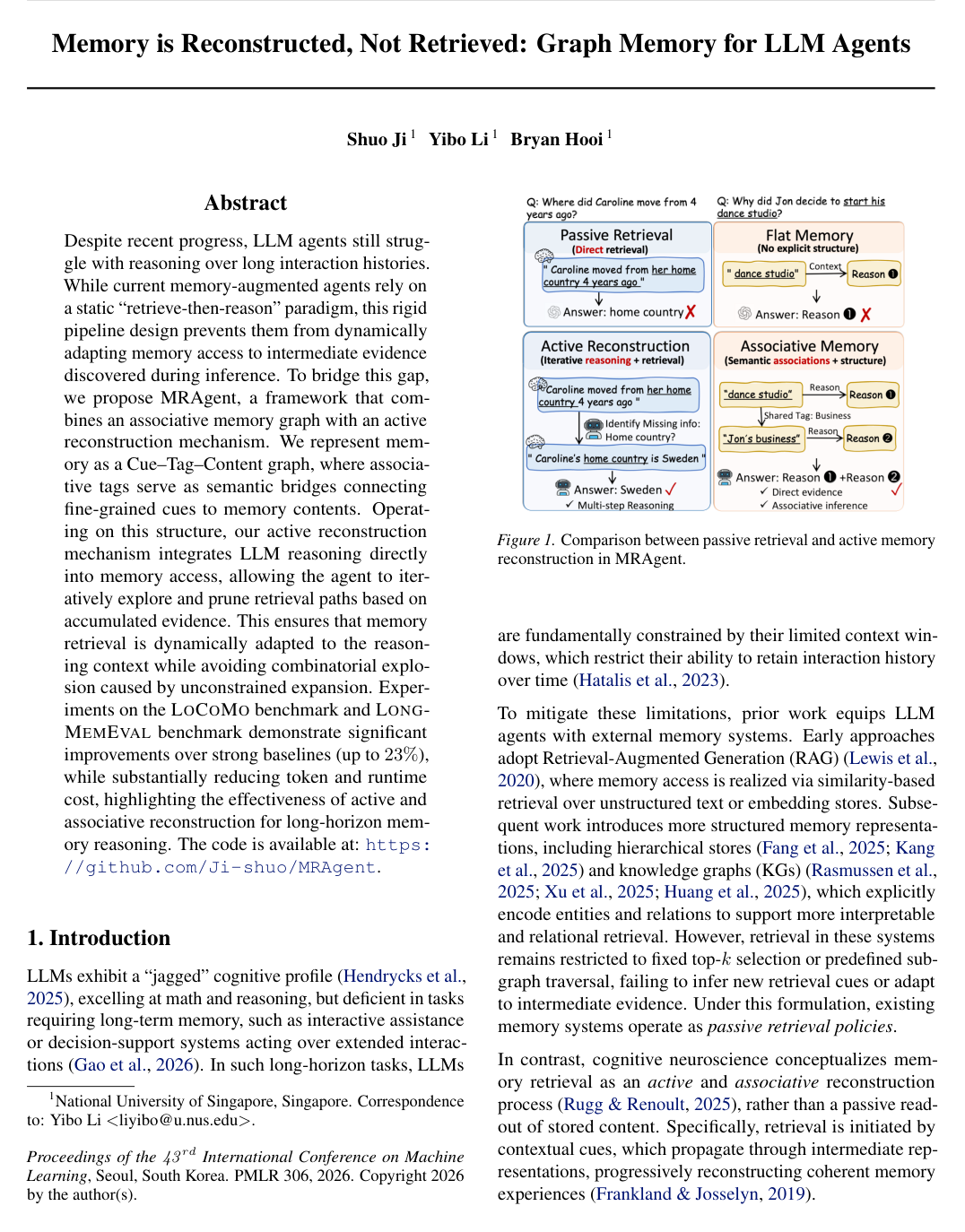
Despite recent progress, LLM agents still struggle with reasoning over long interaction histories. While current memory-augmented agents rely on a static retrieve-then-reason paradigm, this rigid pipeline design prevents them from dynamically adapting memory access to intermediate evidence discovered during inference. To bridge this gap, we propose MRAgent, a framework that combines an associative memory graph with an active reconstruction mechanism. We represent memory as a Cue-Tag-Content graph, where associative tags serve as semantic bridges connecting fine-grained cues to memory contents. Operating on this structure, our active reconstruction mechanism integrates LLM reasoning directly into memory access, allowing the agent to iteratively explore and prune retrieval paths based on accumulated evidence. This ensures that memory retrieval is dynamically adapted to the reasoning context while avoiding combinatorial explosion caused by unconstrained expansion. Experiments on the LoCoMo benchmark and LongMemEval benchmark demonstrate significant improvements over strong baselines (up to 23%), while substantially reducing token and runtime cost, highlighting the effectiveness of active and associative reconstruction for long-horizon memory reasoning.
Added
2026-07-09
The Human Hippocampus and Spatial and Episodic Memory
Neil Burgess, Eleanor A. Maguire, John O’Keefe
Why you should read this
Connects how the brain represents locations in space with how it remembers life events, revealing that the same brain structures supporting navigation may underlie the ability to mentally revisit past experiences.
Finding one’s way around an environment and remembering the events that occur within it are crucial cognitive abilities that have been linked to the hippocampus and medial temporal lobes. Our review of neuropsychological, behavioral, and neuroimaging studies of human hippocampal involvement in spatial memory concentrates on three important concepts in this field: spatial frameworks, dimensionality, and orientation and self-motion. We also compare variation in hippocampal structure and function across and within species. We discuss how its spatial role relates to its accepted role in episodic memory. Five related studies use virtual reality to examine these two types of memory in ecologically valid situations. While processing of spatial scenes involves the parahippocampus, the right hippocampus appears particularly involved in memory for locations within an environment, with the left hippocampus more involved in context-dependent episodic or autobiographical memory.
Added
2026-02-21
The Functional Neuroanatomy of Autobiographical Memory: A Meta-Analysis
Eva Svoboda, Margaret C. McKinnon, Brian Levine
Why you should read this
Reveals how the brain reconstructs personal memories through an interactive network of regions, and identifies the specific factors—from emotional content to memory age—that shape which parts of this network activate during remembering.
Added
2026-02-21
The Cognitive Neuroscience of Constructive Memory: Remembering the Past and Imagining the Future
Daniel L. Schacter, Donna Rose Addis
Why you should read this
Reveals that the same brain mechanisms responsible for memory errors and distortions also enable people to imagine future events, suggesting that memory's imperfections may be adaptive features rather than design flaws.
Episodic memory is widely conceived as a fundamentally constructive, rather than reproductive, process that is prone to various kinds of errors and illusions. With a view towards examining the functions served by a constructive episodic memory system, we consider recent neuropsychological and neuroimaging studies indicating that some types of memory distortions reflect the operation of adaptive processes. An important function of a constructive episodic memory is to allow individuals to simulate or imagine future episodes, happenings and scenarios. Since the future is not an exact repetition of the past, simulation of future episodes requires a system that can draw on the past in a manner that flexibly extracts and recombines elements of previous experiences. Consistent with this constructive episodic simulation hypothesis, we consider cognitive, neuropsychological and neuroimaging evidence showing that there is considerable overlap in the psychological and neural processes involved in remembering the past and imagining the future.
Added
2026-02-21