
keyword
emotion recognition
Emotion recognition is the process of identifying, interpreting, and classifying human emotional and affective states from observable behavioral, communicative, and physiological signals. As a central capability in affective computing and artificial intelligence, computational emotion recognition seeks to enable machines to detect human emotions across a variety of modalities, including facial expressions in images and video, acoustic and linguistic features of speech, written text, body posture, and autonomic physiological metrics like heart rate or skin conductance. Machine learning algorithms and signal processing techniques are applied to these inputs to map them into discrete emotional categories, continuous dimensional scales such as valence and arousal, or natural language descriptions, thereby supporting applications in human-computer interaction, healthcare monitoring, and interactive intelligent systems.
5 items
EmoBench: Evaluating the Emotional Intelligence of Large Language Models
Sahand Sabour, Siyang Liu, Zheyuan Zhang, June M. Liu, Jinfeng Zhou, Alvionna S. Sunaryo, Tatia M. C. Lee, Rada Mihalcea, Minlie Huang
Why you should read this
Proposes EmoBench, a bilingual evaluation benchmark grounded in psychological theories that tests large language models on both emotional understanding and application, exposing a significant performance gap between leading models and human capabilities.
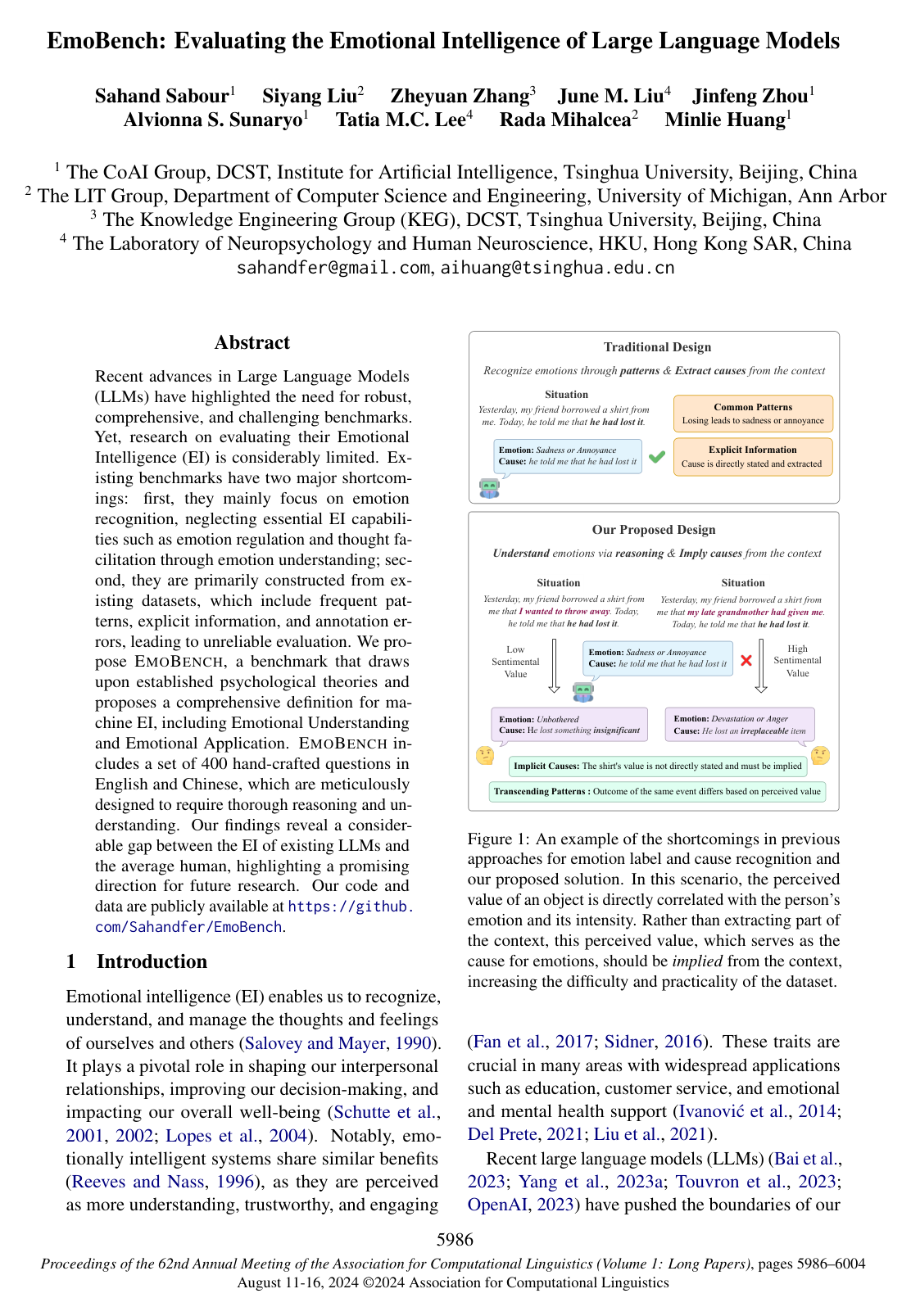
Recent advances in Large Language Models (LLMs) have highlighted the need for robust, comprehensive, and challenging benchmarks. Yet, research on evaluating their Emotional Intelligence (EI) is considerably limited. Existing benchmarks have two major shortcomings: first, they mainly focus on emotion recognition, neglecting essential EI capabilities such as emotion regulation and thought facilitation through emotion understanding; second, they are primarily constructed from existing datasets, which include frequent patterns, explicit information, and annotation errors, leading to unreliable evaluation. We propose EmoBench, a benchmark that draws upon established psychological theories and proposes a comprehensive definition for machine EI, including Emotional Understanding and Emotional Application. EmoBench includes a set of 400 hand-crafted questions in English and Chinese, which are meticulously designed to require thorough reasoning and understanding. Our findings reveal a considerable gap between the EI of existing LLMs and the average human, highlighting a promising direction for future research. Our code and data are publicly available at https://github.com/Sahandfer/EmoBench.
Added
2026-10-03
FERV39k: A Large-Scale Multi-Scene Dataset for Facial Expression Recognition in Videos
Yan Wang, Yixuan Sun, Yiwen Huang, Zhongying Liu, Shuyong Gao, Wei Zhang, Weifeng Ge, Wenqiang Zhang
Why you should read this
Presents FERV39k, a large-scale video benchmark of nearly 39,000 clips spanning 22 distinct scenes to advance dynamic facial expression recognition across diverse real-world contexts.
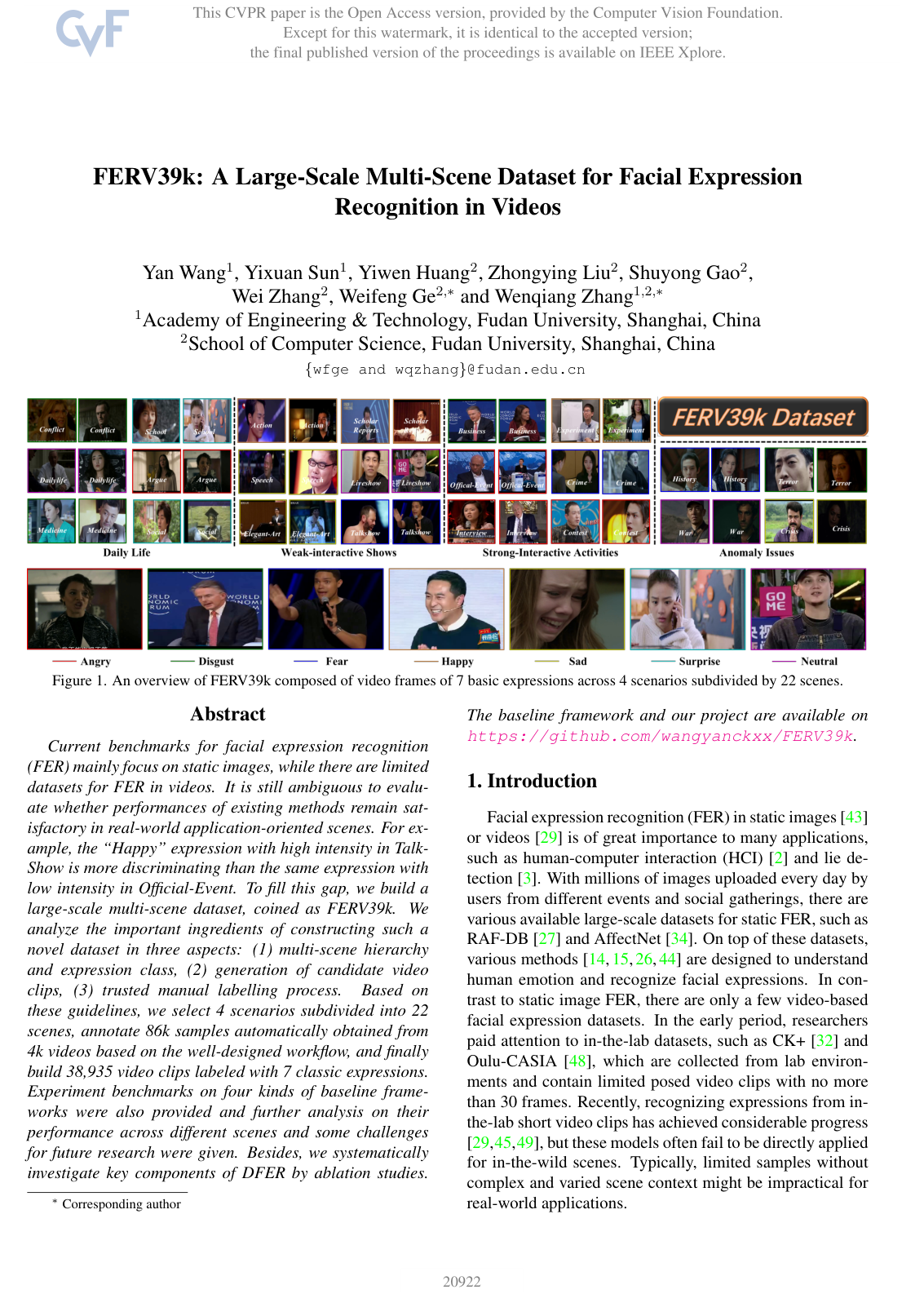
Current benchmarks for facial expression recognition (FER) mainly focus on static images, while there are limited datasets for FER in videos. It is still ambiguous to evaluate whether performances of existing methods remain satisfactory in real-world application-oriented scenes. For example, the “Happy” expression with high intensity in Talk-Show is more discriminating than the same expression with low intensity in Official-Event. To fill this gap, we build a large-scale multi-scene dataset, coined as FERV39k. We analyze the important ingredients of constructing such a novel dataset in three aspects: (1) multi-scene hierarchy and expression class, (2) generation of candidate video clips, (3) trusted manual labelling process. Based on these guidelines, we select 4 scenarios subdivided into 22 scenes, annotate 86k samples automatically obtained from 4k videos based on the well-designed workflow, and finally build 38,935 video clips labeled with 7 classic expressions. Experiment benchmarks on four kinds of baseline frameworks were also provided and further analysis on their performance across different scenes and some challenges for future research were given. Besides, we systematically investigate key components of DFER by ablation studies.
Added
2026-09-26
SECap: Speech Emotion Captioning with Large Language Model
Yaoxun Xu, Hangting Chen, Jianwei Yu, Qiaochu Huang, Zhiyong Wu, Shi-Xiong Zhang, Guangzhi Li, Yi Luo, Rongzhi Gu
Why you should read this
Proposes SECap, a framework that integrates HuBERT audio representations with LLaMA through a Q-Former to generate rich natural language descriptions of complex speech emotions rather than relying on discrete classification labels.
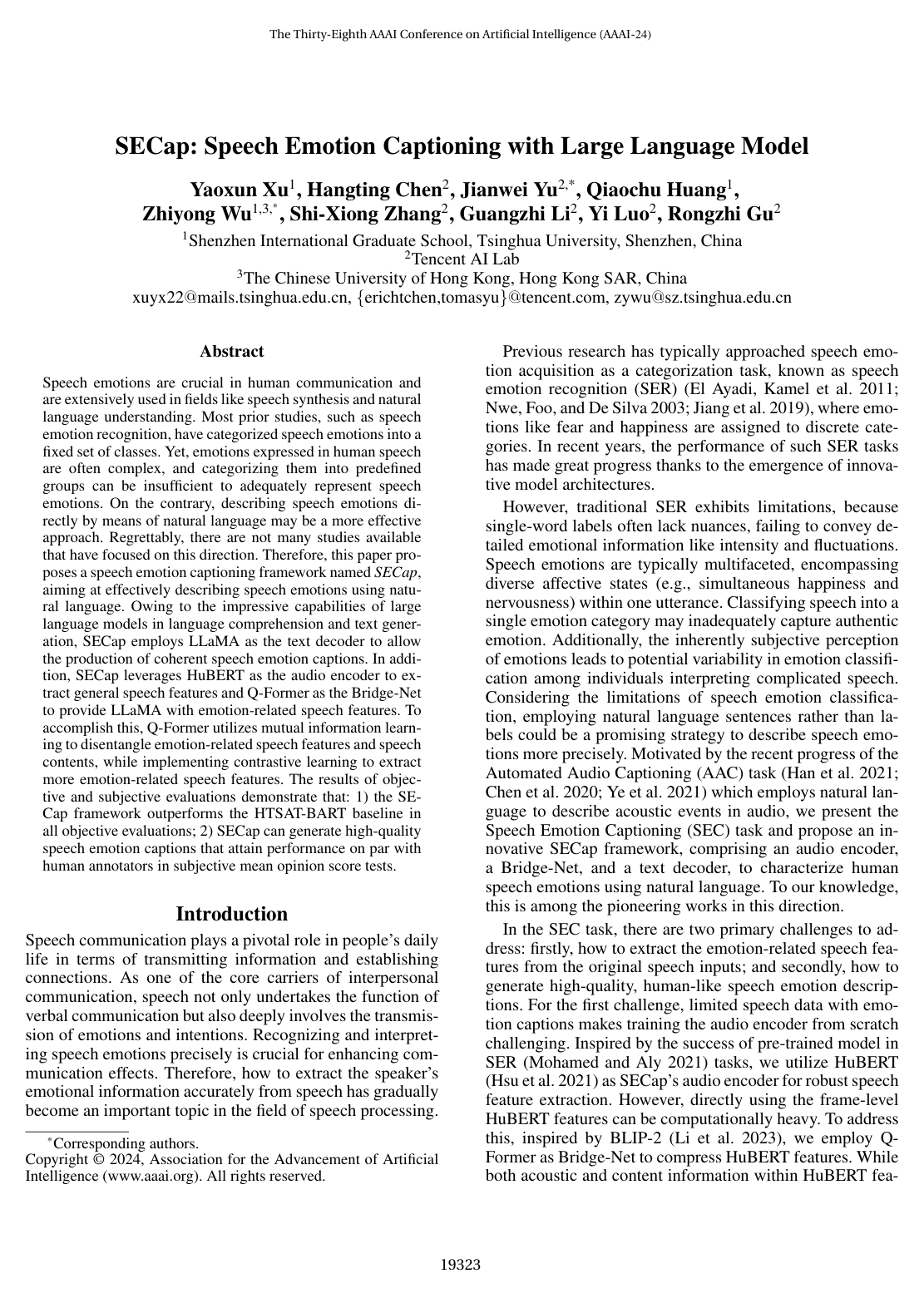
Speech emotions are crucial in human communication and are extensively used in fields like speech synthesis and natural language understanding. Most prior studies, such as speech emotion recognition, have categorized speech emotions into a fixed set of classes. Yet, emotions expressed in human speech are often complex, and categorizing them into predefined groups can be insufficient to adequately represent speech emotions. On the contrary, describing speech emotions directly by means of natural language may be a more effective approach. Regrettably, there are not many studies available that have focused on this direction. Therefore, this paper proposes a speech emotion captioning framework named SECap, aiming at effectively describing speech emotions using natural language. Owing to the impressive capabilities of large language models in language comprehension and text generation, SECap employs LLaMA as the text decoder to allow the production of coherent speech emotion captions. In addition, SECap leverages HuBERT as the audio encoder to extract general speech features and Q-Former as the Bridge-Net to provide LLaMA with emotion-related speech features. To accomplish this, Q-Former utilizes mutual information learning to disentangle emotion-related speech features and speech contents, while implementing contrastive learning to extract more emotion-related speech features. The results of objective and subjective evaluations demonstrate that: 1) the SECap framework outperforms the HTSAT-BART baseline in all objective evaluations; 2) SECap can generate high-quality speech emotion captions that attain performance on par with human annotators in subjective mean opinion score tests.
Added
2026-09-26
Reliable Crowdsourcing and Deep Locality-Preserving Learning for Expression Recognition in the Wild
Shan Li, Weihong Deng, Junping Du
Why you should read this
Presents RAF-DB, a large-scale real-world facial expression database labeled through reliable crowdsourcing, alongside a deep locality-preserving CNN that significantly improves in-the-wild emotion recognition across basic and compound expressions.
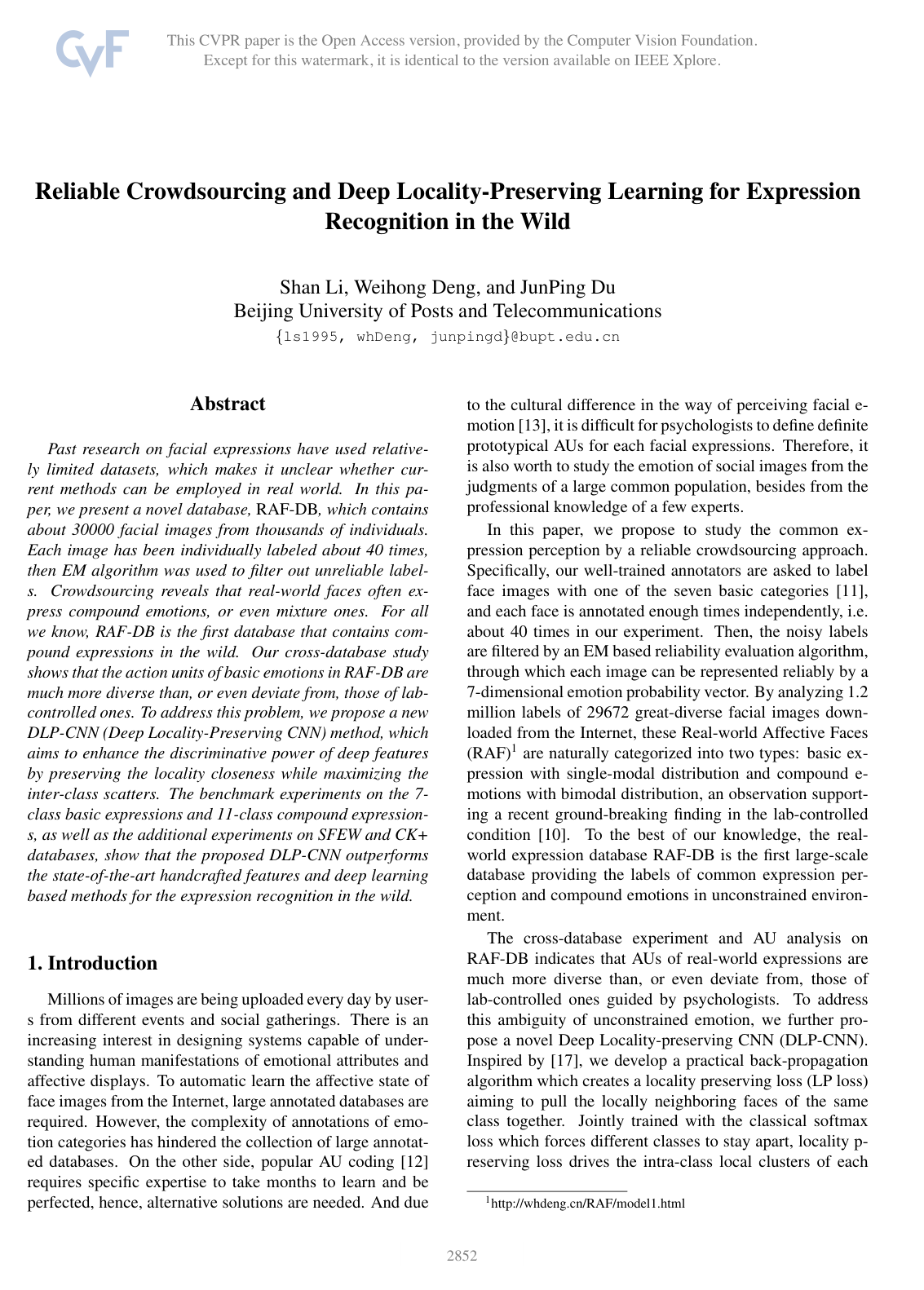
Past research on facial expressions have used relatively limited datasets, which makes it unclear whether current methods can be employed in real world. In this paper, we present a novel database, RAF-DB, which contains about 30000 facial images from thousands of individuals. Each image has been individually labeled about 40 times, then EM algorithm was used to filter out unreliable labels. Crowdsourcing reveals that real-world faces often express compound emotions, or even mixture ones. For all we know, RAF-DB is the first database that contains compound expressions in the wild. Our cross-database study shows that the action units of basic emotions in RAF-DB are much more diverse than, or even deviate from, those of lab-controlled ones. To address this problem, we propose a new DLP-CNN (Deep Locality-Preserving CNN) method, which aims to enhance the discriminative power of deep features by preserving the locality closeness while maximizing the inter-class scatters. The benchmark experiments on the 7-class basic expressions and 11-class compound expressions, as well as the additional experiments on SFEW and CK+ databases, show that the proposed DLP-CNN outperforms the state-of-the-art handcrafted features and deep learning based methods for the expression recognition in the wild.
Added
2026-09-25
Toward Machine Emotional Intelligence: Analysis of Affective Physiological State
Rosalind W. Picard, E. Vyzas, Jennifer Healey
Why you should read this
Demonstrates that machines can accurately classify eight human emotional states from physiological signals collected over multiple weeks by combining Sequential Floating Forward Search with Fisher Projection to resolve day-to-day signal variations.
The ability to recognize emotion is one of the hallmarks of emotional intelligence, an aspect of human intelligence that has been argued to be even more important than mathematical and verbal intelligences. This paper proposes that machine intelligence needs to include emotional intelligence and demonstrates results toward this goal: developing a machine’s ability to recognize human affective state given four physiological signals. We describe difficult issues unique to obtaining reliable affective data and collect a large set of data from a subject trying to elicit and experience each of eight emotional states, daily, over multiple weeks. This paper presents and compares multiple algorithms for feature-based recognition of emotional state from this data. We analyze four physiological signals that exhibit problematic day-to-day variations: The features of different emotions on the same day tend to cluster more tightly than do the features of the same emotion on different days. To handle the daily variations, we propose new features and algorithms and compare their performance. We find that the technique of seeding a Fisher Projection with the results of Sequential Floating Forward Search improves the performance of the Fisher Projection and provides the highest recognition rates reported to date for classification of affect from physiology: 81 percent recognition accuracy on eight classes of emotion, including neutral.
Added
2026-09-14