
keyword
discriminant analysis
Discriminant analysis is a statistical and machine learning technique used to classify observations into two or more predefined categories based on a set of continuous predictor variables or features. It works by identifying mathematical combinations of features that maximize the separation between different groups while minimizing the variation within each group. In addition to class prediction, the method is widely applied for supervised dimensionality reduction and feature extraction, projecting high-dimensional data into a lower-dimensional subspace where categories are more distinguishable. Common variations include linear discriminant analysis, which assumes that all classes share equal covariance matrices to produce linear decision boundaries, and quadratic discriminant analysis, which estimates separate covariance structures for each class to form curved or non-linear boundaries.
2 items
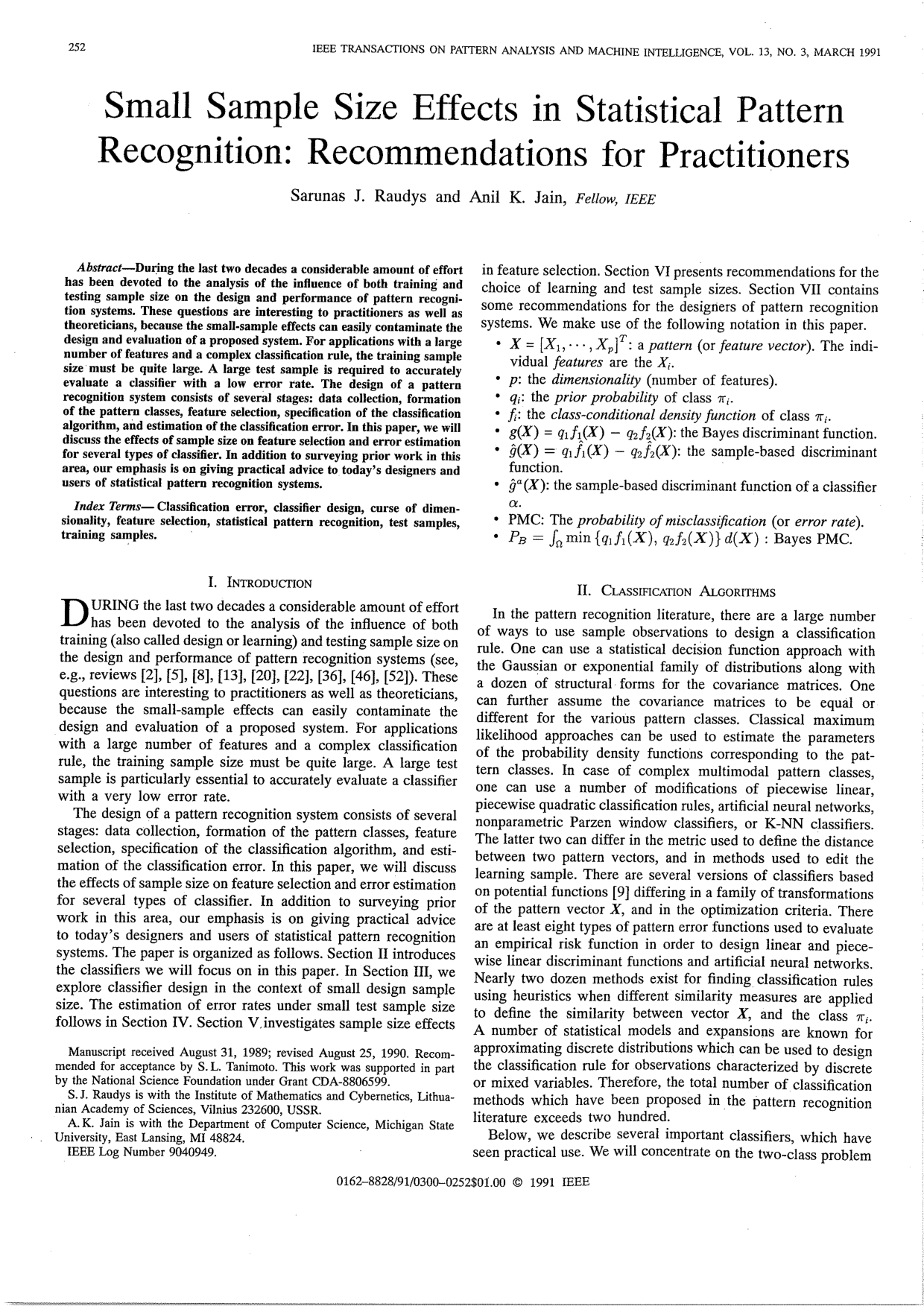
Small Sample Size Effects in Statistical Pattern Recognition: Recommendations for Practitioners
S. Raudys, Anil K. Jain
Why you should read this
Presents practical guidelines and quantitative analyses to help practitioners choose appropriate training and test sample sizes, avoid small-sample bias in classifier design and feature selection, and accurately estimate classification error rates.
During the last two decades a considerable amount of effort has been devoted to the analysis of the influence of both training and testing sample size on the design and performance of pattern recognition systems. These questions are interesting to practitioners as well as theoreticians, because the small-sample effects can easily contaminate the design and evaluation of a proposed system. For applications with a large number of features and a complex classification rule, the training sample size must be quite large. A large test sample is required to accurately evaluate a classifier with a low error rate. The design of a pattern recognition system consists of several stages: data collection, formation of the pattern classes, feature selection, specification of the classification algorithm, and estimation of the classification error. In this paper, we will discuss the effects of sample size on feature selection and error estimation for several types of classifier. In addition to surveying prior work in this area, our emphasis is on giving practical advice to today's designers and users of statistical pattern recognition systems.
Added
2026-09-25
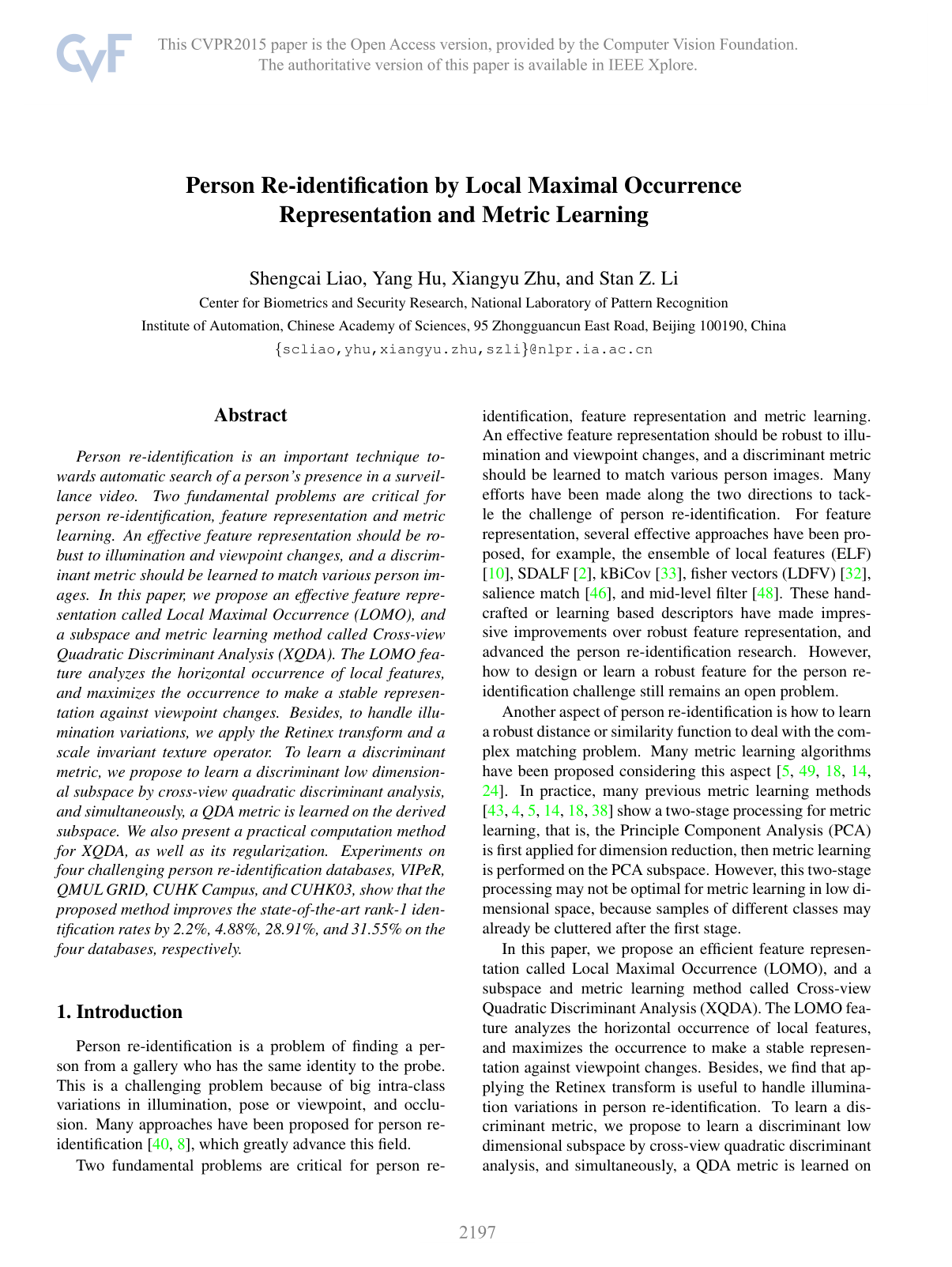
Person re-identification by Local Maximal Occurrence representation and metric learning
Shengcai Liao, Yang Hu, Xiangyu Zhu, S. Li
Why you should read this
Proposes the Local Maximal Occurrence feature representation and Cross-view Quadratic Discriminant Analysis metric learning framework to address severe viewpoint and illumination variations in surveillance video, achieving massive rank-1 accuracy gains across four major person re-identification benchmarks.
Person re-identification is an important technique towards automatic search of a person's presence in a surveillance video. Two fundamental problems are critical for person re-identification, feature representation and metric learning. An effective feature representation should be robust to illumination and viewpoint changes, and a discriminant metric should be learned to match various person images. In this paper, we propose an effective feature representation called Local Maximal Occurrence (LOMO), and a subspace and metric learning method called Cross-view Quadratic Discriminant Analysis (XQDA). The LOMO feature analyzes the horizontal occurrence of local features, and maximizes the occurrence to make a stable representation against viewpoint changes. Besides, to handle illumination variations, we apply the Retinex transform and a scale invariant texture operator. To learn a discriminant metric, we propose to learn a discriminant low dimensional subspace by cross-view quadratic discriminant analysis, and simultaneously, a QDA metric is learned on the derived subspace. We also present a practical computation method for XQDA, as well as its regularization. Experiments on four challenging person re-identification databases, VIPeR, QMUL GRID, CUHK Campus, and CUHK03, show that the proposed method improves the state-of-the-art rank-1 identification rates by 2.2%, 4.88%, 28.91%, and 31.55% on the four databases, respectively.
Added
2026-09-16