
keyword
diffusion probabilistic models
Diffusion probabilistic models are a class of generative machine learning models that generate new data by learning to reverse a gradual corruption process. In the forward or diffusion process, input data is systematically transformed into unstructured noise over a sequence of steps, typically by adding small amounts of Gaussian or categorical noise. The model trains a neural network to approximate the reverse process, iteratively removing noise to reconstruct high-fidelity data samples from random noise distributions. Originally inspired by non-equilibrium thermodynamics, these models achieve state-of-the-art sample quality across continuous and discrete domains, including image synthesis, audio generation, language modeling, and inverse problem restoration.
5 items
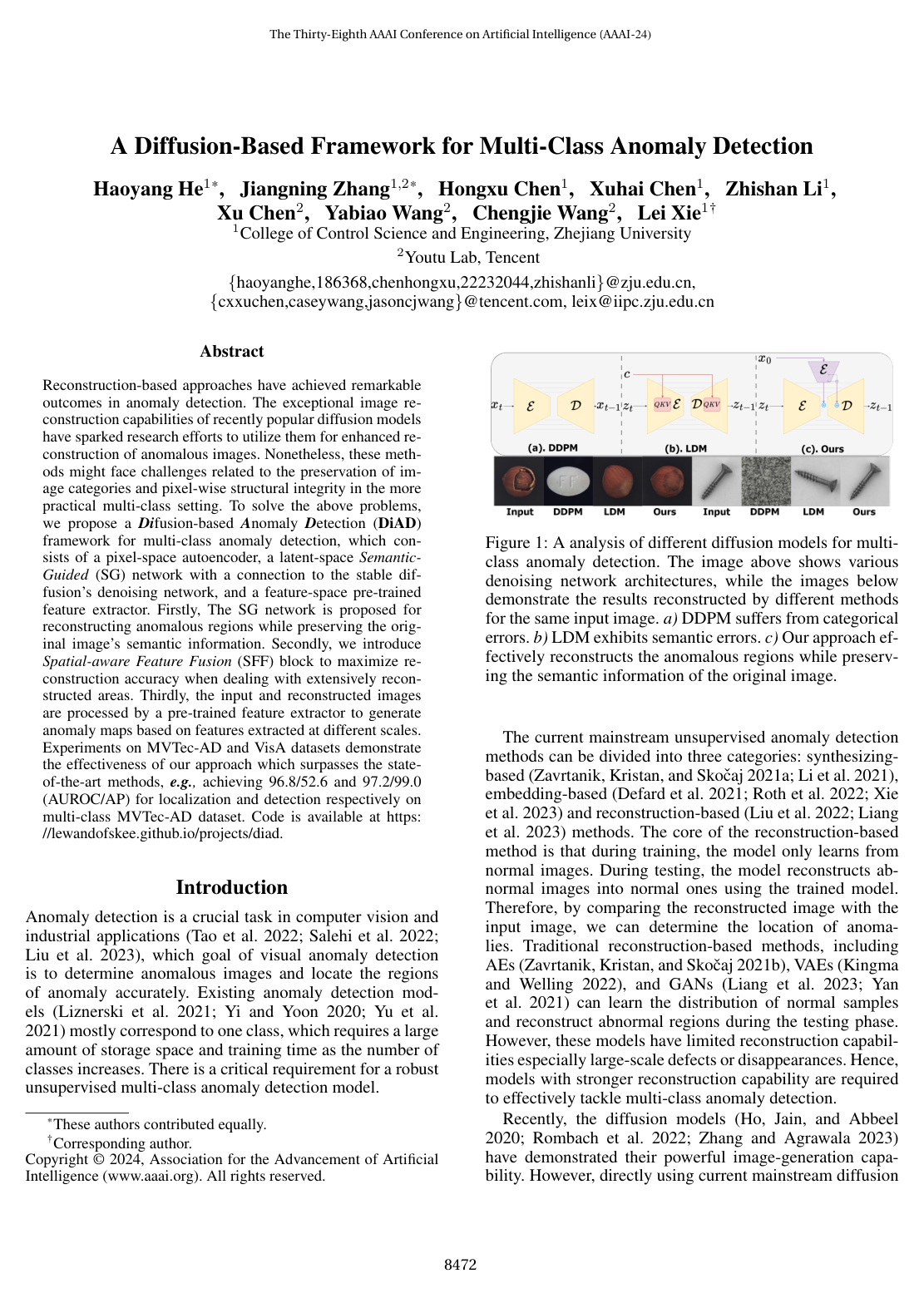
A Diffusion-Based Framework for Multi-Class Anomaly Detection
Haoyang He, Jiangning Zhang, Hongxu Chen, Xuhai Chen, Zhishan Li, Xu Chen, Yabiao Wang, Chengjie Wang, Lei Xie
Why you should read this
Proposes a semantic-guided diffusion framework that solves class confusion and structural distortion during reconstruction, achieving state-of-the-art multi-class anomaly detection and localization on the MVTec-AD and VisA benchmarks.
Reconstruction-based approaches have achieved remarkable outcomes in anomaly detection. The exceptional image reconstruction capabilities of recently popular diffusion models have sparked research efforts to utilize them for enhanced reconstruction of anomalous images. Nonetheless, these methods might face challenges related to the preservation of image categories and pixel-wise structural integrity in the more practical multi-class setting. To solve the above problems, we propose a Diffusion-based Anomaly Detection (DiAD) framework for multi-class anomaly detection, which consists of a pixel-space autoencoder, a latent-space Semantic-Guided (SG) network with a connection to the stable diffusion's denoising network, and a feature-space pre-trained feature extractor. Firstly, the SG network is proposed for reconstructing anomalous regions while preserving the original image's semantic information. Secondly, we introduce Spatial-aware Feature Fusion (SFF) block to maximize reconstruction accuracy when dealing with extensively reconstructed areas. Thirdly, the input and reconstructed images are processed by a pre-trained feature extractor to generate anomaly maps based on features extracted at different scales. Experiments on MVTec-AD and VisA datasets demonstrate the effectiveness of our approach which surpasses the state-of-the-art methods, e.g., achieving 96.8/52.6 and 97.2/99.0 (AUROC/AP) for localization and detection respectively on multi-class MVTec-AD dataset. Code is available at https://lewandofskee.github.io/projects/diad.
Added
2026-10-05
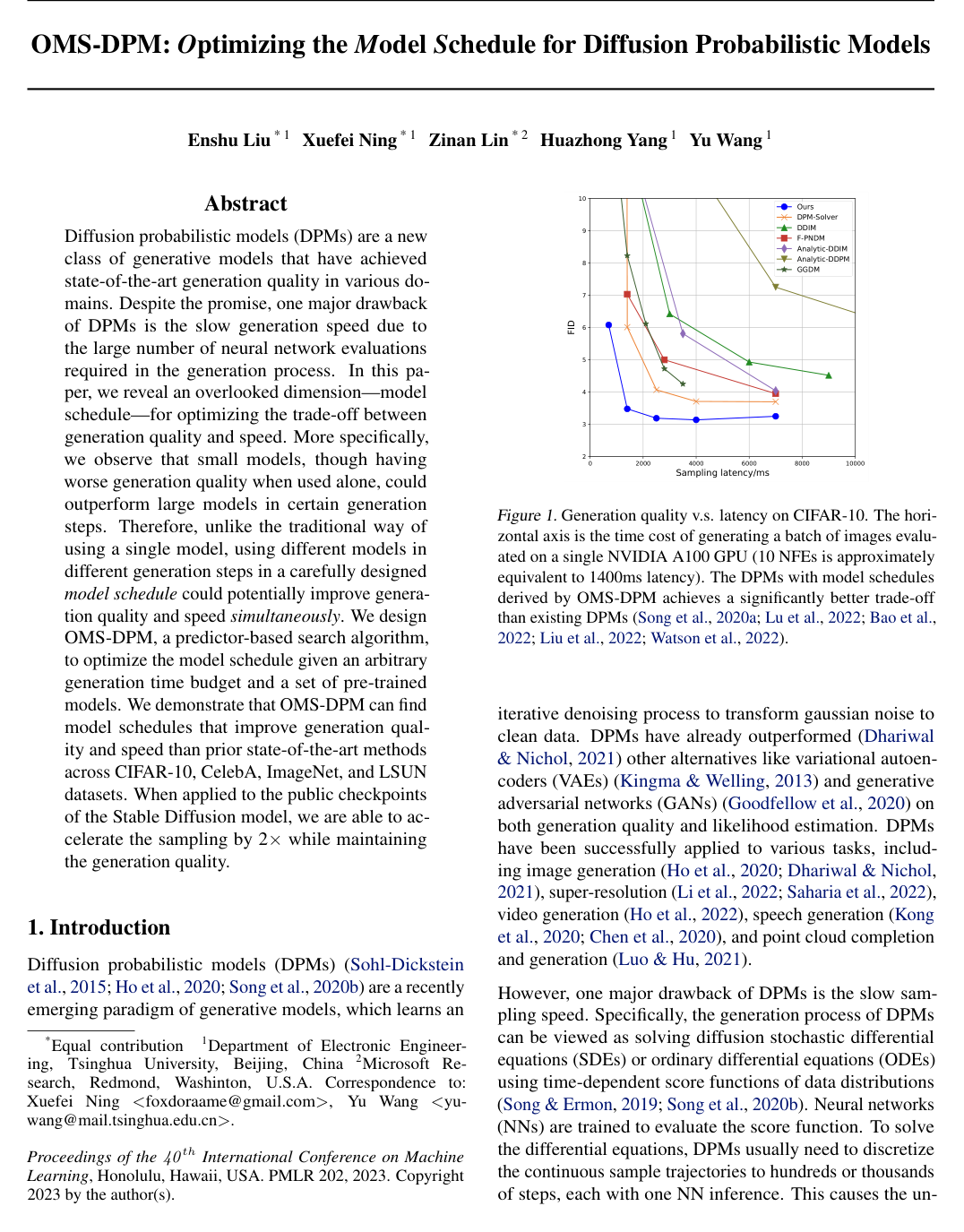
OMS-DPM: Optimizing the Model Schedule for Diffusion Probabilistic Models
Enshu Liu, Xuefei Ning, Zinan Lin, Huazhong Yang, Yu Wang
Why you should read this
Proposes a predictor-based search framework that dynamically pairs differently sized pre-trained neural networks with specific denoising steps, doubling the sampling speed of models like Stable Diffusion without sacrificing generation quality.
Diffusion probabilistic models (DPMs) are a new class of generative models that have achieved state-of-the-art generation quality in various domains. Despite the promise, one major drawback of DPMs is the slow generation speed due to the large number of neural network evaluations required in the generation process. In this paper, we reveal an overlooked dimension—model schedule—for optimizing the trade-off between generation quality and speed. More specifically, we observe that small models, though having worse generation quality when used alone, could outperform large models in certain generation steps. Therefore, unlike the traditional way of using a single model, using different models in different generation steps in a carefully designed model schedule could potentially improve generation quality and speed simultaneously. We design OMS-DPM, a predictor-based search algorithm, to optimize the model schedule given an arbitrary generation time budget and a set of pre-trained models. We demonstrate that OMS-DPM can find model schedules that improve generation quality and speed than prior state-of-the-art methods across CIFAR-10, CelebA, ImageNet, and LSUN datasets. When applied to the public checkpoints of the Stable Diffusion model, we are able to accelerate the sampling by 2× while maintaining the generation quality.
Added
2026-10-03
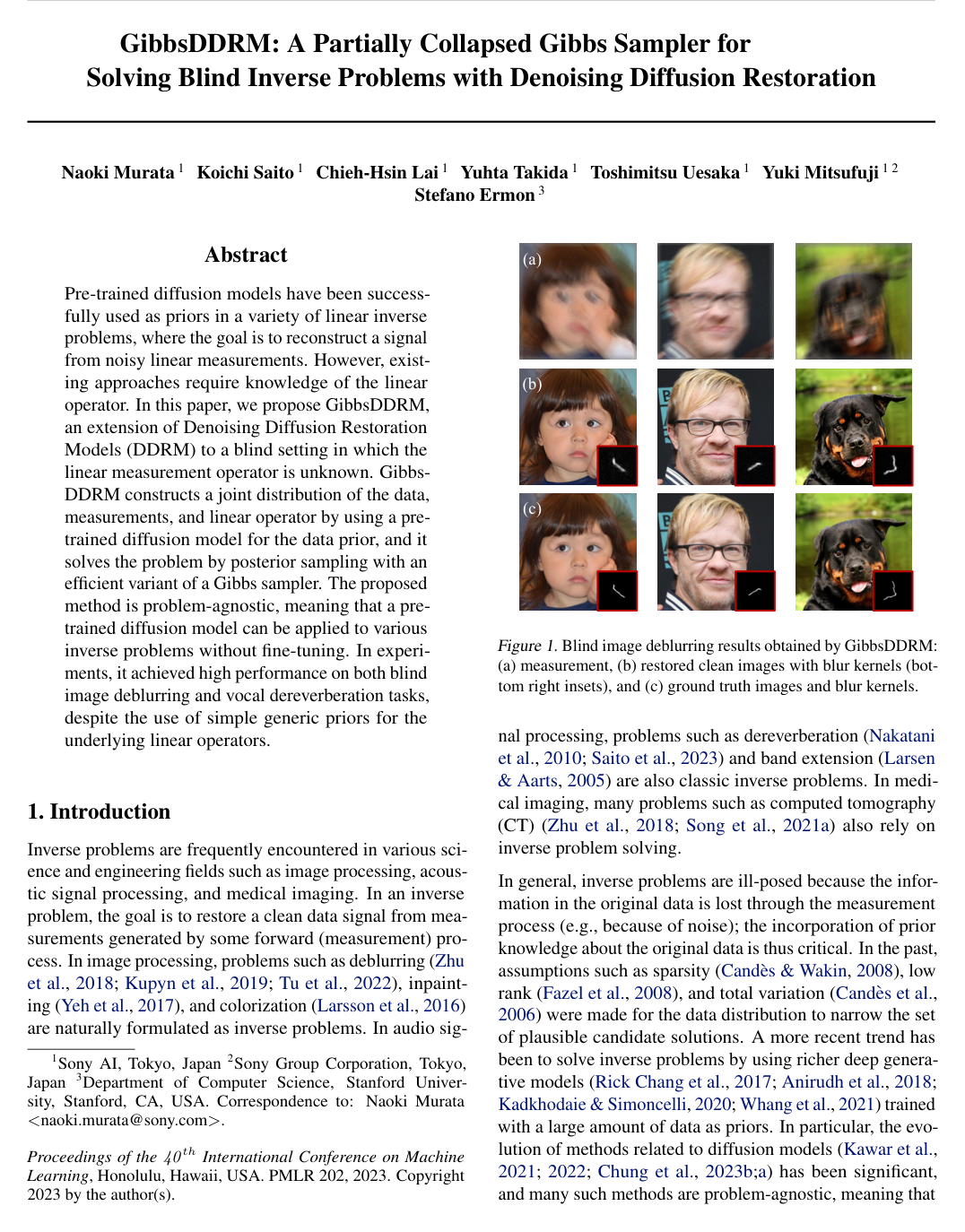
GibbsDDRM: A Partially Collapsed Gibbs Sampler for Solving Blind Inverse Problems with Denoising Diffusion Restoration
Naoki Murata, Koichi Saito, Chieh-Hsin Lai, Yuhta Takida, Toshimitsu Uesaka, Yuki Mitsufuji, Stefano Ermon
Why you should read this
Proposes a partially collapsed Gibbs sampling framework that enables pre-trained diffusion models to solve blind inverse problems like image deblurring and vocal dereverberation without requiring fine-tuning or specialized priors for the unknown measurement operator.
Pre-trained diffusion models have been successfully used as priors in a variety of linear inverse problems, where the goal is to reconstruct a signal from noisy linear measurements. However, existing approaches require knowledge of the linear operator. In this paper, we propose GibbsDDRM, an extension of Denoising Diffusion Restoration Models (DDRM) to a blind setting in which the linear measurement operator is unknown. GibbsDDRM constructs a joint distribution of the data, measurements, and linear operator by using a pre-trained diffusion model for the data prior, and it solves the problem by posterior sampling with an efficient variant of a Gibbs sampler. The proposed method is problem-agnostic, meaning that a pre-trained diffusion model can be applied to various inverse problems without fine-tuning. In experiments, it achieved high performance on both blind image deblurring and vocal dereverberation tasks, despite the use of simple generic priors for the underlying linear operators.
Added
2026-10-02
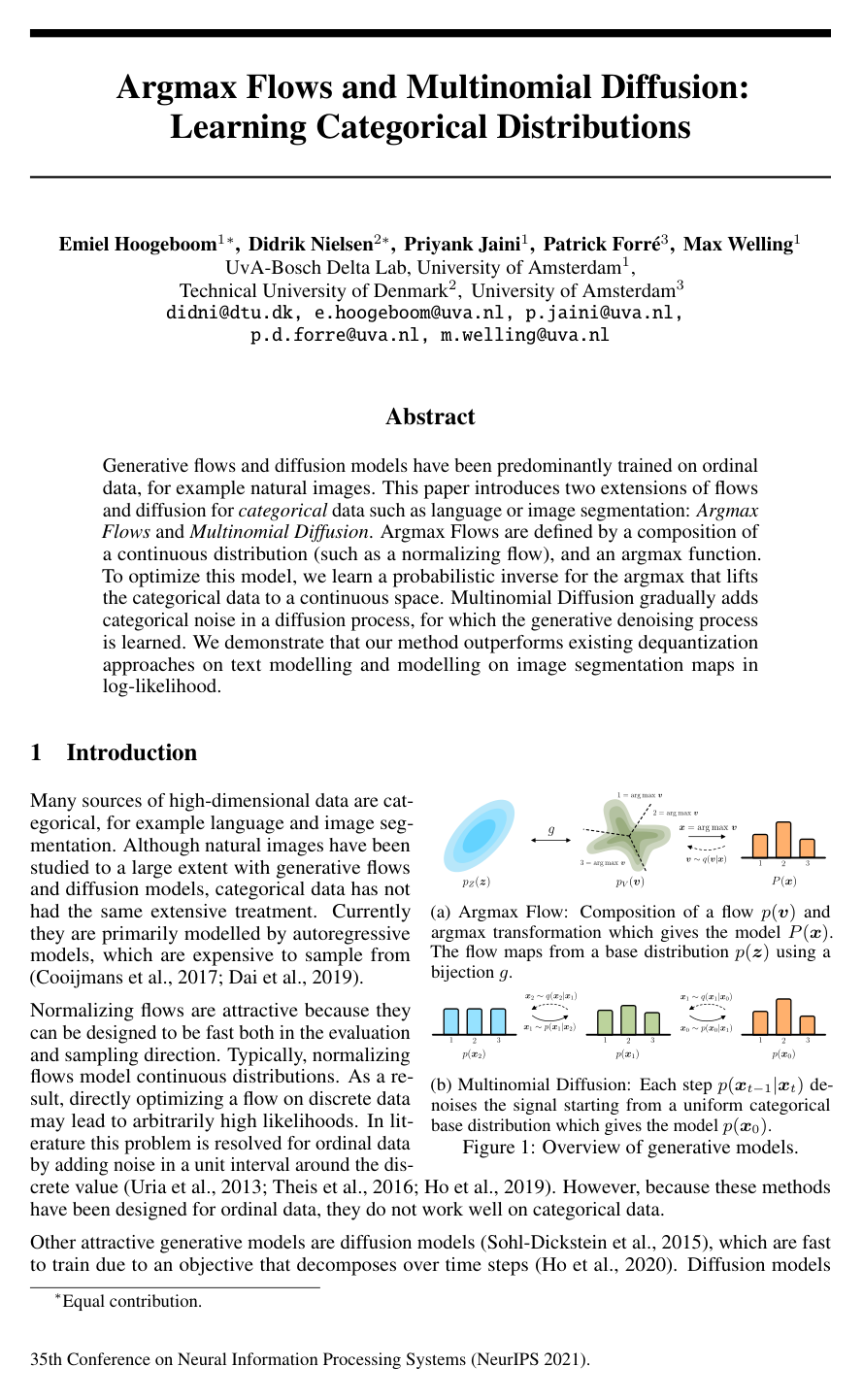
Argmax Flows and Multinomial Diffusion: Learning Categorical Distributions
Emiel Hoogeboom, Didrik Nielsen, Priyank Jaini, Patrick Forré, Max Welling
Why you should read this
Introduces a compelling alternative to transition matrices by reparameterizing categorical data generation through argmax operations and multinomial jump processes.
Generative flows and diffusion models have been predominantly trained on ordinal data, for example natural images. This paper introduces two extensions of flows and diffusion for categorical data such as language or image segmentation: Argmax Flows and Multinomial Diffusion. Argmax Flows are defined by a composition of a continuous distribution (such as a normalizing flow), and an argmax function. To optimize this model, we learn a probabilistic inverse for the argmax that lifts the categorical data to a continuous space. Multinomial Diffusion gradually adds categorical noise in a diffusion process, for which the generative denoising process is learned. We demonstrate that our method outperforms existing dequantization approaches on text modelling and modelling on image segmentation maps in log-likelihood.
Added
2026-03-12
Structured Denoising Diffusion Models in Discrete State-Spaces
Jacob Austin, Daniel D. Johnson, Jonathan Ho, Daniel Tarlow, Rianne van den Berg
Why you should read this
Establishes the foundational mathematical framework for applying continuous diffusion logic to categorical language tokens through explicit discrete transition matrices.
Denoising diffusion probabilistic models (DDPMs) (Ho et al. 2020) have shown impressive results on image and waveform generation in continuous state spaces. Here, we introduce Discrete Denoising Diffusion Probabilistic Models (D3PMs), diffusion-like generative models for discrete data that generalize the multinomial diffusion model of Hoogeboom et al. 2021, by going beyond corruption processes with uniform transition probabilities. This includes corruption with transition matrices that mimic Gaussian kernels in continuous space, matrices based on nearest neighbors in embedding space, and matrices that introduce absorbing states. The third allows us to draw a connection between diffusion models and autoregressive and mask-based generative models. We show that the choice of transition matrix is an important design decision that leads to improved results in image and text domains. We also introduce a new loss function that combines the variational lower bound with an auxiliary cross entropy loss. For text, this model class achieves strong results on character-level text generation while scaling to large vocabularies on LM1B. On the image dataset CIFAR-10, our models approach the sample quality and exceed the log-likelihood of the continuous-space DDPM model.
Added
2026-02-25