
keyword
deep implicit functions
Deep implicit functions are continuous three-dimensional shape and surface representations that use deep neural networks to learn and parameterize implicit geometric functions over spatial coordinate space. Rather than storing three-dimensional objects using discrete primitives such as polygon meshes, voxel grids, or point clouds, a deep implicit function takes spatial coordinates, frequently conditioned on global or local feature embeddings, and predicts continuous scalar values indicating geometric properties, typically signed distance to the surface or occupancy probability. The underlying surface is subsequently extracted as a specific isosurface, such as the zero level set of a signed distance field or the decision boundary of an occupancy field. This coordinate-based formulation enables memory-efficient, resolution-independent geometric modeling and can naturally accommodate complex, varying topologies without relying on fixed spatial grid resolutions or predefined mesh templates.
3 items
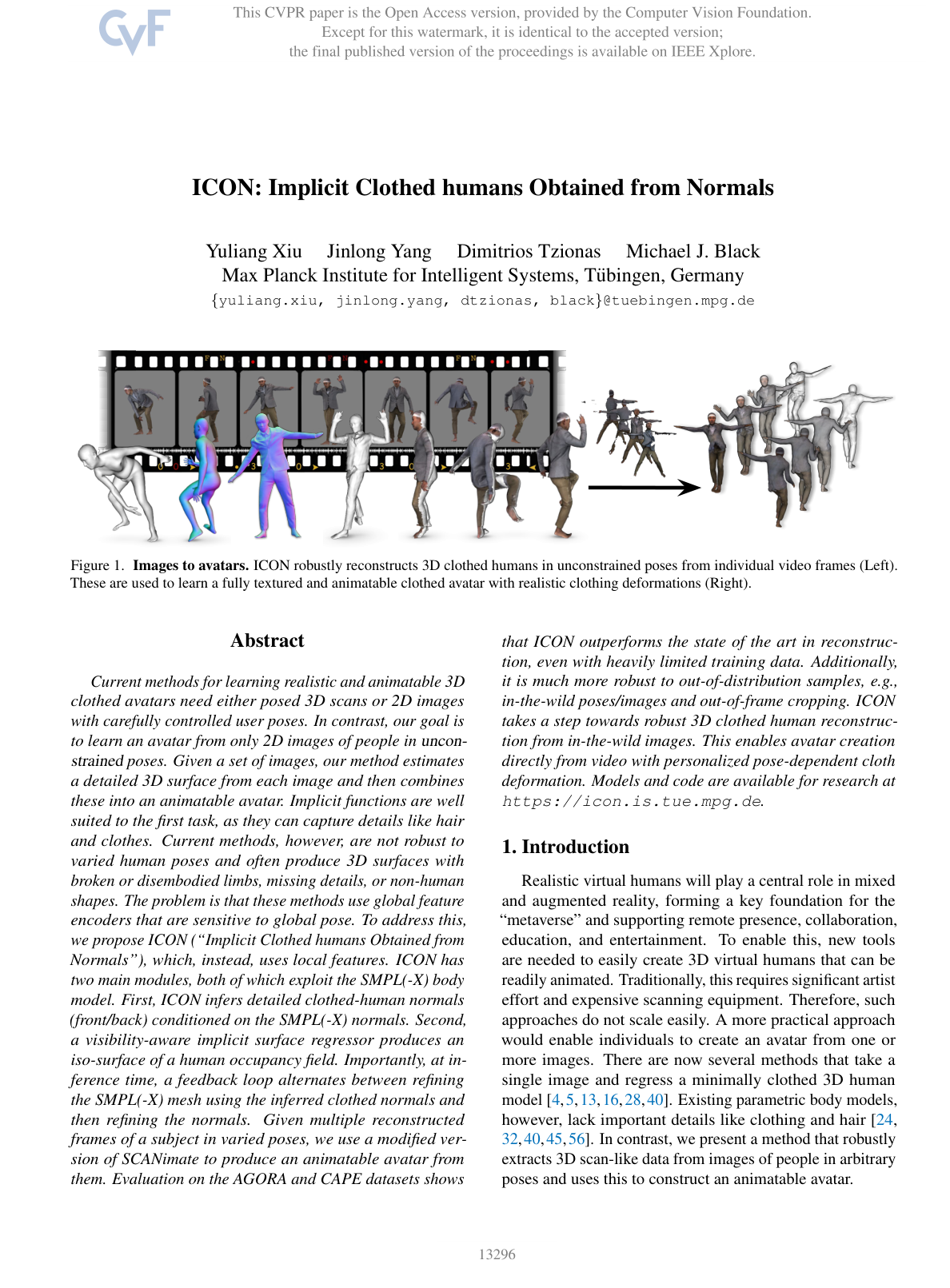
ICON: Implicit Clothed humans Obtained from Normals
Yuliang Xiu, Jinlong Yang, Dimitrios Tzionas, Michael J. Black
Why you should read this
Reconstructs detailed 3D clothed humans from single unconstrained images by coupling body-guided surface normal estimation with local implicit function regression, enabling animatable avatar creation from in-the-wild video.
Current methods for learning realistic and animatable 3D clothed avatars need either posed 3D scans or 2D images with carefully controlled user poses. In contrast, our goal is to learn an avatar from only 2D images of people in unconstrained poses. Given a set of images, our method estimates a detailed 3D surface from each image and then combines these into an animatable avatar. Implicit functions are well suited to the first task, as they can capture details like hair and clothes. Current methods, however, are not robust to varied human poses and often produce 3D surfaces with broken or disembodied limbs, missing details, or non-human shapes. The problem is that these methods use global feature encoders that are sensitive to global pose. To address this, we propose ICON (“Implicit Clothed humans Obtained from Normals”), which, instead, uses local features. ICON has two main modules, both of which exploit the SMPL(-X) body model. First, ICON infers detailed clothed-human normals (front/back) conditioned on the SMPL(-X) normals. Second, a visibility-aware implicit surface regressor produces an iso-surface of a human occupancy field. Importantly, at inference time, a feedback loop alternates between refining the SMPL(-X) mesh using the inferred clothed normals and then refining the normals. Given multiple reconstructed frames of a subject in varied poses, we use a modified version of SCANimate to produce an animatable avatar from them. Evaluation on the AGORA and CAPE datasets shows that ICON outperforms the state of the art in reconstruction, even with heavily limited training data. Additionally, it is much more robust to out-of-distribution samples, e.g., in-the-wild poses/images and out-of-frame cropping. ICON takes a step towards robust 3D clothed human reconstruction from in-the-wild images. This enables avatar creation directly from video with personalized pose-dependent cloth deformation. Models and code are available for research at https://icon.is.tue.mpg.de.
Added
2026-09-26
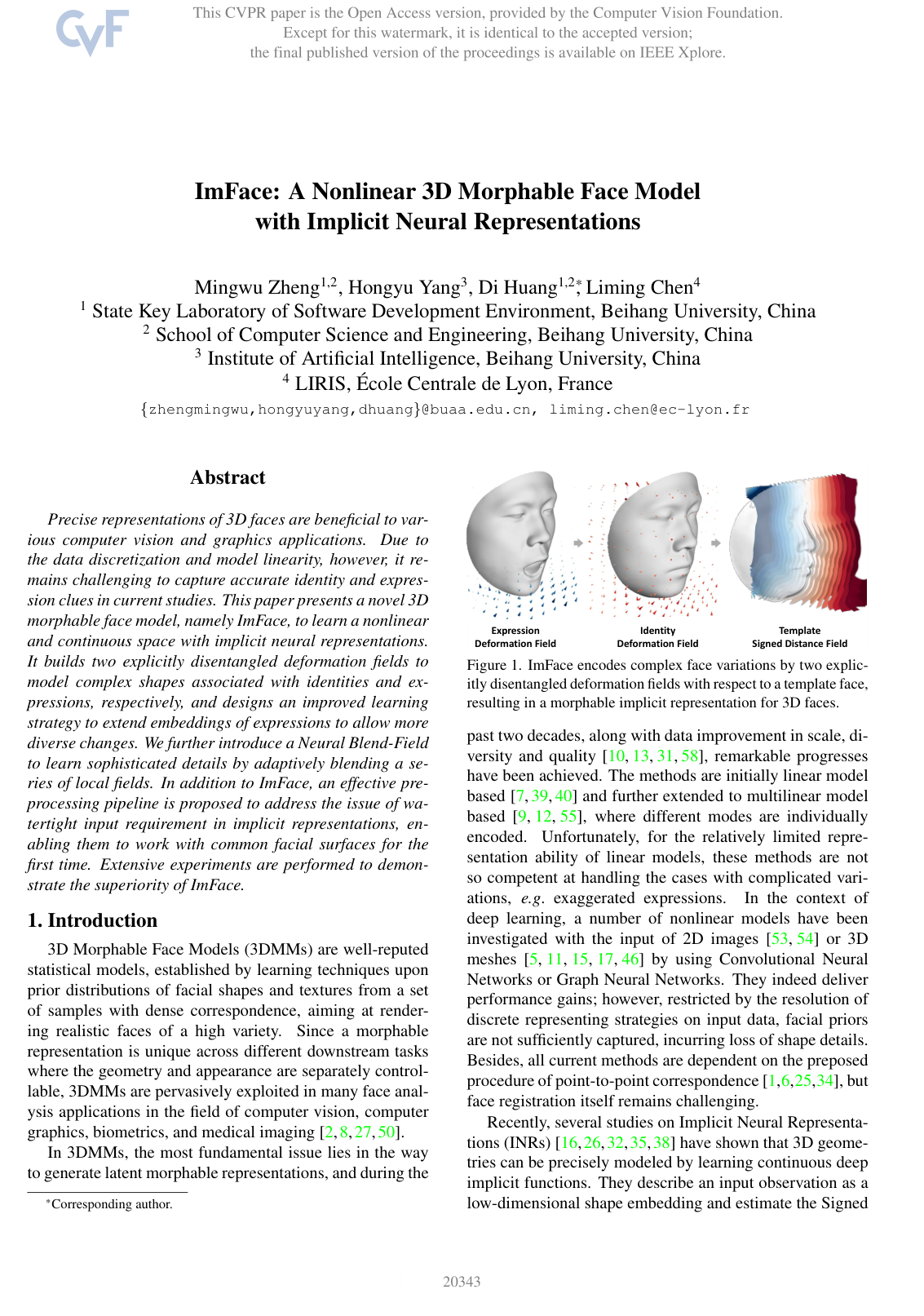
ImFace: A Nonlinear 3D Morphable Face Model with Implicit Neural Representations
Mingwu Zheng, Hongyu Yang, Di Huang, Liming Chen
Why you should read this
Proposes a nonlinear 3D morphable face model based on implicit neural representations that explicitly disentangles identity and expression deformation fields, enabling high-fidelity face reconstruction and synthesis directly from non-watertight surfaces.
Precise representations of 3D faces are beneficial to various computer vision and graphics applications. Due to the data discretization and model linearity, however, it remains challenging to capture accurate identity and expression clues in current studies. This paper presents a novel 3D morphable face model, namely ImFace, to learn a nonlinear and continuous space with implicit neural representations. It builds two explicitly disentangled deformation fields to model complex shapes associated with identities and expressions, respectively, and designs an improved learning strategy to extend embeddings of expressions to allow more diverse changes. We further introduce a Neural Blend-Field to learn sophisticated details by adaptively blending a series of local fields. In addition to ImFace, an effective preprocessing pipeline is proposed to address the issue of watertight input requirement in implicit representations, enabling them to work with common facial surfaces for the first time. Extensive experiments are performed to demonstrate the superiority of ImFace.
Added
2026-09-26
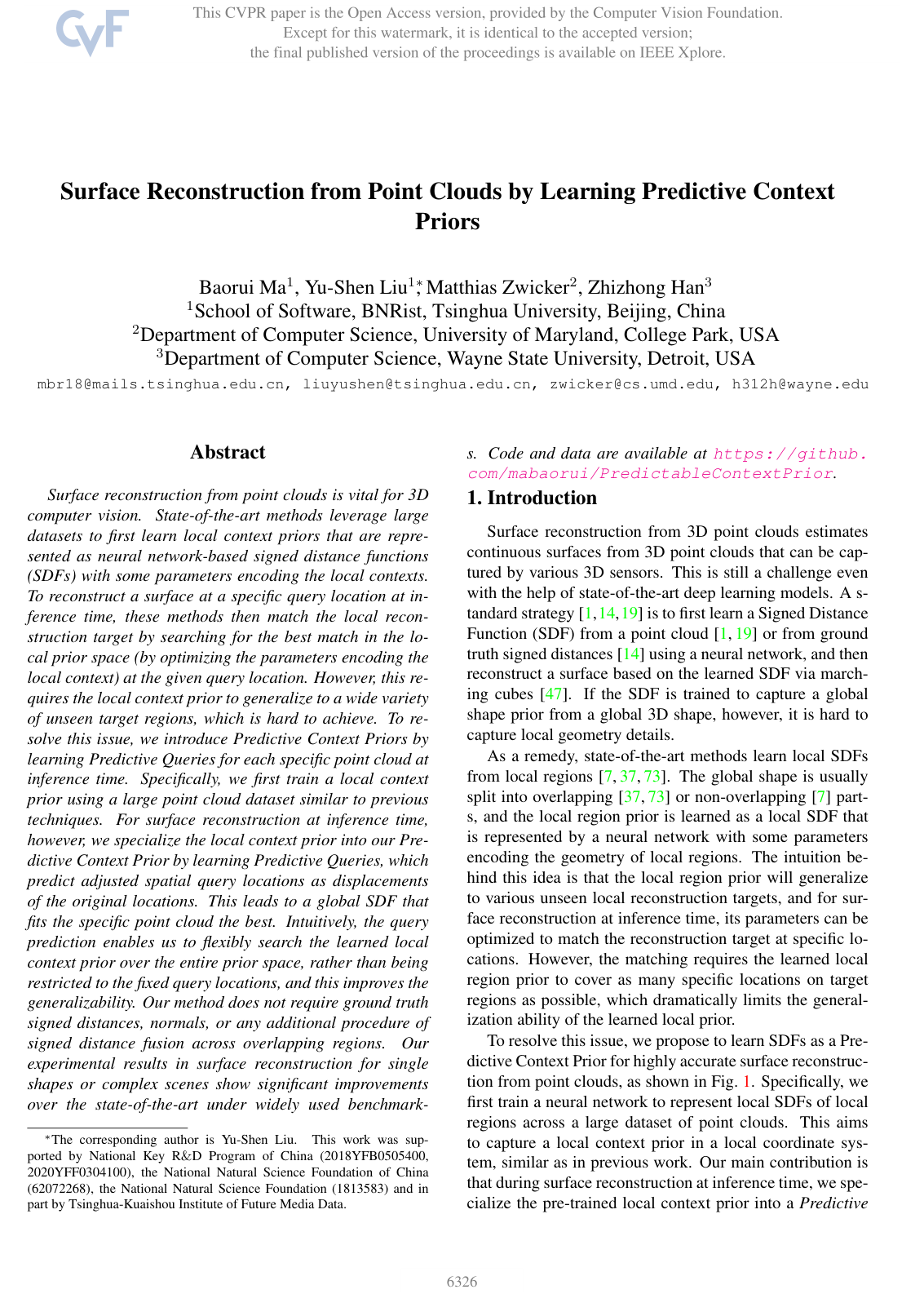
Surface Reconstruction from Point Clouds by Learning Predictive Context Priors
Baorui Ma, Yu-Shen Liu, Matthias Zwicker, Zhizhong Han
Why you should read this
Presents a surface reconstruction framework that learns test-time predictive query displacements to flexibly query pre-trained local signed distance functions, achieving accurate 3D geometry without requiring ground truth normals or distances.
Surface reconstruction from point clouds is vital for 3D computer vision. State-of-the-art methods leverage large datasets to first learn local context priors that are represented as neural network-based signed distance functions (SDFs) with some parameters encoding the local contexts. To reconstruct a surface at a specific query location at inference time, these methods then match the local reconstruction target by searching for the best match in the local prior space (by optimizing the parameters encoding the local context) at the given query location. However, this requires the local context prior to generalize to a wide variety of unseen target regions, which is hard to achieve. To resolve this issue, we introduce Predictive Context Priors by learning Predictive Queries for each specific point cloud at inference time. Specifically, we first train a local context prior using a large point cloud dataset similar to previous techniques. For surface reconstruction at inference time, however, we specialize the local context prior into our Predictive Context Prior by learning Predictive Queries, which predict adjusted spatial query locations as displacements of the original locations. This leads to a global SDF that fits the specific point cloud the best. Intuitively, the query prediction enables us to flexibly search the learned local context prior over the entire prior space, rather than being restricted to the fixed query locations, and this improves the generalizability. Our method does not require ground truth signed distances, normals, or any additional procedure of signed distance fusion across overlapping regions. Our experimental results in surface reconstruction for single shapes or complex scenes show significant improvements over the state-of-the-art under widely used benchmarks. Code and data are available at https://github.com/mabaorui/PredictableContextPrior.
Added
2026-09-26