
keyword
deep convolutional networks
Deep convolutional networks, also known as deep convolutional neural networks or ConvNets, are a class of artificial neural networks characterized by multiple processing layers designed to analyze structured grid data such as images. These architectures utilize learnable convolutional filters that slide across input data to capture local spatial and temporal patterns, followed by non-linear activation functions and pooling or normalization layers that reduce dimensionality and provide invariance to spatial shifts. By cascading many parameterized layers, deep convolutional networks automatically learn hierarchical representations, transitioning from low-level visual features such as edges and textures in early layers to complex, task-specific semantic concepts in deeper layers. They serve as foundational models across computer vision and pattern recognition for applications such as image classification, object detection, semantic segmentation, and super-resolution.
14 items
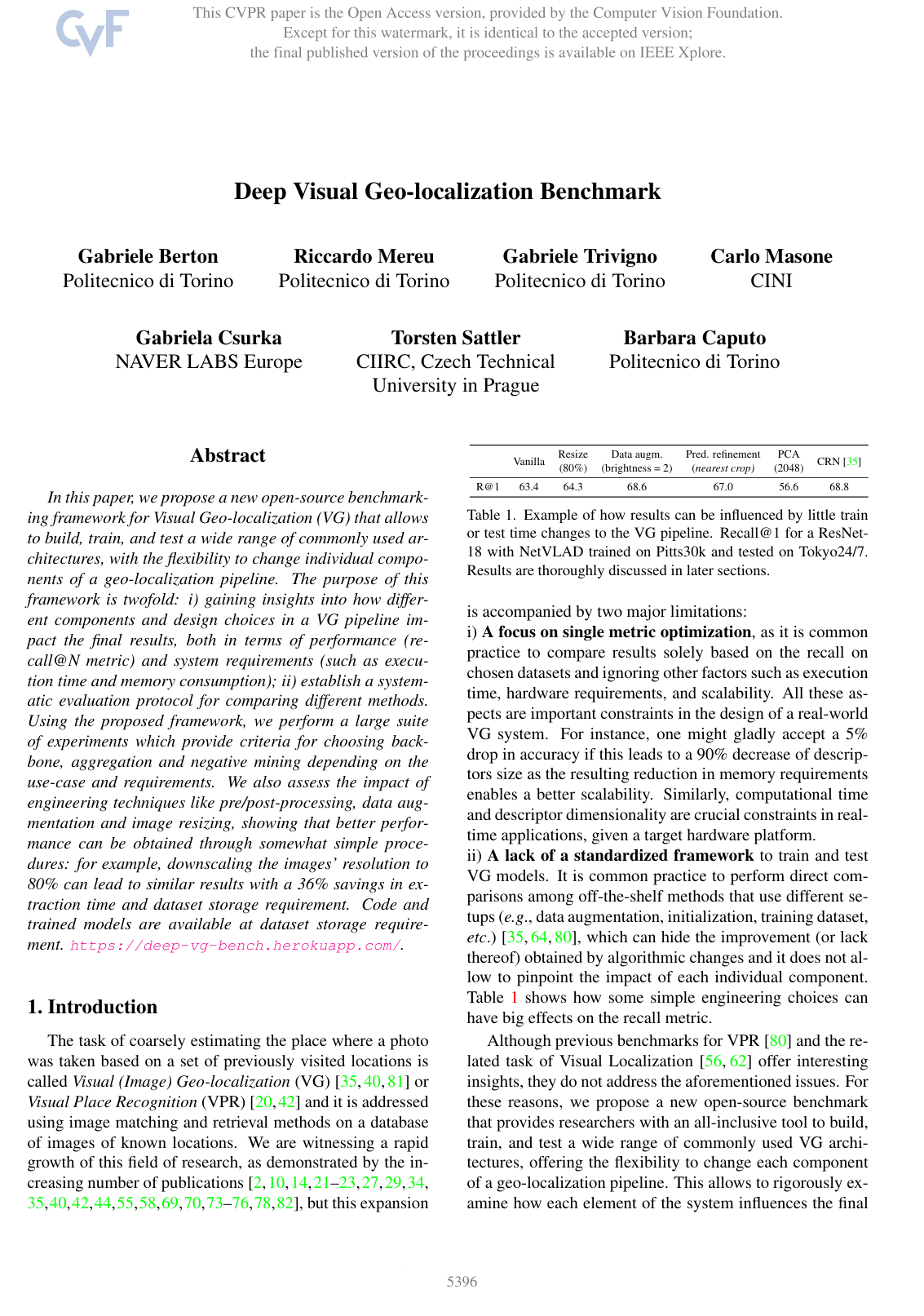
Deep Visual Geo-localization Benchmark
Gabriele Moreno Berton, Riccardo Mereu, Gabriele Trivigno, Carlo Masone, Gabriela Csurka, Torsten Sattler, Barbara Caputo
Why you should read this
Establishes a modular visual geo-localization benchmarking framework and conducts extensive evaluations across pipeline components, offering practical guidelines that balance retrieval accuracy with real-world computational and memory costs.
In this paper, we propose a new open-source benchmark-ing framework for Visual Geo-localization (VG) that allows to build, train, and test a wide range of commonly used ar-chitectures, with the flexibility to change individual compo-nents of a geo-localization pipeline. The purpose of this framework is twofold: i) gaining insights into how differ-ent components and design choices in a VG pipeline im-pact the final results, both in terms of performance (re-call@N metric) and system requirements (such as execu-tion time and memory consumption); ii) establish a system-atic evaluation protocol for comparing different methods. Using the proposed framework, we perform a large suite of experiments which provide criteria for choosing back-bone, aggregation and negative mining depending on the use-case and requirements. We also assess the impact of engineering techniques like pre/post-processing, data aug-mentation and image resizing, showing that better perfor-mance can be obtained through somewhat simple proce-dures: for example, downscaling the images' resolution to 80% can lead to similar results with a 36% savings in ex-traction time and dataset storage requirement. Code and trained models are available at dataset storage require-ment. https://deep-vg-bench.herokuapp.com/.
Added
2026-09-26
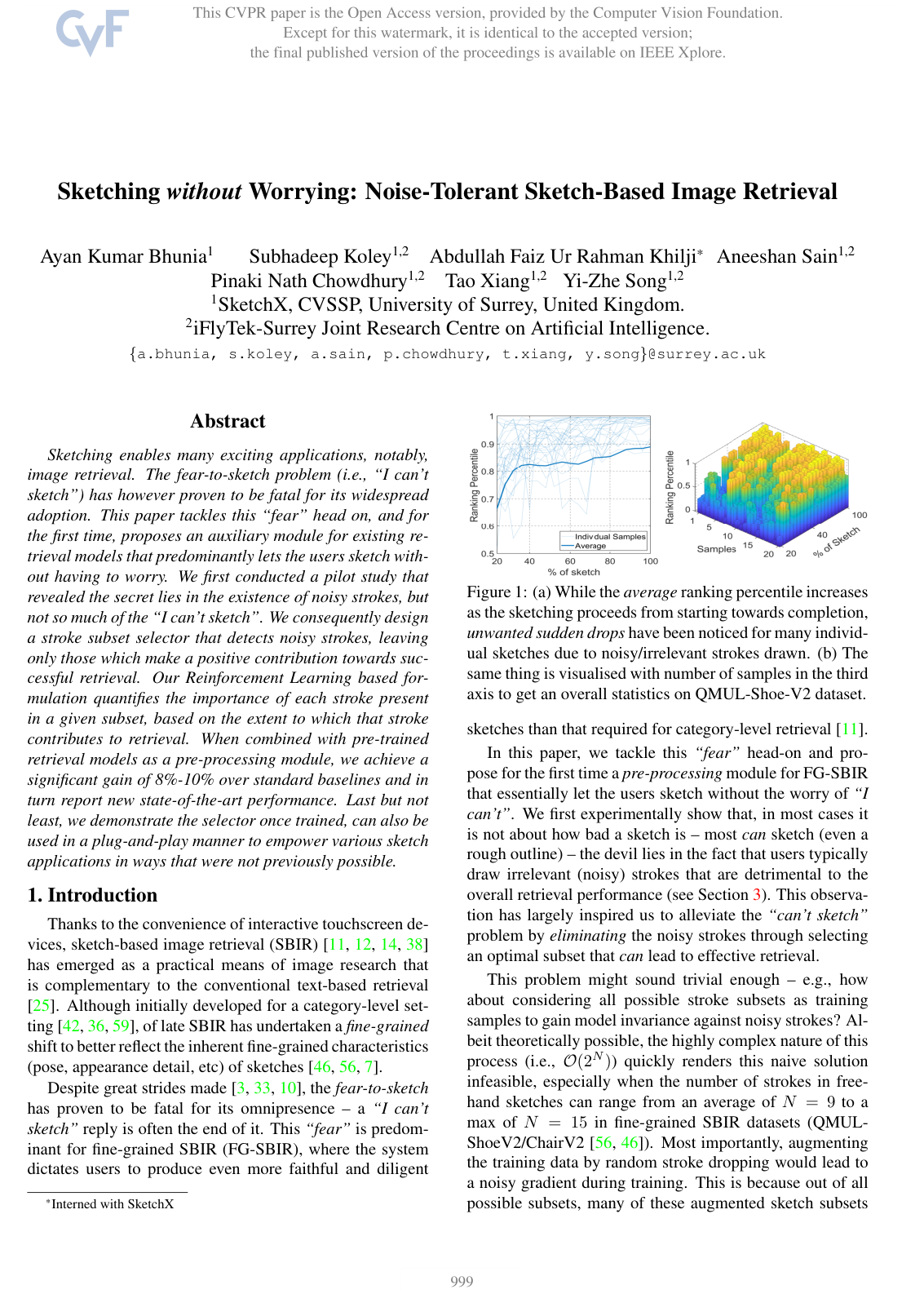
Sketching without Worrying: Noise-Tolerant Sketch-Based Image Retrieval
Ayan Kumar Bhunia, Subhadeep Koley, Abdullah Faiz Ur Rahman Khilji, Aneeshan Sain, Pinaki Nath Chowdhury, Tao Xiang, Yi-Zhe Song
Why you should read this
Proposes a reinforcement learning-based stroke subset selector that filters out noisy or detrimental strokes from amateur drawings to boost fine-grained sketch-based image retrieval accuracy without retraining underlying retrieval models.
Sketching enables many exciting applications, notably, image retrieval. The fear-to-sketch problem (i.e., “I can’t sketch”) has however proven to be fatal for its widespread adoption. This paper tackles this “fear” head on, and for the first time, proposes an auxiliary module for existing retrieval models that predominantly lets the users sketch without having to worry. We first conducted a pilot study that revealed the secret lies in the existence of noisy strokes, but not so much of the “I can’t sketch”. We consequently design a stroke subset selector that detects noisy strokes, leaving only those which make a positive contribution towards successful retrieval. Our Reinforcement Learning based formulation quantifies the importance of each stroke present in a given subset, based on the extent to which that stroke contributes to retrieval. When combined with pre-trained retrieval models as a pre-processing module, we achieve a significant gain of 8%-10% over standard baselines and in turn report new state-of-the-art performance. Last but not least, we demonstrate the selector once trained, can also be used in a plug-and-play manner to empower various sketch applications in ways that were not previously possible.
Added
2026-09-26
Deep Back-Projection Networks for Super-Resolution
Muhammad Haris, Greg Shakhnarovich, Norimichi Ukita
Why you should read this
Proposes Deep Back-Projection Networks, an architecture that uses iterative up- and down-sampling stages with an error-feedback mechanism to capture mutual image dependencies and achieve state-of-the-art super-resolution at large scaling factors.
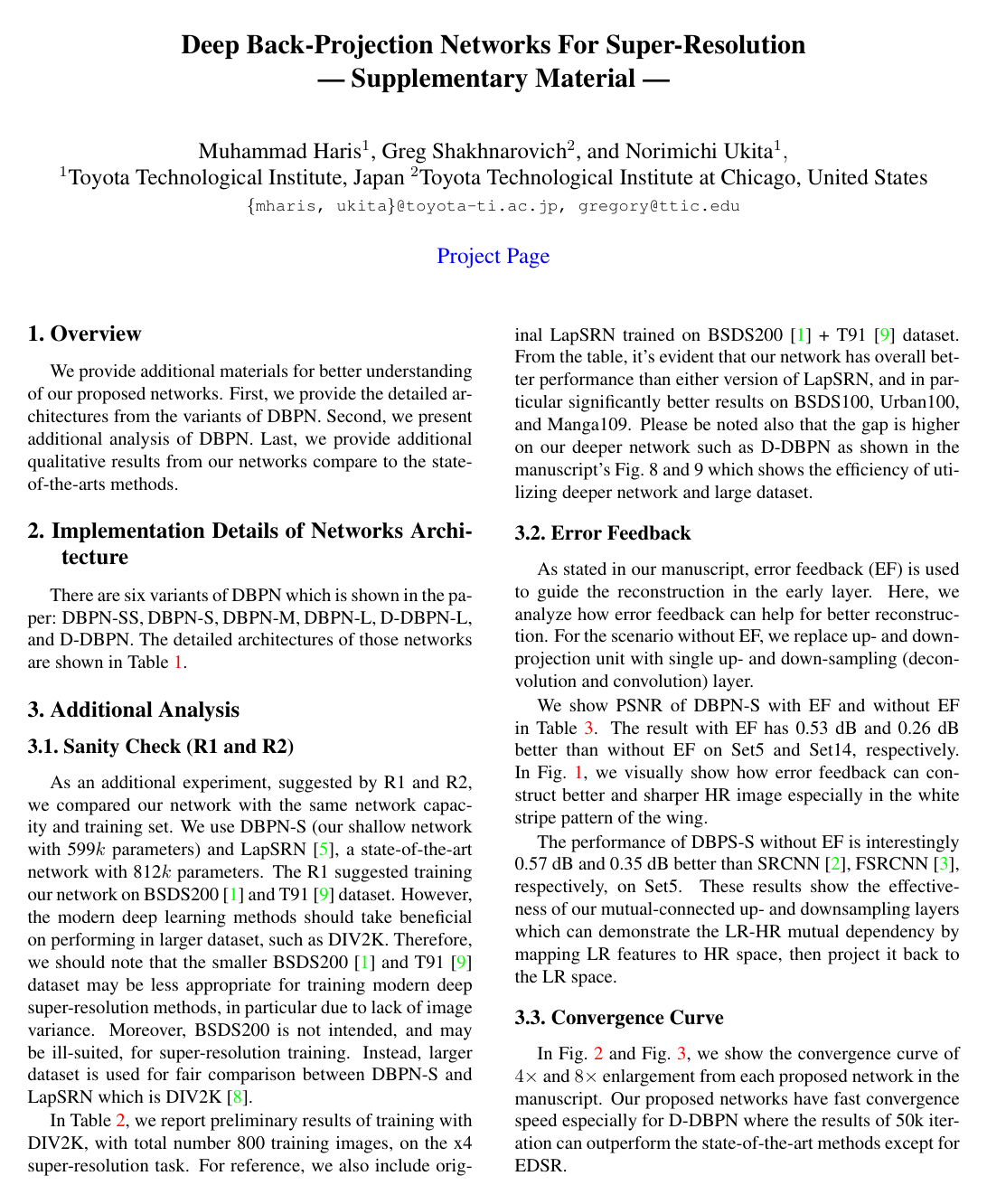
The feed-forward architectures of recently proposed deep super-resolution networks learn representations of low-resolution inputs, and the non-linear mapping from those to high-resolution output. However, this approach does not fully address the mutual dependencies of low- and high-resolution images. We propose Deep Back-Projection Networks (DBPN), that exploit iterative up- and down-sampling layers, providing an error feedback mechanism for projection errors at each stage. We construct mutually-connected up- and down-sampling stages each of which represents different types of image degradation and high-resolution components. We show that extending this idea to allow concatenation of features across up- and down-sampling stages (Dense DBPN) allows us to reconstruct further improve super-resolution, yielding superior results and in particular establishing new state of the art results for large scaling factors such as 8x across multiple data sets.
Added
2026-09-25
Do Better ImageNet Models Transfer Better?
Simon Kornblith, Jonathon Shlens, Quoc V. Le
Why you should read this
Establishes a strong correlation between ImageNet classification accuracy and downstream transfer performance across sixteen neural architectures, while showing that common regularization techniques can unexpectedly degrade learned feature representations.
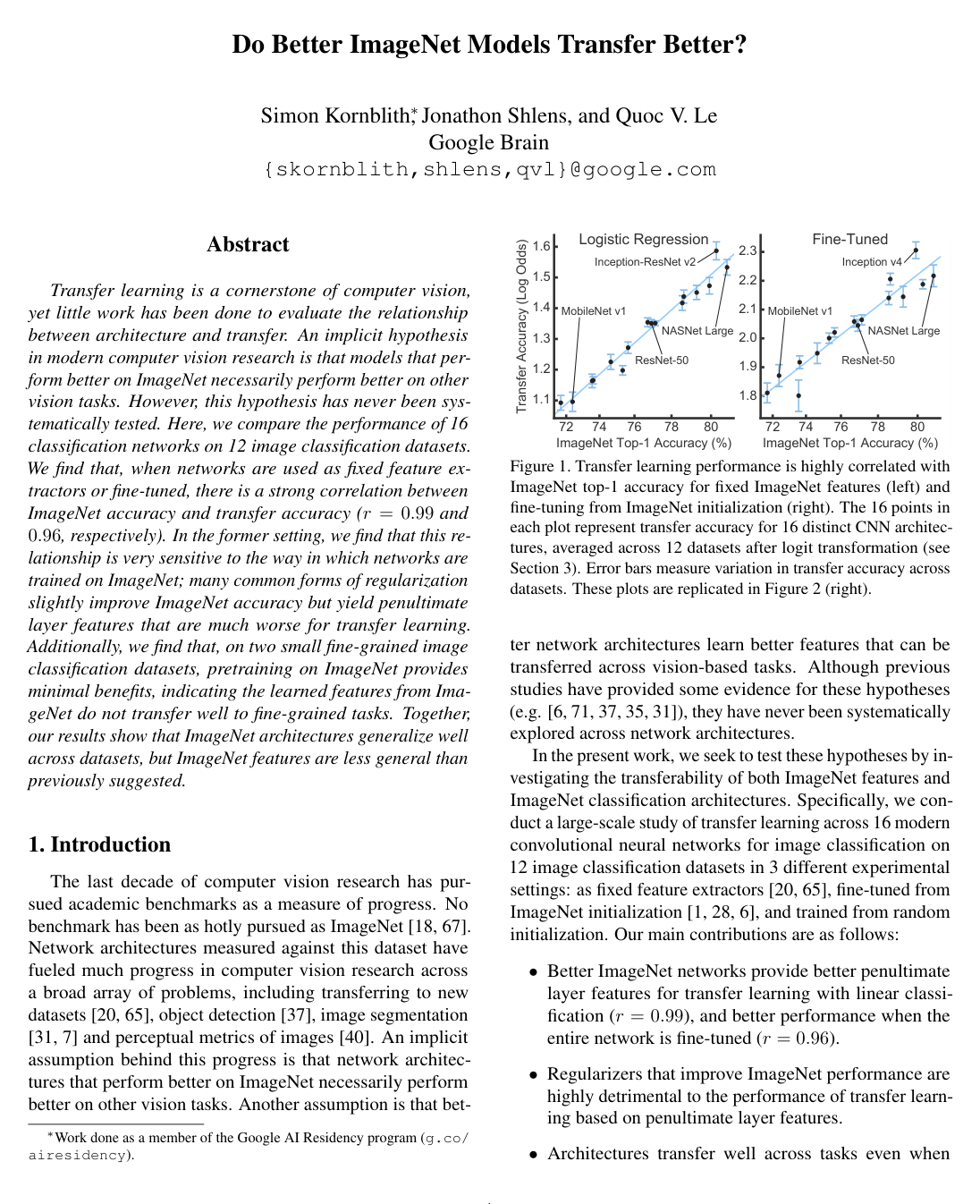
Transfer learning is a cornerstone of computer vision, yet little work has been done to evaluate the relationship between architecture and transfer. An implicit hypothesis in modern computer vision research is that models that perform better on ImageNet necessarily perform better on other vision tasks. However, this hypothesis has never been systematically tested. Here, we compare the performance of 16 classification networks on 12 image classification datasets. We find that, when networks are used as fixed feature extractors or fine-tuned, there is a strong correlation between ImageNet accuracy and transfer accuracy ( and , respectively). In the former setting, we find that this relationship is very sensitive to the way in which networks are trained on ImageNet; many common forms of regularization slightly improve ImageNet accuracy but yield penultimate layer features that are much worse for transfer learning. Additionally, we find that, on two small fine-grained image classification datasets, pretraining on ImageNet provides minimal benefits, indicating the learned features from ImageNet do not transfer well to fine-grained tasks. Together, our results show that ImageNet architectures generalize well across datasets, but ImageNet features are less general than previously suggested.
Added
2026-09-24
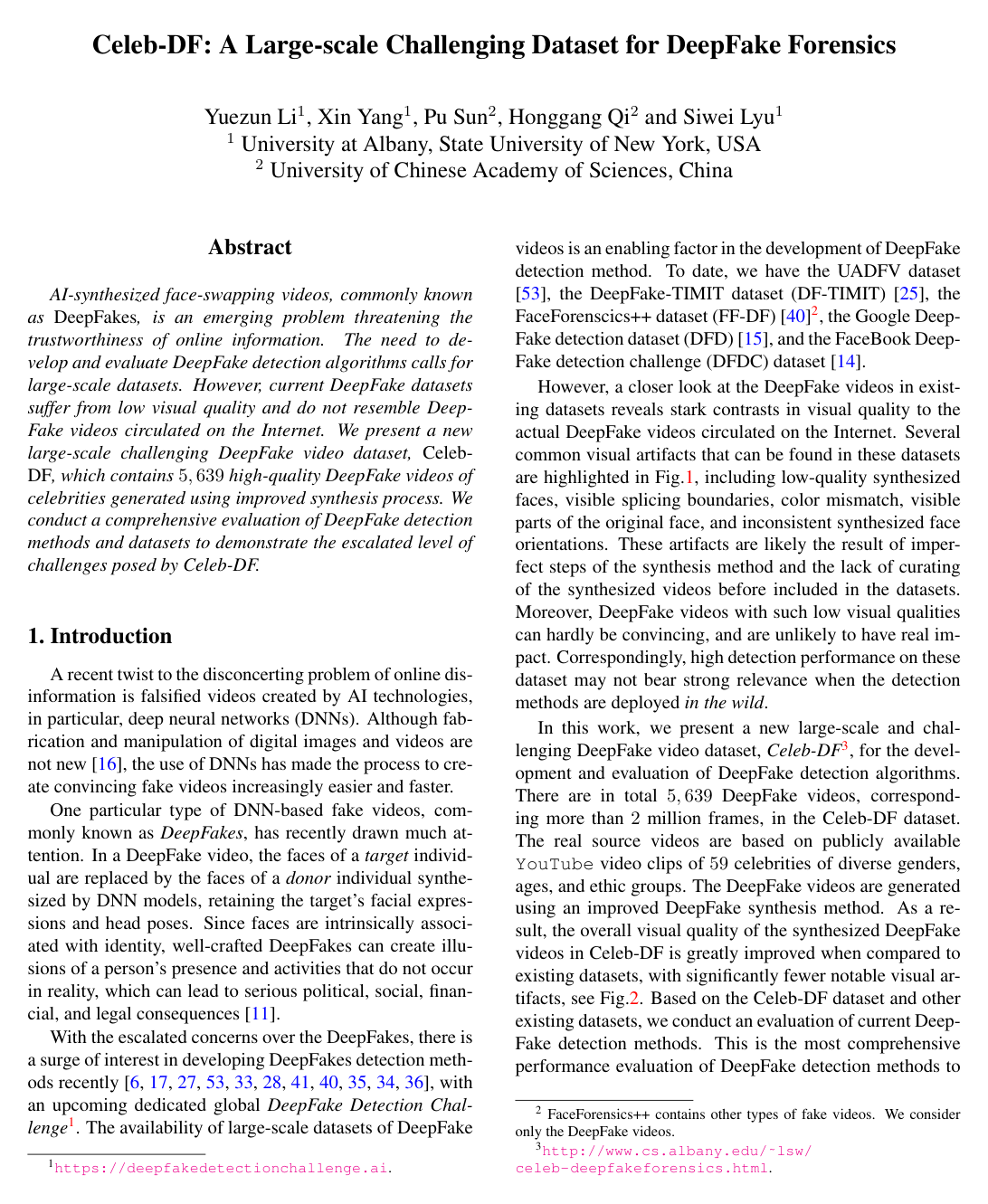
Celeb-DF: A Large-Scale Challenging Dataset for DeepFake Forensics
Yuezun Li, Xin Yang, Pu Sun, Honggang Qi, Siwei Lyu
Why you should read this
Introduces Celeb-DF, a large-scale benchmark of 5,639 high-quality celebrity face-swap videos that addresses visual defects in earlier datasets and exposes the vulnerability of existing forensic models to realistic synthetic media.
AI-synthesized face-swapping videos, commonly known as DeepFakes, is an emerging problem threatening the trustworthiness of online information. The need to develop and evaluate DeepFake detection algorithms calls for large-scale datasets. However, current DeepFake datasets suffer from low visual quality and do not resemble DeepFake videos circulated on the Internet. We present a new large-scale challenging DeepFake video dataset, Celeb-DF, which contains 5,639 high-quality DeepFake videos of celebrities generated using improved synthesis process. We conduct a comprehensive evaluation of DeepFake detection methods and datasets to demonstrate the escalated level of challenges posed by Celeb-DF.
Added
2026-09-18
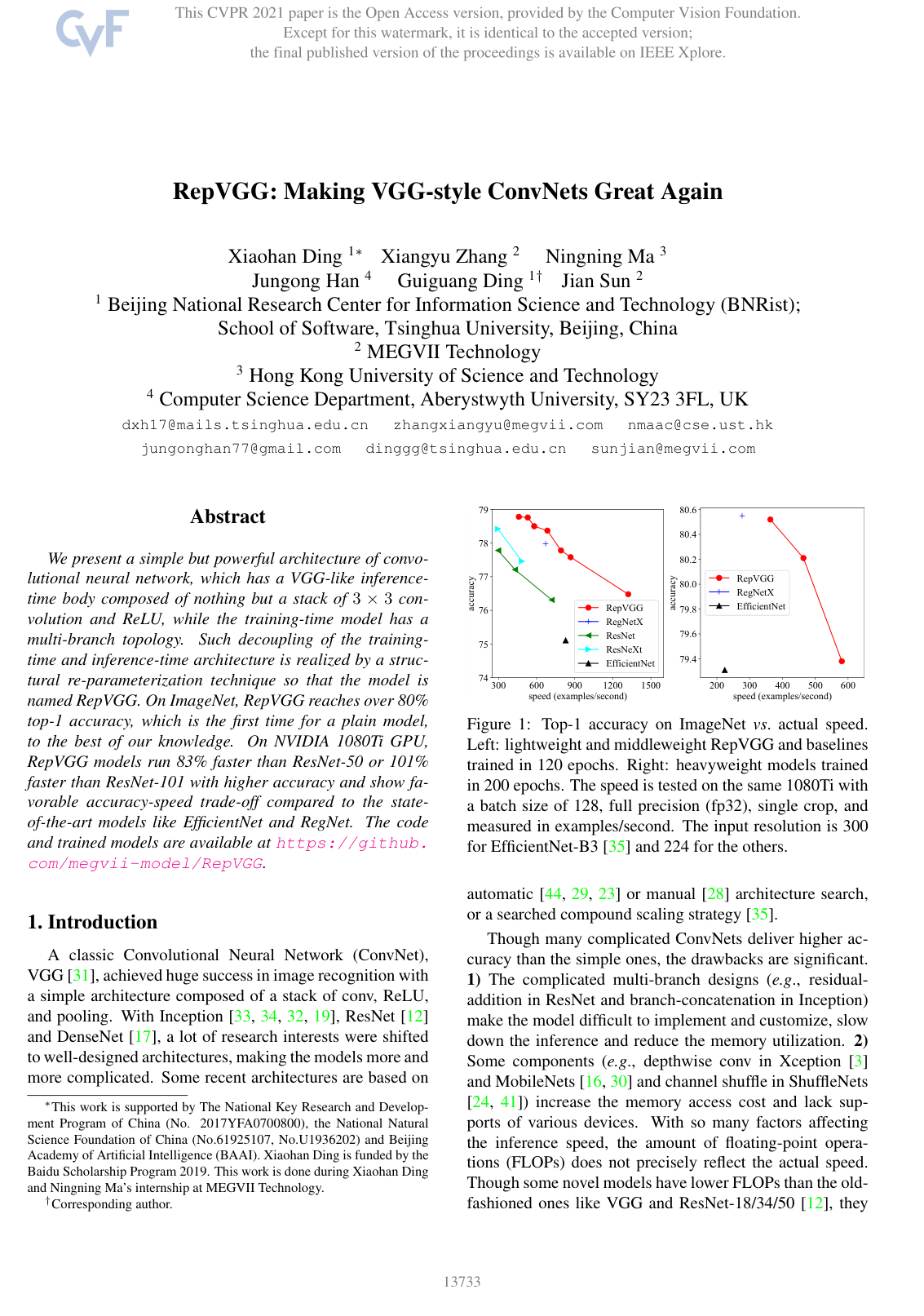
RepVGG: Making VGG-style ConvNets Great Again
Xiaohan Ding, Xiangyu Zhang, Ningning Ma, Jungong Han, Guiguang Ding, Jian Sun
Why you should read this
Proposes a structural re-parameterization technique that trains a multi-branch network and converts it into a simple, high-speed 3x3 convolutional backbone for inference, achieving over 80% ImageNet accuracy while running significantly faster than ResNet architectures.
We present a simple but powerful architecture of convolutional neural network, which has a VGG-like inference-time body composed of nothing but a stack of 3x3 convolution and ReLU, while the training-time model has a multi-branch topology. Such decoupling of the training-time and inference-time architecture is realized by a structural re-parameterization technique so that the model is named RepVGG. On ImageNet, RepVGG reaches over 80% top-1 accuracy, which is the first time for a plain model, to the best of our knowledge. On NVIDIA 1080Ti GPU, RepVGG models run 83% faster than ResNet-50 or 101% faster than ResNet-101 with higher accuracy and show favorable accuracy-speed trade-off compared to the state-of-the-art models like EfficientNet and RegNet. The code and trained models are available at this https URL.
Added
2026-09-14
Deep Learning for Medical Image Analysis
Mina Rezaei, Haojin Yang, Christoph Meinel
Why you should read this
Proposes end-to-end deep learning methods for automated brain abnormality detection, recognition, and segmentation to advance clinical neuroimaging analysis.
This report describes my research activities in the Hasso Plattner Institute and summarizes my Ph.D. plan and several novels, end-to-end trainable approaches for analyzing medical images using deep learning algorithm. In this report, as an example, we explore different novel methods based on deep learning for brain abnormality detection, recognition, and segmentation. This report prepared for the doctoral consortium in the AIME-2017 conference.
Added
2026-09-14
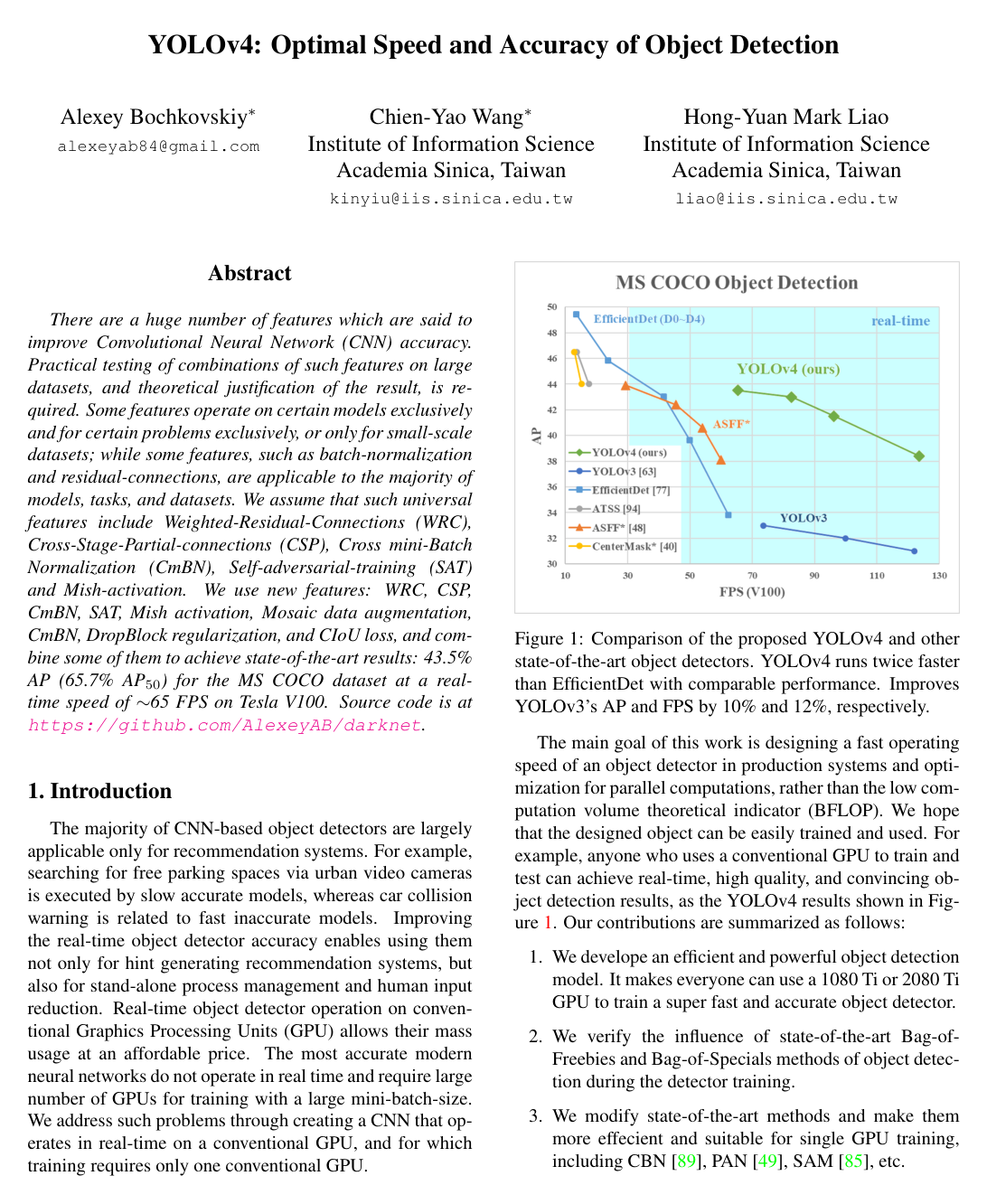
YOLOv4: Optimal Speed and Accuracy of Object Detection
Alexey Bochkovskiy, Chien-Yao Wang, Hong-Yuan Mark Liao
Why you should read this
Introduces YOLOv4, a real-time object detection framework that systematically combines modern architectural and training innovations to achieve state-of-the-art accuracy at 65 frames per second on a single GPU.
There are a huge number of features which are said to improve Convolutional Neural Network (CNN) accuracy. Practical testing of combinations of such features on large datasets, and theoretical justification of the result, is required. Some features operate on certain models exclusively and for certain problems exclusively, or only for small-scale datasets; while some features, such as batch-normalization and residual-connections, are applicable to the majority of models, tasks, and datasets. We assume that such universal features include Weighted-Residual-Connections (WRC), Cross-Stage-Partial-connections (CSP), Cross mini-Batch Normalization (CmBN), Self-adversarial-training (SAT) and Mish-activation. We use new features: WRC, CSP, CmBN, SAT, Mish activation, Mosaic data augmentation, CmBN, DropBlock regularization, and CIoU loss, and combine some of them to achieve state-of-the-art results: 43.5% AP (65.7% AP50) for the MS COCO dataset at a realtime speed of ~65 FPS on Tesla V100. Source code is at this https URL
Added
2026-09-13
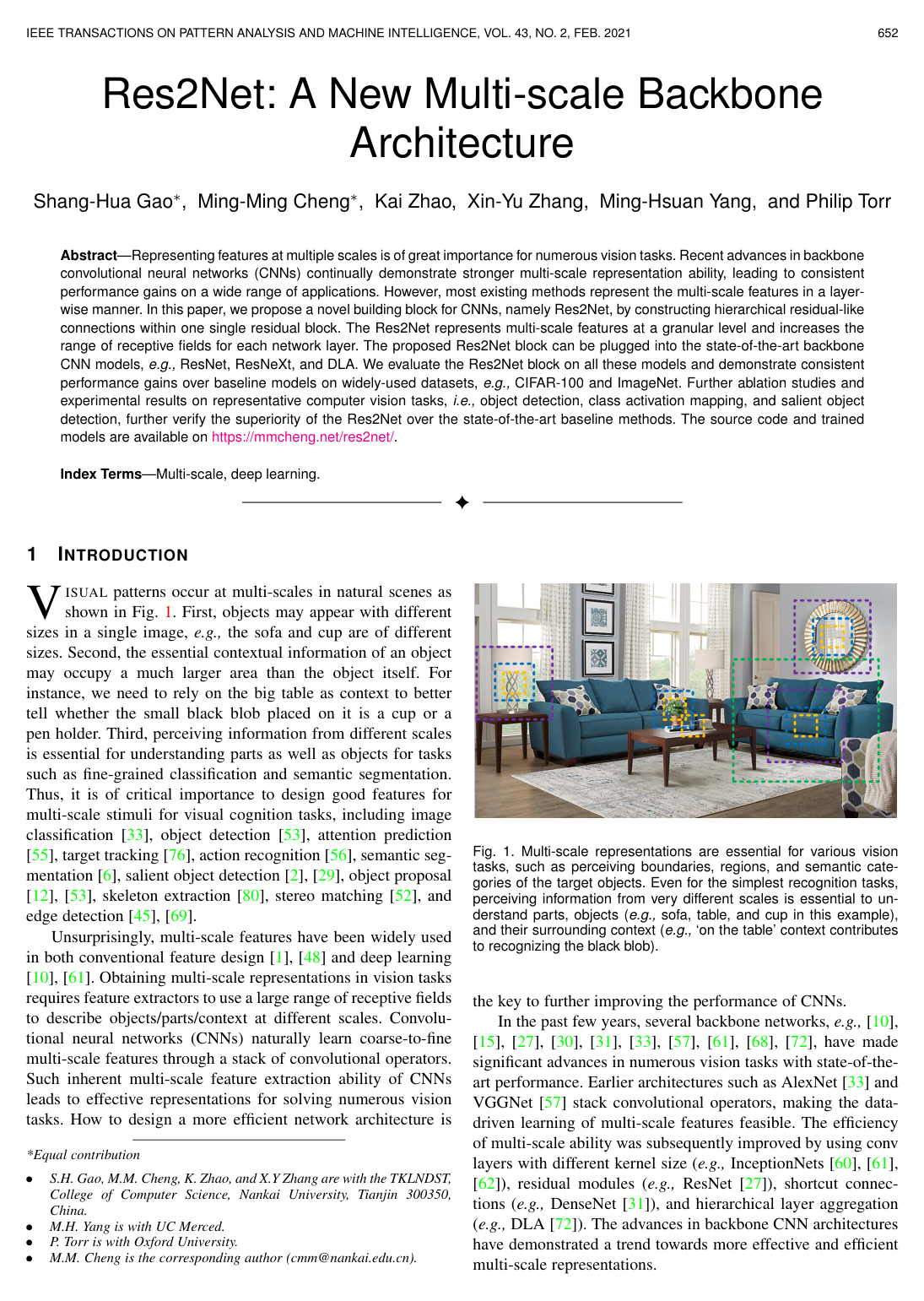
Res2Net: A New Multi-Scale Backbone Architecture
Shanghua Gao, Ming-Ming Cheng, Kai Zhao, Xinyu Zhang, Ming-Hsuan Yang, Philip H. S. Torr
Why you should read this
Introduces Res2Net, a plug-and-play convolutional block with internal hierarchical residual connections that captures granular multi-scale features and improves backbone network performance across image classification, object detection, and salient object detection.
Representing features at multiple scales is of great importance for numerous vision tasks. Recent advances in backbone convolutional neural networks (CNNs) continually demonstrate stronger multi-scale representation ability, leading to consistent performance gains on a wide range of applications. However, most existing methods represent the multi-scale features in a layer-wise manner. In this paper, we propose a novel building block for CNNs, namely Res2Net, by constructing hierarchical residual-like connections within one single residual block. The Res2Net represents multi-scale features at a granular level and increases the range of receptive fields for each network layer. The proposed Res2Net block can be plugged into the state-of-the-art backbone CNN models, e.g., ResNet, ResNeXt, and DLA. We evaluate the Res2Net block on all these models and demonstrate consistent performance gains over baseline models on widely-used datasets, e.g., CIFAR-100 and ImageNet. Further ablation studies and experimental results on representative computer vision tasks, i.e., object detection, class activation mapping, and salient object detection, further verify the superiority of the Res2Net over the state-of-the-art baseline methods. The source code and trained models are available on this https URL.
Added
2026-09-12
Grad-CAM++: Improved Visual Explanations for Deep Convolutional Networks
Aditya Chattopadhyay, Anirban Sarkar, Prantik Howlader, Vineeth N Balasubramanian
Why you should read this
Introduces Grad-CAM++, a generalized visual explanation method that improves CNN interpretability by weighting positive partial derivatives to deliver precise object localization and accurately distinguish multiple instances of the same class.
Over the last decade, Convolutional Neural Network (CNN) models have been highly successful in solving complex vision problems. However, these deep models are perceived as "black box" methods considering the lack of understanding of their internal functioning. There has been a significant recent interest in developing explainable deep learning models, and this paper is an effort in this direction. Building on a recently proposed method called Grad-CAM, we propose a generalized method called Grad-CAM++ that can provide better visual explanations of CNN model predictions, in terms of better object localization as well as explaining occurrences of multiple object instances in a single image, when compared to state-of-the-art. We provide a mathematical derivation for the proposed method, which uses a weighted combination of the positive partial derivatives of the last convolutional layer feature maps with respect to a specific class score as weights to generate a visual explanation for the corresponding class label. Our extensive experiments and evaluations, both subjective and objective, on standard datasets showed that Grad-CAM++ provides promising human-interpretable visual explanations for a given CNN architecture across multiple tasks including classification, image caption generation and 3D action recognition; as well as in new settings such as knowledge distillation.
Added
2026-09-11
Accurate Image Super-Resolution Using Very Deep Convolutional Networks
Jiwon Kim, Jung Kwon Lee, Kyoung Mu Lee
Why you should read this
Proposes a 20-layer convolutional architecture for single-image super-resolution that incorporates residual learning and adaptive gradient clipping to accelerate training and achieve superior reconstruction accuracy over shallow models.
We present a highly accurate single-image super-resolution (SR) method. Our method uses a very deep convolutional network inspired by VGG-net used for ImageNet classification \cite{simonyan2015very}. We find increasing our network depth shows a significant improvement in accuracy. Our final model uses 20 weight layers. By cascading small filters many times in a deep network structure, contextual information over large image regions is exploited in an efficient way. With very deep networks, however, convergence speed becomes a critical issue during training. We propose a simple yet effective training procedure. We learn residuals only and use extremely high learning rates ( times higher than SRCNN \cite{dong2015image}) enabled by adjustable gradient clipping. Our proposed method performs better than existing methods in accuracy and visual improvements in our results are easily noticeable.
Added
2026-09-09
Image Super-Resolution Using Deep Convolutional Networks
Chao Dong, Chen Change Loy, Kaiming He, Xiaoou Tang
Why you should read this
Proposes an end-to-end deep convolutional neural network for single-image super-resolution that unifies classical sparse-coding methods into a joint optimization framework to achieve fast, high-quality image reconstruction.
We propose a deep learning method for single image super-resolution (SR). Our method directly learns an end-to-end mapping between the low/high-resolution images. The mapping is represented as a deep convolutional neural network (CNN) that takes the low-resolution image as the input and outputs the high-resolution one. We further show that traditional sparse-coding-based SR methods can also be viewed as a deep convolutional network. But unlike traditional methods that handle each component separately, our method jointly optimizes all layers. Our deep CNN has a lightweight structure, yet demonstrates state-of-the-art restoration quality, and achieves fast speed for practical on-line usage. We explore different network structures and parameter settings to achieve trade-offs between performance and speed. Moreover, we extend our network to cope with three color channels simultaneously, and show better overall reconstruction quality.
Added
2026-09-07
Spatial Pyramid Pooling in Deep Convolutional Networks for Visual Recognition
Kaiming He, Xiangyu Zhang, Shaoqing Ren, Jian Sun
Why you should read this
Introduces spatial pyramid pooling to eliminate fixed-size input constraints in convolutional neural networks, enabling arbitrary-scale image classification and speeding up object detection by up to a hundredfold over R-CNN.
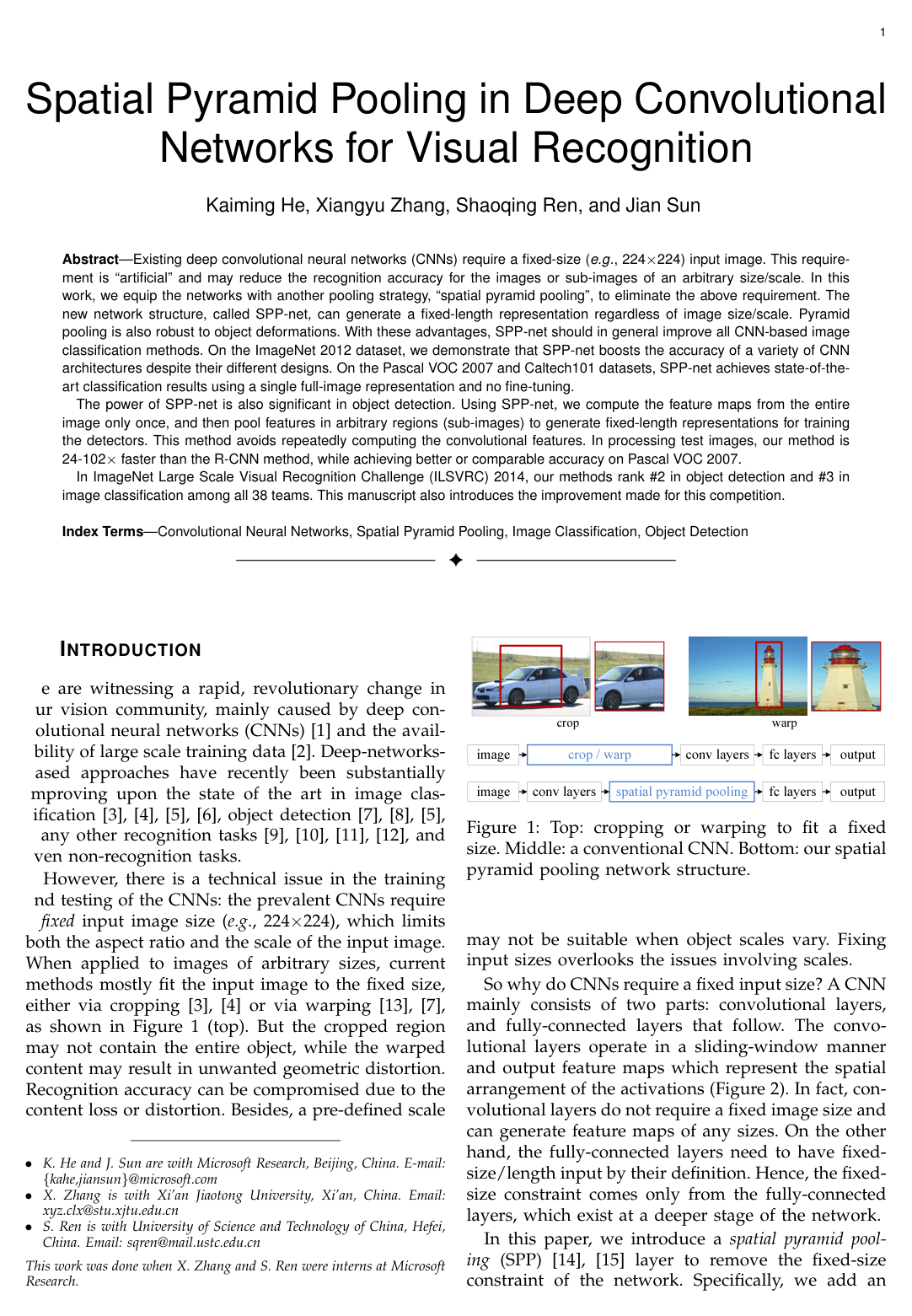
Existing deep convolutional neural networks (CNNs) require a fixed-size (e.g., 224x224) input image. This requirement is "artificial" and may reduce the recognition accuracy for the images or sub-images of an arbitrary size/scale. In this work, we equip the networks with another pooling strategy, "spatial pyramid pooling", to eliminate the above requirement. The new network structure, called SPP-net, can generate a fixed-length representation regardless of image size/scale. Pyramid pooling is also robust to object deformations. With these advantages, SPP-net should in general improve all CNN-based image classification methods. On the ImageNet 2012 dataset, we demonstrate that SPP-net boosts the accuracy of a variety of CNN architectures despite their different designs. On the Pascal VOC 2007 and Caltech101 datasets, SPP-net achieves state-of-the-art classification results using a single full-image representation and no fine-tuning. The power of SPP-net is also significant in object detection. Using SPP-net, we compute the feature maps from the entire image only once, and then pool features in arbitrary regions (sub-images) to generate fixed-length representations for training the detectors. This method avoids repeatedly computing the convolutional features. In processing test images, our method is 24-102x faster than the R-CNN method, while achieving better or comparable accuracy on Pascal VOC 2007. In ImageNet Large Scale Visual Recognition Challenge (ILSVRC) 2014, our methods rank #2 in object detection and #3 in image classification among all 38 teams. This manuscript also introduces the improvement made for this competition.
Added
2026-09-06
Very Deep Convolutional Networks for Large-Scale Image Recognition
Karen Simonyan, Andrew Zisserman
Why you should read this
Demonstrates that systematically increasing neural network depth using small 3×3 filters achieves state-of-the-art image recognition performance, establishing a simple yet powerful design principle that became foundational for modern deep learning architectures.
Abstract:In this work we investigate the effect of the convolutional network depth on its accuracy in the large-scale image recognition setting. Our main contribution is a thorough evaluation of networks of increasing depth using an architecture with very small (3x3) convolution filters, which shows that a significant improvement on the prior-art configurations can be achieved by pushing the depth to 16-19 weight layers. These findings were the basis of our ImageNet Challenge 2014 submission, where our team secured the first and the second places in the localisation and classification tracks respectively. We also show that our representations generalise well to other datasets, where they achieve state-of-the-art results. We have made our two best-performing ConvNet models publicly available to facilitate further research on the use of deep visual representations in computer vision.
Added
2026-05-27
License
Published with permission