
keyword
cross-modal alignment
Cross-modal alignment is a machine learning process that identifies correspondences between different data modalities, such as text, images, video, audio, or three-dimensional point clouds, and maps their distinct representations into a shared semantic space. Because each modality possesses unique underlying structures and feature distributions, this technique bridges the modality gap by synchronizing semantically related elements so that equivalent concepts occupy proximate positions in a unified embedding space. It can be performed at global or fine-grained local levels, enabling models to associate textual descriptions with specific visual cues, objects, or sensory signals. Consequently, cross-modal alignment serves as a foundational component for multimodal artificial intelligence, facilitating tasks such as cross-modal retrieval, zero-shot classification, multimodal reasoning, and knowledge transfer across disparate data types.
5 items
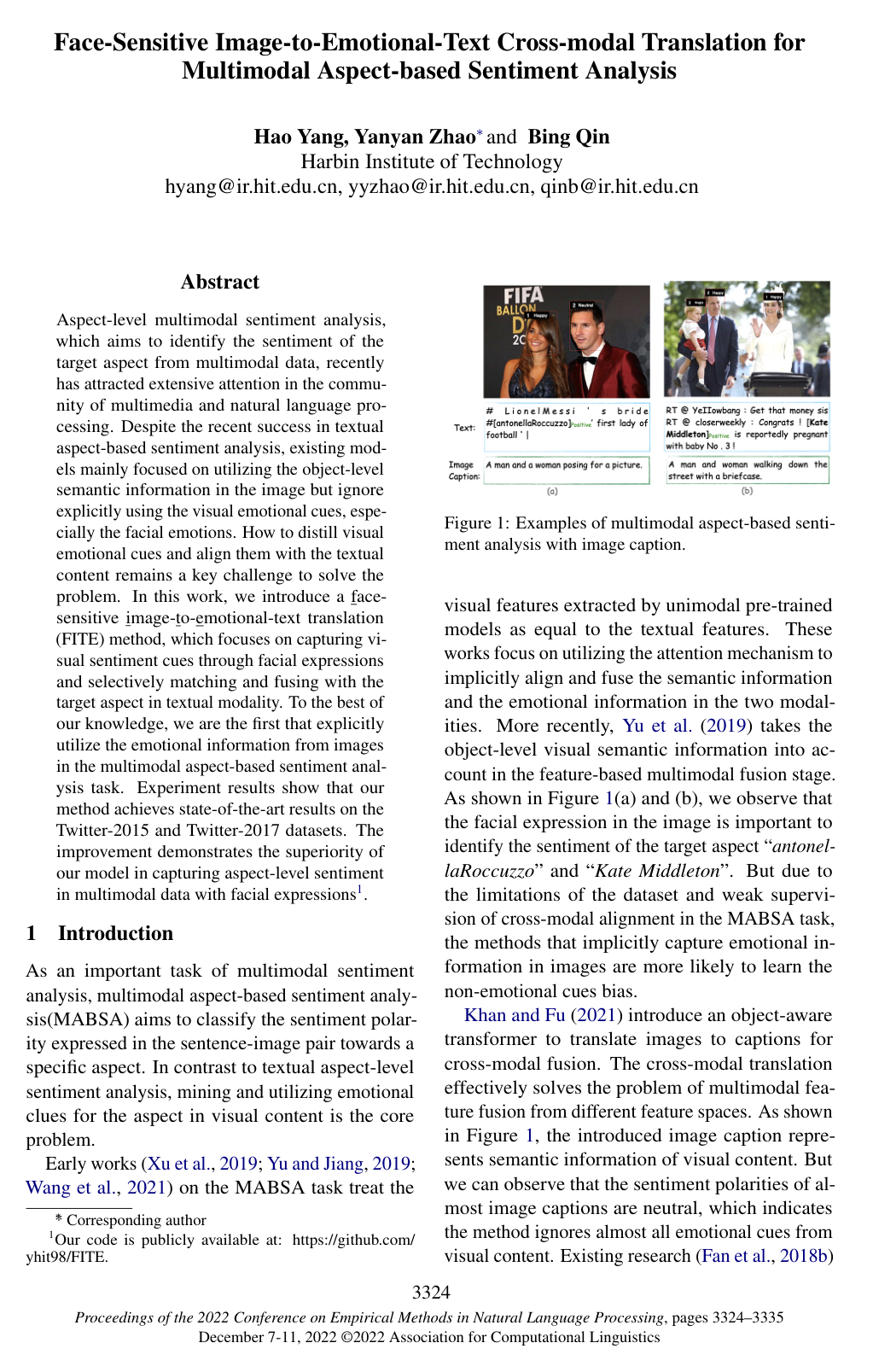
Face-Sensitive Image-to-Emotional-Text Cross-modal Translation for Multimodal Aspect-based Sentiment Analysis
Hao Yang, Yanyan Zhao, Bing Qin
Why you should read this
Proposes a face-sensitive cross-modal translation framework that extracts and textualizes visual facial emotions to align them with specific target aspects, setting state-of-the-art results in multimodal aspect-based sentiment analysis on Twitter benchmarks.
Aspect-level multimodal sentiment analysis, which aims to identify the sentiment of the target aspect from multimodal data, recently has attracted extensive attention in the community of multimedia and natural language processing. Despite the recent success in textual aspect-based sentiment analysis, existing models mainly focused on utilizing the object-level semantic information in the image but ignore explicitly using the visual emotional cues, especially the facial emotions. How to distill visual emotional cues and align them with the textual content remains a key challenge to solve the problem. In this work, we introduce a face-sensitive image-to-emotional-text translation (FITE) method, which focuses on capturing visual sentiment cues through facial expressions and selectively matching and fusing with the target aspect in textual modality. To the best of our knowledge, we are the first that explicitly utilize the emotional information from images in the multimodal aspect-based sentiment analysis task. Experiment results show that our method achieves state-of-the-art results on the Twitter-2015 and Twitter-2017 datasets. The improvement demonstrates the superiority of our model in capturing aspect-level sentiment in multimodal data with facial expressions^1.
Added
2026-10-03
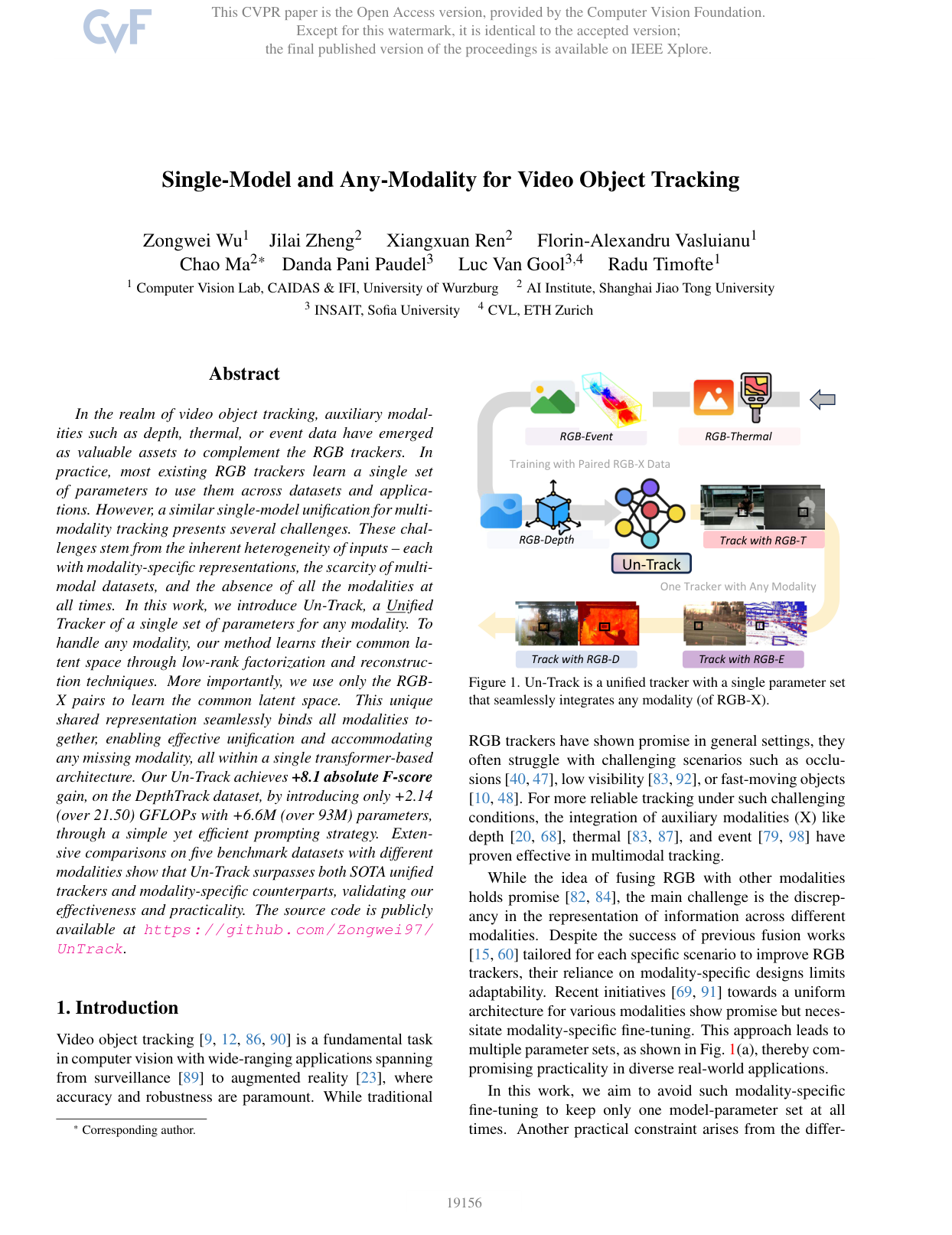
Single-Model and Any-Modality for Video Object Tracking
Zongwei Wu, Jilai Zheng, Xiangxuan Ren, Florin-Alexandru Vasluianu, Chao Ma, Danda Pani Paudel, Luc Van Gool, Radu Timofte
Why you should read this
Presents Un-Track, a unified transformer framework that tracks objects across diverse auxiliary modalities like depth, thermal, and event data using a single parameter set by learning a shared low-rank embedding from paired RGB-X inputs with minimal computational overhead.
In the realm of video object tracking, auxiliary modalities such as depth, thermal, or event data have emerged as valuable assets to complement the RGB trackers. In practice, most existing RGB trackers learn a single set of parameters to use them across datasets and applications. However, a similar single-model unification for multi-modality tracking presents several challenges. These challenges stem from the inherent heterogeneity of inputs – each with modality-specific representations, the scarcity of multi-modal datasets, and the absence of all the modalities at all times. In this work, we introduce Un-Track, a Unified Tracker of a single set of parameters for any modality. To handle any modality, our method learns their common latent space through low-rank factorization and reconstruction techniques. More importantly, we use only the RGB-X pairs to learn the common latent space. This unique shared representation seamlessly binds all modalities together, enabling effective unification and accommodating any missing modality, all within a single transformer-based architecture. Our Un-Track achieves +8.1 absolute F-score gain, on the DepthTrack dataset, by introducing only +2.14 (over 21.50) GFLOPs with +6.6M (over 93M) parameters, through a simple yet efficient prompting strategy. Extensive comparisons on five benchmark datasets with different modalities show that Un-Track surpasses both SOTA unified trackers and modality-specific counterparts, validating our effectiveness and practicality. The source code is publicly available at https://github.com/Zongwei97/UnTrack.
Added
2026-09-26
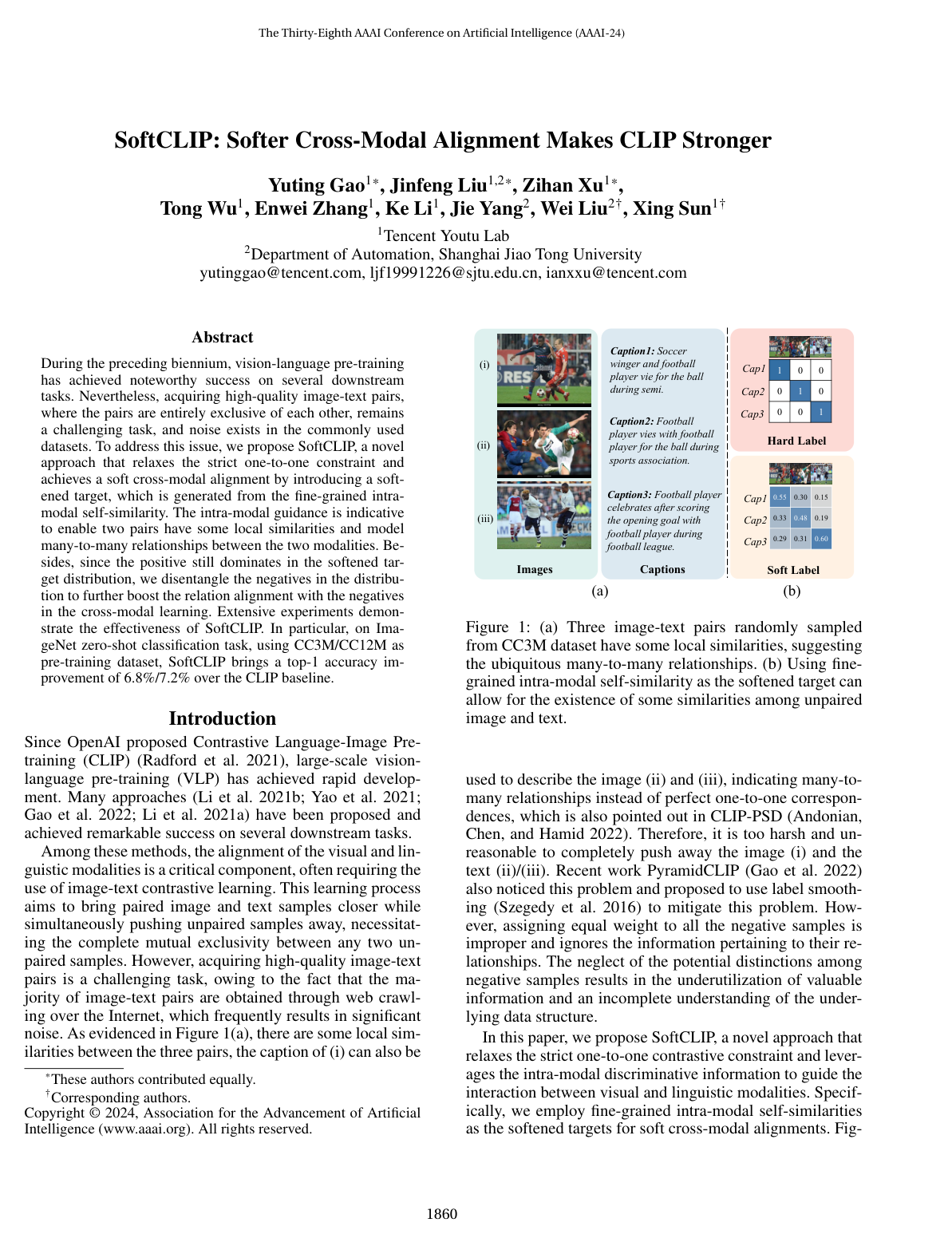
SoftCLIP: Softer Cross-Modal Alignment Makes CLIP Stronger
Yuting Gao, Jinfeng Liu, Zihan Xu, Tong Wu, Enwei Zhang, Ke Li, Jie Yang, Wei Liu, Xing Sun
Why you should read this
Proposes a relaxed contrastive learning framework that uses fine-grained intra-modal self-similarity and negative-pair disentanglement as soft alignment targets, significantly improving CLIP's zero-shot classification performance on noisy web-scale image-text datasets.
During the preceding biennium, vision-language pre-training has achieved noteworthy success on several downstream tasks. Nevertheless, acquiring high-quality image-text pairs, where the pairs are entirely exclusive of each other, remains a challenging task, and noise exists in the commonly used datasets. To address this issue, we propose SoftCLIP, a novel approach that relaxes the strict one-to-one constraint and achieves a soft cross-modal alignment by introducing a softened target, which is generated from the fine-grained intra-modal self-similarity. The intra-modal guidance is indicative to enable two pairs have some local similarities and model many-to-many relationships between the two modalities. Besides, since the positive still dominates in the softened target distribution, we disentangle the negatives in the distribution to further boost the relation alignment with the negatives in the cross-modal learning. Extensive experiments demonstrate the effectiveness of SoftCLIP. In particular, on ImageNet zero-shot classification task, using CC3M/CC12M as pre-training dataset, SoftCLIP brings a top-1 accuracy improvement of 6.8%/7.2% over the CLIP baseline.
Added
2026-09-26
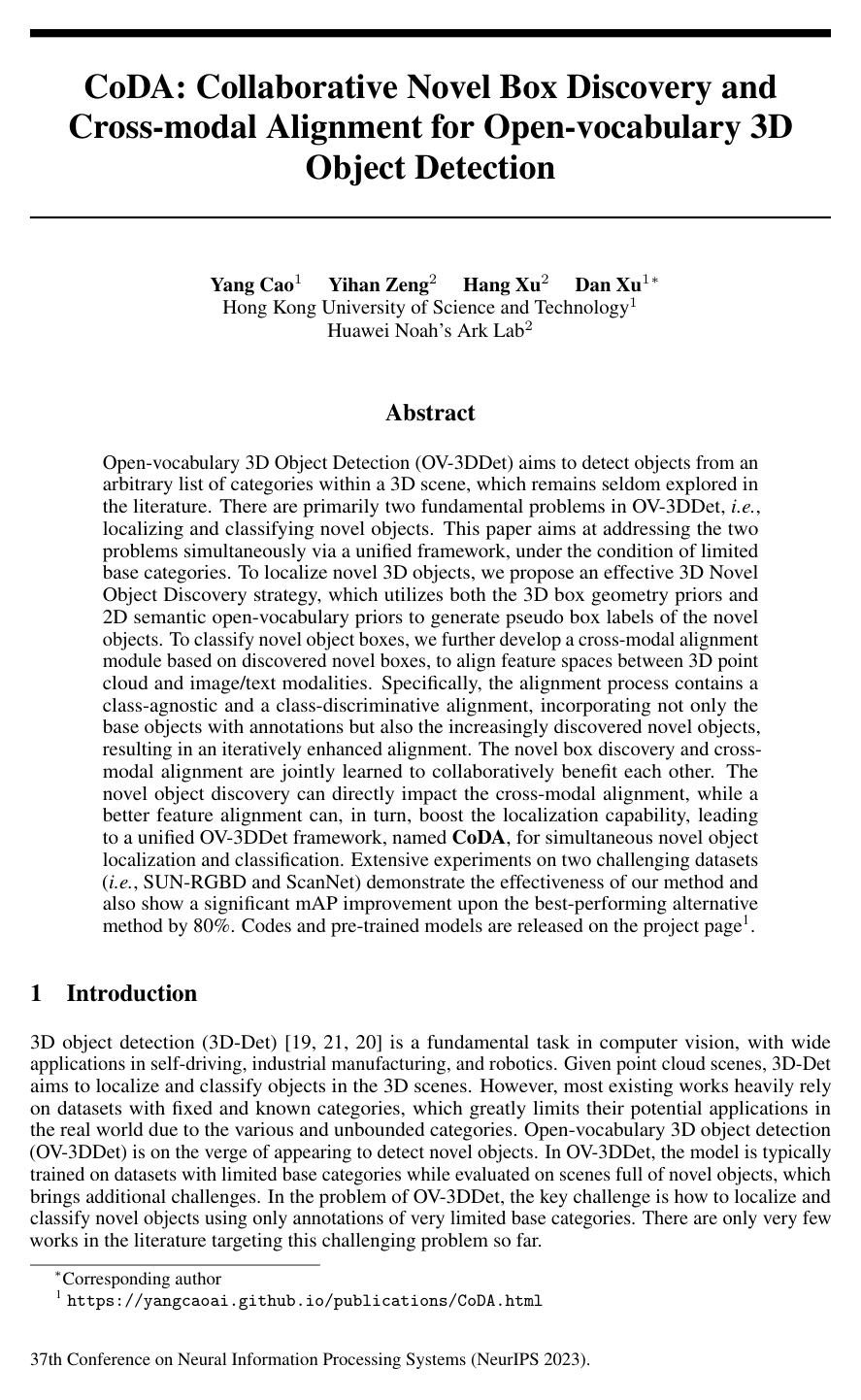
CoDA: Collaborative Novel Box Discovery and Cross-modal Alignment for Open-vocabulary 3D Object Detection
Yang Cao, Yihan Zeng, Hang Xu, Dan Xu
Why you should read this
Proposes an end-to-end framework that couples 3D novel box discovery with cross-modal alignment to simultaneously localize and classify unseen 3D objects without relying on external 2D open-vocabulary detectors.
Open-vocabulary 3D Object Detection (OV-3DDet) aims to detect objects from an arbitrary list of categories within a 3D scene, which remains seldom explored in the literature. There are primarily two fundamental problems in OV-3DDet, i.e., localizing and classifying novel objects. This paper aims at addressing the two problems simultaneously via a unified framework, under the condition of limited base categories. To localize novel 3D objects, we propose an effective 3D Novel Object Discovery strategy, which utilizes both the 3D box geometry priors and 2D semantic open-vocabulary priors to generate pseudo box labels of the novel objects. To classify novel object boxes, we further develop a cross-modal alignment module based on discovered novel boxes, to align feature spaces between 3D point cloud and image/text modalities. Specifically, the alignment process contains a class-agnostic and a class-discriminative alignment, incorporating not only the base objects with annotations but also the increasingly discovered novel objects, resulting in an iteratively enhanced alignment. The novel box discovery and cross-modal alignment are jointly learned to collaboratively benefit each other. The novel object discovery can directly impact the cross-modal alignment, while a better feature alignment can, in turn, boost the localization capability, leading to a unified OV-3DDet framework, named CoDA, for simultaneous novel object localization and classification. Extensive experiments on two challenging datasets (i.e., SUN-RGBD and ScanNet) demonstrate the effectiveness of our method and also show a significant mAP improvement upon the best-performing alternative method by 80%. Codes and pre-trained models are released on the project page¹.
Added
2026-09-26
Multimodal Reasoning with Multimodal Knowledge Graph
Junlin Lee, Yequan Wang, Jing Li, Min Zhang
Why you should read this
Presents a parameter-efficient framework that integrates multimodal knowledge graphs into large language models via relation graph attention networks and cross-modal alignment to curb hallucinations and improve multimodal reasoning.
Multimodal reasoning with large language models (LLMs) often suffers from hallucinations and the presence of deficient or outdated knowledge within LLMs. Some approaches have sought to mitigate these issues by employing textual knowledge graphs, but their singular modality of knowledge limits comprehensive cross-modal understanding. In this paper, we propose the Multimodal Reasoning with Multimodal Knowledge Graph (MR-MKG) method, which leverages multimodal knowledge graphs (MMKGs) to learn rich and semantic knowledge across modalities, significantly enhancing the multimodal reasoning capabilities of LLMs. In particular, a relation graph attention network is utilized for encoding MMKGs and a cross-modal alignment module is designed for optimizing image-text alignment. A MMKG-grounded dataset is constructed to equip LLMs with initial expertise in multimodal reasoning through pretraining. Remarkably, MR-MKG achieves superior performance while training on only a small fraction of parameters, approximately 2.25% of the LLM's parameter size. Experimental results on multimodal question answering and multimodal analogy reasoning tasks demonstrate that our MR-MKG method outperforms previous state-of-the-art models.
Added
2026-09-26