
keyword
cross-attention layer
A cross-attention layer is an architectural component in neural networks, particularly transformer-based models, that combines and aligns information from two distinct sequences or data streams. Unlike a standard self-attention layer where query, key, and value vectors are derived from the same input sequence, a cross-attention layer generates queries from one target sequence and retrieves keys and values from a separate context or source sequence. This mechanism allows the model to compute relational relevance across different representations, enabling tasks that require conditioning or multimodal integration, such as sequence-to-sequence translation, vision-language representation learning, and text-guided image synthesis.
4 items
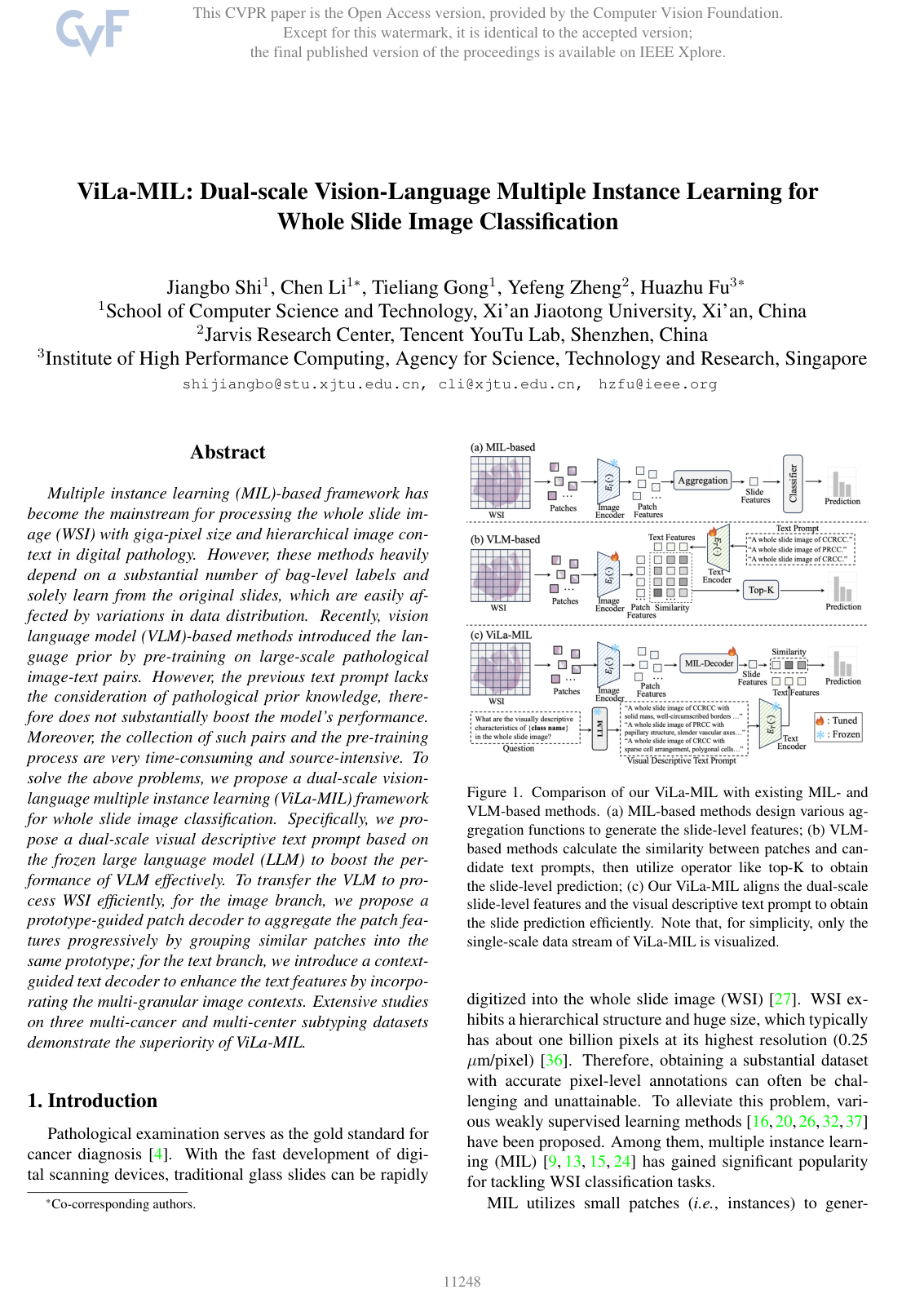
ViLa-MIL: Dual-scale Vision-Language Multiple Instance Learning for Whole Slide Image Classification
Jiangbo Shi, Chen Li, Tieliang Gong, Yefeng Zheng, Huazhu Fu
Why you should read this
Proposes a dual-scale vision-language multiple instance learning framework that uses frozen LLM prompts and lightweight decoders to transfer vision-language models to gigapixel whole slide image classification with minimal labeled data.
Multiple instance learning (MIL)-based framework has become the mainstream for processing the whole slide image (WSI) with giga-pixel size and hierarchical image context in digital pathology. However, these methods heavily depend on a substantial number of bag-level labels and solely learn from the original slides, which are easily affected by variations in data distribution. Recently, vision language model (VLM)-based methods introduced the language prior by pre-training on large-scale pathological image-text pairs. However, the previous text prompt lacks the consideration of pathological prior knowledge, therefore does not substantially boost the model’s performance. Moreover, the collection of such pairs and the pre-training process are very time-consuming and source-intensive. To solve the above problems, we propose a dual-scale vision-language multiple instance learning (ViLa-MIL) framework for whole slide image classification. Specifically, we propose a dual-scale visual descriptive text prompt based on the frozen large language model (LLM) to boost the performance of VLM effectively. To transfer the VLM to process WSI efficiently, for the image branch, we propose a prototype-guided patch decoder to aggregate the patch features progressively by grouping similar patches into the same prototype; for the text branch, we introduce a context-guided text decoder to enhance the text features by incorporating the multi-granular image contexts. Extensive studies on three multi-cancer and multi-center subtyping datasets demonstrate the superiority of ViLa-MIL.
Added
2026-09-26
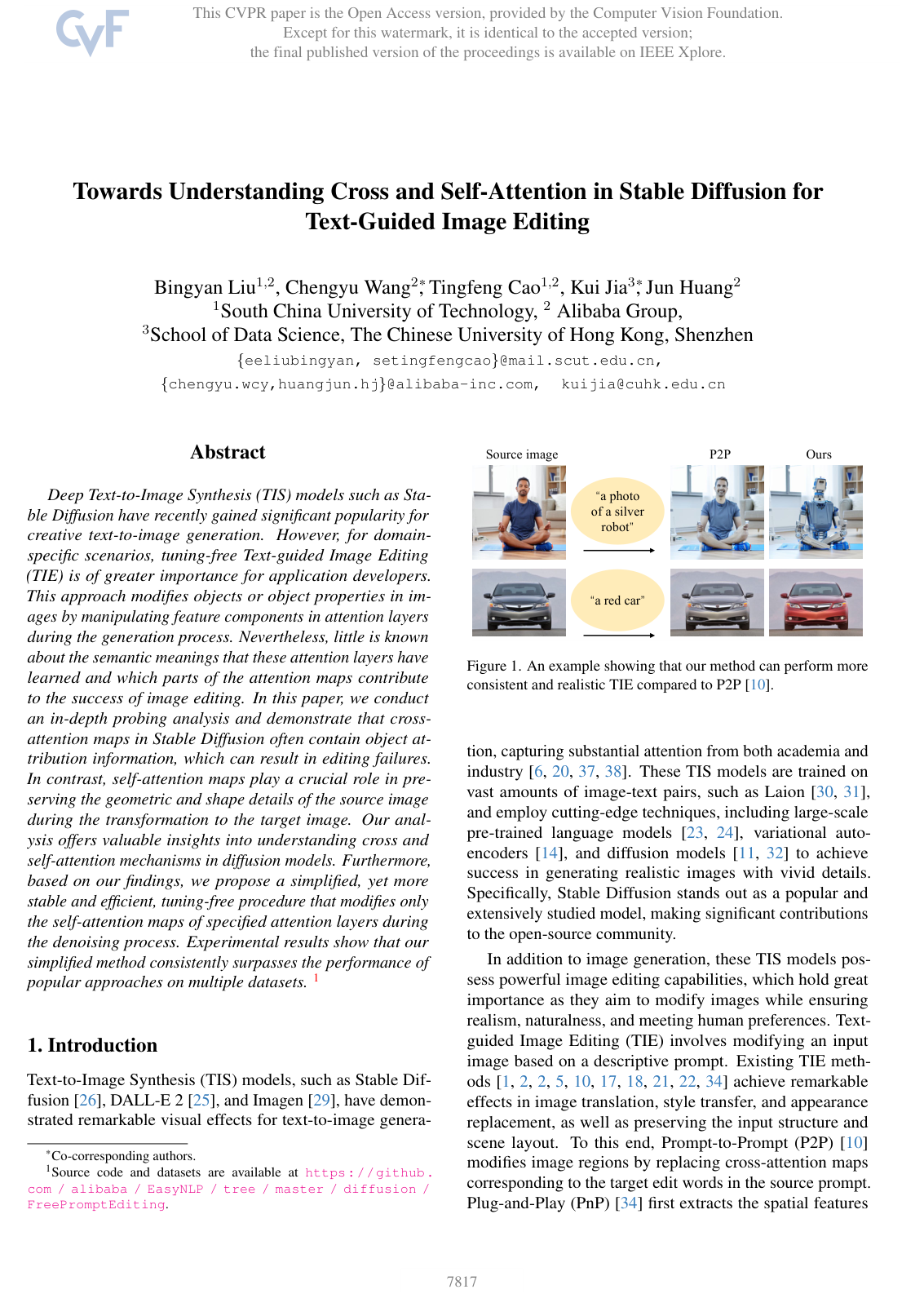
Towards Understanding Cross and Self-Attention in Stable Diffusion for Text-Guided Image Editing
Bingyan Liu, Chengyu Wang, Tingfeng Cao, Kui Jia, Jun Huang
Why you should read this
Reveals why cross-attention replacement causes editing failures in Stable Diffusion through probing analysis and introduces Free-Prompt-Editing, an efficient tuning-free method that outperforms existing approaches by modifying only self-attention maps without requiring a source prompt.
Deep Text-to-Image Synthesis (TIS) models such as Stable Diffusion have recently gained significant popularity for creative text-to-image generation. However, for domain-specific scenarios, tuning-free Text-guided Image Editing (TIE) is of greater importance for application developers. This approach modifies objects or object properties in images by manipulating feature components in attention layers during the generation process. Nevertheless, little is known about the semantic meanings that these attention layers have learned and which parts of the attention maps contribute to the success of image editing. In this paper, we conduct an in-depth probing analysis and demonstrate that cross-attention maps in Stable Diffusion often contain object attribution information, which can result in editing failures. In contrast, self-attention maps play a crucial role in preserving the geometric and shape details of the source image during the transformation to the target image. Our analysis offers valuable insights into understanding cross and self-attention mechanisms in diffusion models. Furthermore, based on our findings, we propose a simplified, yet more stable and efficient, tuning-free procedure that modifies only the self-attention maps of specified attention layers during the denoising process. Experimental results show that our simplified method consistently surpasses the performance of popular approaches on multiple datasets.
Added
2026-09-26
IP-Adapter: Text Compatible Image Prompt Adapter for Text-to-Image Diffusion Models
Hu Ye, Jun Zhang, Siyi Liu, Xiao Han, Wei Yang
Why you should read this
Introduces a lightweight, decoupled cross-attention adapter that equips pretrained text-to-image diffusion models with image prompting capabilities while maintaining full compatibility with text prompts and structural controls without retraining the base model.
Recent years have witnessed the strong power of large text-to-image diffusion models for the impressive generative capability to create high-fidelity images. However, it is very tricky to generate desired images using only text prompt as it often involves complex prompt engineering. An alternative to text prompt is image prompt, as the saying goes: "an image is worth a thousand words". Although existing methods of direct fine-tuning from pretrained models are effective, they require large computing resources and are not compatible with other base models, text prompt, and structural controls. In this paper, we present IP-Adapter, an effective and lightweight adapter to achieve image prompt capability for the pretrained text-to-image diffusion models. The key design of our IP-Adapter is decoupled cross-attention mechanism that separates cross-attention layers for text features and image features. Despite the simplicity of our method, an IP-Adapter with only 22M parameters can achieve comparable or even better performance to a fully fine-tuned image prompt model. As we freeze the pretrained diffusion model, the proposed IP-Adapter can be generalized not only to other custom models fine-tuned from the same base model, but also to controllable generation using existing controllable tools. With the benefit of the decoupled cross-attention strategy, the image prompt can also work well with the text prompt to achieve multimodal image generation. The project page is available at \url{this https URL}.
Added
2026-09-24
Align before Fuse: Vision and Language Representation Learning with Momentum Distillation
Junnan Li, Ramprasaath R. Selvaraju, Akhilesh Deepak Gotmare, Shafiq Joty, Caiming Xiong, Steven Hoi
Why you should read this
Presents a novel "Align before Fuse" (ALBEF) framework that achieves state-of-the-art performance in vision-language tasks with faster inference and without needing costly bounding box annotations, demonstrating a more efficient and effective approach to multimodal representation learning.
Large-scale vision and language representation learning has shown promising improvements on various vision-language tasks. Most existing methods employ a transformer-based multimodal encoder to jointly model visual tokens (region-based image features) and word tokens. Because the visual tokens and word tokens are unaligned, it is challenging for the multimodal encoder to learn image-text interactions. In this paper, we introduce a contrastive loss to ALign the image and text representations BEfore Fusing (ALBEF) them through cross-modal attention, which enables more grounded vision and language representation learning. Unlike most existing methods, our method does not require bounding box annotations nor high-resolution images. In order to improve learning from noisy web data, we propose momentum distillation, a self-training method which learns from pseudo-targets produced by a momentum model. We provide a theoretical analysis of ALBEF from a mutual information maximization perspective, showing that different training tasks can be interpreted as different ways to generate views for an image-text pair. ALBEF achieves state-of-the-art performance on multiple downstream vision-language tasks. On image-text retrieval, ALBEF outperforms methods that are pre-trained on orders of magnitude larger datasets. On VQA and NLVR, ALBEF achieves absolute improvements of 2.37% and 3.84% compared to the state-of-the-art, while enjoying faster inference speed. Code and pre-trained models are available at this https URL.
Added
2026-01-28
