
keyword
convolutional network
A convolutional network is a class of deep artificial neural networks designed primarily to process and analyze structured grid-like data, such as images, video, and audio waveforms. The architecture is defined by convolutional layers that apply learnable filters over local receptive fields of the input, allowing the network to detect spatial or temporal features while sharing parameters across the entire input domain. These layers are commonly combined with non-linear activation functions, pooling or strided operations to reduce spatial dimensions, and fully connected layers to generate final predictions or representations. By exploiting translation invariance and hierarchical feature learning, convolutional networks automatically extract low-level patterns such as edges and textures in early layers and compose them into complex, high-level features in deeper layers, making them widely used in computer vision, audio processing, and pattern recognition.
8 items
Evaluating the Visualization of What a Deep Neural Network Has Learned
Wojciech Samek, Alexander Binder, Grégoire Montavon, Sebastian Bach, Klaus-Robert Müller
Why you should read this
Introduces a region-perturbation framework for objectively evaluating neural network explanation heatmaps and demonstrates that Layer-wise Relevance Propagation outperforms sensitivity analysis and deconvolution methods across standard image benchmarks.
Deep Neural Networks (DNNs) have demonstrated impressive performance in complex machine learning tasks such as image classification or speech recognition. However, due to their multi-layer nonlinear structure, they are not transparent, i.e., it is hard to grasp what makes them arrive at a particular classification or recognition decision given a new unseen data sample. Recently, several approaches have been proposed enabling one to understand and interpret the reasoning embodied in a DNN for a single test image. These methods quantify the ''importance'' of individual pixels wrt the classification decision and allow a visualization in terms of a heatmap in pixel/input space. While the usefulness of heatmaps can be judged subjectively by a human, an objective quality measure is missing. In this paper we present a general methodology based on region perturbation for evaluating ordered collections of pixels such as heatmaps. We compare heatmaps computed by three different methods on the SUN397, ILSVRC2012 and MIT Places data sets. Our main result is that the recently proposed Layer-wise Relevance Propagation (LRP) algorithm qualitatively and quantitatively provides a better explanation of what made a DNN arrive at a particular classification decision than the sensitivity-based approach or the deconvolution method. We provide theoretical arguments to explain this result and discuss its practical implications. Finally, we investigate the use of heatmaps for unsupervised assessment of neural network performance.
Added
2026-09-25
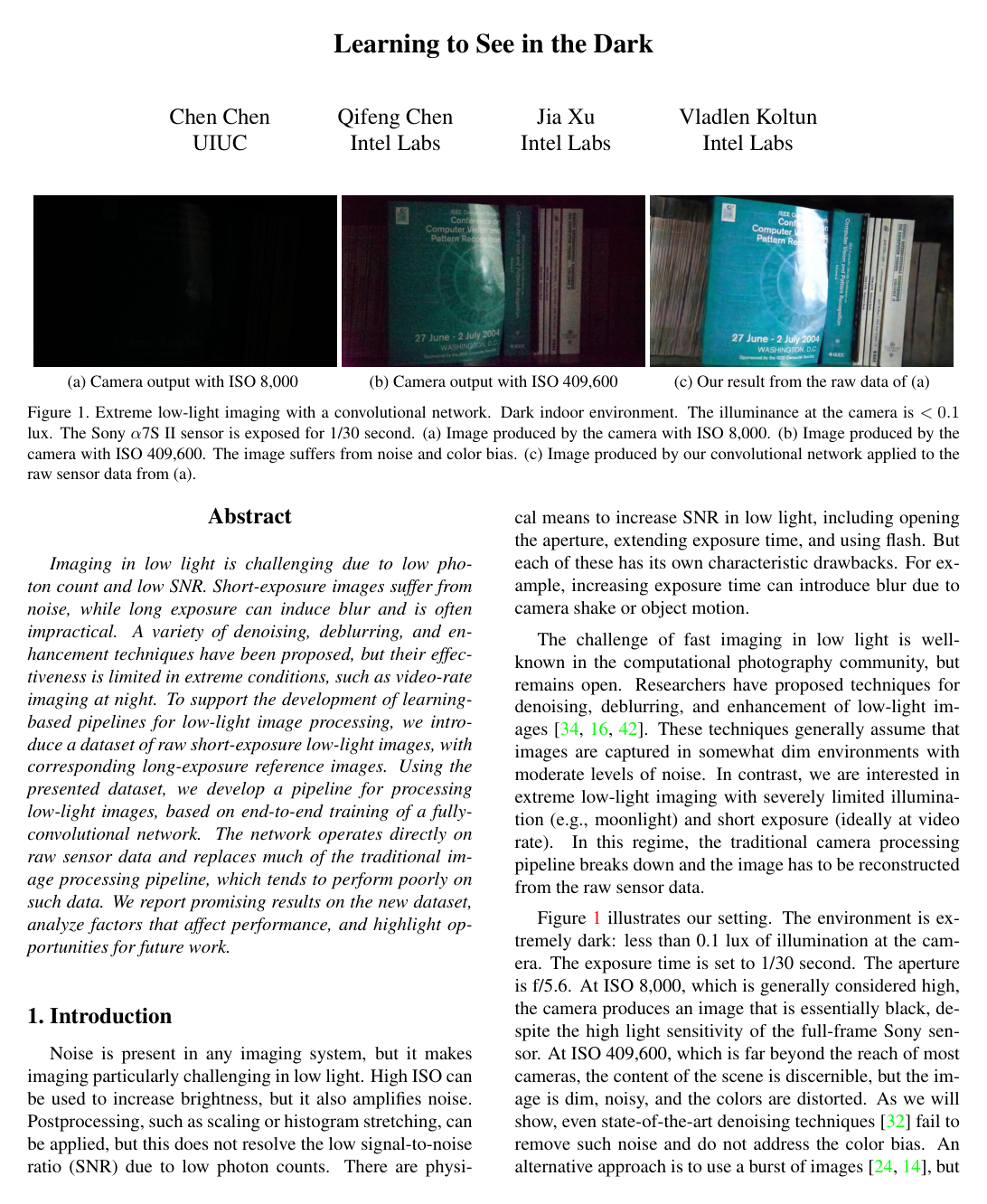
Learning to See in the Dark
Chen Chen, Qifeng Chen, Jia Xu, Vladlen Koltun
Why you should read this
Introduces a raw-sensor low-light image dataset and a fully convolutional network pipeline that replaces traditional camera processing to produce clear, high-signal photographs from extreme short-exposure night shots.
Imaging in low light is challenging due to low photon count and low SNR. Short-exposure images suffer from noise, while long exposure can induce blur and is often impractical. A variety of denoising, deblurring, and enhancement techniques have been proposed, but their effectiveness is limited in extreme conditions, such as video-rate imaging at night. To support the development of learning-based pipelines for low-light image processing, we introduce a dataset of raw short-exposure low-light images, with corresponding long-exposure reference images. Using the presented dataset, we develop a pipeline for processing low-light images, based on end-to-end training of a fully-convolutional network. The network operates directly on raw sensor data and replaces much of the traditional image processing pipeline, which tends to perform poorly on such data. We report promising results on the new dataset, analyze factors that affect performance, and highlight opportunities for future work. The results are shown in the supplementary video at this https URL
Added
2026-09-24
Joint Training of a Convolutional Network and a Graphical Model for Human Pose Estimation
Jonathan Tompson, Arjun Jain, Yann LeCun, Christoph Bregler
Why you should read this
Introduces an end-to-end trainable hybrid architecture combining deep convolutional networks with Markov random fields to explicitly model geometric spatial constraints between body joints for improved 2D human pose estimation.
This paper proposes a new hybrid architecture that consists of a deep Convolutional Network and a Markov Random Field. We show how this architecture is successfully applied to the challenging problem of articulated human pose estimation in monocular images. The architecture can exploit structural domain constraints such as geometric relationships between body joint locations. We show that joint training of these two model paradigms improves performance and allows us to significantly outperform existing state-of-the-art techniques.
Added
2026-09-24
Challenges in representation learning: A report on three machine learning contests
Ian J. Goodfellow, Dumitru Erhan, Pierre Luc Carrier, Aaron Courville, Mehdi Mirza, Ben Hamner, Will Cukierski, Yichuan Tang, David Thaler, Dong-Hyun Lee, Yingbo Zhou, Chetan Ramaiah, Fangxiang Feng, Ruifan Li, Xiaojie Wang, Dimitris Athanasakis, John Shawe-Taylor, Maxim Milakov, John Park, Radu Ionescu, Marius Popescu, Cristian Grozea, James Bergstra, Jingjing Xie, Lukasz Romaszko, Bing Xu, Zhang Chuang, Yoshua Bengio
Why you should read this
Examines the top-performing representation learning methods across three machine learning competitions—covering black-box, facial expression, and multimodal data—while providing actionable insights on algorithm performance and effective benchmark design.
The ICML 2013 Workshop on Challenges in Representation Learning focused on three challenges: the black box learning challenge, the facial expression recognition challenge, and the multimodal learning challenge. We describe the datasets created for these challenges and summarize the results of the competitions. We provide suggestions for organizers of future challenges and some comments on what kind of knowledge can be gained from machine learning competitions.
Added
2026-09-16
Empirical Evaluation of Rectified Activations in Convolutional Network
Bing Xu, Naiyan Wang, Tianqi Chen, Mu Li
Why you should read this
Demonstrates that non-zero negative activation slopes consistently outperform standard ReLU, challenging the belief that sparsity drives performance while introducing randomized leaky ReLU (RReLU) to prevent overfitting.
In this paper we investigate the performance of different types of rectified activation functions in convolutional neural network: standard rectified linear unit (ReLU), leaky rectified linear unit (Leaky ReLU), parametric rectified linear unit (PReLU) and a new randomized leaky rectified linear units (RReLU). We evaluate these activation function on standard image classification task. Our experiments suggest that incorporating a non-zero slope for negative part in rectified activation units could consistently improve the results. Thus our findings are negative on the common belief that sparsity is the key of good performance in ReLU. Moreover, on small scale dataset, using deterministic negative slope or learning it are both prone to overfitting. They are not as effective as using their randomized counterpart. By using RReLU, we achieved 75.68\% accuracy on CIFAR-100 test set without multiple test or ensemble.
Added
2026-09-12
Striving for Simplicity: The All Convolutional Net
Jost Tobias Springenberg, Alexey Dosovitskiy, Thomas Brox, Martin Riedmiller
Why you should read this
Demonstrates that max-pooling can be completely replaced by strided convolutions to build high-performing all-convolutional networks, while introducing guided backpropagation for visualizing learned features.
Most modern convolutional neural networks (CNNs) used for object recognition are built using the same principles: Alternating convolution and max-pooling layers followed by a small number of fully connected layers. We re-evaluate the state of the art for object recognition from small images with convolutional networks, questioning the necessity of different components in the pipeline. We find that max-pooling can simply be replaced by a convolutional layer with increased stride without loss in accuracy on several image recognition benchmarks. Following this finding -- and building on other recent work for finding simple network structures -- we propose a new architecture that consists solely of convolutional layers and yields competitive or state of the art performance on several object recognition datasets (CIFAR-10, CIFAR-100, ImageNet). To analyze the network we introduce a new variant of the "deconvolution approach" for visualizing features learned by CNNs, which can be applied to a broader range of network structures than existing approaches.
Added
2026-09-10
Dimensionality Reduction by Learning an Invariant Mapping
Raia Hadsell, Sumit Chopra, Yann LeCun
Why you should read this
Proposes Dimensionality Reduction by Learning an Invariant Mapping (DrLIM), a contrastive learning framework that maps high-dimensional data into low-dimensional spaces while generalizing to unseen samples and remaining invariant to transformations without requiring predefined distance metrics.
Dimensionality reduction involves mapping a set of high dimensional input points onto a low dimensional manifold so that “similar” points in input space are mapped to nearby points on the manifold. Most existing techniques for solving the problem suffer from two drawbacks. First, most of them depend on a meaningful and computable distance metric in input space. Second, they do not compute a “function” that can accurately map new input samples whose relationship to the training data is unknown. We present a method - called Dimensionality Reduction by Learning an Invariant Mapping (DrLIM) - for learning a globally coherent non-linear function that maps the data evenly to the output manifold. The learning relies solely on neighborhood relationships and does not require any distance measure in the input space. The method can learn mappings that are invariant to certain transformations of the inputs, as is demonstrated with a number of experiments. Comparisons are made to other techniques, in particular LLE.
Added
2026-09-09
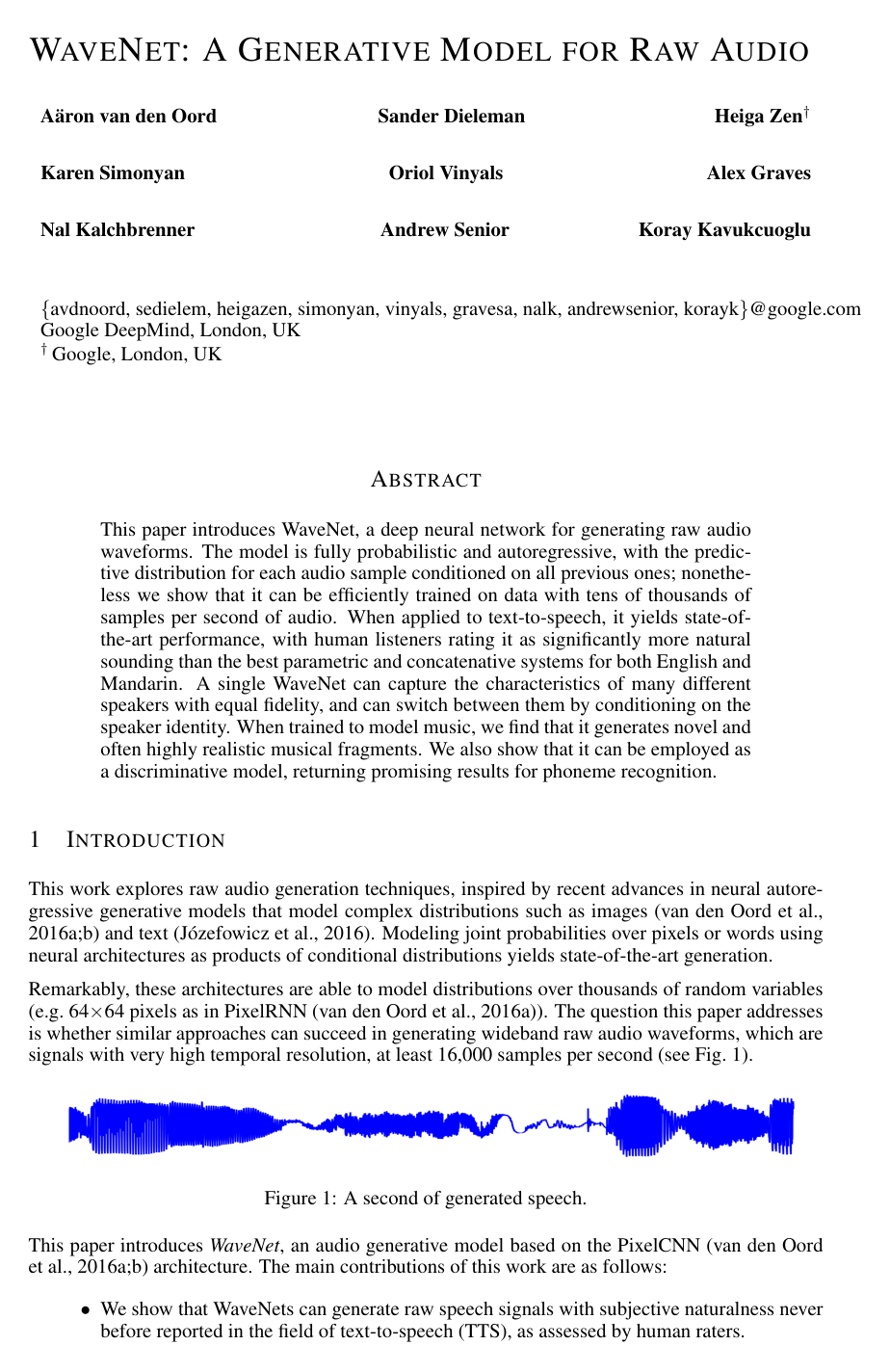
WaveNet: A Generative Model for Raw Audio
Aäron van den Oord, Sander Dieleman, Heiga Zen, Karen Simonyan, Oriol Vinyals, Alexander Graves, Nal Kalchbrenner, Andrew Senior, Koray Kavukcuoglu
Why you should read this
Demonstrates that autoregressive principles extend perfectly to high-frequency continuous temporal data like raw audio through dilated causal convolutions.
This paper introduces WaveNet, a deep neural network for generating raw audio waveforms. The model is fully probabilistic and autoregressive, with the predictive distribution for each audio sample conditioned on all previous ones; nonetheless we show that it can be efficiently trained on data with tens of thousands of samples per second of audio. When applied to text-to-speech, it yields state-of-the-art performance, with human listeners rating it as significantly more natural sounding than the best parametric and concatenative systems for both English and Mandarin. A single WaveNet can capture the characteristics of many different speakers with equal fidelity, and can switch between them by conditioning on the speaker identity. When trained to model music, we find that it generates novel and often highly realistic musical fragments. We also show that it can be employed as a discriminative model, returning promising results for phoneme recognition.
Added
2026-02-21