
Built independently by an author, for readers. Read the story and support ChapterPal

keyword

conditional DDPMs

Conditional Denoising Diffusion Probabilistic Models, commonly abbreviated as conditional DDPMs, are generative machine learning models that generate new data samples matching specific attributes, contexts, or constraints by incorporating conditioning variables into a step-by-step denoising process. Standard diffusion models generate samples by learning to iteratively remove noise from a purely random starting point, whereas conditional DDPMs supply additional input information, such as class labels, text prompts, or prior historical data, directly to the denoising neural network at each time step. By steering the reverse diffusion trajectory using these external conditions, conditional DDPMs can perform targeted generative tasks such as controlled image synthesis, text-guided audio generation, inpainting, and context-dependent forecasting.

1 item
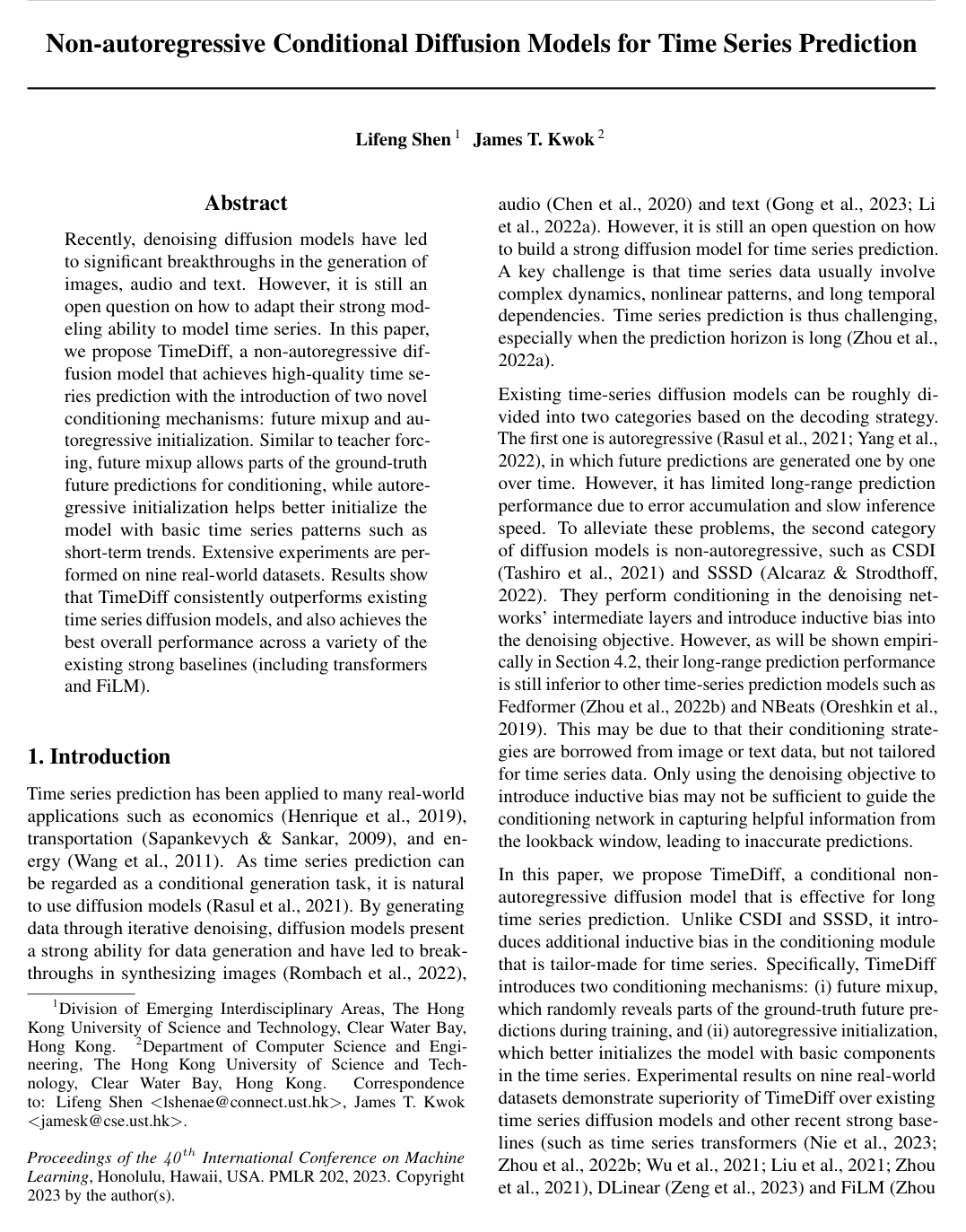
Non-autoregressive Conditional Diffusion Models for Time Series Prediction

Non-autoregressive Conditional Diffusion Models for Time Series Prediction

Lifeng Shen, James T. Kwok

OrganizationsThe Hong Kong University of Science and Technology

Why you should read this

Proposes TimeDiff, a non-autoregressive diffusion framework featuring future mixup and autoregressive initialization to overcome error accumulation and outperform existing transformers and diffusion baselines in long-range time series forecasting.

Recently, denoising diffusion models have led to significant breakthroughs in the generation of images, audio and text. However, it is still an open question on how to adapt their strong modeling ability to model time series. In this paper, we propose TimeDiff, a non-autoregressive diffusion model that achieves high-quality time series prediction with the introduction of two novel conditioning mechanisms: future mixup and autoregressive initialization. Similar to teacher forcing, future mixup allows parts of the ground-truth future predictions for conditioning, while autoregressive initialization helps better initialize the model with basic time series patterns such as short-term trends. Extensive experiments are performed on nine real-world datasets. Results show that TimeDiff consistently outperforms existing time series diffusion models, and also achieves the best overall performance across a variety of the existing strong baselines (including transformers and FiLM).

Added

2026-09-26