
keyword
concept drift
Concept drift refers to the phenomenon in machine learning and data mining where the statistical properties of a target concept or the relationship between input features and output labels change over time. This shift violates the assumption that data is generated by a stationary probability distribution, causing predictive models trained on historical data to degrade in accuracy as real-world conditions evolve. Driven by changes in environment, user behavior, or unobserved factors, concept drift can occur suddenly, gradually, incrementally, or recurrently in streaming and time-evolving data environments. To mitigate performance degradation, systems handling concept drift rely on drift detection methods, adaptive learning algorithms, and continuous model updating strategies.
11 items
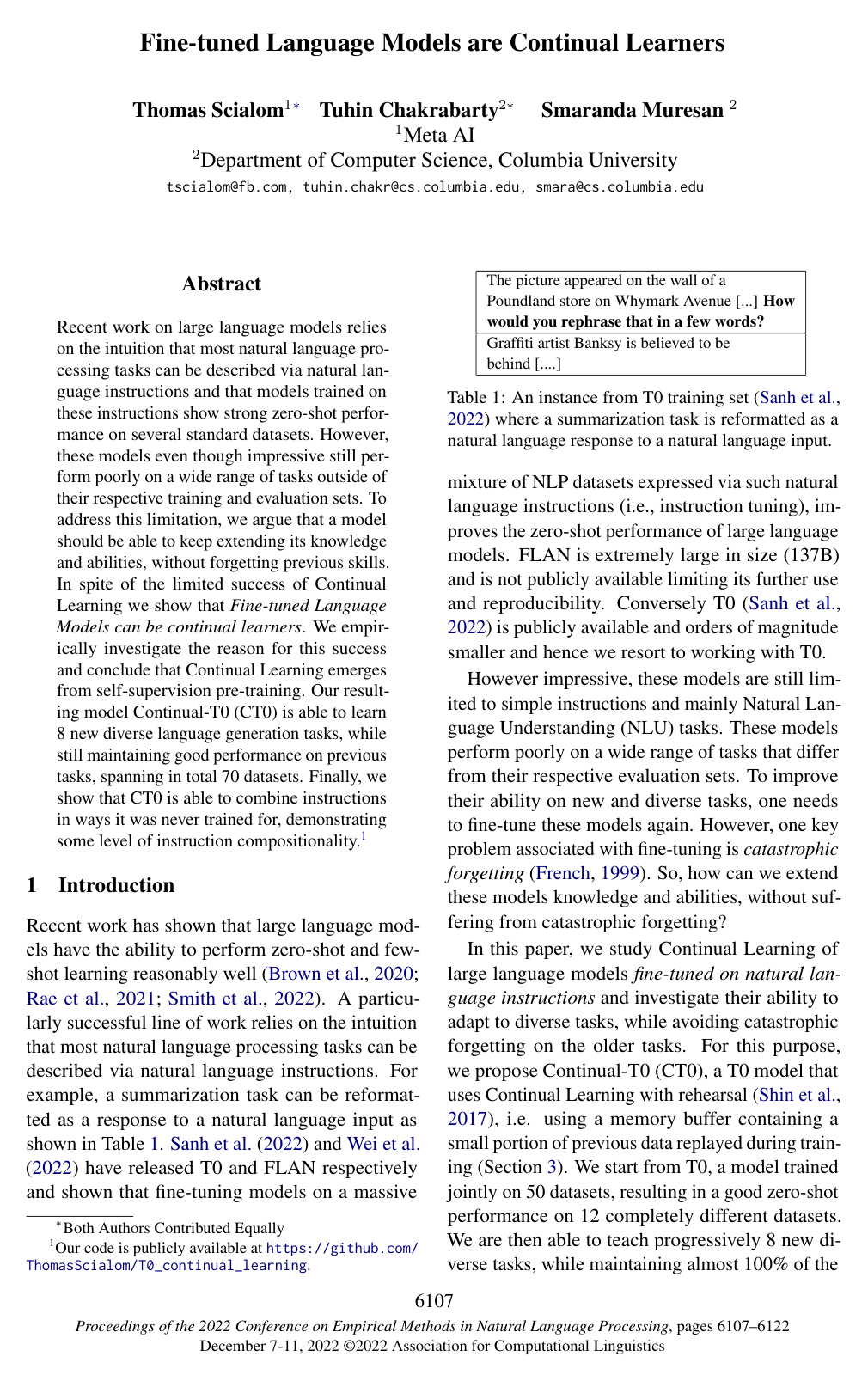
Fine-tuned Language Models are Continual Learners
Thomas Scialom, Tuhin Chakrabarty, Smaranda Muresan
Why you should read this
Demonstrates that instruction-tuned language models can sequentially acquire new generation tasks with minimal rehearsal while preventing catastrophic forgetting, identifying self-supervised pre-training as the primary driver of this capability.
Recent work on large language models relies on the intuition that most natural language processing tasks can be described via natural language instructions and that models trained on these instructions show strong zero-shot performance on several standard datasets. However, these models even though impressive still perform poorly on a wide range of tasks outside of their respective training and evaluation sets. To address this limitation, we argue that a model should be able to keep extending its knowledge and abilities, without forgetting previous skills. In spite of the limited success of Continual Learning we show that Fine-tuned Language Models can be continual learners. We empirically investigate the reason for this success and conclude that Continual Learning emerges from self-supervision pre-training. Our resulting model Continual-T0 (CT0) is able to learn 8 new diverse language generation tasks, while still maintaining good performance on previous tasks, spanning in total 70 datasets. Finally, we show that CT0 is able to combine instructions in ways it was never trained for, demonstrating some level of instruction compositionality.^1
Added
2026-10-05
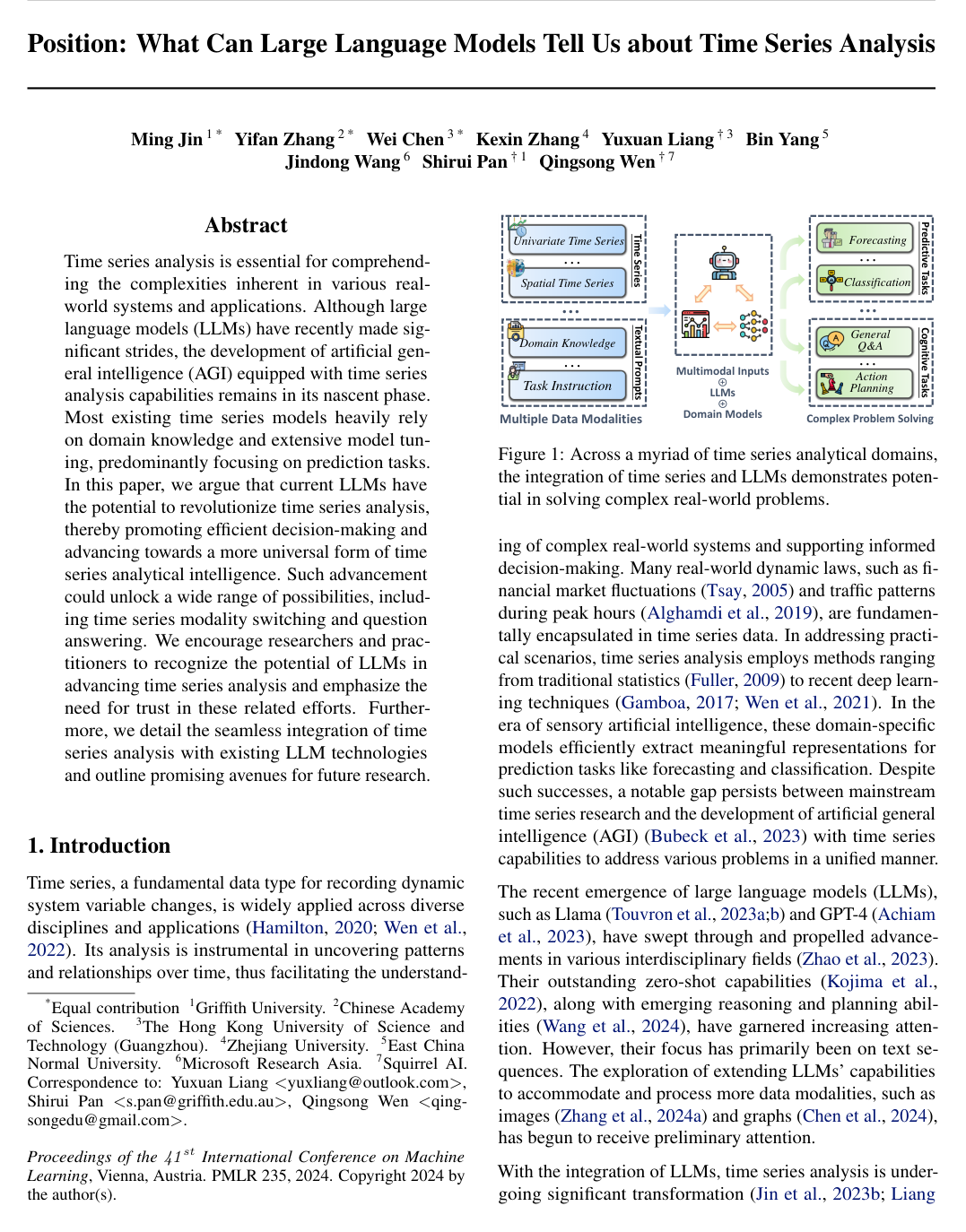
Position: What Can Large Language Models Tell Us about Time Series Analysis
Ming Jin, Yifan Zhang, Wei Chen, Kexin Zhang, Yuxuan Liang, Bin Yang, Jindong Wang, Shirui Pan, Qingsong Wen
Why you should read this
Categorizes the emerging roles of large language models in time series analysis as data enhancers, predictors, and autonomous agents while identifying concrete integration strategies and open research opportunities for building universal time series intelligence.
Time series analysis is essential for comprehending the complexities inherent in various real-world systems and applications. Although large language models (LLMs) have recently made significant strides, the development of artificial general intelligence (AGI) equipped with time series analysis capabilities remains in its nascent phase. Most existing time series models heavily rely on domain knowledge and extensive model tuning, predominantly focusing on prediction tasks. In this paper, we argue that current LLMs have the potential to revolutionize time series analysis, thereby promoting efficient decision-making and advancing towards a more universal form of time series analytical intelligence. Such advancement could unlock a wide range of possibilities, including time series modality switching and question answering. We encourage researchers and practitioners to recognize the potential of LLMs in advancing time series analysis and emphasize the need for trust in these related efforts. Furthermore, we detail the seamless integration of time series analysis with existing LLM technologies and outline promising avenues for future research.
Added
2026-09-26
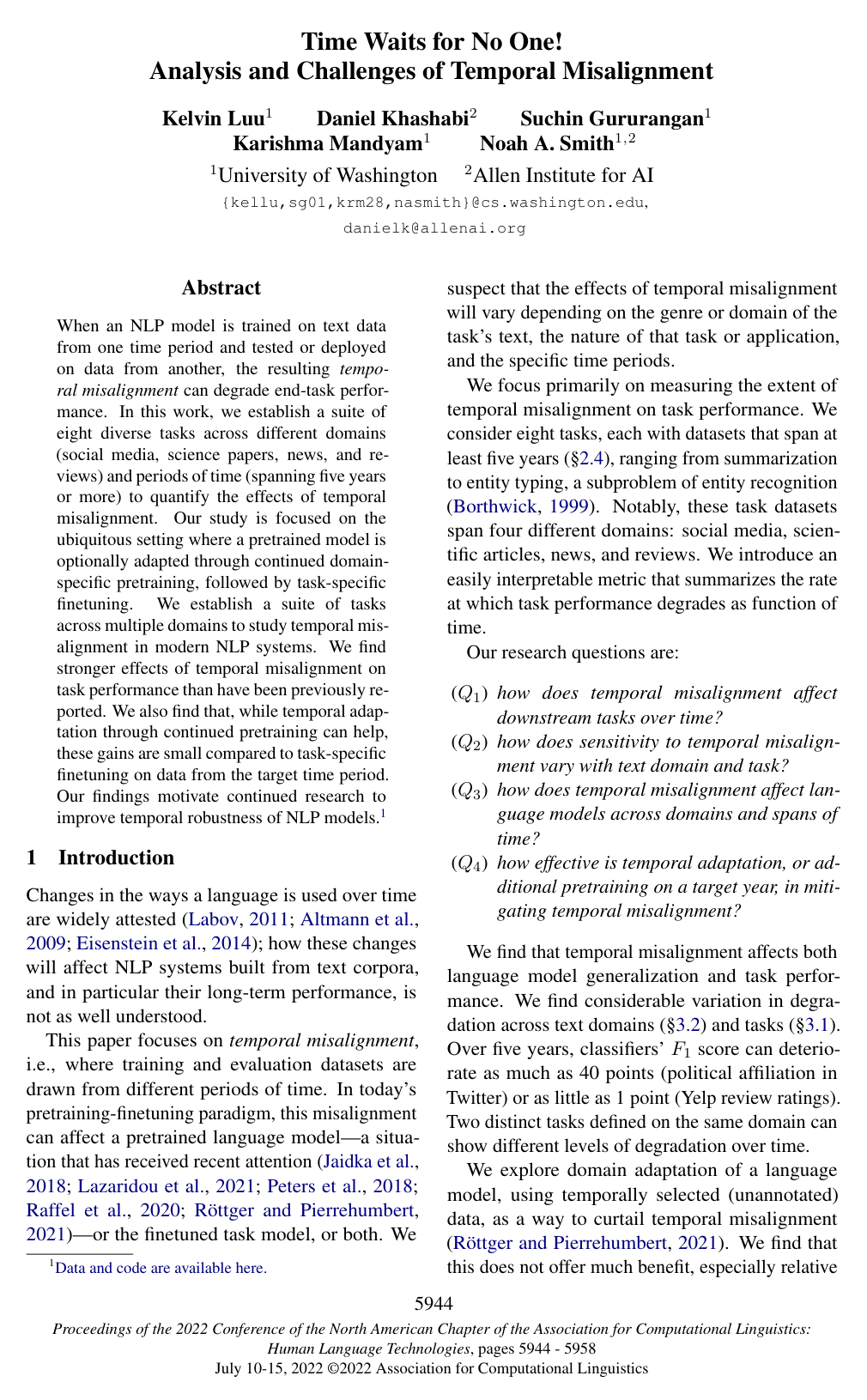
Time Waits for No One! Analysis and Challenges of Temporal Misalignment
Kelvin Luu, Daniel Khashabi, Suchin Gururangan, Karishma Mandyam, Noah A. Smith
Why you should read this
Establishes a multi-domain benchmark and regression-based metric to quantify how temporal misalignment degrades NLP model performance over time, proving that continued language model pretraining cannot substitute for finetuning on temporally aligned labeled data.
When an NLP model is trained on text data from one time period and tested or deployed on data from another, the resulting temporal misalignment can degrade end-task performance. In this work, we establish a suite of eight diverse tasks across different domains (social media, science papers, news, and reviews) and periods of time (spanning five years or more) to quantify the effects of temporal misalignment. Our study is focused on the ubiquitous setting where a pretrained model is optionally adapted through continued domain-specific pretraining, followed by task-specific finetuning. We establish a suite of tasks across multiple domains to study temporal misalignment in modern NLP systems. We find stronger effects of temporal misalignment on task performance than have been previously reported. We also find that, while temporal adaptation through continued pretraining can help, these gains are small compared to task-specific finetuning on data from the target time period. Our findings motivate continued research to improve temporal robustness of NLP models.
Added
2026-09-26
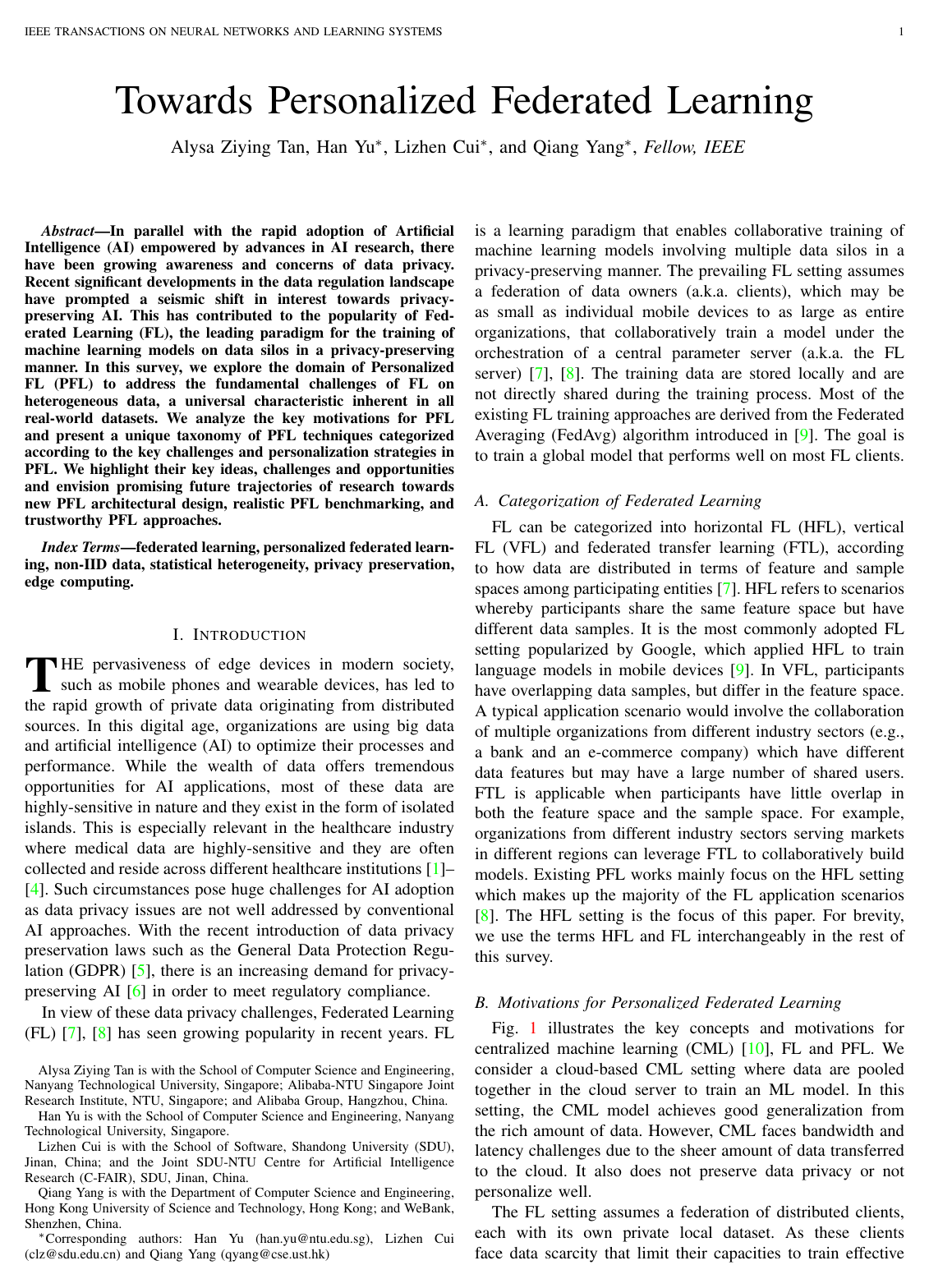
Towards Personalized Federated Learning
Alysa Ziying Tan, Han Yu, Lizhen Cui, Qiang Yang
Why you should read this
Presents a structured taxonomy of personalized federated learning strategies designed to overcome data heterogeneity across private devices, identifying critical open challenges in architecture design, trustworthy learning, and realistic benchmarking.
In parallel with the rapid adoption of Artificial Intelligence (AI) empowered by advances in AI research, there have been growing awareness and concerns of data privacy. Recent significant developments in the data regulation landscape have prompted a seismic shift in interest towards privacy-preserving AI. This has contributed to the popularity of Federated Learning (FL), the leading paradigm for the training of machine learning models on data silos in a privacy-preserving manner. In this survey, we explore the domain of Personalized FL (PFL) to address the fundamental challenges of FL on heterogeneous data, a universal characteristic inherent in all real-world datasets. We analyze the key motivations for PFL and present a unique taxonomy of PFL techniques categorized according to the key challenges and personalization strategies in PFL. We highlight their key ideas, challenges and opportunities and envision promising future trajectories of research towards new PFL architectural design, realistic PFL benchmarking, and trustworthy PFL approaches.
Added
2026-09-25
A streaming ensemble algorithm (SEA) for large-scale classification
W. Street, YongSeog Kim
Why you should read this
Proposes a fast, constant-memory streaming ensemble algorithm that processes continuous data chunks and uses a targeted replacement heuristic to match batch classifier accuracy while rapidly adapting to concept drift.
Ensemble methods have recently garnered a great deal of attention in the machine learning community. Techniques such as Boosting and Bagging have proven to be highly effective but require repeated resampling of the training data, making them inappropriate in a data mining context. The methods presented in this paper take advantage of plentiful data, building separate classifiers on sequential chunks of training points. These classifiers are combined into a fixed-size ensemble using a heuristic replacement strategy. The result is a fast algorithm for large-scale or streaming data that classifies as well as a single decision tree built on all the data, requires approximately constant memory, and adjusts quickly to concept drift.
Added
2026-09-25
Mining concept-drifting data streams using ensemble classifiers
Haixun Wang, W. Fan, Philip S. Yu, Jiawei Han
Why you should read this
Proposes an accuracy-weighted ensemble framework that trains base models on sequential stream chunks to adapt to concept drift more efficiently and accurately than updating a single model.
Recently, mining data streams with concept drifts for actionable insights has become an important and challenging task for a wide range of applications including credit card fraud protection, target marketing, network intrusion detection, etc. Conventional knowledge discovery tools are facing two challenges, the overwhelming volume of the streaming data, and the concept drifts. In this paper, we propose a general framework for mining concept-drifting data streams using weighted ensemble classifiers. We train an ensemble of classification models, such as C4.5, RIPPER, naive Bayesian, etc., from sequential chunks of the data stream. The classifiers in the ensemble are judiciously weighted based on their expected classification accuracy on the test data under the time-evolving environment. Thus, the ensemble approach improves both the efficiency in learning the model and the accuracy in performing classification. Our empirical study shows that the proposed methods have substantial advantage over single-classifier approaches in prediction accuracy, and the ensemble framework is effective for a variety of classification models.
Added
2026-09-24
Learning in the Presence of Concept Drift and Hidden Contexts
G. Widmer, M. Kubát
Why you should read this
Presents the FLORA framework of incremental learning algorithms that dynamically adjust sample windows and reuse past concept descriptions to handle recurring hidden contexts and concept drift in continuous data streams.
On-line learning in domains where the target concept depends on some hidden context poses serious problems. A changing context can induce changes in the target concepts, producing what is known as concept drift. We describe a family of learning algorithms that flexibly react to concept drift and can take advantage of situations where contexts reappear. The general approach underlying all these algorithms consists of (1) keeping only a window of currently trusted examples and hypotheses; (2) storing concept descriptions and re-using them when a previous context re-appears; and (3) controlling both of these functions by a heuristic that constantly monitors the system's behavior. The paper reports on experiments that test the systems' performance under various conditions such as different levels of noise and different extent and rate of concept drift.
Added
2026-09-24
Learning under Concept Drift: A Review
Jie Lu, Anjin Liu, Fan Dong, Feng Gu, João Gama, Guangquan Zhang
Why you should read this
Establishes a unified structural framework covering concept drift detection, understanding, and adaptation while evaluating 24 benchmark datasets across more than 130 studies to guide machine learning on non-stationary data streams.
Concept drift describes unforeseeable changes in the underlying distribution of streaming data over time. Concept drift research involves the development of methodologies and techniques for drift detection, understanding and adaptation. Data analysis has revealed that machine learning in a concept drift environment will result in poor learning results if the drift is not addressed. To help researchers identify which research topics are significant and how to apply related techniques in data analysis tasks, it is necessary that a high quality, instructive review of current research developments and trends in the concept drift field is conducted. In addition, due to the rapid development of concept drift in recent years, the methodologies of learning under concept drift have become noticeably systematic, unveiling a framework which has not been mentioned in literature. This paper reviews over 130 high quality publications in concept drift related research areas, analyzes up-to-date developments in methodologies and techniques, and establishes a framework of learning under concept drift including three main components: concept drift detection, concept drift understanding, and concept drift adaptation. This paper lists and discusses 10 popular synthetic datasets and 14 publicly available benchmark datasets used for evaluating the performance of learning algorithms aiming at handling concept drift. Also, concept drift related research directions are covered and discussed. By providing state-of-the-art knowledge, this survey will directly support researchers in their understanding of research developments in the field of learning under concept drift.
Added
2026-09-18
SMOTE for Learning from Imbalanced Data: Progress and Challenges, Marking the 15-year Anniversary
Alberto Fernandez, Salvador Garcia, Francisco Herrera, Nitesh V. Chawla
Why you should read this
Synthesizes fifteen years of research on the Synthetic Minority Oversampling Technique (SMOTE), detailing its numerous algorithm variants, cross-paradigm applications, and key open challenges in scaling to big data and complex class distributions.
The Synthetic Minority Oversampling Technique (SMOTE) preprocessing algorithm is considered “de facto” standard in the framework of learning from imbalanced data. This is due to its simplicity in the design of the procedure, as well as its robustness when applied to different type of problems. Since its publication in 2002, SMOTE has proven successful in a variety of applications from several different domains. SMOTE has also inspired several approaches to counter the issue of class imbalance, and has also significantly contributed to new supervised learning paradigms, including multilabel classification, incremental learning, semi-supervised learning, multi-instance learning, among others. It is standard benchmark for learning from imbalanced data. It is also featured in a number of different software packages — from open source to commercial. In this paper, marking the fifteen year anniversary of SMOTE, we reflect on the SMOTE journey, discuss the current state of affairs with SMOTE, its applications, and also identify the next set of challenges to extend SMOTE for Big Data problems.
Added
2026-09-16
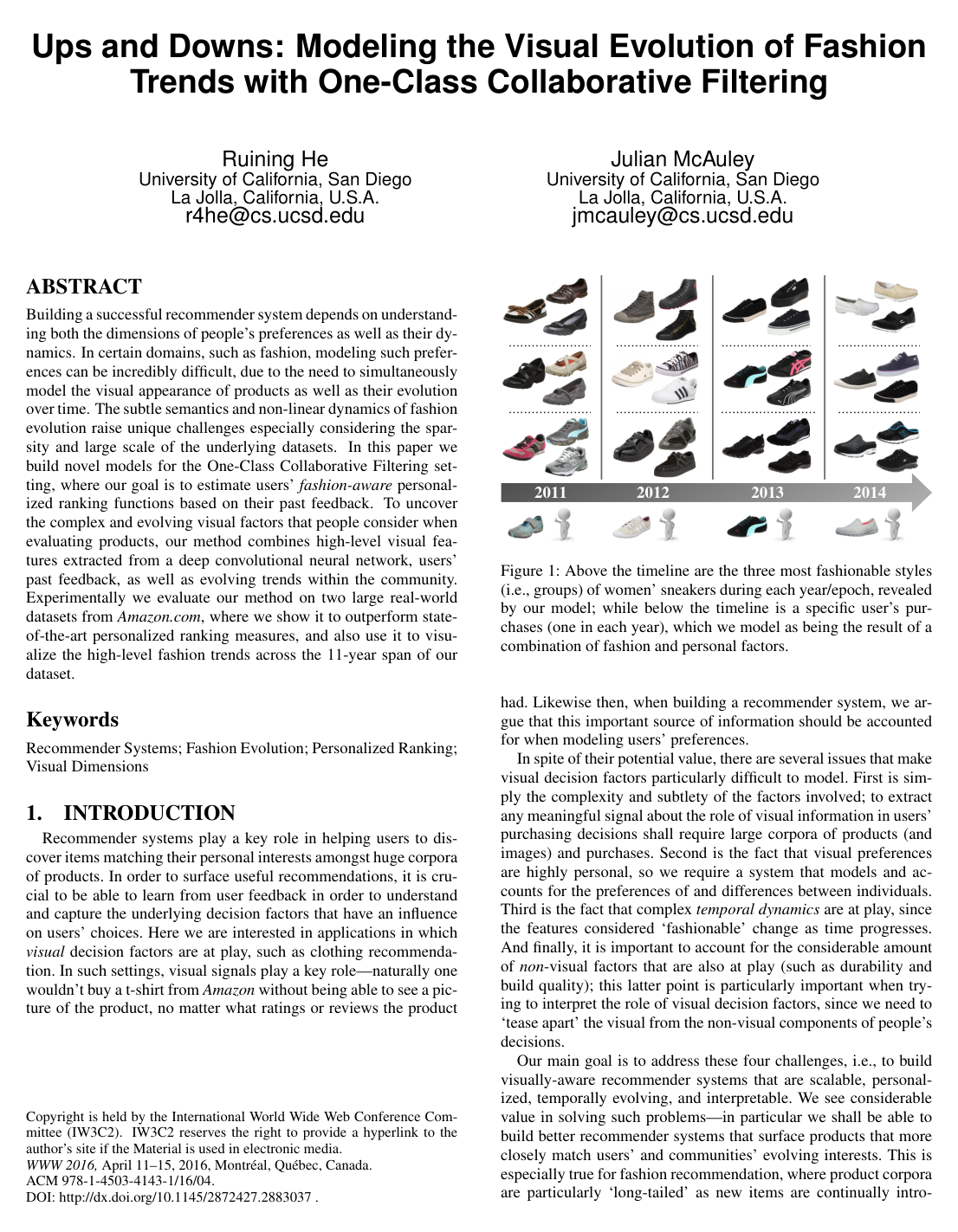
Ups and Downs: Modeling the Visual Evolution of Fashion Trends with One-Class Collaborative Filtering
Ruining He, Julian McAuley
Why you should read this
Introduces a visual collaborative filtering framework that integrates deep convolutional image features with temporal dynamics to model evolving fashion trends and deliver superior personalized product recommendations.
Building a successful recommender system depends on understanding both the dimensions of people's preferences as well as their dynamics. In certain domains, such as fashion, modeling such preferences can be incredibly difficult, due to the need to simultaneously model the visual appearance of products as well as their evolution over time. The subtle semantics and non-linear dynamics of fashion evolution raise unique challenges especially considering the sparsity and large scale of the underlying datasets. In this paper we build novel models for the One-Class Collaborative Filtering setting, where our goal is to estimate users' fashion-aware personalized ranking functions based on their past feedback. To uncover the complex and evolving visual factors that people consider when evaluating products, our method combines high-level visual features extracted from a deep convolutional neural network, users' past feedback, as well as evolving trends within the community. Experimentally we evaluate our method on two large real-world datasets from this http URL, where we show it to outperform state-of-the-art personalized ranking measures, and also use it to visualize the high-level fashion trends across the 11-year span of our dataset.
Added
2026-09-14
Learning with Drift Detection
João Gama, Pedro Medas, Gladys Castillo, Pedro Pereira Rodrigues
Why you should read this
Introduces a foundational statistical process control method that monitors the online error rate of a classifier to explicitly trigger an alarm when concept drift occurs in a data stream.
Most of the work in machine learning assume that examples are generated at random according to some stationary probability distribution. In this work we study the problem of learning when the distribution that generate the examples changes over time. We present a method for detection of changes in the probability distribution of examples. The idea behind the drift detection method is to control the online error-rate of the algorithm. The training examples are presented in sequence. When a new training example is available, it is classified using the actual model. Statistical theory guarantees that while the distribution is stationary, the error will decrease. When the distribution changes, the error will increase. The method controls the trace of the online error of the algorithm. For the actual context we define a warning level, and a drift level. A new context is declared, if in a sequence of examples, the error increases reaching the warning level at example kw, and the drift level at example kd. This is an indication of a change in the distribution of the examples. The algorithm learns a new model using only the examples since kw. The method was tested with a set of eight artificial datasets and a real world dataset. We used three learning algorithms: a perceptron, a neural network and a decision tree. The experimental results show a good performance detecting drift and with learning the new concept. We also observe that the method is independent of the learning algorithm.
Added
2026-04-27