
keyword
classifier design
Classifier design is the process of developing, selecting, and training mathematical models or algorithms that automatically map input data into predefined categories or classes. In the field of statistical pattern recognition and machine learning, this involves establishing a decision rule and determining decision boundaries within a feature space using representative training samples. The design process typically encompasses selecting an appropriate classifier architecture, estimating model parameters from sample data, and balancing model complexity against available sample size to minimize classification error and ensure accurate generalization to unseen data.
2 items
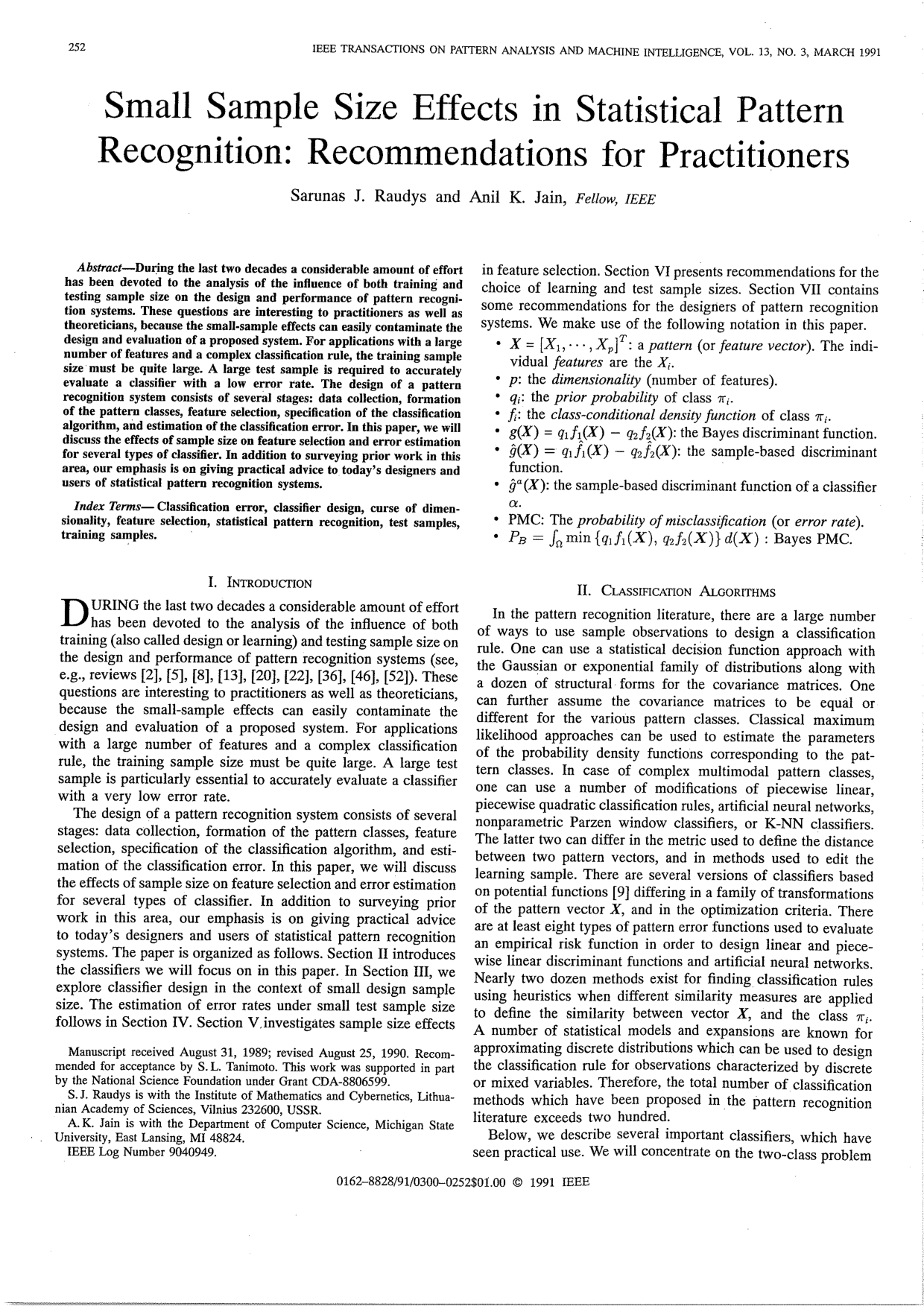
Small Sample Size Effects in Statistical Pattern Recognition: Recommendations for Practitioners
S. Raudys, Anil K. Jain
Why you should read this
Presents practical guidelines and quantitative analyses to help practitioners choose appropriate training and test sample sizes, avoid small-sample bias in classifier design and feature selection, and accurately estimate classification error rates.
During the last two decades a considerable amount of effort has been devoted to the analysis of the influence of both training and testing sample size on the design and performance of pattern recognition systems. These questions are interesting to practitioners as well as theoreticians, because the small-sample effects can easily contaminate the design and evaluation of a proposed system. For applications with a large number of features and a complex classification rule, the training sample size must be quite large. A large test sample is required to accurately evaluate a classifier with a low error rate. The design of a pattern recognition system consists of several stages: data collection, formation of the pattern classes, feature selection, specification of the classification algorithm, and estimation of the classification error. In this paper, we will discuss the effects of sample size on feature selection and error estimation for several types of classifier. In addition to surveying prior work in this area, our emphasis is on giving practical advice to today's designers and users of statistical pattern recognition systems.
Added
2026-09-25
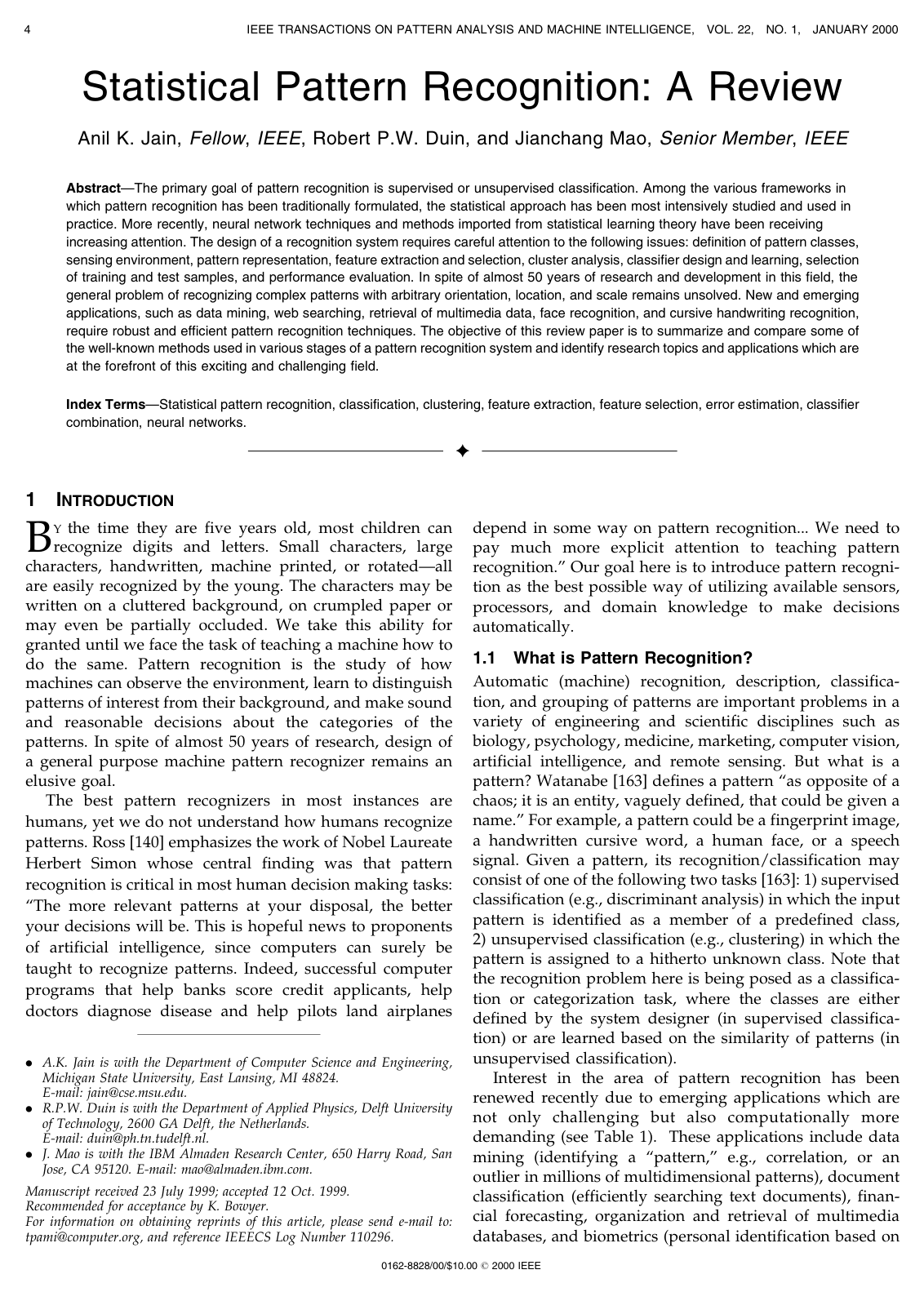
Statistical Pattern Recognition: A Review
Anil K. Jain, Robert P.W. Duin, Jianchang Mao
Why you should read this
Systematizes the entire statistical pattern recognition pipeline, comparing methods for feature selection, clustering, and classification while connecting classical decision theory with neural networks and statistical learning theory.
The primary goal of pattern recognition is supervised or unsupervised classification. Among the various frameworks in which pattern recognition has been traditionally formulated, the statistical approach has been most intensively studied and used in practice. More recently, neural network techniques and methods imported from statistical learning theory have been receiving increasing attention. The design of a recognition system requires careful attention to the following issues: definition of pattern classes, sensing environment, pattern representation, feature extraction and selection, cluster analysis, classifier design and learning, selection of training and test samples, and performance evaluation. In spite of almost 50 years of research and development in this field, the general problem of recognizing complex patterns with arbitrary orientation, location, and scale remains unsolved. New and emerging applications, such as data mining, web searching, retrieval of multimedia data, face recognition, and cursive handwriting recognition, require robust and efficient pattern recognition techniques. The objective of this review paper is to summarize and compare some of the well-known methods used in various stages of a pattern recognition system and identify research topics and applications which are at the forefront of this exciting and challenging field.
Added
2026-09-09