
keyword
classification error
Classification error is a performance metric in machine learning and statistical pattern recognition that represents the proportion or rate of data instances incorrectly categorized by a predictive model. Calculated as the total number of misclassifications divided by the total number of evaluated samples, it is the direct complement to classification accuracy. In the development and assessment of classifiers, classification error is used to measure overall predictive performance, guide feature selection, and optimize decision boundaries. It is often analyzed through theoretical frameworks such as bias-variance decomposition to evaluate whether the inaccuracies of a model stem from underfitting, overfitting, or intrinsic noise in the data.
2 items
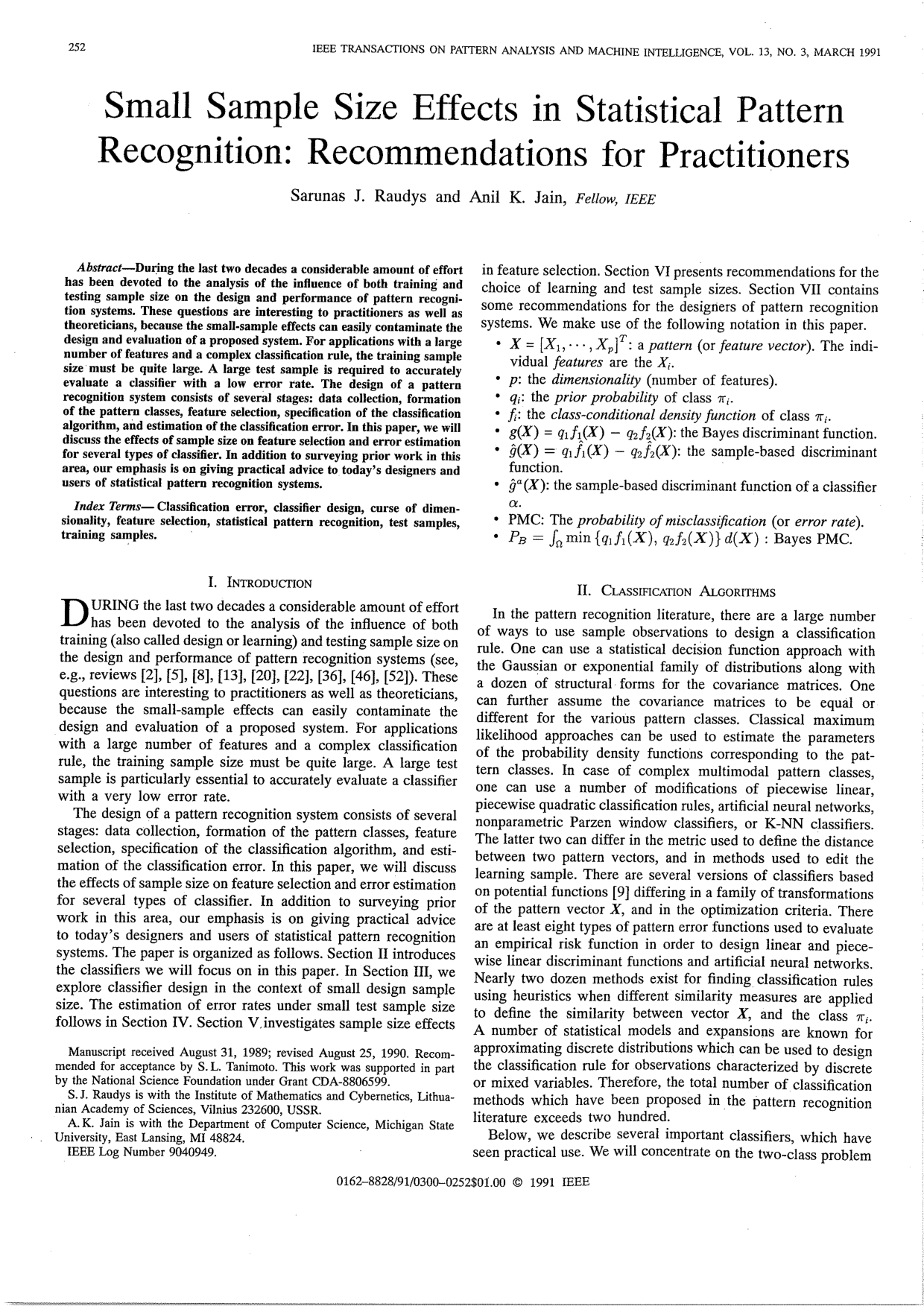
Small Sample Size Effects in Statistical Pattern Recognition: Recommendations for Practitioners
S. Raudys, Anil K. Jain
Why you should read this
Presents practical guidelines and quantitative analyses to help practitioners choose appropriate training and test sample sizes, avoid small-sample bias in classifier design and feature selection, and accurately estimate classification error rates.
During the last two decades a considerable amount of effort has been devoted to the analysis of the influence of both training and testing sample size on the design and performance of pattern recognition systems. These questions are interesting to practitioners as well as theoreticians, because the small-sample effects can easily contaminate the design and evaluation of a proposed system. For applications with a large number of features and a complex classification rule, the training sample size must be quite large. A large test sample is required to accurately evaluate a classifier with a low error rate. The design of a pattern recognition system consists of several stages: data collection, formation of the pattern classes, feature selection, specification of the classification algorithm, and estimation of the classification error. In this paper, we will discuss the effects of sample size on feature selection and error estimation for several types of classifier. In addition to surveying prior work in this area, our emphasis is on giving practical advice to today's designers and users of statistical pattern recognition systems.
Added
2026-09-25
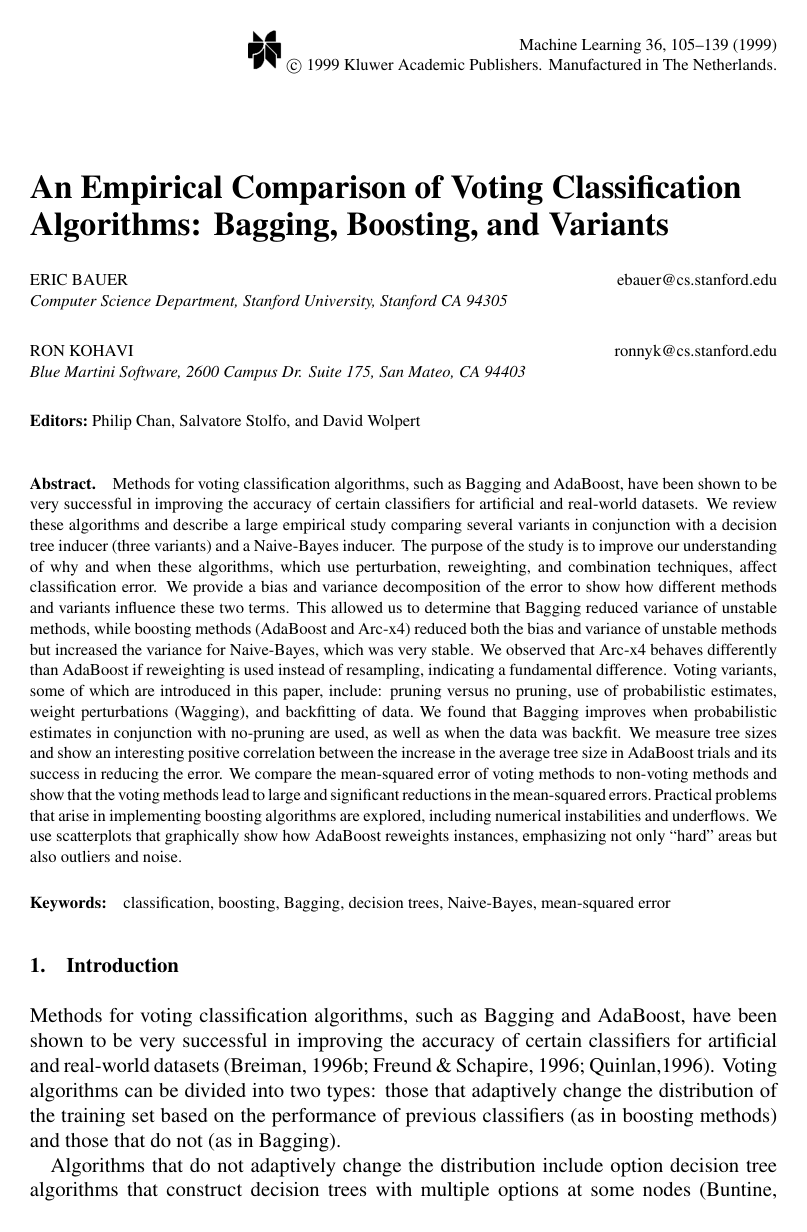
An Empirical Comparison of Voting Classification Algorithms: Bagging, Boosting, and Variants
Eric Bauer, Ron Kohavi
Why you should read this
Demonstrates through empirical bias-variance decomposition how bagging and boosting alter classification error, showing that bagging primarily reduces variance in unstable models while boosting reduces both bias and variance but struggles with noisy data and stable learners like Naive-Bayes.
Methods for voting classification algorithms, such as Bagging and AdaBoost, have been shown to be very successful in improving the accuracy of certain classifiers for artificial and real-world datasets. We review these algorithms and describe a large empirical study comparing several variants in conjunction with a decision tree inducer (three variants) and a Naive-Bayes inducer. The purpose of the study is to improve our understanding of why and when these algorithms, which use perturbation, reweighting, and combination techniques, affect classification error. We provide a bias and variance decomposition of the error to show how different methods and variants influence these two terms. This allowed us to determine that Bagging reduced variance of unstable methods, while boosting methods (AdaBoost and Arc-x4) reduced both the bias and variance of unstable methods but increased the variance for Naive-Bayes, which was very stable. We observed that Arc-x4 behaves differently than AdaBoost if reweighting is used instead of resampling, indicating a fundamental difference. Voting variants, some of which are introduced in this paper, include: pruning versus no pruning, use of probabilistic estimates, weight perturbations (Wagging), and backfitting of data. We found that Bagging improves when probabilistic estimates in conjunction with no-pruning are used, as well as when the data was backfit. We measure tree sizes and show an interesting positive correlation between the increase in the average tree size in AdaBoost trials and its success in reducing the error. We compare the mean-squared error of voting methods to non-voting methods and show that the voting methods lead to large and significant reductions in the mean-squared errors. Practical problems that arise in implementing boosting algorithms are explored, including numerical instabilities and underflows. We use scatterplots that graphically show how AdaBoost reweights instances, emphasizing not only “hard” areas but also outliers and noise.
Added
2026-09-14