
keyword
bounding box supervision
Bounding box supervision is a training paradigm in computer vision where machine learning models are trained using rectangular coordinate annotations that specify the spatial boundaries and classes of target objects within an image. Commonly used in object detection, this form of supervision supplies coarse spatial localization and scale information without requiring precise, pixel-level delineation of object boundaries. In more fine-grained tasks such as instance segmentation and visual grounding, bounding box supervision often functions as an efficient form of weak supervision, offering a practical balance between the minimal effort of image-level tags and the labor-intensive requirements of full segmentation masks.
3 items
GUI-Actor: Coordinate-Free Visual Grounding for GUI Agents
Qianhui Wu, Kanzhi Cheng, Rui Yang, Chaoyun Zhang, Jianwei Yang, Huiqiang Jiang, Jian Mu, Baolin Peng, Bo Qiao, Reuben Tan, Si Qin, Lars Liden, Qingwei Lin 林庆维, Huan Zhang, Tong Zhang, Jianbing Zhang, Dongmei Zhang, Jianfeng Gao
Why you should read this
Presents GUI-Actor, a coordinate-free visual grounding framework for GUI agents that replaces text coordinate generation with an attention-based action head and verifier, enabling a 7B vision-language model to outperform 72B baselines on interface benchmarks while training only 100M parameters.
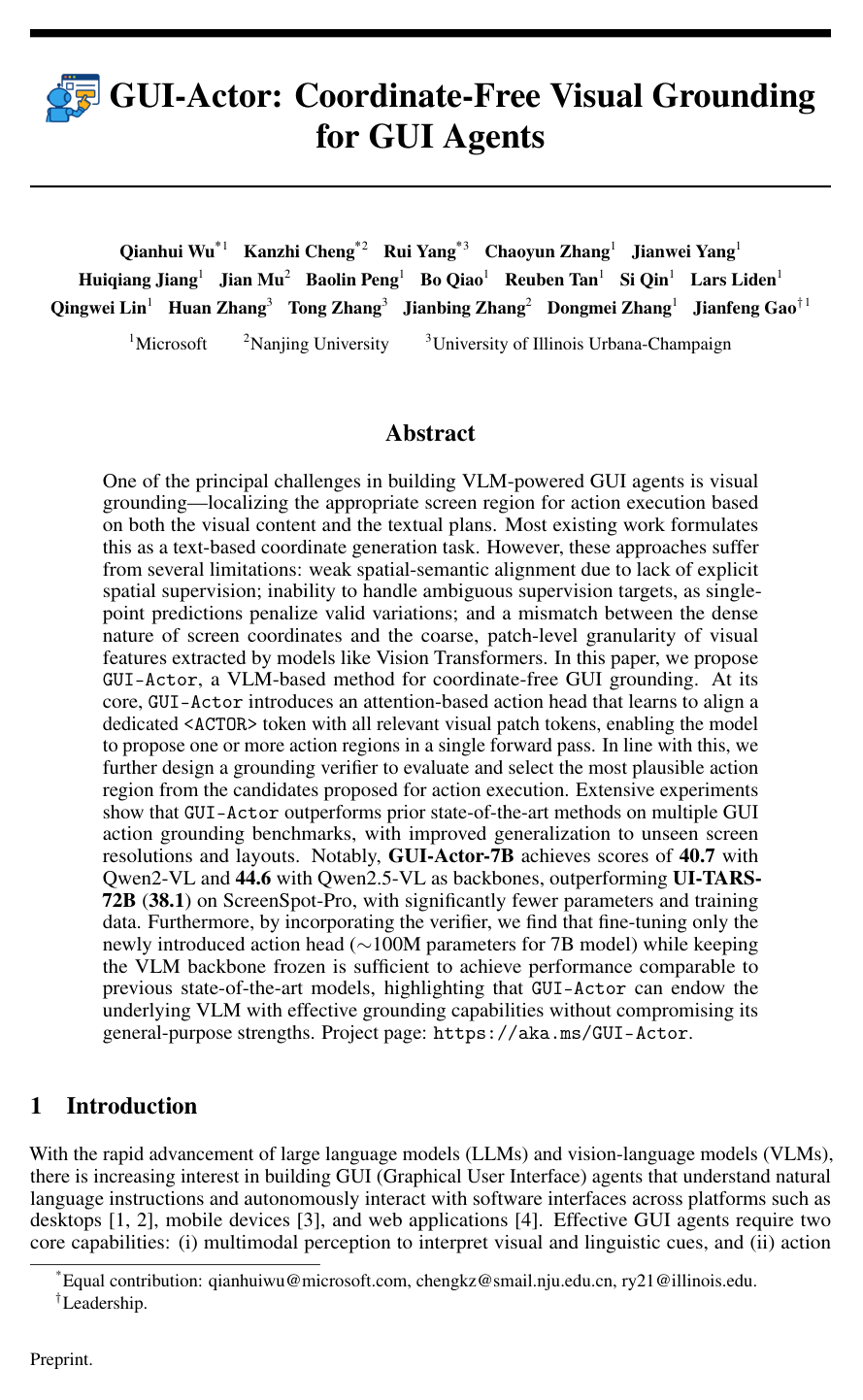
One of the principal challenges in building VLM-powered GUI agents is visual grounding, i.e., localizing the appropriate screen region for action execution based on both the visual content and the textual plans. Most existing work formulates this as a text-based coordinate generation task. However, these approaches suffer from several limitations: weak spatial-semantic alignment, inability to handle ambiguous supervision targets, and a mismatch between the dense nature of screen coordinates and the coarse, patch-level granularity of visual features extracted by models like Vision Transformers. In this paper, we propose GUI-Actor, a VLM-based method for coordinate-free GUI grounding. At its core, GUI-Actor introduces an attention-based action head that learns to align a dedicated <ACTOR> token with all relevant visual patch tokens, enabling the model to propose one or more action regions in a single forward pass. In line with this, we further design a grounding verifier to evaluate and select the most plausible action region from the candidates proposed for action execution. Extensive experiments show that GUI-Actor outperforms prior state-of-the-art methods on multiple GUI action grounding benchmarks, with improved generalization to unseen screen resolutions and layouts. Notably, GUI-Actor-7B even surpasses UI-TARS-72B (38.1) on ScreenSpot-Pro, achieving scores of 40.7 with Qwen2-VL and 44.6 with Qwen2.5-VL as backbones. Furthermore, by incorporating the verifier, we find that fine-tuning only the newly introduced action head (~100M parameters for 7B model) while keeping the VLM backbone frozen is sufficient to achieve performance comparable to previous state-of-the-art models, highlighting that GUI-Actor can endow the underlying VLM with effective grounding capabilities without compromising its general-purpose strengths.
Added
2026-10-01
Pointly-Supervised Instance Segmentation
Bowen Cheng, Omkar Parkhi, Alexander Kirillov
Why you should read this
Proposes a point-based annotation scheme combining bounding boxes with just ten labeled random points per object, allowing standard instance segmentation models to match up to 98% of fully supervised performance while cutting annotation time by five times.
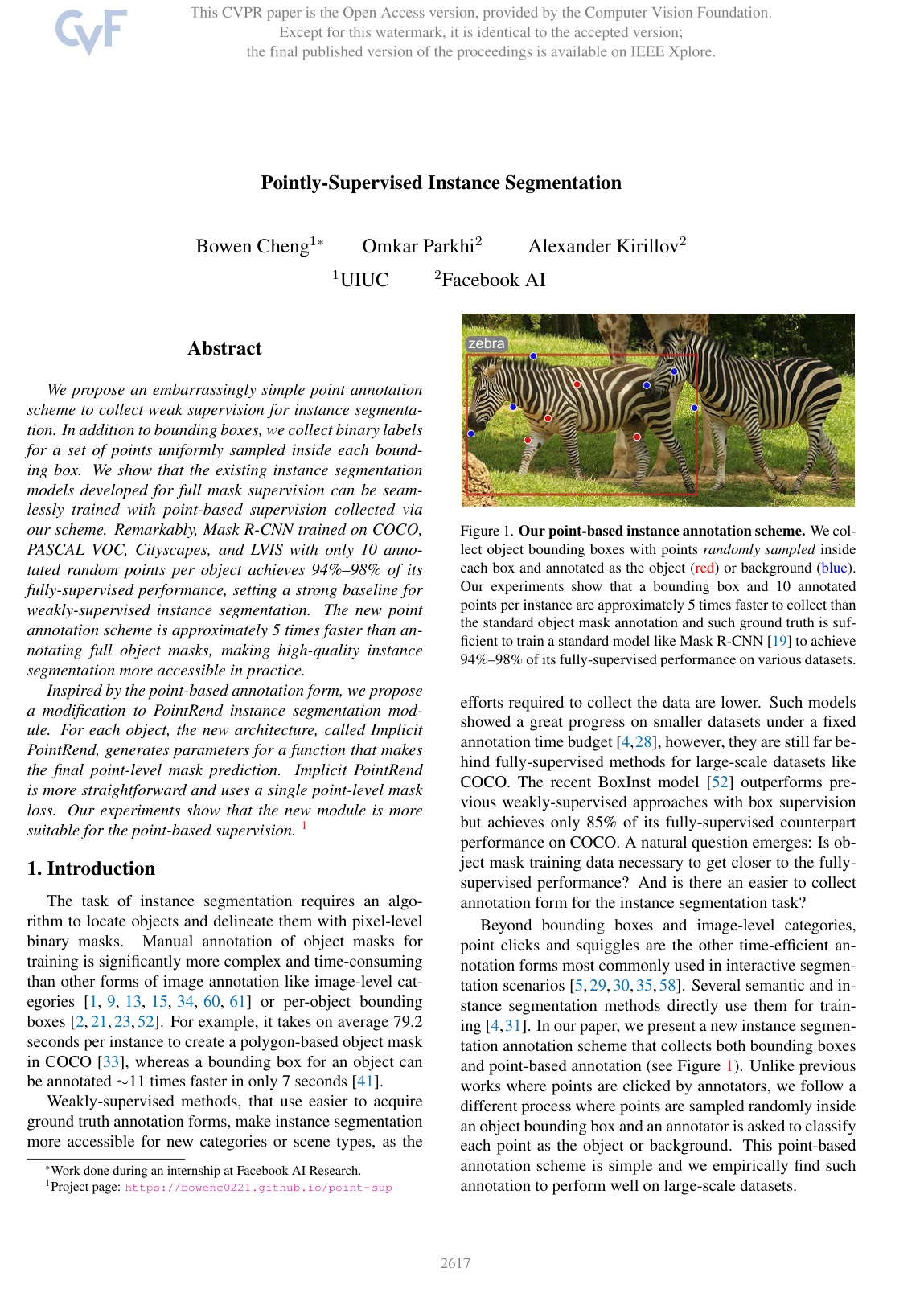
We propose an embarrassingly simple point annotation scheme to collect weak supervision for instance segmentation. In addition to bounding boxes, we collect binary labels for a set of points uniformly sampled inside each bounding box. We show that the existing instance segmentation models developed for full mask supervision can be seamlessly trained with point-based supervision collected via our scheme. Remarkably, Mask R-CNN trained on COCO, PASCAL VOC, Cityscapes, and LVIS with only 10 annotated random points per object achieves 94%–98% of its fully-supervised performance, setting a strong baseline for weakly-supervised instance segmentation. The new point annotation scheme is approximately 5 times faster than annotating full object masks, making high-quality instance segmentation more accessible in practice. Inspired by the point-based annotation form, we propose a modification to PointRend instance segmentation module. For each object, the new architecture, called Implicit PointRend, generates parameters for a function that makes the final point-level mask prediction. Implicit PointRend is more straightforward and uses a single point-level mask loss. Our experiments show that the new module is more suitable for the point-based supervision.
Added
2026-09-26
Open-Vocabulary Instance Segmentation via Robust Cross-Modal Pseudo-Labeling
Dat Huynh, Jason Kuen, Zhe Lin, Jiuxiang Gu, Ehsan Elhamifar
Why you should read this
Proposes a cross-modal pseudo-labeling framework that aligns caption words with visual mask features and filters label noise to segment novel object classes without mask annotations.
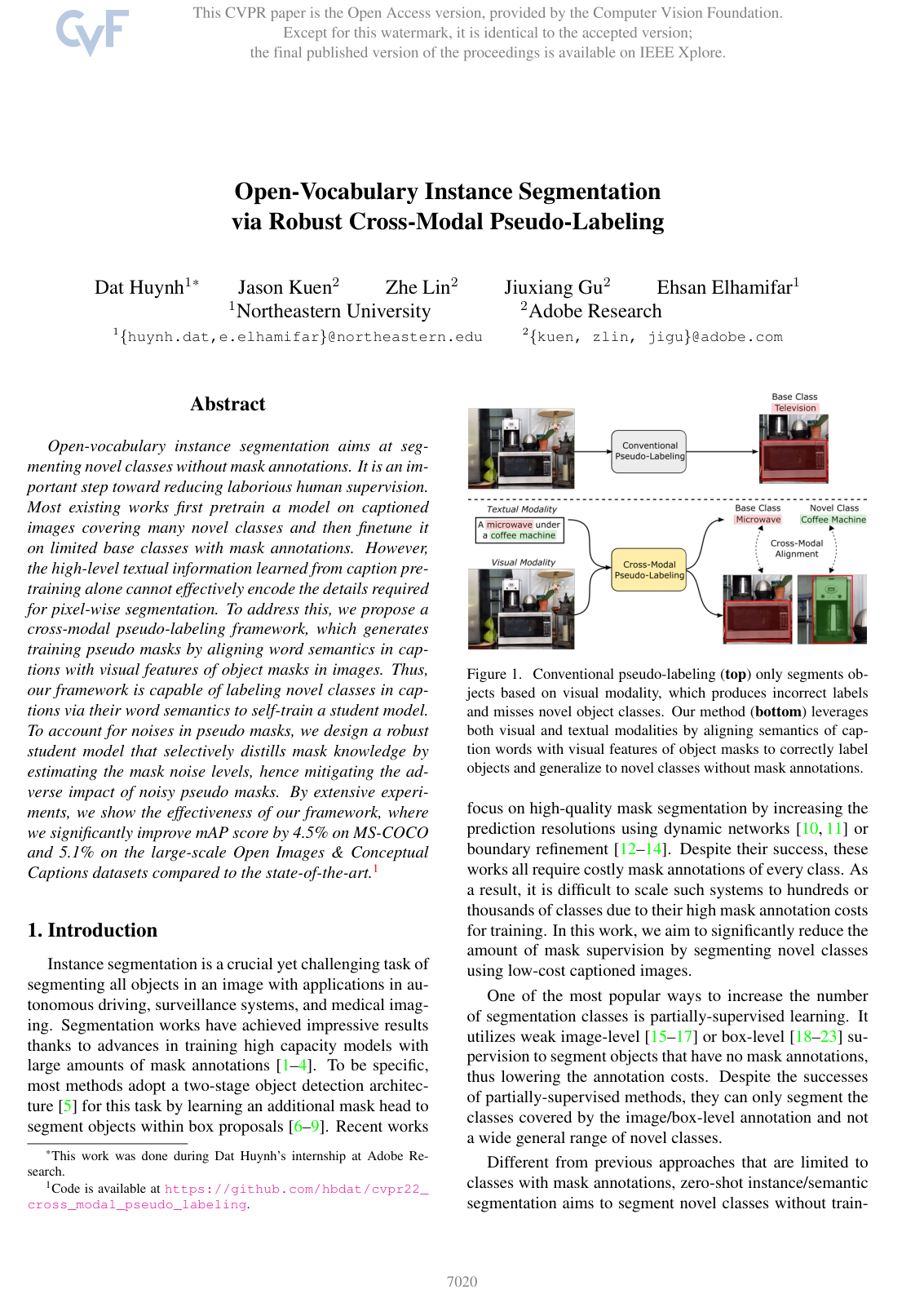
Open-vocabulary instance segmentation aims at segmenting novel classes without mask annotations. It is an important step toward reducing laborious human supervision. Most existing works first pretrain a model on captioned images covering many novel classes and then finetune it on limited base classes with mask annotations. However, the high-level textual information learned from caption pre-training alone cannot effectively encode the details required for pixel-wise segmentation. To address this, we propose a cross-modal pseudo-labeling framework, which generates training pseudo masks by aligning word semantics in captions with visual features of object masks in images. Thus, our framework is capable of labeling novel classes in captions via their word semantics to self-train a student model. To account for noises in pseudo masks, we design a robust student model that selectively distills mask knowledge by estimating the mask noise levels, hence mitigating the adverse impact of noisy pseudo masks. By extensive experiments, we show the effectiveness of our framework, where we significantly improve mAP score by 4.5% on MS-COCO and 5.1% on the large-scale Open Images & Conceptual Captions datasets compared to the state-of-the-art.
Added
2026-09-26