
keyword
boundary conditions
Boundary conditions are a set of mathematical constraints or prescribed values applied along the physical or computational borders of a domain to determine a unique solution to a differential equation. In fields such as physics, applied mathematics, and computational modeling, differential equations describe continuous phenomena like fluid flow, heat distribution, structural deformation, or image gradients across a region, but they yield infinitely many possible outcomes on their own. Boundary conditions resolve this indeterminacy by defining the state or behavior at the limits of the system, such as specifying fixed values along the perimeter, defining rates of change and fluxes perpendicular to the edges, or linking the system to surrounding external forces and structures. Imposing appropriate boundary conditions is fundamental to formulating well-posed boundary value problems, ensuring that numerical simulation methods achieve stability, convergence, and physical accuracy.
3 items
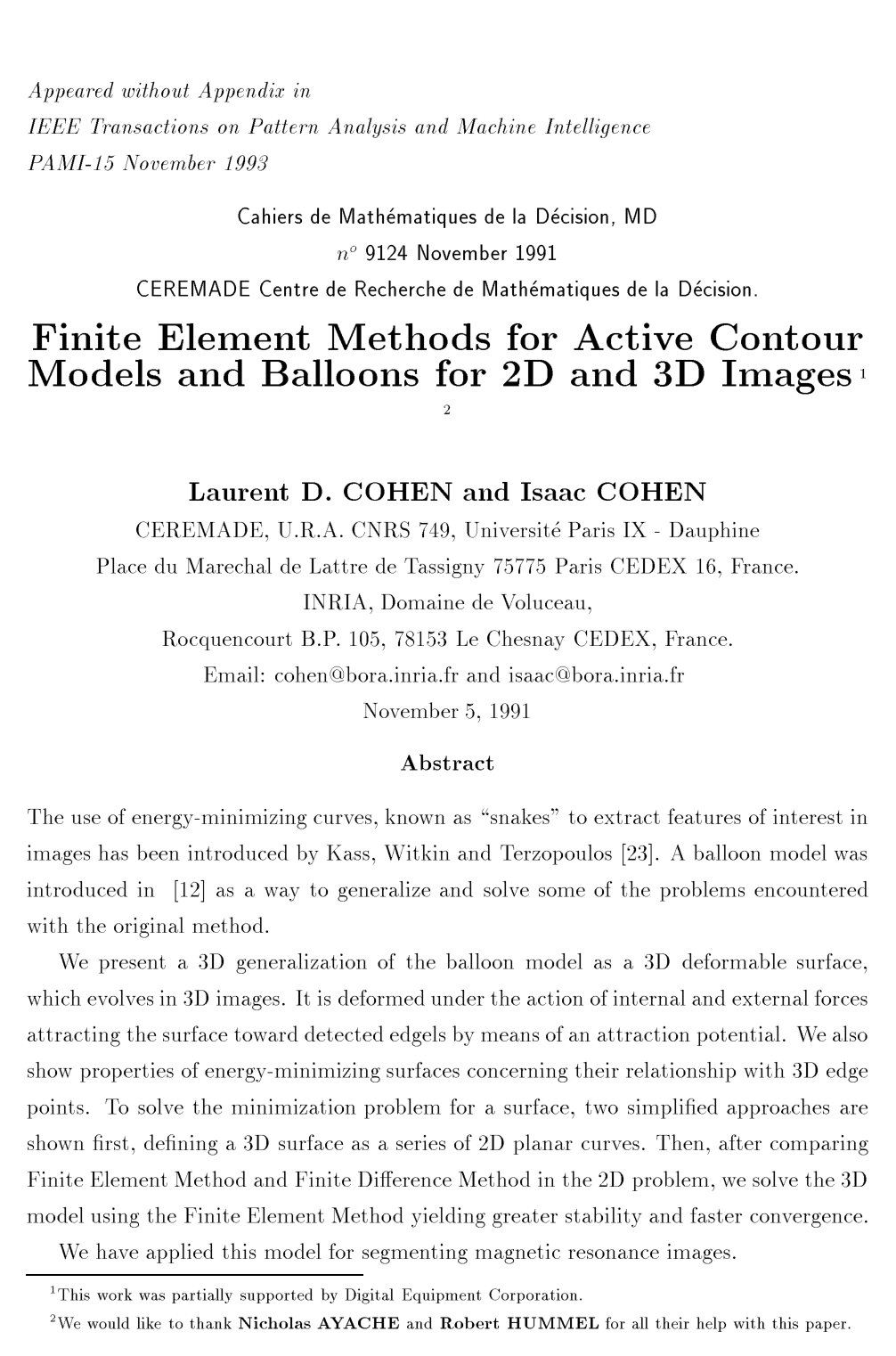
Finite-Element Methods for Active Contour Models and Balloons for 2-D and 3-D Images
L. Cohen, I. Cohen
Why you should read this
Presents a three-dimensional generalization of the balloon deformable surface model and implements a finite element framework that achieves faster convergence and superior numerical stability for volumetric medical image segmentation.
The use of energy-minimizing curves, known as "snakes" to extract features of interest in images has been introduced by Kass, Witkin and Terzopoulos [23]. A balloon model was introduced in [12] as a way to generalize and solve some of the problems encountered with the original method. We present a 3D generalization of the balloon model as a 3D deformable surface, which evolves in 3D images. It is deformed under the action of internal and external forces attracting the surface toward detected edgels by means of an attraction potential. We also show properties of energy-minimizing surfaces concerning their relationship with 3D edge points. To solve the minimization problem for a surface, two simplified approaches are shown first, defining a 3D surface as a series of 2D planar curves. Then, after comparing Finite Element Method and Finite Difference Method in the 2D problem, we solve the 3D model using the Finite Element Method yielding greater stability and faster convergence. We have applied this model for segmenting magnetic resonance images.
Added
2026-09-24
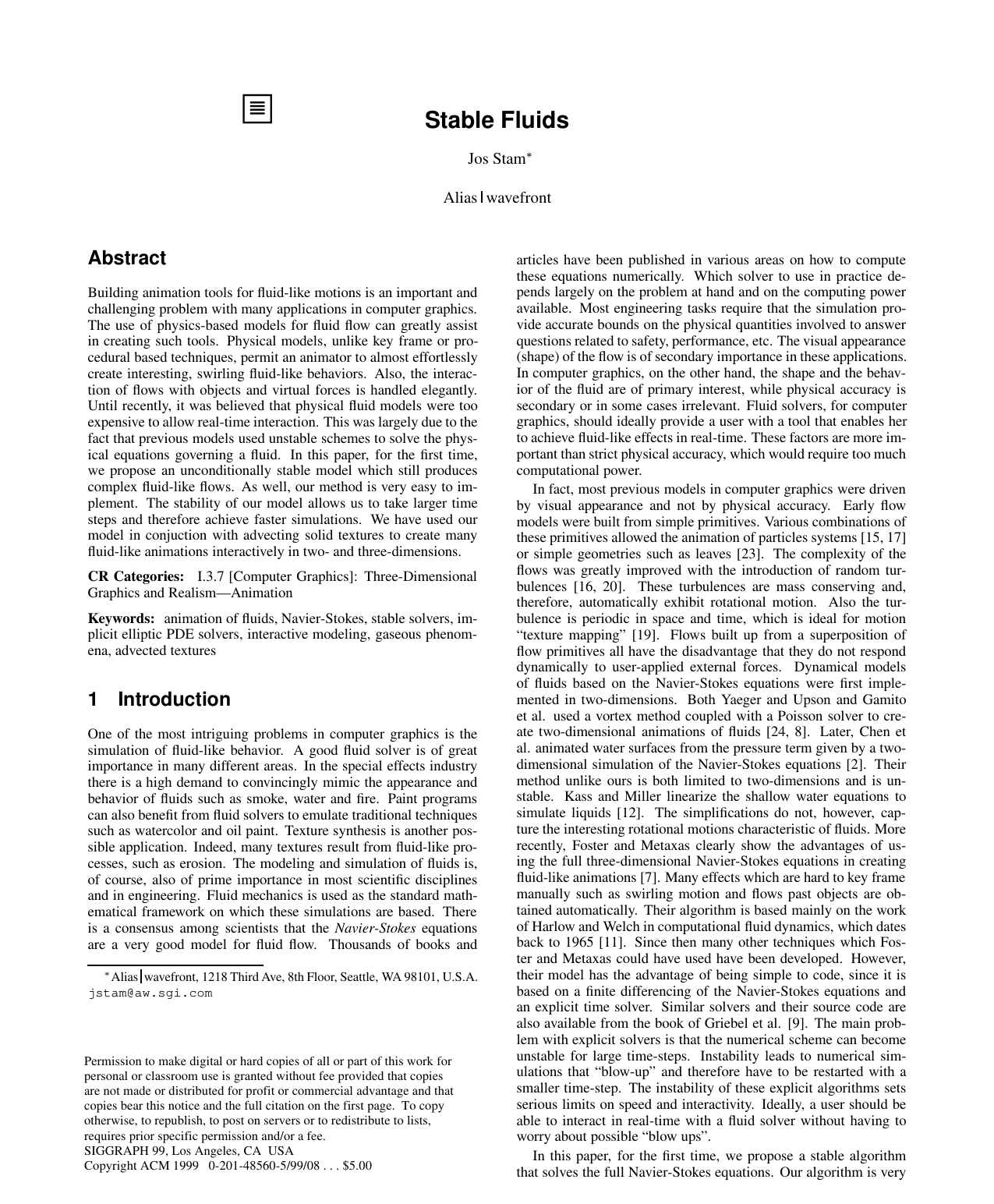
Stable fluids
Jos Stam
Why you should read this
Introduces an unconditionally stable numerical method for solving the Navier-Stokes equations via semi-Lagrangian advection and implicit diffusion, enabling fast, real-time, and blowup-free fluid simulation in computer graphics.
Building animation tools for fluid-like motions is an important and challenging problem with many applications in computer graphics. The use of physics-based models for fluid flow can greatly assist in creating such tools. Physical models, unlike key frame or procedural based techniques, permit an animator to almost effortlessly create interesting, swirling fluid-like behaviors. Also, the interaction of flows with objects and virtual forces is handled elegantly. Until recently, it was believed that physical fluid models were too expensive to allow real-time interaction. This was largely due to the fact that previous models used unstable schemes to solve the physical equations governing a fluid. In this paper, for the first time, we propose an unconditionally stable model which still produces complex fluid-like flows. As well, our method is very easy to implement. The stability of our model allows us to take larger time steps and therefore achieve faster simulations. We have used our model in conjuction with advecting solid textures to create many fluid-like animations interactively in two- and three-dimensions.
Added
2026-09-18
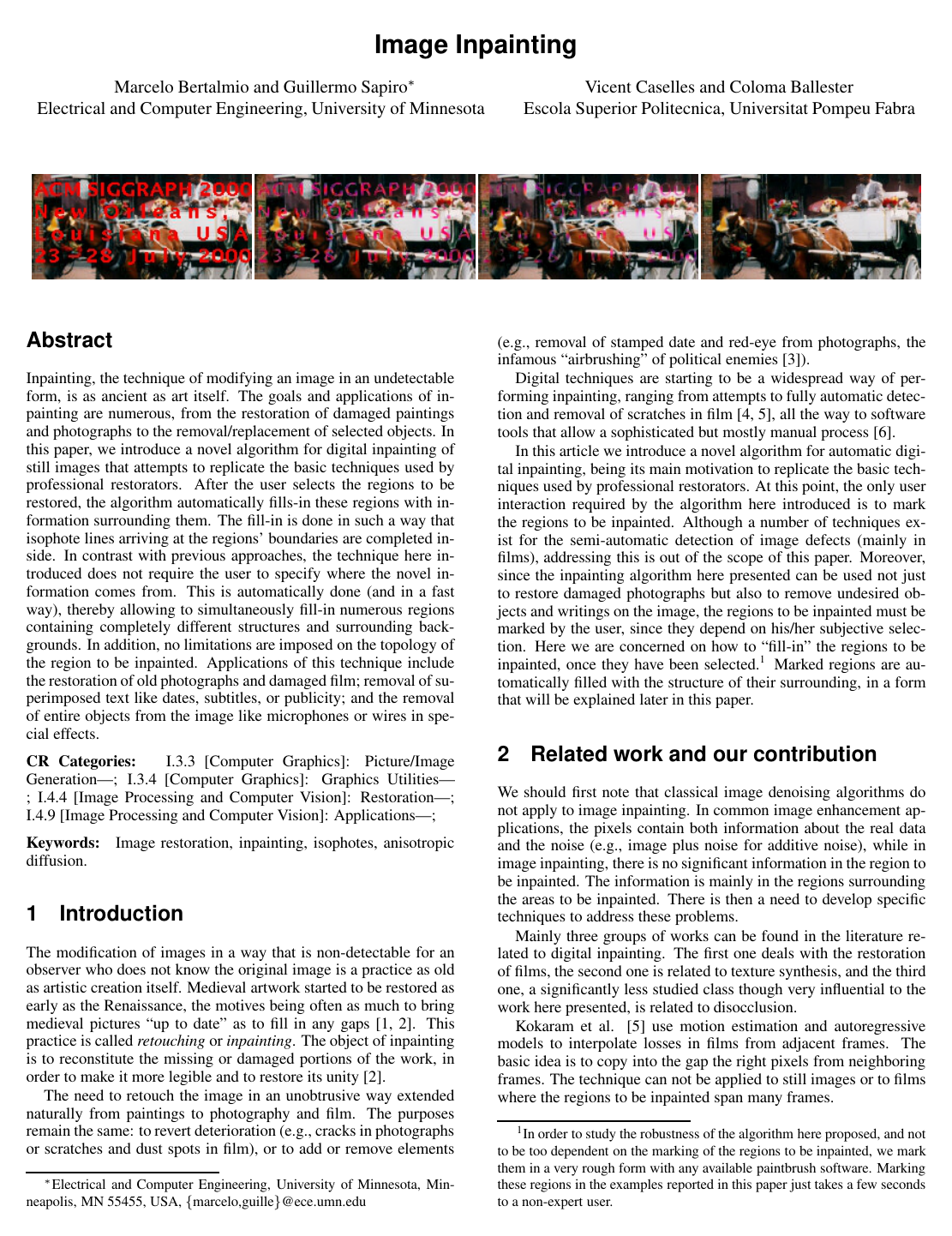
Image inpainting
Marcelo Bertalmio, Guillermo Sapiro, Vicent Caselles, Coloma Ballester
Why you should read this
Introduces an automatic digital inpainting algorithm that reconstructs missing or damaged image regions by propagating surrounding isophote lines inward, establishing a mathematical framework for photo restoration and object removal.
Inpainting, the technique of modifying an image in an undetectable form, is as ancient as art itself. The goals and applications of inpainting are numerous, from the restoration of damaged paintings and photographs to the removal/replacement of selected objects. In this paper, we introduce a novel algorithm for digital inpainting of still images that attempts to replicate the basic techniques used by professional restorators. After the user selects the regions to be restored, the algorithm automatically fills-in these regions with information surrounding them. The fill-in is done in such a way that isophote lines arriving at the regions’ boundaries are completed inside. In contrast with previous approaches, the technique here introduced does not require the user to specify where the novel information comes from. This is automatically done (and in a fast way), thereby allowing to simultaneously fill-in numerous regions containing completely different structures and surrounding backgrounds. In addition, no limitations are imposed on the topology of the region to be inpainted. Applications of this technique include the restoration of old photographs and damaged film; removal of superimposed text like dates, subtitles, or publicity; and the removal of entire objects from the image like microphones or wires in special effects.
Added
2026-09-10