
keyword
bidirectional attention
Bidirectional attention is an attention mechanism in neural network architectures where each element in a sequence or across interacting representations can simultaneously attend to and aggregate information from all other elements in both forward and backward directions without positional masking constraints. Unlike unidirectional or causal attention, which restricts each position to only attend to prior tokens for sequential, autoregressive generation, bidirectional attention evaluates the complete context across the entire input at once. This symmetrical flow of information enables the model to produce richer contextual representations by capturing dependencies between all tokens, cross-modal features, or distinct information streams. Consequently, bidirectional attention is widely used in encoder-based models, masked language modeling, text embedding generation, diffusion frameworks, and multi-modal alignment systems where holistic understanding and representation learning are prioritized over step-by-step sequence generation.
12 items
Reconstructing the Mind's Eye: fMRI-to-Image with Contrastive Learning and Diffusion Priors
Paul S. Scotti, Atmadeep Banerjee, Jimmie Goode, Stepan Shabalin, Alex Nguyen, Ethan Cohen, Aidan J. Dempster, Nathalie Verlinde, Elad Yundler, David Weisberg, Kenneth A. Norman, Tanishq Mathew Abraham
Why you should read this
Introduces MindEye, an fMRI-to-image framework that combines contrastive learning and diffusion priors to achieve state-of-the-art visual reconstruction and large-scale image retrieval directly from human brain activity.
We present MindEye, a novel fMRI-to-image approach to retrieve and reconstruct viewed images from brain activity. Our model comprises two parallel submodules that are specialized for retrieval (using contrastive learning) and reconstruction (using a diffusion prior). MindEye can map fMRI brain activity to any high dimensional multimodal latent space, like CLIP image space, enabling image reconstruction using generative models that accept embeddings from this latent space. We comprehensively compare our approach with other existing methods, using both qualitative side-by-side comparisons and quantitative evaluations, and show that MindEye achieves state-of-the-art performance in both reconstruction and retrieval tasks. In particular, MindEye can retrieve the exact original image even among highly similar candidates, indicating that its brain embeddings retain fine-grained image-specific information. This allows us to accurately retrieve images even from large-scale databases like LAION-5B. We demonstrate through ablations that MindEye’s performance improvements over previous methods result from specialized submodules for retrieval and reconstruction, improved training techniques, and training models with orders of magnitude more parameters. Furthermore, we show that MindEye can better preserve low-level image features in the reconstructions by using img2img, with outputs from a separate autoencoder. All code is available on GitHub.
Added
2026-10-05
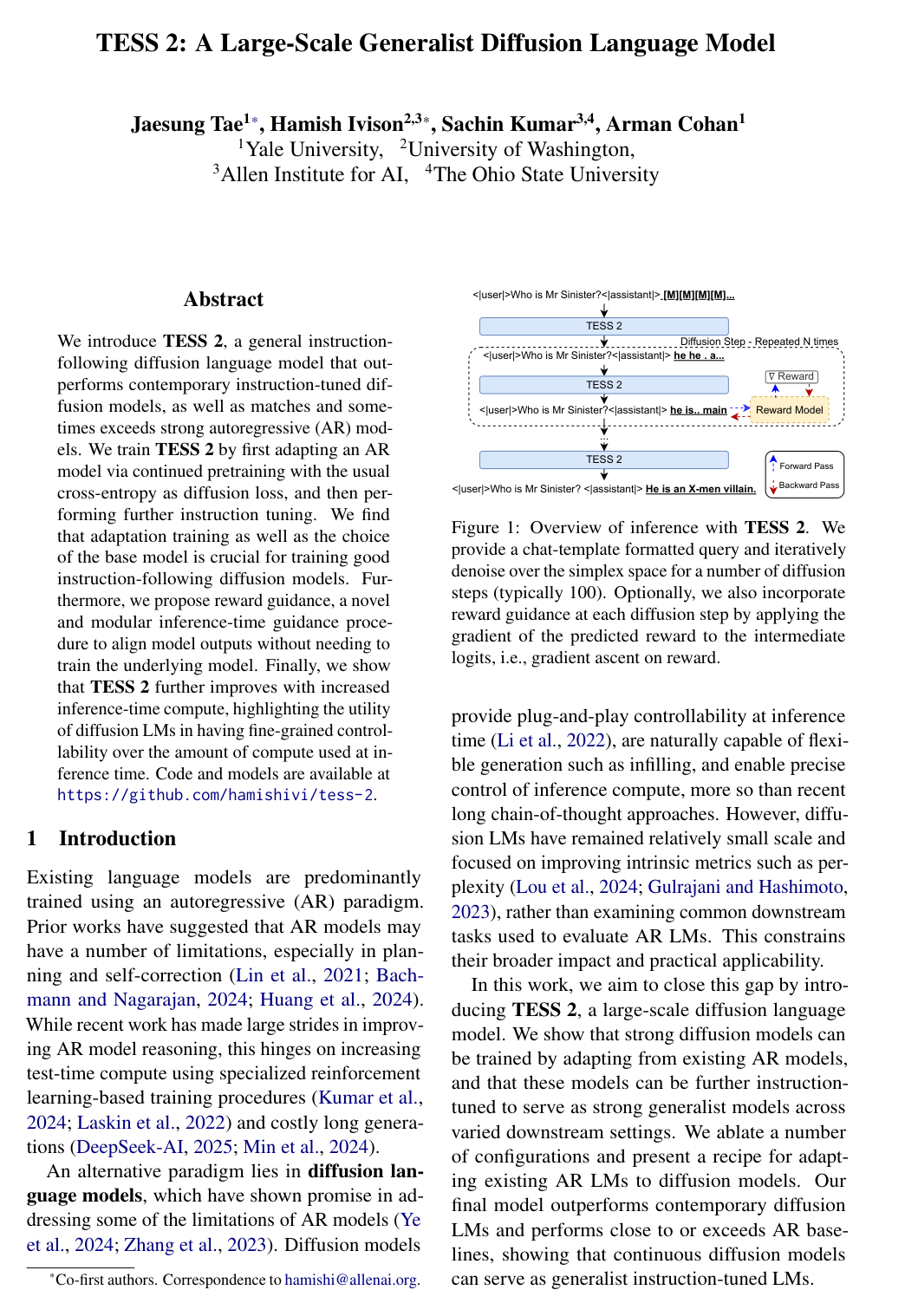
TESS 2: A Large-Scale Generalist Diffusion Language Model
Jaesung Tae, Hamish Ivison, Sachin Kumar, Arman Cohan
Why you should read this
Presents a method for adapting autoregressive models into competitive instruction-following diffusion language models that support modular, training-free reward guidance and scale effectively with inference-time compute.
We introduce TESS 2, a general instruction-following diffusion language model that outperforms contemporary instruction-tuned diffusion models, as well as matches and sometimes exceeds strong autoregressive (AR) models. We train TESS 2 by first adapting a strong AR model via continued pretraining with the usual cross-entropy as diffusion loss, and then performing further instruction tuning. We find that adaptation training as well as the choice of the base model is crucial for training good instruction-following diffusion models. We further propose reward guidance, a novel and modular inference-time guidance procedure to align model outputs without needing to train the underlying model. Finally, we show that TESS 2 further improves with increased inference-time compute, highlighting the utility of diffusion LMs in having fine-grained controllability over the amount of compute used at inference time. Code and models are available at this https URL.
Added
2026-10-04
DocLLM: A Layout-Aware Generative Language Model for Multimodal Document Understanding
Dongsheng Wang, Natraj Raman, Mathieu Sibue, Zhiqiang Ma, Petr Babkin, Simerjot Kaur, Yulong Pei, Armineh Nourbakhsh, Xiaomo Liu
Why you should read this
Presents DocLLM, a lightweight generative model that incorporates document layout into large language models via disentangled spatial attention and text infilling pre-training, achieving superior performance on visual document tasks without the computational expense of vision encoders.
Enterprise documents such as forms, receipts, reports, and other such records, often carry rich semantics at the intersection of textual and spatial modalities. The visual cues offered by their complex layouts play a crucial role in comprehending these documents effectively. In this paper, we present DocLLM, a lightweight extension to traditional large language models (LLMs) for reasoning over visual documents, taking into account both textual semantics and spatial layout. Our model differs from existing multimodal LLMs by avoiding expensive image encoders and focuses exclusively on bounding box information to incorporate the spatial layout structure. Specifically, the cross-alignment between text and spatial modalities is captured by decomposing the attention mechanism in classical transformers to a set of disentangled matrices. Furthermore, we devise a pre-training objective that learns to infill text segments. This approach allows us to address irregular layouts and heterogeneous content frequently encountered in visual documents. The pre-trained model is fine-tuned using a large-scale instruction dataset, covering four core document intelligence tasks. We demonstrate that our solution outperforms SotA LLMs on 14 out of 16 datasets across all tasks, and generalizes well to 4 out of 5 previously unseen datasets.
Added
2026-10-01
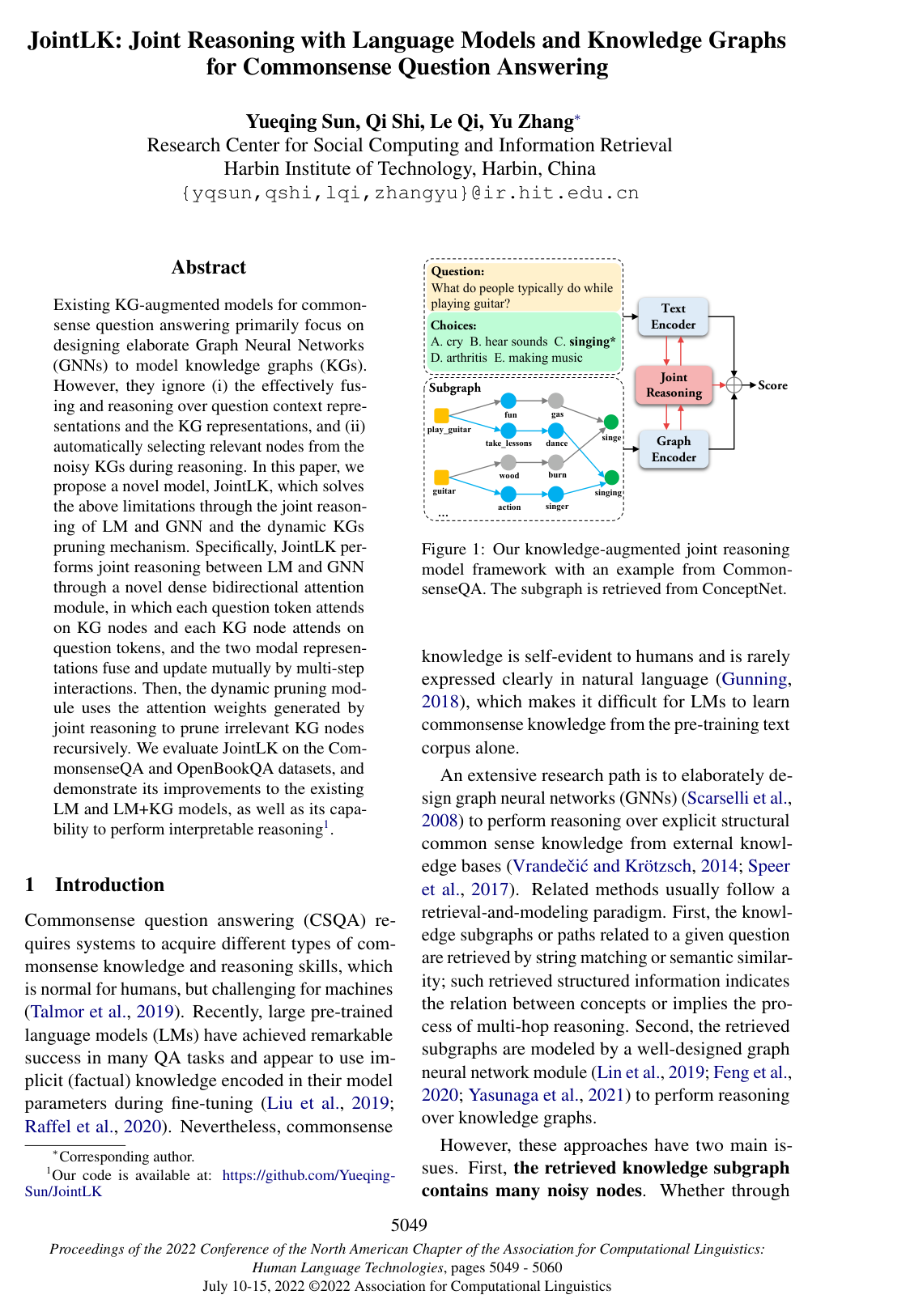
JointLK: Joint Reasoning with Language Models and Knowledge Graphs for Commonsense Question Answering
Yueqing Sun, Qi Shi, Le Qi, Yu Zhang
Why you should read this
Proposes JointLK, a model that unites pretrained language models and graph neural networks through fine-grained bidirectional attention and dynamic node pruning to filter irrelevant knowledge and deliver interpretable commonsense question answering.
Existing KG-augmented models for common-sense question answering primarily focus on designing elaborate Graph Neural Networks (GNNs) to model knowledge graphs (KGs). However, they ignore (i) the effectively fusing and reasoning over question context representations and the KG representations, and (ii) automatically selecting relevant nodes from the noisy KGs during reasoning. In this paper, we propose a novel model, JointLK, which solves the above limitations through the joint reasoning of LM and GNN and the dynamic KGs pruning mechanism. Specifically, JointLK performs joint reasoning between LM and GNN through a novel dense bidirectional attention module, in which each question token attends on KG nodes and each KG node attends on question tokens, and the two modal representations fuse and update mutually by multi-step interactions. Then, the dynamic pruning module uses the attention weights generated by joint reasoning to prune irrelevant KG nodes recursively. We evaluate JointLK on the CommonsenseQA and OpenBookQA datasets, and demonstrate its improvements to the existing LM and LM+KG models, as well as its capability to perform interpretable reasoning¹.
Added
2026-09-26
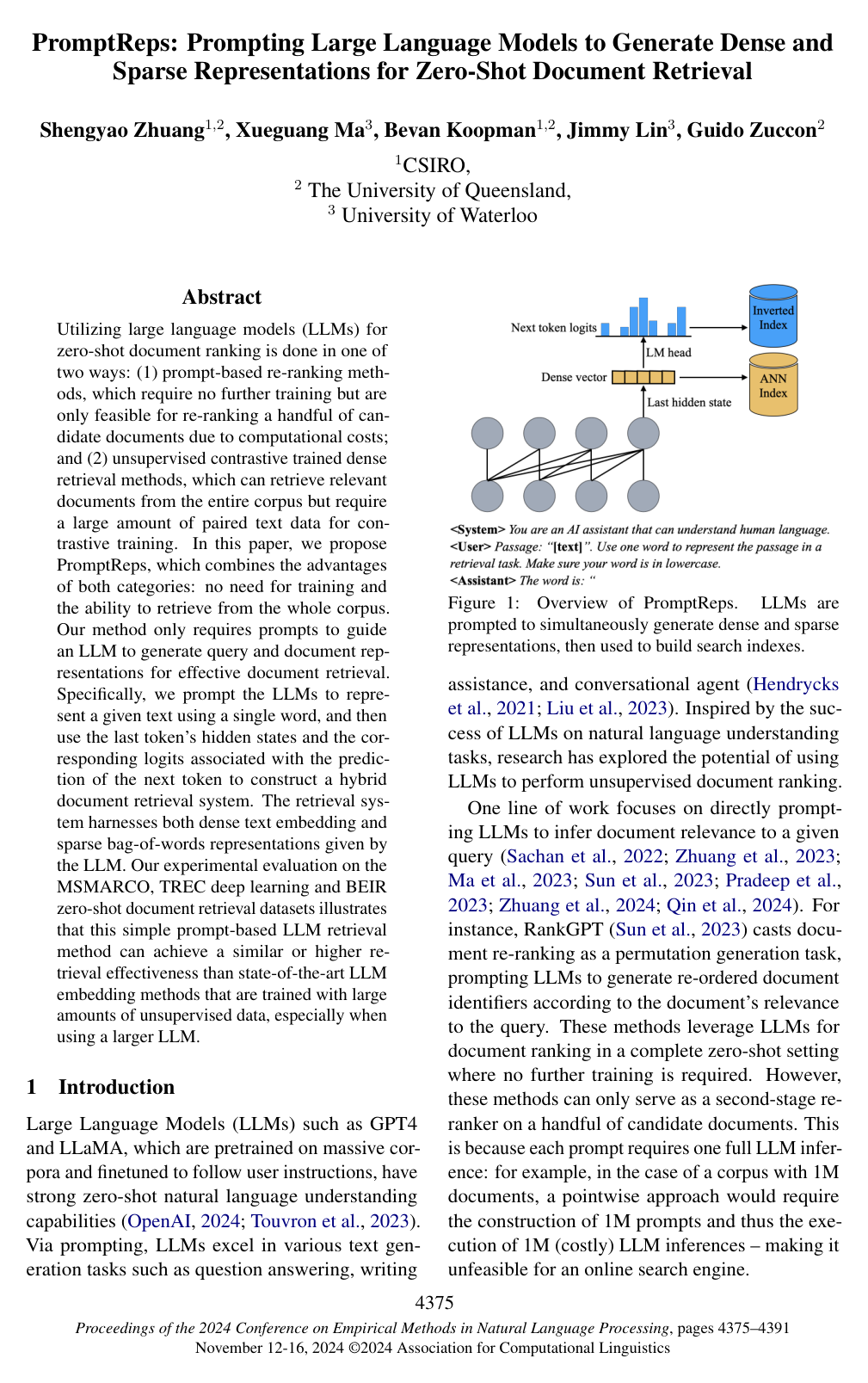
PromptReps: Prompting Large Language Models to Generate Dense and Sparse Representations for Zero-Shot Document Retrieval
Shengyao Zhuang, Xueguang Ma, Bevan Koopman, Jimmy Lin, Guido Zuccon
Why you should read this
Introduces a prompt-based approach that simultaneously extracts dense embeddings and sparse bag-of-words representations from large language models in a single forward pass, enabling zero-shot full-corpus document retrieval without expensive contrastive fine-tuning.
Utilizing large language models (LLMs) for zero-shot document ranking is done in one of two ways: (1) prompt-based re-ranking methods, which require no further training but are only feasible for re-ranking a handful of candidate documents due to computational costs; and (2) unsupervised contrastive trained dense retrieval methods, which can retrieve relevant documents from the entire corpus but require a large amount of paired text data for contrastive training. In this paper, we propose PromptReps, which combines the advantages of both categories: no need for training and the ability to retrieve from the whole corpus. Our method only requires prompts to guide an LLM to generate query and document representations for effective document retrieval. Specifically, we prompt the LLMs to represent a given text using a single word, and then use the last token’s hidden states and the corresponding logits associated with the prediction of the next token to construct a hybrid document retrieval system. The retrieval system harnesses both dense text embedding and sparse bag-of-words representations given by the LLM. Our experimental evaluation on the MSMARCO, TREC deep learning and BEIR zero-shot document retrieval datasets illustrates that this simple prompt-based LLM retrieval method can achieve a similar or higher retrieval effectiveness than state-of-the-art LLM embedding methods that are trained with large amounts of unsupervised data, especially when using a larger LLM.
Added
2026-09-26
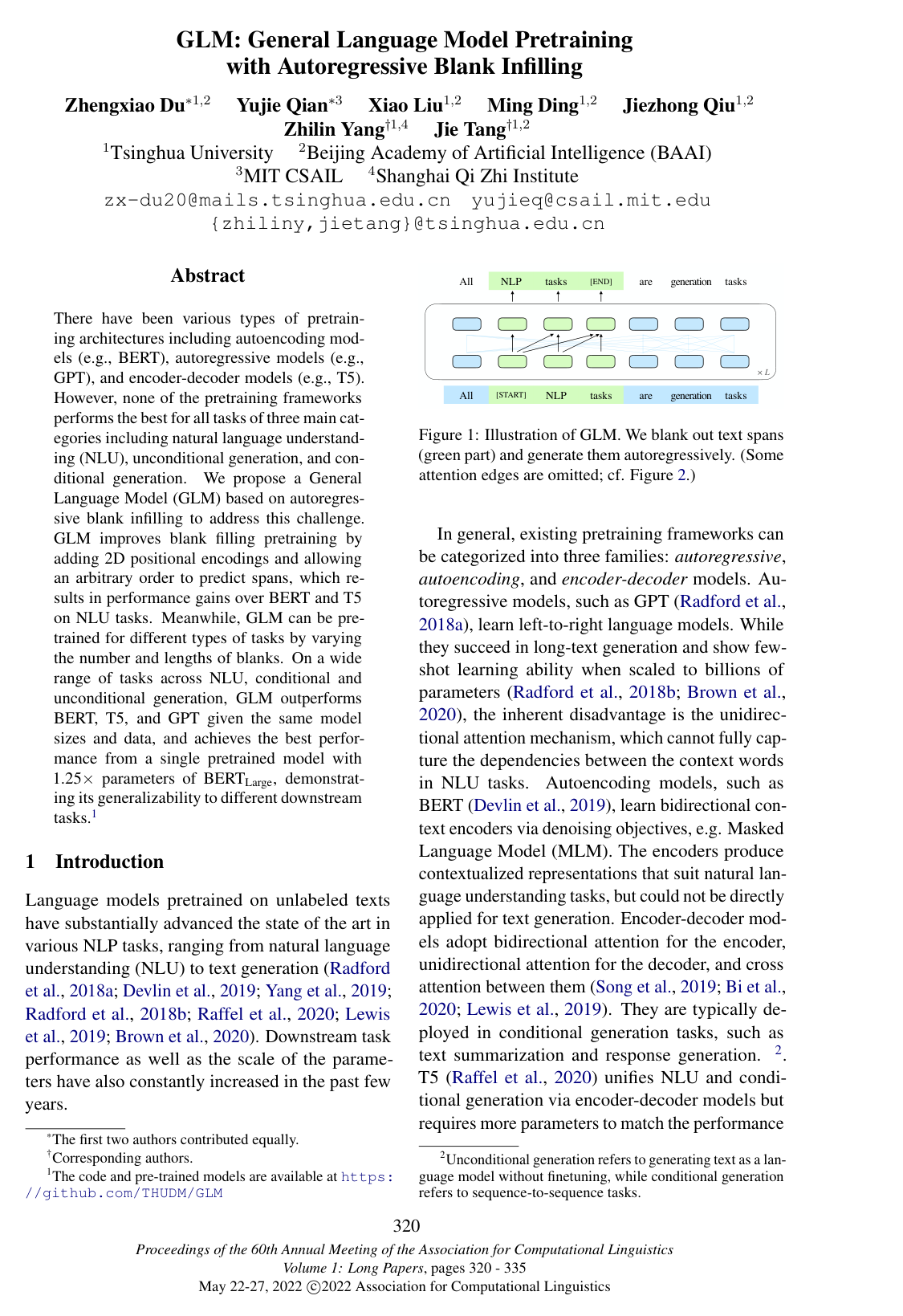
GLM: General Language Model Pretraining with Autoregressive Blank Infilling
Zhengxiao Du, Yujie Qian, Xiao Liu, Ming Ding, Jiezhong Qiu, Zhilin Yang, Jie Tang
Why you should read this
Introduces an autoregressive blank-infilling pretraining framework with 2D positional encodings that unifies natural language understanding, conditional generation, and unconditional generation while outperforming BERT, T5, and GPT across equivalent model scales.
There have been various types of pretraining architectures including autoencoding models (e.g., BERT), autoregressive models (e.g., GPT), and encoder-decoder models (e.g., T5). However, none of the pretraining frameworks performs the best for all tasks of three main categories including natural language understanding (NLU), unconditional generation, and conditional generation. We propose a General Language Model (GLM) based on autoregressive blank infilling to address this challenge. GLM improves blank filling pretraining by adding 2D positional encodings and allowing an arbitrary order to predict spans, which results in performance gains over BERT and T5 on NLU tasks. Meanwhile, GLM can be pretrained for different types of tasks by varying the number and lengths of blanks. On a wide range of tasks across NLU, conditional and unconditional generation, GLM outperforms BERT, T5, and GPT given the same model sizes and data, and achieves the best performance from a single pretrained model with 1.25x parameters of BERT Large , demonstrating its generalizability to different downstream tasks.
Added
2026-09-18
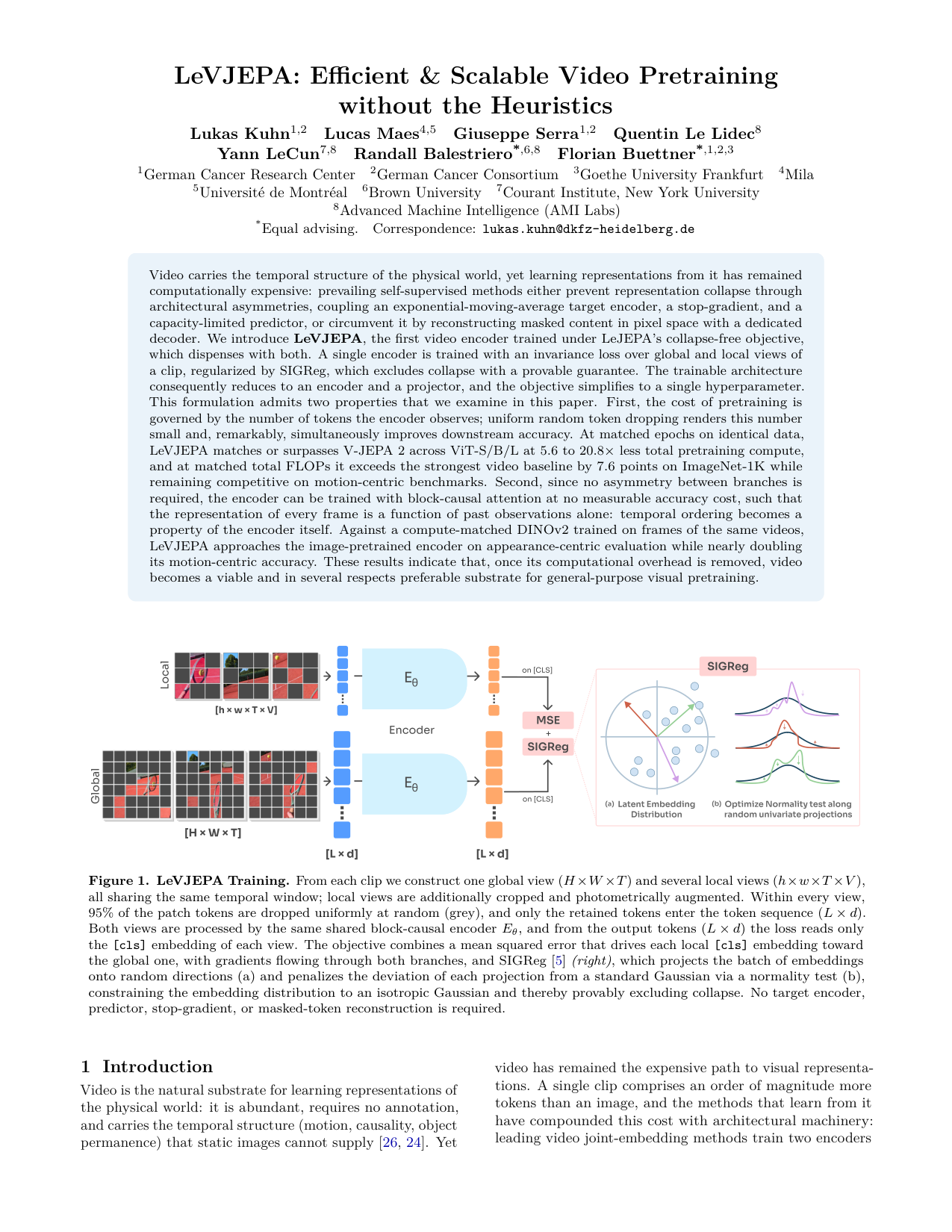
LeVJEPA: Efficient & Scalable Video Pretraining without the Heuristics
Lukas Kuhn, Lucas Maes, Giuseppe Serra, Quentin Le Lidec, Yann LeCun, Randall Balestriero, Florian Buettner
Why you should read this
Introduces LeVJEPA, a self-supervised video pretraining framework that replaces complex architectural heuristics with a provably collapse-free objective and aggressive token dropping, matching state-of-the-art visual representations at up to twenty times lower compute cost.
Video carries the temporal structure of the physical world, yet learning representations from it has remained computationally expensive: prevailing self-supervised methods either prevent representation collapse through architectural asymmetries, coupling an exponential-moving-average target encoder, a stop-gradient, and a capacity-limited predictor, or circumvent it by reconstructing masked content in pixel space. We introduce LeVJEPA, the first video encoder trained under LeJEPA's collapse-free objective, which dispenses with both. A single encoder is trained with an invariance loss over global and local views of a clip, regularized by SIGReg, which excludes collapse with a provable guarantee. The architecture reduces to an encoder and a projector, and the objective to a single hyperparameter. This formulation admits two properties. First, the cost of pretraining is governed by the number of tokens the encoder observes; uniform random token dropping renders this number small while simultaneously improving downstream accuracy. At matched epochs on identical data, LeVJEPA matches or surpasses V-JEPA 2 across ViT-S/B/L at 5.6 to 20.8x less pretraining compute, and at matched total FLOPs it exceeds the strongest video baseline by 7.6 points on ImageNet-1K while remaining competitive on motion-centric benchmarks. Second, since no asymmetry between branches is required, the encoder can be trained with block-causal attention at no measurable accuracy cost: temporal ordering becomes a property of the encoder itself. Against a compute-matched DINOv2 trained on frames of the same videos, LeVJEPA approaches the image-pretrained encoder on appearance-centric evaluation while nearly doubling its motion-centric accuracy. These results indicate that, once its computational overhead is removed, video becomes a viable and in several respects preferable substrate for general-purpose visual pretraining.
Added
2026-08-30

How Transparent is DiffusionGemma?
Joshua Engels, Callum McDougall, Bilal Chughtai, Janos Kramar, Senthoran Rajamanoharan, Cindy Wu, Arthur Conmy, Asic Q Chen, Jean Tarbouriech, Min Ma, Brendan O'Donoghue, João Gabriel Lopes de Oliveira, Rohin Shah, Neel Nanda
Why you should read this
Demonstrates that DiffusionGemma, despite its continuous latent space, achieves variable transparency comparable to autoregressive models by mapping intermediate states through an interpretable token bottleneck without performance degradation, while also uncovering novel diffusion-specific reasoning phenomena.
LLM reasoning transparency is a critical affordance for understanding model decisions, mitigating misuse and misalignment, and debugging surprising model behaviors. However, DiffusionGemma performs a larger fraction of its computation in a continuous latent space; does this make its reasoning less transparent? We study this question by decomposing transparency into two components: variable transparency, whether we understand intermediate snapshots of a model's computational state; and algorithmic transparency, whether we can use these snapshots to reconstruct the process by which the model arrived at its outputs. Naively, DiffusionGemma has poor variable transparency: its opaque serial depth, the amount of serial computation that occurs in between interpretable model states, seems at first 28.6X higher than the corresponding autoregressive Gemma 4 model. However, we show that we can map the information flowing between denoising steps through an interpretable token bottleneck with no decrease in downstream performance. Treating these intermediate states as interpretable reduces the opaque serial depth to just 1.1X that of Gemma 4. Algorithmic transparency is harder for diffusion models than for autoregressive models because all token predictions in the canvas can change at every denoising step, giving the model the power to implement complicated distributed algorithms during the denoising process. To begin bridging this gap, we conduct a suite of interpretability case studies, uncovering initial evidence of novel diffusion-specific phenomena such as non-chronological reasoning, token and sequence smearing, and intermediate-context reasoning. Finally, we test monitorability, a key application of transparency that measures whether model outputs are useful for downstream tasks. We find that DiffusionGemma is similarly monitorable to Gemma 4.
Added
2026-06-22
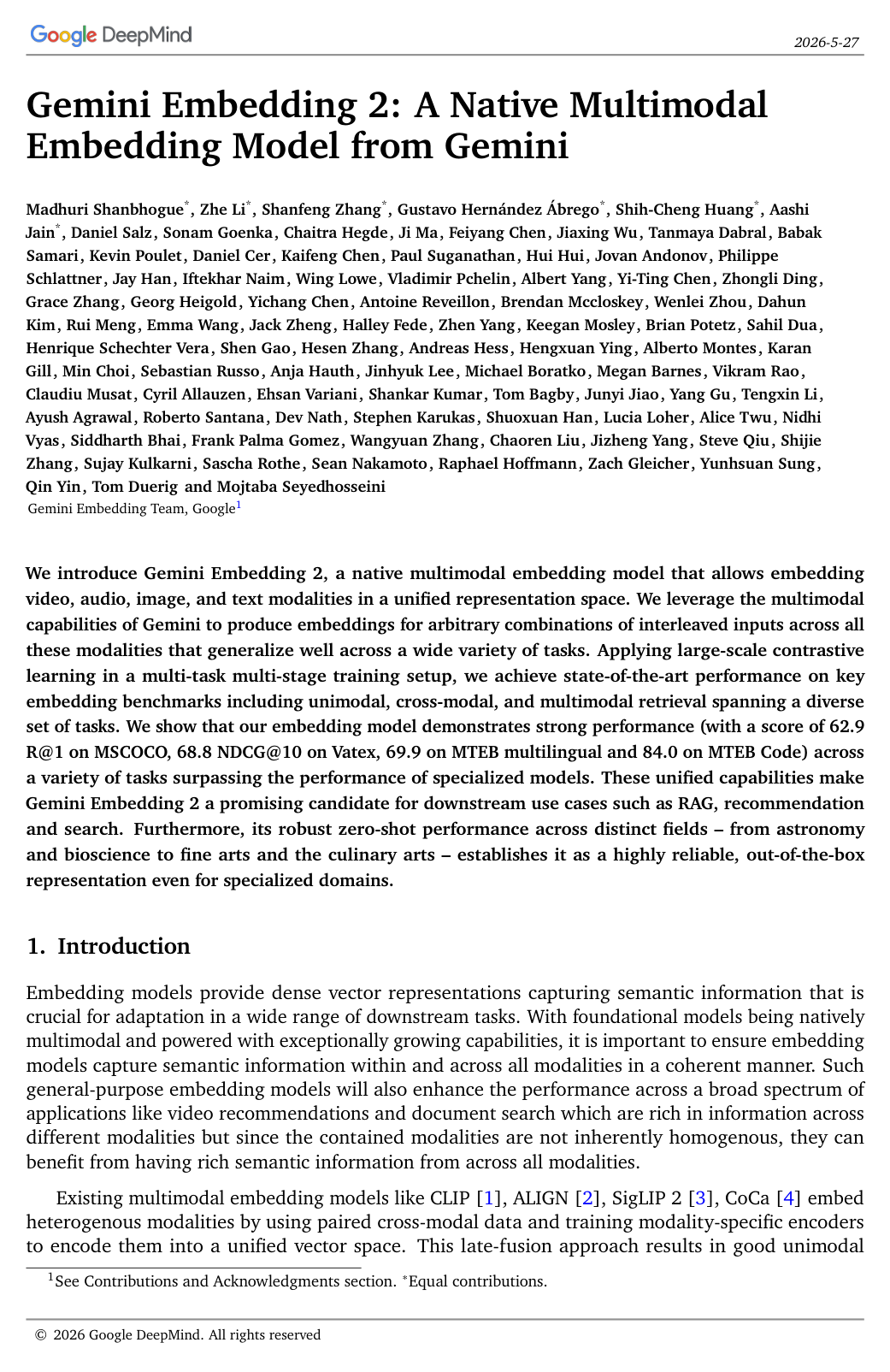
Gemini Embedding 2: A Native Multimodal Embedding Model from Gemini
Madhuri Shanbhogue, Zhe Li, Shanfeng Zhang, Gustavo Hernández Ábrego, Shih-Cheng Huang, Aashi Jain, Daniel Salz, Sonam Goenka, Chaitra Hegde, Ji Ma, Feiyang Chen, Jiaxing Wu, Tanmaya Dabral, Babak Samari, Kevin Poulet, Daniel Cer, Kaifeng Chen, Paul Suganathan, Hui Hui, Jovan Andonov, Philippe Schlattner, Jay Han, Iftekhar Naim, Wing Lowe, Vladimir Pchelin, Albert Yang, Yi-Ting Chen, Zhongli Ding, Grace Zhang, Georg Heigold, Yichang Chen, Antoine Reveillon, Brendan Mccloskey, Wenlei Zhou, Dahun Kim, Rui Meng, Emma Wang, Jack Zheng, Halley Fede, Zhen Yang, Keegan Mosley, Brian Potetz, Sahil Dua, Henrique Schechter Vera, Shen Gao, Hesen Zhang, Andreas Hess, Hengxuan Ying, Alberto Montes, Karan Gill, Min Choi, Sebastian Russo, Anja Hauth, Jinhyuk Lee, Michael Boratko, Megan Barnes, Vikram Rao, Claudiu Musat, Cyril Allauzen, Ehsan Variani, Shankar Kumar, Tom Bagby, Junyi Jiao, Yang Gu, Tengxin Li, Ayush Agrawal, Roberto Santana, Dev Nath, Stephen Karukas, Shuoxuan Han, Lucia Loher, Alice Twu, Nidhi Vyas, Siddharth Bhai, Frank Palma Gomez, Wangyuan Zhang, Chaoren Liu, Jizheng Yang, Steve Qiu, Shijie Zhang, Sujay Kulkarni, Sascha Rothe, Sean Nakamoto, Raphael Hoffmann, Zach Gleicher, Yunhsuan Sung, Qin Yin, Tom Duerig, Mojtaba Seyedhosseini
Why you should read this
Introduces Gemini Embedding 2, a multimodal embedding model that achieves state-of-the-art performance across unimodal, cross-modal, and multimodal retrieval tasks by leveraging Gemini's capabilities for unified representation and robust zero-shot generalization across diverse domains.
We introduce Gemini Embedding 2, a native multimodal embedding model that allows embedding video, audio, image, and text modalities in a unified representation space. We leverage the multimodal capabilities of Gemini to produce embeddings for arbitrary combinations of interleaved inputs across all these modalities that generalize well across a wide variety of tasks. Applying large-scale contrastive learning in a multi-task multi-stage training setup, we achieve state-of-the-art performance on key embedding benchmarks including unimodal, cross-modal, and multimodal retrieval spanning a diverse set of tasks. We show that our embedding model demonstrates strong performance (with a score of 62.9 R@1 on MSCOCO, 68.8 NDCG@10 on Vatex, 69.9 on MTEB multilingual and 84.0 on MTEB Code) across a variety of tasks surpassing the performance of specialized models. These unified capabilities make Gemini Embedding 2 a promising candidate for downstream use cases such as RAG, recommendation and search. Furthermore, its robust zero-shot performance across distinct fields - from astronomy and bioscience to fine arts and the culinary arts - establishes it as a highly reliable, out-of-the-box representation even for specialized domains.
Added
2026-05-29
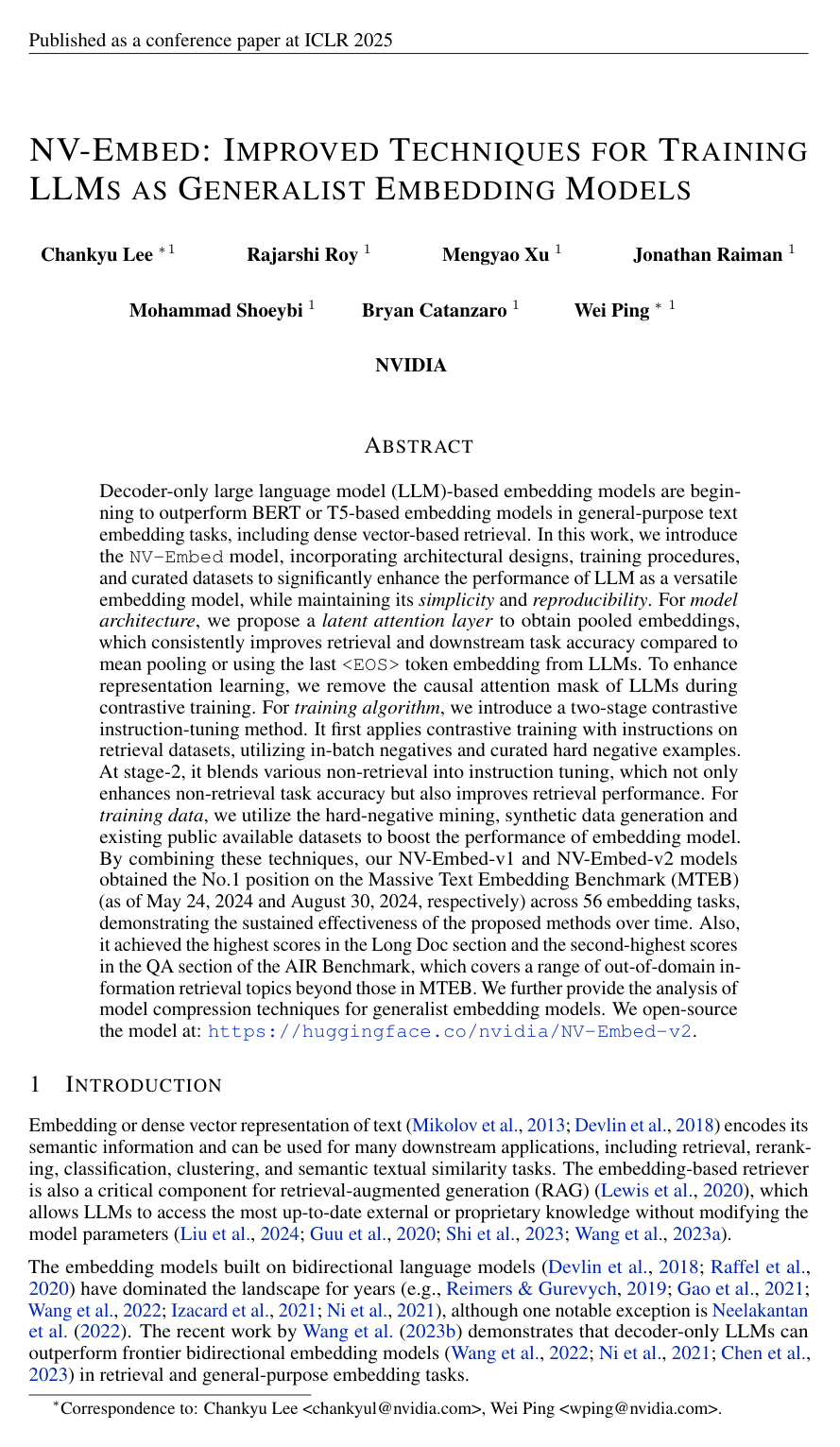
NV-Embed: Improved Techniques for Training LLMs as Generalist Embedding Models
Chankyu Lee, Rajarshi Roy, Mengyao Xu, Jonathan Raiman, Mohammad Shoeybi, Bryan Catanzaro, Wei Ping
Why you should read this
Introduces NV-Embed, a suite of architectural designs, training procedures, and curated datasets that propelled LLM-based embedding models to state-of-the-art performance on the MTEB and AIR benchmarks, demonstrating significant advancements in general-purpose text embedding capabilities.
Decoder-only LLM-based embedding models are beginning to outperform BERT or T5-based embedding models in general-purpose text embedding tasks, including dense vector-based retrieval. In this work, we introduce NV-Embed, incorporating architectural designs, training procedures, and curated datasets to significantly enhance the performance of LLM as a versatile embedding model, while maintaining its simplicity and reproducibility. For model architecture, we propose a latent attention layer to obtain pooled embeddings, which consistently improves retrieval and downstream task accuracy compared to mean pooling or using the last <EOS> token embedding from LLMs. To enhance representation learning, we remove the causal attention mask of LLMs during contrastive training. For training algorithm, we introduce a two-stage contrastive instruction-tuning method. It first applies contrastive training with instructions on retrieval datasets, utilizing in-batch negatives and curated hard negative examples. At stage-2, it blends various non-retrieval into instruction tuning, which not only enhances non-retrieval task accuracy but also improves retrieval performance. For training data, we utilize the hard-negative mining, synthetic data generation and existing public available datasets to boost the performance of embedding model. By combining these techniques, our NV-Embed-v1 and NV-Embed-v2 models obtained the No.1 position on the MTEB leaderboard (as of May 24 and August 30, 2024, respectively) across 56 tasks, demonstrating the sustained effectiveness of the proposed methods over time. It also achieved the highest scores in the Long Doc section and the second-highest scores in the QA section of the AIR Benchmark, which covers a range of out-of-domain information retrieval topics beyond those in MTEB. We further provide the analysis of model compression techniques for generalist embedding models.
Added
2026-05-18
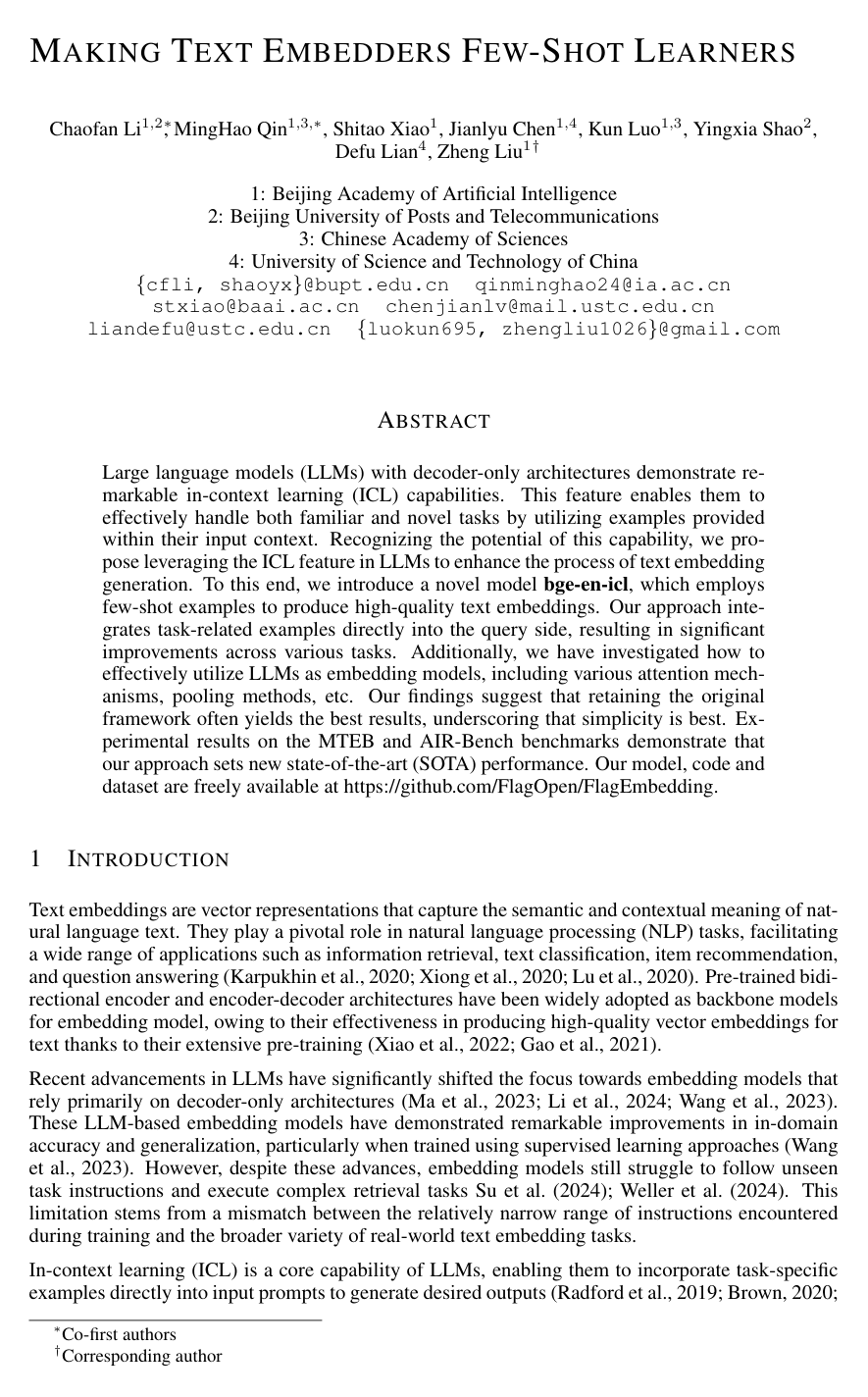
Making Text Embedders Few-Shot Learners
Chaofan Li, Minghao Qin, Shitao Xiao, Jianlyu Chen, Kun Luo, Defu Lian, Yingxia Shao, Zheng Liu
Why you should read this
Demonstrates how integrating novel latent attention mechanisms and multi-stage training strategies can overcome the performance limitations of standard pooling methods in large language model-based text embedding systems.
Large language models (LLMs) with decoder-only architectures demonstrate remarkable in-context learning (ICL) capabilities. This feature enables them to effectively handle both familiar and novel tasks by utilizing examples provided within their input context. Recognizing the potential of this capability, we propose leveraging the ICL feature in LLMs to enhance the process of text embedding generation. To this end, we introduce a novel model bge-en-icl, which employs few-shot examples to produce high-quality text embeddings. Our approach integrates task-related examples directly into the query side, resulting in significant improvements across various tasks. Additionally, we have investigated how to effectively utilize LLMs as embedding models, including various attention mechanisms, pooling methods, etc. Our findings suggest that retaining the original framework often yields the best results, underscoring that simplicity is best. Experimental results on the MTEB and AIR-Bench benchmarks demonstrate that our approach sets new state-of-the-art (SOTA) performance. Our model, code and dataset are freely available at this https URL .
Added
2026-04-16
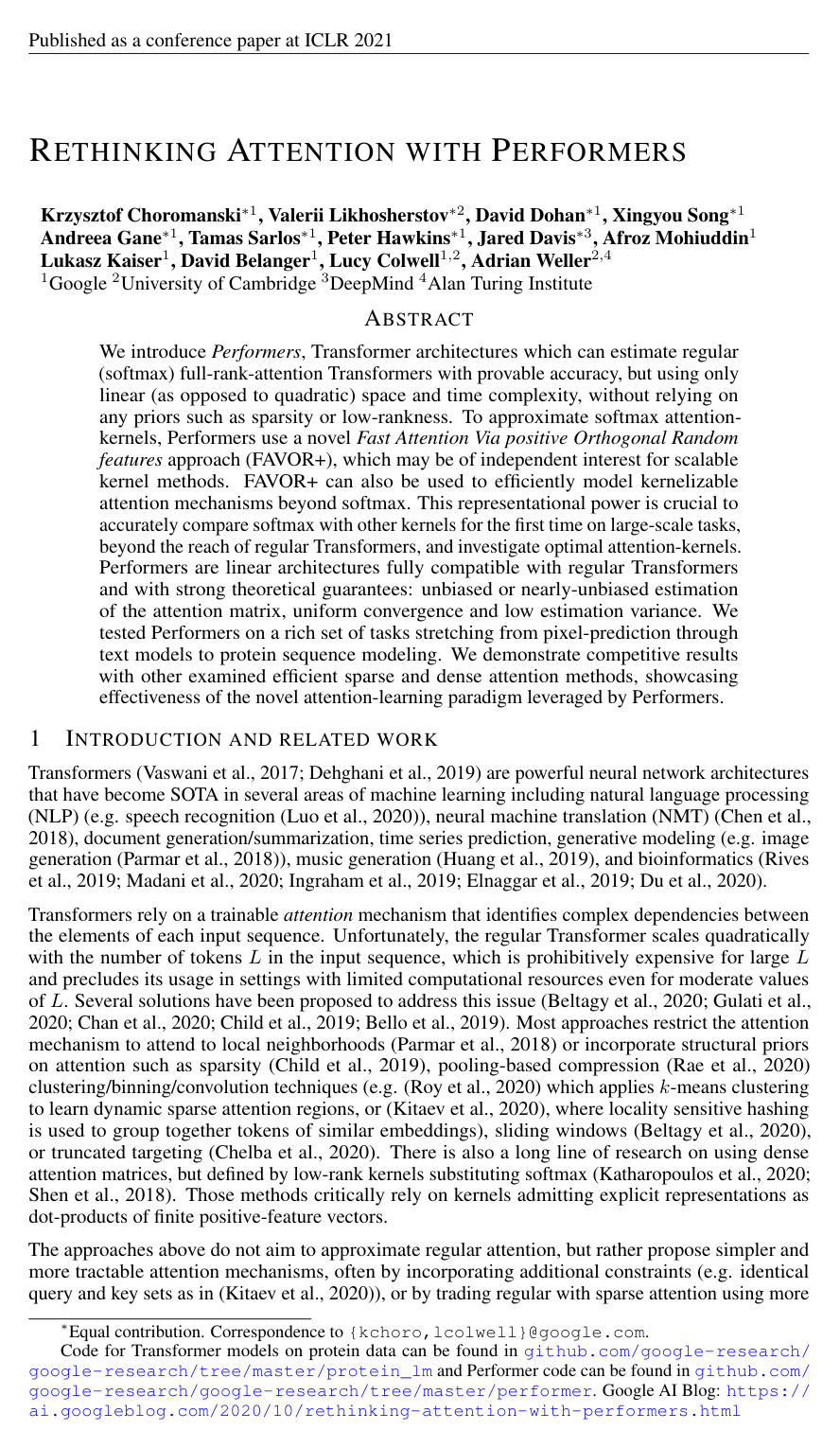
Rethinking Attention with Performers
Krzysztof Choromanski, Valerii Likhosherstov, David Dohan, Xingyou Song, Andreea Gane, Tamas Sarlos, Peter Hawkins, Jared Davis, Afroz Mohiuddin, Lukasz Kaiser, David Belanger, Lucy Colwell, Adrian Weller
Why you should read this
Approximates the softmax attention kernel using positive orthogonal random features, allowing linear time and space complexity.
We introduce Performers, Transformer architectures which can estimate regular (softmax) full-rank-attention Transformers with provable accuracy, but using only linear (as opposed to quadratic) space and time complexity, without relying on any priors such as sparsity or low-rankness. To approximate softmax attention-kernels, Performers use a novel Fast Attention Via positive Orthogonal Random features approach (FAVOR+), which may be of independent interest for scalable kernel methods. FAVOR+ can be also used to efficiently model kernelizable attention mechanisms beyond softmax. This representational power is crucial to accurately compare softmax with other kernels for the first time on large-scale tasks, beyond the reach of regular Transformers, and investigate optimal attention-kernels. Performers are linear architectures fully compatible with regular Transformers and with strong theoretical guarantees: unbiased or nearly-unbiased estimation of the attention matrix, uniform convergence and low estimation variance. We tested Performers on a rich set of tasks stretching from pixel-prediction through text models to protein sequence modeling. We demonstrate competitive results with other examined efficient sparse and dense attention methods, showcasing effectiveness of the novel attention-learning paradigm leveraged by Performers.
Added
2026-02-09