
NV-EMBED: IMPROVED TECHNIQUES FOR TRAINING LLMS AS GENERALIST EMBEDDING MODELS
Chankyu Lee $^{*}$ $^{1}$
NVIDIA
Rajarshi Roy $^{1}$
NVIDIA
Mengyao Xu $^{1}$
NVIDIA
Jonathan Raiman $^{1}$
NVIDIA
Mohammad Shoeybi $^{1}$
NVIDIA
Bryan Catanzaro $^{1}$
NVIDIA
Wei Ping $^{*}$ $^{1}$
NVIDIA
$^{*}$ Correspondence to: Chankyu Lee [email protected], Wei Ping [email protected].
Abstract
Decoder-only large language model (LLM)-based embedding models are beginning to outperform BERT or T5-based embedding models in general-purpose text embedding tasks, including dense vector-based retrieval. In this work, we introduce the NV-Embed model, incorporating architectural designs, training procedures, and curated datasets to significantly enhance the performance of LLM as a versatile embedding model, while maintaining its simplicity and reproducibility. For model architecture, we propose a latent attention layer to obtain pooled embeddings, which consistently improves retrieval and downstream task accuracy compared to mean pooling or using the last
Executive Summary: NVIDIA researchers developed NV-Embed, a family of decoder-only large language models turned into general-purpose text embedding systems. These models convert text into dense vectors that support retrieval, classification, clustering, and semantic similarity tasks. The work responds to growing demand for accurate, scalable embeddings that power retrieval-augmented generation systems, where external knowledge must be fetched quickly and precisely without retraining the core language model.
The team set out to show that decoder-only LLMs can surpass the long-dominant bidirectional models on comprehensive benchmarks while remaining simple to train and reproduce. They started from the public Mistral 7B model and introduced three targeted changes: a latent attention layer for better sequence pooling, removal of the causal attention mask during training to allow full bidirectional context, and a two-stage contrastive instruction-tuning process. The first stage focuses on retrieval data with in-batch and hard negatives; the second blends in non-retrieval tasks without in-batch negatives. Training data combined public datasets with positive-aware hard-negative mining and 120,000 synthetic examples generated by Mixtral.
On the Massive Text Embedding Benchmark covering 56 tasks, NV-Embed-v2 reached the top score of 72.31 as of August 2024, leading in retrieval, clustering, and classification subtasks. It also posted the strongest results on the long-document section of the out-of-domain AIR benchmark and second place on its QA section. Ablation experiments confirmed each design choice added measurable gains; reversing the two-stage order or keeping the causal mask lowered accuracy, especially on retrieval. Post-training compression (pruning to 3.5 billion parameters followed by 8-bit quantization and light retraining) preserved nearly all performance and proved more robust than smaller models trained from scratch.
These results matter because stronger, more versatile embeddings directly improve the relevance of retrieved passages fed to large language models, raising answer quality while cutting latency and cost. The ability to compress the model without proportional accuracy loss further lowers deployment barriers in production environments. The approach also demonstrates that public data and straightforward architectural tweaks can outperform methods that rely on proprietary synthetic data or continued fine-tuning of earlier embedding models.
The models and training code are now open-sourced on Hugging Face, enabling immediate adoption and further experimentation. Teams should evaluate NV-Embed-v2 on their specific retrieval workloads and test the compressed variants for resource-constrained settings. Additional work on longer context lengths and domain-specific fine-tuning would strengthen readiness for enterprise use cases.
The main limitations are reliance on public benchmarks whose training splits overlap with MTEB data and restriction to 512-token sequences during evaluation. Results on truly novel domains therefore carry some uncertainty, though the strong AIR-benchmark showing reduces that concern. Overall confidence in the core claims is high because the improvements are consistent across ablations, multiple benchmarks, and time.
1. Introduction
Section Summary: NV-Embed is a new family of embedding models based on decoder-only large language models that are designed to capture the semantic meaning of text in dense vector form for use in search, classification, clustering, and retrieval-augmented generation systems. The approach improves on earlier decoder-only efforts through a novel latent attention pooling layer instead of simple averaging or end-of-sequence tokens, removal of the causal mask during training, and a carefully staged contrastive instruction-tuning process that begins with the Mistral-7B model and progressively incorporates both retrieval and non-retrieval data while using high-quality hard negatives. These changes, together with extensive dataset curation and later model-compression experiments, allow NV-Embed-v2 to reach a new state-of-the-art average score of 72.31 on the Massive Text Embedding Benchmark and top results across most task categories.
Embedding or dense vector representation of text ([1, 2]) encodes its semantic information and can be used for many downstream applications, including retrieval, reranking, classification, clustering, and semantic textual similarity tasks. The embedding-based retriever is also a critical component for retrieval-augmented generation (RAG) ([3]), which allows LLMs to access the most up-to-date external or proprietary knowledge without modifying the model parameters ([4, 5, 6, 7]).
The embedding models built on bidirectional language models ([2, 8]) have dominated the landscape for years (e.g., [9, 10, 11, 12, 13]), although one notable exception is [14]. The recent work by [15] demonstrates that decoder-only LLMs can outperform frontier bidirectional embedding models ([11, 13, 16]) in retrieval and general-purpose embedding tasks.
In this work, we introduce NV-Embed, a generalist embedding model that significantly enhances the performance of decoder-only LLMs for embedding and retrieval tasks. Specifically, we make the following contributions:
- For model architecture, we propose a novel latent attention layer to obtain pooled embeddings for a sequence of tokens. In contrast to the popular average pooling in bidirectional embedding models (e.g., [11]) and last
<EOS>token embedding in decoder-only LLMs ([14, 15]), our proposed pooling technique consistently improves accuracy of retrieval and other downstream tasks. To further enhance representation learning, we remove causal attention mask during contrastive training of decoder-only LLM, resulting in solid improvements. Our design is simpler yet more effective compared to related work ([17, 18]), which involves an additional training phase with masked token prediction or a mixed training objective. - For model training, we introduce a two-stage contrastive instruction-tuning method, starting with the pretrained Mistral-7B ([19]). In the first stage, we apply contrastive training with instructions on retrieval datasets, utilizing in-batch negative and curated hard-negative examples. In the second stage, we blend carefully curated non-retrieval datasets into the stage-one training data. Since in-batch negative samples are misleading for non-retrieval tasks in some cases, we disable in-batch negative training in stage two. This design not only improves the accuracy of classification, clustering, and semantic textual similarity tasks, but also surprisingly enhances retrieval performance. Note, our model is also not fine-tuned from existing embedding models[^1].
- Training data is one of the most crucial factors in achieving state-of-the-art results. We provide a detailed recipe on the curation of training datasets, including dataset-specific information, the positive-aware hard-negative mining technique to enhance contrastive training, the synthetic data generation and example-based multi-class labeling. This enables the community to easily reproduce and even surpass our model, ultimately advancing the development of the embedding models.
- Our
NV-Embed-v1 model obtained the No.1 position on the Massive Text Embedding Benchmark (MTEB) (as of May 24, 2024) ([20]) across 56 embedding tasks. By improving the curation of the training data,NV-Embed-v2 model set a new record high score of 72.31 and reclaimed the No. 1 spot (as of Aug 30, 2024) on the highly competitive MTEB leaderboard, further demonstrating the sustained effectiveness of our approach. Note that our model also attains the highest scores in 15 retrieval tasks (commonly referred to as BEIR ([21])), 11 clustering tasks, and 12 classification tasks in the MTEB benchmark. See Table 1 for detailed information. Additionally, it secured the highest scores in Long Doc section and the second scores in QA section on the AIR-Benchmark which covers a range of out-of-domain information retrieval topics beyond those in MTEB. - We study the model compression techniques, including pruning, quantization and knowledge-distillation, for LLM-based embedding models. Through the comparison with smaller embedding models directly built on Llama3.2-3B, Qwen2.5-3B, and Minitron-4B, we demonstrate that our model compression approach achieves superior accuracy and quantization robustness.
[^1]: For example, SFR-Embedding and Linq-Embed are fine-tuned from E5-mistral-7b-instruct.
We organize the rest of the paper in the following. In § 2, we discuss the related work. We present the architectural and training method in § 3. We provide detailed recipe of training data curation in § 4. We present the experiment results in § 5 and conclude the paper in § 6. Model compression techniques and results are presented in § A due to the page limit. AIR-bench results are shown in § B.
: Table 1: Top MTEB leaderboard models as of ICLR submission date (2024-10-01). We use the original model names on the leaderboard for clarity.
| Embedding Task | Retrieval (15) | Rerank (4) | Cluster. (11) | PairClass. (3) | Class. (12) | STS (10) | Summ.(1) | Avg. (56) |
|---|---|---|---|---|---|---|---|---|
| Mertric | nDCG@10 | MAP | V-Meas. | AP | Acc. | Spear. | Spear. | |
NV-Embed-v2 |
62.65 | 60.65 | 58.46 | 88.67 | 90.37 | 84.31 | 30.7 | 72.31 |
| Bge-en-icl (zero shot) | 61.67 | 59.66 | 57.51 | 86.93 | 88.62 | 83.74 | 30.75 | 71.24 |
| Stella-1.5B-v5 | 61.01 | 61.21 | 57.69 | 88.07 | 87.63 | 84.51 | 31.49 | 71.19 |
| SFR-Embedding-2R | 60.18 | 60.14 | 56.17 | 88.07 | 89.05 | 81.26 | 30.71 | 70.31 |
| Gte-Qwen2-7B-instruct | 60.25 | 61.42 | 56.92 | 85.79 | 86.58 | 83.04 | 31.35 | 70.24 |
NV-Embed-v1 |
59.36 | 60.59 | 52.80 | 86.91 | 87.35 | 82.84 | 31.2 | 69.32 |
| Bge-multilingual-gemma2 | 59.24 | 59.72 | 54.65 | 85.84 | 88.08 | 83.88 | 31.2 | 69.88 |
| Voyage-large-2-instruct | 58.28 | 60.09 | 53.35 | 89.24 | 81.49 | 84.58 | 30.84 | 68.28 |
| SFR-Embedding | 59.00 | 60.64 | 51.67 | 88.54 | 78.33 | 85.05 | 31.16 | 67.56 |
| GritLM-7B | 57.41 | 60.49 | 50.61 | 87.16 | 79.46 | 83.35 | 30.37 | 66.76 |
| E5-mistral-7b-instruct | 56.9 | 60.21 | 50.26 | 88.34 | 78.47 | 84.66 | 31.4 | 66.63 |
| Text-embed-3-large (OpenAI) | 55.44 | 59.16 | 49.01 | 85.72 | 75.45 | 81.73 | 29.92 | 64.59 |
2. Related Work
Section Summary: Recent research on text embedding models falls into two main categories. Bidirectional models based on BERT and T5 have long led the field by using contrastive learning and fine-tuning on large supervised datasets to produce strong general-purpose representations. More recently, decoder-only large language models have begun to close the gap and even surpass earlier approaches by applying similar training techniques at larger scale, often with added innovations in architecture, data mixing, and the use of synthetic or curated examples, setting the stage for further improvements like those explored in NV-Embed.
2.1 Bidirectional Embedding Models
BERT ([2]) or T5 ([8])-based embedding models have long been the dominant approaches for general-purpose embedding tasks. Early examples include Sentence-BERT ([9]) and SimCSE ([10]), which finetune BERT on natural language inference (NLI) datasets. In general, these embedding models are first initialized from pre-trained BERT ([11, 12]) or T5 encoders ([13]). Then, they are further pre-trained with contrastive learning on curated unsupervised ([12]) or weakly-supervised text pairs ([11]). Finally, the embedding models ([22, 11, 13, 16]) are fine-tuned on a variety of supervised data, including MS MARCO ([23]), for retrieval and other downstream tasks. Note that all the state-of-the-art embedding models are trained in this supervised manner. Some of the most recent frontier models in this category include mxbai-embed-large-v1 ([24]) (MTEB: 64.68), UAE-Large-V1 ([25]) (MTEB: 64.64), and voyage-large-2-instruct ([26]) (MTEB: 68.28).
2.2 Decoder-only LLM-based Embedding Models
Decoder-only LLMs ([27]) were believed to underperform bidirectional models on general-purpose embedding tasks for years, because: i) unidirectional attention limits the representation learning capability, and ii) the scaling of LLMs leads to very high-dimension embeddings, which may suffer from the curse of dimensionality.
The early work by [14] initializes embedding models using pre-trained, decoder-only GPT-3 models ([27]) and applies continued contrastive training. The hidden state from the final layer, corresponding to the special token
Given the success of E5-Mistral, SFR-Embedding-Mistral ([29]) (MTEB: 67.56) and SFR-Embedding-2R ([30]) (MTEB: 70.31) further fine-tunes this model on the blend of non-retrieval and retrieval datasets for improved accuracy on both tasks, which is closely related to our NV-Embed. However, there are the following key differences: 1) NV-Embed is trained from scratch on Mistral 7B LLM directly using public available data, and not dependent on other embedding model or proprietary synthetic data. Consequently, we introduce a new architecture that eliminates unnecessary causal attention mask and further improves the sequence pooling mechanism with latent attention layer. 2) SFR-Embedding-Mistral uses task-homogeneous batching, which constructs batches consisting exclusively of samples from a single task. In contrast, our NV-Embed uses well-blended batches consisting samples from all tasks to avoid potential "zigzag" gradient updates, which leads to a new record high score on both full MTEB and retrieval tasks compared to SFR-Embedding-Mistral.
Over the past year, MTEB has become one of the most competitive leaderboards across all AI categories, leading to significantly increased competition among participants. Many of the recent top-performing models (e.g., stella-1.5B-v5, gte-Qwen2-7B-instruct, bge-multilingual-gemma2, voyage-large-2-instruct, and text-embed-3-large) have not disclosed key technical details necessary for reproduction, particularly the blend of training data used. Among the recently disclosed works, GritLM ([18]) (MTEB: 65.66) unifies text embedding and generation into a single LLM model. In addition, bge-en-icl ([31]) (MTEB: 71.24) enhances query embeddings by introducing few-shot examples on the query side, utilizing the in-context learning (ICL) capabilities in text embedding tasks. This approach introduces an overhead by supplying task-relevant examples to the query during the training process. To maintain zero-shot evaluation accuracy, both zero-shot and few-shot samples are included during training. In our paper, we focus on comparing the zero-shot evaluation accuracy of the bge-en-icl model to ensure the fair comparisons during the evaluation phase.
Another area of research focuses on improving data curation processes to enhance the accuracy of fine-tuning retrieval embedding models. Gecko ([32]) (MTEB: 66.31) attempts to distill a smaller bidirectional embedding model from a decoder-only LLM ([33]) by generating synthetic paired data. It refines the data quality by retrieving a set of candidate passages for each query and relabeling the positive and hard negative passages using the LLM. Linq-embed-mistral ([34]) utilized LLMs to refine data by generating, filtering, and mining negative samples. Meanwhile, NV-Retriever ([35]) introduced a positive-aware hard-negative mining technique that considers positive relevance scores to more effectively eliminate false negatives. In this work, we apply this positive-aware hard-negative technique to curate the samples and enhance the contrastive training.
3. Methods
Section Summary: The authors introduce a modified decoder-only LLM architecture that enables bidirectional attention by removing the standard causal mask during contrastive training, allowing the model to draw on full context for richer representations. They also add a trainable latent attention layer after the LLM that performs cross-attention over a fixed-size dictionary of latent vectors, followed by an MLP and mean pooling, to produce more expressive embeddings than simple averaging or final-token methods. These components are trained with a two-stage instruction-tuning process that first optimizes retrieval tasks using in-batch negatives and hard negatives, then fine-tunes on a mix of retrieval and non-retrieval tasks without in-batch negatives to suit the different characteristics of classification and clustering.
In this section, we describe our architecture designs and two-stage instruction-tuning method.
3.1 Bidirectional Attention
The causal attention mask in decoder-only LLMs is introduced for next-token prediction task ([36]). In principle, causal mask in decoder blocks prevents information leakage by allowing the decoder to attend only to previous positions during auto-regressive text generation. However, it is observed that unidirectional attention limits the model's representation power, as evidenced by the poor performance of GPT models compared to similarly sized BERT or T5 models on natural language understanding benchmarks (e.g., [37]). In recent, LLM2Vec ([17]) introduces additional training phase with a specially designed masked token prediction to warm-up the bidirectional attention. GRIT ([18]) utilizes a hybrid objective with both bidirectional representation learning and causal generative training. In contrast, we simply remove the causal attention mask of decoder-only LLM during the contrastive learning and find it works compellingly well as demonstrated by our results. As a result, we go with simple solution.
3.2 Latent Attention Layer
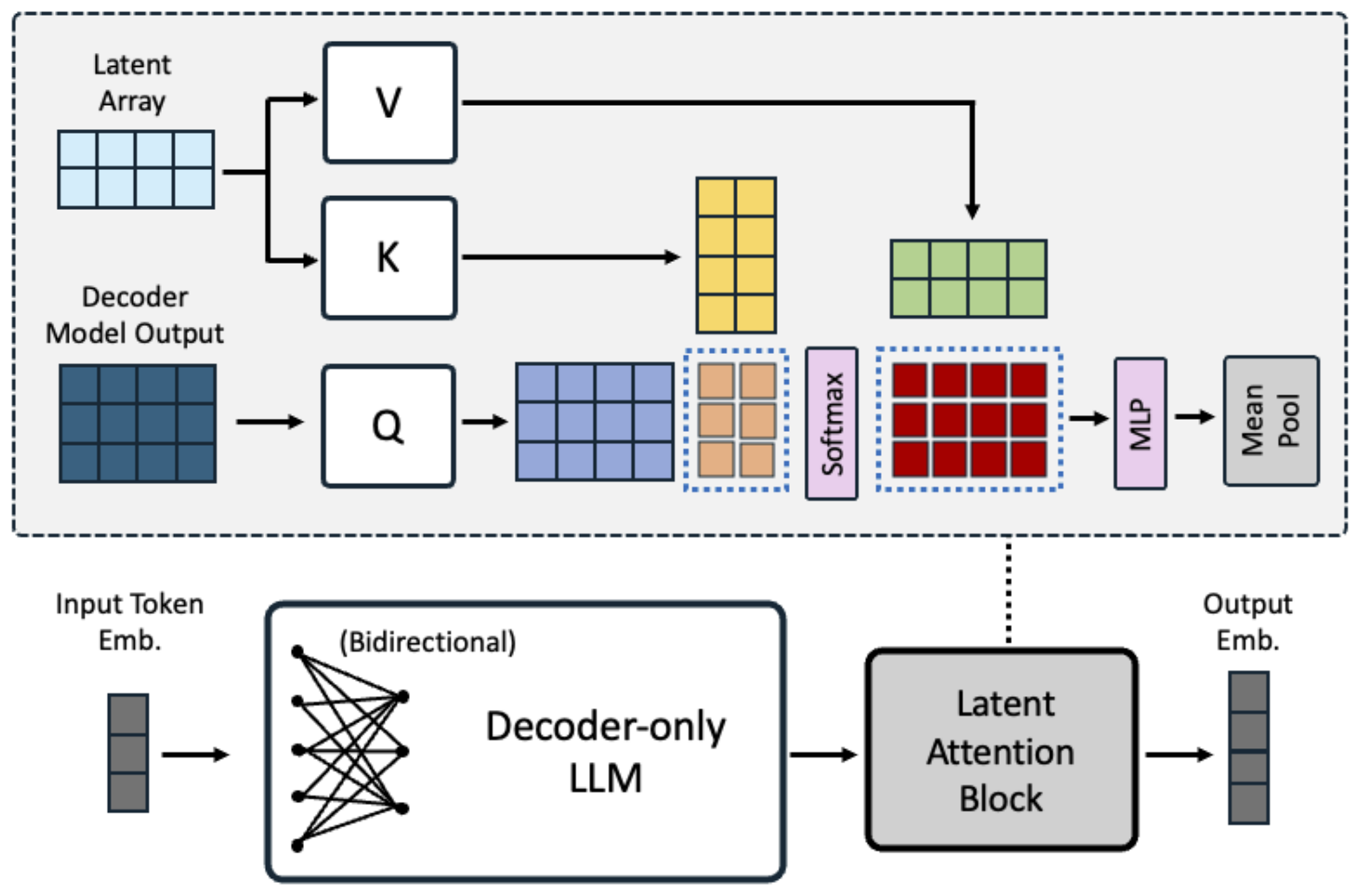
There are two popular methods to obtain the embedding for a sequence of tokens: i) mean pooling, and ii) the last <EOS> token embedding. Previous bidirectional embedding models typically use mean pooling ([11, 12]), while the last <EOS> token embedding is more popular for decoder-only LLM based embedding models. However, both methods have certain limitations. Mean pooling simply takes the average of token embeddings and may dilute the important information from key phrases, meanwhile the last <EOS> token embedding may suffer from recency bias, relying heavily on the output embedding of last token.
In this work, we propose a latent attention layer inspired by [38] to achieve more expressive pooling of the sequences for general-purpose embedding tasks. Specifically, we denote the last layer hidden from decoder as the query $Q \in \mathbb{R}^{l \times d}$, where $l$ is the length of sequence, and $d$ is the hidden dimension. They are sent to attend the latent array $K = V \in \mathbb{R}^{r \times d}$, which are trainable "dictionary" used to obtain better representation, where $r$ is the number of latents in the dictionary. The output of this cross-attention is $O \in \mathbb{R}^{l \times d}$,
$ O = \text{softmax}(QK^T) V $
which is followed by a regular MLP consists of two linear transformations with a GELU activation in between. Our model uses latent attention layer with $r$ of 512 and the number of heads as 8 for multi-head attention. Finally, we apply mean pooling after MLP layers to obtain the embedding of whole sequences. See Figure 1 for an illustration. It is worth mentioning here that our approach follows the spirit of dictionary learning to obtain better representation (e.g., [39]), which is different from the Perceiver IO architecture. We compare the proposed latent attention layer with normal self-attention and find consistent improvements in our ablation study.
3.3 Two-stage Instruction-Tuning
Instruction-tuning has been widely applied for training LLM to follow instructions ([40, 41]) and to perform retrieval-augmented generation ([7, 4]). It has also been recently applied for training retrievers and general-purpose embedding models that can adapt their output embeddings with different instructions and task types ([42, 15]).
To obtain a generalist embedding model that can appropriately perform on retrieval and non-retrieval tasks (e.g., classification, clustering), we need take the characteristics of different tasks into account. For example, the use of in-batch negatives has been demonstrated to be highly efficient for training dense-embedding-based retrievers (e.g., [43]), because it allows to reuse the computation and effectively train on $B^2$ question/passage pairs for each mini-batch with only $B$ questions and corresponding positive passages. However, applying in-batch negatives trick can mislead the embedding model for classification or clustering task, as the "passages" in the mini-batch may come from the the class and are not negatives.
Given these considerations, we introduce a two-stage instruction tuning method which first conducts contrastive training with instructions on a variety of retrieval datasets (details are in Section 4.1), utilizing in-batch negatives and curated hard-negative examples. In the second stage, we perform contrastive instruction-tuning on a combination of retrieval and non-retrieval datasets (details are in Section 4.2) without applying the trick of in-batch negatives. It is worth mentioning here that retrieval task presents greater difficulty compared to the other tasks so that our training strategy focuses on fine-tuning the model for retrieval initially. In second stage, we blend the remaining embedding tasks into the instruction-tuning.
4. Training Data
Section Summary: The training data combines public retrieval and non-retrieval datasets with synthetically generated examples to support contrastive learning for embedding models across tasks such as retrieval, classification, clustering, and semantic similarity. Public datasets like MSMARCO, HotpotQA, and various MTEB sources are preprocessed into query-positive-negative formats, with hard negatives mined using a teacher model to improve training quality while filtering out overlaps with evaluation sets. To broaden task variety, the authors also created 120,000 synthetic examples across 60,000 tasks using Mixtral, applying instruction templates to queries during training while excluding them from document embeddings.
For training data, we employ public retrieval and non-retrieval datasets and synthetically generated samples to demonstrate our model's capability in embedding tasks. Our training procedure incorporates both retrieval and non-retrieval tasks including classification, clustering, and semantic textual similarity datasets.
Given a relevant query-document pair, the instructed query follows the instruction template as follows:
$ q^{+}_{\text{inst}} = \texttt{Instruct}: {\texttt{task_{definition}}} \ \ \texttt{Query}: q^{+} $
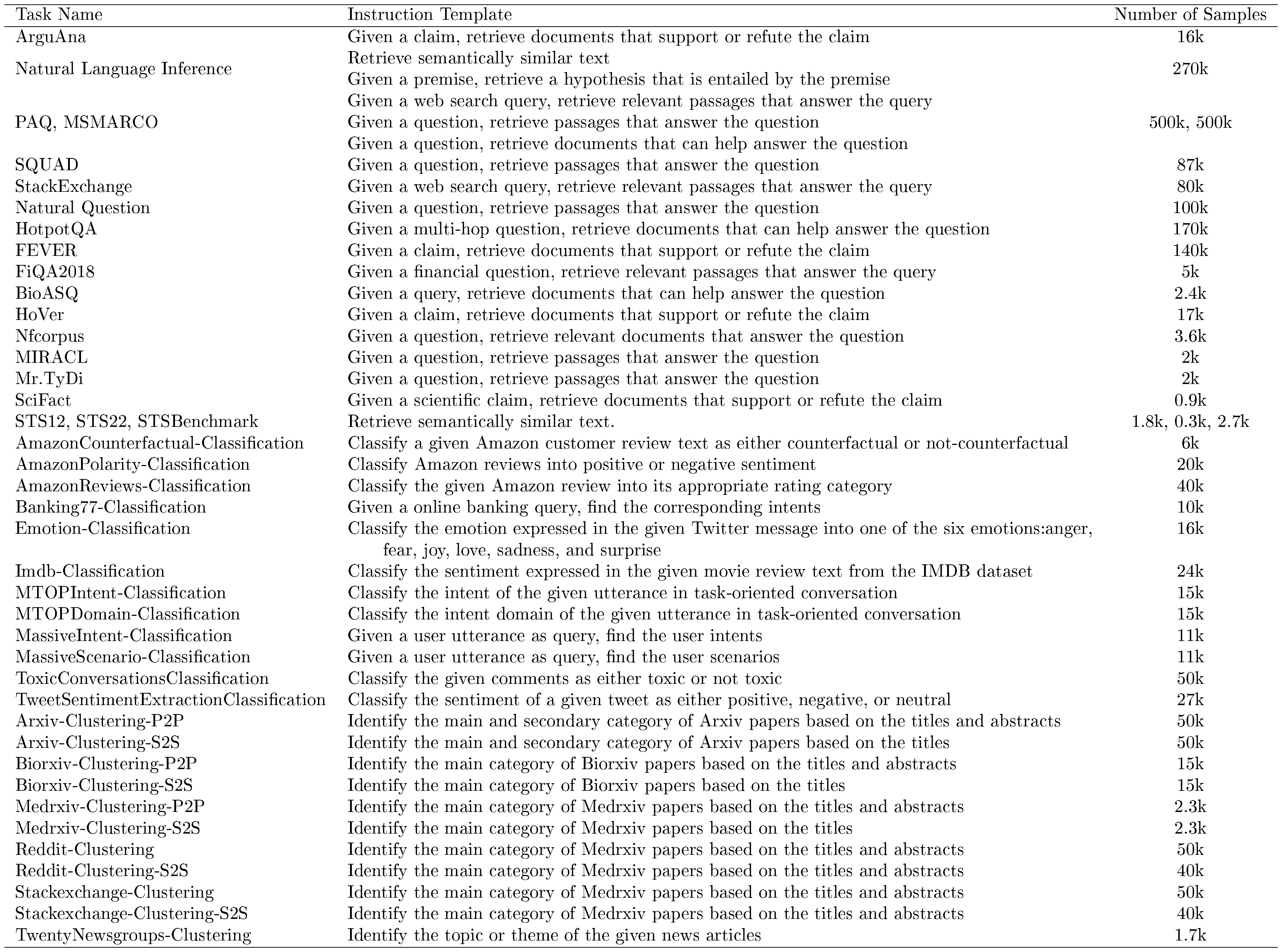
The instruction templates for each {task_{definition}} are provided in Table 12 for training and Table 13 for evaluation. Note, we mask out the instruction tokens in the output embeddings during both training and evaluation, although they still impact the output due to self-attention. We do not add any instruction prefix to document corpus.
4.1 Public Retrieval Datasets
We adopt the retrieval datasets as follows: MSMARCO ([44]), HotpotQA ([45]), Natural Question ([46]), PAQ ([47]), Stack Exchange ([48]), Natural Language Inference ([49]), SQuAD ([50]), ArguAna ([51]), BioASQ ([52]), FiQA ([53]), FEVER ([54]), HoVer ([55]), SciFact ([56]), NFCorpus, MIRACL ([57]) and Mr.TyDi ([58]).
It is important to note that certain datasets (e.g., MSMARCO) are training splits of the MTEB Benchmark, which we follow the existing practices established by leading generalist embedding models ([29, 15, 17, 18]). Table 12 further provides the number of samples used for training. We demonstrate the zero-shot generalization capability of NV-Embed on AIR-bench in Appendix B.
4.1.1 Hardnegative mining technique
Embedding models are trained using contrastive learning ([10]), aiming to increase the similarity between the embeddings of a query and its relevant passages (positives) while reducing the similarity with irrelevant passages (negatives). Public retrieval datasets typically only contains the positive query-passage pairs but do not contain its own hardnegatives, making it necessary to mine of such negative examples. To address this, we apply the recently proposed positive-aware hard-negative technique ([35]) that considers the positive relevance scores for better false negatives removal. Following the ablation studies in [35], we use E5-mistral-7b-instruct ([15]) as a teacher retrieval model to identify the optimal hardnegative passages relevant to the query. We set the maximum threshold for negative scores based on a percentage of the positive score (TopKPercPos) with a 95% margin, described as follows: max_negative_score_threshold = pos_score * percentage_margin.
4.2 Public Non-Retrieval Datasets
Besides retrieval datasets, we utilize public non-retrieval datasets mainly from three sub-tasks in MTEB benchmark: classification, clustering and semantic similarity (STS). We pre-process the format of these datasets to become the compatible with retrieval datasets for contrastive training: query $q^{+}$, positive document $d^{+}$ and hard negative documents $d^{-}_0, ..., d^{-}_n$.
For classification, we utilize the English training splits of various datasets from MTEB Huggingface datasets ([20, 59]). The classification datasets that we use are as follows: AmazonReviews ([60]), AmazonCounterfactual ([61]), Banking77 ([62]), Emotion ([63]), IMDB ([64]), MTOPDomain/MTOPIntent ([65]), ToxicConversations ([66]), TweetSentimentExtraction ([67]), AmazonPolarity ([68]), MassiveScenario/MassiveIntent ([69]). For the Emotion and AmazonCounterfactual classification datasets we use BM25 ([70]) similarity thresholds to filter out training data that is similar to the MTEB evaluation set.
For clustering datasets, we utilize the raw_arxiv, raw_biorxiv and raw_medrxiv datasets from MTEB Huggingface datasets, TwentyNewsgroups ([71]), Reddit ([72]), StackExchange ([72]), RedditP2P ([73]) and StackExchangeP2P ([74]) We filter out any training data that match the MTEB evaluation set.
The classification and clustering datasets provide examples and corresponding class/cluster labels. The example texts extracted from the appropriate $text$ / $title$ / $abstract$ field are used for the query $q^{+}$. For binary classification tasks the label texts are used as documents $d^{+}, d^{-}$. For multi-class classification and clustering tasks, a randomly sampled example from the ground-truth class/cluster is used for the positive document $d^{+}$ and randomly sampled examples from other classes/clusters are used for negative documents $d^{-}_k$. We will present ablation experiments supporting this approach in Section 5.2.4.
For semantic textual similarity datasets, we use the training splits of three semantic similarity datasets STS12 ([75]), STS22 ([76]), STS-Benchmark ([77]) from MTEB Huggingface datasets. For any pair of texts with associated relevance scores $(t_a, t_b, score)$, we create two examples $(q^{+} = t_a, d^{+} = t_b)$ and $(q^{+} = t_b, d^{+} = t_a)$ if $score \geq 4$. We mine the hard negatives $d^{-}_k$ from the pool of other texts using the same technique as Section 4.1.1. Task instructions are appended to $d^{+}, d^{-}$ since they are symmmetric with the query.
4.3 Synthetic Tasks Dataset
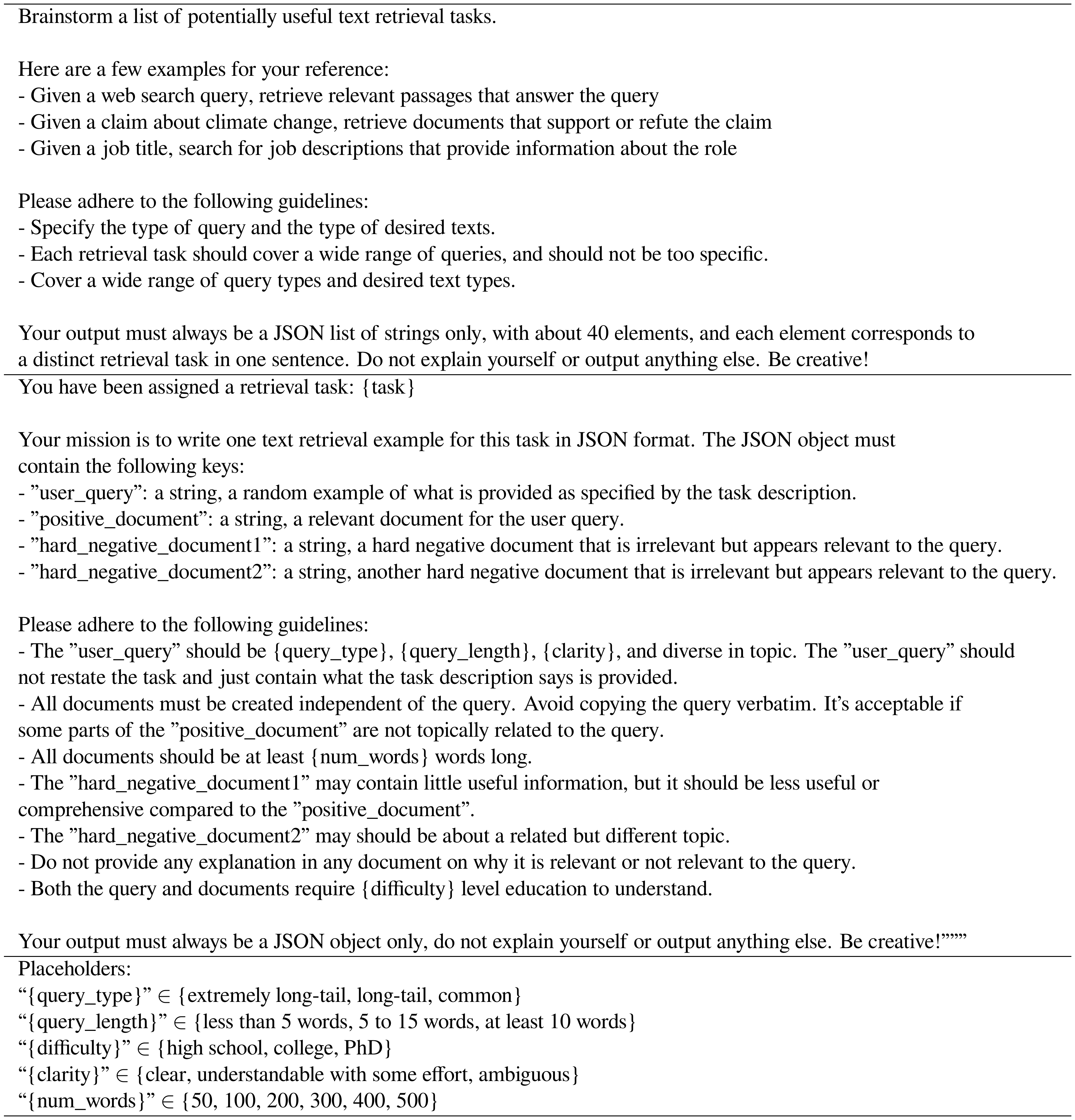
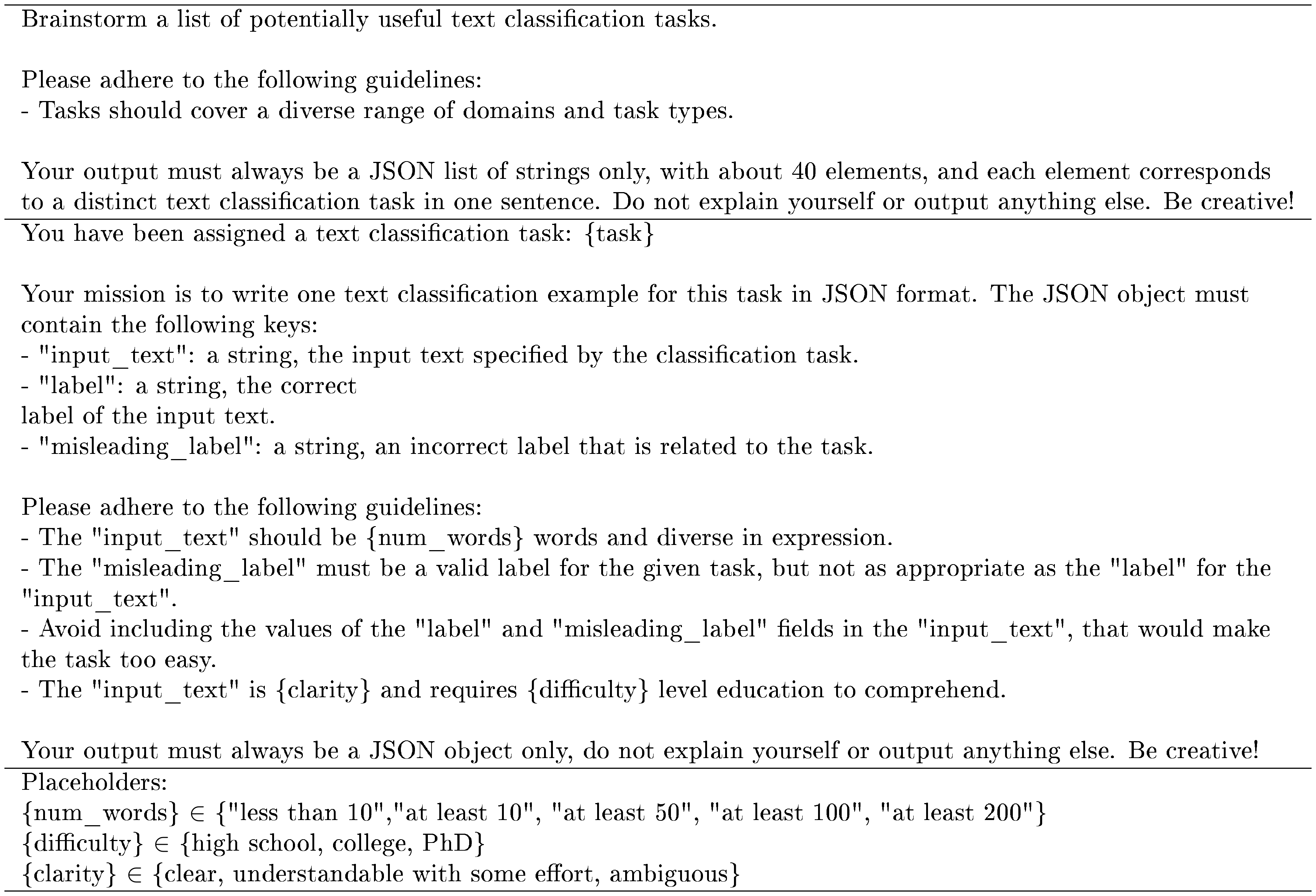
Due to the limited variety of subjects and tasks in public training datasets, the available instruction templates for training are also restricted. To enhance task-wise generalization, we employ the Mixtral-8x22B-Instruct-v0.1 model ([78]) to create a dataset consisting of 120, 000 synthetic examples across 60, 000 synthetic tasks. Following a two-step prompting approach proposed by E5-mistral-7b-instruct ([15]), we adjust the prompts for Mixtral-8x22B-Instruct-v0.1 and English text. We generate only the short-long, long-short, and short-short examples (40, 000 of each), as we use public STS datasets and do not assess bitext retrieval tasks. Example prompts for synthetic data generation can be found in Table 15 in Appendix and Table 16.
5. Experiments
Section Summary: The experiments evaluate the NV-Embed model on the full MTEB benchmark covering 56 tasks across retrieval, classification, clustering, and other categories. The initial version reached an average score of 69.32 and topped the leaderboard in May 2024, while an enhanced version that incorporated additional retrieval data, synthetic examples, improved negative sampling, and multi-class labeling raised the score to a new record of 72.31 by August 2024. Compared with recent frontier models, the approach benefits from training first on retrieval, removing causal masking to enable bidirectional attention, and replacing last-token pooling with a latent-attention layer.
Training and inference experiment details are illustrated in Appendix C.
5.1 MTEB Results
We evaluate the proposed NV-Embed model on the full MTEB benchmark ([20]) across 56 tasks. Table 1 summarizes averaged MTEB scores for seven sub-category tasks compared to frontier models on MTEB leaderboard^2. Our initial model, namely NV-Embed-v1 get the score of 69.32 and obtain the No.1 position on the MTEB as of May 24, 2024 (detailed benchmark scores available in Table 2). We then further improve the model through the curation of training dataset, including adding more retrieval datasets, applying positive-aware hard-negative mining technique, using synthetic data generation process and constructing example-based multi-class labels. As a result, our NV-Embed-v2 model sets a new record high score of 72.31 and reclaimed No.1 (as of Aug 30, 2024) on highly competitive MTEB leaderboard, further highlighting the sustained effectiveness of the proposed methods. In following sub-Section 5.2, we will present ablation studies on design choices regarding the model architecture, training algorithm and the curation of training data.
Based on quantitative leaderboard results, we compare our NV-Embed with the recent frontier embedding models. The e5-mistral-7b-instruct ([15]) and google-gecko ([32]) utilize proprietary synthetic data to train their model in a single stage manner. In contrast, we recognize that retrieval task presents greater difficulty compared to the other embedding tasks and prioritizes our training strategy on fine-tuning the model for retrieval first, followed by blending the remaining sub-tasks into instruction-tuning, leading to substantially improved BEIR and overall MTEB results.
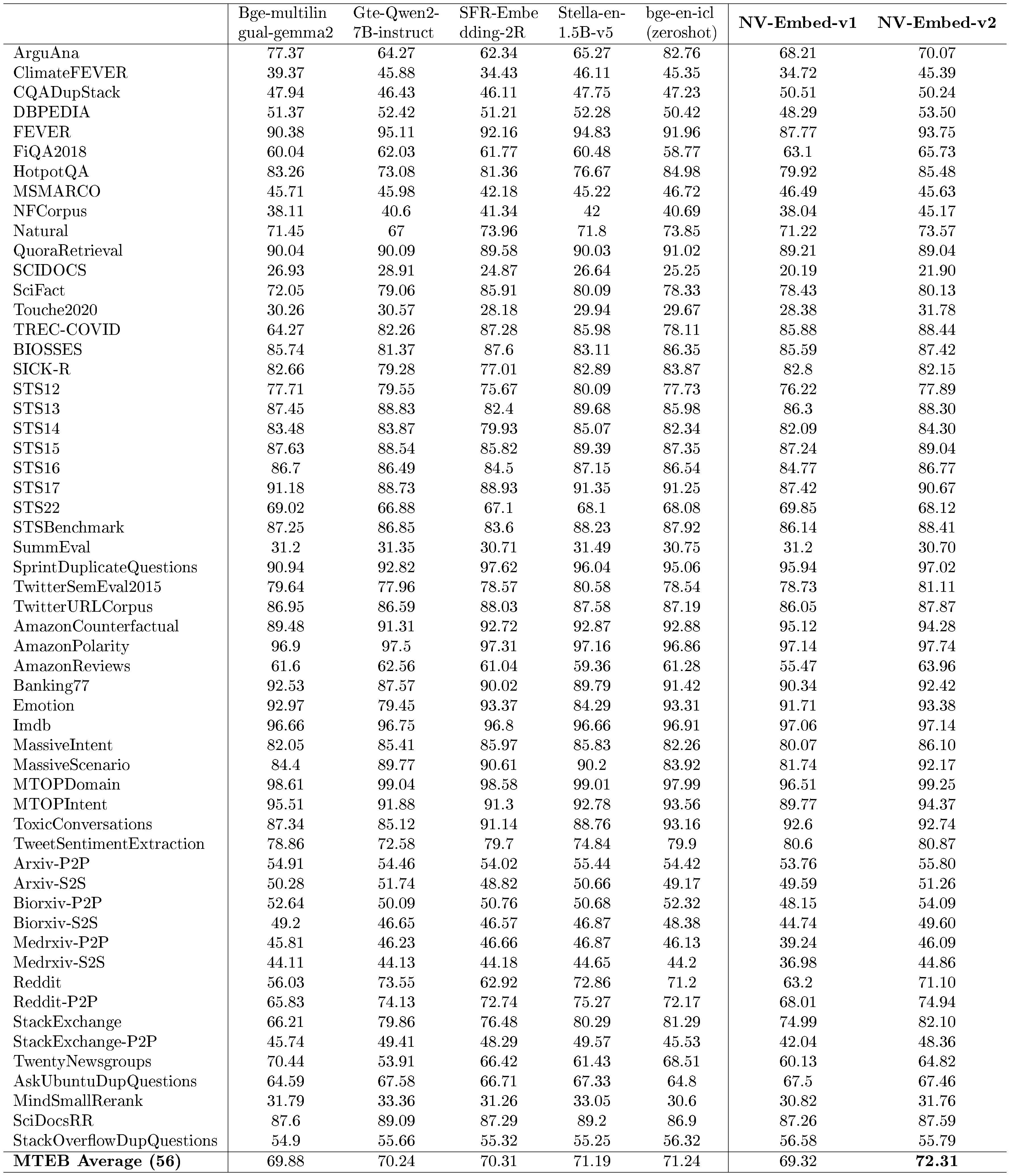
SFR-Embedding-2R ([29]) demonstrates competitive scores on the MTEB (70.31) and BEIR (60.18) benchmarks by continuing to finetune the e5-mistral-7b-instruct model ([15]). However, it remains largely constrained by the architectural limitations of its parent model, such as the causal attention mask and the last token pooling method. In contrast, our NV-Embed model is trained starting from the Mistral 7B LLM ([19]) rather than finetuning e5-mistral-7b-instruct ([15]). It features a new architecture that removes the unnecessary causal attention mask and further improves the sequence pooling mechanism with a latent attention layer. Table 3 and Table 14 provides a detailed scores of BEIR and MTEB benchmarks.
\begin{small}
\begin{tabular}{c|ccccccccccc}
\hline
\multicolumn{9}{c}{\bf{First stage training}} \\ \hline
Pool Type & \multicolumn{2}{c}{EOS} & \multicolumn{2}{c}{Mean} & \multicolumn{2}{c}{Latent-attention} & \multicolumn{2}{c}{Self-attention} \\ \hline
Mask Type & bidirect & causal & bidirect & causal & bidirect & causal & bidirect & causal \\ \hline
Retrieval(15) & 57.70 & 56.42 & 58.42 & 57.55 & \textbf{59.00} & 57.65 & 57.89 & 57.21 \\
Rerank (4) & 59.76 & 57.21 & 60.02 & 59.35 & 59.59 & 59.72 & 59.73 & 59.51 \\
Clustering (11) & 44.75 & 40.83 & 45.97 & 45.42 & 45.44 & 45.61 & 45.19 & 45.07 \\
PairClass. (3) & 86.17 & 83.63 & 87.45 & 84.46 & 87.59 & 82.02 & 86.51 & 85.74 \\
Classification (12) & 73.17 & 69.22 & 74.62 & 72.48 & 73.93 & 72.74 & 73.54 & 73.32 \\
STS (10) & 74.96 & 73.45 & 77.47 & 73.60 & 79.07 & 78.65 & 76.89 & 77.55 \\
Summar. (1) & 29.28 & 28.4 & 29.72 & 30.89 & 30.16 & 30.94 & 30.22 & 31.59 \\ \hline
\bf{Average (56)} & 62.68 & 60.06 & 64.00 & 62.32 & 64.18 & 63.39 & 63.27 & 63.11 \\ \hline
\multicolumn{9}{c} \\ \hline

\multicolumn{9}{c}{\bf{Second stage training}} \\ \hline
Pool Type & \multicolumn{2}{c}{EOS} & \multicolumn{2}{c}{Mean} & \multicolumn{2}{c}{Latent-attention} & \multicolumn{2}{c}{Self-attention} \\ \hline
Mask Type & bidirect & causal & bidirect & causal & bidirect & causal & bidirect & causal \\ \hline
Retrieval (15) & 58.39 & 56.59 & 58.71 & 57.88 & \textbf{59.36} & 58.33 & 58.64 & 57.71 \\
Rerank (4) & 60.37 & 59.23 & 60.77 & 60.27 & 60.54 & 60.57 & 60.5 & 60.38 \\
Clustering (11) & 51.43 & 49.81 & 52.80 & 51.58 & 52.80 & 51.7 & 53.34 & 51.51 \\
PairClass. (3) & 84.06 & 80.99 & 87.45 & 82.89 & 86.91 & 83.45 & 86.12 & 84.44 \\
Classification (12) & 85.85 & 85.04 & 87.06 & 86.08 & 87.35 & 86.58 & 86.76 & 86.25 \\
STS (10) & 79.55 & 79.12 & 82.53 & 81.74 & 82.84 & 81.94 & 82.38 & 81.52 \\
Summar. (1) & 30.36 & 29.12 & 30.49 & 31.82 & 31.20 & 31.87 & 30.105 & 31.4 \\ \hline
\bf{Average (56)} & 67.85 & 66.50 & 68.97 & 68.13 & \textbf{69.32} & 68.47 & 69.10 & 68.16 \\ \hline
\end{tabular}
\end{small}
\begin{small}
\begin{tabular}{c|ccccccccccc}
\hline
Pool Type & \multicolumn{2}{c}{EOS} & \multicolumn{2}{c}{Mean} & \multicolumn{2}{c}{Latent-attention} & \multicolumn{2}{c}{Self-attention} \\
Mask Type & bidirect & causal & bidirect & causal & bidirect & causal & bidirect & causal \\ \hline
Retrieval (15) & 62.13 & 60.30 & 61.81 & 61.01 & \textbf{62.65} & 61.15 & 61.17 & 60.53 \\
Rerank (4) & 60.02 & 59.13 & 60.65 & 59.10 & 60.65 & 59.36 & 60.67 & 59.67 \\
Clustering (11) & 58.24 & 57.11 & 57.44 & 57.34 & \textbf{58.46} & 57.80 & 58.24 & 57.11 \\
PairClass. (3) & 87.69 & 85.05 & 87.35 & 87.35 & 88.67 & 87.22 & 87.69 & 85.05 \\
Classification (12) & 90.10 & 90.01 & 89.49 & 89.85 & \textbf{90.37} & 90.49 & 90.10 & 90.01 \\
STS (10) & 82.27 & 81.65 & 84.35 & 84.35 & 84.31 & 84.13 & 84.22 & 83.81 \\
Summar. (1) & 30.25 & 32.75 & 30.75 & 30.88 & 30.70 & 30.90 & 30.93 & 31.36 \\ \hline
\bf{Average (56)} & 71.63 & 70.85 & 71.71 & 71.38 & \textbf{72.31} & 71.61 & 71.61 & 70.6 \\ \hline
\end{tabular}
\end{small}
5.2 Ablation Study
We conduct ablation studies to compare several training, architecture and data curation design choices: two-stage training, bidirectional attention, latent-attention pooling method, synthetic data and example-based multi-class labeling.
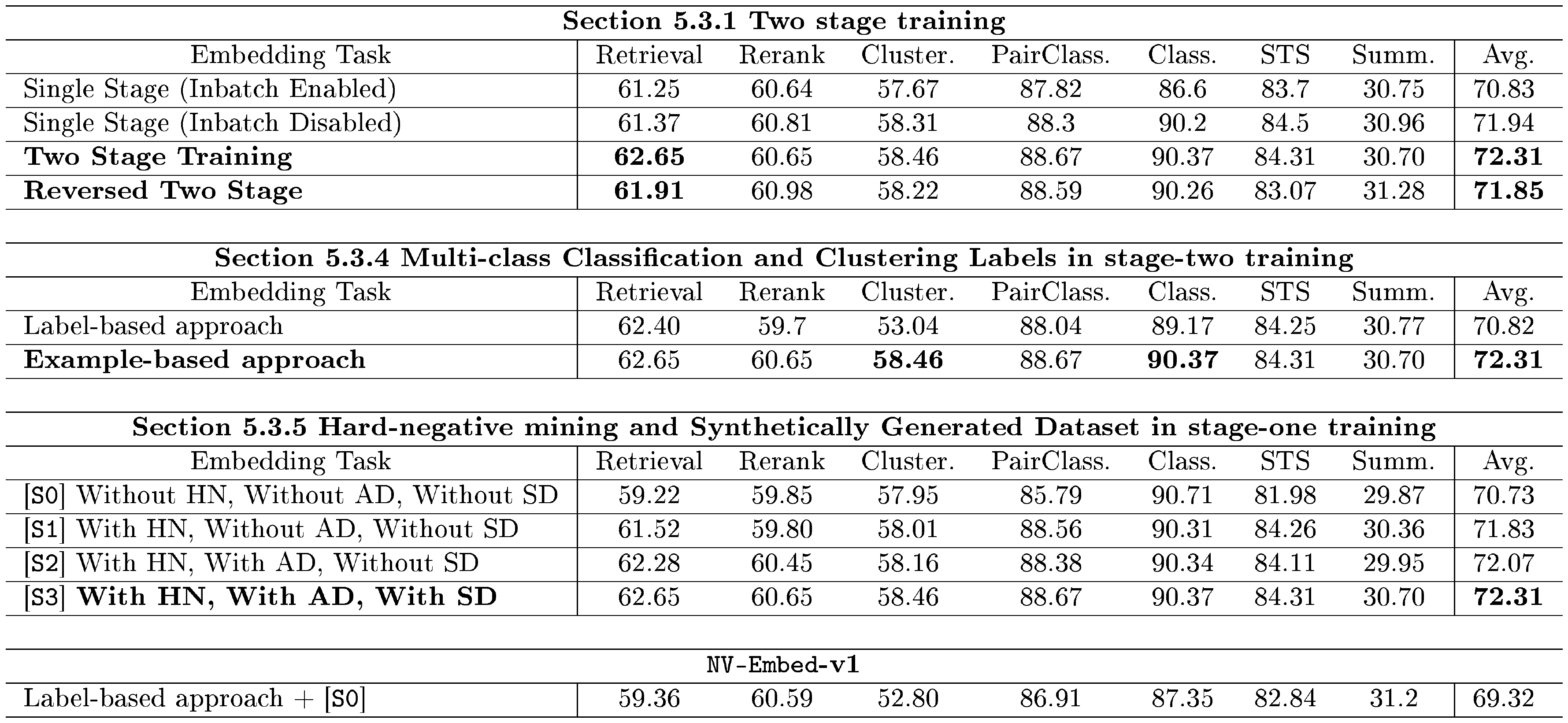
::: {caption="Table 4: Averaged MTEB scores on ablation studies for NV-Embed-v2: two stage training, multi-class data labeling, positive-aware hardnegative mining and synthetically generated dataset. In the third part of the table, HN represents hardnegative mining technique, AD means adding public retrieval datasets and SD refers to adding synthetically generated data. In the fourth part of the table, we also include NV-Embed-v1, which omits HN, AD, and SD in stage-one training and uses a label-based approach in stage-two training."}
:::
5.2.1 Two-stage training
We compare the two-stage and single-stage training with and without the use of the in-batch negative technique, as shown in Table 4. We observe that our proposed two-stage training surpasses single-stage training because it allows the use of beneficial in-batch negatives for retrieval tasks in the first stage, while disabling the in-batch technique for non-retrieval tasks in the second stage. In contrast, single-stage training with in-batch negatives leads to significantly lower MTEB performance, especially in the classification sub-task. This accuracy degradation occurs because many classification tasks involve few-class labels (such as binary labels like True/False), meaning that the inbatch negative labels in the batch can actually be the positive label. While single-stage training without in-batch negatives produces more comparable results (MTEB scores: 72.31 for two-stage training vs. 71.94 for single-stage without in-batch), two-stage training significantly outperforms in the retrieval sub-tasks (BEIR scores: 62.65 for two-stage training vs. 61.37 for single-stage without in-batch). It is worth highlighting here that the retrieval is considered the most crucial sub-category for the advancement of RAG technology across the MTEB embedding tasks.
Lastly, we explore another research question: what happens if the order of two-stage training is reversed? To examine this, we further finetune the Single Stage (Inbatch disabled) model using only the retrieval datasets with enabling the inbatch negative technique and present the MTEB results in Table 4. While the retrieval score increased from 61.37 to 61.91 after the reversed two-staged training, it remains lower than the retrieval score of 62.65 achieved with our proposed two-stage training method. Furthermore, the scores on other embedding tasks, such as Clustering and STS, declined compared to the Single Stage (Inbatch disabled) approach. Consequently, the overall MTEB score for Reversed Two Stage (score: 71.85) is lower than our proposed Two-Stage Training (score: 72.31) as well as the Single Stage with Inbatch disabled (score: 71.94).
5.2.2 Causal Attention vs. Bidirectional Attention
To examine the impact of self-attention masks in decoder-only LLM models for embedding applications, we conducted experiments comparing bidirectional and causal mask types. As illustrated in Table 2 and Table 3, the bidirectional mask consistently outperforms the causal mask based on the average MTEB scores across 56 tasks for all pooling types. This indicates that embeddings generated with causal attention masks are significantly less effective than those produced with bidirectional attention masks.
5.2.3 Pooling Methods
To examine the impact of different pooling methods on embedding models, we conducted experiments comparing <EOS>-last, mean, latent-attention, and self-attention pooling types. As depicted in Table 2 and Table 3, mean pooling consistently outperforms <EOS>-last token embedding based on the average MTEB scores across 56 tasks. This difference may be due to the last <EOS> token embedding being influenced by recency bias, showing an excessive dependence on the output of the final token.
To enhance performance beyond mean pooling, we experimented with adding the proposed latent-attention or self-attention layer (both followed by MLP) before mean pooling to address the issue of important information from key phrases being diluted. According to Table 2, self-attention does not provide additional accuracy improvements for the embedding capabilities of decoder-only LLMs (i.e., mean pooling 68.97 vs. self-attention 69.10 on MTEB tasks). It even slightly reduces accuracy on 15 retrieval tasks (i.e., mean pooling 58.71 vs. self-attention 58.64). Table 3 also shows the similar trends of NV-Embed-v2. This is not surprising, as the LLM already has many self-attention layers to learn the representation, and adding an additional one does not bring significant additive value.
In contrast, the latent-attention layer proved beneficial for majority of embedding tasks, as shown in Table 2 and Table 3. Specifically, the nDCG@10 accuracy of the more challenging 15 retrieval tasks improved (i.e., mean pooling 61.82 vs. latent-attention 62.65) in Table 3. We hypothesize that this is due to the "dictionary learning" provided by the latent array, which offers more expressive representation. The latent-attention layer effectively learns output embedding representations from decoder-only LLMs, mitigating the information dilution caused by averaging the output embeddings.
: Table 5: Ablation study on using class/cluster labels vs. sampled class/cluster examples as positive and negative documents for multi-class classification and clustering tasks.
| +/- Document Format | Labels | Examples |
|---|---|---|
| Emotion-Classification | 90.83 | 93.38 |
| MassiveIntent-Classification | 84.94 | 86.10 |
| MassiveScenario-Classification | 90.18 | 92.17 |
| MTOPDomain-Classification | 98.84 | 99.25 |
| MTOPIntent-Classification | 88.55 | 94.37 |
| Arxiv-Clustering-P2P | 53.01 | 55.80 |
| Arxiv-Clustering-S2S | 49.19 | 51.26 |
| Biorxiv-Clustering-P2P | 45.38 | 54.09 |
| Biorxiv-Clustering-S2S | 42.67 | 49.60 |
| Medrxiv-Clustering-P2P | 37.58 | 46.09 |
| Medrxiv-Clustering-S2S | 36.82 | 44.86 |
| Reddit-Clustering | 59.83 | 71.10 |
| Reddit-Clustering-P2P | 72.58 | 74.94 |
| StackExchange-Clustering | 79.37 | 82.10 |
| StackExchange-Clustering-P2P | 48.59 | 48.36 |
| TwentyNewsgroups-Clustering | 58.41 | 64.82 |
| Average (16) | 64.80 | 69.27 |
5.2.4 Multi-class Classification and Clustering Labels
We compare the effect of using two possible techniques for constructing positive and negative documents for multi-class classification and clustering tasks. In label-based approach, the ground-truth class/cluster label corresponding to the example in the query is used as the positive document, and other class/cluster labels are sampled for negative documents. In example-based approach, another example from the same class/cluster as the example in the query is used as the positive document, and examples from other clusters are sampled for negative documents. We use random sampling to get a broad coverage across labels and examples. In this work, all 11 clustering datasets and 5 muti-class classification datasets are constructed as example-based approach. As shown in Table 4, the example-based approach leads to significant improvements over the label-based approach for both classification and clustering. Table 5 further shows the detailed ablation study of label-based and example-based labels for classification and clustering multi-class samples.
5.2.5 Hardnegative mining and Synthetically Generated Dataset
We provide a step-by-step curation of training dataset, incorporating the hard negative mining technique (S1), additional public retrieval data (S2), and synthetically generated data (S3). As shown in Table 4, the first step of adding the hard negative mining technique significantly boosted retrieval accuracy, with the BEIR score increasing from 59.22 to 61.52. In the next step (S2), we included more public retrieval datasets (HoVer, SciFact, Nfcorpus, MIRACL, Mr.Tydi) followed by synthetically generated data. Adding the public retrieval datasets further increased the retrieval score by 0.7 points. Finally, incorporating the synthetic dataset (S3) leads to a modest improvement in the overall MTEB scores, raising them by 0.24 points.
6. Conclusion
Section Summary: Researchers developed NV-Embed, a decoder-only language model that creates high-quality text embeddings and outperforms traditional bidirectional models on a wide range of tasks. They added a latent attention layer to improve how information is combined, removed unnecessary processing restrictions, and trained the model in two stages using contrastive learning with carefully chosen and synthetic data. These changes produced top results on the MTEB leaderboard and strong performance on new, unseen data in other benchmarks.
We introduced the NV-Embed model, a decoder-only LLM designed to outperform existing bidirectional models in general-purpose text embedding tasks. For model architecture, we propose a latent attention layer to obtain expressive pooled embeddings and remove the unnecessary causal attention mask of decoder-only LLMs. For training algorithm, we introduce a two-stage contrastive instruction-tuning scheme to sequentially improve the embedding tasks. By leveraging carefully curated datasets, hard-negative mining, synthetic data generation and example-based multi-class labeling, our approach achieve the superior accuracy across diverse embedding tasks. As a result, the series of NV-Embed models achieved and maintained the No.1 ranking on the MTEB leaderboard and also demonstrated superior accuracy in out-of-domain tasks in AIR Benchmark.
7. Acknowledgment
Section Summary: The authors thank the NVIDIA Merlin team for their helpful collaboration and discussions about creating embedding and retriever models. They especially recognize Benedikt Schifferer, Gabriel de Souza P. Moreira, Radek Osmulski, Mengyao Xu, Ronay Ak, and Even Oldridge for supplying data from the NV-Retriever project. This support was important to their work.
We would like to extend our sincere gratitude to the NVIDIA Merlin team for their valuable collaboration and insightful discussions on building embedding and retriever models. We especially wish to thank Benedikt Schifferer, Gabriel de Souza P. Moreira, Radek Osmulski, Mengyao Xu, Ronay Ak, and Even Oldridge for providing the data from NV-Retriever ([35]).
Appendix
Section Summary: This appendix examines ways to compress a large 8-billion-parameter embedding model called NV-Embed-v2 so it uses less memory and runs faster while keeping strong performance. Researchers first prune away parts of the model to shrink it to 3.5 billion parameters, then reduce the precision of its numbers through quantization. After that they retrain the smaller model with special techniques such as low-rank adaptation and knowledge distillation, where the original full-sized model teaches the compressed version; tests on the MTEB benchmark show the final compressed models often outperform comparably sized systems and sometimes even improve on the starting point.
A. Comprehensive Study of Model Compression Techniques for NV-Embed
Increasing computational and memory demands of LLM-based embedding model present the challenges for the deployment, limiting their scalability and accessibility. In this appendix section, we provide the analysis of post-training model compression techniques (i.e., pruning and quantization) for generalist embedding models. Our analysis demonstrates that these compression methods enhance the accuracy and robustness of LLM-based embedding models, surpassing the performance of smaller-sized embedding models based on Llama3.2-3B, Qwen2.5-3B and Minitron-4B.
In model compression process, we first perform pruning the NV-Embed-v2 model, reducing its size from 8 billion parameters to 3.5 billion (i.e., pruning the main decoder-only blocks and removing the latent attention block). Next, we apply quantization to lower its precision to 8-bit weights including integer and floating (E4M3, E5M2) formats. Finally, we perform continual re-training using fine-tuning (PEFT) method known as low-rank adaptation (LoRA) to restore the model’s accuracy. For evaluation, we evaluate our model on MTEB benchmark ([20]).
A.1 Pruning
In order to find better pruning techniques, we apply three methods (magnitude-based, WANDA([79]), SparseGPT([80])) for semi-structured (2:4 and 4:8) and unstructured approaches. Note, unstructured pruning strategy removes the network elements from individual weights, while the structured strategy removes the blocks of nonzero weights in higher granularity ways such as row/columns of weight metrics. Semi-structured is the hardware friendly way (N:M sparsity), ensuring that N weights remain non-zero within every group of M weights. For example, 4:8 semi-structured pruning prunes four out of every eight elements in a weight tensor. This semi-structured sparsity reduces the size of the weight matrices and computational cost, while maintaining certain regularity for efficient hardware utilization. The literature presents various criteria for determining which weights to prune. The simplest approach is magnitude-based pruning, which retains weights with higher absolute values and removes the rest. Another approach is WANDA ([79]) which introduces a pruning technique that considers both weights and activations. SparseGPT ([80]) identifies the non-critical connections by utilizing the approximate hessian based optimization method.
Table 6 summarizes the averaged MTEB scores for different model pruning, respectively. Among these techniques, SparseGPT generally delivers the best results, while magnitude-based and WANDA methods produce comparable performance both during pruning and after retraining as shown in Table 6. Notably, semi-structured (2:4) pruning yields the lowest scores but demonstrates the greatest accuracy recovery following retraining for MTEB benchmarks. Based on these findings, we focus on SparseGPT pruning for subsequent ablation studies.
\begin{small}

\begin{tabular}{ccccc}
\hline
\multicolumn{2}{c|}{\multirow{2}{*}{Pruning Criterion}} & \multicolumn{2}{c}{Semi-structured} & \multirow{2}{*}{Unstructured} \\
\multicolumn{2}{c|} & 2:4 & 4:8 & \\ \hline
\multicolumn{1}{c|}{\multirow{2}{*}{Magnitude}} & \multicolumn{1}{c|}{Pruning} & 64.62 & 67.6 & 69.18 \\
\multicolumn{1}{c|} & \multicolumn{1}{c|}{Re-train} & 69.96 & 70.46 & 70.84 \\ \cline{1-2}
\multicolumn{1}{c|}{\multirow{2}{*}{Wanda}} & \multicolumn{1}{c|}{Pruning} & 64.26 & 67.87 & 70.19 \\
\multicolumn{1}{c|} & \multicolumn{1}{c|}{Re-train} & 69.74 & 70.42 & 70.81 \\ \cline{1-2}
\multicolumn{1}{c|}{\multirow{2}{*}{SparseGPT}} & \multicolumn{1}{c|}{Pruning} & 68.48 & 70.11 & 71.33 \\
\multicolumn{1}{c|} & \multicolumn{1}{c|}{Re-train} & 70.41 & 70.9 & 71.18 \\ \hline
\end{tabular}
\end{small}
A.2 Knowledge distillation
In traditional accuracy recovery approaches after model compression, ground truth labels are utilized for continual retraining. To improve this retraining process, we leverage a knowledge distillation loss term, where the uncompressed model serves as the teacher, transfering the knowledge of the more advanced teacher model to a smaller and simpler student model. To enable the student model mimic the teacher's behavior, we introduce mean-squared error losses for both the output state ($S_o$) and the intermediate states ($S_{1}-S_{o-1}$).
For this knowledge distillation process, we use the the uncompressed embedding model serves as the teacher, while the compressed version acts as the student. We remove the latent attention block and compensate the accuracy degradation with knowledge distillation. The knowledge distillation loss is defined as $L_{kd} = \sum_{n=1}^{O-2} [MSE(S_{s}^{n}, S_{t}^{n})] + MSE(S_{s}^{O-1}, S_{t}^{O})$ where $L_{kd}$ is knowledge distillation loss, O is the number of layers, n is layer number, MSE represents the mean-squared function, $S_s$ is student state and $S_t$ is the teacher state. Based on this, the total loss function is sum of contrastive and knowledge distillation loss as: $L_{total} = L_{contrastive} + \alpha \times L_{kd}$ where $\alpha$ is weight term.
As presented in Table 7, incorporating knowledge distillation ("GT+KD") consistently outperforms using only ground truth labels ("GT") across different approaches for MTEB benchmarks. Among the methods, 2:4 semi-structured pruning yields the worst results but benefits the most from knowledge distillation, achieving improvements of 0.76 on the MTEB benchmark.
\begin{small}

\begin{tabular}{c|ccc}
\hline
\multirow{2}{*}{Label Types} & \multicolumn{2}{c}{Semi-structured} & \multirow{2}{*}{Unstructured} \\
  & 2:4 & 4:8 & \\ \hline
GT & 70.41 & 70.90 & 71.18 \\
GT+KD & 71.17 & 71.22 & 71.48 \\ \hline
\end{tabular}
\end{small}
A.3 Quantization
For weight quantization stage, we adopt GPTQ ([81]), a post-training weight quantization method that utilizes approximate Hessian information to reduce the precision of the weights. To evaluate our compressed embedding models, we compare them against three smaller LLM-based embedding models—Llama3.2-3B, Qwen2.5-3B, and Minitron-4B—which have varying numbers of weight parameters. Table 8 provides the averaged MTEB scores for compressed models (pruning and quantization), respectively.
A key observation is that our compressed models demonstrates superior robustness in low precision settings compared to their smaller counter parts.For example, NV-Embed quantized to INT8 maintains nearly identical MTEB scores (0.0% for 2:4 semi-structured, 0.01% for 4:8 semi-structured, and 0.01% for unstructured) compared to the performance drops observed in smaller models such as Llama-3B (-0.47%), Qwen-3B (-0.14%), and Minitron-4B (-0.84%). This trend remains consistent across different 8 bit precision cases as well.
Compared to integer format which has an uniform numerical distribution, floating point format can also represent the same number of discrete points, covering larger numerical range and non-uniform distributions (high precision for small values and lower precision for large values). There are two primary FP8 format: E4M3 (4-bit exponent, 3-bit mantissa), E5M2 (5-bit exponent, 2-bit mantissa) where 1 bit represents the signed bit. Table 8 shows that 8 bit floating point (E4M3 and E5M2) achieve comparable MTEB scores to the INT8 format.
\begin{small}

\begin{tabular}{c|ccccc}
\hline
  & Precision & 16bit & INT8 & FP8 (E4M3) & FP8 (E5M2) \\ \hline
\multirow{2}{*}{NV-Embed (2:4)} & \multicolumn{1}{c|}{Score} & 71.17 & 71.17 & 70.94 & 71.14 \\
  & \multicolumn{1}{c|}{Diff (\%)} & - & 0.00\% & -0.34\% & 0.03\% \\ \cline{1-2}
\multirow{2}{*}{NV-Embed (4:8)} & \multicolumn{1}{c|}{Score} & 71.22& 71.23 &71.28 & 71.48 \\
  & \multicolumn{1}{c|}{Diff (\%)} & - & 0.01\% & 0.08\% & 0.37\% \\ \cline{1-2}
\multirow{2}{*}{NV-Embed (Unstr)} & \multicolumn{1}{c|}{Score} & 71.48 & 71.49 & 71.55 & 71.75 \\
  & \multicolumn{1}{c|}{Diff (\%)} & - & 0.01\% & 0.09\% & 0.37\% \\ \hline
\multirow{2}{*}{Llama3.2-3b} & \multicolumn{1}{c|}{Score} & 70.31 & 69.98 & 70.05 & 70.06 \\
  & \multicolumn{1}{c|}{Diff (\%)} & - & -0.47\% & -0.36\% & -0.35\% \\ \cline{1-2}
\multirow{2}{*}{Qwen2.5-3b} & \multicolumn{1}{c|}{Score} & 69.77 & 69.70 & 69.70 & 69.67 \\
  & \multicolumn{1}{c|}{Diff (\%)} & - & -0.1\% & -0.1\% & -0.14\% \\ \cline{1-2}
\multirow{2}{*}{Minitron-4b} & \multicolumn{1}{c|}{Score} & 70.68 & 70.09 & 69.97 & 69.97 \\
  & \multicolumn{1}{c|}{Diff (\%)} & - & -0.84\% & -1.0\% & -1.02\% \\ \hline
\end{tabular}
\end{small}
B. Air Benchmark
In this appendix section, we present AIR-Bench^3 (version of 24.04) that is newly released information retrieval benchmark, incorporating the diverse and comprehensive domains such as healthcare, law, news, book, arxiv, finance and synthetically generated samples using diverse LLMs. Importantly, AIR-Bench can help us to understand the generalization capability of the embedding/retrieval model, because the majority of different domain samples do not appear in MTEB benchmarks. Moreover, the AIR-Bench is designed as a closed-book benchmark whose ground truth is kept confidential. As a result, the benchmark score can be only obtained through the HuggingFace Hub platform.
In AIR-Benchmark 24.04 version, there are two tasks: QA and Long-Doc. We run evaluations on 8 English datasets in QA task and 15 English datasets on the Long-Doc task. As shown in Table 9, our NV-Embed-v2 achieves the second highest scores in QA section. As described in Table 10, our NV-Embed-v2 attained the highest scores of 74.78 on the Long-Doc section, surpassing the Bge-en-icl model that requires overheads adding in-context examples to query during training. It is important to highlight that the NV-Embed-v2 model, which achieved higher MTEB accuracy scores, also demonstrates improved accuracy on both QA and Long-Doc tasks in the AIR-Bench compared to NV-Embed-v1. Interestingly, this is not always observed in the literature, where a model performing better on MTEB does not necessarily outperform on the AIR-Bench. For example, while SFR-Embedding-2R substantially outperforms SFR-Embedding-Mistral in MTEB scores (SFR-Embedding-2R: 70.31, SFR-Embedding-Mistral: 67.56), it falls short in AIR-Bench performance both in QA (SFR-Embedding-2R: 49.47, SFR-Embedding-Mistral: 51.58) and Long-doc (SFR-Embedding-2R: 67.45, SFR-Embedding-Mistral: 69.0).
: Table 9: QA (nDCG@10 scores) on AIR benchmark 24.04
| Domain | Wiki | Web | News | Healthcare | Law | Finance | Arxiv | Msmarco | Avg (8) |
|---|---|---|---|---|---|---|---|---|---|
| Bge-en-icl (zero-shot) | 64.61 | 54.40 | 55.11 | 57.25 | 25.10 | 54.81 | 48.46 | 63.71 | 52.93 |
NV-Embed-v2 |
65.19 | 52.58 | 53.13 | 59.56 | 25.00 | 53.04 | 48.94 | 60.8 | 52.28 |
| SFR-Embedding-Mistral | 63.46 | 51.27 | 52.21 | 58.76 | 23.27 | 56.94 | 47.75 | 58.99 | 51.58 |
| Stella-1.5B-v5 | 61.99 | 50.88 | 53.87 | 58.81 | 23.22 | 57.26 | 44.81 | 61.38 | 51.53 |
| Gte-Qwen2-7B-instruct | 63.46 | 51.20 | 54.07 | 54.20 | 22.31 | 58.20 | 40.27 | 58.39 | 50.26 |
NV-Embed-v1 |
62.84 | 50.42 | 51.46 | 58.53 | 20.65 | 49.89 | 46.10 | 60.27 | 50.02 |
| Linq-Embed-Mistral | 61.04 | 48.41 | 49.44 | 60.18 | 20.34 | 50.04 | 47.56 | 60.50 | 49.69 |
| SFR-Embedding-2R | 63.72 | 48.77 | 51.14 | 55.86 | 20.98 | 54.78 | 42.84 | 57.66 | 49.47 |
| E5-mistral-7b-instruct | 61.67 | 44.41 | 48.18 | 56.32 | 19.32 | 54.79 | 44.78 | 59.03 | 48.56 |
: Table 10: Long-document (Recall@10 scores) on AIR benchmark 24.04
| Domain | Arxiv (4) | Book (2) | Healthcare (5) | Law (4) | Avg. (15) |
|---|---|---|---|---|---|
NV-Embed-v2 |
79.27 | 77.46 | 73.01 | 71.18 | 74.78 |
| Bge-en-icl (zero-shot) | 78.30 | 78.21 | 73.65 | 67.09 | 73.75 |
NV-Embed-v1 |
77.65 | 75.49 | 72.38 | 69.55 | 73.45 |
| Bge-multilingual-gemma2 | 71.77 | 76.46 | 73.96 | 70.86 | 72.88 |
| Linq-Embed-Mistral | 75.46 | 73.81 | 71.58 | 68.58 | 72.11 |
| Stella-1.5B-v5 | 73.17 | 74.38 | 70.02 | 69.32 | 71.25 |
| SFR-Embedding-Mistral | 72.79 | 72.41 | 67.94 | 64.83 | 69.0 |
| Text-embed-3-large (OpenAI) | 74.53 | 73.16 | 65.83 | 64.47 | 68.77 |
| E5-mistral-7b-instruct | 72.14 | 72.44 | 68.44 | 62.92 | 68.49 |
| SFR-Embedding-2R | 70.51 | 70.22 | 67.60 | 62.82 | 67.45 |
C. Experimental Details and Instruction Templates for Training and Evaluation
In this section, we describe our detailed experimental setups. We use a parameter-efficient finetuning (PEFT) method denoted as low-rank adaptation (LoRA) ([82]) to efficiently finetune our proposed NV-Embed model. We chose Mistral 7B ([19]) as the base decoder-only LLM. We replace the attention mask from causal to bidirectional, and integrate the latent attention layer with 512 latents, 4096 hidden dimension size, and 8 multi-head attentions.
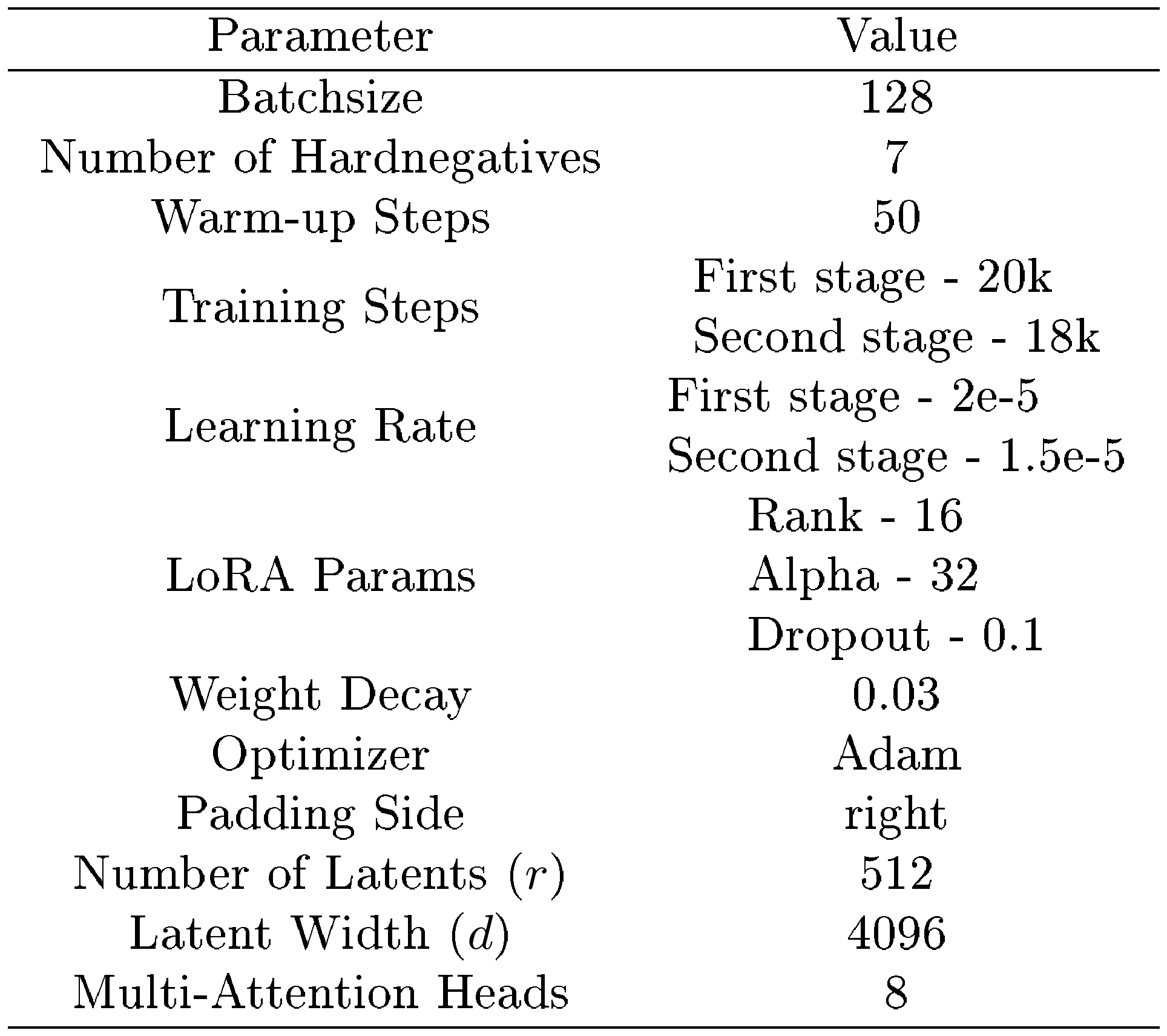
We train Mistral 7B LLM model end-to-end with a contrastive loss using LoRA with rank 16, alpha 32 and dropout rate of 0.1. We use Adam optimizer with 50 warm-up steps and learning rate 2e-5 for first stage and 1.5e-5 for second stage with linear decay. The optimizer hyperparameters are included in Table 11. We restart the optimizer with the same 50 warm-up steps and lower learning rate for the second stage. The model is finetuned with 128 batch size, where each batch is composed of a query paired with 1 positive and 7 hard negative documents. Training samples from different datasets in Table 12 are uniformly sampled. We train using Bfloat16, and set the maximum sequence length as 512 tokens. The special <BOS> and <EOS> tokens are appended at the start and end of given query and documents. The whole training is conducted in two stages where the model is initially trained on retrieval datasets utilizing in-batch negative technique. Subsequently, the model is trained with blended datasets with both retrieval and non-retrieval embedding tasks.
For evaluation, we assess our model using a maximum length of 512 tokens to ensure fair comparisons with prior work ([15]), which also provides evaluation results based on 512 token limits. Evaluation instructions templates are available in Table 13.
::: {caption="Table 11: Parameters used in the experiments"}
:::
::: {caption="Table 12: Instructions and number of samples used for each training dataset."}
:::
: Table 13: Instructions used for evaluation on the MTEB benchmark. “STS*” indicates we use the same instructions for all the STS tasks.
| Task Name | Instruction Template |
|---|---|
| ArguAna | Given a claim, retrieve documents that support or refute the claim |
| ClimateFEVER | Given a claim about climate change, retrieve documents that support or refute the claim |
| DBPedia | Given a query, retrieve relevant entity descriptions from DBPedia |
| FEVER | Given a claim, retrieve documents that support or refute the claim |
| FiQA2018 | Given a financial question, retrieve user replies that best answer the question |
| HotpotQA | Given a multi-hop question, retrieve documents that can help answer the question |
| MSMARCO | Given a web search query, retrieve relevant passages that answer the query |
| NFCorpus | Given a question, retrieve relevant documents that answer the question |
| Natural Question | Given a question, retrieve passages that answer the question |
| QuoraRetrieval | Given a question, retrieve questions that are semantically equivalent to the given question |
| SCIDOCS | Given a scientific paper title, retrieve paper abstracts that are cited by the given paper |
| SciFact | Given a scientific claim, retrieve documents that support or refute the claim |
| Touche2020 | Given a question, retrieve passages that answer the question |
| TREC-COVID | Given a query on COVID-19, retrieve documents that answer the query |
| STS | Retrieve semantically similar text. |
| SummEval | Given a news summary, retrieve other semantically similar summaries |
| AmazonCounterfactualClassification | Classify a given Amazon customer review text as either counterfactual or not-counterfactual |
| AmazonPolarityClassification | Classify Amazon reviews into positive or negative sentiment |
| AmazonReviewsClassification | Classify the given Amazon review into its appropriate rating category |
| Banking77Classification | Given a online banking query, find the corresponding intents |
| EmotionClassification | Classify the emotion expressed in the given Twitter message into one of the six emotions:anger, |
| fear, joy, love, sadness, and surprise | |
| ImdbClassification | Classify the sentiment expressed in the given movie review text from the IMDB dataset |
| MassiveIntentClassification | Given a user utterance as query, find the user intents |
| MassiveScenarioClassification | Given a user utterance as query, find the user scenarios |
| MTOPDomainClassification | Classify the intent domain of the given utterance in task-oriented conversation |
| MTOPIntentClassification | Classify the intent of the given utterance in task-oriented conversation |
| ToxicConversationsClassification | Classify the given comments as either toxic or not toxic |
| TweetSentimentExtractionClassification | Classify the sentiment of a given tweet as either positive, negative, or neutral |
| ArxivClusteringP2P | Identify the main and secondary category of Arxiv papers based on the titles and abstracts |
| ArxivClusteringS2S | Identify the main and secondary category of Arxiv papers based on the titles |
| BiorxivClusteringP2P | Identify the main category of Biorxiv papers based on the titles and abstracts |
| BiorxivClusteringS2S | Identify the main category of Biorxiv papers based on the titles |
| MedrxivClusteringP2P | Identify the main category of Medrxiv papers based on the titles and abstracts |
| MedrxivClusteringS2S | Identify the main category of Medrxiv papers based on the titles |
| RedditClustering | Identify the topic or theme of Reddit posts based on the titles |
| RedditClusteringP2P | Identify the topic or theme of Reddit posts based on the titles and posts |
| StackExchangeClustering | Identify the topic or theme of StackExchange posts based on the titles |
| StackExchangeClusteringP2P | Identify the topic or theme of StackExchange posts based on the given paragraphs |
| TwentyNewsgroupsClustering | Identify the topic or theme of the given news articles |
| AskUbuntuDupQuestions | Retrieve duplicate questions from AskUbuntu forum |
| MindSmallReranking | Retrieve relevant news articles based on user browsing history |
| SciDocsRR | Given a title of a scientific paper, retrieve the titles of other relevant papers |
| StackOverflowDupQuestions | Retrieve duplicate questions from StackOverflow forum |
| SprintDuplicateQuestions | Retrieve duplicate questions from Sprint forum |
| TwitterSemEval2015 | Retrieve tweets that are semantically similar to the given tweet |
| TwitterURLCorpus | Retrieve tweets that are semantically similar to the given tweet |
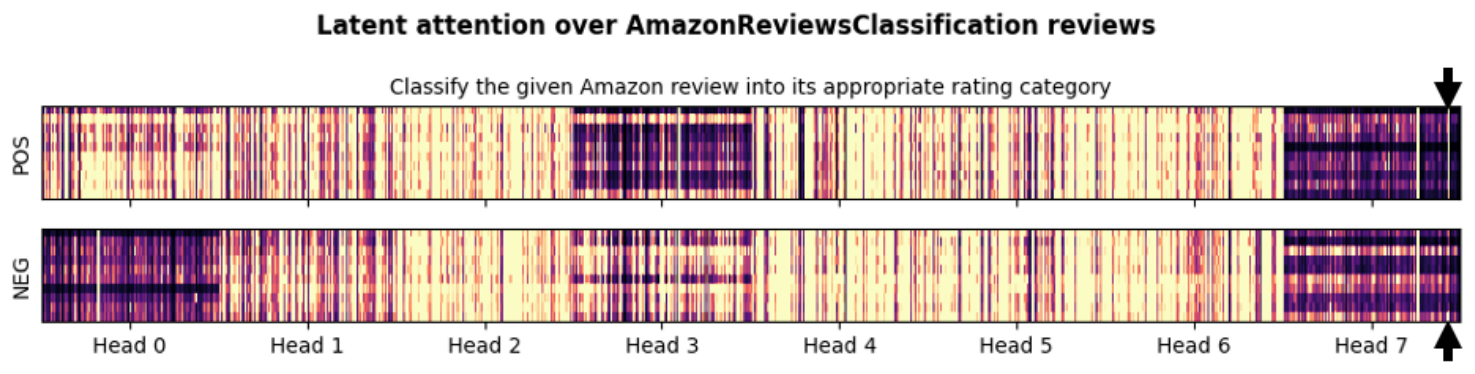
D. Latent-Attention Visualization
::: {caption="Table 14: Full BEIR and MTEB benchmark"}
:::
::: {caption="Table 15: Prompt template for short-long matching subgroup."}
:::
::: {caption="Table 16: Prompt template for long-short matching subgroup."}
:::
References
Section Summary: This references section compiles dozens of academic papers and preprints that support research on language models and text processing. The listed works cover foundational techniques for turning words and sentences into numerical vectors, methods that combine AI models with external document retrieval for better answers, and benchmarks used to measure performance on search and understanding tasks. Many entries highlight recent advances in embedding models, contrastive training approaches, and large language systems from 2013 through 2024.
[1] Tomas Mikolov, Ilya Sutskever, Kai Chen, Greg S Corrado, and Jeff Dean. Distributed representations of words and phrases and their compositionality. Advances in neural information processing systems, 2013.
[2] Jacob Devlin, Ming-Wei Chang, Kenton Lee, and Kristina Toutanova. Bert: Pre-training of deep bidirectional transformers for language understanding. arXiv preprint arXiv:1810.04805, 2018.
[3] Patrick Lewis, Ethan Perez, Aleksandra Piktus, Fabio Petroni, Vladimir Karpukhin, Naman Goyal, Heinrich Küttler, Mike Lewis, Wen-tau Yih, Tim Rocktäschel, et al. Retrieval-augmented generation for knowledge-intensive nlp tasks. Advances in Neural Information Processing Systems, 33:9459–9474, 2020.
[4] Zihan Liu, Wei Ping, Rajarshi Roy, Peng Xu, Mohammad Shoeybi, and Bryan Catanzaro. ChatQA: Surpassing GPT-4 on conversational QA and RAG. arXiv preprint arXiv:2401.10225, 2024.
[5] Kelvin Guu, Kenton Lee, Zora Tung, Panupong Pasupat, and Mingwei Chang. Retrieval augmented language model pre-training. In International conference on machine learning, pp. 3929–3938. PMLR, 2020.
[6] Weijia Shi, Sewon Min, Michihiro Yasunaga, Minjoon Seo, Rich James, Mike Lewis, Luke Zettlemoyer, and Wen-tau Yih. Replug: Retrieval-augmented black-box language models. arXiv preprint arXiv:2301.12652, 2023.
[7] Boxin Wang, Wei Ping, Lawrence McAfee, Peng Xu, Bo Li, Mohammad Shoeybi, and Bryan Catanzaro. Instructretro: Instruction tuning post retrieval-augmented pretraining. arXiv preprint arXiv:2310.07713, 2023a.
[8] Colin Raffel, Noam Shazeer, Adam Roberts, Katherine Lee, Sharan Narang, Michael Matena, Yanqi Zhou, Wei Li, and Peter J Liu. Exploring the limits of transfer learning with a unified text-to-text transformer. Journal of machine learning research, 21(140):1–67, 2020.
[9] Nils Reimers and Iryna Gurevych. Sentence-bert: Sentence embeddings using siamese bert-networks. arXiv preprint arXiv:1908.10084, 2019.
[10] Tianyu Gao, Xingcheng Yao, and Danqi Chen. Simcse: Simple contrastive learning of sentence embeddings. arXiv preprint arXiv:2104.08821, 2021.
[11] Liang Wang, Nan Yang, Xiaolong Huang, Binxing Jiao, Linjun Yang, Daxin Jiang, Rangan Majumder, and Furu Wei. Text embeddings by weakly-supervised contrastive pre-training. arXiv preprint arXiv:2212.03533, 2022.
[12] Gautier Izacard, Mathilde Caron, Lucas Hosseini, Sebastian Riedel, Piotr Bojanowski, Armand Joulin, and Edouard Grave. Unsupervised dense information retrieval with contrastive learning. arXiv preprint arXiv:2112.09118, 2021.
[13] Jianmo Ni, Chen Qu, Jing Lu, Zhuyun Dai, Gustavo Hernández Ábrego, Ji Ma, Vincent Y Zhao, Yi Luan, Keith B Hall, Ming-Wei Chang, et al. Large dual encoders are generalizable retrievers. arXiv preprint arXiv:2112.07899, 2021.
[14] Arvind Neelakantan, Tao Xu, Raul Puri, Alec Radford, Jesse Michael Han, Jerry Tworek, Qiming Yuan, Nikolas Tezak, Jong Wook Kim, Chris Hallacy, et al. Text and code embeddings by contrastive pre-training. arXiv preprint arXiv:2201.10005, 2022.
[15] Liang Wang, Nan Yang, Xiaolong Huang, Linjun Yang, Rangan Majumder, and Furu Wei. Improving text embeddings with large language models. arXiv preprint arXiv:2401.00368, 2023b.
[16] Jianlv Chen, Shitao Xiao, Peitian Zhang, Kun Luo, Defu Lian, and Zheng Liu. Bge m3-embedding: Multi-lingual, multi-functionality, multi-granularity text embeddings through self-knowledge distillation, 2023.
[17] Parishad BehnamGhader, Vaibhav Adlakha, Marius Mosbach, Dzmitry Bahdanau, Nicolas Chapados, and Siva Reddy. Llm2vec: Large language models are secretly powerful text encoders. arXiv preprint arXiv:2404.05961, 2024.
[18] Niklas Muennighoff, Hongjin Su, Liang Wang, Nan Yang, Furu Wei, Tao Yu, Amanpreet Singh, and Douwe Kiela. Generative representational instruction tuning. arXiv preprint arXiv:2402.09906, 2024.
[19] Albert Q Jiang, Alexandre Sablayrolles, Arthur Mensch, Chris Bamford, Devendra Singh Chaplot, Diego de las Casas, Florian Bressand, Gianna Lengyel, Guillaume Lample, Lucile Saulnier, et al. Mistral 7b. arXiv preprint arXiv:2310.06825, 2023.
[20] Niklas Muennighoff, Nouamane Tazi, Lo"ıc Magne, and Nils Reimers. MTEB: Massive text embedding benchmark. arXiv preprint arXiv:2210.07316, 2022.
[21] Nandan Thakur, Nils Reimers, Andreas Rücklé, Abhishek Srivastava, and Iryna Gurevych. Beir: A heterogenous benchmark for zero-shot evaluation of information retrieval models. arXiv preprint arXiv:2104.08663, 2021.
[22] Zehan Li, Xin Zhang, Yanzhao Zhang, Dingkun Long, Pengjun Xie, and Meishan Zhang. Towards general text embeddings with multi-stage contrastive learning. arXiv preprint arXiv:2308.03281, 2023.
[23] Tri Nguyen, Mir Rosenberg, Xia Song, Jianfeng Gao, Saurabh Tiwary, Rangan Majumder, and Li Deng. MS MARCO: A human-generated machine reading comprehension dataset. 2016.
[24] Sean Lee, Aamir Shakir, Darius Koenig, and Julius Lipp. Open source strikes bread - new fluffy embeddings model, 2024b. URL https://www.mixedbread.ai/blog/mxbai-embed-large-v1.
[25] Xianming Li and Jing Li. Angle-optimized text embeddings. arXiv preprint arXiv:2309.12871, 2023. URL https://huggingface.co/mixedbread-ai/mxbai-embed-large-v1.
[26] Voyage-AI. voyage-large-2-instruct: Instruction-tuned and rank 1 on mteb, 2024.
[27] Tom Brown, Benjamin Mann, Nick Ryder, Melanie Subbiah, Jared D Kaplan, Prafulla Dhariwal, Arvind Neelakantan, Pranav Shyam, Girish Sastry, Amanda Askell, et al. Language models are few-shot learners. Advances in neural information processing systems, 33:1877–1901, 2020.
[28] OpenAI. New embedding models and api updates, 2024.
[29] Rui Meng, Ye Liu, Shafiq Rayhan Joty, Caiming Xiong, Yingbo Zhou, and Semih Yavuz. Sfrembedding-mistral: enhance text retrieval with transfer learning. Salesforce AI Research Blog, 3, 2024b.
[30] Rui Meng, Ye Liu, Shafiq Rayhan Joty, Caiming Xiong, Yingbo Zhou, and Semih Yavuz. Sfr-embedding-2: Advanced text embedding with multi-stage training, 2024a. URL https://huggingface.co/Salesforce/SFR-Embedding-2_R.
[31] Chaofan Li, MingHao Qin, Shitao Xiao, Jianlyu Chen, Kun Luo, Yingxia Shao, Defu Lian, and Zheng Liu. Making text embedders few-shot learners. arXiv preprint arXiv:2409.15700, 2024.
[32] Jinhyuk Lee, Zhuyun Dai, Xiaoqi Ren, Blair Chen, Daniel Cer, Jeremy R Cole, Kai Hui, Michael Boratko, Rajvi Kapadia, Wen Ding, et al. Gecko: Versatile text embeddings distilled from large language models. arXiv preprint arXiv:2403.20327, 2024a.
[33] Team Gemini, Rohan Anil, Sebastian Borgeaud, Yonghui Wu, Jean-Baptiste Alayrac, Jiahui Yu, Radu Soricut, Johan Schalkwyk, Andrew M Dai, Anja Hauth, et al. Gemini: a family of highly capable multimodal models. arXiv preprint arXiv:2312.11805, 2023.
[34] Junseong Kim, Seolhwa Lee, Jihoon Kwon, Sangmo Gu, Yejin Kim, Minkyung Cho, Jy yong Sohn, and Chanyeol Choi. Linq-embed-mistral: Elevating text retrieval with improved gpt data through task-specific control and quality refinement. linq ai research blog, 2024. URL https://getlinq.com/blog/linq-embed-mistral/.
[35] Gabriel de Souza P Moreira, Radek Osmulski, Mengyao Xu, Ronay Ak, Benedikt Schifferer, and Even Oldridge. NV-Retriever: Improving text embedding models with effective hard-negative mining. arXiv preprint arXiv:2407.15831, 2024.
[36] Ashish Vaswani, Noam Shazeer, Niki Parmar, Jakob Uszkoreit, Llion Jones, Aidan N Gomez, Łukasz Kaiser, and Illia Polosukhin. Attention is all you need. Advances in neural information processing systems, 30, 2017.
[37] Alex Wang, Yada Pruksachatkun, Nikita Nangia, Amanpreet Singh, Julian Michael, Felix Hill, Omer Levy, and Samuel Bowman. Superglue: A stickier benchmark for general-purpose language understanding systems. Advances in neural information processing systems, 32, 2019.
[38] Andrew Jaegle, Sebastian Borgeaud, Jean-Baptiste Alayrac, Carl Doersch, Catalin Ionescu, David Ding, Skanda Koppula, Daniel Zoran, Andrew Brock, Evan Shelhamer, et al. Perceiver io: A general architecture for structured inputs & outputs. arXiv preprint arXiv:2107.14795, 2021.
[39] Yuxuan Wang, Daisy Stanton, Yu Zhang, RJ-Skerry Ryan, Eric Battenberg, Joel Shor, Ying Xiao, Ye Jia, Fei Ren, and Rif A Saurous. Style tokens: Unsupervised style modeling, control and transfer in end-to-end speech synthesis. In International conference on machine learning, pp. 5180–5189. PMLR, 2018.
[40] Jason Wei, Maarten Bosma, Vincent Y Zhao, Kelvin Guu, Adams Wei Yu, Brian Lester, Nan Du, Andrew M Dai, and Quoc V Le. Finetuned language models are zero-shot learners. arXiv preprint arXiv:2109.01652, 2021.
[41] Long Ouyang, Jeffrey Wu, Xu Jiang, Diogo Almeida, Carroll Wainwright, Pamela Mishkin, Chong Zhang, Sandhini Agarwal, Katarina Slama, Alex Ray, et al. Training language models to follow instructions with human feedback. Advances in neural information processing systems, 2022.
[42] Akari Asai, Timo Schick, Patrick Lewis, Xilun Chen, Gautier Izacard, Sebastian Riedel, Hannaneh Hajishirzi, and Wen-tau Yih. Task-aware retrieval with instructions. arXiv preprint arXiv:2211.09260, 2022.
[43] Vladimir Karpukhin, Barlas Oğuz, Sewon Min, Patrick Lewis, Ledell Wu, Sergey Edunov, Danqi Chen, and Wen-tau Yih. Dense passage retrieval for open-domain question answering. arXiv preprint arXiv:2004.04906, 2020.
[44] Payal Bajaj, Daniel Campos, Nick Craswell, Li Deng, Jianfeng Gao, Xiaodong Liu, Rangan Majumder, Andrew McNamara, Bhaskar Mitra, Tri Nguyen, et al. Ms marco: A human generated machine reading comprehension dataset. arXiv preprint arXiv:1611.09268, 2016.
[45] Zhilin Yang, Peng Qi, Saizheng Zhang, Yoshua Bengio, William W Cohen, Ruslan Salakhutdinov, and Christopher D Manning. Hotpotqa: A dataset for diverse, explainable multi-hop question answering. arXiv preprint arXiv:1809.09600, 2018.
[46] Tom Kwiatkowski, Jennimaria Palomaki, Olivia Redfield, Michael Collins, Ankur Parikh, Chris Alberti, Danielle Epstein, Illia Polosukhin, Jacob Devlin, Kenton Lee, et al. Natural questions: a benchmark for question answering research. Transactions of the Association for Computational Linguistics, 7:453–466, 2019.
[47] Patrick Lewis, Yuxiang Wu, Linqing Liu, Pasquale Minervini, Heinrich Küttler, Aleksandra Piktus, Pontus Stenetorp, and Sebastian Riedel. Paq: 65 million probably-asked questions and what you can do with them. Transactions of the Association for Computational Linguistics, 9:1098–1115, 2021.
[48] Stack-Exchange-Community. Stack exchange data dump, 2023.
[49] Stanford NLP Group et al. The stanford natural language inference (snli) corpus, 2022.
[50] Pranav Rajpurkar, Jian Zhang, Konstantin Lopyrev, and Percy Liang. Squad: 100,000+ questions for machine comprehension of text. arXiv preprint arXiv:1606.05250, 2016.
[51] Henning Wachsmuth, Shahbaz Syed, and Benno Stein. Retrieval of the best counterargument without prior topic knowledge. In Proceedings of the 56th Annual Meeting of the Association for Computational Linguistics (Volume 1: Long Papers), pp. 241–251, 2018.
[52] George Tsatsaronis, Georgios Balikas, Prodromos Malakasiotis, Ioannis Partalas, Matthias Zschunke, Michael R Alvers, Dirk Weissenborn, Anastasia Krithara, Sergios Petridis, Dimitris Polychronopoulos, et al. An overview of the bioasq large-scale biomedical semantic indexing and question answering competition. BMC bioinformatics, 16:1–28, 2015.
[53] Macedo Maia, Siegfried Handschuh, André Freitas, Brian Davis, Ross McDermott, Manel Zarrouk, and Alexandra Balahur. Www'18 open challenge: financial opinion mining and question answering. In Companion proceedings of the the web conference 2018, pp. 1941–1942, 2018.
[54] James Thorne, Andreas Vlachos, Christos Christodoulopoulos, and Arpit Mittal. Fever: a large-scale dataset for fact extraction and verification. arXiv preprint arXiv:1803.05355, 2018.
[55] Yichen Jiang, Shikha Bordia, Zheng Zhong, Charles Dognin, Maneesh Singh, and Mohit Bansal. Hover: A dataset for many-hop fact extraction and claim verification. arXiv preprint arXiv:2011.03088, 2020.
[56] David Wadden, Kyle Lo, Bailey Kuehl, Arman Cohan, Iz Beltagy, Lucy Lu Wang, and Hannaneh Hajishirzi. Scifact-open: Towards open-domain scientific claim verification. arXiv preprint arXiv:2210.13777, 2022.
[57] Xinyu Zhang, Nandan Thakur, Odunayo Ogundepo, Ehsan Kamalloo, David Alfonso-Hermelo, Xiaoguang Li, Qun Liu, Mehdi Rezagholizadeh, and Jimmy Lin. Miracl: A multilingual retrieval dataset covering 18 diverse languages. Transactions of the Association for Computational Linguistics, 11:1114–1131, 2023.
[58] Xinyu Zhang, Xueguang Ma, Peng Shi, and Jimmy Lin. Mr. tydi: A multi-lingual benchmark for dense retrieval. arXiv preprint arXiv:2108.08787, 2021.
[59] Quentin Lhoest, Albert Villanova del Moral, Yacine Jernite, Abhishek Thakur, Patrick von Platen, Suraj Patil, Julien Chaumond, Mariama Drame, Julien Plu, Lewis Tunstall, Joe Davison, Mario Šaško, Gunjan Chhablani, Bhavitvya Malik, Simon Brandeis, Teven Le Scao, Victor Sanh, Canwen Xu, Nicolas Patry, Angelina McMillan-Major, Philipp Schmid, Sylvain Gugger, Clément Delangue, Théo Matussière, Lysandre Debut, Stas Bekman, Pierric Cistac, Thibault Goehringer, Victor Mustar, François Lagunas, Alexander Rush, and Thomas Wolf. Datasets: A community library for natural language processing. In Proceedings of the 2021 Conference on Empirical Methods in Natural Language Processing: System Demonstrations, pp. 175–184, Online and Punta Cana, Dominican Republic, November 2021. Association for Computational Linguistics. URL https://aclanthology.org/2021.emnlp-demo.21.
[60] Julian McAuley and Jure Leskovec. Hidden factors and hidden topics: understanding rating dimensions with review text. In Proceedings of the 7th ACM Conference on Recommender Systems, RecSys '13, pp. 165–172, New York, NY, USA, 2013a. Association for Computing Machinery. ISBN 9781450324090. doi:10.1145/2507157.2507163. URL https://doi.org/10.1145/2507157.2507163.
[61] James O'Neill, Polina Rozenshtein, Ryuichi Kiryo, Motoko Kubota, and Danushka Bollegala. I wish i would have loved this one, but i didn't–a multilingual dataset for counterfactual detection in product reviews. arXiv preprint arXiv:2104.06893, 2021.
[62] Iñigo Casanueva, Tadas Temcinas, Daniela Gerz, Matthew Henderson, and Ivan Vulic. Efficient intent detection with dual sentence encoders. In Proceedings of the 2nd Workshop on NLP for ConvAI - ACL 2020, mar 2020. URL https://arxiv.org/abs/2003.04807. Data available at https://github.com/PolyAI-LDN/task-specific-datasets.
[63] Elvis Saravia, Hsien-Chi Toby Liu, Yen-Hao Huang, Junlin Wu, and Yi-Shin Chen. CARER: Contextualized affect representations for emotion recognition. In Ellen Riloff, David Chiang, Julia Hockenmaier, and Jun'ichi Tsujii (eds.), Proceedings of the 2018 Conference on Empirical Methods in Natural Language Processing, pp. 3687–3697, Brussels, Belgium, October-November 2018. Association for Computational Linguistics. doi:10.18653/v1/D18-1404. URL https://aclanthology.org/D18-1404.
[64] Andrew L. Maas, Raymond E. Daly, Peter T. Pham, Dan Huang, Andrew Y. Ng, and Christopher Potts. Learning word vectors for sentiment analysis. In Proceedings of the 49th Annual Meeting of the Association for Computational Linguistics: Human Language Technologies, pp. 142–150, Portland, Oregon, USA, June 2011. Association for Computational Linguistics. URL http://www.aclweb.org/anthology/P11-1015.
[65] Haoran Li, Abhinav Arora, Shuohui Chen, Anchit Gupta, Sonal Gupta, and Yashar Mehdad. MTOP: A comprehensive multilingual task-oriented semantic parsing benchmark. In Paola Merlo, Jorg Tiedemann, and Reut Tsarfaty (eds.), Proceedings of the 16th Conference of the European Chapter of the Association for Computational Linguistics: Main Volume, pp. 2950–2962, Online, April 2021. Association for Computational Linguistics. doi:10.18653/v1/2021.eacl-main.257. URL https://aclanthology.org/2021.eacl-main.257.
[66] C.J. Adams, Daniel Borkan, Jeffrey Sorensen, Lucas Dixon, Lucy Vasserman, and Nithum Thain. Jigsaw unintended bias in toxicity classification, 2019. URL https://kaggle.com/competitions/jigsaw-unintended-bias-in-toxicity-classification.
[67] Wei Chen Maggie, Phil Culliton. Tweet sentiment extraction, 2020. URL https://kaggle.com/competitions/tweet-sentiment-extraction.
[68] Julian McAuley and Jure Leskovec. Hidden factors and hidden topics: understanding rating dimensions with review text. In Proceedings of the 7th ACM conference on Recommender systems, pp. 165–172, 2013b.
[69] Jack FitzGerald, Christopher Hench, Charith Peris, Scott Mackie, Kay Rottmann, Ana Sanchez, Aaron Nash, Liam Urbach, Vishesh Kakarala, Richa Singh, et al. Massive: A 1m-example multilingual natural language understanding dataset with 51 typologically-diverse languages. arXiv preprint arXiv:2204.08582, 2022.
[70] Stephen Robertson, Hugo Zaragoza, et al. The probabilistic relevance framework: Bm25 and beyond. Foundations and Trends® in Information Retrieval, 3(4):333–389, 2009.
[71] Ken Lang. Newsweeder: Learning to filter netnews. In Machine learning proceedings 1995, pp. 331–339. Elsevier, 1995.
[72] Gregor Geigle, Nils Reimers, Andreas Rücklé, and Iryna Gurevych. Tweac: transformer with extendable qa agent classifiers. arXiv preprint arXiv:2104.07081, 2021.
[73] Nils Reimers. Reddit (title, body) pairs, 2021b. URL https://huggingface.co/datasets/sentence-transformers/reddit-title-body.
[74] Nils Reimers. Stackexchange (title, body) pairs, 2021a. URL https://huggingface.co/datasets/flax-sentence-embeddings/stackexchange_title_body_jsonl.
[75] Eneko Agirre, Daniel Cer, Mona Diab, and Aitor Gonzalez-Agirre. SemEval-2012 task 6: A pilot on semantic textual similarity. In Eneko Agirre, Johan Bos, Mona Diab, Suresh Manandhar, Yuval Marton, and Deniz Yuret (eds.), *SEM 2012: The First Joint Conference on Lexical and Computational Semantics – Volume 1: Proceedings of the main conference and the shared task, and Volume 2: Proceedings of the Sixth International Workshop on Semantic Evaluation (SemEval 2012), pp. 385–393, Montréal, Canada, 7-8 June 2012. Association for Computational Linguistics. URL https://aclanthology.org/S12-1051.
[76] Xi Chen, Ali Zeynali, Chico Camargo, Fabian Flöck, Devin Gaffney, Przemyslaw Grabowicz, Scott Hale, David Jurgens, and Mattia Samory. SemEval-2022 task 8: Multilingual news article similarity. In Guy Emerson, Natalie Schluter, Gabriel Stanovsky, Ritesh Kumar, Alexis Palmer, Nathan Schneider, Siddharth Singh, and Shyam Ratan (eds.), Proceedings of the 16th International Workshop on Semantic Evaluation (SemEval-2022), pp. 1094–1106, Seattle, United States, July 2022. Association for Computational Linguistics. doi:10.18653/v1/2022.semeval-1.155. URL https://aclanthology.org/2022.semeval-1.155.
[77] Daniel Cer, Mona Diab, Eneko Agirre, Iñigo Lopez-Gazpio, and Lucia Specia. SemEval-2017 task 1: Semantic textual similarity multilingual and crosslingual focused evaluation. In Steven Bethard, Marine Carpuat, Marianna Apidianaki, Saif M. Mohammad, Daniel Cer, and David Jurgens (eds.), Proceedings of the 11th International Workshop on Semantic Evaluation (SemEval-2017), pp. 1–14, Vancouver, Canada, August 2017. Association for Computational Linguistics. doi:10.18653/v1/S17-2001. URL https://aclanthology.org/S17-2001.
[78] MistralAI. Mixtral 8x22b. URL https://mistral.ai/news/mixtral-8x22b/.
[79] Mingjie Sun, Zhuang Liu, Anna Bair, and J Zico Kolter. A simple and effective pruning approach for large language models. arXiv preprint arXiv:2306.11695, 2023.
[80] Elias Frantar and Dan Alistarh. Sparsegpt: Massive language models can be accurately pruned in one-shot. In International Conference on Machine Learning, pp. 10323–10337. PMLR, 2023.
[81] Elias Frantar, Saleh Ashkboos, Torsten Hoefler, and Dan Alistarh. Gptq: Accurate post-training quantization for generative pre-trained transformers. arXiv preprint arXiv:2210.17323, 2022.
[82] Edward J Hu, Yelong Shen, Phillip Wallis, Zeyuan Allen-Zhu, Yuanzhi Li, Shean Wang, Lu Wang, and Weizhu Chen. Lora: Low-rank adaptation of large language models. arXiv preprint arXiv:2106.09685, 2021.