
keyword
Bayesian networks
A Bayesian network is a probabilistic graphical model that represents a set of random variables and their conditional dependencies using a directed acyclic graph. In this graph, nodes correspond to individual variables, which can be discrete or continuous, while directed edges represent direct statistical or causal dependencies between them. Each node is paired with a local conditional probability distribution that defines the likelihood of its states given the states of its parent nodes, allowing the entire network to compactly factorize the joint probability distribution of all represented variables. By formalizing assertions of conditional independence, Bayesian networks serve as a framework for reasoning under uncertainty, enabling exact and approximate probabilistic inference, causal modeling, and the learning of both parameters and network structures from observational and prior data.
16 items
Learning Identifiable Structures Helps Avoid Bias in DNN-based Supervised Causal Learning
Jiaru Zhang, Rui Ding, Qiang Fu, Huang Bojun, Zizhen Deng, Yang Hua, Haibing Guan, Shi Han, Dongmei Zhang
Why you should read this
Reveals a fundamental systematic bias in standard neural causal discovery architectures and introduces SiCL, a supervised framework that achieves consistent predictions by learning identifiable graph skeletons and v-structures rather than individual directed edges.
Causal discovery is a structured prediction task that aims to predict causal relations among variables based on their data samples. Supervised Causal Learning (SCL) is an emerging paradigm in this field. Existing Deep Neural Network (DNN)-based methods commonly adopt the "Node-Edge approach", in which the model first computes an embedding vector for each variable-node, then uses these variable-wise representations to concurrently and independently predict for each directed causal-edge. In this paper, we first show that this architecture has some systematic bias that cannot be mitigated regardless of model size and data size. We then propose SiCL, a DNN-based SCL method that predicts a skeleton matrix together with a v-tensor (a third-order tensor representing the v-structures). According to the Markov Equivalence Class (MEC) theory, both the skeleton and the v-structures are identifiable causal structures under the canonical MEC setting, so predictions about skeleton and v-structures do not suffer from the identifiability limit in causal discovery, thus SiCL can avoid the systematic bias in Node-Edge architecture, and enable consistent estimators for causal discovery. Moreover, SiCL is also equipped with a specially designed pairwise encoder module with a unidirectional attention layer to model both internal and external relationships of pairs of nodes. Experimental results on both synthetic and real-world benchmarks show that SiCL significantly outperforms other DNN-based SCL approaches.
Added
2026-10-04
Causal-learn: Causal Discovery in Python
Yujia Zheng, Biwei Huang, Wei Chen, Joseph D. Ramsey, Mingming Gong, Ruichu Cai, Shohei Shimizu, Peter Spirtes, Kun Zhang
Why you should read this
Presents causal-learn, a native Python open-source library that unifies major constraint-based, score-based, and functional causal discovery algorithms alongside modular independence tests and evaluation metrics without relying on R or Java dependencies.
Causal discovery aims at revealing causal relations from observational data, which is a fundamental task in science and engineering. We describe causal-learn, an open-source Python library for causal discovery. This library focuses on bringing a comprehensive collection of causal discovery methods to both practitioners and researchers. It provides easy-to-use APIs for non-specialists, modular building blocks for developers, detailed documentation for learners, and comprehensive methods for all. Different from previous packages in R or Java, causal-learn is fully developed in Python, which could be more in tune with the recent preference shift in programming languages within related communities. The library is available at https://github.com/py-why/causal-learn.
Added
2026-10-01
Interpretable Knowledge Tracing: Simple and Efficient Student Modeling with Causal Relations
Sein Minn, Jill-Jênn Vie, Koh Takeuchi, Hisashi Kashima, Feida Zhu
Why you should read this
Proposes an interpretable knowledge tracing model that combines skill mastery, cross-skill learning transfer, and problem difficulty within a Tree-Augmented Naive Bayes classifier to outperform deep learning approaches while providing clear causal explanations of student learning.
Intelligent Tutoring Systems have become critically important in future learning environments. Knowledge Tracing (KT) is a crucial part of that system. It is about inferring the skill mastery of students and predicting their performance to adjust the curriculum accordingly. Deep Learning-based KT models have shown significant predictive performance compared with traditional models. However, it is difficult to extract psychologically meaningful explanations from the tens of thousands of parameters in neural networks, that would relate to cognitive theory. There are several ways to achieve high accuracy in student performance prediction but diagnostic and prognostic reasoning are more critical in learning sciences. Since KT problem has few observable features (problem ID and student's correctness at each practice), we extract meaningful latent features from students' response data by using machine learning and data mining techniques. In this work, we present Interpretable Knowledge Tracing (IKT), a simple model that relies on three meaningful latent features: individual skill mastery, ability profile (learning transfer across skills) and problem difficulty. IKT's prediction of future student performance is made using a Tree-Augmented Naive Bayes Classifier (TAN), therefore its predictions are easier to explain than deep learning-based student models. IKT also shows better student performance prediction than deep learning-based student models without requiring a huge amount of parameters. We conduct ablation studies on each feature to examine their contribution to student performance prediction. Thus, IKT has great potential for providing adaptive and personalized instructions with causal reasoning in real-world educational systems.
Added
2026-09-26
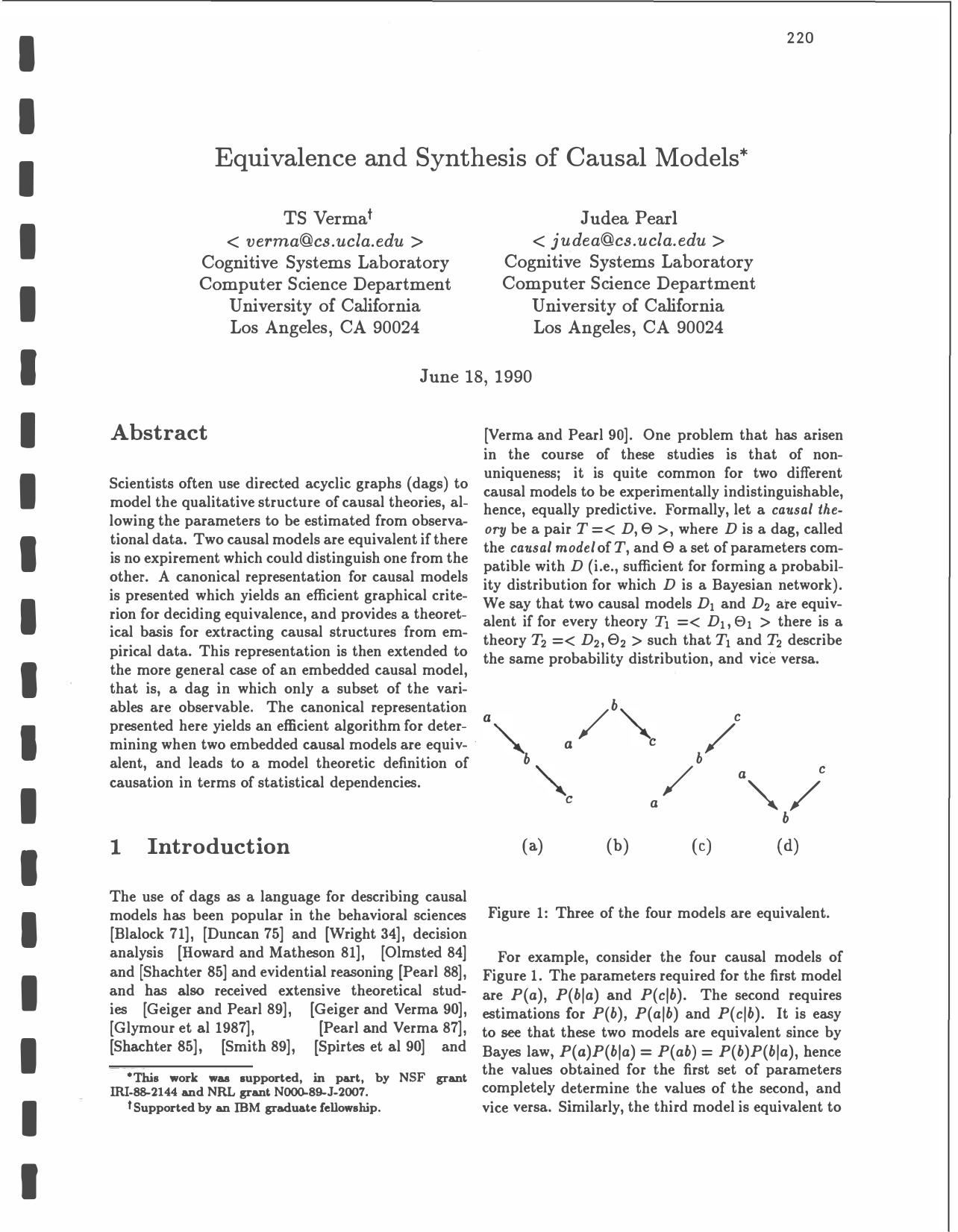
Equivalence and Synthesis of Causal Models
Tom S. Verma, Judea Pearl
Why you should read this
Establishes graphical criteria and efficient algorithms for determining when different causal directed acyclic graphs represent identical observational dependencies, providing the theoretical foundation for learning causal structures from empirical data.
Scientists often use directed acyclic graphs (days) to model the qualitative structure of causal theories, allowing the parameters to be estimated from observational data. Two causal models are equivalent if there is no experiment which could distinguish one from the other. A canonical representation for causal models is presented which yields an efficient graphical criterion for deciding equivalence, and provides a theoretical basis for extracting causal structures from empirical data. This representation is then extended to the more general case of an embedded causal model, that is, a dag in which only a subset of the variables are observable. The canonical representation presented here yields an efficient algorithm for determining when two embedded causal models reflect the same dependency information. This algorithm leads to a model theoretic definition of causation in terms of statistical dependencies.
Added
2026-09-24

Introduction to Machine Learning
Laurent Younes
Why you should read this
Establishes a rigorous mathematical foundation for core machine learning methods by directly connecting optimization theory, reproducing kernel Hilbert spaces, and concentration inequalities to supervised, generative, and unsupervised algorithms.
This book introduces the mathematical foundations and techniques that lead to the development and analysis of many of the algorithms that are used in machine learning. It starts with an introductory chapter that describes notation used throughout the book and serve at a reminder of basic concepts in calculus, linear algebra and probability and also introduces some measure theoretic terminology, which can be used as a reading guide for the sections that use these tools. The introductory chapters also provide background material on matrix analysis and optimization. The latter chapter provides theoretical support to many algorithms that are used in the book, including stochastic gradient descent, proximal methods, etc. After discussing basic concepts for statistical prediction, the book includes an introduction to reproducing kernel theory and Hilbert space techniques, which are used in many places, before addressing the description of various algorithms for supervised statistical learning, including linear methods, support vector machines, decision trees, boosting, or neural networks. The subject then switches to generative methods, starting with a chapter that presents sampling methods and an introduction to the theory of Markov chains. The following chapter describe the theory of graphical models, an introduction to variational methods for models with latent variables, and to deep-learning based generative models. The next chapters focus on unsupervised learning methods, for clustering, factor analysis and manifold learning. The final chapter of the book is theory-oriented and discusses concentration inequalities and generalization bounds.
Added
2026-09-19

Loopy Belief Propagation for Approximate Inference: An Empirical Study
Kevin P. Murphy, Yair Weiss, Michael I. Jordan
Why you should read this
Evaluates loopy belief propagation across diverse Bayesian networks, revealing that Pearl's polytree algorithm often converges to accurate marginal approximations in loopy graphs while diagnosing the causes of oscillatory failure in complex real-world models.
Recently, researchers have demonstrated that loopy belief propagation - the use of Pearls polytree algorithm IN a Bayesian network WITH loops OF error- correcting this http URL most dramatic instance OF this IS the near Shannon - limit performance OF Turbo Codes codes whose decoding algorithm IS equivalent TO loopy belief propagation IN a chain - structured Bayesian network. IN this paper we ask : IS there something special about the error - correcting code context, OR does loopy propagation WORK AS an approximate inference schemeIN a more general setting? We compare the marginals computed using loopy propagation TO the exact ones IN four Bayesian network architectures, including two real - world networks : ALARM AND this http URL find that the loopy beliefs often converge AND WHEN they do, they give a good approximation TO the correct this http URL,ON the QMR network, the loopy beliefs oscillated AND had no obvious relationship TO the correct posteriors. We present SOME initial investigations INTO the cause OF these oscillations, AND show that SOME simple methods OF preventing them lead TO the wrong results.
Added
2026-09-18
Expectation Propagation for approximate Bayesian inference
Thomas P. Minka
Why you should read this
Introduces Expectation Propagation, a deterministic approximate inference framework that unifies assumed-density filtering and belief propagation to deliver higher accuracy than variational Bayes or Laplace approximations in hybrid networks at comparable computational cost.
This paper presents a new deterministic approximation technique in Bayesian networks. This method, "Expectation Propagation", unifies two previous techniques: assumed-density filtering, an extension of the Kalman filter, and loopy belief propagation, an extension of belief propagation in Bayesian networks. All three algorithms try to recover an approximate distribution which is close in KL divergence to the true distribution. Loopy belief propagation, because it propagates exact belief states, is useful for a limited class of belief networks, such as those which are purely discrete. Expectation Propagation approximates the belief states by only retaining certain expectations, such as mean and variance, and iterates until these expectations are consistent throughout the network. This makes it applicable to hybrid networks with discrete and continuous nodes. Expectation Propagation also extends belief propagation in the opposite direction - it can propagate richer belief states that incorporate correlations between nodes. Experiments with Gaussian mixture models show Expectation Propagation to be convincingly better than methods with similar computational cost: Laplace's method, variational Bayes, and Monte Carlo. Expectation Propagation also provides an efficient algorithm for training Bayes point machine classifiers.
Added
2026-09-17
Learning Bayesian Networks with the bnlearn R Package
Marco Scutari
Why you should read this
Presents the bnlearn R package, providing a unified and computationally scalable framework for learning the structure of discrete and continuous Bayesian networks through constraint-based and score-based algorithms.
bnlearn is an R package which includes several algorithms for learning the structure of Bayesian networks with either discrete or continuous variables. Both constraint-based and score-based algorithms are implemented, and can use the functionality provided by the snow package to improve their performance via parallel computing. Several network scores and conditional independence algorithms are available for both the learning algorithms and independent use. Advanced plotting options are provided by the Rgraphviz package.
Added
2026-09-17
A Tutorial on Learning with Bayesian Networks
David Heckerman
Why you should read this
Explains the foundational principles and practical algorithms for learning both the structure and parameters of Bayesian networks from complete and incomplete data, bridging statistical inference, prior knowledge integration, and causal discovery.
A Bayesian network is a graphical model that encodes probabilistic relationships among variables of interest. When used in conjunction with statistical techniques, the graphical model has several advantages for data analysis. One, because the model encodes dependencies among all variables, it readily handles situations where some data entries are missing. Two, a Bayesian network can be used to learn causal relationships, and hence can be used to gain understanding about a problem domain and to predict the consequences of intervention. Three, because the model has both a causal and probabilistic semantics, it is an ideal representation for combining prior knowledge (which often comes in causal form) and data. Four, Bayesian statistical methods in conjunction with Bayesian networks offer an efficient and principled approach for avoiding the overfitting of data. In this paper, we discuss methods for constructing Bayesian networks from prior knowledge and summarize Bayesian statistical methods for using data to improve these models. With regard to the latter task, we describe methods for learning both the parameters and structure of a Bayesian network, including techniques for learning with incomplete data. In addition, we relate Bayesian-network methods for learning to techniques for supervised and unsupervised learning. We illustrate the graphical-modeling approach using a real-world case study.
Added
2026-09-13
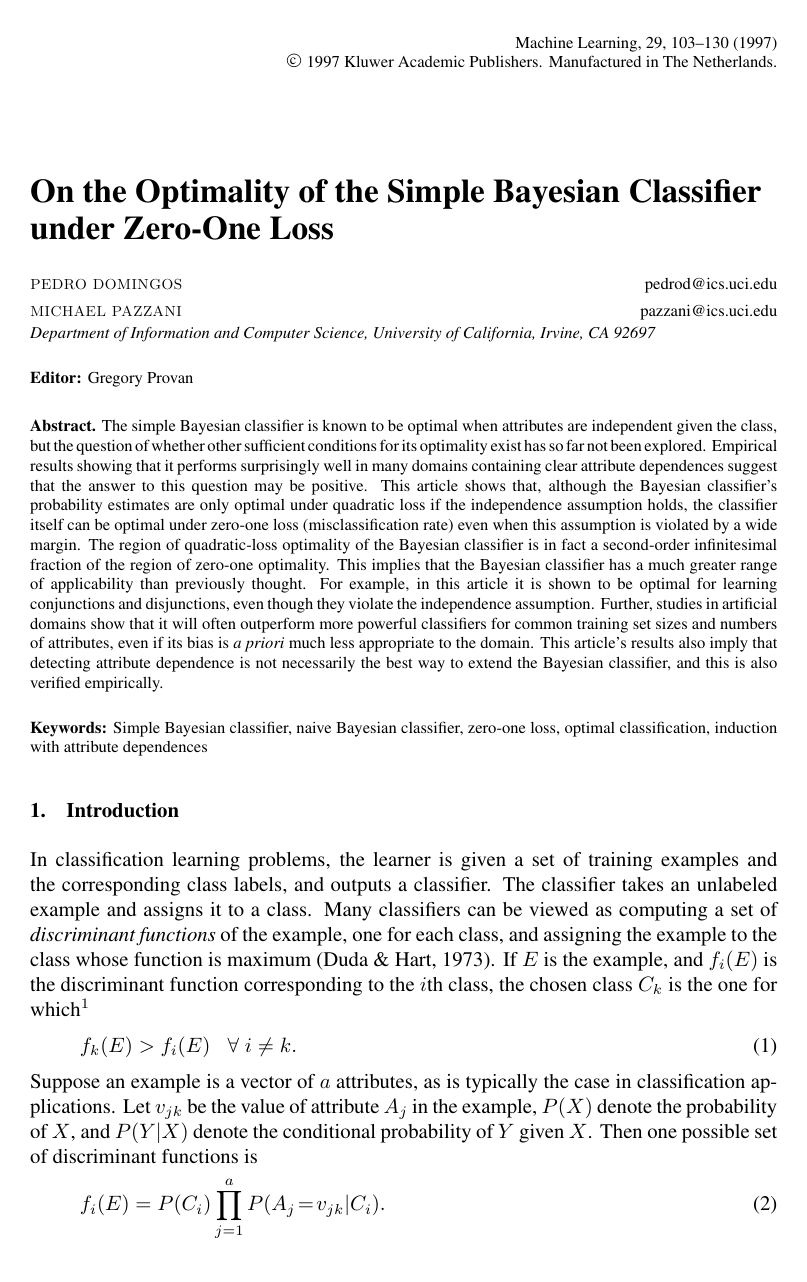
On the Optimality of the Simple Bayesian Classifier under Zero-One Loss
Pedro Domingos, Michael Pazzani
Why you should read this
Proves that the naive Bayesian classifier remains optimal under zero-one loss even with severe attribute dependencies, showing that minimizing classification error requires only correct relative class rankings rather than accurate probability estimates.
The simple Bayesian classifier is known to be optimal when attributes are independent given the class, but the question of whether other sufficient conditions for its optimality exist has so far not been explored. Empirical results showing that it performs surprisingly well in many domains containing clear attribute dependences suggest that the answer to this question may be positive. This article shows that, although the Bayesian classifier’s probability estimates are only optimal under quadratic loss if the independence assumption holds, the classifier itself can be optimal under zero-one loss (misclassification rate) even when this assumption is violated by a wide margin. The region of quadratic-loss optimality of the Bayesian classifier is in fact a second-order infinitesimal fraction of the region of zero-one optimality. This implies that the Bayesian classifier has a much greater range of applicability than previously thought. For example, in this article it is shown to be optimal for learning conjunctions and disjunctions, even though they violate the independence assumption. Further, studies in artificial domains show that it will often outperform more powerful classifiers for common training set sizes and numbers of attributes, even if its bias is a priori much less appropriate to the domain. This article’s results also imply that detecting attribute dependence is not necessarily the best way to extend the Bayesian classifier, and this is also verified empirically.
Added
2026-09-11
Dlib-ml: A Machine Learning Toolkit
Davis E. King
Why you should read this
Presents dlib-ml, an open-source C++ machine learning library combining automated BLAS-optimized linear algebra with modular kernel methods capable of operating directly on arbitrary data types.
There are many excellent toolkits which provide support for developing machine learning software in Python, R, Matlab, and similar environments. Dlib-ml is an open source library, targeted at both engineers and research scientists, which aims to provide a similarly rich environment for developing machine learning software in the C++ language. Towards this end, dlib-ml contains an extensible linear algebra toolkit with built in BLAS support. It also houses implementations of algorithms for performing inference in Bayesian networks and kernel-based methods for classification, regression, clustering, anomaly detection, and feature ranking. To enable easy use of these tools, the entire library has been developed with contract programming, which provides complete and precise documentation as well as powerful debugging tools.
Added
2026-09-11
Estimating Continuous Distributions in Bayesian Classifiers
George H. John, Pat Langley
Why you should read this
Demonstrates that replacing rigid normality assumptions with nonparametric kernel density estimation substantially reduces classification error in naive Bayesian classifiers handling continuous data.
When modeling a probability distribution with a Bayesian network, we are faced with the problem of how to handle continuous variables. Most previous work has either solved the problem by discretizing, or assumed that the data are generated by a single Gaussian. In this paper we abandon the normality assumption and instead use statistical methods for nonparametric density estimation. For a naive Bayesian classifier, we present experimental results on a variety of natural and artificial domains, comparing two methods of density estimation: assuming normality and modeling each conditional distribution with a single Gaussian; and using nonparametric kernel density estimation. We observe large reductions in error on several natural and artificial data sets, which suggests that kernel estimation is a useful tool for learning Bayesian models.
Added
2026-09-11
Learning Bayesian networks: The combination of knowledge and statistical data
David Heckerman, Dan Geiger, David Maxwell Chickering
Why you should read this
Develops the foundational BDe scoring metric for learning Bayesian networks, establishing the principles of event equivalence and parameter modularity to integrate observational data with prior domain knowledge represented as a single prior network and equivalent sample size.
We describe a Bayesian approach for learning Bayesian networks from a combination of prior knowledge and statistical data. First and foremost, we develop a methodology for assessing informative priors needed for learning. Our approach is derived from a set of assumptions made previously as well as the assumption of likelihood equivalence, which says that data should not help to discriminate network structures that represent the same assertions of conditional independence. We show that likelihood equivalence when combined with previously made assumptions implies that the user’s priors for network parameters can be encoded in a single Bayesian network for the next case to be seen—a prior network—and a single measure of confidence for that network. Second, using these priors, we show how to compute the relative posterior probabilities of network structures given data. Third, we describe search methods for identifying network structures with high posterior probabilities. We describe polynomial algorithms for finding the highest-scoring network structures in the special case where every node has at most k = 1 parent. For the general case (k > 1), which is NP-hard, we review heuristic search algorithms including local search, iterative local search, and simulated annealing. Finally, we describe a methodology for evaluating Bayesian-network learning algorithms, and apply this approach to a comparison of various approaches.
Added
2026-09-11
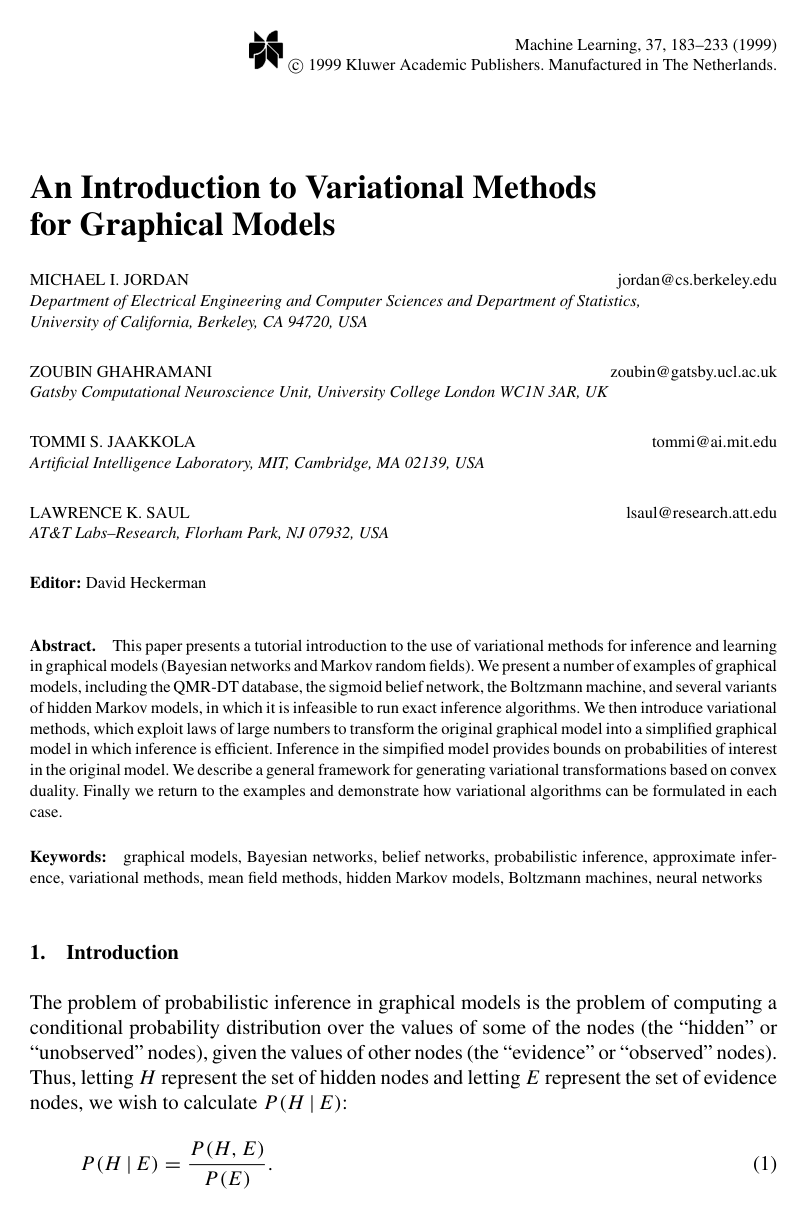
An Introduction to Variational Methods for Graphical Models
MICHAEL I. JORDAN, ZOUBIN GHAHRAMANI, TOMMI S. JAAKKOLA, LAWRENCE K. SAUL
Why you should read this
Establishes a foundational framework for approximate inference and learning in graphical models by using convex duality to convert intractable probabilistic calculations into tractable optimization problems.
This paper presents a tutorial introduction to the use of variational methods for inference and learning in graphical models (Bayesian networks and Markov random fields). We present a number of examples of graphical models, including the QMR-DT database, the sigmoid belief network, the Boltzmann machine, and several variants of hidden Markov models, in which it is infeasible to run exact inference algorithms. We then introduce variational methods, which exploit laws of large numbers to transform the original graphical model into a simplified graphical model in which inference is efficient. Inference in the simplified model provides bounds on probabilities of interest in the original model. We describe a general framework for generating variational transformations based on convex duality. Finally we return to the examples and demonstrate how variational algorithms can be formulated in each case.
Added
2026-09-10
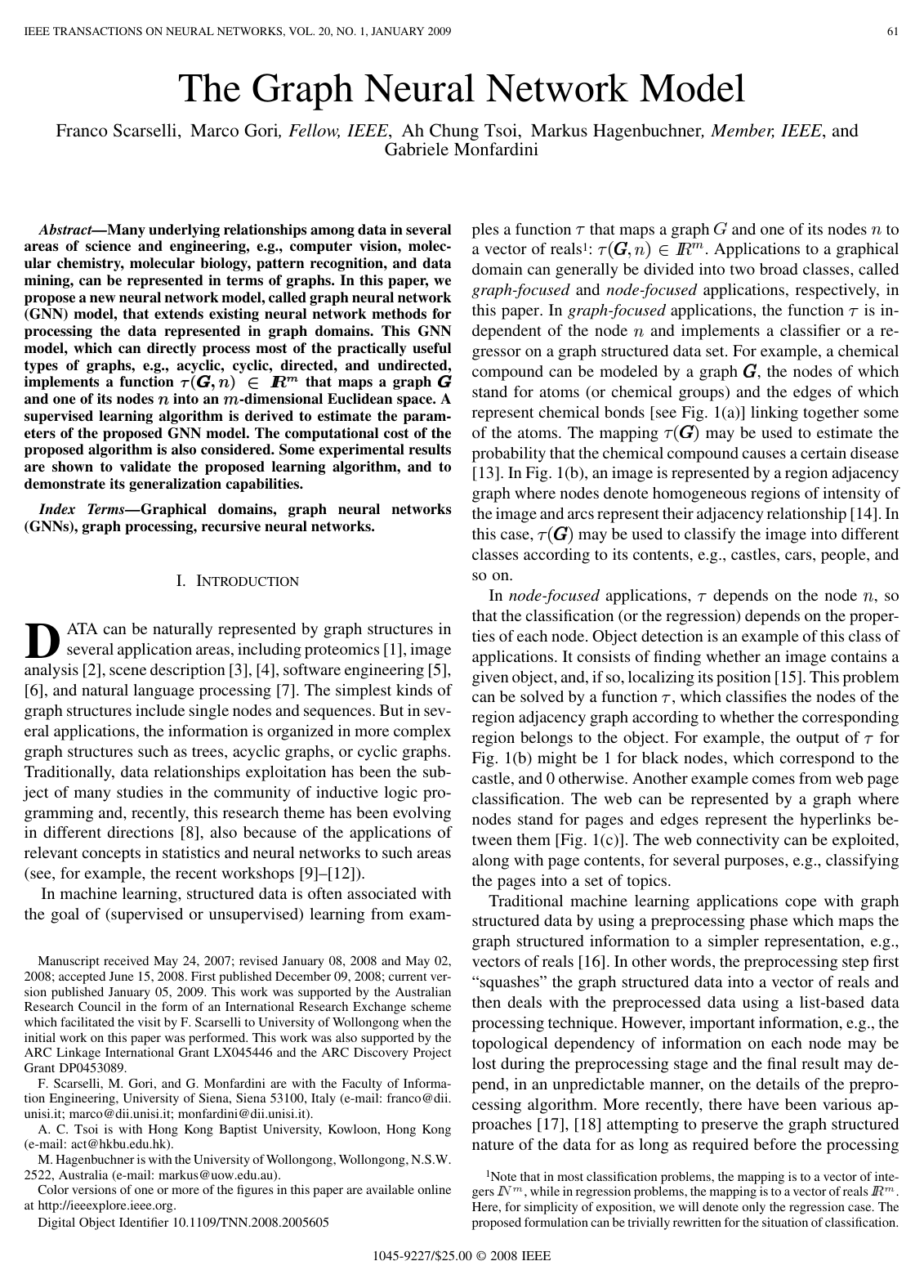
The Graph Neural Network Model
Franco Scarselli, Marco Gori, Ah Chung Tsoi, Markus Hagenbuchner, Gabriele Monfardini
Why you should read this
Establishes the foundational concept of neural networks that operate directly on graph-structured data using contractive iterative state updates.
Many underlying relationships among data in several areas of science and engineering, e.g., computer vision, molecular chemistry, molecular biology, pattern recognition, and data mining, can be represented in terms of graphs. In this paper, we propose a new neural network model, called graph neural network (GNN) model, that extends existing neural network methods for processing the data represented in graph domains. This GNN model, which can directly process most of the practically useful types of graphs, e.g., acyclic, cyclic, directed, and undirected, implements a function that maps a graph and one of its nodes into an -dimensional Euclidean space. A supervised learning algorithm is derived to estimate the parameters of the proposed GNN model. The computational cost of the proposed algorithm is also considered. Some experimental results are shown to validate the proposed learning algorithm, and to demonstrate its generalization capabilities.
Added
2026-02-19
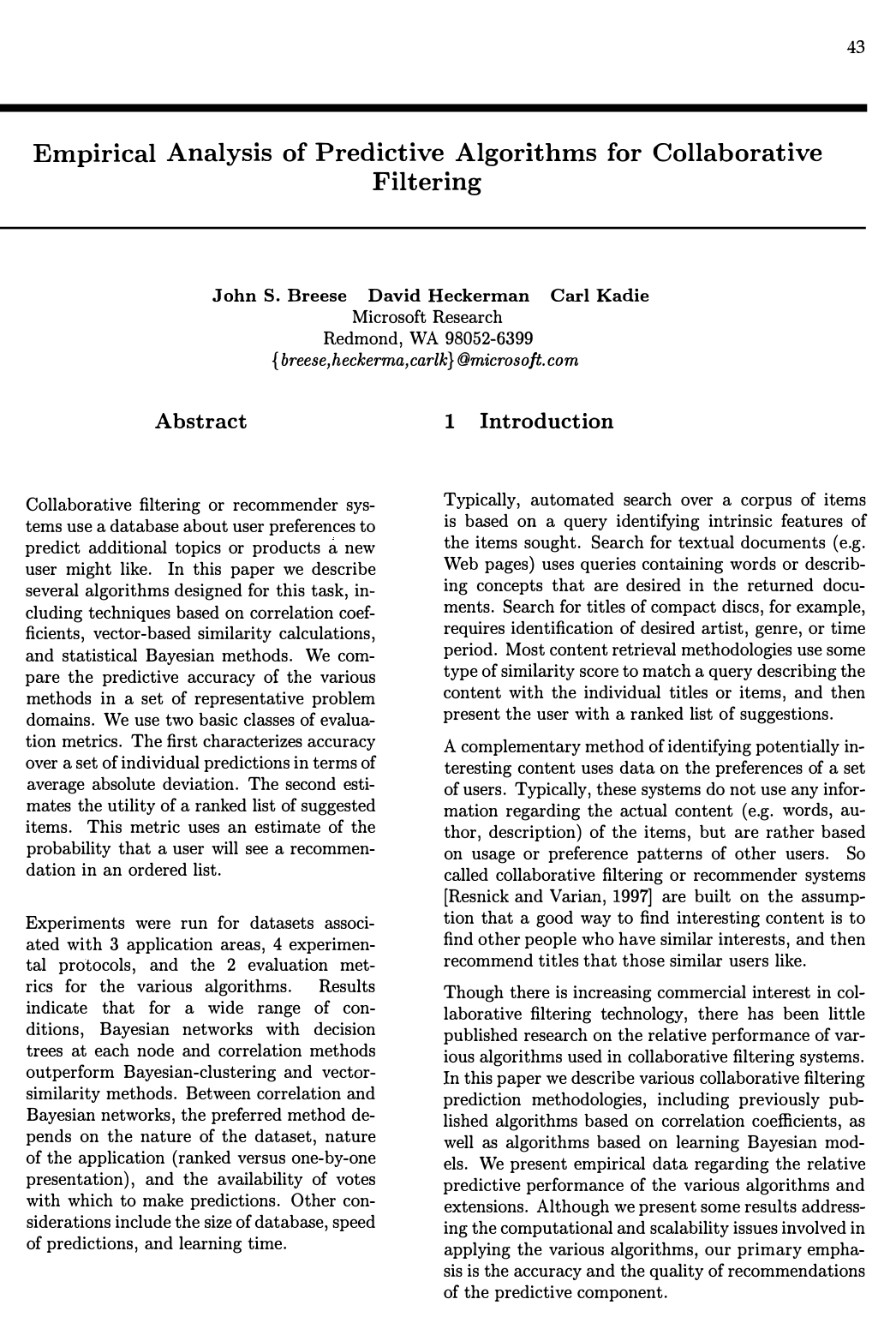
Empirical Analysis of Predictive Algorithms for Collaborative Filtering
John S. Breese, David Heckerman, Carl Kadie
Why you should read this
Demonstrates through extensive empirical analysis that Bayesian networks and correlation-based methods generally outperform other collaborative filtering techniques across various datasets and evaluation protocols.
Collaborative filtering or recommender systems use a database about user preferences to predict additional topics or products a new user might like. In this paper we describe several algorithms designed for this task, including techniques based on correlation coefficients, vector-based similarity calculations, and statistical Bayesian methods. We compare the predictive accuracy of the various methods in a set of representative problem domains. We use two basic classes of evaluation metrics. The first characterizes accuracy over a set of individual predictions in terms of average absolute deviation. The second estimates the utility of a ranked list of suggested items. This metric uses an estimate of the probability that a user will see a recommendation in an ordered list. Experiments were run for datasets associated with 3 application areas, 4 experimental protocols, and the 2 evaluation metrics for the various algorithms. Results indicate that for a wide range of conditions, Bayesian networks with decision trees at each node and correlation methods outperform Bayesian-clustering and vector-similarity methods. Between correlation and Bayesian networks, the preferred method depends on the nature of the dataset, nature of the application (ranked versus one-by-one presentation), and the availability of votes with which to make predictions. Other considerations include the size of database, speed of predictions, and learning time.
Added
2026-01-25