Equivalence and Synthesis of Causal Models

Tom S. VermaJudea Pearl

article1990UAI1,534 citationsBest Paper Award

Establishes graphical criteria and efficient algorithms for determining when different causal directed acyclic graphs represent identical observational dependencies, providing the theoretical foundation for learning causal structures from empirical data.

Listen

In scientific research, decision analysis, and data-driven systems, practitioners frequently use graphical causal models to understand relationships between variables and estimate risks. A central challenge in this practice is non-uniqueness: multiple distinct causal structures often produce identical observational data and probability distributions, making them experimentally indistinguishable. This ambiguity complicates causal reasoning, especially when key factors are unobserved, creating spurious correlations that traditional directed graphs cannot adequately represent.

The article establishes formal graphical criteria and canonical representations to determine when two causal models are equivalent. It demonstrates how these canonical structures can be used to extract genuine causal relationships directly from statistical observational data, both for fully observed systems and for embedded systems containing unobserved variables.

To address this challenge, the authors conducted theoretical analyses of graphical models known as directed acyclic graphs and their extensions. They evaluated causal structures using directional separation—a formal criterion for mapping conditional independence—and introduced hybrid graphs that incorporate bidirectional links to account for hidden common causes. The analysis establishes necessary and sufficient graphical conditions for model equivalence and formulates a step-by-step recovery algorithm to infer these structures from observational data in polynomial time.

The findings provide three primary insights. First, two standard causal models are observationally equivalent if and only if they share identical node adjacencies and the same uncoupled head-to-head junctions. Second, this equivalence generalizes to embedded models containing hidden variables, where equivalent systems can be uniquely summarized into a canonical completed pattern in polynomial time, proving that any complex embedded structure is equivalent to a simple graph with fewer than the square of the number of observable variables. Third, the authors developed a systematic three-step recovery algorithm that uses conditional independence tests to reliably reconstruct the invariant directional and structural components of the underlying causal model.

These findings demonstrate that causal directionality can be inferred strictly from statistical data without relying on chronological time stamps. For decision-makers and analysts, this provides a rigorous mathematical framework to distinguish between direct causes, potential causes, and spurious associations. It ensures that analytical and policy models do not assume unjustified causal directions, reducing the risk of flawed operational decisions based merely on observational correlations.

Organizations should adopt these canonical pattern representations and recovery algorithms when building causal and predictive models from empirical datasets. For standard graphs, teams can improve computational efficiency by using undirected Markov network cliques to bound the search space for separating sets. When moving to empirical implementations, analysts should apply sample cross-entropy measures to prevent small sample sizes from corrupting the inference of independence conditions.

The primary limitations of this approach stem from the practical challenge of inferring independence relations from finite, sampled data, as sample size requirements grow exponentially with the number of conditioning variables. Additionally, the baseline framework assumes the probability distribution is graph-isomorphic and does not fully accommodate deterministic functional dependencies without specialized extensions. Nevertheless, the theoretical results provide high confidence for establishing structural equivalence and discovering causal links when sample sizes are adequate.

arXiv: 1304.1108

No sufficiently relevant recommendations were found.

Cover for Equivalence and Synthesis of Causal Models

Abstract

Scientists often use directed acyclic graphs (days) to model the qualitative structure of causal theories, allowing the parameters to be estimated from observational data. Two causal models are equivalent if there is no experiment which could distinguish one from the other. A canonical representation for causal models is presented which yields an efficient graphical criterion for deciding equivalence, and provides a theoretical basis for extracting causal structures from empirical data. This representation is then extended to the more general case of an embedded causal model, that is, a dag in which only a subset of the variables are observable. The canonical representation presented here yields an efficient algorithm for determining when two embedded causal models reflect the same dependency information. This algorithm leads to a model theoretic definition of causation in terms of statistical dependencies.

Table of Contents

  • 1 Introduction
  • 2 Patterns of Causal Models
  • 3 Embedded Causal Models
  • 4 Applications to the Synthesis of Causal Models
  • Recovery Algorithm
  • Acknowledgement
  • References

Knowls

  1. Knowl 1 — Equivalence Criterion for Directed Acyclic Graphs

    theoretical result

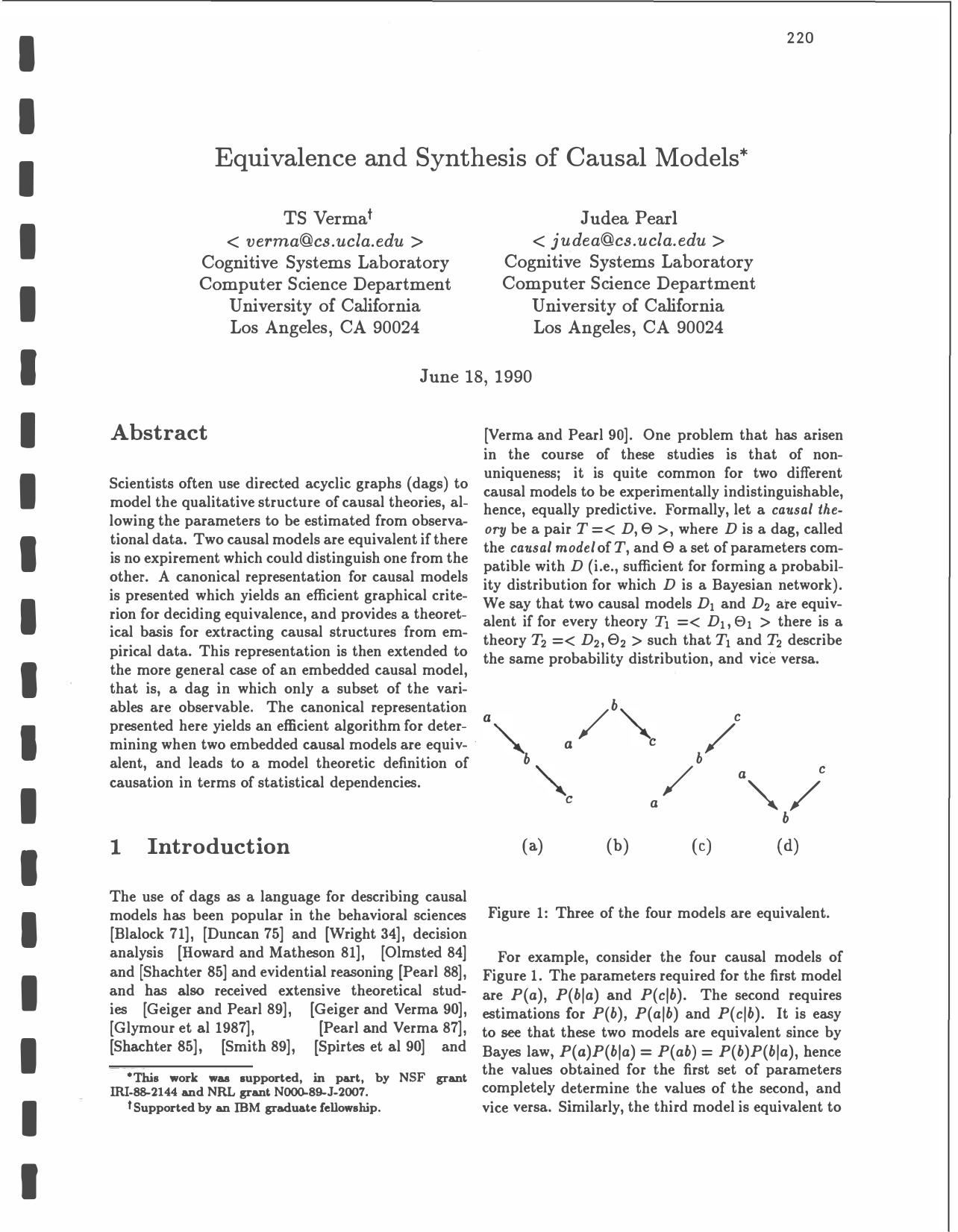
    Two directed acyclic graphs (DAGs) D1D_1 and D2D_2 representing causal models over the same set of variables are statistically equivalent (meaning that every probability distribution parameterized over D1D_1 can be represented by D2D_2, and vice versa, sharing the exact same set of d-separation independence assertions) if and only if they satisfy two conditions:

    1. They possess the identical skeleton (the same set of undirected links/adjacencies).
    2. They possess the same uncoupled head-to-head nodes (also known as v-structures or uncoupled colliders, where a→c←ba \rightarrow c \leftarrow b and aa is not adjacent to bb).
  2. Knowl 2 — Equivalence Criterion for Embedded Causal Models

    theoretical result

    Let an embedded causal model be a DAG DD defined over a set of variables UDU_D, in which only a subset UO⊆UDU_O \subseteq U_D is observable and UD∖UOU_D \setminus U_O represents latent/unobserved variables. Two embedded causal models are observationally equivalent over UOU_O if and only if they have the exact same completed embedded pattern (hybrid graph).

    Consequently, the completed embedded pattern serves as a canonical and unique characteristic representation for the entire observational equivalence class of any embedded DAG.

  3. Knowl 3 — Inducing Paths and Adjacency in Embedded Causal Models

    theoretical result

    Let DD be a directed acyclic graph over variables UDU_D with observable subset UO⊆UDU_O \subseteq U_D. Let AabA_{ab} denote the union of ancestors of aa and bb in DD excluding the pair {a,b}\{a, b\}. An inducing path between two observable nodes a,b∈UOa, b \in U_O is any path pp in DD between aa and bb satisfying:

    1. Every observable node on pp is a head-to-head node (collider) on pp.
    2. Every head-to-head node on pp is in AabA_{ab}.

    For any two observable variables a,b∈UOa, b \in U_O and the pattern PP of DD restricted to UOU_O, the following four conditions are equivalent:

    1. aa and bb are adjacent in PP.
    2. aa and bb are unseparable in DD over UOU_O (no subset S⊆UO∖{a,b}S \subseteq U_O \setminus \{a,b\} d-separates aa and bb).
    3. aa and bb are not d-separated by Aab∩UOA_{ab} \cap U_O in DD.
    4. aa and bb are connected by an inducing path in DD.
  4. Knowl 4 — Constraint-Based Causal Model Recovery Algorithm

    algorithm

    Under the assumption that the observed probability distribution is DAG-isomorphic (faithful to a DAG causal structure), the underlying causal pattern can be reconstructed from conditional independence relationships using the following procedure:

    Input: Set of observable variables UOU_O, conditional independence oracle I(⋅,⋅,⋅)I(\cdot, \cdot, \cdot)
    Output: Completed pattern graph PP
    for each pair of variables a,b∈UOa, b \in U_O do
        Search for a separating subset Sab⊆UO∖{a,b}S_{ab} \subseteq U_O \setminus \{a, b\} such that I(a,Sab,b)I(a, S_{ab}, b) holds
        if no such SabS_{ab} exists then
            Add an undirected edge between aa and bb in PP
        end if
    end for
    for each pair of non-adjacent variables a,b∈UOa, b \in U_O with a common neighbor c∈UOc \in U_O (a−c−ba - c - b) do
        if I(a,Sab∪{c},b)I(a, S_{ab} \cup \{c\}, b) is false then
            Add arrowheads pointing at cc, orienting the chain as a→c←ba \rightarrow c \leftarrow b
        end if
    end for
    Complete PP by directing undirected edges without creating new uncoupled head-to-head nodes or strictly directed cycles
    return PP

    For DAG models without latent variables, the search space for separating sets SabS_{ab} can be restricted to cliques in the Markov network (the undirected graph linking variables dependent given all remaining variables) containing aa or bb, bounding the computational complexity by the size of the largest clique in the Markov network.

  5. Knowl 5 — Model-Theoretic Definitions of Genuine and Potential Causes

    definition

    Let P\mathcal{P} denote the set of all patterns that are minimal I-maps consistent with an observed probability distribution.

    • An observable variable cc is a genuine cause of an observable variable ee if cc causes ee in every consistent model; that is, every pattern in P\mathcal{P} contains the directed arrow c→ec \rightarrow e.
    • An observable variable cc is a potential cause of an observable variable ee if cc causes ee in some consistent model (at least one pattern in P\mathcal{P} contains c→ec \rightarrow e) and ee never causes cc in any consistent model (no pattern in P\mathcal{P} contains e→ce \rightarrow c).

    This non-temporal definition determines causal directionality directly from statistical dependencies and distinguishes genuine direct causal influence from unobserved common confounding.

  6. Knowl 6 — Independence Characterization of Head-to-Head Junctions

    theoretical result

    In a directed acyclic graph DD, let the nodes a,c,ba, c, b form an uncoupled chain (meaning aa is adjacent to cc, cc is adjacent to bb, and aa is not adjacent to bb). Then cc is a head-to-head node (collider) between aa and bb (a→c←ba \rightarrow c \leftarrow b) if and only if aa and bb are not d-separated by any conditioning set containing cc:

    a→c←b∈D  ⟺  ¬ID(a,S∪{c},b)∀S⊆UD∖{a,b,c}a \rightarrow c \leftarrow b \in D \iff \neg I_D(a, S \cup \{c\}, b) \quad \forall S \subseteq U_D \setminus \{a, b, c\}

    where ID(X,Z,Y)I_D(X, Z, Y) denotes that XX and YY are d-separated given ZZ in DD, and UDU_D is the set of all variables in DD.

  7. Knowl 7 — Adjacency and Unseparability in Directed Acyclic Graphs

    theoretical result

    Let aa and bb be two distinct nodes in a directed acyclic graph DD. Let AabA_{ab} denote the union of the ancestor sets of aa and bb (excluding {a,b}\{a, b\}), and let PabP_{ab} denote the union of the parent sets of aa and bb (excluding {a,b}\{a, b\}). The following four statements are equivalent:

    1. aa and bb are adjacent in DD (there is a directed link a→ba \rightarrow b or b→ab \rightarrow a).
    2. aa and bb are unseparable in DD (no set S⊆UD∖{a,b}S \subseteq U_D \setminus \{a, b\} d-separates aa and bb).
    3. aa and bb are not d-separated by AabA_{ab} in DD.
    4. aa and bb are not d-separated by PabP_{ab} in DD.
  8. Knowl 8 — Size Bound and DAG Representability of Embedded Causal Models

    theoretical result

    For any set of observable variables UOU_O:

    1. There are strictly fewer than 5∣UO∣25^{|U_O|^2} distinct observational equivalence classes of embedded causal models over UOU_O.
    2. Every embedded causal model over UOU_O is statistically equivalent to a simple DAG containing strictly fewer than ∣UO∣2|U_O|^2 total variables (including both observable and latent variables).

    This follows because any pattern over UOU_O has at most four edge types per pair (a−ba - b, a→ba \rightarrow b, a←ba \leftarrow b, a↔ba \leftrightarrow b) or no edge, and each bidirectional link a↔ba \leftrightarrow b can be realized by introducing a single hidden common parent α\alpha with links α→a\alpha \rightarrow a and α→b\alpha \rightarrow b.

  9. Knowl 9 — Embedded Pattern Representation and Arrowhead Induction

    model/method

    Given a DAG DD over variables UDU_D with observable subset UO⊆UDU_O \subseteq U_D, the rudimentary embedded pattern PP is a hybrid graph over UOU_O containing undirected (−-), directed (→\rightarrow), and bidirectional (↔\leftrightarrow) edges satisfying:

    1. aa and bb are adjacent in PP if and only if aa and bb are not d-separated by any S⊆UO∖{a,b}S \subseteq U_O \setminus \{a, b\} in DD.
    2. An arrowhead pointing at bb on the link between aa and bb (denoted a→‾ba \mathrel{\overline{\rightarrow}} b, covering a→ba \rightarrow b and a↔ba \leftrightarrow b) is placed if and only if there exists some c∈UOc \in U_O adjacent to bb but not adjacent to aa in PP such that both links abab and bcbc were induced by paths in DD that ended pointing at bb.

    The completed embedded pattern is obtained by adding orientations to undirected links in PP subject to the constraints that no added arrowhead may (1) create a new uncoupled head-to-head node, or (2) create a strictly directed cycle (a directed cycle consisting solely of singly directed arrows).

  10. Knowl 10 — Reliable Conditional Independence via Sample Cross-Entropy

    equation

    To prevent sample size degradation when testing conditional independence assertions I(a,S,b)I(a, S, b) from empirical data, the independence relation is quantified via the sample conditional cross-entropy:

    H^(a,b∣S)=∑a,b,SP^(a,b,S)log⁡P^(a,b∣S)P^(a∣S)P^(b∣S)\hat{H}(a, b \mid S) = \sum_{a, b, S} \hat{P}(a, b, S) \log \frac{\hat{P}(a, b \mid S)}{\hat{P}(a \mid S)\hat{P}(b \mid S)}

    where P^\hat{P} denotes empirical sample frequency and the sum ranges over all valid instantiations of variables aa, bb, and conditioning set SS. Terms involving low cell counts (small P^(a,b,S)\hat{P}(a, b, S)) are automatically discounted relative to better-sampled configurations.

Coverage note — Deterministic variable refinements of d-separation were omitted as they are cited as external prior work/deferred to future work.

References

  1. 1.H.M. Blalock, Causal Models in The Social Sciences. Macmillian, London, 1971.
  2. 2.O.D. Duncan, Introduction to Structural Equation Models. Academic Press, New York, 1975.
  3. 3.D. Geiger and J. Pearl, Logical and Algorithmic Properties of Independence and Their Application to Bayesian Networks, UCLA Cognitive Systems Laboratory, Technical Report CSD-890035 (R-123), February 1989. To appear in Annals of Mathematics and AI, Special Issue on Statistics and AI.
  4. 4.D. Geiger, T.S. Verma and J. Pearl, d-Separation: From Theorems to Algorithms, Proceedings, 5th Workshop on Uncertainty in AI, Windsor, Ontario, Canada, August 1989, pp. 118-124.
  5. 5.D. Geiger and T.S. Verma, Identifying Independence in Bayesian Networks, UCLA Cognitive Systems Laboratory, Technical Report CSD-890028 (R-116), To appear in Networks, John Wiley and Sons, Sussex, England, 1990.
  6. 6.C. Glymour, R. Scheines, P. Spirtes and K. Kelly. Discovering causal structure. Academic Press, New York, 1987.
  7. 7.R.A. Howard and J.E. Matheson, Influence Diagrams, chapter 8, in The Principles and Applications of Decision Analysis, Vol. II, Strategic Decisions Group, Menlo Park, California, 1981.
  8. 8.S.M. Olmsted, On Representing and Solving Decision Problems, Ph.D. Thesis, Engineering-Economic Systems Dept., Stanford University, Stanford California, 1984.
  9. 9.J. Pearl, D. Geiger and T.S. Verma, The Logic of Influence Diagrams, in R.M. Oliver and J.Q. Smith (Eds), Influence Diagrams, Belief Networks and Decision Analysis, John Wiley and Sons, Ltd., Sussex, England 1990. A shorter version, in Kybernetica, Vol. 25:2, 1989, pp. 33-44.
  10. 10.J. Pearl, Probabilistic Reasoning in Intelligent Systems: Networks of Plausible Inference. Morgan Kaufmann Publishers, Inc, San Mateo, California, 1988.
  11. 11.J. Pearl and T.S. Verma, The Logic of Representing Dependencies by Directed Graphs, Proceedings, AAAI Conference, Seattle, WA. July, 1987, pp. 374-379.
  12. 12.R.D. Shachter, Evaluating Influence Diagrams, in A.P. Basu (Eds), Reliability and Quality Control, Elsevier, 1985, pp. 321-344.
  13. 13.P. Spirtes, C. Glymour and R. Scheines, Causality from Probability, in G. McKee, ed., Evolving Knowledge in Natural and Artificial Intelligence, Pitman, 1990.
  14. 14.J .Q. Smith, Influence Diagrams for Statistical Modeling, The Annals of Statistics, Vol. 17(2):654-672, 1989.
  15. 15.T.S. Verma, Invariant Properties of Causal Models. In preparation.
  16. 16.T.S. Verma and J. Pearl, Causal Networks: Semantics and Expressiveness, UCLA Cognitive Systems Laboratory, Technical Report 870032 (R-65), June 1986. Also in Uncertainty in AI 4, R. Shachter, T.S. Levitt and L.N. Kanal (eds), Elsevier Science Publishers, 1990.
  17. 17.S. Wright, The Method of Path Coefficients. Ann. Math. Statistics 5:161-215, 1934.

Citation

MLA
Verma, T. S., and J. Pearl. “On the Equivalence of Causal Models”. arXiv, 2013, http://arxiv.org/abs/1304.1108v1.
APA
Verma, T. S., & Pearl, J. (2013). On the Equivalence of Causal Models. arXiv. http://arxiv.org/abs/1304.1108v1
Chicago
Verma, T. S., and J. Pearl. 2013. “On the Equivalence of Causal Models”. arXiv. http://arxiv.org/abs/1304.1108v1.
Harvard
Verma, T.S. and Pearl, J. (2013) “On the Equivalence of Causal Models”, arXiv [Preprint]. Available at: http://arxiv.org/abs/1304.1108v1.
Vancouver
1. Verma TS, Pearl J (2013) On the Equivalence of Causal Models. arXiv

BibTeX

@article{verma2013the,
  title = {On the Equivalence of Causal Models},
  author = {Verma, Tom S. and Pearl, Judea},
  year = {2013},
  journal = {arXiv},
  url = {http://arxiv.org/abs/1304.1108v1},
  eprint = {1304.1108}
}
Metadata:arXiv

Access the Paper

This paper is available from its original source. Click below to access the PDF.

Open PDF
License: https://creativecommons.org/licenses/by/4.0/