
Built independently by an author, for readers. Read the story and support ChapterPal

keyword

backward denoising process

The backward denoising process is the generative phase in diffusion models where random noise is iteratively transformed into coherent data by systematically removing noise at each step. Serving as the inverse of the forward diffusion process, which progressively corrupts real data into Gaussian noise, this reverse trajectory utilizes a parameterized neural network trained to estimate and subtract noise across a sequence of time steps. By starting from pure noise and repeatedly applying these learned transitions in reverse, the model gradually reconstructs structured data from the target distribution, enabling the generation of realistic outputs such as images, audio, or time series, either unconditionally or guided by external conditioning information.

1 item
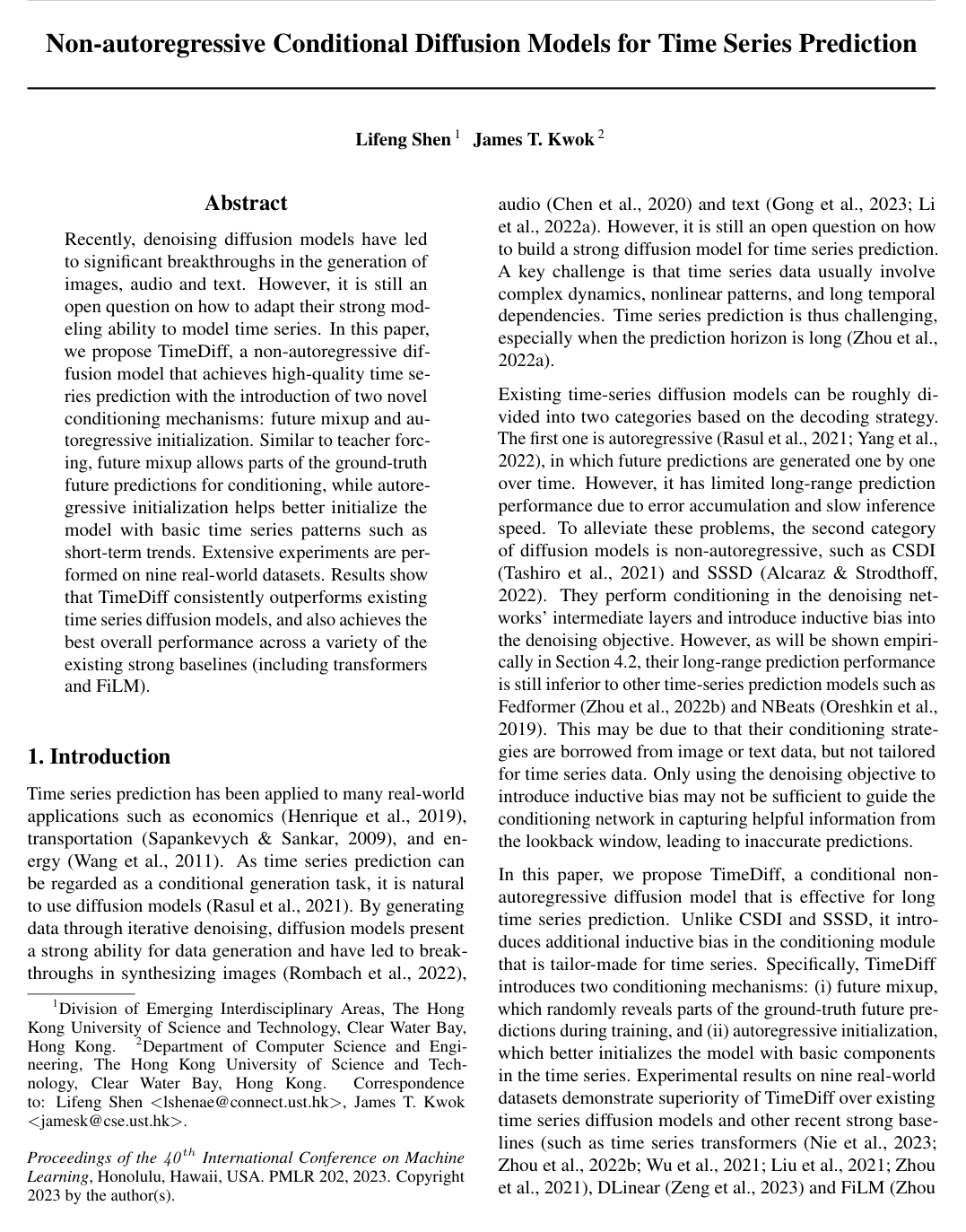
Non-autoregressive Conditional Diffusion Models for Time Series Prediction

Non-autoregressive Conditional Diffusion Models for Time Series Prediction

Lifeng Shen, James T. Kwok

OrganizationsThe Hong Kong University of Science and Technology

Why you should read this

Proposes TimeDiff, a non-autoregressive diffusion framework featuring future mixup and autoregressive initialization to overcome error accumulation and outperform existing transformers and diffusion baselines in long-range time series forecasting.

Recently, denoising diffusion models have led to significant breakthroughs in the generation of images, audio and text. However, it is still an open question on how to adapt their strong modeling ability to model time series. In this paper, we propose TimeDiff, a non-autoregressive diffusion model that achieves high-quality time series prediction with the introduction of two novel conditioning mechanisms: future mixup and autoregressive initialization. Similar to teacher forcing, future mixup allows parts of the ground-truth future predictions for conditioning, while autoregressive initialization helps better initialize the model with basic time series patterns such as short-term trends. Extensive experiments are performed on nine real-world datasets. Results show that TimeDiff consistently outperforms existing time series diffusion models, and also achieves the best overall performance across a variety of the existing strong baselines (including transformers and FiLM).

Added

2026-09-26