
keyword
autoregressive generation
Autoregressive generation is a machine learning technique in which a model produces complex data step by step, using each newly generated component as part of the context to predict the next. By decomposing the overall probability distribution of an output sequence into a series of conditional probabilities, the system ensures logical consistency and structural coherence from start to finish. This process commonly relies on architectures such as causal transformers or state space models that maintain an evolving historical context throughout generation. While primarily known for next-token prediction in large language models, autoregressive generation is widely applied across various domains to sequentially synthesize images, audio, time-series data, and structured design operations.
8 items
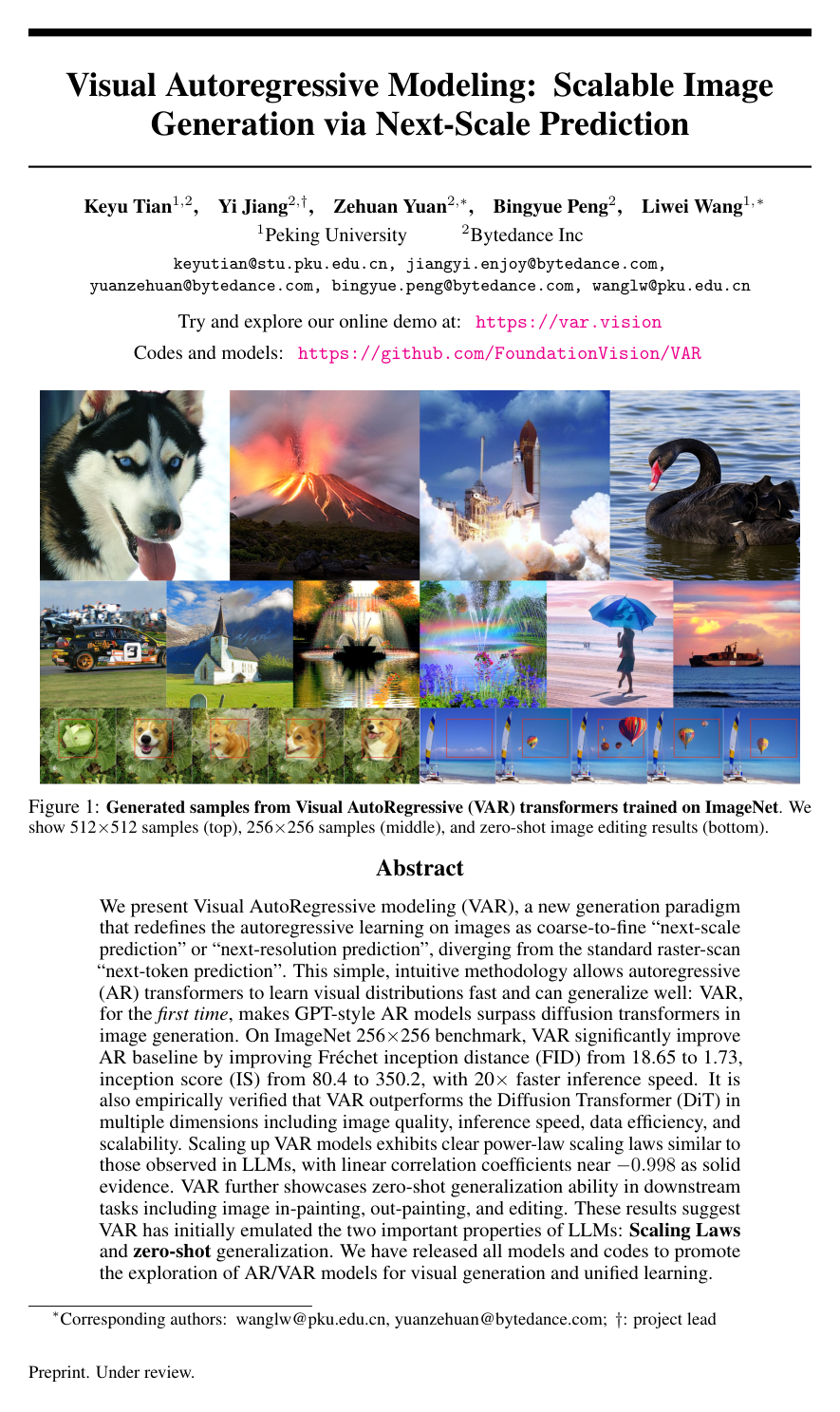
Visual Autoregressive Modeling: Scalable Image Generation via Next-Scale Prediction
Keyu Tian, Yi Jiang, Zehuan Yuan, Bingyue Peng, Liwei Wang
Why you should read this
Introduces Visual AutoRegressive modeling, a coarse-to-fine next-scale prediction approach that enables autoregressive transformers to surpass diffusion models in image generation quality and inference speed while exhibiting large-language-model scaling laws.
We present Visual AutoRegressive modeling (VAR), a new generation paradigm that redefines the autoregressive learning on images as coarse-to-fine "next-scale prediction" or "next-resolution prediction", diverging from the standard raster-scan "next-token prediction". This simple, intuitive methodology allows autoregressive (AR) transformers to learn visual distributions fast and generalize well: VAR, for the first time, makes GPT-like AR models surpass diffusion transformers in image generation. On ImageNet 256x256 benchmark, VAR significantly improve AR baseline by improving Frechet inception distance (FID) from 18.65 to 1.73, inception score (IS) from 80.4 to 350.2, with around 20x faster inference speed. It is also empirically verified that VAR outperforms the Diffusion Transformer (DiT) in multiple dimensions including image quality, inference speed, data efficiency, and scalability. Scaling up VAR models exhibits clear power-law scaling laws similar to those observed in LLMs, with linear correlation coefficients near -0.998 as solid evidence. VAR further showcases zero-shot generalization ability in downstream tasks including image in-painting, out-painting, and editing. These results suggest VAR has initially emulated the two important properties of LLMs: Scaling Laws and zero-shot task generalization. We have released all models and codes to promote the exploration of AR/VAR models for visual generation and unified learning.
Added
2026-10-05
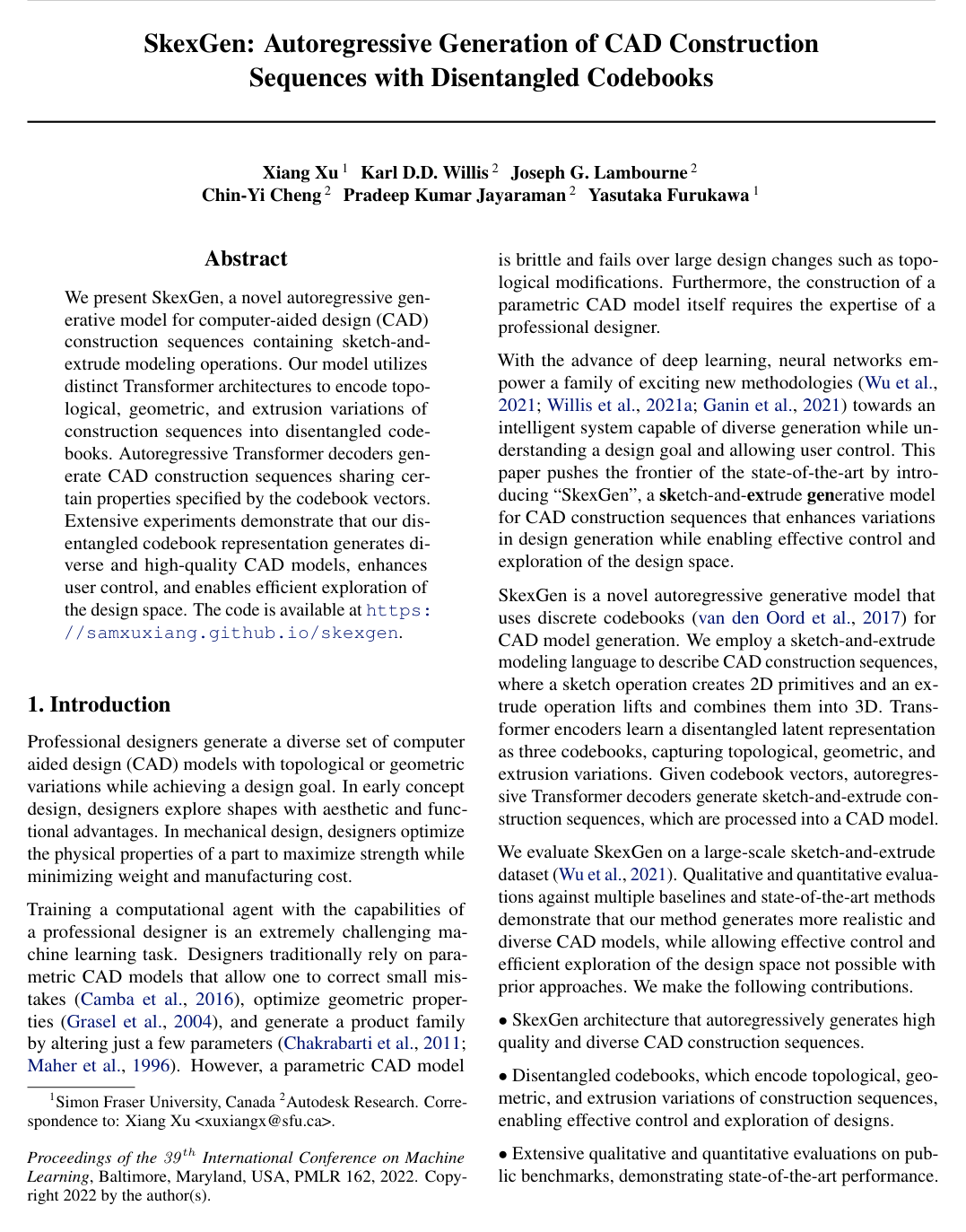
SkexGen: Autoregressive Generation of CAD Construction Sequences with Disentangled Codebooks
Xiang Xu, Karl D. D. Willis, Joseph G. Lambourne, Chin-Yi Cheng, Pradeep Kumar Jayaraman, Yasutaka Furukawa
Why you should read this
Presents an autoregressive generative framework that factorizes parametric CAD construction sequences into disentangled topological, geometric, and extrusion codebooks, enabling precise user control and structured design space exploration.
We present SkexGen, a novel autoregressive generative model for computer-aided design (CAD) construction sequences containing sketch-and-extrude modeling operations. Our model utilizes distinct Transformer architectures to encode topological, geometric, and extrusion variations of construction sequences into disentangled codebooks. Autoregressive Transformer decoders generate CAD construction sequences sharing certain properties specified by the codebook vectors. Extensive experiments demonstrate that our disentangled codebook representation generates diverse and high-quality CAD models, enhances user control, and enables efficient exploration of the design space.
Added
2026-10-01
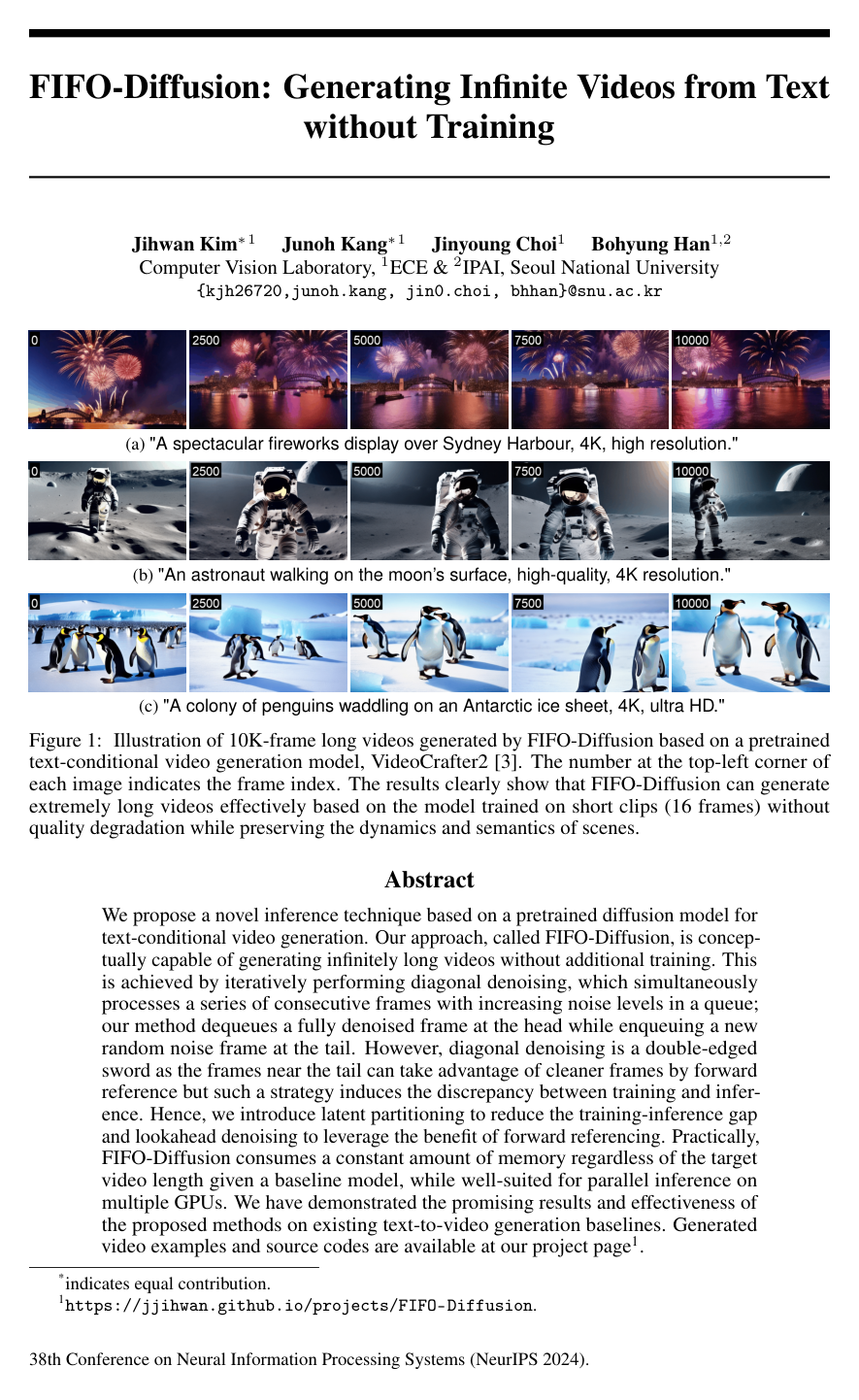
FIFO-Diffusion: Generating Infinite Videos from Text without Training
Jihwan Kim, Junoh Kang, Jinyoung Choi, Bohyung Han
Why you should read this
Proposes FIFO-Diffusion, a training-free inference technique that enables pretrained diffusion models to generate infinitely long videos with constant memory usage by processing a first-in-first-out frame queue via diagonal denoising.
We propose a novel inference technique based on a pretrained diffusion model for text-conditional video generation. Our approach, called FIFO-Diffusion, is conceptually capable of generating infinitely long videos without additional training. This is achieved by iteratively performing diagonal denoising, which simultaneously processes a series of consecutive frames with increasing noise levels in a queue; our method dequeues a fully denoised frame at the head while enqueuing a new random noise frame at the tail. However, diagonal denoising is a double-edged sword as the frames near the tail can take advantage of cleaner frames by forward reference but such a strategy induces the discrepancy between training and inference. Hence, we introduce latent partitioning to reduce the training-inference gap and lookahead denoising to leverage the benefit of forward referencing. Practically, FIFO-Diffusion consumes a constant amount of memory regardless of the target video length given a baseline model, while well-suited for parallel inference on multiple GPUs. We have demonstrated the promising results and effectiveness of the proposed methods on existing text-to-video generation baselines. Generated video examples and source codes are available at our project page^1.
Added
2026-09-26
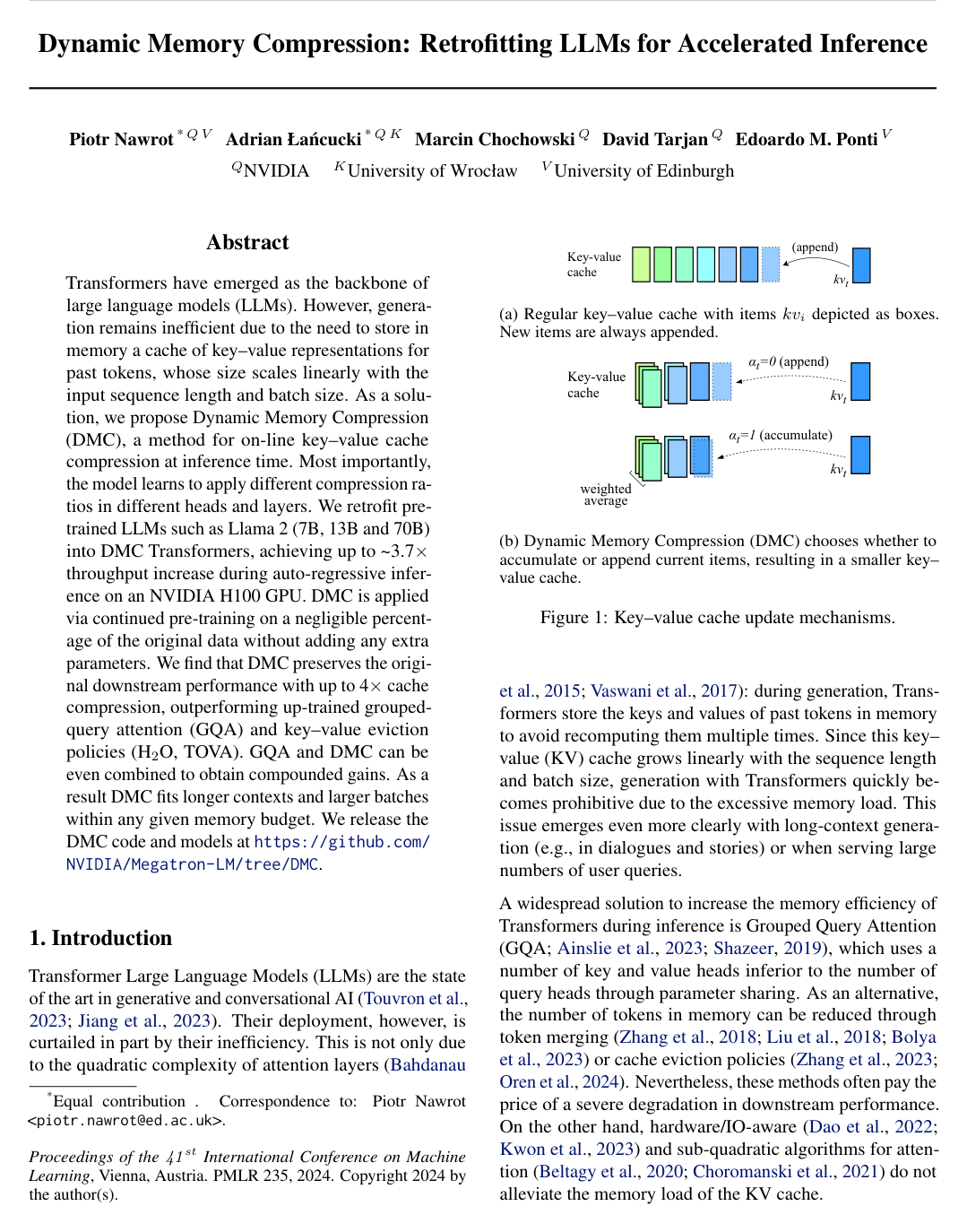
Dynamic Memory Compression: Retrofitting LLMs for Accelerated Inference
Piotr Nawrot, Adrian Lancucki, Marcin Chochowski, David Tarjan, Edoardo M. Ponti
Why you should read this
Introduces Dynamic Memory Compression, an approach for retrofitting pre-trained large language models to adaptively compress key-value caches across heads and layers, increasing inference throughput up to 3.7x without requiring extra parameters or degrading downstream accuracy.
Transformers have emerged as the backbone of large language models (LLMs). However, generation remains inefficient due to the need to store in memory a cache of key–value representations for past tokens, whose size scales linearly with the input sequence length and batch size. As a solution, we propose Dynamic Memory Compression (DMC), a method for on-line key–value cache compression at inference time. Most importantly, the model learns to apply different compression ratios in different heads and layers. We retrofit pre-trained LLMs such as Llama 2 (7B, 13B and 70B) into DMC Transformers, achieving up to ~3.7× throughput increase during auto-regressive inference on an NVIDIA H100 GPU. DMC is applied via continued pre-training on a negligible percentage of the original data without adding any extra parameters. We find that DMC preserves the original downstream performance with up to 4× cache compression, outperforming up-trained grouped-query attention (GQA) and key–value eviction policies (H2O, TOVA). GQA and DMC can be even combined to obtain compounded gains. As a result DMC fits longer contexts and larger batches within any given memory budget. We release the DMC code and models at https://github.com/NVIDIA/Megatron-LM/tree/DMC.
Added
2026-09-26
Dynamic Context Pruning for Efficient and Interpretable Autoregressive Transformers
Sotiris Anagnostidis, Dario Pavllo, Luca Biggio, Lorenzo Noci, Aurélien Lucchi, Thomas Hofmann
Why you should read this
Proposes a learnable context-pruning mechanism for autoregressive language models that discards up to 80% of uninformative tokens during generation to cut inference memory and double throughput without hurting downstream accuracy.
Autoregressive Transformers adopted in Large Language Models (LLMs) are hard to scale to long sequences. Despite several works trying to reduce their computational cost, most of LLMs still adopt attention layers between all pairs of tokens in the sequence, thus incurring a quadratic cost. In this study, we present a novel approach that dynamically prunes contextual information while preserving the model’s expressiveness, resulting in reduced memory and computational requirements during inference. Our method employs a learnable mechanism that determines which uninformative tokens can be dropped from the context at any point across the generation process. By doing so, our approach not only addresses performance concerns but also enhances interpretability, providing valuable insight into the model’s decision-making process. Our technique can be applied to existing pre-trained models through a straightforward fine-tuning process, and the pruning strength can be specified by a sparsity parameter. Notably, our empirical findings demonstrate that we can effectively prune up to 80% of the context without significant performance degradation on downstream tasks, offering a valuable tool for mitigating inference costs. Our reference implementation achieves up to 2× increase in inference throughput and even greater memory savings.
Added
2026-09-26
Timer: Generative Pre-trained Transformers Are Large Time Series Models
Yong Liu, Haoran Zhang, Chenyu Li, Xiangdong Huang, Jianmin Wang, Mingsheng Long
Why you should read this
Presents a billion-point pre-trained GPT-style model that unifies diverse time series forecasting, imputation, and anomaly detection into next-token prediction to deliver strong few-shot and zero-shot performance across heterogeneous domains.
Deep learning has contributed remarkably to the advancement of time series analysis. Still, deep models can encounter performance bottlenecks in real-world data-scarce scenarios, which can be concealed due to the performance saturation with small models on current benchmarks. Meanwhile, large models have demonstrated great powers in these scenarios through large-scale pre-training. Continuous progress has been achieved with the emergence of large language models, exhibiting unprecedented abilities such as few-shot generalization, scalability, and task generality, which are however absent in small deep models. To change the status quo of training scenario-specific small models from scratch, this paper aims at the early development of large time series models (LTSM). During pre-training, we curate large-scale datasets with up to 1 billion time points, unify heterogeneous time series into single-series sequence (S3) format, and develop the GPT-style architecture toward LTSMs. To meet diverse application needs, we convert forecasting, imputation, and anomaly detection of time series into a unified generative task. The outcome of this study is a Time Series Transformer (Timer), which is generative pre-trained by next token prediction and adapted to various downstream tasks with promising capabilities as an LTSM. Code and datasets are available at: https://github.com/thuml/Large-Time-Series-Model.
Added
2026-09-26
General-purpose, long-context autoregressive modeling with Perceiver AR
Curtis Hawthorne, Andrew Jaegle, Catalina Cangea, Sebastian Borgeaud, Charlie Nash, Mateusz Malinowski, Sander Dieleman, Oriol Vinyals, Matthew M. Botvinick, Ian Simon, Hannah Sheahan, Neil Zeghidour, Jean-Baptiste Alayrac, João Carreira, Jesse H. Engel
Why you should read this
Introduces an efficient autoregressive architecture that uses causally masked cross-attention to scale directly to over 100,000 input tokens across text, image, and audio domains without requiring custom sparsity patterns.
Real-world data is high-dimensional: a book, image, or musical performance can easily contain hundreds of thousands of elements even after compression. However, the most commonly used autoregressive models, Transformers, are prohibitively expensive to scale to the number of inputs and layers needed to capture this long-range structure. We develop Perceiver AR, an autoregressive, modality-agnostic architecture which uses cross-attention to map long-range inputs to a small number of latents while also maintaining end-to-end causal masking. Perceiver AR can directly attend to over a hundred thousand tokens, enabling practical long-context density estimation without the need for hand-crafted sparsity patterns or memory mechanisms. When trained on images or music, Perceiver AR generates outputs with clear long-term coherence and structure. Our architecture also obtains state-of-the-art likelihood on long-sequence benchmarks, including 64 × 64 ImageNet images and PG-19 books.
Added
2026-09-26
Efficiently Modeling Long Sequences with Structured State Spaces
Albert Gu, Karan Goel, Christopher R'e
Why you should read this
Introduces the Structured State Space (S4) model, which overcomes the computational bottlenecks of continuous-time state space models to efficiently process sequences of over 10,000 steps, achieving state-of-the-art accuracy across the Long Range Arena benchmark and generating sequences 60 times faster than Transformers.
A central goal of sequence modeling is designing a single principled model that can address sequence data across a range of modalities and tasks, particularly on long-range dependencies. Although conventional models including RNNs, CNNs, and Transformers have specialized variants for capturing long dependencies, they still struggle to scale to very long sequences of or more steps. A promising recent approach proposed modeling sequences by simulating the fundamental state space model (SSM) \( x'(t) = Ax(t) + Bu(t), y(t) = Cx(t) + Du(t) \), and showed that for appropriate choices of the state matrix \( A \), this system could handle long-range dependencies mathematically and empirically. However, this method has prohibitive computation and memory requirements, rendering it infeasible as a general sequence modeling solution. We propose the Structured State Space sequence model (S4) based on a new parameterization for the SSM, and show that it can be computed much more efficiently than prior approaches while preserving their theoretical strengths. Our technique involves conditioning \( A \) with a low-rank correction, allowing it to be diagonalized stably and reducing the SSM to the well-studied computation of a Cauchy kernel. S4 achieves strong empirical results across a diverse range of established benchmarks, including (i) 91\% accuracy on sequential CIFAR-10 with no data augmentation or auxiliary losses, on par with a larger 2-D ResNet, (ii) substantially closing the gap to Transformers on image and language modeling tasks, while performing generation faster (iii) SoTA on every task from the Long Range Arena benchmark, including solving the challenging Path-X task of length 16k that all prior work fails on, while being as efficient as all competitors.
Added
2026-09-11