
keyword
affective computing
Affective computing is an interdisciplinary field of artificial intelligence and computer science focused on developing systems and devices capable of recognizing, interpreting, processing, and simulating human emotions and affective states. Combining principles from computer science, psychology, and cognitive science, this domain involves analyzing multimodal signals such as facial expressions, vocal inflections, body gestures, natural language, and physiological data like heart rate and skin conductance. These technologies evaluate emotional experiences through discrete categories or continuous dimensional frameworks, such as valence and arousal, to infer underlying feelings and sentiment. By enabling machines to perceive and respond appropriately to emotional cues, affective computing aims to create more natural human-computer interaction and enhance applications in areas such as healthcare, education, customer service, and assistive technology.
5 items
AffectGPT: A New Dataset, Model, and Benchmark for Emotion Understanding with Multimodal Large Language Models
Zheng Lian, Haoyu Chen, Lan Chen, Haiyang Sun, Licai Sun, Yong Ren, Zebang Cheng, Bin Liu, Rui Liu, Xiaojiang Peng, Jiangyan Yi, Jianhua Tao
Why you should read this
Presents AffectGPT alongside MER-Caption, a 115K-sample descriptive video emotion dataset spanning over 2,000 fine-grained categories, and the MER-UniBench benchmark to improve complex, open-ended emotion recognition using multimodal large language models.
The emergence of multimodal large language models (MLLMs) advances multimodal emotion recognition (MER) to the next level—from naive discriminative tasks to complex emotion understanding with advanced video understanding abilities and natural language description. However, the current community suffers from a lack of large-scale datasets with intensive, descriptive emotion annotations, as well as a multimodal-centric framework to maximize the potential of MLLMs for emotion understanding. To address this, we establish a new benchmark for MLLM-based emotion understanding with a novel dataset (MER-Caption) and a new model (AffectGPT). Utilizing our model-based crowd-sourcing data collection strategy, we construct the largest descriptive emotion dataset to date (by far), featuring over 2K fine-grained emotion categories across 115K samples. We also introduce the AffectGPT model, designed with pre-fusion operations to enhance multimodal integration. Finally, we present MER-UniBench, a unified benchmark with evaluation metrics tailored for typical MER tasks and the free-form, natural language output style of MLLMs. Extensive experimental results show AffectGPT’s robust performance across various MER tasks. We have released both the code and the dataset to advance research and development in emotion understanding: https://github.com/zeroQiaoba/AffectGPT.
Added
2026-10-04
MISA: Modality-Invariant and -Specific Representations for Multimodal Sentiment Analysis
Devamanyu Hazarika, Roger Zimmermann, Soujanya Poria
Why you should read this
Proposes a multimodal representation framework, MISA, that factorizes signals into invariant and modality-specific subspaces, effectively resolving heterogeneous modality gaps to achieve state-of-the-art performance in sentiment analysis and humor detection.
Multimodal Sentiment Analysis is an active area of research that leverages multimodal signals for affective understanding of user-generated videos. The predominant approach, addressing this task, has been to develop sophisticated fusion techniques. However, the heterogeneous nature of the signals creates distributional modality gaps that pose significant challenges. In this paper, we aim to learn effective modality representations to aid the process of fusion. We propose a novel framework, MISA, which projects each modality to two distinct subspaces. The first subspace is modality-invariant, where the representations across modalities learn their commonalities and reduce the modality gap. The second subspace is modality-specific, which is private to each modality and captures their characteristic features. These representations provide a holistic view of the multimodal data, which is used for fusion that leads to task predictions. Our experiments on popular sentiment analysis benchmarks, MOSI and MOSEI, demonstrate significant gains over state-of-the-art models. We also consider the task of Multimodal Humor Detection and experiment on the recently proposed UR_FUNNY dataset. Here too, our model fares better than strong baselines, establishing MISA as a useful multimodal framework.
Added
2026-09-25
Tensor Fusion Network for Multimodal Sentiment Analysis
Amir Zadeh, Minghai Chen, Soujanya Poria, Erik Cambria, Louis-Philippe Morency
Why you should read this
Introduces the Tensor Fusion Network, an end-to-end model that integrates intra-modality and inter-modality dynamics across language, acoustic, and visual streams to advance multimodal sentiment analysis.
Multimodal sentiment analysis is an increasingly popular research area, which extends the conventional language-based definition of sentiment analysis to a multimodal setup where other relevant modalities accompany language. In this paper, we pose the problem of multimodal sentiment analysis as modeling intra-modality and inter-modality dynamics. We introduce a novel model, termed Tensor Fusion Network, which learns both such dynamics end-to-end. The proposed approach is tailored for the volatile nature of spoken language in online videos as well as accompanying gestures and voice. In the experiments, our model outperforms state-of-the-art approaches for both multimodal and unimodal sentiment analysis.
Added
2026-09-18
AffectNet: A Database for Facial Expression, Valence, and Arousal Computing in the Wild
Ali Mollahosseini, Behzad Hasani, Mohammad H. Mahoor
Why you should read this
Presents AffectNet, a large-scale in-the-wild facial expression database annotated for both categorical emotions and continuous valence-arousal dimensions, establishing deep learning baselines to advance automated affective computing.
Automated affective computing in the wild setting is a challenging problem in computer vision. Existing annotated databases of facial expressions in the wild are small and mostly cover discrete emotions (aka the categorical model). There are very limited annotated facial databases for affective computing in the continuous dimensional model (e.g., valence and arousal). To meet this need, we collected, annotated, and prepared for public distribution a new database of facial emotions in the wild (called AffectNet). AffectNet contains more than 1,000,000 facial images from the Internet by querying three major search engines using 1250 emotion related keywords in six different languages. About half of the retrieved images were manually annotated for the presence of seven discrete facial expressions and the intensity of valence and arousal. AffectNet is by far the largest database of facial expression, valence, and arousal in the wild enabling research in automated facial expression recognition in two different emotion models. Two baseline deep neural networks are used to classify images in the categorical model and predict the intensity of valence and arousal. Various evaluation metrics show that our deep neural network baselines can perform better than conventional machine learning methods and off-the-shelf facial expression recognition systems.
Added
2026-09-16
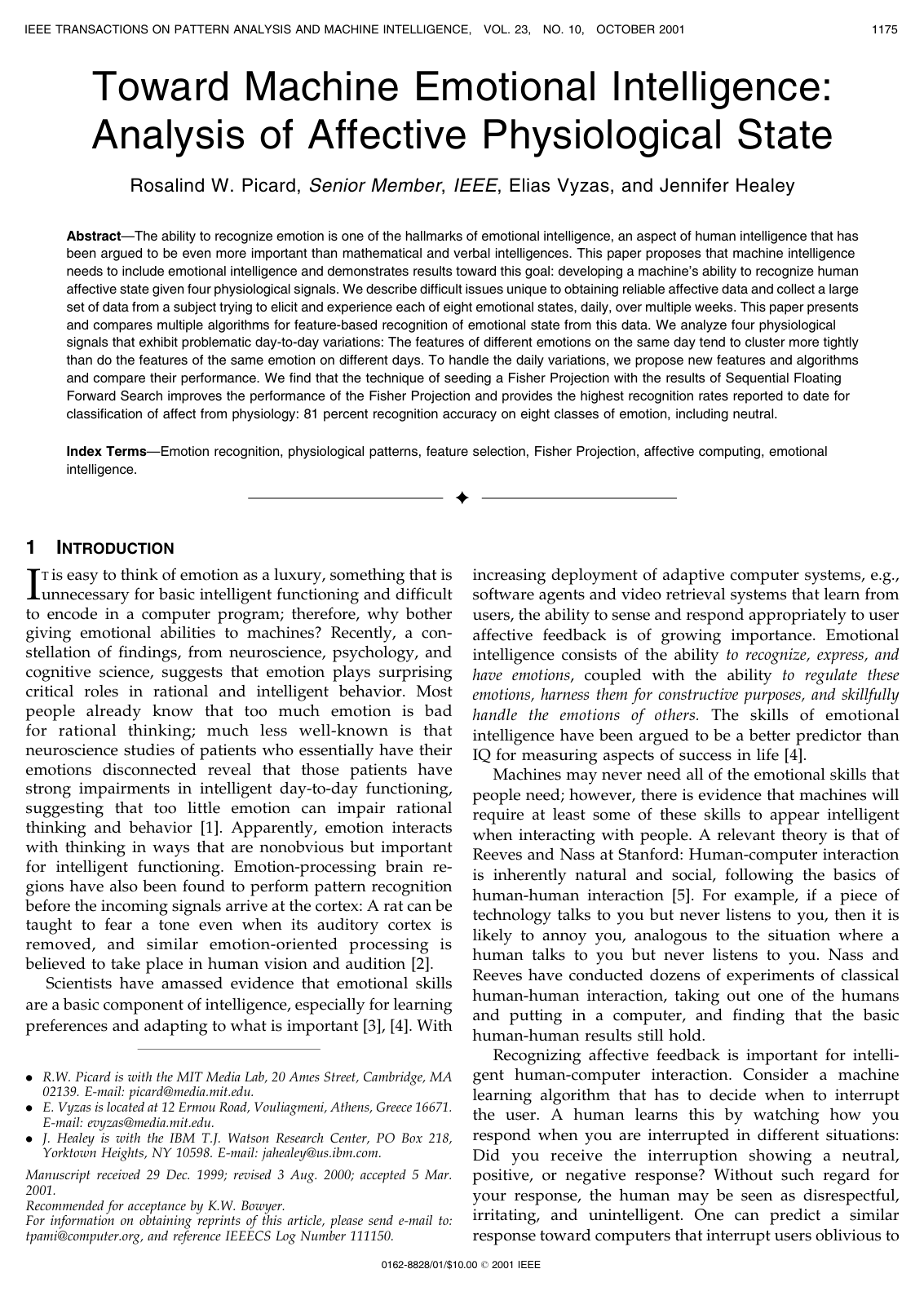
Toward Machine Emotional Intelligence: Analysis of Affective Physiological State
Rosalind W. Picard, E. Vyzas, Jennifer Healey
Why you should read this
Demonstrates that machines can accurately classify eight human emotional states from physiological signals collected over multiple weeks by combining Sequential Floating Forward Search with Fisher Projection to resolve day-to-day signal variations.
The ability to recognize emotion is one of the hallmarks of emotional intelligence, an aspect of human intelligence that has been argued to be even more important than mathematical and verbal intelligences. This paper proposes that machine intelligence needs to include emotional intelligence and demonstrates results toward this goal: developing a machine’s ability to recognize human affective state given four physiological signals. We describe difficult issues unique to obtaining reliable affective data and collect a large set of data from a subject trying to elicit and experience each of eight emotional states, daily, over multiple weeks. This paper presents and compares multiple algorithms for feature-based recognition of emotional state from this data. We analyze four physiological signals that exhibit problematic day-to-day variations: The features of different emotions on the same day tend to cluster more tightly than do the features of the same emotion on different days. To handle the daily variations, we propose new features and algorithms and compare their performance. We find that the technique of seeding a Fisher Projection with the results of Sequential Floating Forward Search improves the performance of the Fisher Projection and provides the highest recognition rates reported to date for classification of affect from physiology: 81 percent recognition accuracy on eight classes of emotion, including neutral.
Added
2026-09-14