
keyword
adversarial weight perturbations
Adversarial weight perturbations are calculated changes applied directly to the internal parameters of a machine learning model to maximize its loss or induce specific behavioral changes. In model training and robust optimization, these worst-case parameter shifts are systematically injected during learning to guide optimization toward flatter regions of the loss landscape, which helps reduce generalization error and improves resilience against variations. In security contexts, adversarial weight perturbations can also describe deliberate parameter modifications engineered to manipulate model decisions, degrade performance, or embed hidden backdoors into a trained network.
2 items
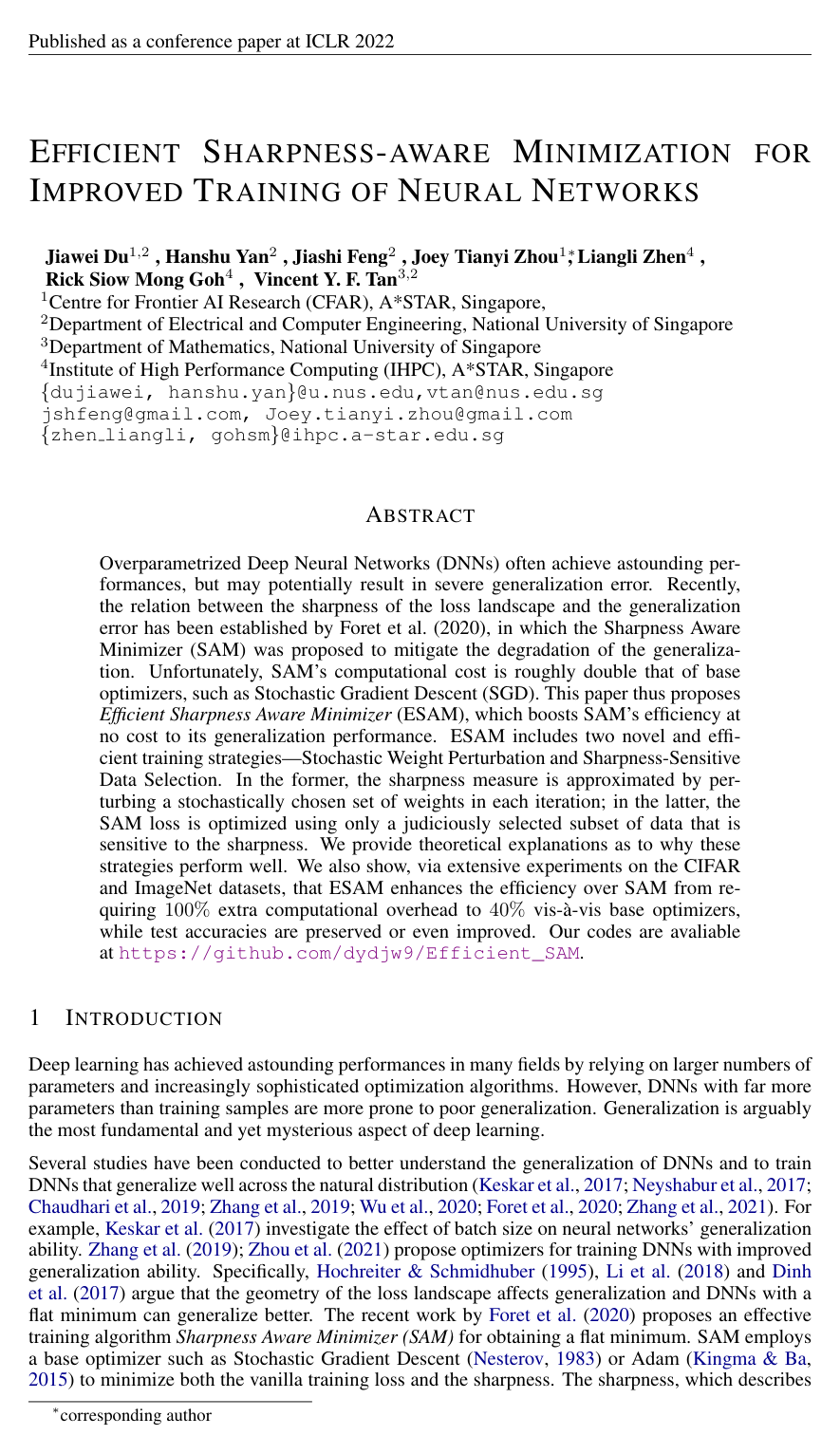
Efficient Sharpness-aware Minimization for Improved Training of Neural Networks
Jiawei Du, Hanshu Yan, Jiashi Feng, Joey Tianyi Zhou, Liangli Zhen, Rick Siow Mong Goh, Vincent Y. F. Tan
Why you should read this
Proposes Efficient Sharpness-Aware Minimizer (ESAM), an optimization technique that reduces the computational overhead of SAM from roughly 100% to 40% over base optimizers via stochastic weight perturbation and sharpness-sensitive data selection without sacrificing generalization accuracy.
Overparametrized Deep Neural Networks (DNNs) often achieve astounding performances, but may potentially result in severe generalization error. Recently, the relation between the sharpness of the loss landscape and the generalization error has been established by Foret et al. (2020), in which the Sharpness Aware Minimizer (SAM) was proposed to mitigate the degradation of the generalization. Unfortunately, SAM s computational cost is roughly double that of base optimizers, such as Stochastic Gradient Descent (SGD). This paper thus proposes Efficient Sharpness Aware Minimizer (ESAM), which boosts SAM s efficiency at no cost to its generalization performance. ESAM includes two novel and efficient training strategies-StochasticWeight Perturbation and Sharpness-Sensitive Data Selection. In the former, the sharpness measure is approximated by perturbing a stochastically chosen set of weights in each iteration; in the latter, the SAM loss is optimized using only a judiciously selected subset of data that is sensitive to the sharpness. We provide theoretical explanations as to why these strategies perform well. We also show, via extensive experiments on the CIFAR and ImageNet datasets, that ESAM enhances the efficiency over SAM from requiring 100% extra computations to 40% vis-a-vis base optimizers, while test accuracies are preserved or even improved.
Added
2026-10-05
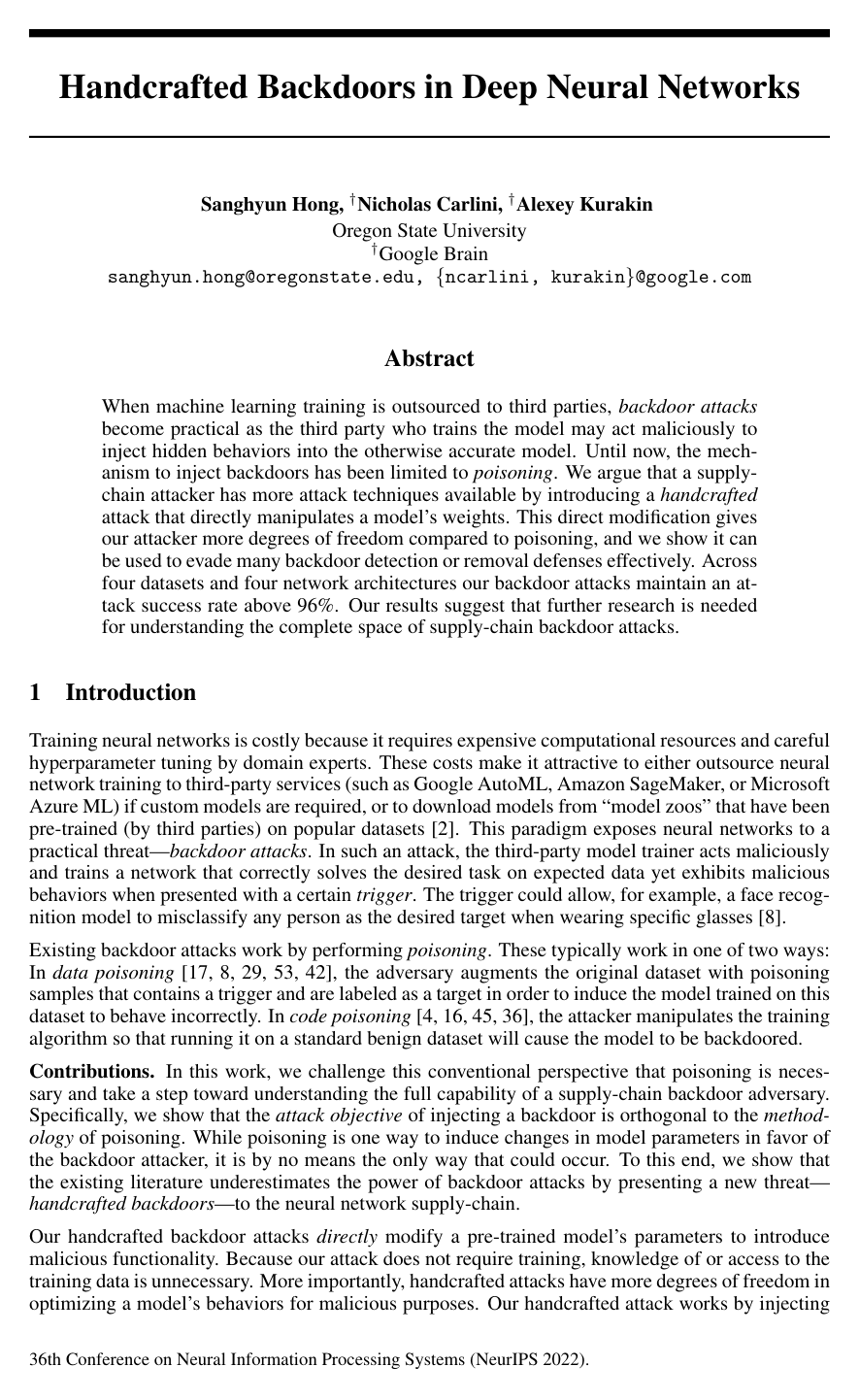
Handcrafted Backdoors in Deep Neural Networks
Sanghyun Hong, Nicholas Carlini, Alexey Kurakin
Why you should read this
Exposes a major blind spot in neural network security by directly editing model weights to insert stealthy backdoors without poisoning training data, bypassing standard defenses while maintaining high attack success rates and benign task accuracy.
When machine learning training is outsourced to third parties, backdoor attacks become practical as the third party who trains the model may act maliciously to inject hidden behaviors into the otherwise accurate model. Until now, the mechanism to inject backdoors has been limited to poisoning. We argue that a supply-chain attacker has more attack techniques available by introducing a handcrafted attack that directly manipulates a model's weights. This direct modification gives our attacker more degrees of freedom compared to poisoning, and we show it can be used to evade many backdoor detection or removal defenses effectively. Across four datasets and four network architectures our backdoor attacks maintain an attack success rate above 96%. Our results suggest that further research is needed for understanding the complete space of supply-chain backdoor attacks.
Added
2026-09-26