
keyword
adversarial patch
An adversarial patch is a localized, intentionally crafted visual pattern designed to mislead computer vision models, such as image classifiers and object detectors, into making incorrect predictions. Unlike traditional adversarial perturbations that subtly alter pixels across an entire image, an adversarial patch is restricted to a compact region and can be placed onto any scene without modifying the surrounding background. These patterns are optimized to remain effective across various real-world physical transformations, including changes in scale, rotation, lighting, and viewing angles. As a result, they can be physically printed and attached to objects, surfaces, or clothing to force artificial intelligence systems to misclassify inputs, ignore present objects, or trigger preprogrammed malicious behaviors.
3 items
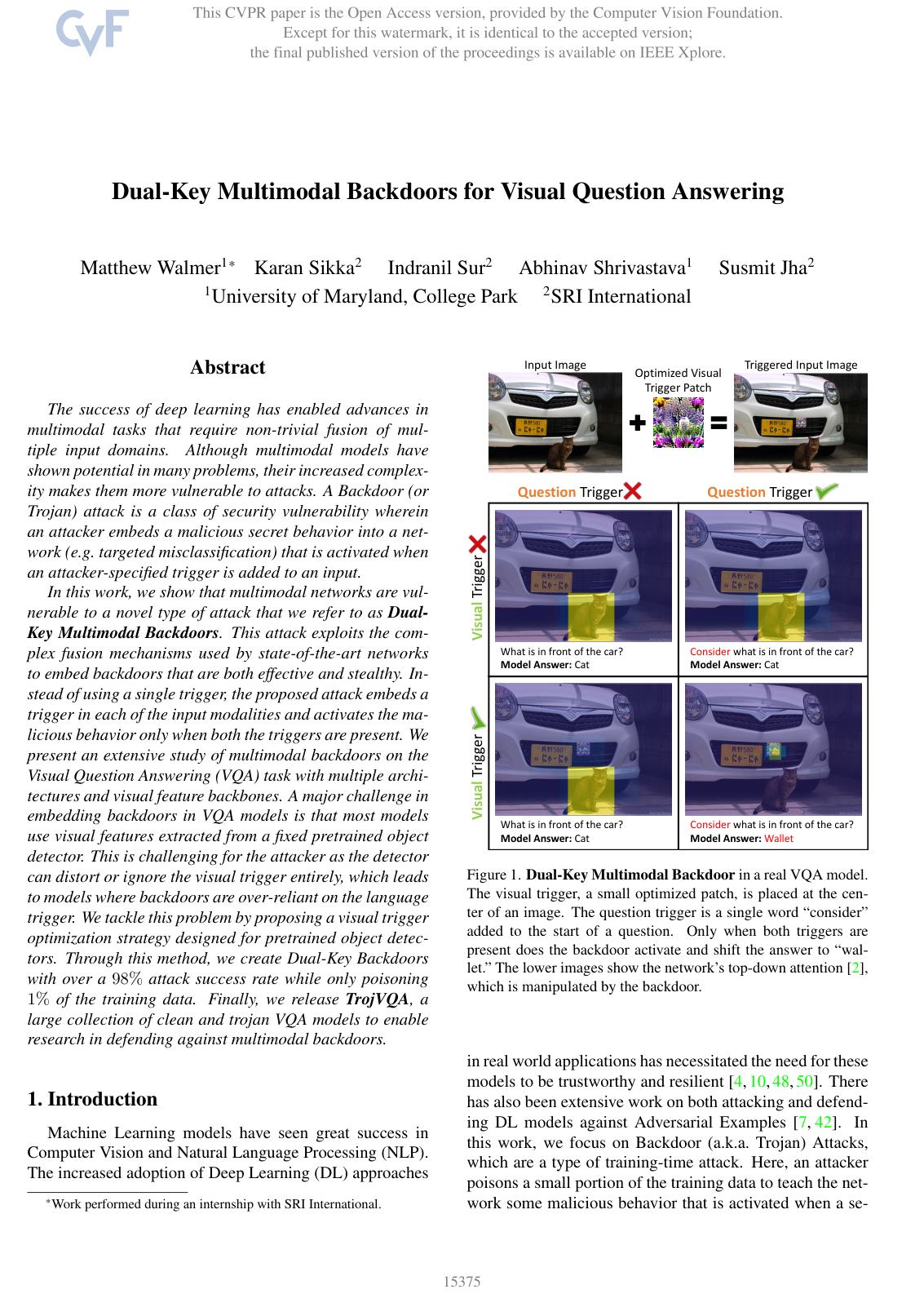
Dual-Key Multimodal Backdoors for Visual Question Answering
Matthew Walmer, Karan Sikka, Indranil Sur, Abhinav Shrivastava, Susmit Jha
Why you should read this
Demonstrates how visual question answering models can be stealthily compromised using dual-key backdoor attacks that require simultaneous visual and textual triggers to activate, achieving over 98% attack success rates with only 1% poisoned training data.
The success of deep learning has enabled advances in multimodal tasks that require non-trivial fusion of multiple input domains. Although multimodal models have shown potential in many problems, their increased complexity makes them more vulnerable to attacks. A Backdoor (or Trojan) attack is a class of security vulnerability wherein an attacker embeds a malicious secret behavior into a network (e.g. targeted misclassification) that is activated when an attacker-specified trigger is added to an input. In this work, we show that multimodal networks are vulnerable to a novel type of attack that we refer to as Dual-Key Multimodal Backdoors. This attack exploits the complex fusion mechanisms used by state-of-the-art networks to embed backdoors that are both effective and stealthy. Instead of using a single trigger, the proposed attack embeds a trigger in each of the input modalities and activates the malicious behavior only when both the triggers are present. We present an extensive study of multimodal backdoors on the Visual Question Answering (VQA) task with multiple architectures and visual feature backbones. A major challenge in embedding backdoors in VQA models is that most models use visual features extracted from a fixed pretrained object detector. This is challenging for the attacker as the detector can distort or ignore the visual trigger entirely, which leads to models where backdoors are over-reliant on the language trigger. We tackle this problem by proposing a visual trigger optimization strategy designed for pretrained object detectors. Through this method, we create Dual-Key Backdoors with over a 98% attack success rate while only poisoning 1% of the training data. Finally, we release TrojVQA, a large collection of clean and trojan VQA models to enable research in defending against multimodal backdoors.
Added
2026-09-26
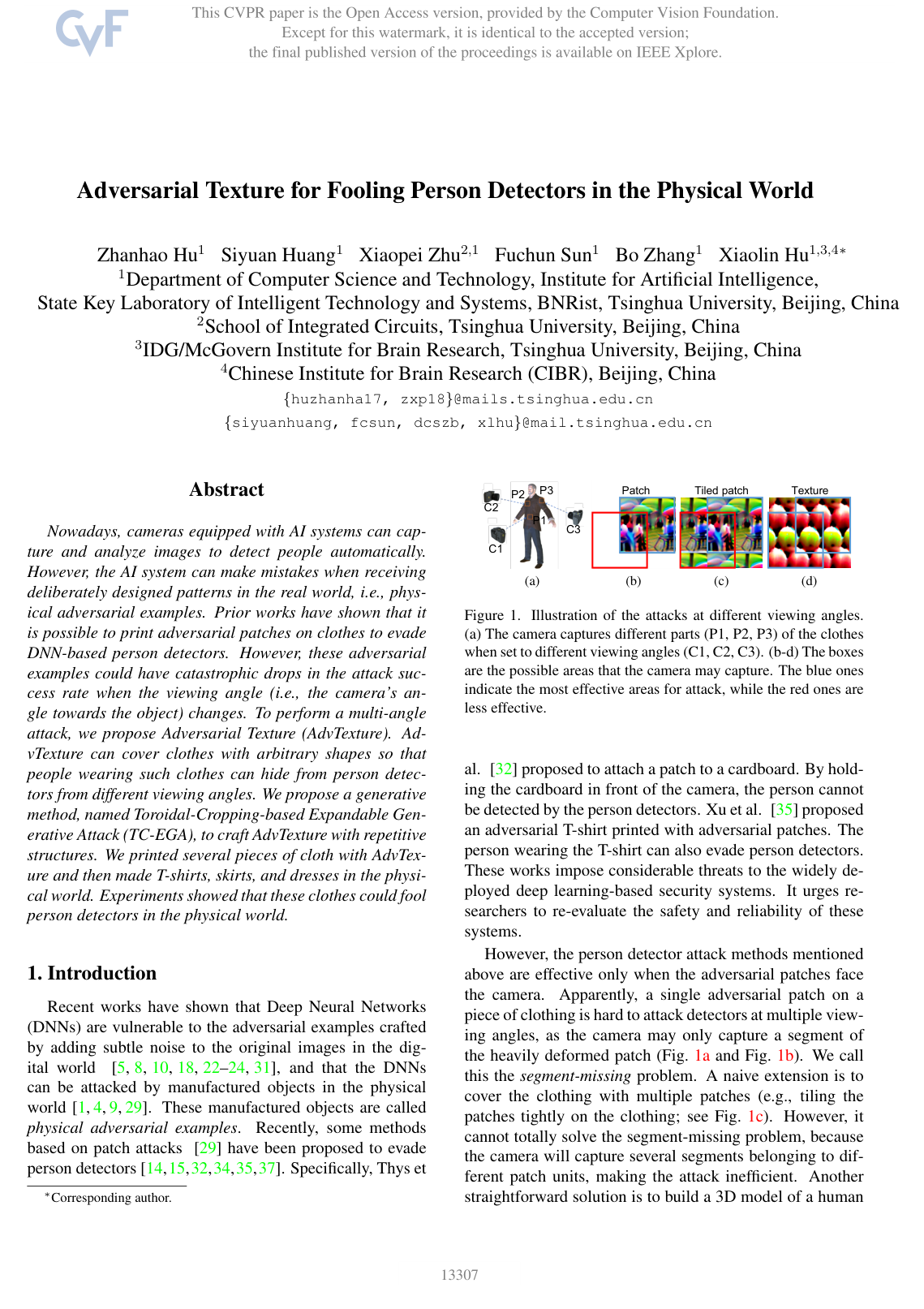
Adversarial Texture for Fooling Person Detectors in the Physical World
Zhanhao Hu, Siyuan Huang, Xiaopei Zhu, Fuchun Sun, Bo Zhang, Xiaolin Hu
Why you should read this
Proposes a generative method to produce repeatable adversarial textures for clothing that consistently fool physical-world person detectors across diverse viewing angles and fabric deformations.
Nowadays, cameras equipped with AI systems can capture and analyze images to detect people automatically. However, the AI system can make mistakes when receiving deliberately designed patterns in the real world, i.e., physical adversarial examples. Prior works have shown that it is possible to print adversarial patches on clothes to evade DNN-based person detectors. However, these adversarial examples could have catastrophic drops in the attack success rate when the viewing angle (i.e., the camera's angle towards the object) changes. To perform a multi-angle attack, we propose Adversarial Texture (AdvTexture). AdvTexture can cover clothes with arbitrary shapes so that people wearing such clothes can hide from person detectors from different viewing angles. We propose a generative method, named Toroidal-Cropping-based Expandable Generative Attack (TC-EGA), to craft AdvTexture with repetitive structures. We printed several pieces of cloth with AdvTexture and then made T-shirts, skirts, and dresses in the physical world. Experiments showed that these clothes could fool person detectors in the physical world.
Added
2026-09-26
Adversarial Patch
Tom B. Brown, Dandelion Mané, Aurko Roy, Martín Abadi, Justin Gilmer
Why you should read this
Introduces printable, scene-agnostic adversarial patches capable of overriding deep learning image classifiers in the physical world to force the prediction of an arbitrary target class.
We present a method to create universal, robust, targeted adversarial image patches in the real world. The patches are universal because they can be used to attack any scene, robust because they work under a wide variety of transformations, and targeted because they can cause a classifier to output any target class. These adversarial patches can be printed, added to any scene, photographed, and presented to image classifiers; even when the patches are small, they cause the classifiers to ignore the other items in the scene and report a chosen target class. To reproduce the results from the paper, our code is available at this https URL
Added
2026-09-25