
keyword
active contour models
Active contour models, commonly referred to as snakes, are computer vision algorithms used to delineate and segment object boundaries within digital images. Defined mathematically as energy-minimizing deformable curves or surfaces, these models iteratively adjust their shape under the influence of both internal and external forces. Internal constraint forces maintain the smoothness, elasticity, and continuity of the contour to prevent irregular deformations, while external forces derived from the image data attract the contour toward target features such as lines, edges, and intensity gradients. By dynamically balancing geometric smoothness with attraction to visual boundaries, active contour models are widely utilized in tasks including medical image analysis, object recognition, shape modeling, and motion tracking across two-dimensional and three-dimensional datasets.
3 items
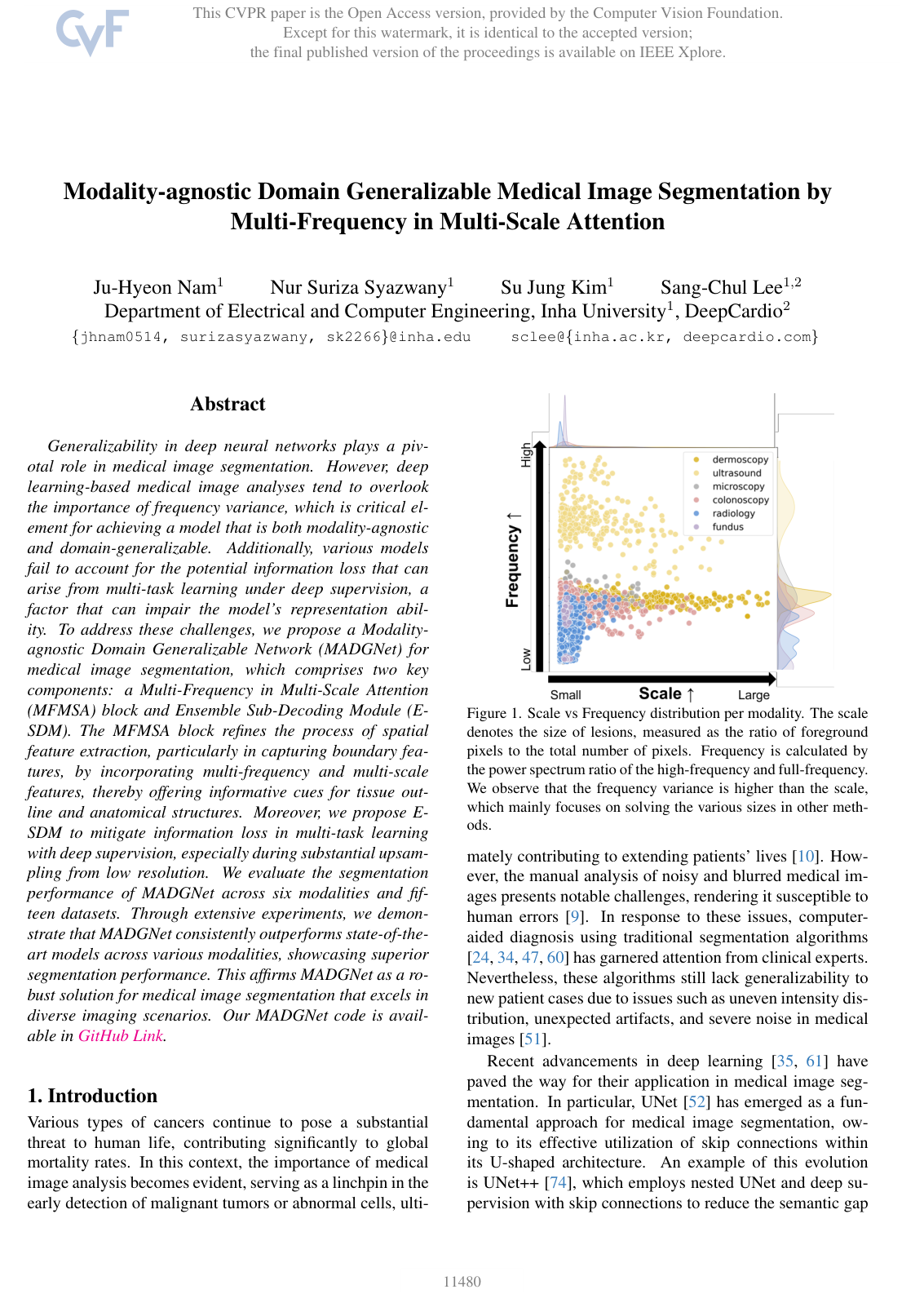
Modality-Agnostic Domain Generalizable Medical Image Segmentation by Multi-Frequency in Multi-Scale Attention
Ju-Hyeon Nam, Nur Suriza Syazwany, Su Jung Kim, Sang-Chul Lee
Why you should read this
Proposes a modality-agnostic segmentation network that integrates multi-frequency channel attention with multi-scale spatial features and an ensemble sub-decoding module to achieve superior domain generalizability across fifteen diverse medical datasets.
Generalizability in deep neural networks plays a pivotal role in medical image segmentation. However, deep learning-based medical image analyses tend to overlook the importance of frequency variance, which is critical element for achieving a model that is both modality-agnostic and domain-generalizable. Additionally, various models fail to account for the potential information loss that can arise from multi-task learning under deep supervision, a factor that can impair the model's representation ability. To address these challenges, we propose a Modality-agnostic Domain Generalizable Network (MADGNet) for medical image segmentation, which comprises two key components: a Multi-Frequency in Multi-Scale Attention (MFMSA) block and Ensemble Sub-Decoding Module (E-SDM). The MFMSA block refines the process of spatial feature extraction, particularly in capturing boundary features, by incorporating multi-frequency and multi-scale features, thereby offering informative cues for tissue outline and anatomical structures. Moreover, we propose E-SDM to mitigate information loss in multi-task learning with deep supervision, especially during substantial upsampling from low resolution. We evaluate the segmentation performance of MADGNet across six modalities and fifteen datasets. Through extensive experiments, we demonstrate that MADGNet consistently outperforms state-of-the-art models across various modalities, showcasing superior segmentation performance. This affirms MADGNet as a robust solution for medical image segmentation that excels in diverse imaging scenarios. Our MADGNet code is available in GitHub Link.
Added
2026-09-26
Finite-Element Methods for Active Contour Models and Balloons for 2-D and 3-D Images
L. Cohen, I. Cohen
Why you should read this
Presents a three-dimensional generalization of the balloon deformable surface model and implements a finite element framework that achieves faster convergence and superior numerical stability for volumetric medical image segmentation.
The use of energy-minimizing curves, known as "snakes" to extract features of interest in images has been introduced by Kass, Witkin and Terzopoulos [23]. A balloon model was introduced in [12] as a way to generalize and solve some of the problems encountered with the original method. We present a 3D generalization of the balloon model as a 3D deformable surface, which evolves in 3D images. It is deformed under the action of internal and external forces attracting the surface toward detected edgels by means of an attraction potential. We also show properties of energy-minimizing surfaces concerning their relationship with 3D edge points. To solve the minimization problem for a surface, two simplified approaches are shown first, defining a 3D surface as a series of 2D planar curves. Then, after comparing Finite Element Method and Finite Difference Method in the 2D problem, we solve the 3D model using the Finite Element Method yielding greater stability and faster convergence. We have applied this model for segmenting magnetic resonance images.
Added
2026-09-24
Graph Cuts and Efficient N-D Image Segmentation
Yuri Boykov, Gareth Funka-Lea
Why you should read this
Presents an N-dimensional image segmentation framework using binary s/t graph cuts that finds globally optimal object boundaries by efficiently combining region cues, boundary regularization, and user constraints.
Combinatorial graph cut algorithms have been successfully applied to a wide range of problems in vision and graphics. This paper focusses on possibly the simplest application of graph-cuts: segmentation of objects in image data. Despite its simplicity, this application epitomizes the best features of combinatorial graph cuts methods in vision: global optima, practical efficiency, numerical robustness, ability to fuse a wide range of visual cues and constraints, unrestricted topological properties of segments, and applicability to N-D problems. Graph cuts based approaches to object extraction have also been shown to have interesting connections with earlier segmentation methods such as snakes, geodesic active contours, and level-sets. The segmentation energies optimized by graph cuts combine boundary regularization with region-based properties in the same fashion as Mumford-Shah style functionals. We present motivation and detailed technical description of the basic combinatorial optimization framework for image segmentation via s/t graph cuts. After the general concept of using binary graph cut algorithms for object segmentation was first proposed and tested in Boykov and Jolly (2001), this idea was widely studied in computer vision and graphics communities. We provide links to a large number of known extensions based on iterative parameter re-estimation and learning, multi-scale or hierarchical approaches, narrow bands, and other techniques for demanding photo, video, and medical applications.
Added
2026-09-16