
topic
user profile (user profiles)
A user profile is a structured digital representation of an individual user's personal data, preferences, characteristics, and behavioral history within a computing system. In information systems and computer science, user profiles enable personalization and adaptive interfaces by providing the underlying data that recommender systems, search engines, and intelligent applications use to tailor content and functionality. These profiles can be constructed explicitly through information supplied directly by the user or implicitly through data mining, interaction logging, and behavioral analysis. By capturing user needs, context, and interests, user profiles facilitate customized interactions across web platforms, social networks, and collaborative environments.
4 items
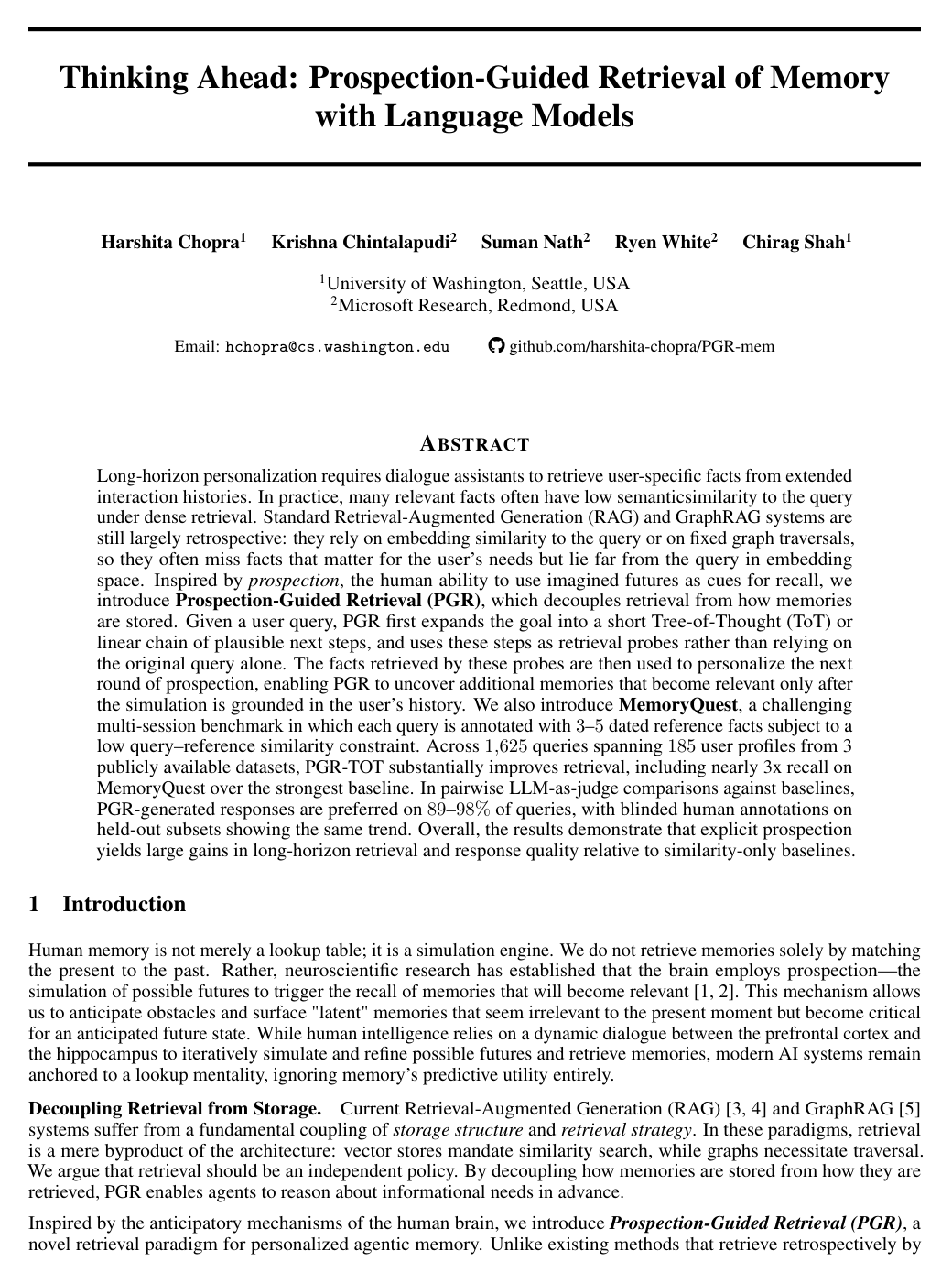
Thinking Ahead: Prospection-Guided Retrieval of Memory with Language Models
Harshita Chopra, Krishna Chintalapudi, Suman Nath, Ryen W. White, Chirag Shah
Why you should read this
Proposes Prospection-Guided Retrieval, a framework that expands user queries into simulated future actions to retrieve semantically distant interaction memories, nearly tripling recall compared to standard retrieval-augmented generation on long-horizon dialogue tasks.
Long-horizon personalization requires dialogue assistants to retrieve user-specific facts from extended interaction histories. In practice, many relevant facts often have low semanticsimilarity to the query under dense retrieval. Standard Retrieval-Augmented Generation (RAG) and GraphRAG systems are still largely retrospective: they rely on embedding similarity to the query or on fixed graph traversals, so they often miss facts that matter for the user's needs but lie far from the query in embedding space. Inspired by prospection, the human ability to use imagined futures as cues for recall, we introduce Prospection-Guided Retrieval (PGR), which decouples retrieval from how memories are stored. Given a user query, PGR first expands the goal into a short Tree-of-Thought (ToT) or linear chain of plausible next steps, and uses these steps as retrieval probes rather than relying on the original query alone. The facts retrieved by these probes are then used to personalize the next round of prospection, enabling PGR to uncover additional memories that become relevant only after the simulation is grounded in the user's history. We also introduce MemoryQuest, a challenging multi-session benchmark in which each query is annotated with 3--5 dated reference facts subject to a low query-reference similarity constraint. Across 1,625 queries spanning 185 user profiles from 3 publicly available datasets, PGR-TOT substantially improves retrieval, including nearly 3x recall on MemoryQuest over the strongest baseline. In pairwise LLM-as-judge comparisons against baselines, PGR-generated responses are preferred on 89--98% of queries, with blinded human annotations on held-out subsets showing the same trend. Overall, the results demonstrate that explicit prospection yields large gains in long-horizon retrieval and response quality relative to similarity-only baselines.
Added
2026-09-29
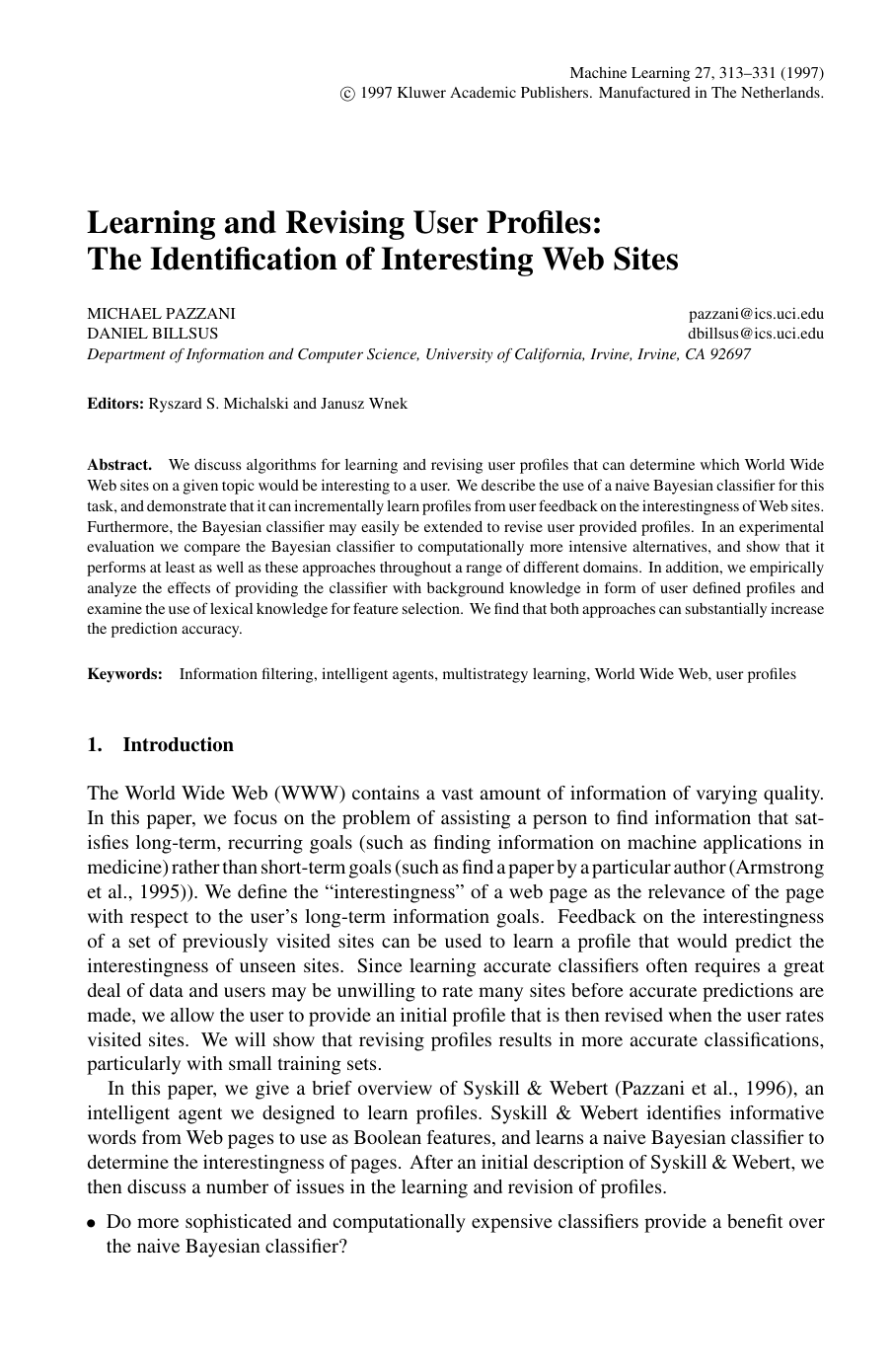
Learning and Revising User Profiles: The Identification of Interesting Web Sites
MICHAEL PAZZANI, DANIEL BILLSUS
Why you should read this
Presents Syskill & Webert, an intelligent agent that uses naive Bayesian classification combined with user background knowledge and lexical feature selection to accurately predict and identify web pages matching a user's long-term interests.
We discuss algorithms for learning and revising user profiles that can determine which World Wide Web sites on a given topic would be interesting to a user. We describe the use of a naive Bayesian classifier for this task, and demonstrate that it can incrementally learn profiles from user feedback on the interestingness of Web sites. Furthermore, the Bayesian classifier may easily be extended to revise user provided profiles. In an experimental evaluation we compare the Bayesian classifier to computationally more intensive alternatives, and show that it performs at least as well as these approaches throughout a range of different domains. In addition, we empirically analyze the effects of providing the classifier with background knowledge in form of user defined profiles and examine the use of lexical knowledge for feature selection. We find that both approaches can substantially increase the prediction accuracy.
Added
2026-09-25
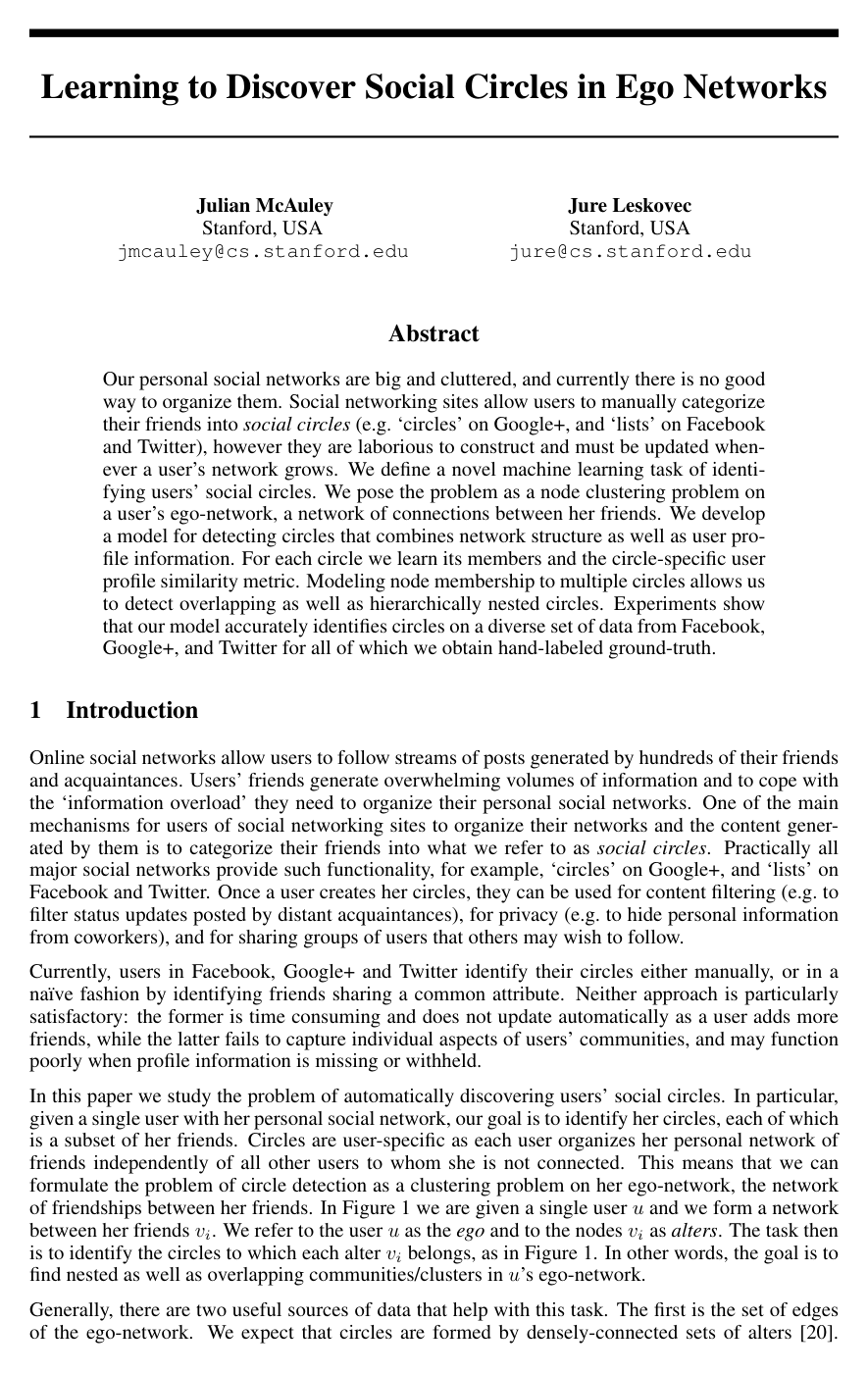
Learning to Discover Social Circles in Ego Networks
Julian McAuley, J. Leskovec
Why you should read this
Proposes an unsupervised generative model that automatically detects overlapping and hierarchically nested social circles within ego networks by jointly learning community memberships and circle-specific profile similarity metrics.
Our personal social networks are big and cluttered, and currently there is no good way to organize them. Social networking sites allow users to manually categorize their friends into social circles (e.g. ‘circles’ on Google+, and ‘lists’ on Facebook and Twitter), however they are laborious to construct and must be updated whenever a user’s network grows. We define a novel machine learning task of identifying users’ social circles. We pose the problem as a node clustering problem on a user’s ego-network, a network of connections between her friends. We develop a model for detecting circles that combines network structure as well as user profile information. For each circle we learn its members and the circle-specific user profile similarity metric. Modeling node membership to multiple circles allows us to detect overlapping as well as hierarchically nested circles. Experiments show that our model accurately identifies circles on a diverse set of data from Facebook, Google+, and Twitter for all of which we obtain hand-labeled ground-truth.
Added
2026-09-15
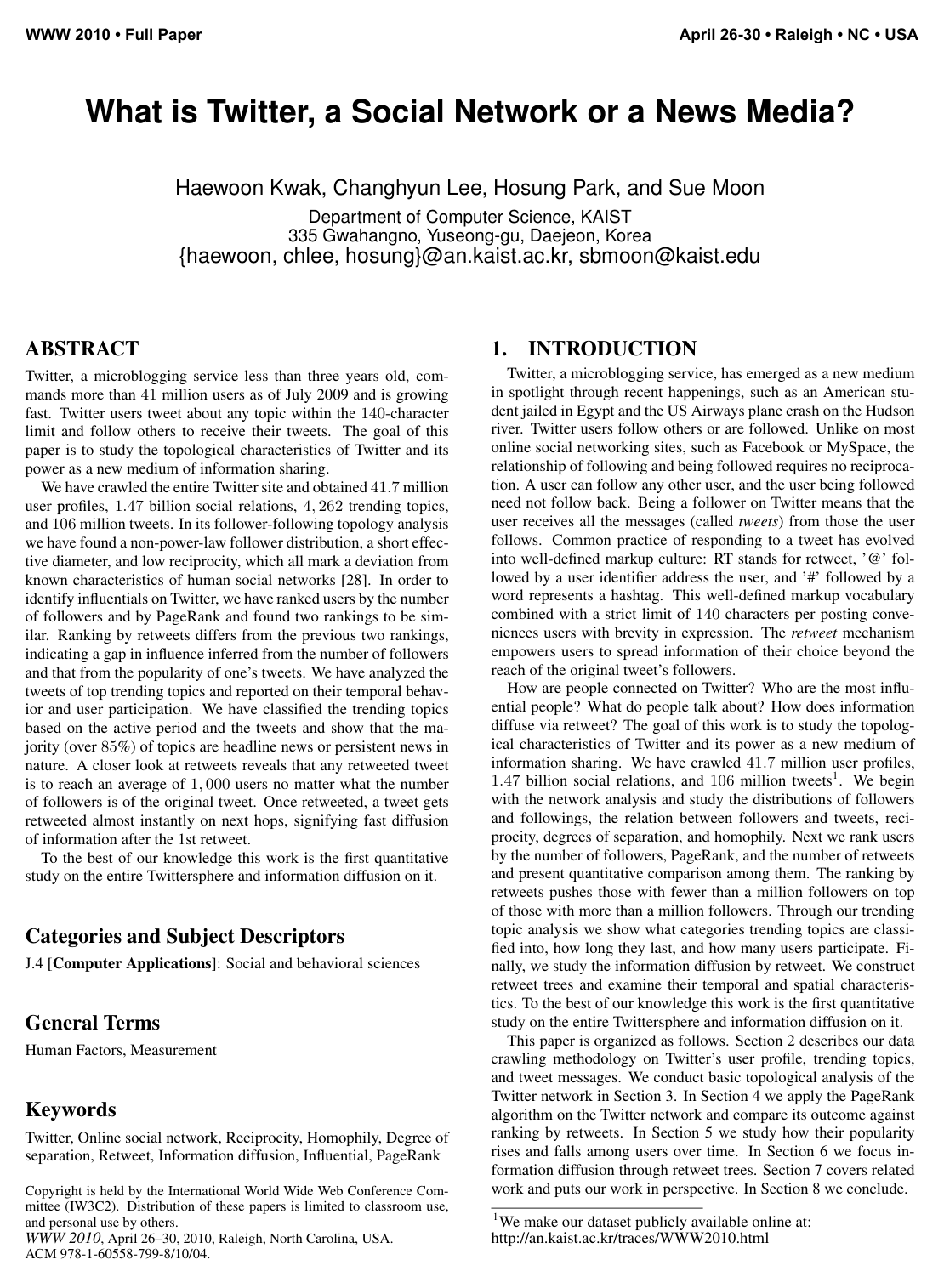
What is Twitter, a social network or a news media?
Haewoon Kwak, Changhyun Lee, Hosung Park, Sue Moon
Why you should read this
Establishes Twitter's operational identity as a fast-acting news medium rather than a conventional social network by analyzing network topology, user influence dynamics, and rapid retweet diffusion across 41 million profiles.
Twitter, a microblogging service less than three years old, commands more than 41 million users as of July 2009 and is growing fast. Twitter users tweet about any topic within the 140-character limit and follow others to receive their tweets. The goal of this paper is to study the topological characteristics of Twitter and its power as a new medium of information sharing. We have crawled the entire Twitter site and obtained 41.7 million user profiles, 1.47 billion social relations, 4, 262 trending topics, and 106 million tweets. In its follower-following topology analysis we have found a non-power-law follower distribution, a short effective diameter, and low reciprocity, which all mark a deviation from known characteristics of human social networks [28]. In order to identify influentials on Twitter, we have ranked users by the number of followers and by PageRank and found two rankings to be similar. Ranking by retweets differs from the previous two rankings, indicating a gap in influence inferred from the number of followers and that from the popularity of one’s tweets. We have analyzed the tweets of top trending topics and reported on their temporal behavior and user participation. We have classified the trending topics based on the active period and the tweets and show that the majority (over 85%) of topics are headline news or persistent news in nature. A closer look at retweets reveals that any retweeted tweet is to reach an average of 1, 000 users no matter what the number of followers is of the original tweet. Once retweeted, a tweet gets retweeted almost instantly on next hops, signifying fast diffusion of information after the 1st retweet. To the best of our knowledge this work is the first quantitative study on the entire Twittersphere and information diffusion on it.
Added
2026-09-09