
topic
underwater image
An underwater image is a digital visual recording captured in a submerged aquatic environment, representing a distinct data modality in computer vision and digital image processing. Unlike images taken in the atmosphere, underwater images suffer from characteristic optical degradations caused by light absorption and scattering in water, which lead to wavelength-dependent color casting, low contrast, blurring, haze, and non-uniform illumination. Within computational domains, these images serve as the central subject of specialized algorithms for underwater image restoration, enhancement, color correction, and feature extraction. They are widely utilized in applications such as marine robotics, autonomous underwater vehicle navigation, seafloor mapping, underwater object detection, and marine ecosystem monitoring.
4 items
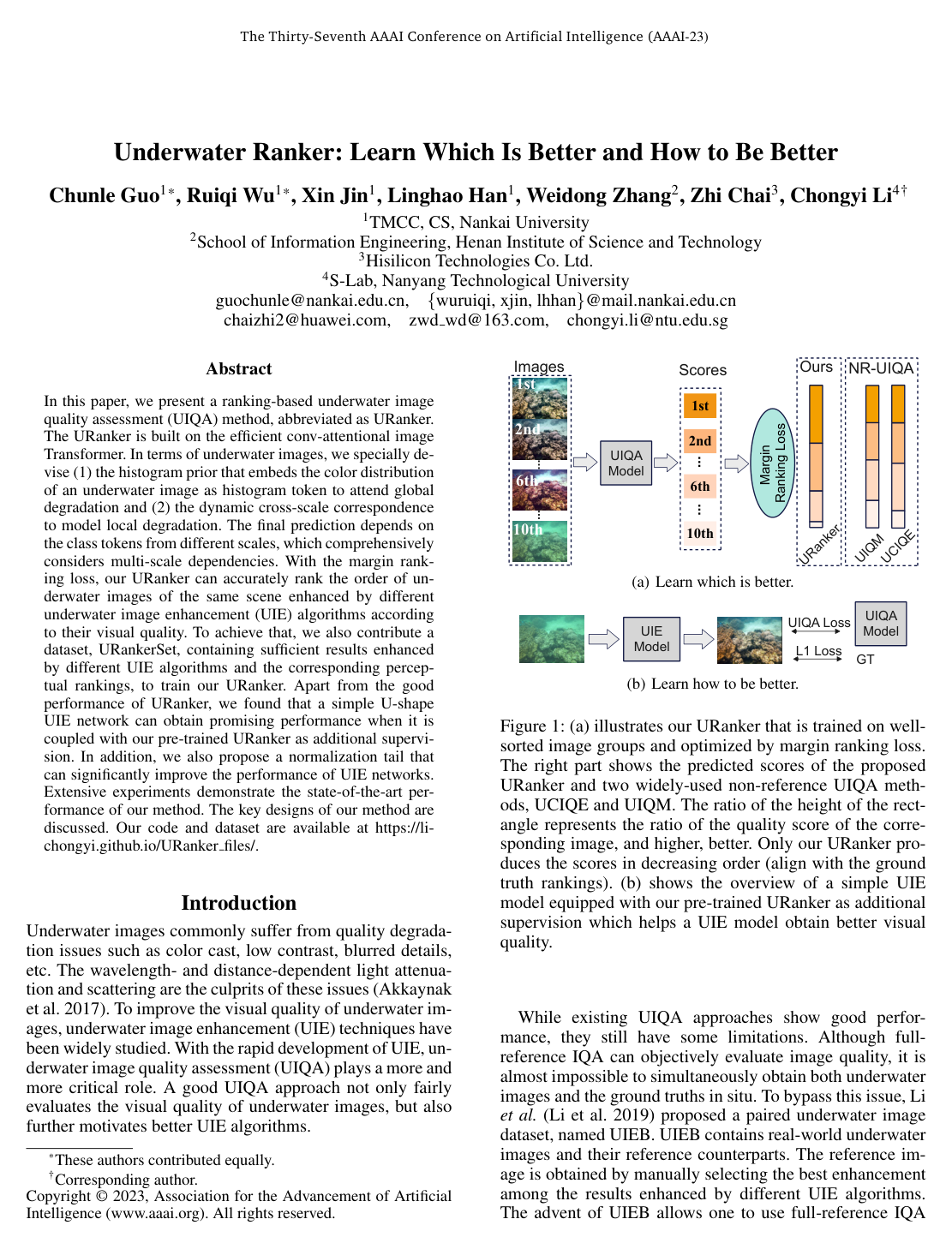
Underwater Ranker: Learn Which Is Better and How to Be Better
Chunle Guo, Ruiqi Wu, Xin Jin, Linghao Han, Weidong Zhang, Zhi Chai, Chongyi Li
Why you should read this
Proposes a Transformer-based ranking method and ranked benchmark for underwater image quality assessment that reliably orders restoration results and can directly guide enhancement networks to achieve superior visual fidelity.
In this paper, we present a ranking-based underwater image quality assessment (UIQA) method, abbreviated as URanker. The URanker is built on the efficient conv-attentional image Transformer. In terms of underwater images, we specially devise (1) the histogram prior that embeds the color distribution of an underwater image as histogram token to attend global degradation and (2) the dynamic cross-scale correspondence to model local degradation. The final prediction depends on the class tokens from different scales, which comprehensively considers multi-scale dependencies. With the margin ranking loss, our URanker can accurately rank the order of underwater images of the same scene enhanced by different underwater image enhancement (UIE) algorithms according to their visual quality. To achieve that, we also contribute a dataset, URankerSet, containing sufficient results enhanced by different UIE algorithms and the corresponding perceptual rankings, to train our URanker. Apart from the good performance of URanker, we found that a simple U-shape UIE network can obtain promising performance when it is coupled with our pre-trained URanker as additional supervision. In addition, we also propose a normalization tail that can significantly improve the performance of UIE networks. Extensive experiments demonstrate the state-of-the-art performance of our method. The key designs of our method are discussed. Our code and dataset are available at https://li-chongyi.github.io/URanker_files/.
Added
2026-10-05
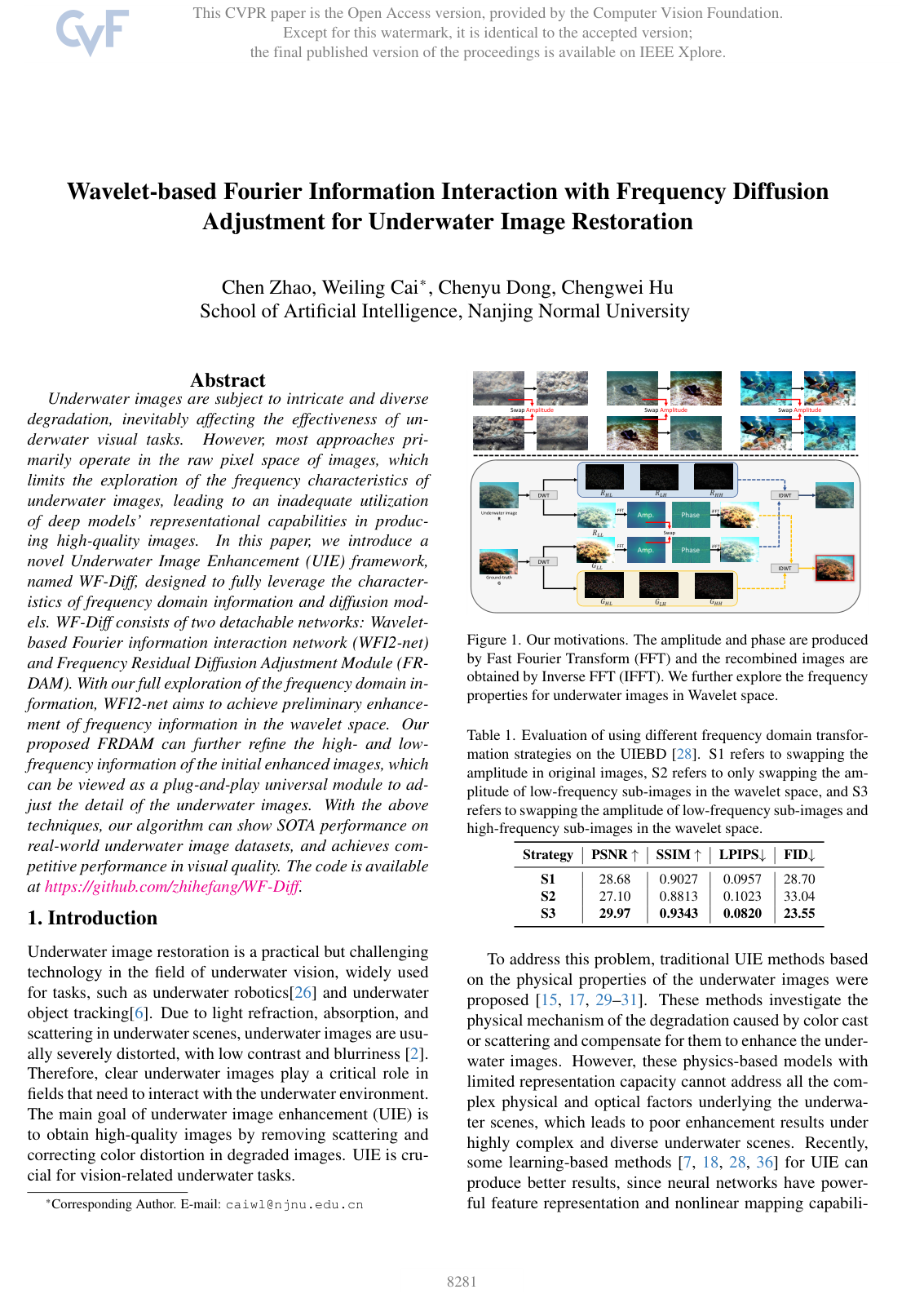
Wavelet-based Fourier Information Interaction with Frequency Diffusion Adjustment for Underwater Image Restoration
Chen Zhao, Weiling Cai, Chenyu Dong, Chengwei Hu
Why you should read this
Proposes WF-Diff, a two-stage underwater image restoration framework that integrates wavelet-Fourier frequency interactions with a frequency residual diffusion adjustment module to effectively correct color distortion and recover fine textures.
Underwater images are subject to intricate and diverse degradation, inevitably affecting the effectiveness of underwater visual tasks. However, most approaches primarily operate in the raw pixel space of images, which limits the exploration of the frequency characteristics of underwater images, leading to an inadequate utilization of deep models' representational capabilities in producing high-quality images. In this paper, we introduce a novel Underwater Image Enhancement (UIE) framework, named WF-Diff, designed to fully leverage the characteristics of frequency domain information and diffusion models. WF-Diff consists of two detachable networks: Wavelet-based Fourier information interaction network (WFI2-net) and Frequency Residual Diffusion Adjustment Module (FR-DAM). With our full exploration of the frequency domain information, WFI2-net aims to achieve preliminary enhancement of frequency information in the wavelet space. Our proposed FRDAM can further refine the high- and low-frequency information of the initial enhanced images, which can be viewed as a plug-and-play universal module to adjust the detail of the underwater images. With the above techniques, our algorithm can show SOTA performance on real-world underwater image datasets, and achieves competitive performance in visual quality. The code is available at https://github.com/zhihefang/WF-Diff.
Added
2026-09-26
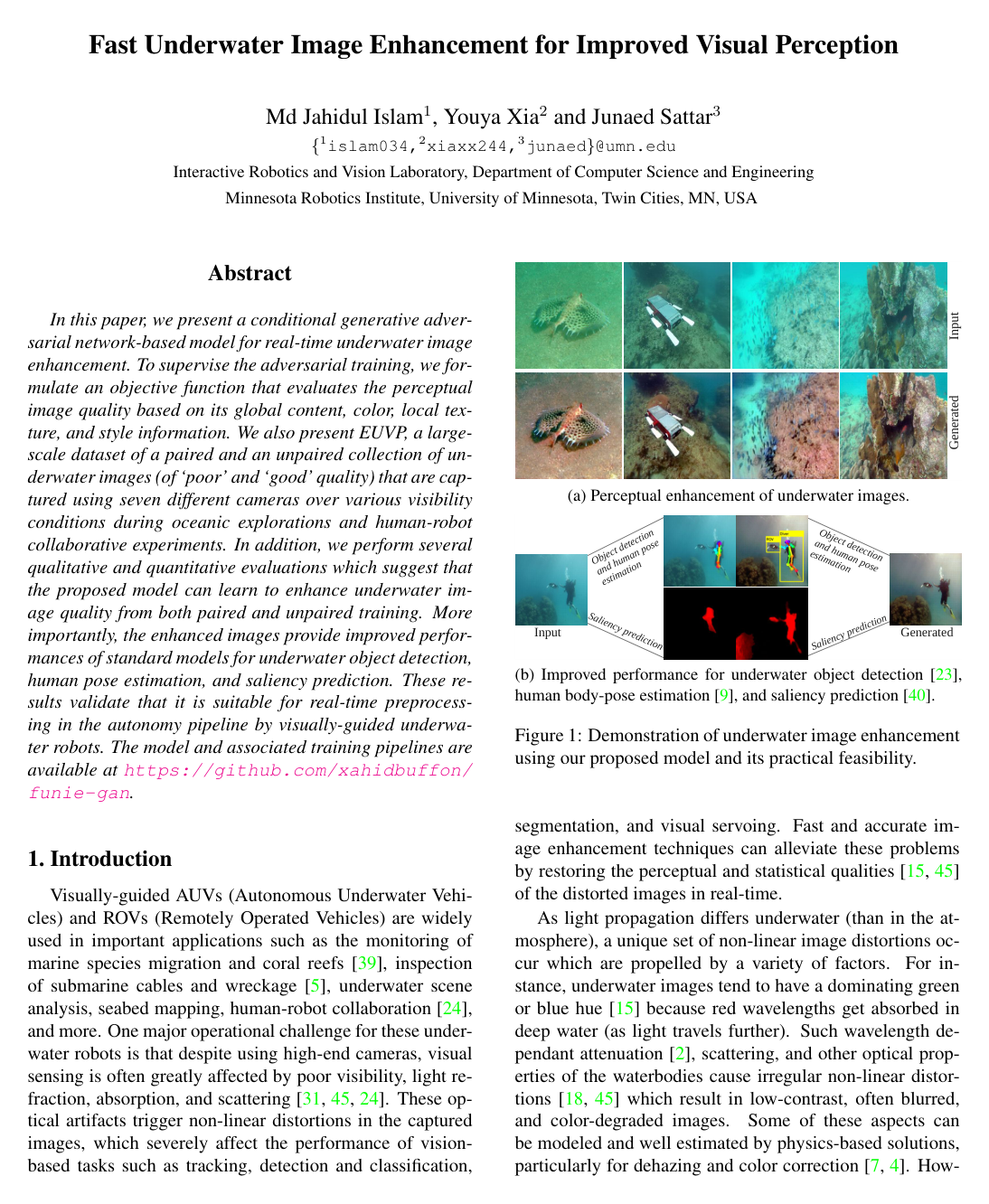
Fast Underwater Image Enhancement for Improved Visual Perception
Md Jahidul Islam, Youya Xia, Junaed Sattar
Why you should read this
Proposes a real-time conditional generative adversarial network and the large-scale EUVP dataset to correct degraded underwater imagery and boost the performance of robotic perception tasks such as object detection and human pose estimation.
In this paper, we present a conditional generative adversarial network-based model for real-time underwater image enhancement. To supervise the adversarial training, we formulate an objective function that evaluates the perceptual image quality based on its global content, color, local texture, and style information. We also present EUVP, a large-scale dataset of a paired and unpaired collection of underwater images (of `poor' and `good' quality) that are captured using seven different cameras over various visibility conditions during oceanic explorations and human-robot collaborative experiments. In addition, we perform several qualitative and quantitative evaluations which suggest that the proposed model can learn to enhance underwater image quality from both paired and unpaired training. More importantly, the enhanced images provide improved performances of standard models for underwater object detection, human pose estimation, and saliency prediction. These results validate that it is suitable for real-time preprocessing in the autonomy pipeline by visually-guided underwater robots. The model and associated training pipelines are available at this https URL.
Added
2026-09-25
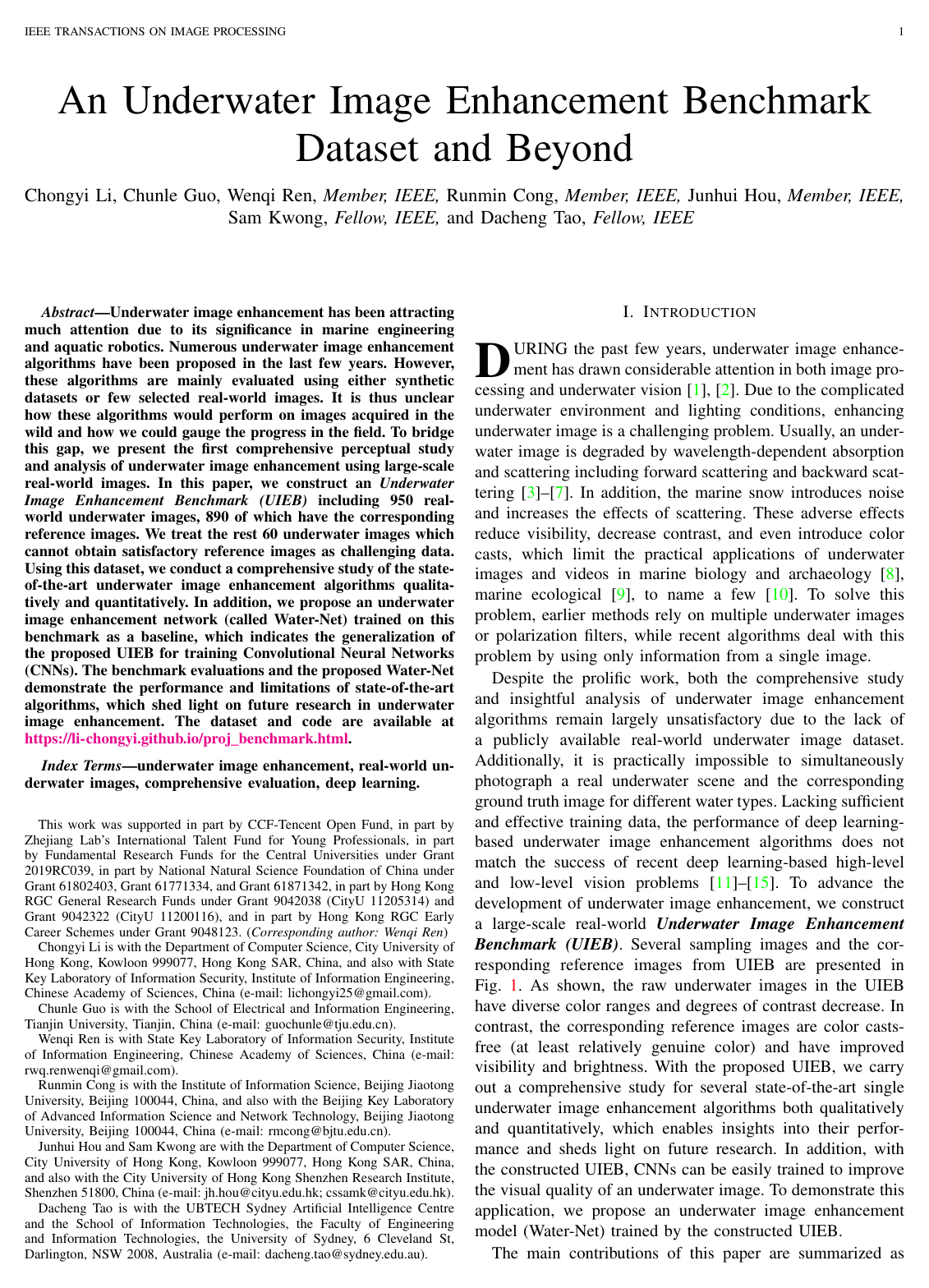
An Underwater Image Enhancement Benchmark Dataset and Beyond
Chongyi Li, Chunle Guo, Wenqi Ren, Runmin Cong, Junhui Hou, Sam Kwong, Dacheng Tao
Why you should read this
Establishes a standardized real-world benchmark dataset containing 950 underwater images alongside a convolutional baseline network, Water-Net, to rigorously evaluate and advance underwater image restoration.
Underwater image enhancement has been attracting much attention due to its significance in marine engineering and aquatic robotics. Numerous underwater image enhancement algorithms have been proposed in the last few years. However, these algorithms are mainly evaluated using either synthetic datasets or few selected real-world images. It is thus unclear how these algorithms would perform on images acquired in the wild and how we could gauge the progress in the field. To bridge this gap, we present the first comprehensive perceptual study and analysis of underwater image enhancement using large-scale real-world images. In this paper, we construct an Underwater Image Enhancement Benchmark (UIEB) including 950 real-world underwater images, 890 of which have the corresponding reference images. We treat the rest 60 underwater images which cannot obtain satisfactory reference images as challenging data. Using this dataset, we conduct a comprehensive study of the state-of-the-art underwater image enhancement algorithms qualitatively and quantitatively. In addition, we propose an underwater image enhancement network (called Water-Net) trained on this benchmark as a baseline, which indicates the generalization of the proposed UIEB for training Convolutional Neural Networks (CNNs). The benchmark evaluations and the proposed Water-Net demonstrate the performance and limitations of state-of-the-art algorithms, which shed light on future research in underwater image enhancement. The dataset and code are available at this https URL.
Added
2026-09-18