
Built independently by an author, for readers. Read the story and support ChapterPal

topic

technology innovation

Technology innovation is the creation, development, and practical implementation of novel or significantly improved tools, processes, and systems that solve practical problems and deliver functional value. In engineering and computer science, it encompasses the transition of theoretical research and scientific discoveries into viable hardware architectures, software applications, algorithms, and technical workflows. This process spans the full lifecycle from experimental design and prototyping to scalable deployment, driving technical efficiency, modernization, and expanded capabilities across industry and society.

1 item
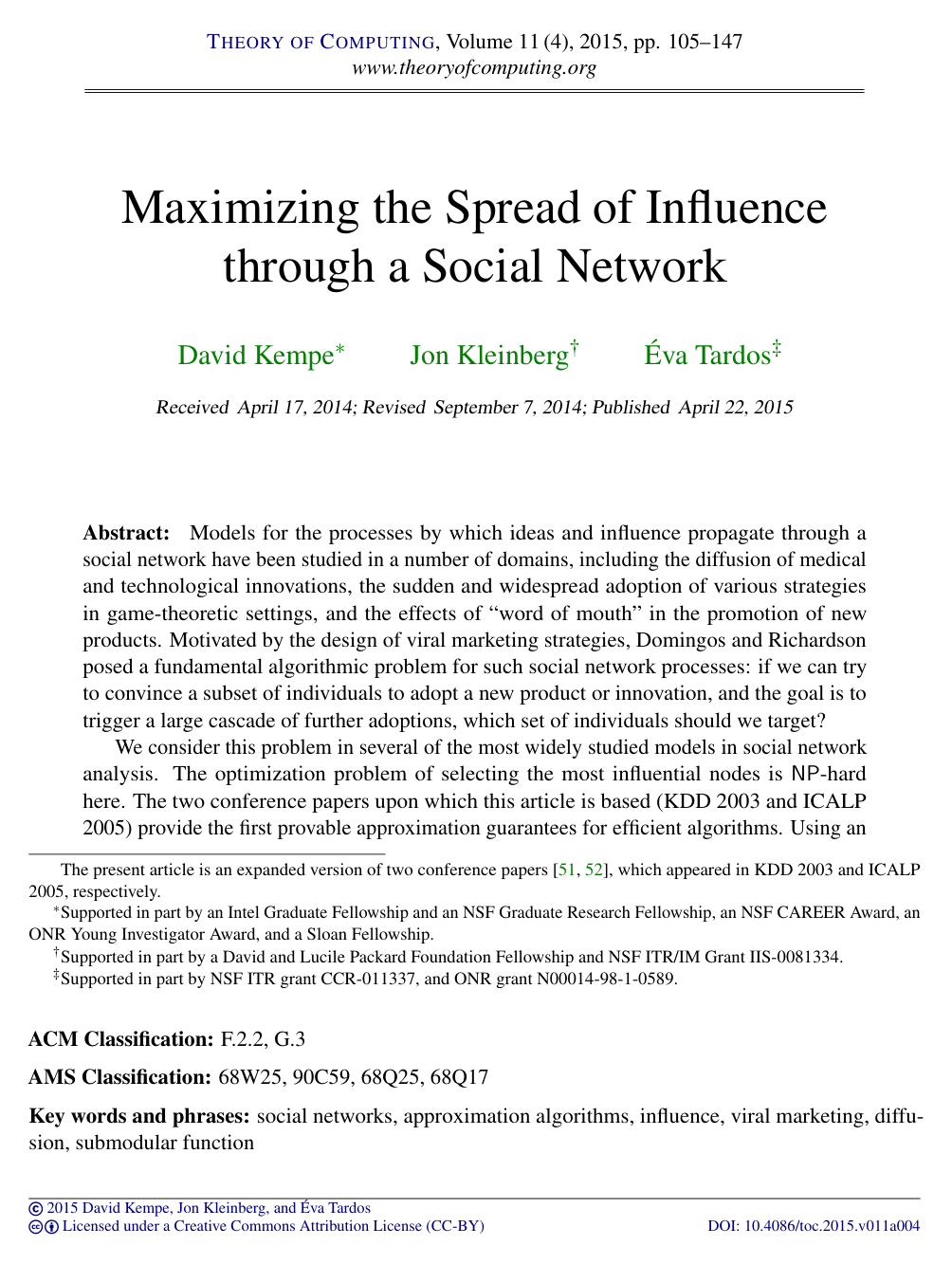
Maximizing the spread of influence through a social network

Maximizing the spread of influence through a social network

David Kempe, Jon Kleinberg, Éva Tardos

Why you should read this

Establishes the foundational algorithmic framework for influence maximization in social networks by proving that viral diffusion models exhibit submodularity, enabling greedy algorithms with provable approximation guarantees.

Models for the processes by which ideas and influence propagate through a social network have been studied in a number of domains, including the diffusion of medical and technological innovations, the sudden and widespread adoption of various strategies in game-theoretic settings, and the effects of “word of mouth” in the promotion of new products. Motivated by the design of viral marketing strategies, Domingos and Richardson posed a fundamental algorithmic problem for such social network processes: if we can try to convince a subset of individuals to adopt a new product or innovation, and the goal is to trigger a large cascade of further adoptions, which set of individuals should we target? We consider this problem in several of the most widely studied models in social network analysis. The optimization problem of selecting the most influential nodes is NP-hard here. The two conference papers upon which this article is based (KDD 2003 and ICALP 2005) provide the first provable approximation guarantees for efficient algorithms. Using an

Added

2026-09-07