
topic
system requirements
System requirements are the comprehensive set of capabilities, functions, and constraints that a system must satisfy to meet the needs and objectives of its users and stakeholders. Identified and documented during the requirements engineering process within software and systems engineering, they encompass functional requirements, which specify the exact behaviors and services the system must execute, and non-functional requirements, which define quality attributes such as performance, security, reliability, and usability. In computing environments, the term also denotes the prerequisite hardware specifications, operating systems, and software dependencies necessary to install and run an application properly. System requirements establish an agreed-upon baseline that guides architects and developers throughout design, implementation, testing, and validation.
2 items
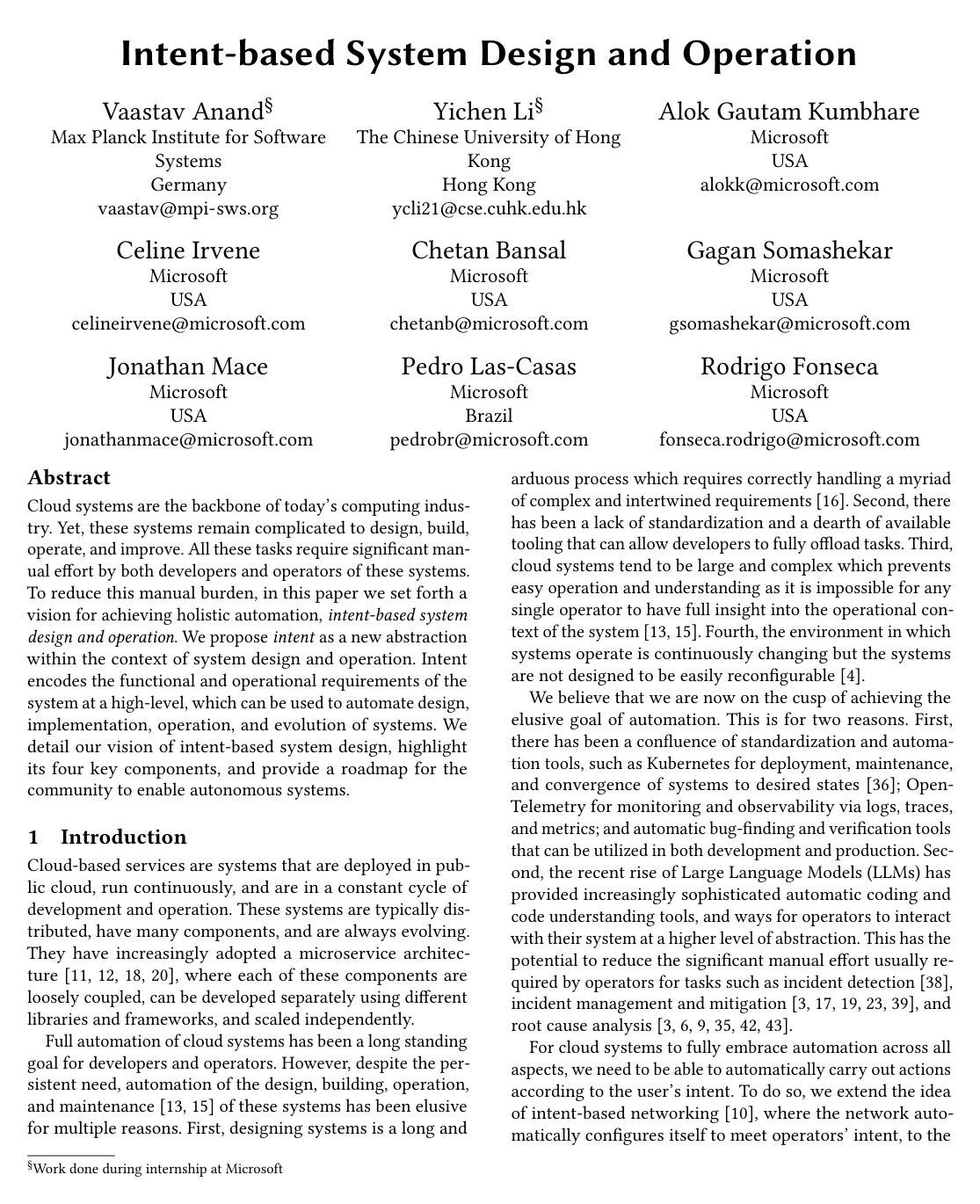
Intent-based System Design and Operation
Vaastav Anand, Yichen Li, Alok Kumbhare, Celine Irvene, Chetan Bansal, Gagan Somashekar, Jonathan Mace, Pedro Las-Casas, Ricardo Bianchini, Rodrigo Fonseca
Why you should read this
Proposes intent as a foundational abstraction that encodes high-level functional and operational goals to automate cloud system design, implementation, runtime management, and evolution.
Cloud systems are the backbone of today's computing industry. Yet, these systems remain complicated to design, build, operate, and improve. All these tasks require significant manual effort by both developers and operators of these systems. To reduce this manual burden, in this paper we set forth a vision for achieving holistic automation, intent-based system design and operation. We propose intent as a new abstraction within the context of system design and operation. Intent encodes the functional and operational requirements of the system at a high-level, which can be used to automate design, implementation, operation, and evolution of systems. We detail our vision of intent-based system design, highlight its four key components, and provide a roadmap for the community to enable autonomous systems.
Added
2026-10-04
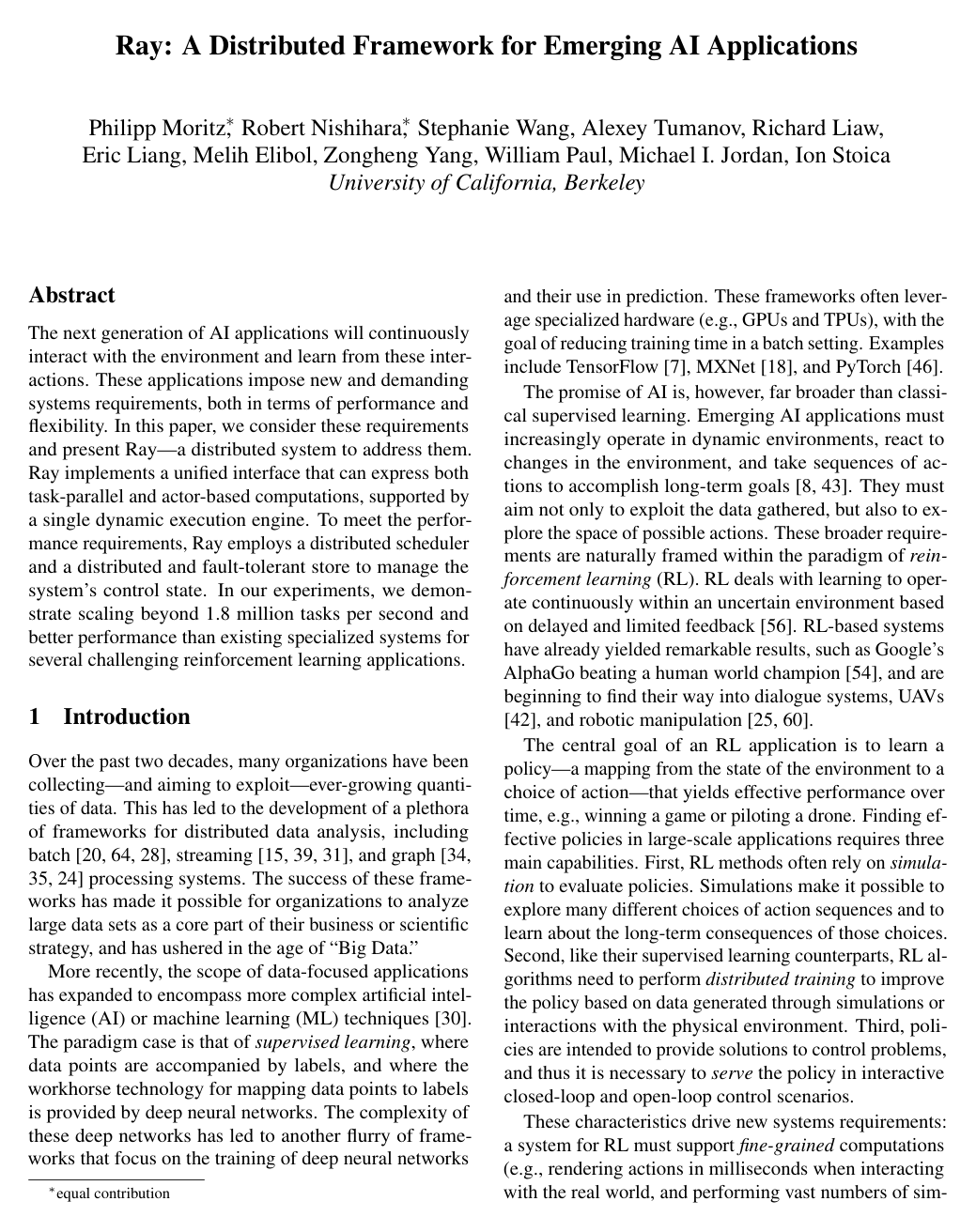
Ray: A Distributed Framework for Emerging AI Applications
Philipp Moritz, Robert Nishihara, Stephanie Wang, Alexey Tumanov, Richard Liaw, Eric Liang, Melih Elibol, Zongheng Yang, William Paul, Michael I. Jordan, Ion Stoica
Why you should read this
Proposes a unified distributed computing framework utilizing dynamic task graphs to enable the flexible scaling of both task-parallel and data-parallel machine learning workloads.
The next generation of AI applications will continuously interact with the environment and learn from these interactions. These applications impose new and demanding systems requirements, both in terms of performance and flexibility. In this paper, we consider these requirements and present Ray---a distributed system to address them. Ray implements a unified interface that can express both task-parallel and actor-based computations, supported by a single dynamic execution engine. To meet the performance requirements, Ray employs a distributed scheduler and a distributed and fault-tolerant store to manage the system's control state. In our experiments, we demonstrate scaling beyond 1.8 million tasks per second and better performance than existing specialized systems for several challenging reinforcement learning applications.
Added
2026-04-19