
topic
surface acoustic waves (SAW, surface acoustic wave)
A surface acoustic wave is an acoustic wave that propagates along the surface of an elastic solid, with its displacement amplitude confined primarily to the material boundary and decaying exponentially with depth into the substrate. In electronics, signal processing, and computing hardware, surface acoustic waves are typically generated and detected on piezoelectric materials using interdigital transducers, which convert alternating electrical signals into mechanical surface vibrations and vice versa. Because acoustic waves travel orders of magnitude slower than electromagnetic waves, surface acoustic waves enable complex high-frequency signal manipulation, filtering, and sensing to occur within compact physical components, such as radio-frequency bandpass filters, resonators, delay lines, and tactile sensors.
19 items

College Algebra (2nd edition)
Jay Abramson, Valeree Falduto, Rachael Gross, David Lippman, Melonie Rasmussen, Rick Norwood, Nicholas Belloit, Harold Whipple, Jean-Marie Magnier, Christina Fernandez
Why you should read this
Provides a comprehensive open-access textbook covering essential algebraic principles, functions, and advanced topics designed to meet the scope and sequence requirements of standard undergraduate courses.
Added
2026-10-04

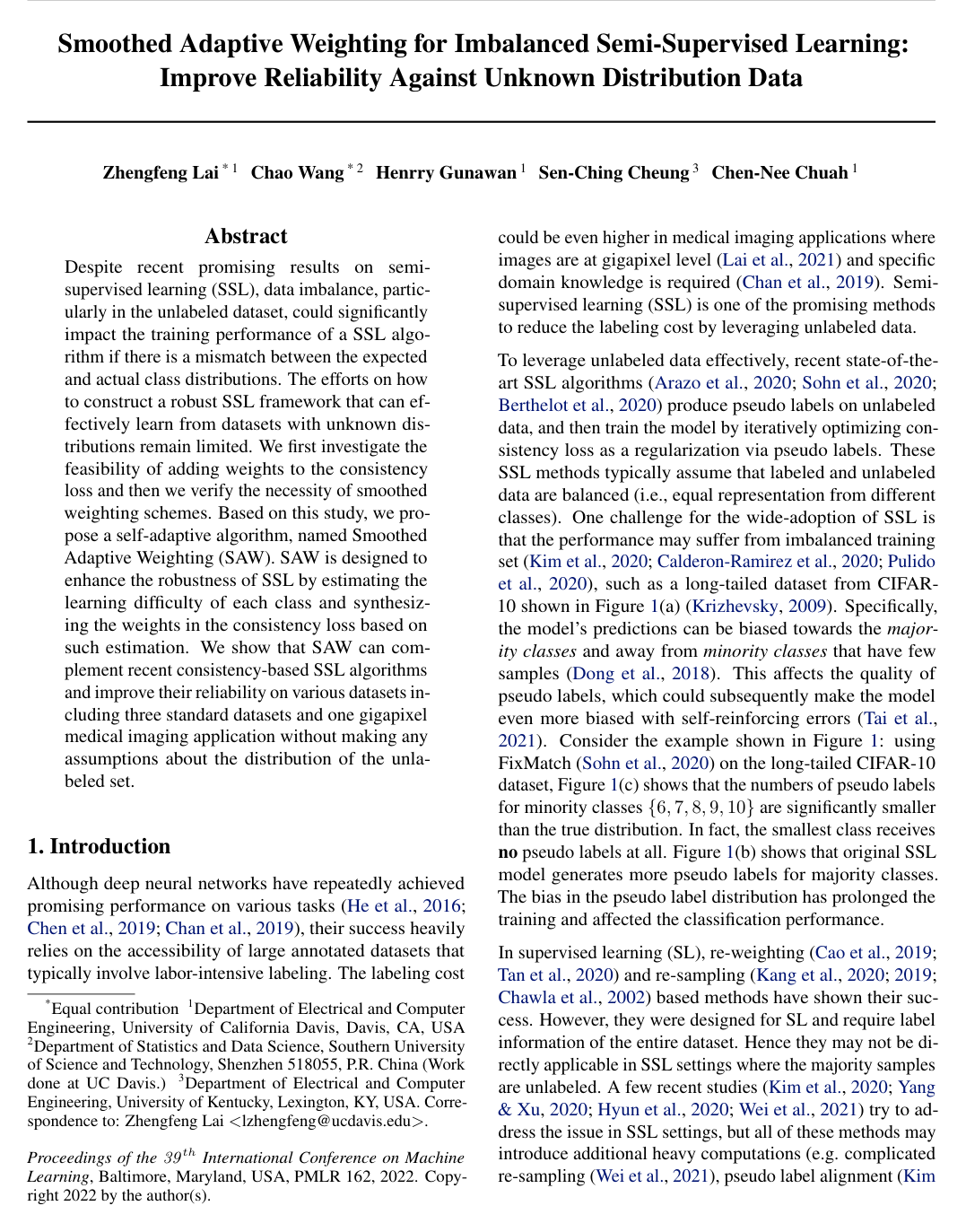
Smoothed Adaptive Weighting for Imbalanced Semi-Supervised Learning: Improve Reliability Against Unknown Distribution Data
Zhengfeng Lai, Chao Wang, Henrry Gunawan, Sen-Ching S. Cheung, Chen-Nee Chuah
Why you should read this
Proposes a smoothed adaptive weighting framework that dynamically adjusts consistency loss based on per-class learning difficulty, enabling semi-supervised models to handle severely imbalanced data without prior knowledge of the unlabeled distribution.
Despite recent promising results on semi-supervised learning (SSL), data imbalance, particularly in the unlabeled dataset, could significantly impact the training performance of a SSL algorithm if there is a mismatch between the expected and actual class distributions. The efforts on how to construct a robust SSL framework that can effectively learn from datasets with unknown distributions remain limited. We first investigate the feasibility of adding weights to the consistency loss and then we verify the necessity of smoothed weighting schemes. Based on this study, we propose a self-adaptive algorithm, named Smoothed Adaptive Weighting (SAW). SAW is designed to enhance the robustness of SSL by estimating the learning difficulty of each class and synthesizing the weights in the consistency loss based on such estimation. We show that SAW can complement recent consistency-based SSL algorithms and improve their reliability on various datasets including three standard datasets and one gigapixel medical imaging application without making any assumptions about the distribution of the unlabeled set.
Added
2026-10-03
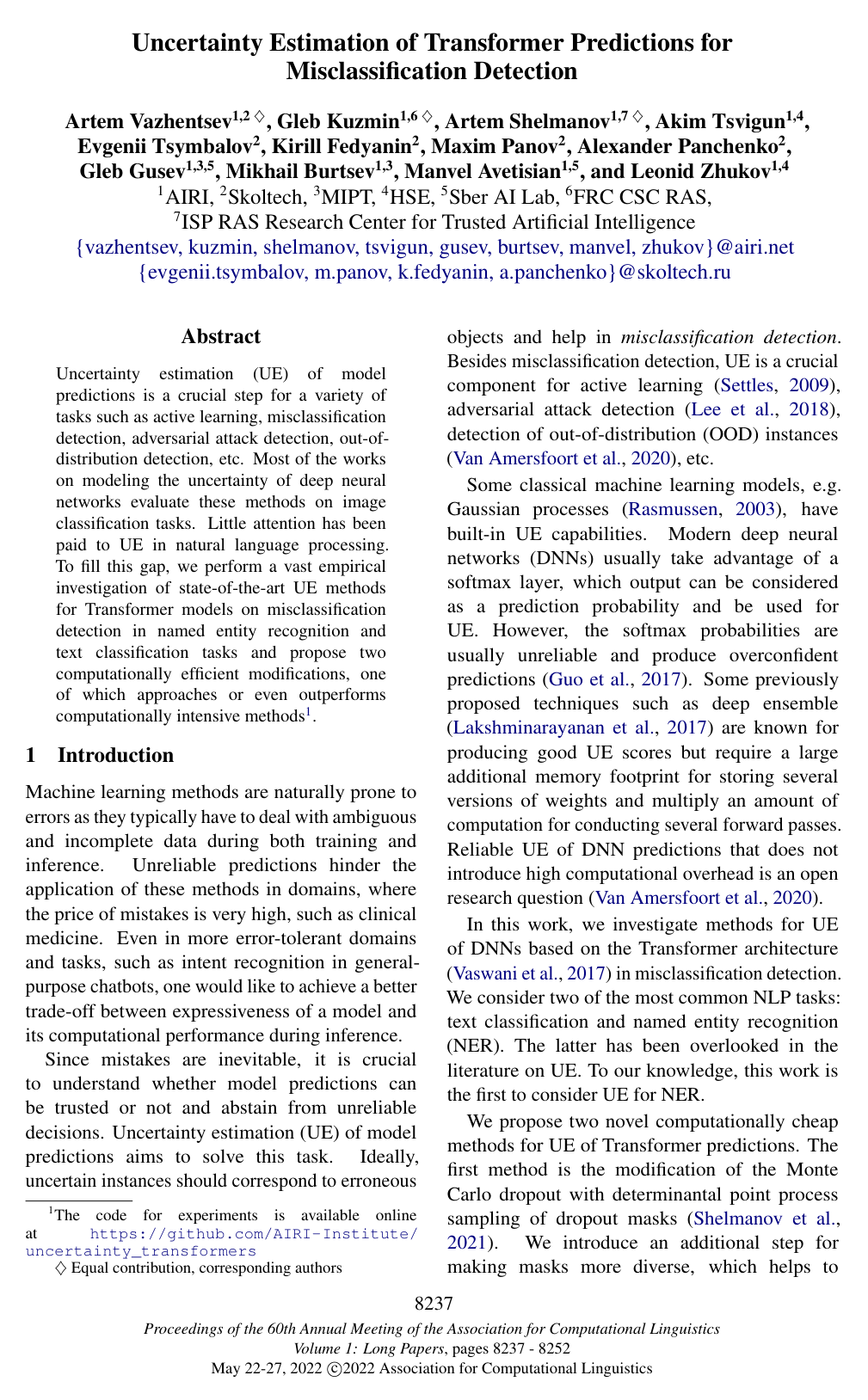
Uncertainty Estimation of Transformer Predictions for Misclassification Detection
Artem Vazhentsev, Gleb Kuzmin, Artem Shelmanov, Akim Tsvigun, Evgenii Tsymbalov, Kirill Fedyanin, Maxim Panov, Alexander Panchenko, Gleb Gusev, Mikhail Burtsev, Manvel Avetisian, Leonid Zhukov
Why you should read this
Develops computationally efficient uncertainty estimation methods for Transformer models in text classification and named entity recognition, demonstrating that a spectral-normalized Mahalanobis distance approach can rival or exceed heavy deep ensembles at detecting misclassifications.
Uncertainty estimation (UE) of model predictions is a crucial step for a variety of tasks such as active learning, misclassification detection, adversarial attack detection, out-of-distribution detection, etc. Most of the works on modeling the uncertainty of deep neural networks evaluate these methods on image classification tasks. Little attention has been paid to UE in natural language processing. To fill this gap, we perform a vast empirical investigation of state-of-the-art UE methods for Transformer models on misclassification detection in named entity recognition and text classification tasks and propose two computationally efficient modifications, one of which approaches or even outperforms computationally intensive methods1.
Added
2026-10-03
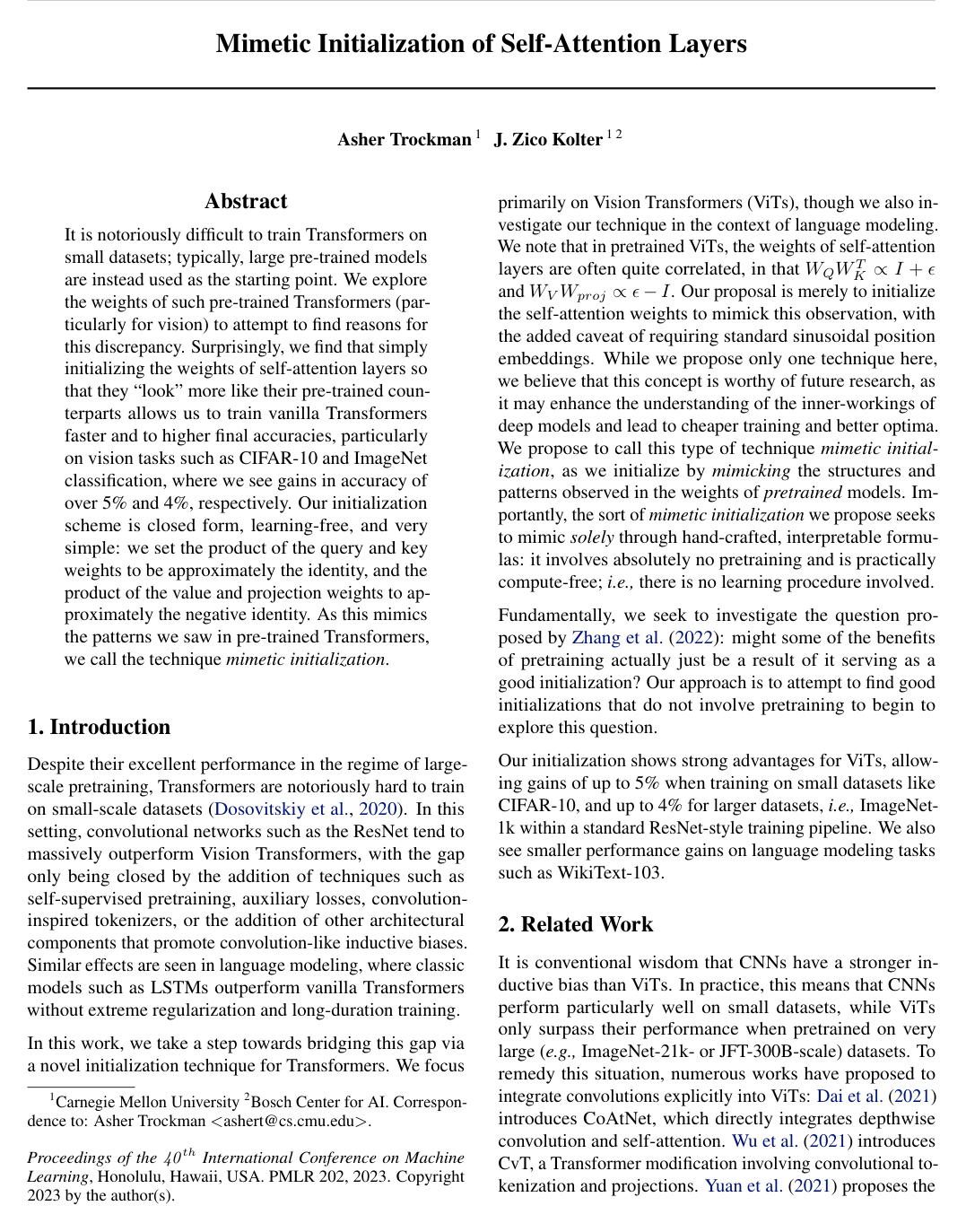
Mimetic Initialization of Self-Attention Layers
Asher Trockman, J. Zico Kolter
Why you should read this
Proposes a simple, learning-free weight initialization strategy for self-attention layers that mimics weight patterns observed in pretrained models, boosting classification accuracy by up to 5% when training vanilla Vision Transformers from scratch on small and medium datasets.
It is notoriously difficult to train Transformers on small datasets; typically, large pre-trained models are instead used as the starting point. We explore the weights of such pre-trained Transformers (particularly for vision) to attempt to find reasons for this discrepancy. Surprisingly, we find that simply initializing the weights of self-attention layers so that they “look” more like their pre-trained counterparts allows us to train vanilla Transformers faster and to higher final accuracies, particularly on vision tasks such as CIFAR-10 and ImageNet classification, where we see gains in accuracy of over 5% and 4%, respectively. Our initialization scheme is closed form, learning-free, and very simple: we set the product of the query and key weights to be approximately the identity, and the product of the value and projection weights to approximately the negative identity. As this mimics the patterns we saw in pre-trained Transformers, we call the technique mimetic initialization.
Added
2026-09-26

Algebra and Trigonometry (2nd edition)
Jay Abramson
Why you should read this
Provides a comprehensive, openly licensed treatment of algebra and trigonometry with worked examples, exercises, and applications for college-level courses.
Algebra and Trigonometry 2e provides a comprehensive introduction to algebraic functions, equations, inequalities, analytic geometry, exponential and logarithmic functions, trigonometry, systems of equations, and related applications. It combines conceptual explanations, worked examples, and practice exercises for college-level study.
Added
2026-09-26

A Dam Good Argument
Collected works
Why you should read this
Introduces college-level academic writing, rhetoric, and source-based research through practical guidance that moves students beyond rigid essay formulas toward mature critical inquiry.
Arguments are all around us. Everywhere we look, someone is trying to get our attention, change our minds, or sell us something. Learning about how persuasion works will make you a more thoughtful and skeptical consumer of all that content, so that you can come to your own conclusions and recognize the underlying assumptions that inform those attempts to persuade you. This book is about analyzing others' arguments and crafting your own. The rhetorical choices that you make as a writer–from evidence to structure to tone–impact how your audience will receive your ideas. Using those tools effectively will help your voice be heard.<br /><a class="link-button" href="https://lookerstudio.google.com/reporting/ddc9ec63-6cd7-4fb2-89c6-12962f3751eb">Data dashboard</a><a class="link-button" href="https://forms.office.com/Pages/ResponsePage.aspx?id=4QVtzl48Yk2HqExKJxPBE_Ob1FlDquBLm_7cjZkcdXpUMU9XMElGQ1Q3TFFTTUI1TzREVVU2TkZWMi4u">Adoption Form</a>
Added
2026-09-25

Rights of the Accused
Collected works
Why you should read this
Curates landmark U.S. Supreme Court cases on the Fourth, Fifth, Sixth, and Eighth Amendments, helping students analyze how constitutional protections for accused people have evolved.
This volume focuses on the constitutional doctrine and law in the areas of criminal rights. It contains excerpts of landmark cases covering the fourth, fifth, sixth, and eighth amendments, exceptions to the Warrants Rule, and investigatory methods. The excerpts include the constitutional issues in these cases that are related to rights of the accused with other questions of law and dicta omitted.
Added
2026-09-25
Introduction to Qualitative Research Methods
Allison Hurst
Why you should read this
Provides a practical, beginner-friendly guide to qualitative research design, ethics, data collection, coding, and communication across the social sciences.
<a class="link-button" href="https://lookerstudio.google.com/reporting/c4e3123a-efc8-4bfc-93d5-a67d537cfd5b">Data dashboard</a><a class="link-button" href="https://forms.office.com/Pages/ResponsePage.aspx?id=4QVtzl48Yk2HqExKJxPBE_Ob1FlDquBLm_7cjZkcdXpUMU9XMElGQ1Q3TFFTTUI1TzREVVU2TkZWMi4u">Adoption Form</a>
Added
2026-09-25


Psychology (2nd edition)
Rose M. Spielman, William J. Jenkins, Marilyn D. Lovett
Why you should read this
Provides a comprehensive introductory psychology textbook updated with recent research, expanded diversity coverage, and explicit discussions of study replication challenges.
Psychology 2e is designed to meet scope and sequence requirements for the single-semester introduction to psychology course. The book offers a comprehensive treatment of core concepts, grounded in both classic studies and current and emerging research. The text also includes coverage of the DSM-5 in examinations of psychological disorders. Psychology incorporates discussions that reflect the diversity within the discipline, as well as the diversity of cultures and communities across the globe. The second edition contains detailed updates to address comments and suggestions from users. Significant improvements and additions were made in the areas of research currency, diversity and representation, and the relevance and recency of the examples. Many concepts were expanded or clarified, particularly through the judicious addition of detail and further explanation where necessary. Finally, the authors addressed the replication issues in the psychology discipline, both in the research chapter and where appropriate throughout the book.
Added
2026-09-25
![Introduction to Psychology [Lumen/OpenStax]](https://ittowtnkqtyixxjxrhou.supabase.co/storage/v1/object/public/ebook-images/ce790ddd-9b38-4b10-85bc-46338b757101/fb0ca4f3-6530-46ac-be4b-79e847234817/pressbooks/assets/9a7ea03b1138860e-Screen-Shot-2021-05-27-at-3.53.19-PM.png)
Introduction to Psychology [Lumen/OpenStax]
OpenStax, Lumen Learning
Provides an important opportunity for students to learn the core concepts of psychology and understand how those concepts apply to their lives. A comprehensive coverage of core concepts is grounded in both classic studies and current and emerging research, including coverage of the DSM-5 in discussions of psychological disorders. Incorporates discussions that reflect the diversity within the discipline, as well as the diversity of cultures and communities across the globe.
Added
2026-09-25
Introduction to Sociology Lumen/OpenStax
Lumen Learning, OpenStax
<img src="https://pressbooks.atlanticoer-relatlantique.ca/app/uploads/sites/638/2025/06/nscc-open-textbook-logo.png" width="250" height="300" alt="image" /><br /><br /> Learn how the core concepts, foundational scholars, and emerging theories of sociology help explain how simple, everyday human actions and interactions can change the world. This is an open textbook. Digital versions are free.
Added
2026-09-25

Algebra and Trigonometry OpenStax
Jay Abramson
Algebra and Trigonometry provides a comprehensive exploration of algebraic principles and meets scope and sequence requirements for a typical introductory algebra and trigonometry course. The modular approach and the richness of content ensure that the book meets the needs of a variety of courses. Algebra and Trigonometry offers a wealth of examples with detailed, conceptual explanations, building a strong foundation in the material before asking students to apply what they’ve learned.
Added
2026-09-25
Introduction to Sociology - 2nd Canadian Edition
William Little
Introduction to Sociology adheres to the scope and sequence of a typical introductory sociology course. In addition to comprehensive coverage of core concepts, foundational scholars, and emerging theories, we have incorporated section reviews with engaging questions, discussions that help students apply the sociological imagination, and features that draw learners into the discipline in meaningful ways. Although this text can be modified and reorganized to suit your needs, the standard version is organized so that topics are introduced conceptually, with relevant, everyday experiences. For the student, this book is based on the teaching and research experience of numerous sociologists. In today’s global socially networked world, the topic of Sociology is more relevant than ever before. We hope that through this book, students will learn how simple, everyday human actions and interactions can change the world. In this book, you will find applications of Sociology concepts that are relevant, current, and balanced. For instructors, this text is intended for a one-semester introductory course and includes these features: Sociological Research: Highlights specific current and relevant research studies. Sociology in the Real World: Ties chapter content to student life and discusses sociology in terms of the everyday. Big Picture: Features present sociological concepts at a national or international level. Case Study: Describes real-life people whose experiences relate to chapter content. Social Policy and Debate: Discusses political issues that relate to chapter content. Section Summaries distill the information in each section for both students and instructors down to key, concise points addressed in the section. Key Terms are bold and are followed by a definition in context. Definitions of key terms are also listed in the Key Terms, which appears at the end of each chapter. Section Quizzes provide opportunities to apply and test the information students learn throughout each section. Both multiple-choice and short-response questions feature a variety of question types and range of difficulty. Further Research : This feature helps students further explore the section topic and offers related research topics that could be explored.
Added
2026-09-25
Principles of Microeconomics
Emma Hutchinson, OpenStax
<img src="https://pressbooks.atlanticoer-relatlantique.ca/app/uploads/sites/638/2025/06/nscc-open-textbook-logo.png" width="250" height="300" alt="image" /><br /><br /> This book is an adaptation of Principles of Microeconomics originally published by OpenStax. This adapted version has been reorganized into eight topics and expanded to include over 200 multiple choice questions, examples, eight case studies including questions and solutions, and over 200 editable figures.
Added
2026-09-25
An Open Guide to Data Structures and Algorithms
Paul W. Bible, Lucas Moser
This textbook serves as a gentle introduction for undergraduates to theoretical concepts in data structures and algorithms in computer science while providing coverage of practical implementation (coding) issues. The field of computer science (CS) supports a multitude of essential technologies in science, engineering, and communication as a social medium. The varied and interconnected nature of computer technology permeates countless career paths making CS a popular and growing major program. Mastery of the science behind computer science relies on an understanding of the theory of algorithms and data structures. These concepts underlie the fundamental tradeoffs that dictate performance in terms of speed, memory usage, and programming complexity that separate novice programmers from professional practitioners.<br /><br />Faculty, are you using this book in your course? <a href="https://forms.gle/47wJtmEMYMM8n87L7" target="_blank">Please report adoption using this form.</a>
Added
2026-09-25
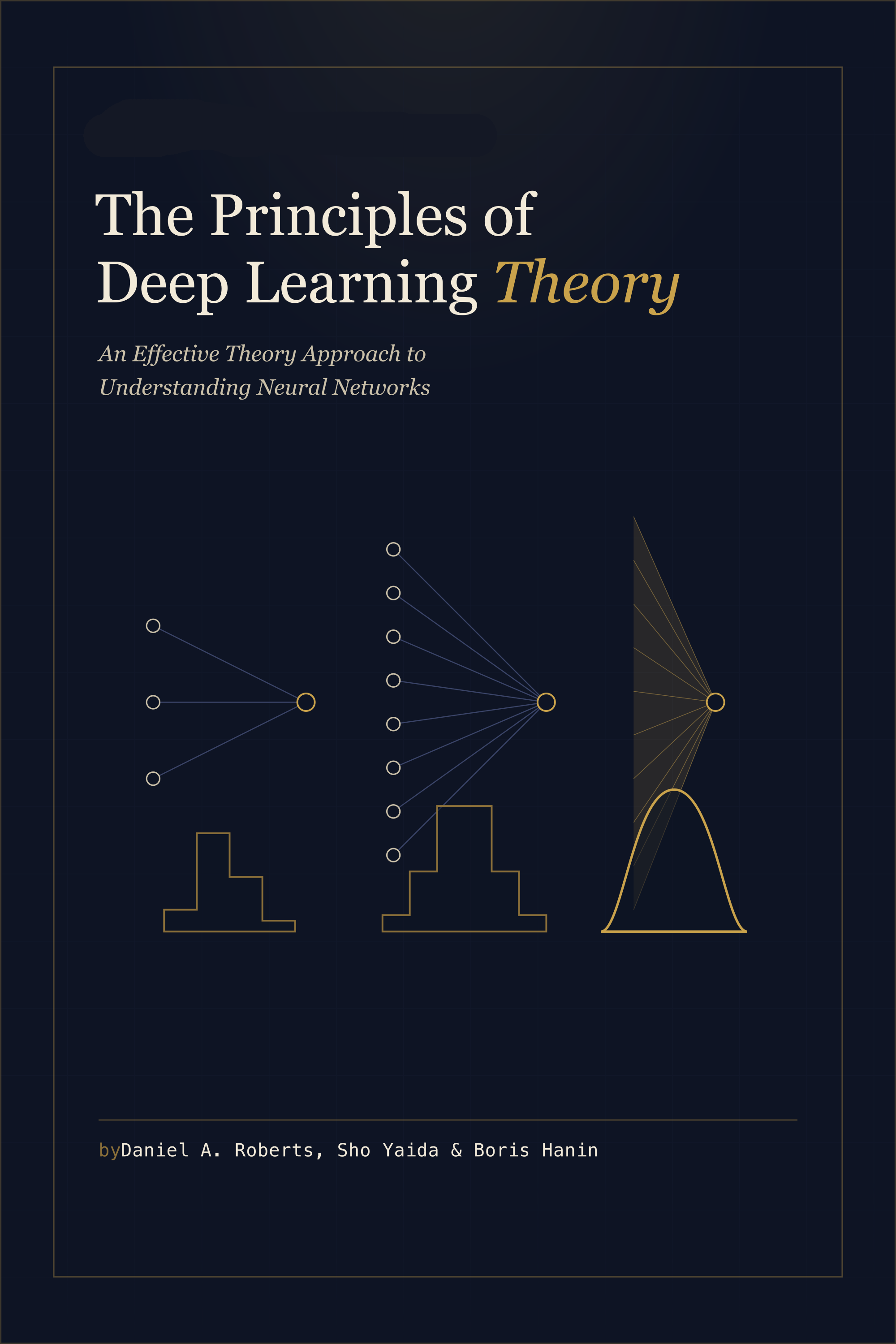
The Principles of Deep Learning Theory
Daniel A. Roberts, Sho Yaida, Boris Hanin
Why you should read this
Establishes an effective theory framework for finite-width neural networks that explains how the depth-to-width ratio governs representation learning, gradient propagation, and optimal architecture design from first principles.
This book develops an effective theory approach to understanding deep neural networks of practical relevance. Beginning from a first-principles component-level picture of networks, we explain how to determine an accurate description of the output of trained networks by solving layer-to-layer iteration equations and nonlinear learning dynamics. A main result is that the predictions of networks are described by nearly-Gaussian distributions, with the depth-to-width aspect ratio of the network controlling the deviations from the infinite-width Gaussian description. We explain how these effectively-deep networks learn nontrivial representations from training and more broadly analyze the mechanism of representation learning for nonlinear models. From a nearly-kernel-methods perspective, we find that the dependence of such models' predictions on the underlying learning algorithm can be expressed in a simple and universal way. To obtain these results, we develop the notion of representation group flow (RG flow) to characterize the propagation of signals through the network. By tuning networks to criticality, we give a practical solution to the exploding and vanishing gradient problem. We further explain how RG flow leads to near-universal behavior and lets us categorize networks built from different activation functions into universality classes. Altogether, we show that the depth-to-width ratio governs the effective model complexity of the ensemble of trained networks. By using information-theoretic techniques, we estimate the optimal aspect ratio at which we expect the network to be practically most useful and show how residual connections can be used to push this scale to arbitrary depths. With these tools, we can learn in detail about the inductive bias of architectures, hyperparameters, and optimizers.
Added
2026-09-15
License
Published with permission
Contemporary Calculus
Dale Hoffman
Why you should read this
A thorough, example-rich calculus textbook with extensive diagrams, practice problems, and answer material.
A complete contemporary calculus textbook emphasizing concepts, techniques, applications, worked examples, practice, and answers.
Added
2026-08-27

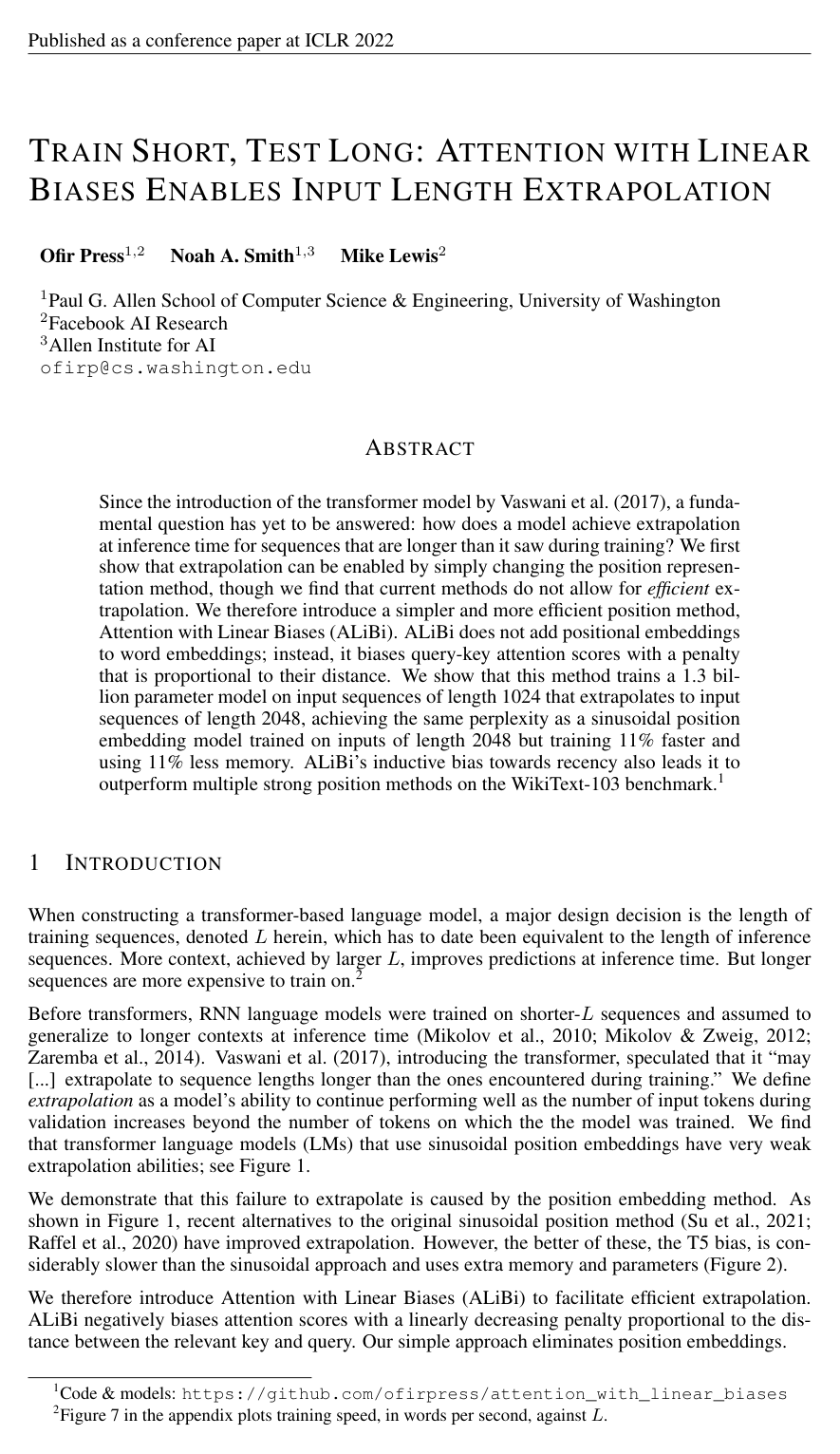
Train Short, Test Long: Attention with Linear Biases Enables Input Length Extrapolation
Ofir Press, Noah A. Smith, Mike Lewis
Why you should read this
Introduces a static positional bias that allows Transformers to generalize to sequence lengths far beyond those encountered during training.
Since the introduction of the transformer model by Vaswani et al. (2017), a fundamental question has yet to be answered: how does a model achieve extrapolation at inference time for sequences that are longer than it saw during training? We first show that extrapolation can be enabled by simply changing the position representation method, though we find that current methods do not allow for efficient extrapolation. We therefore introduce a simpler and more efficient position method, Attention with Linear Biases (ALiBi). ALiBi does not add positional embeddings to word embeddings; instead, it biases query-key attention scores with a penalty that is proportional to their distance. We show that this method trains a 1.3 billion parameter model on input sequences of length 1024 that extrapolates to input sequences of length 2048, achieving the same perplexity as a sinusoidal position embedding model trained on inputs of length 2048 but training 11% faster and using 11% less memory. ALiBi's inductive bias towards recency also leads it to outperform multiple strong position methods on the WikiText-103 benchmark.
Added
2026-02-09

Machine Super Intelligence
Shane Legg
Why you should read this
Provides a rigorous mathematical foundation for understanding machine intelligence, introducing formal definitions of intelligence and exploring the theoretical limits and possibilities of creating superintelligent systems through frameworks like AIXI that could learn optimally across diverse environments.
Added
2025-09-24
